🌿 Key Takeaways
- Peace lily care requires bright indirect light, evenly moist soil, and medium to high humidity — three conditions most homes naturally provide
- Benefits of peace lily plants include powerful air purification, elegant white blooms, and exceptional tolerance of low light conditions
- Do peace lilies clean the air? Yes — they absorb formaldehyde, benzene, and carbon monoxide making them one of the most effective air-purifying houseplants available
- Peace lily light requirements are flexible — they thrive in bright indirect light but survive in low light better than most flowering houseplants
- Peace lily flowers are green when aging naturally — this is completely normal and not a sign of illness
- Can a peace lily be planted outdoors? Yes — but only in warm, frost-free climates (USDA zones 10–12)
- Meaning of peace lily is deeply symbolic — representing purity, peace, hope, and new beginnings across many cultures
- Overwatering is the most common cause of peace lily dying — always check soil before watering
- Browse our full indoor plant care guides for companion plant ideas that pair beautifully with peace lilies
Why the Peace Lily Is One of the Most Beloved Indoor Plants
There is a reason the peace lily appears in homes, offices, hospitals, and workspaces across the world. It is one of a rare category of houseplants that combines genuine visual elegance with practical air-purifying function and remarkable resilience — all wrapped in a plant that genuinely forgives beginner mistakes.
The peace lily (Spathiphyllum wallisii) is not a true lily — true lilies belong to the Lilium genus. But what it lacks in botanical purity it more than makes up for in real-world performance. Its deep, glossy dark green leaves, graceful white spathes, and ability to signal its own thirst by gently drooping make it one of the most communicative and forgiving houseplants you can grow.
This complete peace lily care guide covers everything — from peace lily light requirements and watering to fertilizing, repotting, propagation, troubleshooting a peace lily dying, and the deep cultural meaning of peace lily across different traditions. Whether you are a first-time plant owner or an experienced collector expanding your indoor garden, everything you need is here.
What Exactly Is a Peace Lily?
Spathiphyllum Wallisii — The Plant Behind the Name
The peace lily (Spathiphyllum wallisii) is a tropical evergreen plant native to the forest floors of Central and South America, where it grows naturally under the dense canopy of tropical rainforests — receiving filtered light, consistent moisture, and high ambient humidity.
This natural habitat explains everything about how peace lilies behave indoors. They are adapted to dappled, indirect light rather than direct sun. They thrive in humid conditions — which is why bathrooms and kitchens suit them so well. And they prefer consistently moist (not waterlogged) soil that mimics the perpetually damp forest floor of their native environment.
The white bloom that gives the peace lily its name is not technically a flower — it is a spathe, a modified leaf that surrounds a central spike (spadix) carrying the true tiny flowers. This same structure appears in philodendrons, anthuriums, and calla lilies — the peace lily is botanically related to all of them.
Peace Lily Varieties — Which One Should You Choose?
Several peace lily varieties are available to home growers, each with slightly different characteristics:
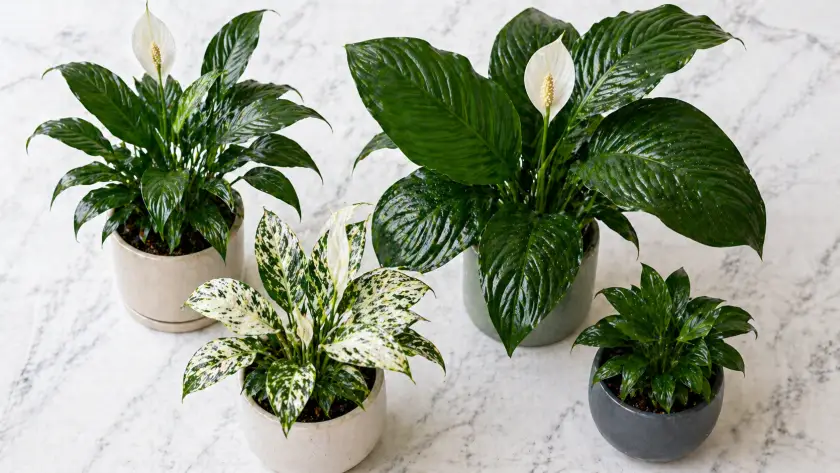
Standard Spathiphyllum Wallisii
The most common variety — compact, dark green leaves, and reliable white blooms. Perfect for desks, shelves, and smaller spaces. This is the variety most people picture when they think of a peace lily.
Domino Peace Lily — Variegated Variety
A stunning variegated form with green and white marbled foliage. Slightly slower growing than the standard variety but considerably more visually dramatic — one of the most sought-after indoor plant varieties for those building a distinctive indoor plant collection.
Spathiphyllum Sensation — Large Peace Lily
The largest commonly available peace lily variety — can reach 120–150cm with enormous paddle-shaped leaves. A genuine statement plant for living rooms and open spaces. Works beautifully as a natural room divider in open-plan rooms.
Red Peace Lily — Is It Real?
Red peace lily varieties are sometimes advertised but are not naturally occurring in true peace lilies. What is sometimes sold as a red peace lily is typically an anthurium — a related plant with red spathes. True Spathiphyllum species produce only white or cream-colored spathes. If you are searching for a red peace lily, you are most likely looking for an anthurium rather than a true Spathiphyllum.
Peace Lily Meaning and Symbolism
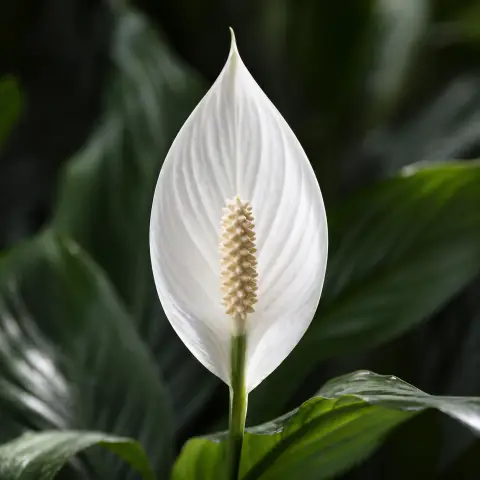
Meaning of Peace Lily — What Does It Represent?
The meaning of peace lily is one of the richest of any houseplant — drawing from religious, cultural, and symbolic traditions across multiple continents.
What Do Peace Lilies Symbolize?
What do peace lilies symbolize varies by cultural context — but certain themes appear consistently across traditions:
- Peace and tranquility — The white spathe is universally associated with calm, stillness, and the absence of conflict — hence the name itself
- Purity and innocence — White flowers across most cultures symbolize an unspoiled, clean spirit
- Hope and new beginnings — Peace lilies bloom reliably even in challenging conditions — symbolizing resilience and optimism
- Healing and sympathy — Peace lilies are among the most commonly given plants at funerals and during times of grief, symbolizing the peace of the departed soul and comfort for the living
- Prosperity — In Feng Shui practice, peace lilies are considered fortune-bringing plants. Our guide on Feng Shui indoor plants covers the best placement positions for maximizing positive energy flow
What Does Peace Lily Symbolize in Different Cultures?
What does peace lily symbolize across specific cultural contexts:
Christianity: The white spathe is associated with the Virgin Mary — purity, grace, and spiritual peace. Peace lilies are frequently used in Easter and religious ceremonies.
Eastern cultures: The significance of peace lily in East Asian traditions connects to harmony, balance, and the calming of troubled environments. They are considered one of the most auspicious plants for the home.
Feng Shui: Peace lilies are placed in the eastern (health) or southeastern (abundance) areas of the home to promote positive chi flow and material wellbeing.
Western contemporary: What do peace lily represent in modern gift-giving? They are the plant of comfort — given to express sympathy, support during illness, and celebration of new life chapters.
Benefits of Peace Lily Plants
Do Peace Lilies Clean the Air?
Do peace lilies clean the air? Yes — this is one of the most well-documented benefits of peace lily plants. NASA’s landmark Clean Air Study identified peace lilies as among the most effective air-purifying houseplants available, capable of absorbing:
- Formaldehyde — released by furniture, carpets, and building materials
- Benzene — from cleaning products and paint
- Carbon monoxide — from gas appliances and traffic pollution
- Trichloroethylene — from dry cleaning chemicals and adhesives
- Xylene — from printing and rubber industries
For a comprehensive look at air-purifying houseplants and how they compare, our guide on air-purifying indoor plants that actually work ranks the most effective species with detailed placement advice.
Additional Benefits of Peace Lily Plants
Beyond air purification, the benefits of peace lily plants extend across several dimensions:
Humidity regulation: Peace lilies release moisture vapor through their leaves — raising ambient humidity in dry rooms and reducing the irritation caused by dry indoor air during winter heating season. For additional humidity management strategies, our guide on humidity hacks for happy plants covers simple techniques that work alongside peace lily growing.
Mental wellbeing: Research consistently links plant presence in living and working spaces with reduced stress, improved mood, and enhanced concentration. Our guide on improving your home office with plants explores the specific wellbeing impact of peace lilies in work environments.
Aesthetic impact: Few houseplants combine the visual impact of deep glossy green leaves with the elegance of white blooms as effectively as the peace lily. It works in every interior style — from minimalist to maximalist, contemporary to traditional.
Sleep quality: Peace lilies continue absorbing carbon dioxide and releasing oxygen overnight — making them excellent bedroom plants for improved sleep quality. Our guide on decorating your bedroom with plants covers optimal bedroom placement for peace lilies specifically.
Complete Peace Lily Care Guide
Peace Lily Light Requirements
How Much Light Does a Peace Lily Need?
Peace lily light requirements are one of the plant’s most important care factors — and one of its most forgiving qualities. Peace lilies are genuinely adaptable across a wider light range than most flowering houseplants.
| Light Condition | Peace Lily Response |
|---|---|
| Bright indirect light | Best growth, most frequent blooming |
| Moderate indirect light | Good growth, reliable performance |
| Low light | Survives well, fewer blooms |
| Direct morning sun | Tolerated briefly |
| Direct intense afternoon sun | Leaf scorch — avoid completely |
| Deep shade | Survives but rarely blooms |
Peace Lily in Low Light — What to Expect
Peace lilies are one of the best plants for surviving low light conditions — making them exceptional for offices, hallways, and rooms with limited window access. In genuinely low light conditions:
- Expect fewer or no blooms — the plant prioritizes leaf growth over flowering
- Water less frequently — lower light means slower evaporation and soil drying
- Avoid overwatering — the most common mistake in low light peace lily care
- Consider moving to a brighter position for 2–4 weeks during spring to encourage flowering
For a complete guide to managing indoor light across different plant types, our complete guide to indoor light covers everything from window orientation to grow light selection.
Watering a Peace Lily
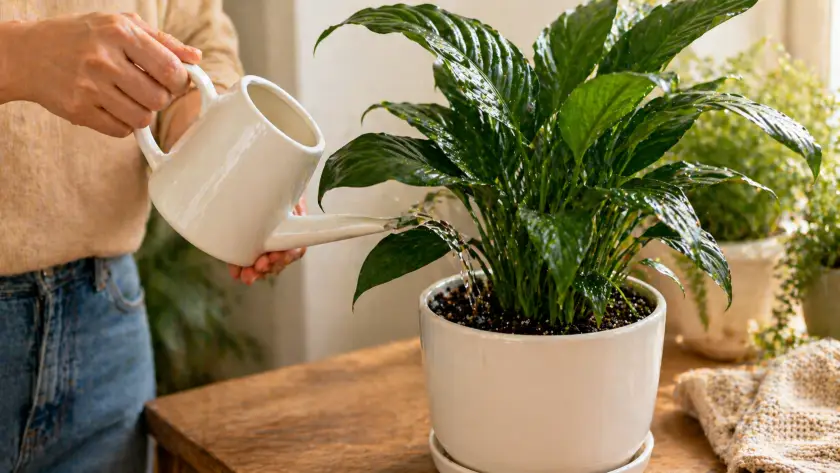
How Often to Water a Peace Lily
Peace lilies prefer evenly moist soil — not dry, not waterlogged. This is the single most nuanced aspect of peace lily care because the sweet spot is narrower than for many other houseplants.
Watering frequency:
- Spring and Summer: Every 5–7 days — check soil first
- Autumn: Every 7–10 days
- Winter: Every 10–14 days
Always use the finger test — push one finger into the top inch of soil. If it feels dry at 1 inch depth, water thoroughly. If it still feels moist — wait. Never follow a fixed watering schedule without checking the soil first.
The Droop Signal — Peace Lily’s Built-In Watering Alarm
One of the most useful peace lily care features is its droop response. When a peace lily needs water, its leaves gently wilt and droop — providing a clear, visible signal before any damage occurs. Water immediately when you see this drooping and the plant will recover within a few hours.
This droop signal only indicates thirst when soil is genuinely dry. If leaves droop but soil is still moist — the cause is likely root rot or cold shock rather than underwatering.
Watering Timing — Morning Is Always Best
Never water your peace lily in the evening. Water sitting in soil overnight creates ideal root rot conditions — especially for a plant that already prefers consistently moist soil. Our guide on the worst times to water your plants explains exactly why morning watering produces the healthiest results. For a complete watering system, our complete watering guide covers timing, technique, and frequency across all indoor plant types.
Water Quality for Peace Lilies
Peace lilies are sensitive to fluoride and chlorine in tap water — these minerals accumulate in leaf tissue and cause brown leaf tips over time. Use filtered water, rainwater, or allow tap water to sit in an open container for 24 hours before use to allow chlorine to dissipate.
Temperature and Humidity for Peace Lilies
Ideal Temperature
- Ideal range: 16°C to 24°C (60°F to 75°F)
- Minimum temperature: Above 13°C (55°F)
- Avoid: Cold drafts from windows and doors, heating vents that create dry hot air, and temperatures below 10°C which cause cold shock and leaf damage
Humidity Requirements
Peace lilies love humidity — reflecting their tropical rainforest origins. Medium to high humidity produces the most vigorous growth and most frequent blooming.
Best humid locations for peace lilies:
- Bathrooms with natural light — our guide on best plants for your bathroom identifies peace lilies as one of the top bathroom plant choices
- Kitchens near a window
- Any room with a humidifier running
For additional humidity management strategies that work alongside peace lily placement, our humidity hacks guide covers DIY solutions including pebble trays and grouping plants together. Our detailed guide on building a DIY indoor humidity tray gives step-by-step instructions for creating the perfect humid microclimate around your peace lily.
Best Soil for Peace Lilies
What Soil Mix Works Best?
Peace lilies need well-draining soil that retains some moisture — a balance between the moisture retention they need and the drainage that prevents root rot.
Recommended peace lily soil mix:
- All-purpose potting mix as the base (60%)
- Perlite for drainage (20%)
- Coco coir for moisture retention (20%)
Key requirements:
- Never use heavy garden soil — it compacts and waterloggs
- Always use pots with drainage holes — without exception
- Refresh soil every 1–2 years even without repotting — old soil compacts and loses drainage capacity
Our comprehensive guide on the best soil mix for every plant type covers exactly how to build custom mixes for moisture-loving tropical plants like peace lilies.
Peace Lily Fertilizer — Best Fertilizer for Peace Lily
How to Fertilize a Peace Lily
Peace lily fertilizer needs are moderate — they benefit from regular feeding during the growing season but are easily over-fertilized, which causes brown leaf tips and root damage.
Fertilizing schedule:
- Spring: Begin monthly feeding with balanced liquid fertilizer (diluted to half strength)
- Summer: Continue monthly feeding — switch to a bloom-boosting fertilizer (higher phosphorus ratio) to encourage flowering
- Autumn: Reduce to every 6–8 weeks as growth slows
- Winter: Stop feeding entirely — the plant is resting
Best Fertilizer for Peace Lily — What to Choose
Best fertilizer for peace lily options:
Liquid balanced fertilizer (20-20-20): Use at half the recommended strength monthly during spring and summer. The most reliable all-round option for consistent healthy growth.
Bloom booster (10-30-10): Higher phosphorus content encourages flower production. Apply once in early spring and once in early summer for the most reliable blooming.
Slow-release pellets: Sprinkle on soil surface in spring — releases nutrients gradually over 3–6 months. A low-maintenance option for peace lily fertilizer that reduces the risk of over-application.
Our guide on fertilizing indoor vs outdoor plants explains the key differences in feeding requirements and timing for indoor tropical plants.
How to Repot a Peace Lily
How Do I Repot a Peace Lily?
How do I repot a peace lily is one of the most commonly asked questions in peace lily care — and the process is simpler than most plant owners expect.
When to repot:
- Roots are visibly growing through drainage holes
- Plant becomes top-heavy and unstable
- Soil dries out within 2–3 days of watering
- Every 1–2 years as general maintenance
Best time to repot: Spring or early summer — when the plant is entering its active growing season and will recover fastest from the stress of transplanting.
How to Replant a Peace Lily — Step by Step
How to replant a peace lily and how to transplant a peace lily follow the same process:
- Water the plant 24 hours before repotting to reduce transplant stress
- Choose a new pot 2–3cm wider than the current one — peace lilies bloom best when slightly pot-bound, so do not upsize too dramatically
- Add a layer of fresh potting mix to the base of the new pot
- Tip the plant gently out of its current pot — support the root ball, never pull by the stems
- Shake off old soil from around the roots
- Inspect roots — trim any brown, mushy, or dead roots with clean scissors
- Position in the new pot at the same depth as before
- Fill around the root ball with fresh potting mix — press gently to remove air pockets
- Water lightly and place in indirect light for 2 weeks to recover
How to transplant peace lily plant tip: If the plant has multiple stems and you want to multiply your collection, this is the ideal time to divide — see the propagation section below.
Our guide on repotting mistakes to avoid covers the most common errors plant owners make during peace lily transplanting.
Can a Peace Lily Be Planted Outdoors?
Peace Lilies Outside — What You Need to Know
Can a peace lily be planted outdoors? Yes — but with important conditions. Can peace lily grow outdoors successfully depends entirely on your climate.
Can peace lilies be planted outdoors in:
- USDA Zones 10–12 (frost-free year-round): Yes — peace lilies thrive as outdoor garden plants in these warm, humid climates
- USDA Zones 8–9 (mild winters): Peace lilies can be grown outdoors but must be brought inside before temperatures drop below 10°C
- USDA Zones 1–7 (cold winters): Outdoor growing is only possible as a summer container plant that is brought indoors before autumn
Can Peace Lily Be Outside in Summer?
Can peace lily be outside during summer months in temperate climates? Yes — moving peace lilies to a sheltered outdoor position during warm summer months can dramatically accelerate growth and encourage blooming. Key requirements for peace lilies outside:
- Dappled shade or bright indirect light — never direct afternoon sun
- Sheltered position away from wind
- Consistently moist soil — outdoor conditions dry soil faster than indoors
- Minimum temperature above 15°C at night
Can you plant a peace lily outside permanently in cold climates? No — frost will kill peace lilies. Always bring them back indoors before temperatures drop below 10°C in autumn.
Peace Lily Propagation
Peace lilies cannot be propagated from leaf cuttings — unlike snake plants or pothos. The only reliable propagation method is division — separating the plant’s root system into individual clumps during repotting.
How to Propagate a Peace Lily by Division
- Remove the plant from its pot during your regular repotting process
- Gently shake loose old soil to expose the root system
- Identify natural separation points — look for individual stems with their own roots
- Use clean, sharp scissors or a knife to separate root clusters — each division needs at least 2–3 leaves and an intact root system
- Pot each division separately in fresh potting mix
- Water lightly and place in warm, indirect light
- Expect 2–4 weeks of recovery time before new growth appears
For a broader guide to propagating different houseplant types, our step-by-step guide on how to propagate houseplants at home covers multiple methods across species.
Peace Lily Blooming — Getting Your Peace Lily to Flower
Why Is My Peace Lily Not Blooming?
Peace lily blooms are triggered by a combination of adequate light, consistent feeding, and stable growing conditions. If your peace lily is not blooming:
- Increase light: Move to a brighter indirect light position — this is the most common fix
- Feed regularly: Apply a bloom-boosting fertilizer (higher phosphorus) in spring and summer
- Check temperature: Consistent warmth (18–24°C) encourages blooming
- Check pot size: Slightly pot-bound plants bloom more freely than those in oversized pots
Peace Lily Flowers Are Green — Is This Normal?
Peace lily flowers are green is one of the most frequently asked questions about this plant — and the answer is completely reassuring. Peace lily with green flowers is a completely natural phenomenon.
Green coloring in peace lily blooms occurs because:
- Natural aging: White spathes gradually turn green as they age — this is the spathe transitioning back to its leaf-like state after the blooming period
- Too much fertilizer: Excess nitrogen causes spathes to emerge green rather than white
- Insufficient light: Low light conditions can cause blooms to emerge pale or greenish rather than pure white
What to do: Trim green or aging blooms at the base to encourage new white flower production. Ensure adequate indirect light and reduce nitrogen-heavy fertilizer applications.
Peace Lily Problems — Diagnosis and Solutions
| Problem | Most Likely Cause | Solution |
|---|---|---|
| Yellow leaves | Overwatering or root rot | Let soil dry, check roots, repot if needed |
| Brown leaf tips | Tap water fluoride or low humidity | Use filtered water, increase humidity |
| Drooping leaves (dry soil) | Underwatering | Water immediately — will recover in hours |
| Drooping leaves (moist soil) | Root rot or cold shock | Check roots, move to warmer spot |
| No blooms | Insufficient light or nutrients | Brighter position + bloom fertilizer |
| Green flowers | Natural aging or excess nitrogen | Trim spent blooms, reduce nitrogen feed |
| Black leaf tips | Cold damage or overwatering | Move away from drafts, reduce watering |
| Pale washed-out leaves | Too much direct sun | Move to indirect light immediately |
| Mushy base | Severe root rot | Emergency repot, remove all affected roots |
Peace Lily Dying — How to Care for a Peace Lily That Is Dying
Peace lily dying is almost always caused by one of three problems — overwatering, root rot, or cold shock. How to care for a peace lily that is dying depends on identifying the correct cause.
How to Revive Peace Lily Plant — Step by Step
How to revive peace lily plant when it is severely struggling:
- Diagnose first — check soil moisture, root health, and temperature exposure before taking action
- If overwatered: Allow soil to dry completely, improve drainage, consider repotting into fresh mix
- If root rot: Unpot immediately, trim all brown/mushy roots, dust with cinnamon, repot into fresh well-draining mix
- If underwatered: Water thoroughly and place in a humid position — recovery happens within hours for mild cases
- If cold shocked: Move to a consistently warm position (above 18°C), reduce watering, and give 2–4 weeks recovery time
Our comprehensive guide on how to revive a dying plant gives you a complete step-by-step rescue plan applicable to peace lilies specifically. For root rot diagnosis and treatment, our guide on root rot — how to identify, prevent and treat it covers the complete recovery process.
Yellow Leaves
Yellow leaves on a peace lily indicate overwatering in the vast majority of cases. Our guide on why plant leaves turn yellow gives the complete diagnostic process for yellow leaves across all houseplant species.
Brown Leaf Tips
Brown tips result from fluoride/chlorine in tap water, low humidity, or excess fertilizer. Switch to filtered water, increase ambient humidity, and reduce fertilizer frequency. Our guide on what your plant’s leaves are telling you decodes all leaf symptoms in detail.
Signs of Overwatering
Consistently wet soil, yellow lower leaves, musty smell from the pot, and soft stems at the base are all clear overwatering signals. Our guide on signs you are overwatering gives the complete corrective process for peace lilies and all tropical houseplants.
Is a Peace Lily Toxic?
Yes — peace lilies are mildly toxic to cats, dogs, and humans if ingested. The plant contains calcium oxalate crystals that cause mouth irritation, drooling, difficulty swallowing, and digestive upset. Symptoms are rarely life-threatening but are unpleasant.
Keep peace lilies out of reach of pets and young children. For pet-safe plant alternatives and strategies for growing beautiful plants in homes with animals, our guides on cat-friendly plants and dog-friendly plants give complete safe alternatives and placement strategies.
Where to Display Your Peace Lily
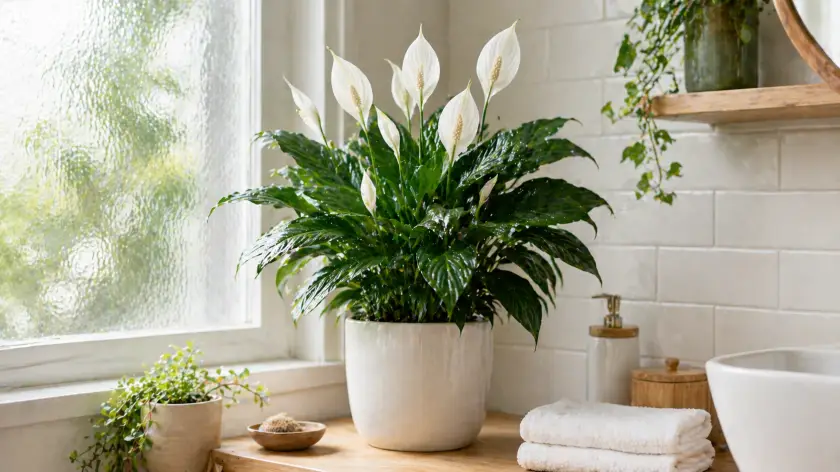
Bathroom
Peace lilies are among the best plants for bathrooms — humidity from showers and baths replicates their natural rainforest environment. Position near a frosted or natural window for best results.
Bedroom
Night-time air purification and oxygen production make peace lilies excellent bedroom plants. Position away from cold windows and heating vents. Our guide on decorating your bedroom with plants covers optimal bedroom placement strategies.
Home Office
Air-purifying properties and low light tolerance make peace lilies ideal for home offices. Our guide on improving your home office with plants covers specific positioning and the wellbeing impact of peace lily presence in work environments.
Living Room
A large Spathiphyllum Sensation variety creates a dramatic focal point in living room corners. Pair with trailing plants for textural contrast — our guide on styling indoor plants by room gives complete room-by-room styling guidance.
Shelves and Display Areas
Smaller peace lily varieties look stunning on shelves alongside trailing plants — the upright white blooms contrast beautifully with cascading foliage. For scent considerations alongside peace lily placement, our guide on indoor plants that smell amazing gives excellent companion plant suggestions.
Frequently Asked Questions
What Are the Main Benefits of Peace Lily Plants?
Benefits of peace lily plants include powerful air purification — absorbing formaldehyde, benzene, carbon monoxide, and xylene. They increase indoor humidity, produce oxygen both day and night, improve mental wellbeing in living and working spaces, and bring deep symbolic meaning across multiple cultural traditions. They are also among the most forgiving and beginner-friendly flowering houseplants available.
Do Peace Lilies Clean the Air Effectively?
Do peace lilies clean the air? Yes — NASA’s Clean Air Study confirmed peace lilies as among the most effective air-purifying houseplants. They absorb multiple categories of indoor air pollutants including VOCs from furniture, cleaning products, and building materials. A single mature peace lily measurably improves air quality in a standard room — multiple plants have a proportionally greater effect.
Can a Peace Lily Be Planted Outdoors Permanently?
Can a peace lily be planted outdoors permanently? Only in frost-free climates — USDA zones 10–12. Can peace lily grow outdoors in temperate climates? Yes as a summer container plant that is brought indoors before temperatures drop. Peace lilies outside in cold climates will be killed by frost — they are not cold-hardy plants.
How Do I Repot a Peace Lily Correctly?
How do I repot a peace lily? Water 24 hours before repotting. Choose a new pot 2–3cm wider. Remove the plant, inspect and trim any damaged roots, repot into fresh well-draining mix at the same depth, water lightly, and place in indirect light for 2 weeks to recover. How to transplant a peace lily follows exactly the same process — the terms are interchangeable.
Why Are My Peace Lily Flowers Green?
Peace lily flowers are green when they are naturally aging — the white spathe gradually transitions back to its leaf-like green state after the bloom period ends. Peace lily with green flowers can also indicate excess nitrogen fertilizer or insufficient light. Trim aging green blooms at the base and move to a brighter indirect light position to encourage new white flower production.
What Is the Meaning of a Peace Lily?
Meaning of a peace lily encompasses peace, purity, hope, healing, and new beginnings. What do peace lilies symbolize varies by culture — in Christian tradition they represent purity and grace; in Feng Shui they bring positive energy and prosperity; in contemporary gift-giving they represent sympathy, comfort, and support. The significance of peace lily as a gift plant is among the deepest of any houseplant species.
How to Care for a Peace Lily That Is Dying?
How to care for a peace lily that is dying begins with accurate diagnosis. Check soil moisture — if wet, root rot is likely and immediate repotting is needed. If dry, water thoroughly and place in a humid warm position. If cold shocked, move to consistent warmth above 18°C. How to revive peace lily plant successfully requires removing the root cause before the plant can recover — treating symptoms without addressing the cause will not work.
What Is the Best Fertilizer for Peace Lily?
Best fertilizer for peace lily is a balanced liquid fertilizer (20-20-20) applied at half strength monthly during spring and summer. Switch to a bloom-boosting formula (higher phosphorus) in early spring and early summer to encourage flowering. Peace lily fertilizer should never be applied at full strength — dilute to half the manufacturer’s recommended dose to avoid burning sensitive roots.
What Does Peace Lily Symbolize in Feng Shui?
In Feng Shui practice, the peace lily symbolizes the purification of energy, the calming of conflict, and the promotion of harmonious relationships. It is placed in the eastern area of the home (health sector) or southeastern area (abundance sector) to attract positive chi. The white blooms are considered especially auspicious — representing clarity and spiritual alignment.
Related Guides on Patch Plants
- 🐍 Snake Plant Care Guide — Complete Sansevieria Tips
- 🌵 Aloe Vera Care Guide for Home
- 💧 Worst Times to Water Your Plants
- 🪴 Complete Watering Guide for Healthy Thriving Plants
- 🔬 Root Rot — How to Identify, Prevent and Treat It
- 💦 DIY Indoor Humidity Tray — Step by Step Guide
- 🌿 Air-Purifying Indoor Plants That Actually Work
- 🏠 How to Style Indoor Plants by Room
- 🌱 Browse All Indoor Plant Guides
Final Thoughts
Peace lily care comes down to three consistent principles — indirect light, evenly moist soil, and medium to high humidity. Master these three and your peace lily will reward you with glossy dark green foliage, elegant white blooms, and measurably cleaner indoor air for years.
Whether you are drawn to the peace lily for its air-purifying benefits, its deep cultural meaning of peace lily across traditions, its forgiving nature as a beginner plant, or simply its quiet elegance in a room — it is one of the most consistently rewarding houseplants available at any experience level.
Water in the morning. Keep soil evenly moist. Give it indirect light. Increase humidity where possible. And watch as this remarkable tropical plant — which has brought calm and beauty to homes across the world for generations — does exactly what it has always done: thrive quietly, bloom reliably, and fill every room it inhabits with a sense of living, breathing peace.
According to the Royal Horticultural Society, peace lilies are among the most recommended houseplants for improving indoor air quality and creating calming, biophilic living environments — making them one of the most evidence-backed plant choices you can make for your home. 🌿