
🌿 Key Takeaways
- How often to water plants depends on plant type, pot size, season, and humidity — never water on a fixed schedule without checking soil first
- Best times to water plants is always morning — cooler temperatures reduce evaporation and morning moisture dries before evening, preventing fungal disease
- Is it ok to water plants at night? No — evening watering leaves moisture on leaves and soil overnight, promoting fungal growth and root rot
- Watering plants on vacation requires planning — self-watering pots, wicking systems, or asking a plant-sitter are the most reliable solutions
- Hydrogen peroxide watering plants — diluted 3% hydrogen peroxide in water can treat fungus gnats and add oxygen to root zones safely
- How much to water plants is always “until water flows from drainage holes” — never a fixed amount regardless of pot size
- Watering leaves directly is generally harmful — water at soil level, not on foliage, to prevent disease
- Browse our full indoor plant care guides and outdoor plant guides for plant-specific watering requirements
Why Watering Plants Is the Most Important — and Most Misunderstood — Plant Care Skill
Watering house plants and outdoor gardens seems straightforward — grab a can, pour water, done. But incorrect watering causes more houseplant deaths than any other single factor. Overwatering kills through root rot. Underwatering kills through dehydration. And the symptoms of both can look surprisingly similar — making correct diagnosis the first essential skill.
How often to water plants is the question every plant owner asks — and the honest answer is: it depends entirely on the plant, the pot, the season, and your home environment. A snake plant needs water every 2–3 weeks. A peace lily needs water weekly. A Boston fern needs checking every 2–3 days. No single watering schedule works across a mixed plant collection.
This complete guide covers everything — when is the best time to water plants, how to diagnose overwatering and underwatering, watering plants on vacation solutions, plant watering system options, and specific guidance for every major plant category.
When Is the Best Time to Water Plants?

Best Times to Water Plants — Morning Always Wins
When is the best time to water outdoor plants and indoor plants? Morning — specifically between 6am and 10am — is universally recommended by horticulturalists and the Royal Horticultural Society alike.
Why morning watering works best:
- Temperatures are coolest — reducing evaporation and maximizing water absorption into soil
- Plants have a full day to absorb moisture before cooler nighttime temperatures arrive
- Any water that splashes on leaves dries during the day — preventing the fungal conditions that night moisture creates
- Roots are most actively absorbing water during daytime growing hours
Good time to water plants in summer specifically: Water before 8am if possible — as temperatures rise through mid-morning, evaporation increases rapidly and midday watering is largely wasted.
Is It Ok to Water Plants at Night?
Is it ok to water plants at night? No — and can I water plants at night without causing problems? Not ideally. Evening and nighttime watering leaves moisture on soil surfaces, in plant saucers, and on leaf surfaces through the dark hours when temperatures drop and evaporation slows dramatically.
This creates exactly the conditions that fungal diseases, root rot, and mold thrive in — particularly problematic for pothos, peace lily, and other moisture-sensitive tropical species.
Exception: In extreme summer heat — temperatures consistently above 35°C — evening watering of outdoor plants reduces heat stress that would otherwise damage plants during the hottest part of the day. In this specific case, water directly at soil level and never on leaves.
Our dedicated guide on the worst times to water your plants covers the complete timing science — including exactly why midday and evening watering causes measurable harm to plant health.
How Often Should I Water My Plants? — The Complete Answer
How Often to Water Plants — By Plant Category
How often water plants varies dramatically by species. Using a single schedule for all plants is one of the most common beginner mistakes — causing simultaneous overwatering of drought-tolerant species and underwatering of moisture-lovers.
Watering frequency by plant type:
| Plant Type | Frequency | Key Rule |
|---|---|---|
| Succulents and cacti | Every 3–4 weeks | Entire pot must feel dry |
| Snake plant | Every 2–3 weeks | Soil completely dry first |
| ZZ plant | Every 3–4 weeks | Lift pot — water when light |
| Pothos | Every 7–10 days | Top 2 inches dry |
| Peace lily | Every 7 days | Water when begins to droop |
| Ferns | Every 2–3 days | Never fully dry |
| Christmas cactus | Every 2 weeks | Top inch dry between |
| Money tree | Every 7–10 days | Check soil depth |
| Aloe vera | Every 2–3 weeks | Completely dry throughout |
How Often Should I Water My Garden?
How often should I water my garden outdoors depends on weather, soil type, and plant selection. A general framework:
- Established garden plants: Deep watering 2–3 times weekly during growing season
- Newly planted specimens: More frequent watering for first 4–6 weeks while roots establish
- Vegetable gardens: Most vegetables need consistent moisture — how often to water vege garden is typically every 1–2 days in summer heat
- Lawn: 1–2 deep waterings weekly produces healthier grass than daily light watering
How long to water plants with hose for outdoor gardens: Deep, slow watering for 20–30 minutes per zone produces better results than short daily sessions — encouraging roots to grow deeper toward consistent moisture.
For outdoor plant-specific watering guidance, our guides on top drought-resistant plants and best low-maintenance outdoor plants for busy gardeners cover plants that minimise outdoor watering demands significantly.
How Much to Water Plants — The Universal Rule
How Much Water Do Plants Actually Need?
How much to water plants is a question with one universal answer regardless of plant type: water until water flows freely from drainage holes, then stop. Never water a fixed amount — the correct amount is determined by pot size, soil composition, and how dry the soil has become since the last watering.
The finger test — the most reliable watering guide:
- Push your finger 1–2 inches into the soil
- Dry at that depth — water thoroughly now
- Still moist at that depth — wait and check again tomorrow
- Completely dry throughout entire pot (for drought-tolerant species) — water now
The weight test — ideal for drought-tolerant species: Lift the pot. A light pot means dry soil throughout — water now. A heavy pot means moisture remains — wait. This test is particularly reliable for aloe vera, ZZ plant, and snake plant — species where overwatering is the primary risk.
Overwatering vs Underwatering — How to Tell the Difference
Signs Your Plant Needs Water
Watering house plants correctly starts with reading the signals:
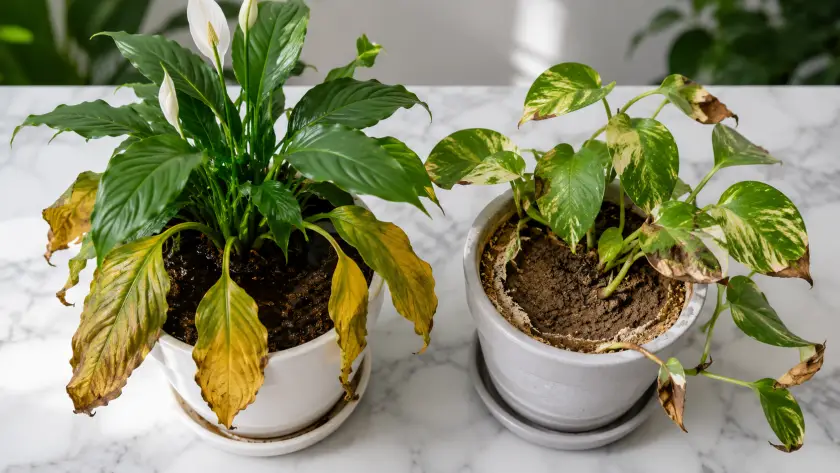
- Wilting or drooping — the most visible underwatering sign
- Dry, pulling-away-from-pot-edges soil
- Leaves curling inward — the plant conserving moisture
- Crispy, brown leaf tips and edges
- Pot feels noticeably lighter than after watering
Signs You Are Overwatering
- Yellow leaves — particularly lower, older leaves first
- Mushy or soft stems at the base
- Persistently wet soil that never dries within 7 days
- Musty or unpleasant soil odor
- Fungus gnats hovering around the pot
Our guides on signs you are overwatering and how to correct it and why your plant leaves are turning yellow cover the complete diagnostic process for both conditions.
The most important distinction: Mushy stems + wet soil = overwatering. Crispy tips + dry soil = underwatering. Both can cause yellowing — but the soil moisture level tells you which is occurring.
For plants that have progressed to root rot from chronic overwatering, our guide on root rot — how to identify, prevent and treat it covers emergency treatment. For severely struggling plants, our complete guide to reviving a dying plant covers the full rescue process.
Watering Leaves — What You Need to Know
Should You Water Leaves Directly?
Watering leaves of most houseplants is generally harmful rather than beneficial. Water sitting on leaves — particularly in lower light or cooler temperatures — creates the humid, moist conditions that fungal diseases and bacterial infections thrive in.
Exceptions where leaf misting is beneficial:
- High-humidity tropical species (calatheas, ferns, orchids) in very dry indoor air
- Dust removal on large-leaved species like rubber plant and monstera — though a damp cloth is more effective than spraying
- Never mist succulents, cacti, or other drought-adapted species
Always water at soil level — direct water into the pot at the base of the plant rather than pouring over the top of leaves. This applies to all watering pot plants situations whether indoor or outdoor containers.
For correct leaf cleaning that doesn’t involve watering leaves directly, our guide on how to clean plant leaves without damaging them covers the safest techniques for every leaf type.
Watering Plants on Vacation — Complete Solutions

How to Water Plants While Away
Watering plants on vacation is one of the most common plant owner concerns — and there are several reliable solutions depending on how long you will be away.
How to Water a Plant While Away — By Duration
1–2 weeks away:
Self-watering pots are the most effective solution for short absences — our honest review of self-watering pots — do they really work? covers which systems actually deliver consistent results.
Wicking systems: Place one end of a cotton wick in a water-filled bottle or bowl and bury the other end in the plant’s soil. Water travels up the wick by capillary action — providing a slow, consistent moisture supply.
Grouping plants: Moving plants together creates a more humid microclimate through combined transpiration — reducing individual moisture loss.
2–4 weeks away:
Plant watering systems — drip irrigation kits, gravity-fed drip stakes, and automated timer-controlled watering systems — provide the most reliable how to water plants on vacation solution for extended absences. Our guide on DIY indoor humidity tray covers humidity maintenance that complements vacation watering solutions.
Plant-sitter: For collections including moisture-sensitive plants — peace lily, ferns, trailing plants — a reliable plant-sitter remains the most practical solution.
Before leaving for vacation:
- Water thoroughly 24 hours before departure
- Move plants away from direct sun — reduces water loss through transpiration
- Remove any flowering plants from windowsills — blooms increase water demand dramatically
- Group all plants together in the coolest available room
How Can I Water Plants While Away — Drought-Tolerant Collections
How can I water my plants on vacation with minimal concern? Choose drought-tolerant plants. Collections built around snake plant, ZZ plant, aloe vera, and pothos can comfortably survive 2–3 weeks without watering — making vacation plant stress largely a non-issue.
Hydrogen Peroxide Watering Plants — The Complete Guide
Does Hydrogen Peroxide Help Plants?
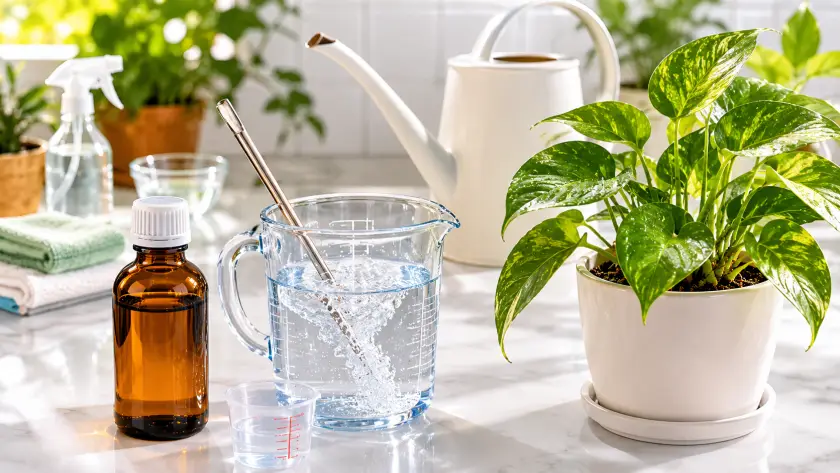
Hydrogen peroxide watering plants is a growing trend in plant care — and when used correctly, diluted hydrogen peroxide provides genuine benefits:
Benefits of hydrogen peroxide for plants:
- Kills fungus gnats: A 3% hydrogen peroxide solution diluted 1:4 with water (1 part H₂O₂ to 4 parts water) poured into the soil kills fungus gnat larvae on contact — one of the most effective organic gnat treatments available
- Adds oxygen to root zone: Hydrogen peroxide breaks down into water and oxygen in soil — providing roots with additional oxygen that benefits growth in compacted or waterlogged conditions
- Treats early root rot: Diluted hydrogen peroxide solution can help sterilize soil in mild root rot cases — though severe root rot always requires repotting into fresh dry soil
How to use hydrogen peroxide for plants:
- Use only 3% pharmacy-grade hydrogen peroxide — never industrial concentrations
- Dilute 1 part 3% H₂O₂ to 4 parts water for soil treatment
- Water normally with the solution — replace standard watering once every 2–3 weeks maximum
- Do not use on seedlings or recently propagated cuttings — too harsh for developing root systems
For complete fungus gnat treatment guidance that includes hydrogen peroxide watering plants as one of several organic solutions, our guides on how to keep pests away from outdoor plants and plants that keep bugs away without chemical repellents cover organic pest management comprehensively.
Garden Watering Plants — Outdoor Watering Complete Guide
Garden Water Management for Outdoor Plants
Garden watering plants outdoors requires different thinking from indoor plant care — because outdoor plants face rain, wind, evaporation, and temperature variability that indoor plants never experience.
Key outdoor watering principles:
Water deeply and infrequently: Shallow daily watering encourages surface root development. Deep watering 2–3 times weekly develops roots that reach deeper soil moisture — producing drought-resistant plants that perform well even when you miss watering days.
Check soil before watering after rain: Rain often wets only the top few centimetres of soil — deeper soil may remain completely dry even after heavy rainfall. Always check soil depth before assuming rain has provided adequate moisture.
Mulch is your best outdoor watering tool: A 5–7cm layer of organic mulch reduces soil moisture evaporation by up to 50% — dramatically reducing how often should I water my garden frequency while simultaneously improving soil health.
For garden water conservation strategies that reduce outdoor watering demands, our guides on top drought-resistant plants and creating a colorful garden for all seasons cover plant selection and garden design that minimises irrigation requirements.
For wildlife-friendly garden watering that creates habitat water sources alongside plant irrigation, our guide on how to design a wildlife-friendly garden covers water feature integration in garden design.
Plant Watering System Options — Indoor and Outdoor
Best Plant Watering Systems by Need
Plant watering system options range from simple manual tools to sophisticated automated setups:
Indoor plant waterer options:
- Long-spout watering cans — allow precise watering at soil level without wetting leaves
- Self-watering pots — reservoir-fed systems that maintain consistent soil moisture
- Wicking stakes — terracotta or ceramic stakes that slowly release moisture from connected water bottles
- Drip irrigation kits — timer-controlled systems ideal for watering plants while away
Plant waterer indoor specialty products:
- Moisture meters — eliminate guesswork by measuring actual soil moisture at root depth
- Watering globes — glass globes filled with water that release moisture slowly into soil
- Battery-powered drip systems — programmable systems providing automated precision watering
Outdoor garden water systems:
- Soaker hoses — deliver water directly to root zones with minimal evaporation
- Drip irrigation — most water-efficient outdoor plant watering system available
- Sprinkler systems — effective for lawn and large planting areas but least efficient for individual plant watering
Watering Specific Plant Environments
Watering Pot Plants — Container Watering Rules
Watering pot plants in containers requires more frequent attention than in-ground planting — because container soil dries faster than garden soil. Container plants also exhaust soil nutrients faster — making correct watering even more critical for maintaining healthy root systems.
Container watering rules:
- Always water until drainage flows — never just moisten the surface
- Empty saucers 30 minutes after watering — standing water causes root rot
- Terracotta pots dry faster than plastic — adjust frequency accordingly
- Larger pots dry more slowly than small ones — adjust frequency accordingly
For outdoor container watering guidance, our guide on the best plants for container gardening on patios covers seasonal watering adjustments for patio and balcony container collections.
Watering House Plants in Specific Rooms
Watering house plants requirements vary by room:
Bathroom plants: High ambient humidity reduces watering frequency. Our guide on the best plants for your bathroom identifies the specific watering adjustments for bathroom plant collections.
Bedroom plants: Stable temperatures and lower light reduce watering frequency. Our guide on decorating your bedroom with plants covers bedroom-specific plant care.
Home office plants: Air conditioning dramatically dries soil faster in summer. Our guide on improving your home office with plants covers office watering adjustments.
Kitchen plants: Higher humidity from cooking reduces watering frequency slightly. Our guide on indoor plants that smell amazing covers fragrant kitchen plant care.
Seasonal Watering Adjustments
How Watering Changes Through the Year
How often to water plants changes significantly with the seasons — one of the most important watering principles that fixed-schedule watering ignores entirely.
Spring (increasing frequency): As days lengthen and temperatures rise, plants enter active growth and water consumption increases. Begin checking plants every 2–3 days and adjust frequency upward from winter levels.
Summer (maximum frequency): Peak watering demand — most plants need checking every 1–2 days. When is the best time to water outdoor plants in summer? Before 8am — before heat intensifies evaporation.
Autumn (reducing frequency): As growth slows with shorter days and cooler temperatures, reduce watering frequency gradually. Continue checking soil before watering — never reduce automatically.
Winter (minimum frequency): Most houseplants enter a rest period — some need watering only monthly. Never water indoor plants in winter without checking soil thoroughly first.
For complete seasonal plant care guidance that covers watering alongside other seasonal adjustments, our guides on outdoor plants that survive British winters without fuss and shade-loving plants for outdoor spaces cover seasonal watering for specific outdoor plant categories.
Water Quality for Plants
What Water Is Best for Plants?
The quality of water used for watering house plants matters more than most owners realise — particularly for sensitive species.
Tap water concerns: Fluoride and chlorine in tap water cause brown leaf tips over time in sensitive species including peace lily, spider plant, and pothos. Hard tap water creates white mineral deposits on soil surface.
Best water for plants:
- Rainwater — the gold standard for all plants
- Filtered water — removes chlorine and reduces fluoride
- Tap water left in an open container for 24 hours — allows chlorine to dissipate naturally
- Distilled water — effective but removes beneficial minerals over time
Humidity and Watering — The Connection
How Humidity Affects Watering Frequency
Indoor humidity levels significantly affect how often to water plants — low humidity increases water loss through leaf transpiration, causing soil to dry faster and requiring more frequent watering.
Low humidity indicators: Crispy leaf tips and edges on tropical plants despite adequate soil moisture.
For comprehensive humidity management that reduces watering stress on tropical houseplants, our guides on humidity hacks for happy plants and DIY humidity tray guide cover the most effective solutions.
Watering and Soil — The Inseparable Partnership
How Soil Affects Watering
Correct garden watering plants technique means nothing if soil drainage is wrong. Dense, moisture-retentive soil stays wet for weeks regardless of how carefully you water — creating root rot conditions in drought-tolerant species. Fast-draining gritty mixes dry within days — causing underwatering in moisture-loving species.
Always match soil type to plant water requirements. Our complete soil mix guide covers the exact potting mix for every plant category — the essential companion to correct watering technique.
For repotting into fresh soil — which dramatically improves watering effectiveness in exhausted, compacted potting mix — our complete repotting guide and repotting mistakes to avoid cover the complete process.
Frequently Asked Questions
How Often Should I Water My Plants?
How often to water plants — use the finger test rather than a calendar. For most tropical houseplants, check every 3–5 days and water when the top 1–2 inches are dry. For drought-tolerant species, water only when the entire pot feels light. For moisture-lovers like ferns, check every 1–2 days.
When Is the Best Time to Water Plants?
When is it the best time to water plants? Morning — between 6am and 10am. Best times to water plants in morning reduces evaporation, allows all-day absorption, and ensures leaves dry before nightfall preventing fungal disease. Good time to water plants in the afternoon is acceptable for indoor plants only. Never water in the evening for outdoor plants.
Can I Water Plants at Night?
Can I water plants at night? Ideally no — is it ok to water plants at night for houseplants? It is less harmful than for outdoor plants but still not recommended. Evening watering slows evaporation and leaves moisture around roots and on leaves through the coldest hours. Morning watering is always preferable.
How to Water Plants on Vacation?
How to water plants on vacation — for 1–2 weeks: self-watering pots, wicking systems, or grouping plants together. For 2–4 weeks: automated drip plant watering system, plant-sitter, or choose drought-tolerant collections that genuinely survive extended periods without care.
Is Hydrogen Peroxide Safe for Watering Plants?
Hydrogen peroxide watering plants at 3% concentration diluted 1:4 with water is safe and beneficial — killing fungus gnat larvae, adding root zone oxygen, and treating mild fungal issues in soil. Never use concentrations above 3% and never use on seedlings or recently propagated cuttings.
Should I Water Leaves Directly?
Watering leaves directly is generally harmful — it promotes fungal disease. Always water at soil level. The only exception is misting high-humidity tropical species in very dry air — and even then, mist only in the morning so leaves dry before nightfall.
Related Guides on Patch Plants
- 💧 Worst Times to Water Your Plants — Avoid These Mistakes
- 🌱 Signs You Are Overwatering — How to Correct It
- 🔬 Root Rot — How to Identify, Prevent and Treat It
- 🌿 The Truth About Self-Watering Pots
- 💦 DIY Humidity Tray for Indoor Plants
- 🌿 Humidity Hacks for Happy Plants
- 🪴 Best Soil Mix for Every Plant Type
- 🌿 How to Repot a Plant — Complete Guide
- 🍃 Why Your Plant Leaves Are Turning Yellow
- 🌿 Leaf Curl, Browning and Droop — What Your Plant Is Telling You
- 🌿 How to Revive a Dying Plant — Step by Step
- 🌱 Browse All Indoor Plant Guides
Final Thoughts about Watering Plants
Watering house plants and outdoor gardens correctly is a skill built through observation — not a formula applied mechanically. How often water plants need attention changes with the season, the plant, the pot, and your home environment. The universal principles never change: check before you water, water thoroughly when you do, ensure drainage is excellent, and time your watering to the morning whenever possible.
When is the best time water plants? Morning. Is it ok to water plants at night? No. How much to water plants? Until water flows from drainage holes. These three answers cover the most impactful watering decisions you will make.
Master the finger test and the weight test. Build the observation habit that how often to water plants correctly requires. And your plants — whether a single snake plant on a windowsill or a full indoor jungle — will reward that attentiveness with growth, color, and health that no other care practice can substitute for. 🌿
I don’t think the title of your article matches the content lol. Just kidding, mainly because I had some doubts after reading the article. Binance
Undeniably consider that which you stated.
Your favorite reason seemed to be on the internet the simplest thing to
bear in mind of. I say to you, I certainly get annoyed even as folks think about issues that they plainly don’t understand
about. You managed to hit the nail upon the top as neatly as outlined out the entire thing with no need side-effects ,
folks could take a signal. Will probably be again to get more.
Thanks
Hi there, You have done an incredible job. I’ll certainly digg it and personally suggest to my friends.
I am sure they’ll be benefited from this website.
Thank you for your sharing. I am worried that I lack creative ideas. It is your article that makes me full of hope. Thank you. But, I have a question, can you help me?
น่าสนใจมาก, ขอบคุณสำหรับความรู้นี้.
Here is my page: PGSLOT SH
[…] better watering habits, use complete watering guide, worst times to water plants, and signs you are […]
[…] the complete watering guide, worst times to water plants, and signs you are overwatering if you struggle with watering […]
Pretty section of content. I just stumbled upon your website
and in accession capital to assert that I get in fact enjoyed account
your blog posts. Any way I will be subscribing to your feeds and even I achievement you access consistently fast.
Why visitors still make use of to read news papers when in this technological globe everything is presented
on web?
Good answer back in return of this question with firm arguments
and telling all regarding that.
Hey there! I realize this is somewhat off-topic however I
needed to ask. Does managing a well-established website like yours take a lot of work?
I’m completely new to running a blog however I do write in my diary on a daily basis.
I’d like to start a blog so I will be able to share my
personal experience and thoughts online. Please let me know if you have any
kind of suggestions or tips for brand new aspiring blog owners.
Appreciate it!
[…] guide connects well with complete watering tips, humidity hacks, and DIY humidity […]
[…] guide connects well with cactus care guide, complete watering tips, and how to repot a […]
Does your site have a contact page? I’m having trouble locating it but, I’d like
to send you an e-mail. I’ve got some ideas for your blog you might be interested in hearing.
Either way, great site and I look forward to seeing it improve over time.
I’m really enjoying the theme/design of your site.
Do you ever run into any browser compatibility problems?
A few of my blog visitors have complained about my site not working correctly in Explorer but looks great in Safari.
Do you have any tips to help fix this problem?
[…] this guide with complete watering tips, complete indoor light guide, and how to keep outdoor plants […]
[…] this guide with complete watering tips, yellow leaves on plants, and root rot […]
[…] Use this guide with how to revive a dying plant, yellow leaves on plants, and complete watering tips. […]
What’s up to every one, the contents existing at this web site are truly
awesome for people experience, well, keep up the nice work fellows.
ฉันเห็นด้วยกับจุดยืนของคุณ,
และต้องการอ่านเนื้อหาเพิ่มเติมจากคุณ.
My homepage :: PGWS
Howdy! This blog post couldn’t be written much better!
Looking at this post reminds me of my previous roommate!
He continually kept preaching about this. I’ll forward this post to
him. Fairly certain he’ll have a very good read. Thank you for sharing!
Ahaa, its pleasant dialogue about this post here at this blog, I have read all that,
so at this time me also commenting at this place.
Awesome article.
This piece of writing presents clear idea designed for
the new people of blogging, that truly how to do running a blog.
Great items from you, man. I’ve take note your stuff prior
to and you’re just too excellent. I really like what you’ve received right here, certainly like what you’re stating and the
way by which you are saying it. You’re making it entertaining and you still take care of to keep
it wise. I cant wait to read far more from you.
That is really a wonderful website.
[…] more help, use Croton Petra care, complete watering tips, and complete indoor light […]
Hi there! I could have sworn I’ve been to this blog before
but after browsing through some of the post I
realized it’s new to me. Anyways, I’m definitely glad I
found it and I’ll be bookmarking and checking back frequently!
I truly love your site.. Pleasant colors & theme.
Did you build this web site yourself? Please reply back as
I’m planning to create my own site and would love
to find out where you got this from or just what the
theme is named. Cheers!
Thank you for the auspicious writeup. It in fact was a amusement
account it. Look advanced to far added agreeable from
you! However, how can we communicate?
Your point of view caught my eye and was very interesting. Thanks. I have a question for you.
[…] deeper help, use complete guide to indoor light, complete watering tips, and humidity […]
Thank you for your sharing. I am worried that I lack creative ideas. It is your article that makes me full of hope. Thank you. But, I have a question, can you help me? https://accounts.binance.com/es-LA/register-person?ref=VDVEQ78S
Discover the freedom of buy Adderall online without prescrition Adderall Online Without Prescription, your reliable source for prompt solutions!
Navigate a user-friendly platform offering high-quality Adderall, crafted to boost
your energy. Whether you’re managing personal challenges or aiming for success, our seamless service delivers discreetly with complete
privacy. Visit for unlimited access to reputable products,
uplifting your needs instantly.
Why wait when you can optimize your routine with Buy Adderall Online Without Prescription? Our extensive inventory connects you to premium products
at affordable prices, with lightning-fast delivery to meet your demands.
Browse with ease on our sleek platform, updated regularly to ensure
reliable stock. No barriers—just quick access to the boost you need.
Shop now and redefine your experience today!
Откровенные видео можно транслировать на надежных платформах для
обеспечения конфиденциальности.
Откройте для себя безопасные веб-сайты для качественного просмотра.
My site :: orgy porn videos
Nieuwste adult websites brengen innovatieve inhoud voor volwassen entertainment.
Ontdek gegarandeerde porno hubs voor een moderne ervaring.
Also visit my site – buy Rhino online
成人内容 可通过 有保障 的网站获取。探索 可靠平台 以获得高质量内容。
Look at my site; LESBIAN PORN VIDEOS
Материалы для взрослых доступны на различных
сайтах для взрослых в развлекательных целях.
Всегда выбирайте надежные сайты для взрослых для защищенного опыта.
Also visit my web site BUY VIAGRA
When I originally commented I clicked the “Notify me when new comments are added” checkbox and now
each time a comment is added I get four emails with the same comment.
Is there any way you can remove me from that service? Thanks a lot!
最佳成人网站 提供高质量的成人娱乐内容。选择
有保障的平台 以获得安全且愉快的观看体验。
Premium adult platforms bieden veilige en premium inhoud voor volwassenen. Ontdek gegarandeerde
platforms voor een kwaliteitservaring.
Also visit my web site … buy viagra online
Сексуальный контент широко доступен на
специализированных платформах для зрелой аудитории.
Выбирайте гарантированные источники для обеспечения безопасности.
my website – www porn websites
Сексуальный контент широко доступен на специализированных платформах для
зрелой аудитории. Выбирайте надежные сайты для взрослых для обеспечения безопасности.
成人网站 提供广泛的成人娱乐视频选择。选择 可靠平台
以获得保密体验。
Here is my website: 残酷色情电影
Top xxx sites bieden veilige en premium inhoud voor volwassenen. Ontdek veilige sites voor een kwaliteitservaring.
Stream adult content securely on reputable adult platforms.
Find reliable video sources for a premium experience.
my web page – discount levitra tablets blog
Контент для взрослых можно транслировать
на надежных платформах для обеспечения конфиденциальности.
Откройте для себя безопасные веб-сайты для качественного просмотра.
my website best anal porn site
Adult content is available on various adult websites for entertainment.
Always choose secure content hubs for a protected experience.
My website; ORGY PORN VIDEOS
新成人网站 提供创新的成人娱乐内容。发现
有保障的色情中心 以获得现代化的体验。
Also visit my blog post; 在线购买伟哥
Adult video’s kijken op veilige en betrouwbare platforms.
Vind gegarandeerde videobronnen voor een premium ervaring.
Visit my webpage: buy viagra online
Premium pornosites bieden premium inhoud voor volwassenen. Ontdek veilige hubs
voor kwaliteit en privacy.
My webpage :: full porn movies
Новейшие сайты для взрослых предлагают
инновационный контент для развлечений для взрослых.
Откройте для себя надежные свежие сайты для современного опыта.
Here is my web bblog – buy viagra online
Seksuele inhoud is breed beschikbaar op speciale platforms voor volwassenen.
Kies voor betrouwbare adult hubs voor veiligheid.
Look into my blog post: BEST ANAL PORN SITE
浏览露骨材料 通过选择经过验证的成人网站来安全进行。使用 可靠的色情中心 以获得私密的娱乐体验。
Also visit my web-site … 最佳肛门色情网站
优质xxx平台 提供高质量的成人娱乐内容。选择 可靠中心 以获得安全且愉快的观看体验。
Смотрите видео для взрослых на безопасных и надежных платформах.
Найдите безопасные хабы потоковой передачи для первоклассного опыта.
Also visit my page :: жестокое порно клипы
Fantastic! This platform is seriously great! The selection of shemale porn videos is insane – so
many sexy trans girls in crystal-clear scenes. The loading is fast and flawless and new content are added every day.
If you’re want to watch shemale fucks guy porn videos featuring seductive performers and raw action, this is without a doubt the best
spot. Highly recommended!
Контент для взрослых можно транслировать на
надежных платформах для обеспечения конфиденциальности.
Откройте для себя гарантированные источники видео для качественного просмотра.
Also visit my blog post … ORGY PORN VIDEOS
Best xxx sites provide premium content for mature audiences.
Explore secure hubs for quality and privacy.
My web site: cialis price shoppers drug mart
成人材料 可在各种成人娱乐网站上获取,供娱乐用途。始终选择 受保护的内容中心 以确保安全体验。
Feel free to visit my web site: 群体手淫
Top adult platforms provide premium content for mature audiences.
Explore secure hubs for quality and privacy.
Look at my web blog BUY CANNABIS ONLINE
[…] the fundamentals behind these requirements, see our complete watering guide, soil mix guide, repotting guide, and pruning […]
New porn sites bring innovative content for adult entertainment.
Explore trusted best anal porn site hubs for a modern experience.
Ищите откровенные видео, исследуя надежные платформы в
Интернете. Изучите безопасные сайты для приватного просмотра.
My web blog buy viagra
Leading BEST ANAL PORN SITE
websites offer secure and premium content for adults. Discover trusted platforms for a quality experience.
Amazing! This website is absolutely addictive! The collection of shemale porn videos
is insane – loads of sexy trans girls in premium
scenes. The playback is fast and flawless and new clips are added frequently.
If you’re want to watch shemale porn videos featuring beautiful performers and intense action, this is definitely the best spot.
Strongly recommended!
Take a look at my blog Thai ladyboy
Наконец-то случайно наткнулся на такое количество качественных полных версий порно!
Раньше никак не мог найти, а
тут все проблемы решены. Картинка профессиональная, актрисы супер красивые,
невозможно остановиться.
Поделился с друзьями этот сайт. Частые обновления.
Разные вкусы полных порнофильмов
присутствуют. Спасибо админу!
My webpage … Порнофильмы
观看色情内容 通过选择经过验证的成人网站来安全进行。使用 安全平台 以获得私密的娱乐体验。
My webpage: BRUTAL PORN MOVIES
Где смотреть порно, исследуя надежные платформы в Интернете.
Изучите безопасные сайты для приватного просмотра.
新成人网站 提供创新的成人娱乐内容。发现 有保障的色情中心 以获得现代化的体验。
my website … 女同性恋色情影片
[…] the fundamentals behind these requirements, read our complete guide to watering plants, soil mix guide, pruning basics, and wider Plant Care […]
[…] you’re still getting comfortable with plant watering, our complete plant watering guide explains moisture management in more […]
[…] If you’re unsure whether your watering habits are helping or hurting your plants, read our complete plant watering guide. […]