The best climbing houseplants for most homes are golden pothos, heartleaf philodendron, monstera, satin pothos and hoya, all of which climb happily up a moss pole or trellis in bright, indirect light. For pet-friendly homes, hoya, grape ivy, Madagascar jasmine and pink jasmine are listed as non-toxic by the ASPCA. I am Sawera Shahid, a botanist at Patch Plants, and in this guide I compare 15 indoor climbers by how they climb, how much light they need and whether they are safe around pets.
Climbing houseplants add height without taking up floor space, and many grow bigger, more mature leaves once they have something to climb. Below you will find a quick comparison table, the 15 plants with care notes, how to choose the right support, and the most common mistakes to avoid.
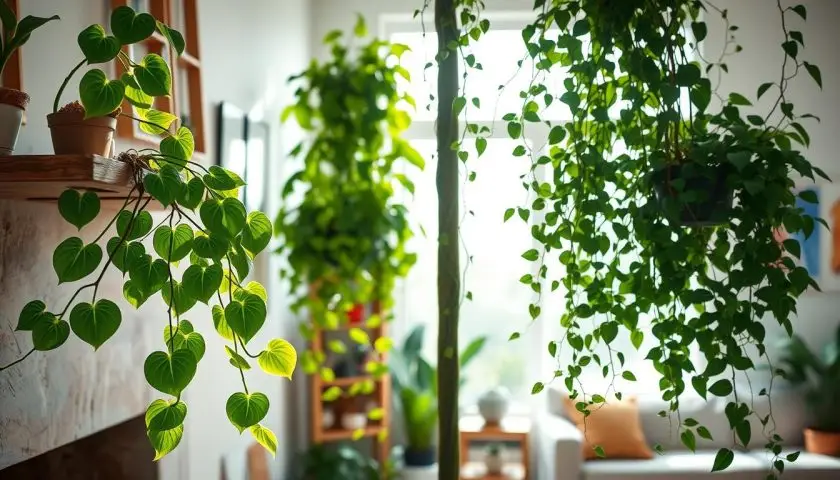
How Indoor Climbing Plants Climb
Understanding how a plant climbs tells you which support it needs. Indoor climbing plants use one of four main methods:
- Aerial roots: roots that grow from the stem and grip a surface. Pothos, philodendron, monstera, satin pothos, arrowhead plant, English ivy and creeping fig climb this way. They do best on a moss pole or textured surface they can root into.
- Twining stems: stems that wind around a support. Hoyas, pink jasmine and Madagascar jasmine twine, so they suit hoops, canes and trellises.
- Tendrils: thin, coiling shoots that wrap around anything they touch. Grape ivy and passionflower use tendrils and need a trellis or wires.
- Scrambling: long stems that lean on other plants or supports and need tying in.
As a botanist, I find the aroids especially interesting. In the wild, many of them start life on the forest floor and then climb tree trunks towards the light. As they climb, their leaves often become larger and, in monstera, more deeply split. Indoors, a moss pole recreates that tree trunk and encourages this mature growth.
Climbing Houseplants Compared
| Plant | How It Climbs | Light | Pets (ASPCA) |
|---|---|---|---|
| Golden pothos | Aerial roots | Low to bright, indirect | Toxic |
| Heartleaf philodendron | Aerial roots | Medium to bright, indirect | Toxic |
| Monstera deliciosa | Aerial roots | Bright, indirect | Toxic |
| Mini monstera | Aerial roots | Bright, indirect | Not listed; treat as toxic |
| Monstera adansonii | Aerial roots | Bright, indirect | Not listed; treat as toxic |
| Satin pothos | Aerial roots | Bright, indirect | Toxic |
| Arrowhead plant | Aerial roots | Medium to bright, indirect | Toxic |
| English ivy | Aerial roots | Bright, indirect; cool | Toxic |
| Creeping fig | Aerial roots | Medium, indirect | Toxic (Ficus) |
| Hoya carnosa | Twining | Bright, some sun | Non-toxic |
| Hoya pubicalyx | Twining | Bright, some sun | Non-toxic |
| Pink jasmine | Twining | Bright, cool winter | Non-toxic (jasmine) |
| Madagascar jasmine | Twining | Bright, filtered | Non-toxic |
| Grape ivy | Tendrils | Medium to bright, indirect | Non-toxic |
| Blue passionflower | Tendrils | Bright, some sun | Not listed; keep away from pets |
Pet status is taken from the ASPCA toxic and non-toxic plant lists. Where a plant is not listed, I have noted it rather than assume it is safe.
15 Best Climbing Houseplants
1. Golden Pothos (Epipremnum aureum)
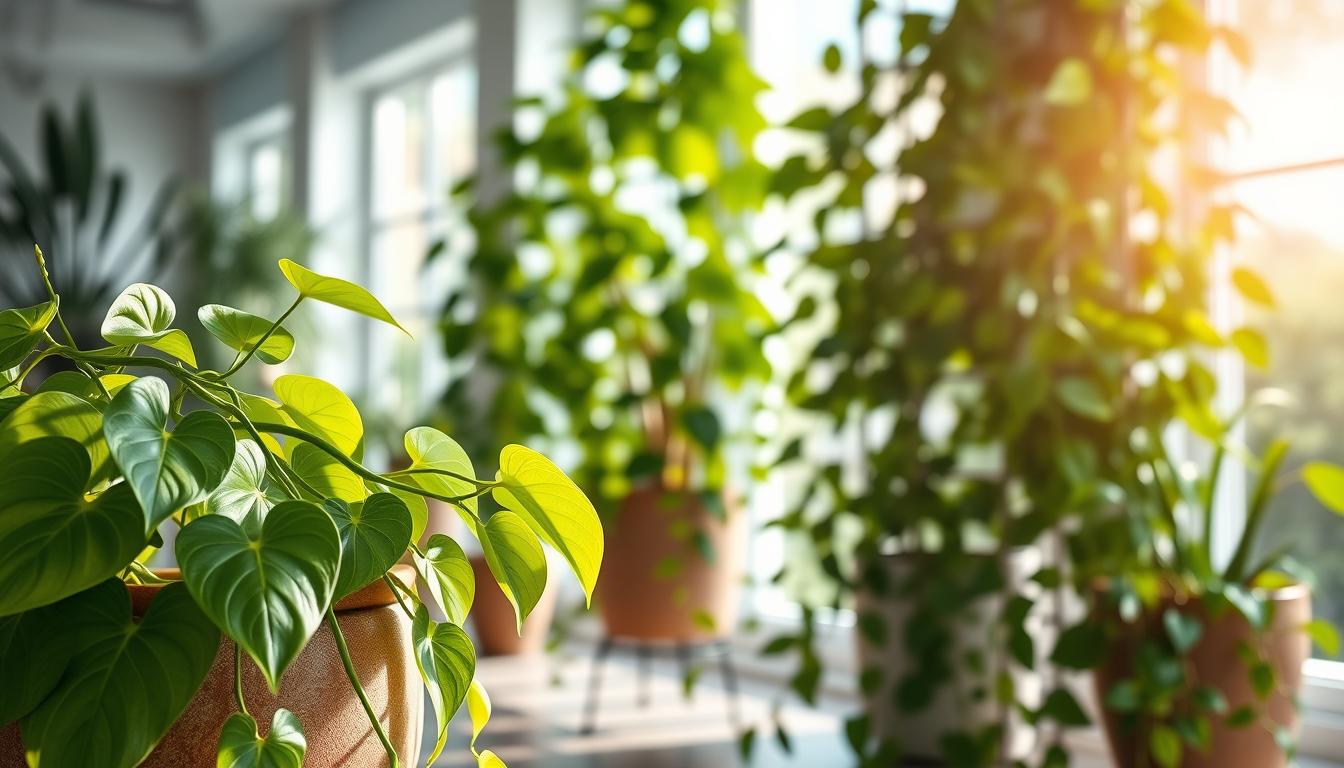
Golden pothos is the easiest of all climbing houseplants. It tolerates lower light than most, grows quickly and climbs with aerial roots that grip a moss pole. Its heart-shaped leaves are splashed with yellow, and they grow noticeably larger when the plant is allowed to climb rather than trail. Water when the top few centimetres of compost are dry. The ASPCA lists golden pothos as toxic to cats and dogs because it contains insoluble calcium oxalates.
2. Heartleaf Philodendron (Philodendron hederaceum)
The heartleaf philodendron has soft, glossy, heart-shaped leaves and climbs with aerial roots. It is almost as forgiving as pothos and is often confused with it, but its leaves are thinner and more matte, and new leaves emerge from a sheath called a cataphyll. Varieties such as ‘Brasil’, with lime-green streaks, need the same care. The ASPCA lists philodendrons as toxic to cats and dogs.
3. Monstera Deliciosa
Monstera deliciosa is the classic statement climber. Young plants have small, solid leaves, but as the plant matures and climbs, the leaves become larger and develop the splits and holes it is famous for. Give it bright, indirect light and a sturdy moss pole, and tie the stems in loosely as it grows. Our guide to the moss pole for plants explains how to set one up. The ASPCA lists monstera (split-leaf philodendron) as toxic to pets.
4. Mini Monstera (Rhaphidophora tetrasperma)
Despite its common name, the mini monstera is not a true monstera. It belongs to a related genus in the same family, Araceae. It has small, deeply split leaves and grows quickly, making it ideal if you want the monstera look in a smaller space. It climbs with aerial roots and does best on a moss pole in bright, indirect light. It is not on the ASPCA list, but like other aroids it contains calcium oxalate crystals, so treat it as toxic to pets.
5. Monstera Adansonii
Monstera adansonii, the Swiss cheese vine, has thin leaves full of oval holes. It grows faster and stays more compact than Monstera deliciosa, and it can be trained up a pole or allowed to trail. It likes bright, indirect light and higher humidity than pothos. It is not listed separately by the ASPCA, but as a monstera it should be kept away from pets.
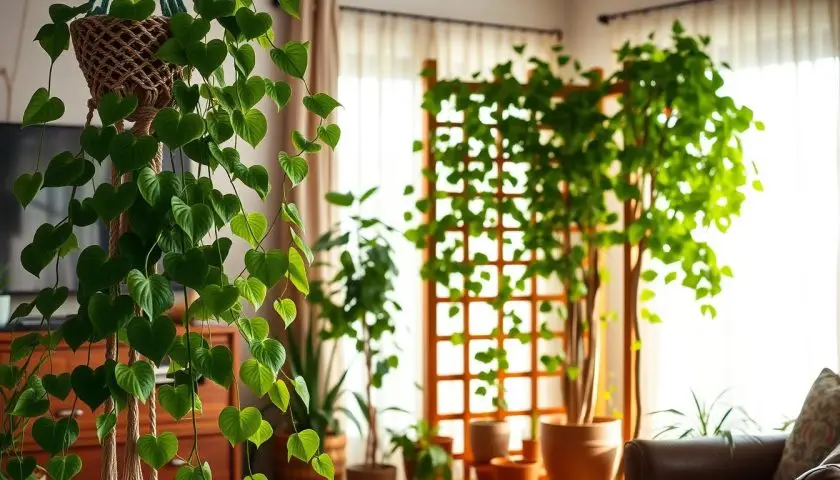
6. Satin Pothos (Scindapsus pictus)
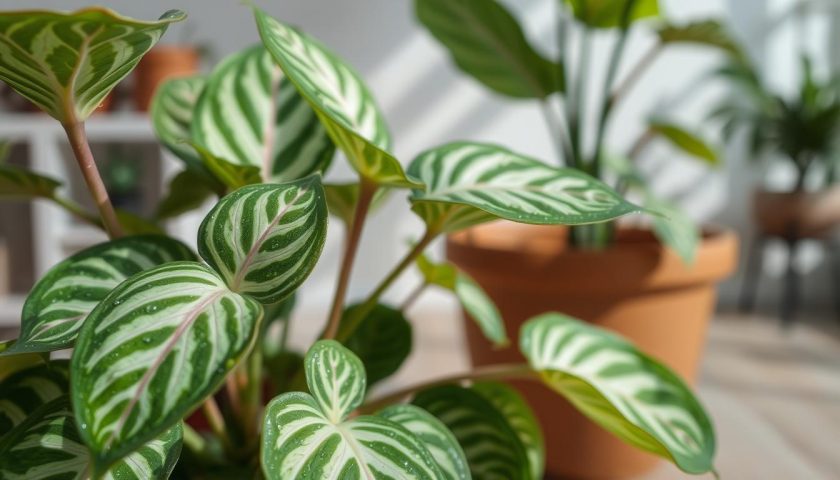
Satin pothos has velvety, dark green leaves splashed with silver. NC State Extension notes that in its native habitat it climbs tree trunks using rootlets and can reach about 3m (10ft). It prefers bright, indirect light, moist but well-drained compost and room temperatures of 18 to 29°C (65 to 85°F), and does not tolerate cold air or direct sun. The ASPCA lists satin pothos as toxic to cats, dogs and horses.
7. Arrowhead Plant (Syngonium podophyllum)
The arrowhead plant starts as a compact, bushy plant, but as it matures it produces climbing stems with aerial roots. Its leaves change shape as it grows, from simple arrowheads to lobed leaves on climbing stems. A moss pole helps it climb neatly. It contains calcium oxalates and is toxic to pets. Read our full guide to the arrowhead plant for detailed care.
8. English Ivy (Hedera helix)
English ivy is a true climber that clings with aerial roots. Indoors, it prefers bright, indirect light and cooler rooms, and it struggles in warm, dry air, where spider mites can become a problem. It looks lovely trained over a hoop or small trellis. The ASPCA lists English ivy as toxic to cats, dogs and horses.
9. Creeping Fig (Ficus pumila)
Creeping fig has tiny leaves and clings tightly to walls, bark or moss with aerial roots. Indoors it is often trained over topiary frames or up a moss pole. It needs evenly moist compost and humid air, as the small leaves dry out quickly. The ASPCA lists figs (Ficus species) as toxic to pets, with sap that can irritate the skin and gut.
10. Hoya Carnosa (Wax Plant)
Hoya carnosa is a twining climber with thick, waxy leaves and clusters of star-shaped, waxy flowers. It does best in bright light and can take some direct sun, and it prefers to dry out a little between waterings. Train it around a hoop or trellis. Do not cut off the old flower stalks, as hoyas often flower from the same spurs again. The ASPCA lists hoya as non-toxic to pets, which makes it one of the best climbing houseplants for pet owners.
11. Hoya Pubicalyx
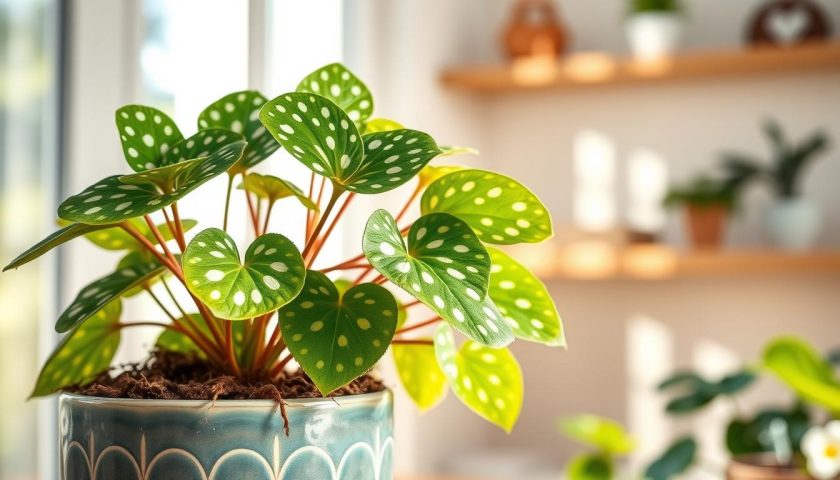
Hoya pubicalyx is a faster-growing hoya with long, speckled leaves and clusters of pink to purple flowers. Its care is the same as Hoya carnosa: bright light, a twining support and compost that dries a little between waterings. A University of Florida IFAS guide, citing the ASPCA, lists it among the non-toxic houseplants.
12. Pink Jasmine (Jasminum polyanthum)
Pink jasmine is a twining climber grown for its clusters of pink buds that open to scented white flowers in late winter and spring. It needs bright light and a cool spell in autumn and winter to set buds, so it suits a cool, bright porch or conservatory better than a warm living room. Train it around a hoop or small trellis. The ASPCA lists true jasmine (Jasminum) as non-toxic to pets.
13. Madagascar Jasmine (Stephanotis floribunda)
Madagascar jasmine is a twining climber with glossy, leathery leaves and waxy, highly scented white flowers. It needs bright, filtered light, steady warmth and moderate watering, and it dislikes being moved once in bud. Give it a hoop or trellis. The ASPCA lists it as non-toxic to cats, dogs and horses.
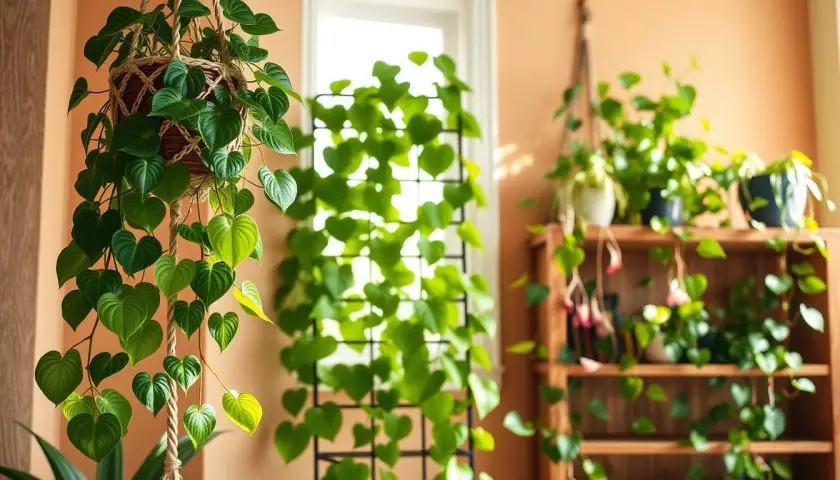
14. Grape Ivy (Cissus rhombifolia)
Grape ivy is a member of the grape family, Vitaceae, and climbs with tendrils. Its glossy leaves are divided into three toothed leaflets. It tolerates medium light well, making it a good choice for rooms away from the window, and it looks best trained up a trellis or allowed to cascade. The ASPCA lists grape ivy as non-toxic to cats, dogs and horses.
15. Blue Passionflower (Passiflora caerulea)
Blue passionflower is a vigorous tendril climber with intricate white and blue flowers. Indoors it needs a bright spot with some direct sun, such as a conservatory, and a trellis or wires to climb. It grows quickly, so prune it in spring to keep it in check. I could not find it on the ASPCA list, so I recommend keeping it out of reach of pets to be safe.
Choosing the Right Support
Matching the support to the climbing method makes training much easier:
| Support | Best For | Why It Works |
|---|---|---|
| Moss or coir pole | Pothos, philodendron, monstera, satin pothos, arrowhead plant | Aerial roots can grow into a moist, textured surface |
| Hoop or wire frame | Hoya, jasmine, English ivy | Twining stems wind around it neatly |
| Trellis | Grape ivy, passionflower, jasmine | Tendrils and twining stems grip the slats |
| Wall or frame | Creeping fig | Small aerial roots cling to the surface |
Insert the support when you pot the plant, so you do not damage the roots later. Tie stems in loosely with soft ties, and keep moss poles slightly moist so aerial roots can grow into them. For a full walk-through, see our guide to the moss pole for plants.
How to Care for Climbing Houseplants
Most climbing houseplants share a few needs:
- Light: bright, indirect light suits most climbers. Too little light makes stems long and bare, with small leaves. Our complete guide to indoor light explains how to judge it.
- Water: most prefer the top of the compost to dry slightly between waterings. Overwatering is the most common cause of yellow leaves; see our guide to signs you are overwatering.
- Humidity: aroids such as monstera, satin pothos and philodendron appreciate extra humidity, which a DIY humidity tray can provide.
- Feeding: feed with a balanced liquid fertiliser in spring and summer, when growth is fastest.
- Pruning: trim long or bare stems in spring to encourage bushier growth, and use the cuttings to start new plants.
Propagating Climbing Houseplants
Many indoor climbing plants are easy to propagate from stem cuttings. For aroids such as pothos, philodendron and monstera, cut just below a node with an aerial root and root it in water or moist compost. Hoyas and grape ivy also root from stem cuttings in warmth. See our guide on how to propagate houseplants for step-by-step help, and our guide on how to repot a plant when your climber outgrows its pot.
Common Mistakes With Climbing Houseplants
| Mistake | What Happens | Fix |
|---|---|---|
| Too little light | Long, bare stems with small leaves | Move closer to a bright window |
| Wrong support | Plant flops or will not attach | Match support to climbing method |
| Dry moss pole | Aerial roots do not grow in | Mist or water the pole regularly |
| Ties too tight | Stems are damaged as they thicken | Use soft, loose ties and check them often |
| Overwatering | Yellow leaves, root rot | Let the top of the compost dry slightly |
| Ignoring pet safety | Risk to cats and dogs | Choose ASPCA non-toxic climbers |
For pest problems such as webbing on ivy, see our guide to spider mites on plants.
Climbing vs Trailing Houseplants
Many climbing houseplants, such as pothos, philodendron and grape ivy, can also be grown as trailing plants in a hanging pot or on a shelf. The difference is mainly in how you train them. Climbing usually gives larger, more mature leaves, while trailing gives a softer, cascading look. If you prefer that look, see our guide to trailing plants that look stunning on shelves and bookcases, including the string of hearts.
Frequently Asked Questions
What is the easiest climbing houseplant?
Golden pothos is the easiest. It tolerates lower light, grows quickly and climbs a moss pole readily. Heartleaf philodendron is a close second.
Which climbing houseplants are safe for cats?
The ASPCA lists hoya, grape ivy, Madagascar jasmine and true jasmine as non-toxic to cats and dogs. Pothos, philodendron, monstera and English ivy are toxic.
Do climbing houseplants need a moss pole?
Plants that climb with aerial roots, such as monstera, pothos and philodendron, do best on a moss pole. Twining plants such as hoya prefer a hoop or trellis.
Why are my climbing plant’s leaves getting smaller?
Small leaves on long, bare stems usually mean too little light. Many aroids also produce smaller leaves when they trail instead of climb.
Which climbing houseplant flowers indoors?
Hoyas, pink jasmine, Madagascar jasmine and blue passionflower all flower indoors in bright light. Jasmines need a cool winter spell to set buds.
Final Thoughts
As a botanist, I love climbing houseplants because they show how plants have adapted to reach the light. Choose a climber that suits your light and your pets, give it the right kind of support for how it climbs, and it will reward you with bigger leaves and a living green column in your room.
At Patch Plants, I write our guides so you can understand why each plant behaves the way it does. For more ideas, browse our tropical house plants and our guide to making your plants cat-friendly.
Sources: ASPCA, Toxic and Non-Toxic Plants; NC State Extension, Scindapsus pictus; UF/IFAS, Houseplants, Pets and Poison.

About the author
Sawera Shahid is a botanist with an MPhil in Botany and 5+ years of writing about plants. As founder and lead writer of Patch Plants, she writes practical, science-backed guides on indoor plants, outdoor gardens and plant problems, checked against RHS and university extension advice.