Indoor light for plants depends on three things: how bright it is, how many hours it lasts each day, and what kind of light it is. Most houseplants want bright to medium indirect light for 12–14 hours a day. A south-facing window gives the most light, east and west windows give medium to bright light, and north windows give the least. Light falls off fast as you move away from the glass. When windows are not enough, a full-spectrum LED grow light can fill the gap.
Light is the factor people most often underestimate in plant care. It drives photosynthesis, so it decides how fast a plant grows, how much water it uses, whether it flowers, and how well it keeps its variegation. This guide explains low, medium and bright light in practical terms, shows how to read your windows, explains how to tell when a plant needs more or less light, and covers when and how to add artificial light.
At Patch Plants, every guide is researched and written by Sawera Shahid, a botanist with an MPhil in Botany who has more than five years of plant-care writing experience. We base our advice on plant science and extension research, so you can make clear, practical decisions about your own windows and rooms.
What Kind of Light Do Plants Need?
Plants use light energy to make sugars from water and carbon dioxide. Without enough of it, they slowly use up their reserves, grow weak and stretched, and become more prone to rot because they use less water.
Three parts of indoor light matter:
- Intensity: how bright the light is, measured in foot-candles (or lux)
- Duration: how many hours of usable light the plant gets each day
- Quality: the colors, or spectrum, in the light
Our eyes adjust to dim rooms, so a spot that feels bright to us can be very dim for a plant. That is why many plants decline in the middle of a room even though it “looks” bright.
Low, Medium and Bright Indoor Light Explained
Plant labels use terms like “low light” and “bright indirect light.” University of Minnesota Extension gives these ranges:
| Light Level | Foot-candles | Typical Spot |
|---|---|---|
| Low | About 50–250 | Near a north-facing window or a fairly dim corner |
| Medium | About 250–1,000 | An east window, or near a west window out of direct sun |
| High (bright) | Over 1,000 | A south or southwest window |
Colorado State University’s PlantTalk adds that few plants tolerate light below about 50 foot-candles. Even “low-light” plants need some light to survive.
What Is Medium Light for Plants?
Medium light is bright enough to read comfortably in daytime without a lamp, but with little or no direct sun on the leaves. CSU describes it as about 2–6 feet back from, or a foot to the side of, an east or west window. Pothos, philodendron, peace lily and dracaena do well here.
What Is Bright Indirect Light?
Bright indirect light is a spot close to a bright window where the plant sees a lot of sky but is not baked by hot midday sun. An east window, or a spot just out of the sun’s path near a south or west window, often fits. Most foliage houseplants, including monstera and calathea, grow best here.
What Is Direct Sun?
Direct sun means sunlight falls straight onto the leaves for several hours. Cacti, succulents, aloe, herbs and many flowering plants like it. Our guide to houseplants that like direct sunlight lists good choices.
How Window Direction Changes Indoor Light
The directions below assume you live in the Northern Hemisphere. In the Southern Hemisphere, swap north and south.
- South-facing: the brightest window, with sun for much of the day, especially in winter. Ideal for sun lovers; set tropical foliage plants back from the glass or behind a sheer curtain.
- West-facing: bright, with hot afternoon sun. Good for many plants a few feet back from the glass.
- East-facing: gentle morning sun and bright light the rest of the day. Ideal for most houseplants.
- North-facing: steady, low to medium light with little direct sun. Best for low-light plants placed close to the glass.
Distance from the Window Matters More Than You Think
Light drops off quickly as you move into a room. CSU’s guide shows the same east or west window giving high light within 2 feet but only medium light 2–6 feet back. A plant a few steps from the window can receive a small fraction of the light on the sill. Curtains, trees, buildings, roof overhangs and dirty glass reduce it further.
How to Check the Light in Your Home
- Shadow test: hold your hand a foot above the plant at midday. A sharp shadow means bright light, a soft shadow means medium light, and a faint or no shadow means low light.
- Light meter: a cheap meter or phone app gives a rough foot-candle or lux reading. Readings vary, so use them to compare spots rather than as exact numbers.
- Watch the plant: growth leaning hard toward the window is the plant telling you it wants more light.
How Many Hours of Light Do Houseplants Need?
University of Minnesota Extension suggests about 12–14 hours of light a day for foliage houseplants and 14–16 hours for flowering houseplants under artificial light. Natural daylight in winter can fall well short of that, especially at higher latitudes, which is why many plants slow down or stall in winter.
Some plants also use day length as a signal to flower. Poinsettias and Christmas cactus need long nights to set buds, which is why they bloom around the winter holidays. Our poinsettia care guide explains how to use darkness to trigger color.
Signs a Plant Has Too Little or Too Much Light
Too Little Light
University of Minnesota Extension lists these signs:
- Pale green, yellowish or washed-out leaves
- Leggy growth: long, thin stems leaning toward the light
- Long gaps between leaves on the stem
- Older leaves dropping
- Variegated plants turning more solid green
- Flowering plants not forming buds
Plants in low light also use less water, so the soil stays wet longer and root rot becomes more likely. Our guide to the signs you’re overwatering explains how light and watering are linked.
Too Much Light
- Bleached, faded or yellow-white patches on leaves facing the window
- Crispy brown scorch marks or edges
- Leaves curling or folding away from the sun
- Soil drying out very quickly
Our leaf curl, browning and droop guide helps you tell light damage from other problems, and our guide on why plant leaves turn yellow covers other causes of pale leaves.
Natural Light vs Artificial Light for Plants
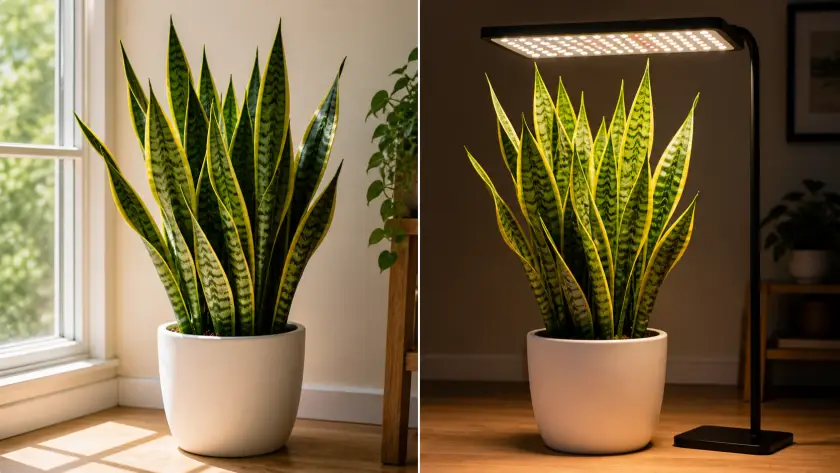
Sunlight is free and full-spectrum, and even a north window outdoors is far brighter than most lamps. But daylight changes with the season and weather, and many rooms simply do not get enough of it. Artificial light is steady and controllable, but it only helps when it is bright enough and close enough to the plant.
| Natural Light | Artificial Light | |
|---|---|---|
| Cost | Free | Fixture plus electricity |
| Consistency | Varies with season, weather and window | Same every day with a timer |
| Spectrum | Full spectrum | Depends on the bulb; full-spectrum LEDs come closest |
| Best use | Main light source wherever possible | Dark rooms, winter, shelves, herbs and seedlings |
Many growers use both: a bright window as the main source, with an LED topping up light in winter or for plants placed further into the room.
Using Grow Lights to Supplement Indoor Light
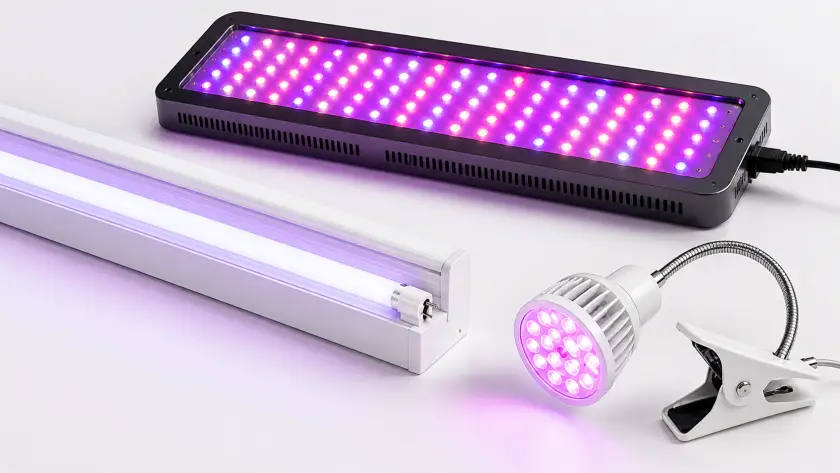
Grow lights are lamps made to give plants the light they use for photosynthesis. University of Minnesota Extension compares the main types:
- LED: very energy efficient, long-lasting, low heat and available in many styles. The best choice for most homes.
- Fluorescent: cheaper up front and still useful for seedlings and herbs, but less efficient than LEDs.
- Incandescent: inefficient and hot, and tends to make plants stretch. Not recommended.
Ordinary household bulbs are usually too dim, or too far away, to make a real difference. Iowa State Extension notes that standard fluorescent tubes can grow houseplants only when placed close to the leaves.
For a full guide to choosing types, colors and fixtures, see our dedicated guide to grow lights for indoor plants.
How to Use a Grow Light
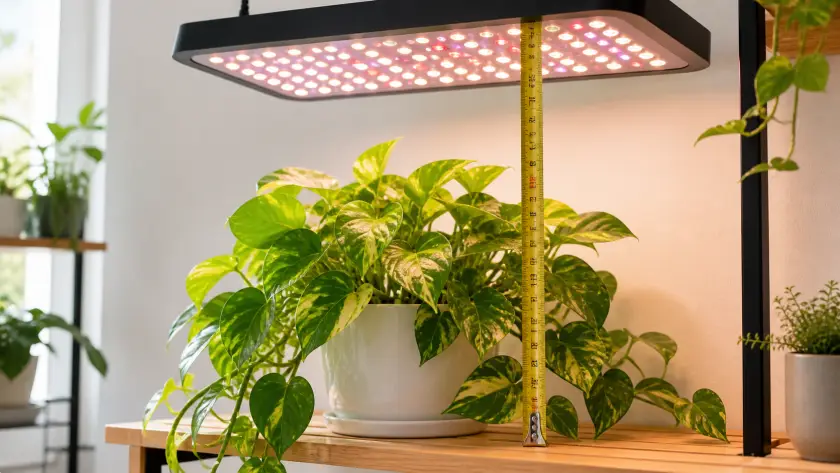
Distance and timing matter more than the label on the box. University of Minnesota Extension gives these starting points:
| Plants | Distance from Light | Hours per Day |
|---|---|---|
| Foliage houseplants | 12–24 inches | 12–14 |
| Flowering houseplants | 6–12 inches | 14–16 |
| Herbs and leafy greens | 6–12 inches | 12–14 |
| Seedlings | 4–6 inches, raised as they grow | 16–18 |
- Use a plug-in timer so the schedule stays consistent
- Give plants a dark period every night; they need rest too
- Choose white or full-spectrum LEDs for most plants; they suit all growth stages and look natural in a room
- Watch the leaves: bleaching means move the light up, stretching means move it closer
Growing Herbs Under Artificial Light

Culinary herbs are sun lovers, and most kitchen windowsills are too dim for them in winter, which is why supermarket basil often flops. A grow light 6–12 inches above the pots for 12–14 hours a day makes indoor herbs far more productive.
- Easiest under lights: basil, parsley, chives, mint and cilantro
- Need the most light: rosemary, thyme and oregano
Rosemary is particularly fussy indoors; our guide to growing rosemary indoors explains how to keep it healthy.
Matching Plants to the Light You Have
Low Light
No plant thrives in darkness, but a few cope with low light near a north window or deeper in a bright room: ZZ plant, snake plant, cast iron plant, pothos and some philodendrons. See our low light house plants, small low light indoor plants and plants for bathrooms with no windows. Our snake plant care guide explains why it is a top pick for dim spots.
Medium to Bright Indirect Light
This is where most popular houseplants are happiest, including monstera, pothos, peace lily and spider plants. Variegated and colorful foliage plants usually need the brighter end of this range to keep their color.
Bright Light and Direct Sun
Cacti, succulents, aloe, jade, citrus and herbs need your brightest window or a grow light. Our succulent care guide and cactus care guide explain how much sun they need.
Indoor Light Room by Room
- Living room: usually has the largest windows; place light lovers close to the glass and medium-light plants a few feet back. See our guide to styling indoor plants by room.
- Bedroom: often dimmer and cooler; choose low to medium-light plants. Our tips on decorating your bedroom with plants help.
- Home office: overhead lighting adds a little usable light for tolerant plants; see our office-friendly plants.
- Bathroom: humid but often dark; a window is a big advantage. See our best plants for your bathroom.
- Kitchen: a sunny sill is ideal for herbs, with a grow light in winter.
- Shelves and hanging baskets: often further from windows, so check light carefully; our low light hanging plants and trailing plants for shelves suit these spots.
Seasonal Changes in Indoor Light
Winter is the hardest season for houseplants. Days are shorter, the sun sits lower, and skies are often cloudy. CSU notes that a north window that gives medium light in summer may give only low light in winter, while a south window gets more direct sun in winter as the sun sits lower.
- Move plants closer to windows in autumn and winter
- Clean windows and wipe dusty leaves so more light reaches them
- Water less, because plants in low light use less water
- Add a grow light for plants that stall or stretch
- In summer, pull sensitive plants back from hot south and west windows
- Rotate pots every few weeks so growth stays even
Our complete watering guide explains how to adjust watering through the seasons.
Frequently Asked Questions
What kind of light do indoor plants need?
Most houseplants need bright to medium indirect light for about 12–14 hours a day. Cacti, succulents and herbs need direct sun, while a few tough plants tolerate low light near a north window.
What is medium light for plants?
Medium light is roughly 250–1,000 foot-candles. In practice, that is a few feet back from an east or west window, or close to a north window in summer, with little direct sun on the leaves.
Can normal light bulbs grow plants?
Ordinary room lighting is usually too dim to grow plants on its own. White LED or fluorescent lights can help if they are placed close to the plants, within about 12–24 inches, for 12–14 hours a day.
How do I know if my plant needs more light?
Look for long, thin stems leaning toward the window, small pale leaves, wide gaps between leaves, variegation fading to green, and no flowers. Move it closer to a window or add a grow light.
Which window is best for houseplants?
In the Northern Hemisphere, an east-facing window suits most houseplants. South and west windows suit sun lovers, while north windows suit low-light plants placed close to the glass.
Final Thoughts
Good indoor light is about matching each plant to the right spot. Learn how bright your windows really are, place plants close enough to use that light, adjust for the seasons, and add an LED where daylight falls short. Get the light right, and watering, feeding and flowering all become much easier.
Explore more plant care advice in our indoor plants collection.