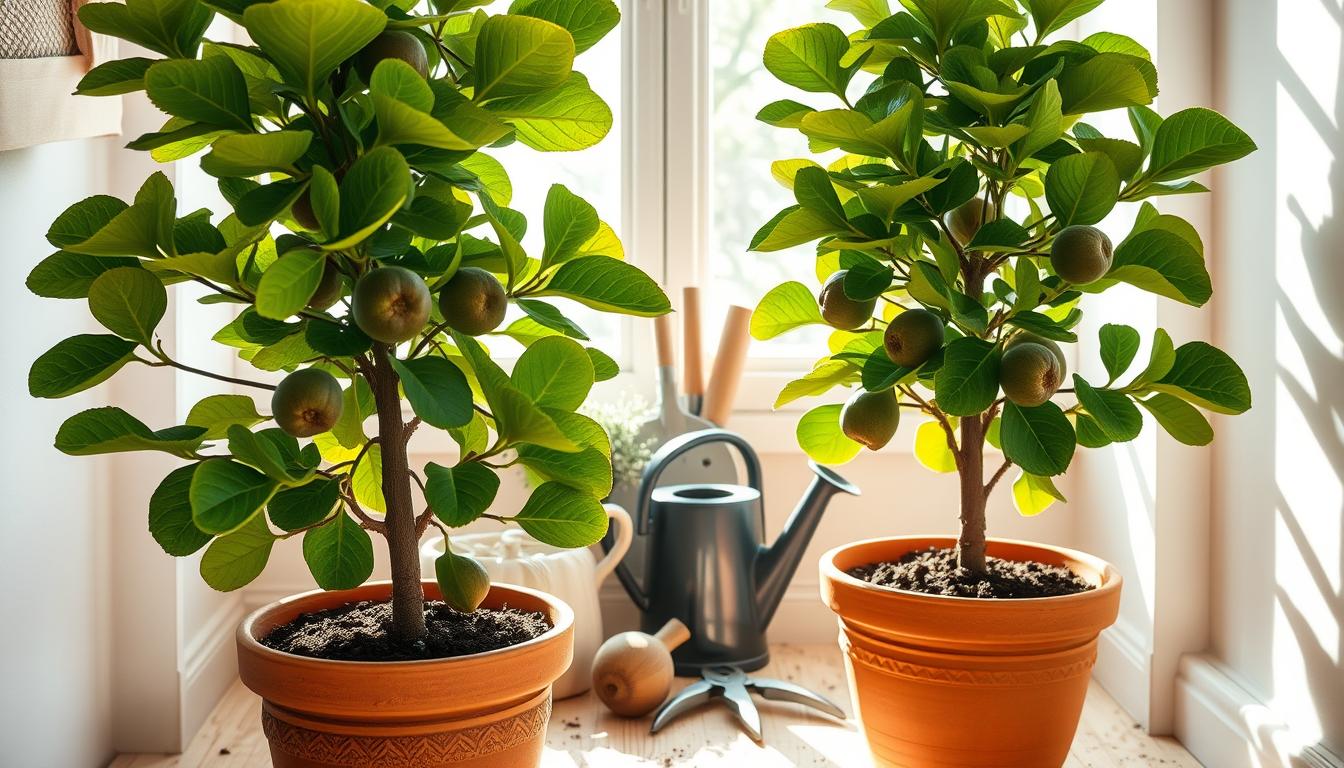
A fig in a pot is one of the most rewarding fruit trees for a patio or balcony, because a container actually helps it. Restricted roots push the tree to fruit instead of growing leaves. Good fig tree care in pots comes down to a sunny, sheltered spot, a gritty free-draining mix, even moisture in summer, and a cool, dormant winter.
I am Sawera Shahid, a botanist at Patch Plants. This guide covers choosing the pot and soil, light, watering, feeding, pruning, winter protection, why a fig may not fruit, and how to deal with leaf drop and fig rust disease. For more edible plants for small spaces, see our guide to easy outdoor edible plants.
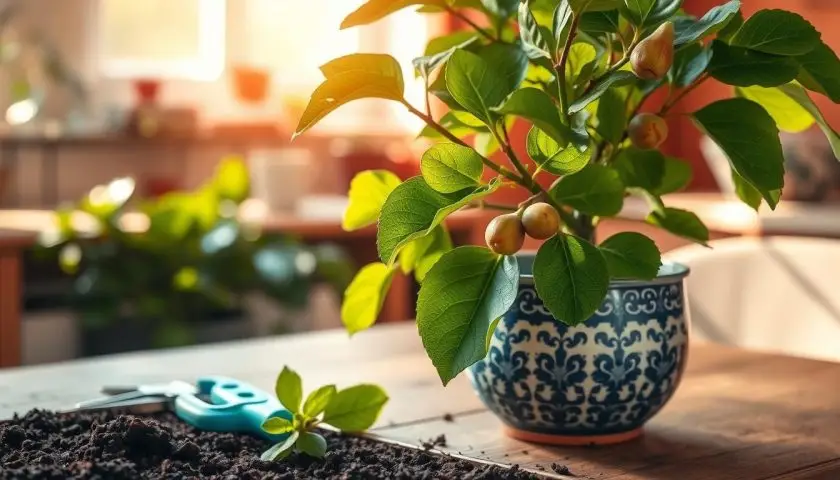
Fig Tree Care in Pots at a Glance
The Royal Horticultural Society (RHS) describes figs as needing a warm, sunny, sheltered spot to crop well. Container figs also need regular attention to moisture, because pots dry out quickly. This table summarises the essentials.
| Care Factor | What a Potted Fig Needs | Source Guidance |
|---|---|---|
| Pot | About 30cm (1ft) wide and deep to start, with drainage holes | RHS |
| Compost | Good-quality soil-based or soilless mix that drains well | RHS, UNH Extension |
| Light | Warm, sunny, sheltered spot; full sun in summer | RHS, UNH Extension |
| Water | Evenly moist in the growing season; never standing in water | RHS |
| Feeding | High-potassium liquid feed every two weeks until figs ripen | RHS |
| Winter | Unheated, frost-free space; very little water | RHS, Penn State Extension |
Choosing a Variety and Container for Fig Tree Care
Pick a variety suited to pots and to your climate. Clemson Cooperative Extension lists cold-tolerant cultivars for landscapes and containers, including ‘Violette de Bordeaux’, which stays comparatively small at about 2.7 feet in its table. Penn State Extension notes that ‘Chicago Hardy’ is the exception to its cold-damage limits, so it is a sensible choice where winters are harsh. Ask your nursery which varieties crop reliably in your area.
For the pot, the RHS suggests starting at about 30cm (1ft) wide and deep, with plenty of drainage holes. University of New Hampshire (UNH) Extension advises leaving about one to two inches between the roots and the container wall at planting, and moving up only as the roots fill the pot. Do not overpot. The RHS says restricting the roots encourages fruiting, while a pot that is too large mostly produces leaves.
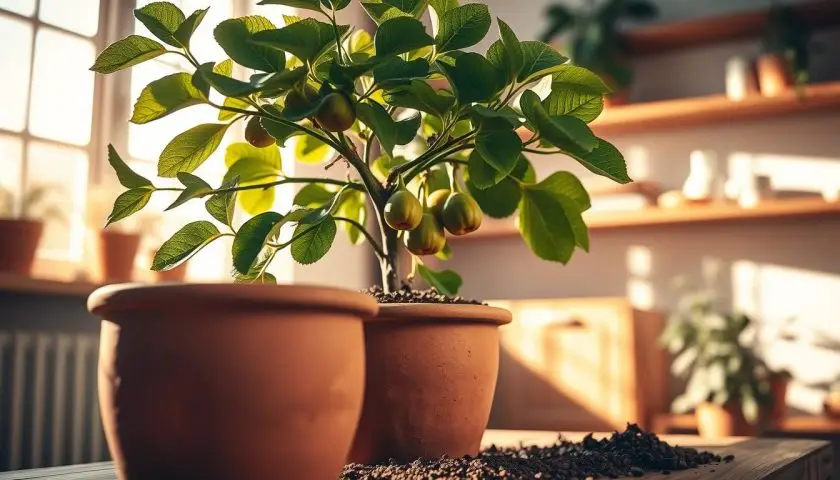
Soil Mix for Fig Tree Care in Containers
The RHS recommends good-quality, peat-free, soil-based compost, which it says lasts three to four years in a fig pot. UNH Extension suggests a quality soilless potting mix that is lightweight, holds moisture and provides air space around the roots, usually containing perlite or vermiculite. Avoid heavy garden soil in pots, because it packs down and drains poorly. For general guidance, read our soil mix guide.
Repotting is a once-in-a-while job. The RHS advises repotting every couple of years in March, moving to a pot only slightly larger. Once the tree is too big to handle, repot into the same pot, remove loose compost, trim the roots lightly, and topdress in the years between by replacing the top layer of compost. See also how to repot a plant.
Sunlight for Fig Tree Care
For reliable fig tree care, put your fig in the sunniest, most sheltered place you have. The RHS suggests a warm, sunny spot, ideally against a south-facing wall. UNH Extension says to move the tree to a full sun location after the last frost date, and to acclimate it by increasing its sun exposure gradually over a few weeks in spring. Keep it out of cold, exposed wind.
A fig is best treated as a patio tree that spends winter in a cool, unheated space, rather than as a living-room houseplant. The sources I checked cover moving a potted fig indoors only for winter dormancy, not for year-round indoor growing.
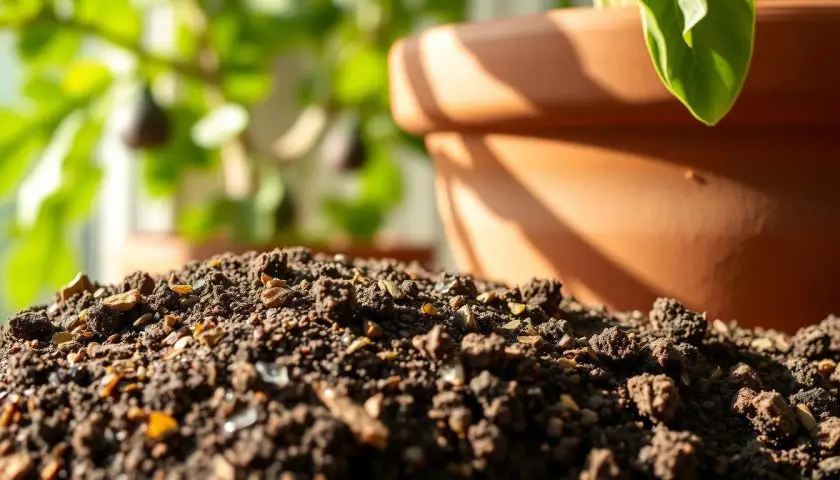
Fig Tree Care: Watering Schedule for Pots
Good fig tree care means skipping a fixed watering schedule and checking the pot instead. The RHS says to keep the soil evenly moist during the growing season, and warns that container figs dry out quickly, so check daily in hot, dry weather. UNH Extension suggests watering when the top one to two inches of mix are dry, until water drains from the bottom. The RHS also says not to let pots stand in trays of water, especially in winter.
| Problem | Typical Signs | Fix |
|---|---|---|
| Too dry | Yellowing, dropping leaves (Clemson lists drought stress) | Water thoroughly and check more often in heat |
| Too wet | Soggy mix, no drainage | Empty saucers, check drainage holes, let the top dry |
| Root-bound | Roots at the drainage holes, pot dries fast | Repot in March or trim roots |
Feeding in Fig Tree Care
The RHS advises an organic, high-potassium liquid fertiliser every two weeks during the growing season until the figs start ripening in late summer. A tomato feed fits this description. UNH Extension suggests a complete liquid fertiliser used at no more than the recommended rate and interval. Follow the label, and stop feeding when figs begin to ripen.
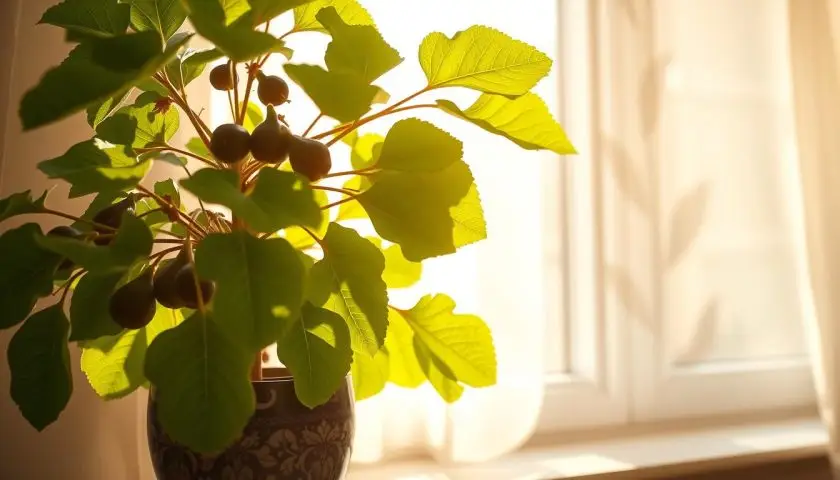
Pruning in Fig Tree Care
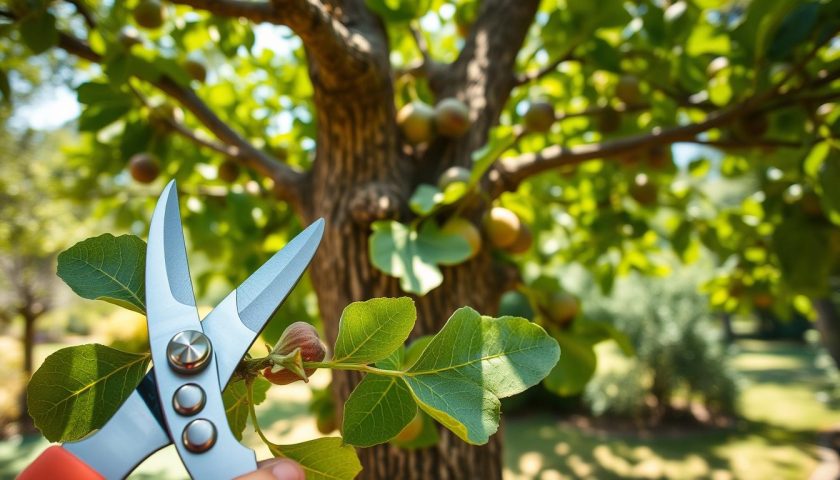
The RHS says to prune twice a year, in spring and early summer, to control size and encourage fruiting. In spring, cut back frost-damaged, crossing or weak branches and remove crowded ones entirely. In early summer, pinch out new shoots once they have five to six leaves. Wear gloves, because the sap irritates the skin.
Know where the fruit comes from before you cut. The RHS explains that pea-sized embryo figs form at shoot tips in late summer and overwinter, and these are the only figs likely to ripen outdoors. Larger figs that form on the current season’s growth in summer seldom ripen outside, and can be removed in mid-autumn. Protect the embryo figs from frost, and avoid heavy cuts that remove them. A dedicated guide on pruning will follow on Patch Plants.
Winter Fig Tree Care and Dormancy
A potted fig needs a cold, dormant rest, but not a hard freeze. Penn State Extension says that after a hard frost you can remove the remaining leaves and unripe figs and bring the container into an insulated, unheated space that is ideally dark, such as a garage or cool basement. It adds that figs need about 100 hours of chilling to fruit, so the plant should stay dormant until spring. The RHS suggests an unheated greenhouse, shed or porch, kept there until after the last frost in late spring.
- When to move it: when leaves begin to turn or before the first killing frost, according to UNH Extension.
- Watering: keep the mix barely moist so the roots do not dry out. Penn State Extension says about once a month, while UNH Extension says to water when the top two inches are dry, perhaps every week or two. Do not overwater.
- Cold limit: Penn State Extension says edible figs tolerate temperatures down to about 20°F and suffer serious damage below 15°F, except ‘Chicago Hardy’.
- Bringing it out: Penn State Extension says April. Check your own last frost date first.
Why a Potted Fig May Not Fruit
- Roots are not restricted enough. The RHS says unrestricted roots encourage leafy growth over fruit.
- The tree is young. Clemson Extension says young, vigorous plants may take three to four years to bear quality fruit, and advises stopping fertiliser if growth is excessive.
- Cool or poor summers. The RHS says ripening can fail in cooler locations or poor summers.
- Hot, dry weather before ripening. Clemson Extension notes this can cause fruit drop, and that mulch and supplemental watering help.
A fig is ripe when, according to the RHS, the skin feels soft, the fruit hangs limply, and it may split or produce a droplet of sugary liquid from the eye. Pick by holding the stalk and tearing it from the branch.
Leaf Drop Causes and Fig Rust Disease
Leaf drop in autumn is normal as the tree goes dormant. Out of season, look for these leaf drop causes:
| Symptom | Likely Cause | What to Do |
|---|---|---|
| Yellow leaves dropping in summer | Drought stress | Water deeply; check the pot daily in heat |
| Small raised reddish-brown spots under leaves | Fig rust disease | Clear fallen leaves; improve airflow |
| Leaves dying quickly in hot, wet weather | Leaf blight | Remove affected leaves; improve airflow |
| Leaves yellowing and falling in autumn | Natural dormancy | Move to a cool, unheated space |
Clemson Extension describes fig rust disease as appearing mainly on leaves in late summer, with small, raised, reddish-brown spots and a dusty golden-yellow spore mass on the undersides. Severely infected leaves turn yellow-brown and drop. Rust is usually not fatal, but repeated outbreaks weaken the plant. Clemson recommends removing fallen leaves in late autumn and pruning for better airflow, and says spraying is not warranted unless rust is an annual problem.
The RHS says figs are generally healthy, though scale insects and red spider mites can affect those grown under glass, and mealybug is also listed. See our guide to spider mites on plants if you spot webbing, and root rot if the mix stays wet.
Common Mistakes in Fig Tree Care
| Mistake | Why It Hurts | Better Practice |
|---|---|---|
| Using an oversized pot | Encourages leaves, not fruit, and holds excess water | Move up only slightly each time |
| Letting the pot stand in water | Roots sit wet, especially in winter | Empty saucers after watering |
| Overfeeding a young tree | Excess leafy growth | Follow the label; stop if growth is excessive |
| Cutting off the embryo figs | Removes next year’s crop | Prune lightly and know the fruiting wood |
| Leaving the pot out in a hard freeze | Frost damage to wood and fruitlets | Move to an unheated, frost-free space |
Frequently Asked Questions
How often should I water a potted fig tree?
Check the pot rather than following a calendar. Water when the top one to two inches of mix are dry, and check daily in hot weather. Never let the pot stand in water.
How do I protect a potted fig tree in winter?
After leaves drop, move it to an unheated, frost-free space such as a garage or shed, and keep the mix only slightly moist. Bring it out after the last frost in spring.
Why is my fig tree losing its leaves?
Autumn leaf drop is normal. In summer, causes include drought stress, fig rust disease and leaf blight. Check the underside of leaves for reddish-brown spots and clear fallen leaves.
When should I prune a fig tree in a pot?
The RHS says twice a year, in spring and early summer. Remove frost-damaged, crossing and weak branches in spring, and pinch out shoot tips in early summer.
Are fig trees safe for cats and dogs?
No. The ASPCA lists fig as toxic to dogs, cats and horses, with ficin and psoralen causing gastrointestinal and dermal irritation. Keep pets away, and call your vet if they chew the plant. The sap can also irritate human skin.
Final Thoughts
Fig tree care in pots rewards simple habits. As a botanist, my advice is to give it a sheltered, sunny spot, resist the urge to overpot or overwater, feed it with a potassium-rich fertiliser, and let it rest somewhere cool in winter. Patience matters too, since a young tree may need a few years to crop well. For more ideas, explore Patch Plants and our outdoor plants section.
Sources: RHS, How to grow figs; RHS, Figs: pruning and training; UNH Extension, Is it possible to grow an edible fig in a container?; Penn State Extension, Winterizing Your Fig Tree; Clemson Cooperative Extension, Figs; ASPCA, Fig.