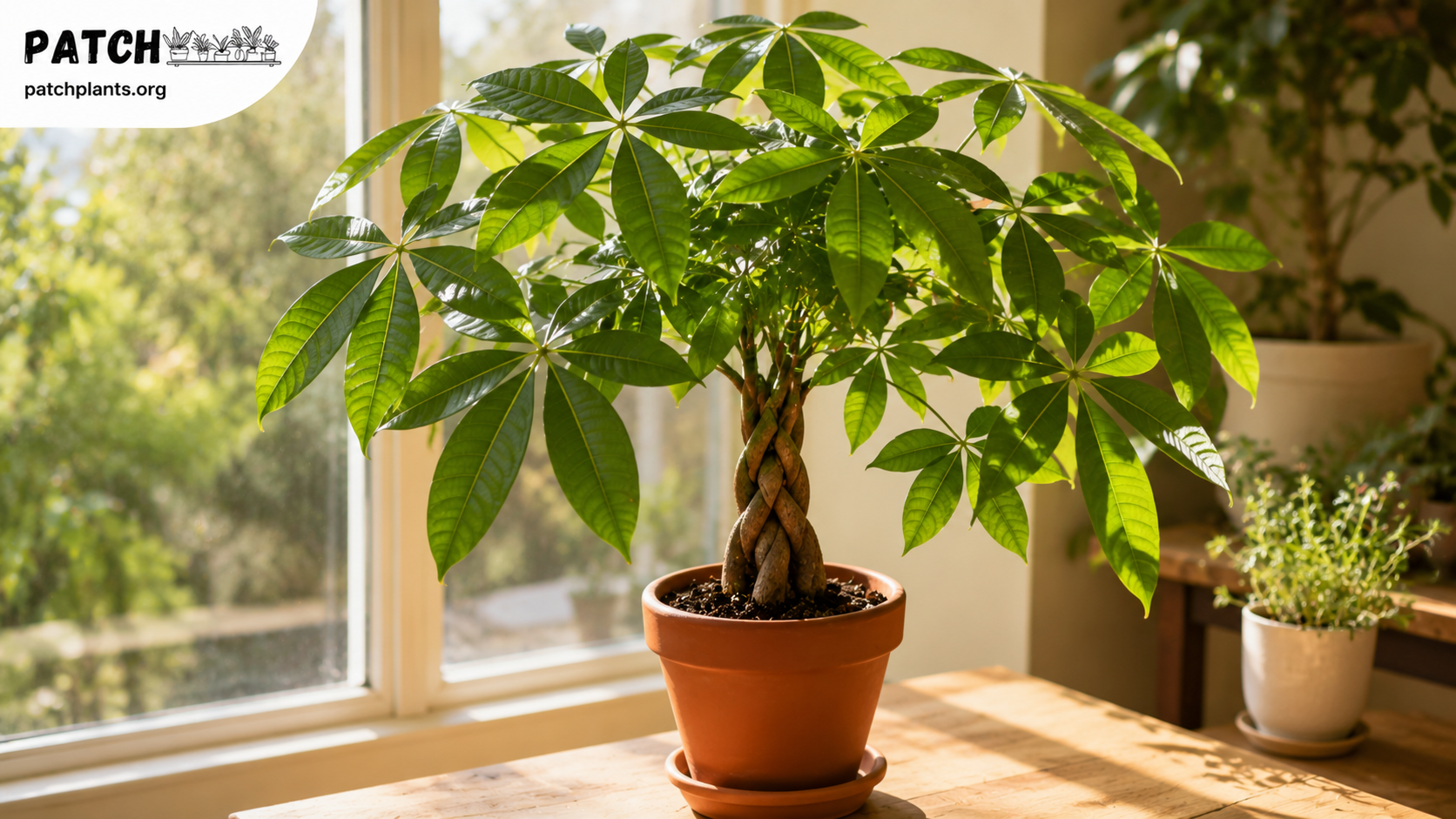
Money tree care is simple when you get three things right: bright indirect light, balanced watering, and good drainage. The money tree, Pachira aquatica, is a tropical plant known for its glossy, hand-shaped leaves and distinctive braided trunk. It can make an attractive addition to a living room, bedroom, or home office when its growing conditions are suitable.
To care for a money tree indoors, place it near a bright window away from harsh afternoon sunlight. Check the upper 1–2 inches of soil before watering, make sure the deeper root zone is not waterlogged, and empty any water collected beneath the pot. Keep the plant warm and protect it from cold drafts or direct heating and cooling airflow.
This complete guide covers 11 essential money tree care tips, including watering, lighting, potting soil, fertilizer, pruning, repotting, braided trunk care, and propagation. You will also learn how to identify the causes of yellow leaves, curling foliage, brown tips, leaf drop, and root rot.
Money Tree Care at a Glance
| Care Requirement | Best Practice |
|---|---|
| Botanical name | Pachira aquatica |
| Common names | Money Tree, Guiana Chestnut, Malabar Chestnut |
| Plant family | Malvaceae |
| Light | Bright indirect light; avoid sudden exposure to strong direct sunshine |
| Watering | Water when the upper soil has dried sufficiently, after checking deeper moisture |
| Soil | Moisture-retentive but well-draining indoor potting mix |
| Temperature | Approximately 65–80°F (18–27°C) indoors |
| Humidity | Moderate to higher indoor humidity |
| Fertilizer | Balanced houseplant fertilizer during active growth when needed |
| Pruning | Preferably spring or active growing season |
| Propagation | Suitable stem cuttings, air layering, or seeds |
| Pet safety | ASPCA lists Pachira aquatica as non-toxic to cats and dogs |
Key Takeaways
- Money tree care begins with bright indirect light and a potting mix that drains well while retaining some moisture.
- Check soil moisture before watering instead of automatically watering once a week.
- Money trees prefer warm, relatively stable conditions and should be protected from cold drafts.
- Yellow leaves, curling foliage, and drooping are symptoms with several possible causes. Check the soil and roots before making changes.
- Braided and unbraided money trees have similar care requirements, but braided stems should be inspected for restrictive ties or damage.
- Repot when the roots are crowded or the soil has deteriorated, not simply because another year has passed.
- Healthy stem cuttings can be used for propagation, although successful rooting takes time and depends on conditions.
- Money tree is different from jade plant. The ASPCA lists Pachira aquatica as non-toxic to cats and dogs, while jade plant is toxic.
What Is a Money Tree Plant?
The money tree is Pachira aquatica, a tropical tree in the mallow family, Malvaceae. It is native to tropical regions of Central and South America, where it grows in moist environments including areas near waterways.
In nature, money trees can grow into large trees. Indoors, they remain much smaller because of container size, lighting, growing conditions, and occasional pruning. A mature houseplant may reach several feet tall, depending on how it is managed.
The leaves are palmately compound, meaning several leaflets radiate from a central point. The number can vary, and healthy leaves commonly show five or more leaflets.
Commercial money trees frequently have braided trunks. Growers create these arrangements by weaving several young, flexible stems together. The braided appearance is ornamental and does not represent a separate species.
The North Carolina State Extension Gardener Plant Toolbox describes Pachira aquatica as a tropical tree that prefers indirect sunlight, moist but well-drained growing conditions, and protection from standing water.
Why Is It Called a Money Tree?
The money tree became associated with prosperity and good fortune through popular cultural traditions, including its use in Feng Shui-inspired arrangements. Braided trunks and the leaflets are sometimes interpreted as symbols of growth or abundance.
These meanings are cultural rather than scientific. Keeping a money tree cannot guarantee financial success, but it can be an attractive plant and a meaningful gift.
For plant symbolism and placement ideas, read our Feng Shui indoor plants guide.

How to Care for a Money Tree in 11 Essential Steps
1. Place Your Money Tree in Bright Indirect Light
Appropriate light is one of the most important parts of money tree care. The plant generally performs best near a bright window where it receives plenty of light without long periods of harsh direct sun.
An east-facing window may provide useful morning light. A south- or west-facing window can also work when the plant is set back from intense sunlight or protected by a sheer curtain.
The correct placement depends on your location, season, window size, outdoor shade, and distance from the glass. A plant several feet from a window may receive much less light than one positioned close to it.
Signs Your Money Tree Needs More Light
- Long, weak stems with widely spaced leaves
- Smaller new foliage than expected
- Slow growth during otherwise suitable growing conditions
- Strong leaning toward the nearest window
- Soil remaining wet for unusually long periods because water use is reduced
Signs of Too Much Direct Sunlight
- Pale or bleached patches on exposed leaves
- Brown, dry areas concentrated on the window-facing side
- Sudden damage after moving the plant closer to direct sun
If a money tree has been growing in shade, move it to brighter light gradually. Sudden exposure to intense sunlight can scorch foliage that has not acclimated.
The Royal Horticultural Society’s Pachira aquatica profile recommends bright light or partial shade for indoor cultivation.
For further help, read our indoor lighting guide.
2. Water Your Money Tree According to Soil Moisture
Money tree watering causes confusion because the plant originates from moist tropical environments but can develop root problems in poorly drained indoor containers.
The key is to provide moisture while allowing oxygen to remain available around the roots.
A practical starting point is to water when the top 1–2 inches (2.5–5 cm) of the growing medium become dry. However, this should not be treated as an automatic instruction if the deeper root zone remains very wet.
How to Water a Money Tree Correctly
- Check the upper growing medium with a finger or wooden skewer.
- For a large container, assess the moisture deeper in the root zone.
- If the medium has dried appropriately, water thoroughly and evenly.
- Continue until excess water begins draining from the bottom.
- Allow the pot to drain completely.
- Empty the saucer or decorative cover pot.
- Check the soil again before the next watering.
A small amount of water added every day may leave deeper roots inadequately hydrated while keeping the surface repeatedly wet. Thorough watering followed by appropriate drying is usually easier to manage.
How Often Should You Water a Money Tree?
| Growing Situation | Likely Effect | Watering Advice |
|---|---|---|
| Bright, warm room | Higher water use | Check soil more often |
| Cool, shaded room | Slower drying | Wait longer if the root zone remains moist |
| Small pot | May dry more quickly | Monitor container weight and soil moisture |
| Oversized plastic pot | May retain excess moisture | Check below the surface before watering |
| Winter growth slowdown | Reduced water demand | Water less frequently as conditions require |
No single weekly schedule works in every home. A money tree near a bright window may need water sooner than an identical plant in a cool, low-light location.
Signs of Underwatering
- Drooping foliage combined with very dry soil
- Lightweight container and dry root ball
- Loss of leaf firmness
- Dry growing medium pulling away from the pot edges
Signs of Excessive Moisture
- Several yellow leaves while the soil remains wet
- Softening near the lower stems
- Unpleasant smell from the root zone
- Dark, mushy, decaying roots
- Persistent wilting despite saturated soil
Important: Drooping leaves do not always mean a plant needs water. Waterlogged and damaged roots can also cause wilting because they cannot absorb moisture properly.
See our complete houseplant watering guide and signs of overwatering guide.
3. Use Well-Draining Money Tree Soil
The best soil for money tree care should retain enough moisture for a tropical plant while still draining freely.
Potting media that remain constantly saturated can reduce root aeration and contribute to root problems. A mix that dries out extremely quickly may be difficult to manage in warmer conditions.
Example Money Tree Soil Mix
- 2 parts quality indoor potting mix
- 1 part perlite or pumice for aeration
- 1 part fine pine bark or a suitable chunky amendment
This is a flexible starting recipe rather than a universal formula. Adjust the proportions according to the original mix, pot material, humidity, and watering conditions.
A commercial indoor potting mix may already drain well enough without modification. The most important qualities are reasonable moisture retention, aeration, and drainage.
Soil Problems to Watch For
- Growing medium staying saturated for unusually long periods
- Heavy compaction that reduces root aeration
- Water running around a very dry root ball without soaking it properly
- Rotting roots associated with poor drainage
Avoid using heavy outdoor garden soil in small indoor containers, where it may compact and drain poorly.
Our soil mix guide explains how different ingredients affect root conditions.
4. Choose the Right Pot and Drainage
The container is just as important as the soil. A money tree should have functional drainage holes so excess water can escape after watering.
Decorative cover pots are fine, but remove any collected water. Leaving a nursery pot sitting in water can damage otherwise healthy roots.
Terracotta vs. Plastic Pots
| Pot Type | Advantages | Considerations |
|---|---|---|
| Terracotta | Porous material can encourage moisture loss | May require more frequent checks in warm conditions |
| Plastic nursery pot | Lightweight and holds moisture longer | Needs careful watering in cool, shaded spaces |
| Glazed ceramic with drainage | Decorative and often stable | Drainage and pot size still matter |
| Decorative cachepot | Allows attractive presentation | Never leave standing water beneath the inner pot |
Choose a pot that accommodates the roots without surrounding them with an excessive volume of unused growing medium.
If you are repotting, use our Soil Calculator to estimate the potting-mix volume required. This calculator link is a supplementary planning tool; it does not replace checking the root system and selecting the correct pot.
5. Keep Money Tree Temperatures Warm and Stable
Money trees are tropical plants and generally prefer warm, stable indoor temperatures.
A practical range for many homes is approximately 65–80°F (18–27°C), although the plant’s response depends on its acclimation and growing conditions.
North Carolina State Extension identifies approximately 65–75°F as a suitable range and emphasizes protection from cold conditions.
Where Not to Place a Money Tree
- Directly beneath an air-conditioning vent
- Beside a heater or radiator
- Against cold window glass during winter
- Next to exterior doors that open frequently in cold weather
- In locations with rapid temperature fluctuations
If you move the plant outdoors for part of the warm season, gradually acclimate it to stronger light and bring it back inside before cold weather becomes a problem.
6. Provide Suitable Humidity Without Overwatering
Money trees appreciate moderately humid conditions, but many established indoor plants adapt to ordinary household humidity.
If indoor air becomes extremely dry, leaf tips may become brown or crispy. However, similar symptoms can also result from inconsistent watering, damaged roots, fertilizer salts, or heat stress.
How to Support Indoor Humidity
- Use a clean humidifier if the room is unusually dry.
- Measure humidity with a hygrometer rather than guessing.
- Keep the plant away from drying airflow.
- Group compatible houseplants together where space allows.
- Maintain normal ventilation and avoid keeping the foliage constantly wet.
Do not increase watering simply because the air is dry. Humidity concerns and soil moisture problems require different solutions.
For further tips, visit our indoor plant humidity guide.
7. Fertilize During Active Growth
Money trees can benefit from appropriate fertilizer during periods of healthy new growth, usually spring and summer in many indoor settings.
However, fertilizer cannot compensate for inadequate light, poor drainage, or unhealthy roots.
Simple Fertilizer Routine
- Choose a balanced houseplant fertilizer suitable for indoor foliage plants.
- Follow the product’s label instructions.
- Use an appropriate diluted application rate if recommended.
- Feed primarily when the plant is actively growing.
- Reduce or stop unnecessary feeding when growth slows.
- Avoid fertilizing a severely stressed or root-damaged plant.
Signs of possible fertilizer accumulation include white crusting on the growing medium and recurring leaf-tip damage. These symptoms have multiple causes, so review the entire care routine before assuming fertilizer is responsible.
8. Prune Your Money Tree to Maintain a Balanced Shape
Pruning can help manage height, remove damaged growth, and encourage branching.
Spring is generally a suitable time for more substantial pruning because plants are often entering a period of active growth.
How to Prune a Money Tree
- Examine the plant and decide which branches need shortening.
- Use clean, sharp pruning shears.
- Identify a healthy leaf node or suitable branching point.
- Make a clean cut just above that point.
- Remove clearly dead or damaged growth.
- Avoid removing excessive healthy foliage from a weak plant.
- Monitor new growth before making additional major cuts.
Do not cut through or attempt to separate an established braided trunk simply to change its shape. Focus on the canopy unless a specific damaged stem requires careful treatment.
For general techniques, see our pruning basics guide.
9. Repot Your Money Tree When Needed
Repotting is useful when roots become significantly crowded, the growing medium deteriorates, or the pot is no longer stable.
A plant does not automatically require a larger container every year. Some indoor money trees remain healthy in the same pot for an extended period.
Signs Your Money Tree May Need Repotting
- Roots filling most of the available container space
- Substantial root growth through drainage holes
- Unusually rapid drying caused by a crowded root system
- Potting mix breaking down and losing drainage
- A plant becoming top-heavy or unstable
Money Tree Repotting Steps
- Choose a container only modestly larger than the root ball.
- Make sure it has functional drainage holes.
- Prepare fresh, suitably draining potting mix.
- Remove the plant carefully while supporting the trunk and foliage.
- Inspect the roots for damage or decay.
- Keep healthy, firm roots intact as much as possible.
- Position the plant at approximately its previous growing depth.
- Fill around the root ball without heavily compacting the medium.
- Water appropriately and allow excess moisture to drain.
- Return the plant to stable, suitable indirect light while it adjusts.
Repotting can temporarily stress a plant. Avoid immediately combining major pruning, heavy fertilization, drastic light changes, and repotting unless necessary.
Read our complete repotting guide for additional instructions.

10. Inspect the Braided Money Tree Trunk
Braided money tree care follows the same lighting, watering, soil, and temperature principles as care for an unbraided Pachira aquatica.
The braided trunk is created by training several flexible young stems together. As the stems mature and become thicker, restrictive bands or ties can damage them.
How to Care for a Braided Trunk
- Inspect the lower braided stems periodically.
- Check for tight plastic ties, wires, or decorative bands.
- Remove or loosen accessible restrictive materials carefully when safe to do so.
- Do not force mature woody stems into a new braid.
- Watch for soft, blackened, or collapsing areas that may indicate damage or disease.
- Keep the root zone healthy because an attractive braid cannot compensate for failing roots.
Some braided specimens are composed of several individual plants sharing the same container. Their growth rates can differ, so one stem may become stronger than another.
Should You Continue Braiding a Money Tree?
You do not need to continue braiding to keep the plant healthy. New flexible stems may sometimes be trained carefully, but forcing older woody growth can cause serious damage.
If the existing braid is stable, it is usually better to leave the established structure alone and maintain the foliage with appropriate pruning.
11. Propagate a Money Tree From Healthy Stem Cuttings
Money tree propagation can be attempted using suitable stem cuttings. Professional propagation may also involve seeds or air layering.
For home growers, healthy stem material taken during an active growing period is often a practical starting point.
How to Propagate a Money Tree in Potting Mix
- Select a healthy stem with several leaves and visible nodes.
- Use a clean, sharp tool to take a suitable cutting below a node.
- Remove lower leaves that would be buried in the rooting medium.
- Prepare a small container with lightly moist, well-aerated propagation mix.
- Insert the cutting so that a suitable lower node is in contact with the medium.
- Place the container in warm conditions with bright indirect light.
- Maintain suitable moisture without leaving the cutting waterlogged.
- Provide humidity while allowing adequate airflow.
- Monitor for root growth and signs of new development before moving the plant to a larger pot.
Rooting success varies with cutting maturity, temperature, moisture, season, and growing conditions. Not every cutting will root, and a fixed number of days cannot be guaranteed.
Can You Propagate Money Tree in Water?
Water propagation is sometimes attempted, but roots formed in water may need time to adapt to a potting medium. Rooting directly in a suitable propagation mix is another option.
Whichever method you choose, use healthy stems and maintain cleanliness to reduce decay.
The RHS Pachira aquatica profile identifies cuttings, seeds, and air layering as propagation options.
For a broader explanation of stem cuttings and nodes, visit our houseplant propagation guide.
How to Tell if Your Money Tree Is Healthy
A healthy money tree normally has firm stems, green leaves, and roots that can absorb water without remaining saturated.
Healthy plants do not necessarily produce new leaves continuously throughout the year. Growth can slow when daylight decreases or temperatures change.
Healthy Money Tree Checklist
- Leaves are generally firm and appropriately colored.
- New growth appears during suitable growing periods.
- The trunk remains firm rather than soft or collapsing.
- Growing medium drains excess water.
- Roots are not severely crowded or decaying.
- No significant pest infestation is present.
- The plant is not experiencing repeated rapid leaf loss.
One older yellow leaf does not necessarily mean the entire plant is unhealthy. Look at the overall pattern of growth and symptoms.
Money Tree Yellow Leaves: Causes and Solutions
Money tree yellow leaves are a symptom that can have several causes. Excessively wet soil is important to investigate, but it is not the only possibility.
1. Excessive Soil Moisture
If several leaves turn yellow while the growing medium remains wet for a long time, review watering and drainage.
Check that the pot has drainage holes, the saucer is empty, and the roots are not sitting in saturated soil.
2. Insufficient Light
A money tree grown in an overly dark location may produce weaker foliage and use water more slowly. This can contribute to prolonged moisture retention and other problems.
Move the plant gradually toward brighter indirect light.
3. Natural Leaf Aging
Older lower leaves may occasionally turn yellow and fall as part of normal growth. If the rest of the canopy looks healthy, monitor the plant before making major changes.
4. Root Stress or Recent Repotting
Root disturbance may cause temporary yellowing or leaf drop. Check whether the plant was recently repotted, moved, or exposed to very different environmental conditions.
5. Pest or Nutrient Problems
Heavy infestations and nutrient imbalances can also affect foliage color. However, do not automatically fertilize a yellowing plant until moisture, light, roots, and pests have been checked.
For broader diagnosis, read our guide to why plant leaves turn yellow.
Why Are My Money Tree Leaves Curling?
Money tree leaves curling can result from underwatering, root damage, temperature stress, low humidity, excessive sunlight, or pests.
The first step is to check the potting medium.
- Curling with very dry soil: The plant may need water.
- Curling with saturated soil: Investigate possible root stress before watering again.
- Curling after direct sun exposure: Review leaf temperature and light intensity.
- Curling with fine webbing or stippling: Inspect for spider mites.
- Curling after moving the plant: Consider changes in temperature, light, and airflow.
Leaf curling is not a reliable diagnosis by itself. Compare the symptoms with soil moisture, root health, and recent environmental changes.
Why Is My Money Tree Losing Leaves?
Money tree leaf loss can occur after relocation, watering problems, exposure to cold drafts, inadequate light, pests, or root damage.
A few older leaves falling occasionally may be normal. Rapid shedding affecting multiple branches is more concerning.
How to Diagnose Sudden Leaf Drop
- Check whether the plant was recently moved.
- Inspect the soil for excessive dryness or saturation.
- Check for cold or hot airflow from vents.
- Look for pests beneath the leaves.
- Inspect the trunk and root zone if decline continues.
- Make measured corrections rather than changing every care factor at once.
Money trees can sometimes produce healthy new foliage after a stressful period when their roots and main stems remain viable.
Why Does My Money Tree Have Brown Leaf Tips?
Brown leaf tips may result from inconsistent watering, dry indoor air, fertilizer salts, temperature stress, or damaged roots.
Check whether the brown areas are dry and crispy, wet and spreading, or associated with other symptoms.
If the plant otherwise looks healthy, review the watering routine and environment before assuming a serious disease is present.
Existing brown tissue generally will not turn green again. The goal is to support healthy new foliage rather than restore damaged leaf edges.
How to Save a Money Tree With Root Rot
Root rot can develop when the root zone remains excessively wet or poorly aerated, allowing roots to deteriorate.
Warning signs include persistently wet soil, yellow leaves, wilting, soft lower stems, and decaying roots.
Step-by-Step Money Tree Root Rot Recovery
- Carefully remove the plant from its container.
- Inspect the roots for mushiness, collapse, or an unpleasant odor.
- Preserve firm, healthy roots, even when some are naturally tan or brown.
- Remove clearly rotted tissue using clean tools.
- Check whether any braided stem has become soft or damaged near the soil.
- Repot in a clean container with appropriate fresh potting mix and drainage.
- Adjust watering to the condition of the remaining root system.
- Provide suitable indirect light and stable temperatures.
- Monitor for recovery without applying excessive fertilizer.
Do not identify root rot based on color alone. Root texture, smell, and overall tissue condition are more useful indicators.
If the lower trunk is severely damaged but healthy upper stem material remains, attempting to propagate a suitable cutting may be an option.
For more detail, read our root rot identification and treatment guide.

Money Tree Problems: Quick Troubleshooting Table
| Symptom | Possible Cause | What to Check First |
|---|---|---|
| Yellow leaves | Excess moisture, low light, aging, root stress | Soil moisture and roots |
| Curling leaves | Dry soil, damaged roots, heat, pests | Moisture and leaf undersides |
| Brown tips | Dry air, moisture stress, fertilizer salts | Environment and watering history |
| Drooping leaves | Underwatering or waterlogged roots | Deeper soil moisture |
| Rapid leaf drop | Environmental change or root problems | Recent changes and drainage |
| Soft trunk base | Possible rot or physical damage | Stem tissue and root condition |
| Weak, stretched branches | Insufficient light | Actual illumination |
| Sticky leaves | Possible sap-sucking insects | Scale, mealybugs, and other pests |
Common Money Tree Pests and How to Handle Them
Money trees can be affected by several common houseplant pests, including spider mites, scale insects, mealybugs, and aphids.
Spider Mites
Spider mites can cause tiny pale marks on foliage and may produce fine webbing when infestations become established.
Mealybugs
Mealybugs look like small white, cotton-like insects, often appearing near leaf joints or along stems.
Scale Insects
Scale may appear as small bumps attached to stems or leaves. Some species produce sticky honeydew.
Aphids
Aphids may cluster around tender new growth and cause distorted leaves or sticky residue.
What to Do if You Find Pests
- Move the affected money tree away from other houseplants.
- Identify the insect before applying any treatment.
- Remove visible pests carefully where practical.
- Use a treatment specifically labeled for the pest and indoor plant application.
- Test sprays on a small area when appropriate.
- Repeat inspection to check whether the infestation is returning.
Do not use random household chemicals or highly concentrated homemade treatments on foliage. These can damage leaves and may be unsafe indoors.
The RHS lists scale insects, red spider mites, and aphids among potential pests of Pachira aquatica.
Money Tree Care by Season
Seasonal adjustments help maintain healthy growth because indoor light and water use change throughout the year.
Spring Money Tree Care
- Monitor new growth as daylight increases.
- Inspect roots and repot if necessary.
- Prune damaged or overly long branches.
- Begin appropriate feeding if the plant is actively growing.
Summer Money Tree Care
- Provide bright indirect light and protect leaves from harsh afternoon sun.
- Check moisture more frequently if the room becomes warm.
- Keep the plant away from strong air-conditioning airflow.
- Inspect for pests and abnormal leaf damage.
Autumn Money Tree Care
- Review watering as daylight and growth decrease.
- Reduce fertilizer if growth slows.
- Check the plant’s distance from cold windows.
- Avoid unnecessary major repotting when conditions are becoming less favorable.
Winter Money Tree Care
- Maintain adequate light, using suitable supplemental lighting if necessary.
- Check soil moisture carefully because the medium may dry more slowly.
- Protect the plant from cold drafts and heating vents.
- Avoid excessive fertilizer when growth is reduced.
- Monitor humidity if indoor heating makes the air unusually dry.
How Big Does a Money Tree Get Indoors?
A money tree can grow several feet tall indoors when given enough space and suitable conditions. NC State Extension notes that indoor specimens commonly remain around 6–8 feet or less, although actual size varies.
Pruning, container size, available light, and the individual plant’s growth habit affect how large it becomes.
If you want a compact money tree, manage growth with careful pruning and an appropriate container rather than repeatedly allowing it to become severely root-bound.
Where Should You Put a Money Tree in Your Home?
The best money tree location is one with appropriate light, temperature, and enough room for foliage development.
Living Room
Place the plant near a bright window where it receives filtered daylight. A money tree can serve as a focal point beside seating or shelves without obstructing movement.
Home Office
A money tree can look attractive near a bright office window. Keep the container stable and away from electronics that could be damaged during watering.
Bedroom
A bedroom may work if there is sufficient light and the plant is protected from cold drafts or direct vent airflow.
Entryway
Money trees are sometimes displayed near entrances because of their prosperity symbolism. Choose this placement only if the entry receives enough light and remains warm.
For Feng Shui meaning and room placement, visit our guide to Feng Shui indoor plants.
Money Tree vs. Jade Plant vs. Chinese Money Plant
Several indoor plants are sold with names that include “money.” They are not interchangeable, and their care requirements can be very different.
| Plant | Botanical Name | Best Light | Pet Safety |
|---|---|---|---|
| Money Tree | Pachira aquatica | Bright indirect | ASPCA lists as non-toxic |
| Jade Plant | Crassula ovata | Bright light and some sun | Toxic to cats and dogs |
| Chinese Money Plant | Pilea peperomioides | Bright indirect | ASPCA lists as non-toxic |
If you are shopping for a money tree, check the botanical label to make sure you are purchasing Pachira aquatica.
Our jade plant care guide explains how its requirements differ from those of the tropical money tree.
Is a Money Tree Toxic to Cats and Dogs?
The ASPCA lists Pachira aquatica as non-toxic to cats and dogs. This makes it a useful option for pet owners who want an indoor tree-like plant.
However, non-toxic does not mean edible or completely risk-free. Pets that chew large amounts of plant material may still develop gastrointestinal upset.
The ASPCA Money Tree toxicity profile identifies the species as non-toxic to dogs and cats.
Pet Safety Tips
- Confirm the botanical name on the plant label.
- Keep fertilizers, insecticides, and plant-care products away from pets.
- Prevent repeated chewing or digging in potting soil.
- Secure large containers that could fall over.
- Contact a veterinarian if a pet develops symptoms after eating plant material.
For related guidance, explore our cat-friendly plants guide and dog-friendly plants guide.
10 Common Money Tree Care Mistakes to Avoid
- Watering by the calendar: Check soil moisture first.
- Using a container without drainage: Roots need oxygen and protection from standing water.
- Keeping the plant in deep shade: Bright indirect light supports healthy growth.
- Moving it suddenly into intense sunlight: Acclimate gradually.
- Using an oversized pot: Excess growing medium may remain wet too long.
- Overfertilizing: More fertilizer does not correct poor light or root damage.
- Ignoring the braided trunk: Restrictive ties can damage expanding stems.
- Assuming yellow leaves always mean underwatering: Check the root zone.
- Repotting unnecessarily: Look for genuine signs of root crowding or soil deterioration.
- Changing several care conditions simultaneously: Make measured adjustments and monitor the response.
Money Tree Care Checklist
| Task | When to Check | What to Look For |
|---|---|---|
| Light | At placement and season changes | Bright indirect light without scorch |
| Soil moisture | Before watering | Upper soil dryness and deeper root-zone moisture |
| Drainage | After watering | No standing water in saucer or cachepot |
| Humidity | When conditions become dry | Dry air and other possible causes of leaf damage |
| Leaves | Regularly | Yellowing, curling, pests, dust |
| Braided trunk | Periodically | Restrictive ties, stem damage, softness |
| Fertilizer | During active growth if needed | Product directions and healthy root conditions |
| Repotting | When plant condition suggests it | Root crowding, unstable container, deteriorated mix |
Frequently Asked Questions About Money Tree Care
How do you take care of a money tree indoors?
Place Pachira aquatica in bright indirect light, use well-draining potting mix, and water when the upper soil has dried sufficiently. Allow excess moisture to drain, maintain warm conditions, and protect the plant from cold drafts and abrupt environmental changes.
How often should you water a money tree?
There is no reliable universal watering interval. Check the upper 1–2 inches of soil and make sure the deeper root zone is not still waterlogged. Water thoroughly when needed and empty any collected water. Frequency changes with light, temperature, pot size, growing medium, and season.
Why are my money tree leaves turning yellow?
Yellow leaves may result from excessive soil moisture, inadequate light, root stress, environmental changes, pest problems, or normal aging. If several leaves yellow while the soil remains wet, check drainage and roots before watering again.
Why are my money tree leaves curling?
Curling foliage may indicate underwatering, damaged roots, temperature stress, dry air, excessive sun exposure, or pests. Examine soil moisture and recent changes first. Curling alone does not prove the plant needs more water.
Is a money tree toxic to cats or dogs?
The ASPCA lists the money tree, Pachira aquatica, as non-toxic to cats and dogs. However, pets may still experience stomach upset after eating plant material. Do not confuse the money tree with jade plant, which is toxic to pets.
Final Thoughts on Money Tree Care
Money tree care is easiest when you focus on the plant’s real needs instead of trying to follow a rigid schedule. Provide bright indirect light, appropriate soil moisture, drainage, warmth, and a stable environment.
When yellow leaves, curling, brown tips, or drooping appear, check soil moisture and roots before adding more water or fertilizer. A careful diagnosis is more useful than treating every symptom the same way.
With appropriate pruning, occasional repotting, regular pest checks, and careful attention to its braided trunk, Pachira aquatica can remain an attractive indoor plant for many years.
For more plant-care guidance, explore our best indoor plants for beginners, complete watering guide, and Feng Shui plant placement guide.