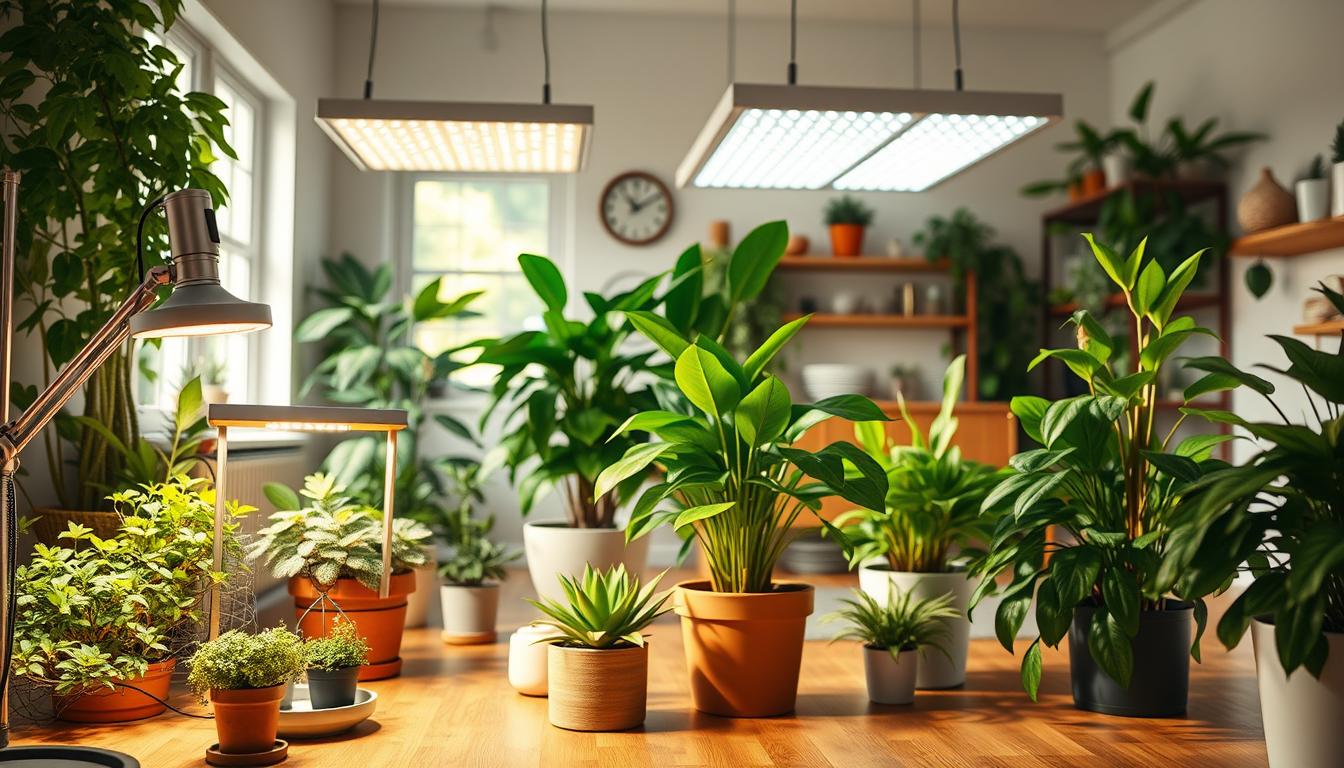
The best grow lights for indoor plants for most homes are full-spectrum white LED lights, either screw-in bulbs, strip lights or panels, placed about 15–30 cm (6–12 inches) above small and medium plants and run for 12–14 hours a day on a timer. Match the strength of the light to the plant: low-light foliage plants need far less than herbs, succulents or flowering plants. Watch new growth and adjust the height or hours one step at a time.
Grow lights make it possible to grow healthy plants in dim rooms, north-facing flats, basements and offices, and to get plants through short winter days. This guide explains how plants use light, when you need a grow light, how to choose one, how far away and how long to run it, how to set it up safely, and how to fix common problems.
At Patch Plants, botanist Sawera Shahid often hears from readers whose plants are “dying for no reason” when the real problem is simply too little light. A grow light is not a luxury for serious collectors; for many homes it is the single most useful plant-care tool. You can read more about how our guides are written on the About Patch Plants page.
Key Takeaways
- Full-spectrum white LEDs are the best all-round choice: efficient, cool-running and pleasant to live with.
- Most grow lights work best 15–30 cm above the plant tops; fluorescent tubes need to be closer, at about 10–15 cm.
- Run lights for about 12–14 hours a day on a timer, and always give plants a dark period.
- Brightness at the leaf matters more than watts or lumens; check the manufacturer’s PPFD chart if one is given.
- Low-light foliage plants need much less light than herbs, succulents, seedlings and flowering plants.
- Stretching means too little light; bleaching or crisp patches mean too much or too close.
- Keep cords and plugs away from water, and change one setting at a time.
How Light Affects Indoor Plant Growth
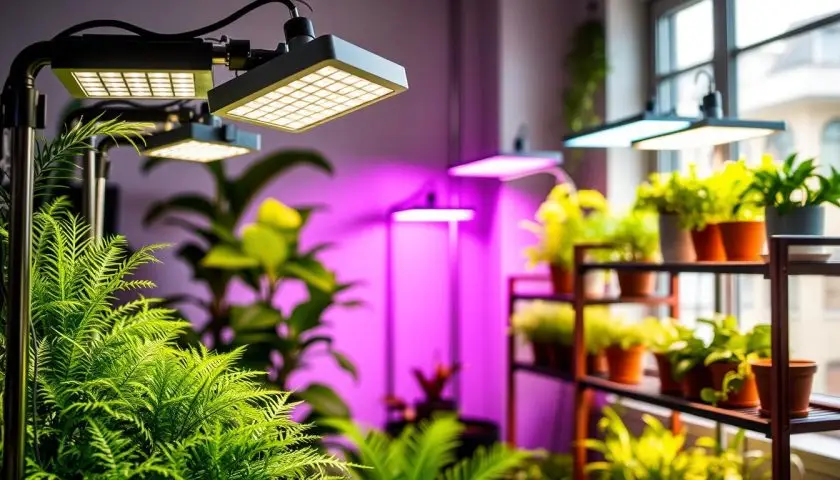
Plants use light to make food through photosynthesis. The part of the light spectrum they use, roughly 400–700 nanometres, is called photosynthetically active radiation (PAR). Blue and red light drive photosynthesis most efficiently, but plants use green light too, which is why balanced full-spectrum white light grows healthy plants and looks natural in a room.
Three things decide how much light a plant actually gets:
- Intensity: how bright the light is at leaf level. It falls off quickly with distance, so moving a light even a little further away noticeably reduces the light reaching the leaves.
- Duration: how many hours a day the light is on.
- Coverage: whether the light reaches all of the plant, including lower leaves and plants at the edge of a shelf.
Intensity multiplied by hours gives the daily light dose, sometimes called daily light integral (DLI). A weak light left on longer can help a little, but it cannot fully make up for light that is far too dim, and plants still need a dark period every night.
Signs Your Plant Needs More Light
- Stems stretching toward the window, with long gaps between leaves (etiolation).
- New leaves smaller or paler than older ones; variegated plants turning plain green.
- Slow or no growth in spring and summer, and no flowers on flowering plants.
- Soil staying wet for a long time after watering, because the plant is using little water.
Signs of Too Much Light
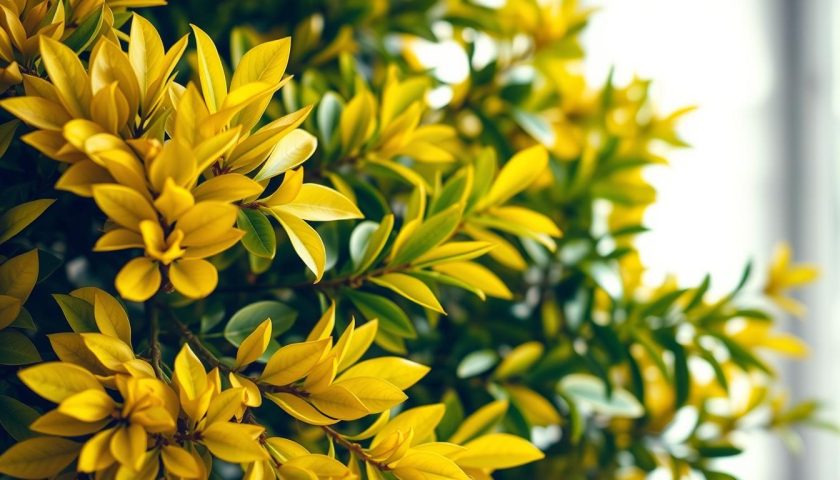
- Bleached, yellow-white or pale patches on the leaves facing the light.
- Crispy brown scorch marks, or leaves curling away from the light.
- Soil drying out unusually fast under the fixture.
For a full explanation of light levels at home, see our complete guide to indoor light.
When Do You Need a Grow Light?
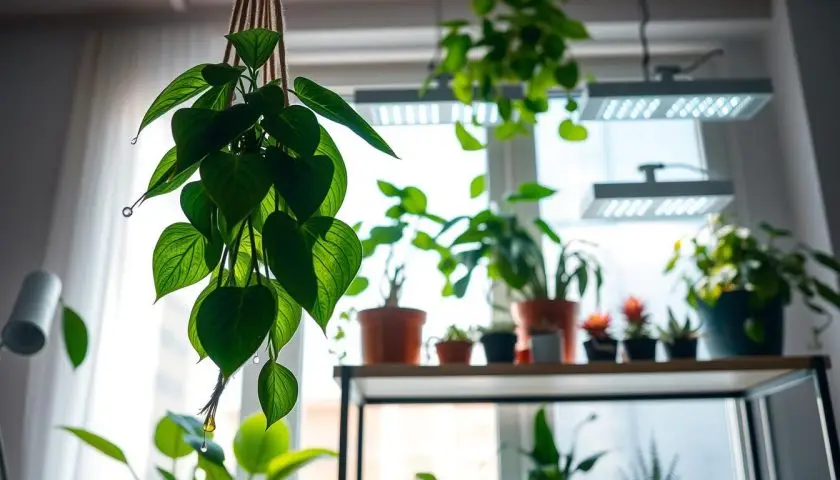
Light drops sharply a few metres from a window, so a corner that looks bright to us can be very dim for a plant. A grow light is worth adding when:
| Situation | Typical light level | What to do |
|---|---|---|
| Bright south- or west-facing window | High | Usually no grow light needed, except perhaps in winter |
| East- or north-facing window | Medium to low | Add a light for high-light plants and in winter |
| 2–3 metres or more from a window | Low | Grow light recommended for most plants |
| Windowless room, basement or office | Very low | Grow light needed as the main light source |
| Winter in northern countries | Low and short days | Add 4–6 hours of supplemental light |
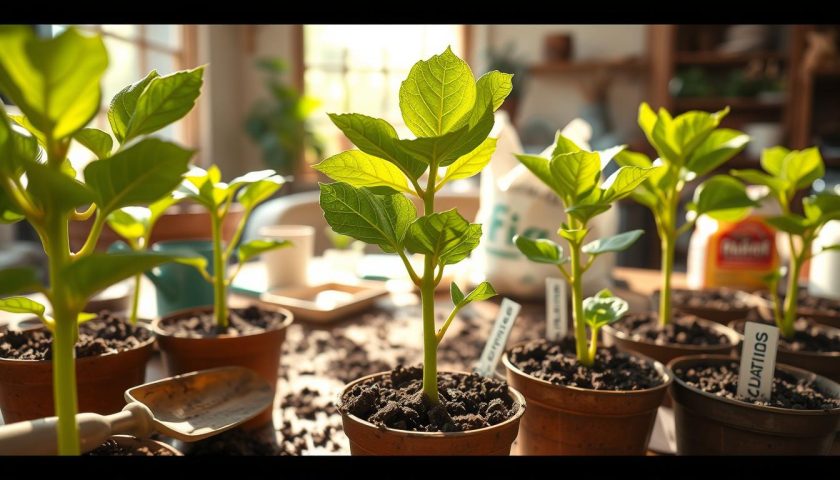
| Seedlings, herbs, succulents indoors | Need high light | Use a dedicated grow light close to the plants |
If you would rather not use a light, choose plants that cope with dim spots; see our guides to low-light houseplants, small low-light indoor plants and plants for a bathroom with no window. Even these grow better with some extra light.
How to Choose a Grow Light
Assess Your Space First
- Measure the area you need to light, such as a shelf, a tabletop or a single floor plant, and the height between the plant tops and where the light will hang.
- Group plants by light need so high-light plants share one light and low-light plants another.
- Check power access so you can use a timer without long cables trailing across floors or past watering areas.
- Think about looks: in a living room, a warm-white bulb in a lamp or a slim strip under a shelf blends in far better than a purple panel.
Types of Grow Lights
| Type | Best for | Heat | Efficiency |
|---|---|---|---|
| LED bulbs (screw-in) | One or two plants, in an existing lamp or spotlight | Low | High |
| LED strips and bars | Shelves, cabinets, under-cupboard herbs | Low | High |
| LED panels | Large collections, seedlings, high-light plants | Low to moderate | High |
| Fluorescent tubes (T5/T8) | Seed trays and propagation shelves | Low to moderate | Medium |
| Ordinary household LED bulbs | Low-light foliage plants close to the bulb | Low | Medium for plants |
For most homes, full-spectrum white LED lights are the best choice. They use little electricity, run cool, last for years and make plants look natural. Red-and-blue “blurple” lights grow plants well but give an odd purple glow that makes it hard to spot pests or problems, so they suit spare rooms better than living spaces.
Fluorescent tubes still work well. Iowa State University Extension notes that an ordinary fixture with two fluorescent tubes, kept about 4–6 inches (10–15 cm) above the plants and run for 12–14 hours a day, provides adequate light for houseplants.
What the Numbers Mean
- Watts measure electricity use, not how much light the plant gets.
- Lumens measure brightness as the human eye sees it; useful for comparing similar white lights, but not designed for plants.
- Colour temperature (K): 4000–6500K looks like daylight and suits foliage; 2700–3000K warm white looks cosier and still grows plants. Full-spectrum lights often sit around 3500–5000K.
- PPFD (photosynthetic photon flux density, in µmol/m²/s) measures the usable light actually reaching a surface. Good manufacturers publish a PPFD chart at different heights; this is the most useful figure when choosing and positioning a light.
As a rough guide, low-light foliage plants are happy at about 50–150 µmol/m²/s, typical foliage houseplants at about 100–250, and herbs, succulents and flowering plants at 300 or more. Seedlings grow strong at around 150–300.
How Far Should a Grow Light Be From Plants?
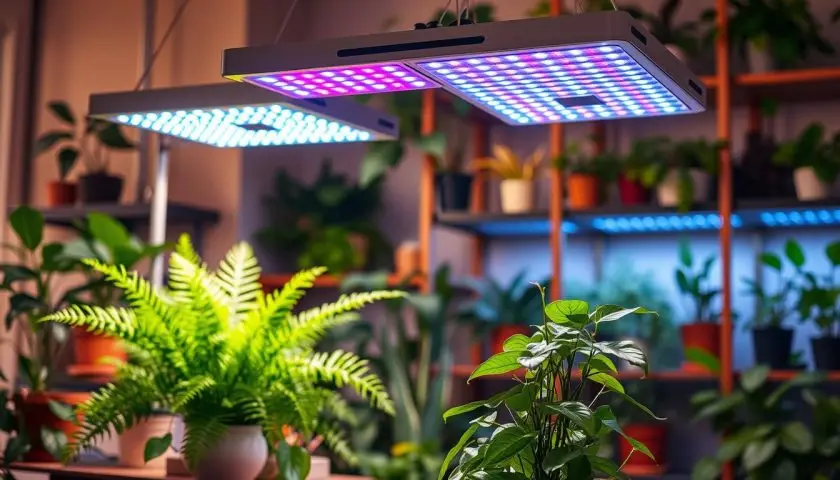
Always measure from the light to the top of the plant (the canopy), not to the pot or the shelf. The right distance depends on how strong the light is, so start with the manufacturer’s recommendation and use these as general starting points:
| Light type | Seedlings | Foliage houseplants | Herbs, succulents, flowering plants |
|---|---|---|---|
| Fluorescent tubes | 5–10 cm (2–4 in) | 10–15 cm (4–6 in) | 5–10 cm (2–4 in) |
| LED bulbs and strips | 10–20 cm (4–8 in) | 15–45 cm (6–18 in) | 10–30 cm (4–12 in) |
| Higher-power LED panels | 30–60 cm (12–24 in) | 45–90 cm (18–36 in) | 30–60 cm (12–24 in) |
- Stretching or pale new growth: move the light closer or choose a stronger light.
- Bleaching or scorched leaves: raise the light or dim it.
- Uneven growth: centre the light, add a second fixture or turn the pots weekly.
- Plants grow: raise the light to keep the same distance.
A plant light meter, or a light-meter app as a rough guide, helps find dark spots on a shelf and shows how quickly light drops as you move the fixture.
How Long to Leave Grow Lights On
Use a plug-in timer or smart plug so the lights switch on and off at the same time every day. Consistency matters more than the exact number of hours.
| Plants | Grow light as main light source | Grow light added to a window |
|---|---|---|
| Low-light foliage plants | 10–12 hours | 4–6 hours, mainly in winter |
| Most foliage houseplants | 12–14 hours | 4–6 hours, morning or evening |
| Herbs and succulents | 14–16 hours | 6–8 hours |
| Seedlings | 14–16 hours | Usually used as the main source |
Do not run grow lights for 24 hours: plants need a dark period, and continuous light can cause leaf damage in some species. Some flowering plants, such as poinsettias and Christmas cactus, need long, completely dark nights in autumn to flower, so keep them away from evening lights then; see our poinsettia care guide and Christmas cactus care guide.
Plants under brighter light grow faster and use more water and nutrients, so check the soil more often after you add a grow light. Our complete watering guide explains how to adjust.
Best Plants to Grow Under Lights
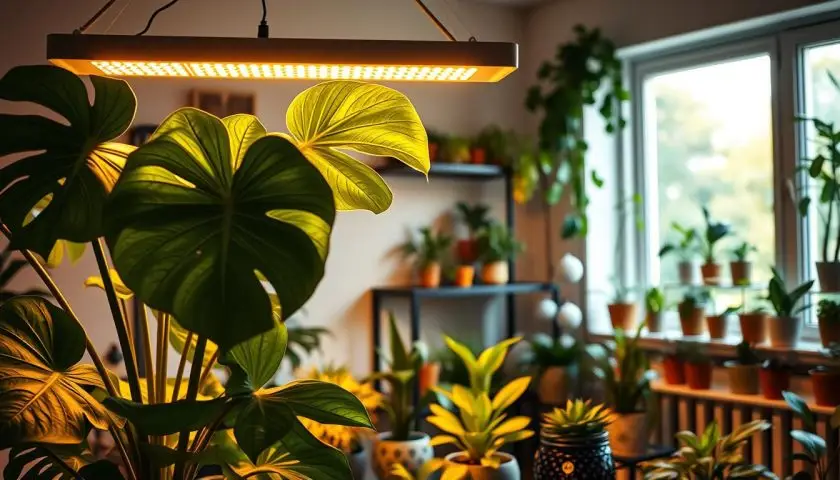
- Easy foliage plants: pothos, ZZ plant, snake plant and philodendron grow well under a simple LED bulb or strip.
- Light-hungry tropicals: monstera and fiddle leaf fig grow fuller, bigger leaves under a stronger light in a dim room.
- Succulents and cacti: most stretch indoors in winter without strong light; see our succulent care guide and cactus care guide.
- Kitchen herbs: basil, parsley and chives need bright light for 14–16 hours to stay compact.
- Shelf displays: slim LED strips under shelves keep trailing plants full; see our guide to trailing plants for shelves and bookcases.
Grow lights are also ideal for desks and offices; our guides to office plants that survive fluorescent lighting and improving your home office with plants have more ideas.
How to Set Up Grow Lights Safely
- Secure the fixture: use hooks, chains or clamps rated for its weight, and check clamps regularly so lights cannot fall.
- Keep water away from electrics: place plugs, extension leads and timers above or away from where you water, and leave a “drip loop” in cables so water runs off rather than into sockets.
- Don’t overload sockets: check the total wattage against the rating of your extension lead or power strip.
- Allow airflow: even LEDs produce some heat. Leave space around fixtures and avoid sealing lights inside closed cabinets without ventilation.
- Protect your eyes: avoid staring into bright LEDs, and angle lights so they don’t shine into living areas.
- Buy certified products with the appropriate safety marks for your country (such as UKCA/CE or UL).
White walls, shelves or reflective film can bounce more light onto plants, but don’t block airflow around the fixture.
Troubleshooting Grow Light Problems
| Symptom | Likely lighting cause | What to do |
|---|---|---|
| Long, stretched stems | Light too weak or too far | Move closer or use a stronger light |
| Bleached or scorched leaves | Light too strong or too close | Raise or dim the light |
| Plants leaning or lopsided | Uneven coverage | Centre the light or turn pots weekly |
| Lower leaves yellowing and dropping | Lower canopy shaded | Add side lighting or prune to open the plant |
| Slow growth despite good distance | Too few hours or a weak light | Increase hours gradually, up to 14–16 |
| Soil drying very fast | Heat or very strong light | Raise the light and water more often |
Change only one thing at a time, such as height or hours, and wait a week or two to see how new growth responds. Not every problem is about light: yellow leaves, brown tips and drooping can also come from watering, pests, temperature or root problems. Our guides to why leaves turn yellow and leaf curl, browning and droop help you rule out other causes.
Common Grow Light Mistakes
- Using a decorative bulb too far away: an ordinary lamp across the room gives plants very little usable light.
- Placing a strong panel too close: this bleaches leaves; follow the manufacturer’s height chart.
- Lighting only the top of the plant: lower leaves yellow and drop.
- Leaving lights on all the time: plants need darkness every day.
- Forgetting to adjust watering: plants under lights often need water more often.
- Treating every plant the same: a cactus and a fern need very different light levels.
Frequently Asked Questions
What is the best grow light for indoor plants for beginners?
A full-spectrum white LED grow bulb in an adjustable desk lamp or clamp lamp, or an LED strip for a shelf, is the easiest place to start. They are affordable, run cool, use little electricity and look natural in a room.
How far should a grow light be from plants?
Most LED bulbs and strips work well about 15–30 cm (6–12 inches) above foliage plants, while stronger LED panels usually sit 30–60 cm or higher. Fluorescent tubes need to be closer, about 10–15 cm. Always check the manufacturer’s guidance and adjust if plants stretch or bleach.
How many hours a day should grow lights be on?
About 12–14 hours a day suits most houseplants when the grow light is their main light source. Herbs, succulents and seedlings do well with 14–16 hours. If the light is supplementing a window, 4–6 extra hours is usually enough. Never leave lights on for 24 hours.
Can a normal LED bulb work as a grow light?
A bright, ordinary white LED bulb can keep low-light foliage plants healthy if it is placed close to them, roughly 15–30 cm away, for 12 or more hours a day. For herbs, succulents, seedlings or flowering plants, a dedicated grow light gives much better results.
Do grow lights use a lot of electricity?
Not usually. A small LED grow bulb or strip typically uses around 10–40 watts. Running a 20-watt light for 12 hours a day uses about 0.24 kWh, so it costs only a few pence or cents a day, depending on your electricity price.
Final Thoughts
A good grow light turns dim corners, dark winters and windowless rooms into places where plants can thrive. Choose a full-spectrum LED that suits your space, place it at the right height, run it on a timer for 12–14 hours a day, and watch how new growth responds. Adjust one step at a time, and your plants will grow fuller, greener and stronger all year. If you are just starting out, our guide to the best indoor plants for first-time plant parents suggests easy plants to pair with your first grow light.