The short version of succulent care: give them bright light, a fast-draining gritty mix, and a deep soak only after the soil has dried out completely. Most succulents die from too much water, not too little, so when in doubt, wait another few days. Everything below builds on those three succulent care rules, then covers the specific needs of popular varieties, propagation, pet safety and the problems that trip people up.
I am Sawera Shahid, a botanist at Patch Plants, and I have grown succulents on sunny sills and in dim corners alike. The difference between a plant that thrives and one that rots almost always comes down to the habits below.
What Makes Succulents Different
Succulents store water in thick leaves, stems or roots, which is how they survive long dry spells in places like Mexico, South Africa and Madagascar. That storage is also their weakness at home. Roots that sit in damp soil cannot breathe, and they rot long before the leaves show a problem.
So good succulent care is really about copying a dry climate: strong light, sharp drainage, and a wet-then-dry watering rhythm. Cacti are a specialised branch of the succulent family, and their needs are close enough that our cactus care guide pairs well with this one.
Light for Succulent Care
Most succulents want as much bright light as you can give them. Iowa State University Extension recommends ten or more hours of bright, indirect light, and says most need at least six to eight. The RHS says the same thing in simpler words: put them on a sunny windowsill all year round.
- A south or west window is best for sun lovers such as echeveria and jade.
- Haworthia and similar small rosette types cope with less light and suit an east window or a brighter spot a little back from the glass.
- Rotate the pot every week or two so growth stays even.
- If stems stretch and the colour fades, the plant is reaching for light. Move it closer or add a grow light.
If you are unsure how much light your room actually gets, our indoor light guide shows how to judge it.
Watering: The Soak and Dry Method
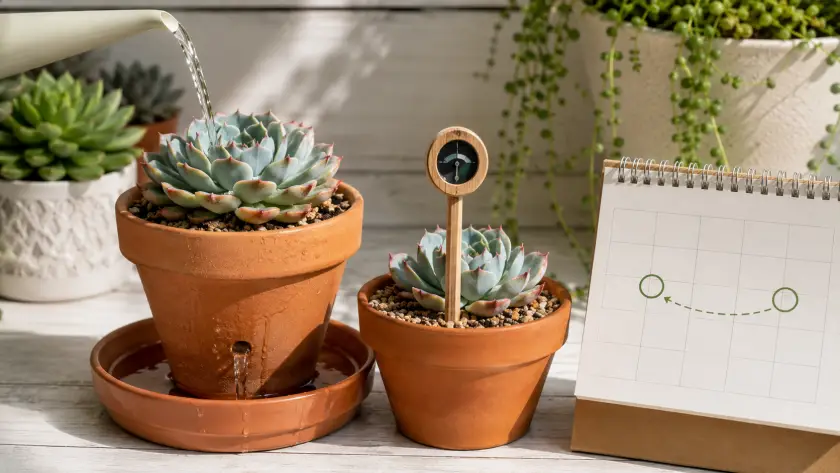
Water thoroughly until it runs out of the drainage hole, then leave the plant alone until the soil is completely dry. Iowa State suggests starting at roughly every two to three weeks and adjusting for your conditions, because pot size, light and temperature all change how fast the soil dries.
- Push a finger or a wooden skewer to the bottom of the pot. If anything feels damp, wait.
- Water slowly around the base, not over the leaves or into the rosette centre.
- Let the pot drain fully and empty any saucer within a few hours.
- In winter, water far less. The RHS advises minimal or no watering through the cool rest period, roughly November to early March.
Your plant will tell you how it feels. Succulent care is easier once you read the signs: wrinkled, soft lower leaves usually mean thirst, while yellow, translucent leaves and a mushy stem mean too much water. Our guide to overwatering signs and the wider watering guide go deeper.
Soil and Pots for Succulent Care
Ordinary potting soil holds too much moisture. Use a cactus and succulent mix, or make your own with roughly one part organic matter to two parts mineral material such as perlite, pumice or coarse sand, the ratio Iowa State gives. The RHS suggests adding up to 30 per cent grit or fine gravel to a bought compost.
Choose a pot with a drainage hole, and keep it just big enough for the roots. Extra soil stays wet longer and invites rot. Terracotta helps because it breathes and dries faster than glazed ceramic or plastic. For recipes and ratios, see our soil mix guide, and our repotting guide shows the process step by step. Repot in spring when the roots have filled the pot.
Temperature and Feeding for Healthy Succulents
Most succulents are comfortable between about 55 and 75°F (13 to 24°C), and some tolerate roughly 45 to 85°F, according to Iowa State. A cooler winter rest, around 8 to 10°C (46 to 50°F) per the RHS, helps many types flower and keeps growth compact. Keep them away from radiators and cold glass.
Feed only in spring and summer. Use a general fertiliser at half to a quarter of the label rate, or a cactus feed as directed, and skip feeding in winter.
Succulent Care by Variety
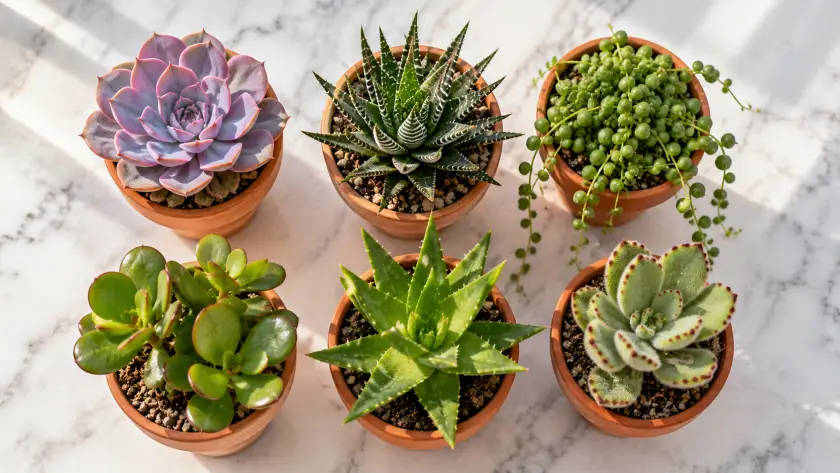
Echeveria
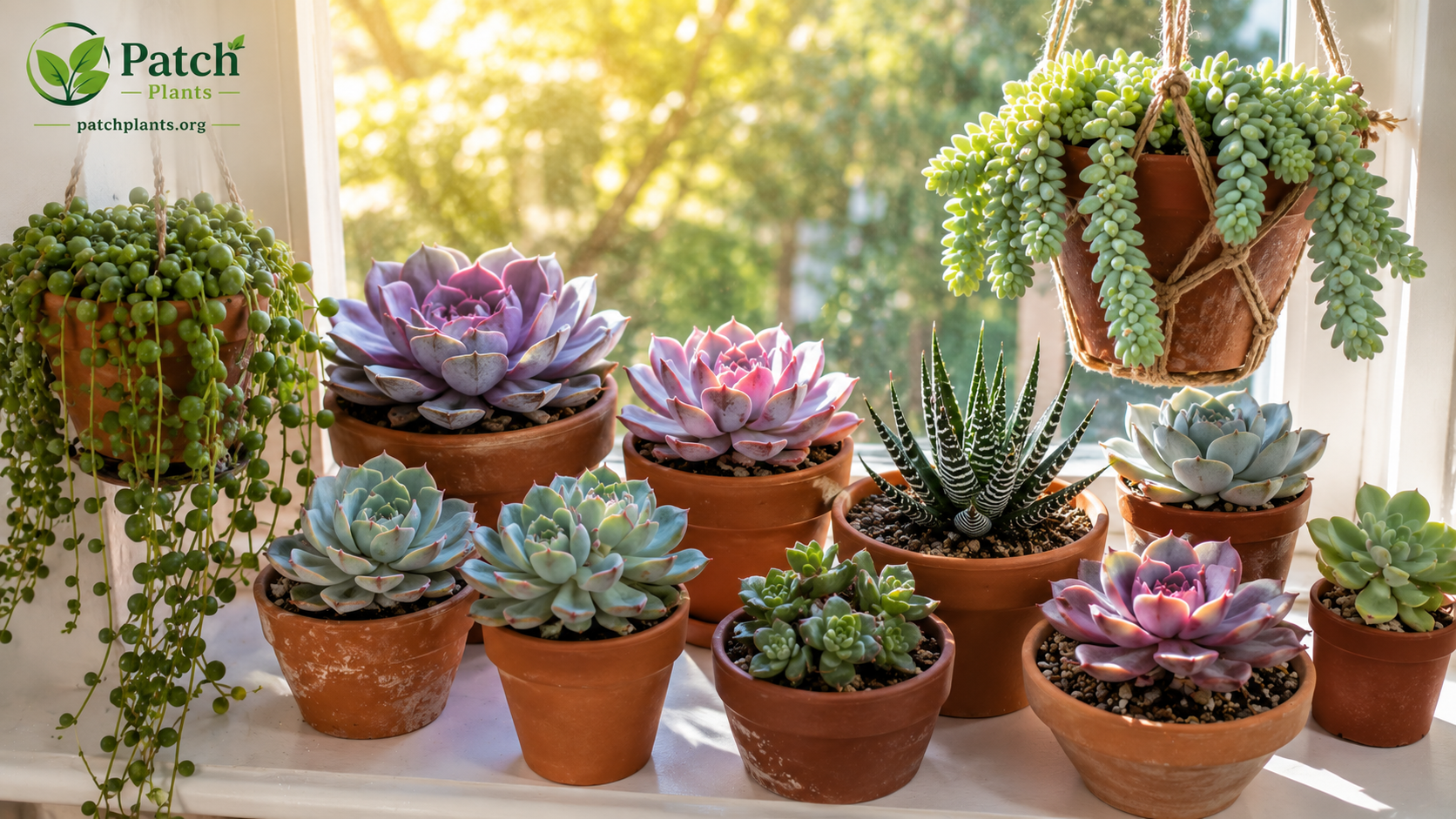
Echeveria forms neat rosettes in grey, blue, pink and purple and comes from the semi-arid parts of Mexico and Central America. It wants the brightest spot you have, a very gritty mix, and water only once the soil is bone dry. Keep water out of the rosette centre, where it can sit and rot the heart of the plant.
Haworthia
Haworthia is one of the best succulents for lower light. It comes from South African scrubland, where it grows in the shade of rocks and larger plants. Give it bright, indirect light and water a little less often than echeveria. Direct afternoon sun can scorch the leaves.
String of Pearls
Senecio rowleyanus trails from a hanging pot and prefers bright, indirect light, with good air movement and a gritty mix. Its small leaves store less water than larger succulents, so it needs slightly more frequent drinks, but never let the pot stay wet. Our string of pearls care guide covers it fully.
Donkey Tail
Sedum morganianum has plump, overlapping blue-green leaves on hanging stems that can reach 60 to 90 cm over several years. Treat it like other trailing succulents: bright light, careful watering and gentle handling, because the leaves drop at a touch.
Jade Plant
Crassula ovata is slow-growing, forgiving and long-lived, developing a woody trunk with age. It tolerates a bit more watering than fussier types but still needs the soil to dry between drinks. See our jade plant care guide.
Bear Paw and Split Rock
Bear paw (Cotyledon tomentosa) has fuzzy, tooth-tipped leaves and needs bright light and water kept off the leaf surface. Split rock (Pleiospilos nelii), a South African mimicry plant that looks like a split stone, is one of the more demanding types. Water it sparingly and keep it dry in winter.
Aloe Vera
Aloe suits the same bright, well-drained conditions. Our aloe vera care guide has the details.
Growing Succulents Outdoors
Many succulents can spend summer outside in a bright spot, which usually makes them sturdier. Move them gradually from indoor light to stronger sun over a week or two to avoid sunburn. Bring tender types back indoors before nights turn cold, and give outdoor pots shelter from prolonged wet, as the RHS advises, since cold plus damp is what kills most of them.
Propagating Succulents
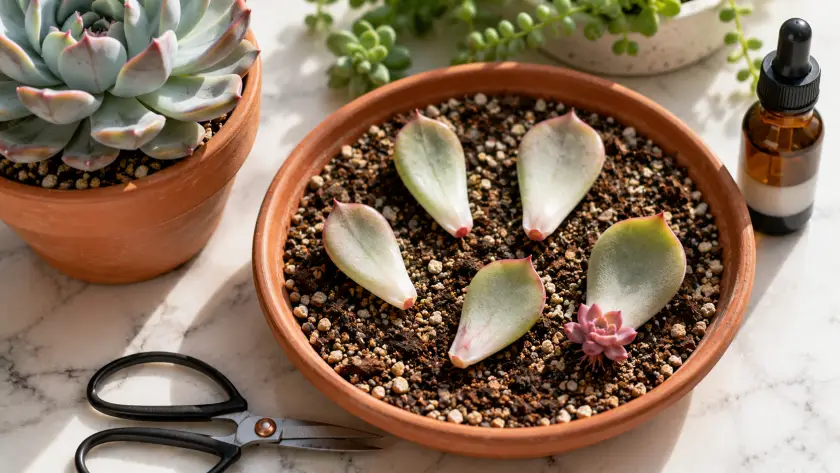
Succulents are among the easiest plants to multiply, and repotting is a good moment to do it.
- Leaf cuttings: twist a healthy leaf off cleanly, let the end dry for a few days, then lay it on dry mix and mist lightly once roots appear.
- Stem cuttings: cut below a node, let the cut callus over for several days, then plant in gritty mix.
- Offsets: separate the small pups that grow around the base and pot them individually.
Our propagation guide covers other houseplants too.
Are Succulents Safe for Pets?
It depends on the plant. The ASPCA lists echeveria and hens and chicks (Sempervivum) as non-toxic, but jade plant and string of pearls as toxic to pets. For jade, it notes vomiting, depression and incoordination. If your pet chews any plant, call your vet or the ASPCA Animal Poison Control line, and check the exact plant on the ASPCA toxic and non-toxic plant list. Our guides to making plants cat friendly and dog friendly help with placement.
Common Succulent Care Problems and Fixes
- Soft, yellow or translucent leaves: overwatering. Stop watering, check the roots, and repot into dry gritty mix if they are brown and mushy. See root rot signs and treatment.
- Wrinkled, deflated leaves: underwatering. Give a full soak.
- Stretched, pale growth: not enough light. Move closer to a window or add a grow light.
- Scorched patches: sudden strong sun. Acclimatise gradually.
- White cottony clusters or webbing: mealybugs or spider mites. The RHS notes both attack succulents. Wipe off with a cotton bud dipped in alcohol, improve airflow and repeat weekly.
For a plant that looks beyond saving, try our plant rescue plan.
Frequently Asked Questions
How often should I water succulents?
There is no fixed schedule. Water deeply only when the soil is completely dry, which often means every two to three weeks indoors and much less in winter.
Can succulents live indoors without direct sun?
Some can, such as haworthia, but most need bright light and will stretch and fade without it. A grow light is a reliable fix in dark rooms.
What is the best soil for succulents?
A fast-draining mix of about one part organic matter to two parts perlite, pumice or coarse sand, or a bought cactus and succulent mix.
Why are my succulent’s leaves mushy?
Mushy, translucent leaves nearly always mean overwatering and early root rot. Let the soil dry, remove damaged tissue, and repot if the roots are brown.
Are succulents toxic to cats and dogs?
Some are and some are not. The ASPCA lists jade plant and string of pearls as toxic and echeveria as non-toxic, so check each plant before bringing it home.
Final Thoughts
Good succulent care is mostly restraint: bright light, sharp drainage and patience with the watering can. Start with forgiving varieties such as jade or haworthia, learn how your windows and pots behave, and you will soon read your plants at a glance. For more plant guides and care tips, explore Patch Plants, where I share what I have learned as a botanist, and browse our plant care articles next.
Sources: Iowa State University Extension, Growing Succulents Indoors; RHS, Houseplant cacti and succulents growing guide; ASPCA, Jade Plant.

About the author
Sawera Shahid is a botanist with an MPhil in Botany and 5+ years of writing about plants. As founder and lead writer of Patch Plants, she writes practical, science-backed guides on indoor plants, outdoor gardens and plant problems, checked against RHS and university extension advice.