
Key Takeaways
- Office-friendly plants are specifically those species that evolved in shaded forest understories or developed exceptional low-light tolerance — making them uniquely capable of not just surviving but genuinely thriving under fluorescent lighting conditions that would kill most other houseplants.
- Office plants that tolerate fluorescent lighting share key characteristics — broad leaf surfaces that maximise light capture from whatever spectrum is available, slow metabolic rates that reduce energy requirements, and water-storing tissues that buffer the erratic watering that busy office routines inevitably create.
- Low-maintenance office plants are the most practical choice for work environments — snake plant, ZZ plant, pothos, and cast iron plant all require watering only every 2–3 weeks, tolerate missed waterings without dramatic response, and continue growing steadily through the neglect that office life creates.
- Indoor office plants provide benefits that go well beyond aesthetics — research consistently shows that plants in work environments reduce stress, improve focus, reduce absenteeism, and make spaces feel less clinical, making office plant ideas an investment in workplace wellbeing as well as decoration.
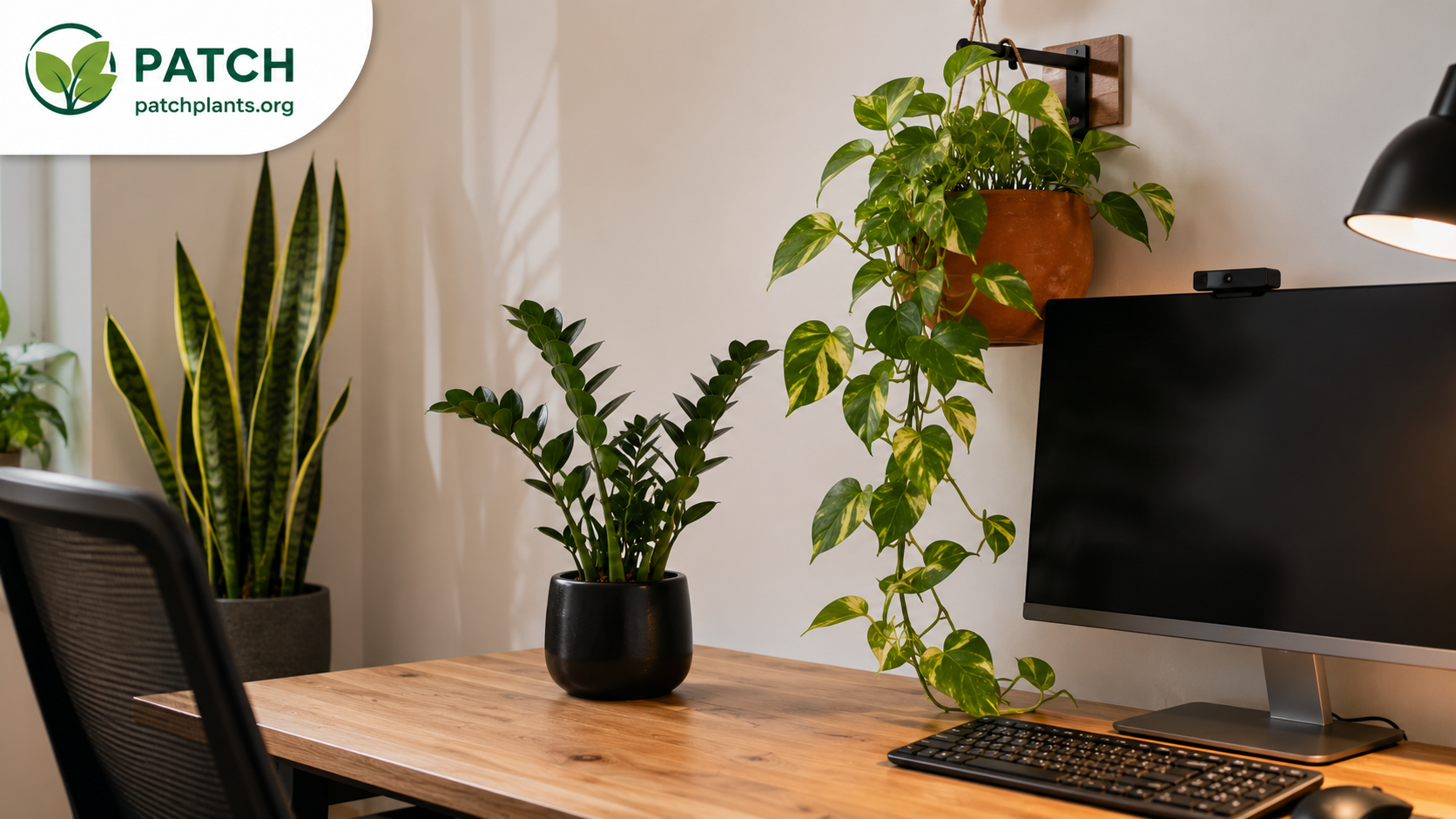
- Office desk plants should be compact enough to fit on a standard desk without overwhelming the workspace — snake plant, ZZ plant in a small pot, pothos in a trailing display, and peace lily all work as good office desk plants without requiring the floor space of larger specimens.
- Plants for office with no windows — the most challenging office environment — are limited to a specific group of genuinely dark-tolerant species: ZZ plant, snake plant, cast iron plant, and peace lily, all of which have demonstrated the ability to grow under artificial ceiling lighting alone without access to any natural light.
- Home office plants follow the same selection criteria as corporate office plants but with one important advantage — home office environments typically offer more control over light placement, allowing grow light supplementation that genuinely expands the range of viable good office plants beyond the most shade-tolerant group.
- Small office plants — particularly compact ZZ plants, haworthia, small snake plant varieties, and trailing pothos — are ideal for desk positions where a full-sized floor plant would be impractical, providing all the visual and psychological benefits of office greenery in a footprint that leaves the desk functional.
- Plants for office decoration that double as air purifiers — peace lily, snake plant, spider plant, and pothos — provide dual value in office environments where air quality is affected by synthetic materials, printer emissions, and poor ventilation.
- The best office-friendly plants for complete beginners to office plant keeping are ZZ plant and snake plant — both genuinely require almost nothing beyond occasional watering, both tolerate the full range of typical office conditions, and both provide the consistent, reliable greenery that makes indoor plants for office environments worthwhile.
Introduction
Every office has them — the brave, struggling plants that someone optimistically placed near the window six months ago, now slowly losing their battle against fluorescent lighting, dry air-conditioned air, forgotten waterings over long weekends, and the existential challenge of growing in a space designed entirely for human productivity rather than botanical flourishing. Most houseplants placed in typical office conditions without careful species selection don’t survive. But office-friendly plants — chosen specifically for their tolerance of low light, inconsistent care, and artificial environments — not only survive these conditions but look genuinely good while doing it.
The fundamental requirement for office plants is light tolerance. Fluorescent office lighting provides a fraction of the light intensity of even a north-facing window, and the spectral composition is different from natural light in ways that affect some plants significantly. The species that succeed as indoor office plants are those that evolved under the dense shade of tropical forest canopies — conditions that prepared them, almost accidentally, for exactly the low-intensity artificial lighting of modern office environments.
This complete guide covers the best office-friendly plants for every office environment — from the standard open-plan desk to the windowless cubicle, from the home office with good natural light to the basement meeting room that never sees the sun. For each plant, care requirements under office conditions are covered specifically — not general care, but the adapted approach that works when watering happens every two weeks and light never comes from a window. Our complete indoor light guide, complete watering guide, and improve home office with plants guide provide connected detail.
Why Office-Friendly Plants Matter More Than Just Decoration
Indoor plants for office environments provide benefits that justify the care investment far beyond their aesthetic contribution. The documented effects of plants in workspaces include measurable reductions in stress and anxiety among workers, improved concentration and cognitive performance in tasks requiring sustained attention, reduction in sick building syndrome symptoms (headaches, fatigue, irritability) associated with poor indoor air quality, and a consistent psychological improvement in how workers experience their environment.
Office greenery changes the feel of a space in ways that are difficult to quantify but immediately felt — the organic, irregular form of a living plant softens the hard lines and uniform surfaces of office furniture, the green colour provides visual rest for eyes fatigued by screens, and the simple presence of something living and growing in an environment otherwise defined by productivity and performance creates an unconscious sense that the space is inhabitable rather than merely functional.
For home office plants, the benefits extend to the psychology of the home-working environment specifically — plants help define the home office as a distinct, purposeful space within the home, contributing to the mental separation between work and personal life that home workers consistently report as one of their primary challenges. See our improve home office with plants guide for home office plant selection and positioning in detail.
The Best Office-Friendly Plants — Complete Guide

1. Snake Plant — The Best Office Plant Overall
Snake plant (Sansevieria) is the definitive office-friendly plant — it is genuinely difficult to name a combination of office conditions that a well-established snake plant cannot tolerate. It survives fluorescent-only lighting, watering intervals of 3–4 weeks (or longer), the low humidity of air-conditioned offices, temperature fluctuations between occupied and unoccupied hours, and the complete darkness of weekends with office lights switched off.
For office desk plants use, the compact varieties — Sansevieria trifasciata ‘Hahnii’ (bird’s nest snake plant), Fernwood Mikado — stay under 30–40cm and fit on standard desks without overwhelming the workspace. For floor positions in larger offices, standard Sansevieria trifasciata reaches 90–120cm and creates a striking architectural statement in corners. Water every 3–4 weeks in summer, monthly in winter — the only reliable way to damage a snake plant in office conditions is overwatering. See our signs of overwatering guide.
Light: Any — genuinely the most light-adaptable office plant available Water: Every 3–4 weeks in summer, monthly in winter Desk or floor: Both depending on variety Pet safe: ⚠️ Toxic
Full care at our snake plant care guide.
2. ZZ Plant — Best Plant for Windowless Office
ZZ plant (Zamioculcas zamiifolia) is the most recommended of all plants for office with no windows — its rhizome water-storage system and extreme shade tolerance make it the single most reliable office-friendly plant for the darkest office positions. In offices where natural light is genuinely absent and the only light source is fluorescent ceiling lighting, ZZ plant continues growing — slowly, but visibly — where almost no other office plants would survive.
The glossy, deep green leaflets on arching stems create a sophisticated appearance that suits modern office aesthetics particularly well. ZZ plant grows slowly enough that it maintains its desk-appropriate proportions for years without repotting — a genuine advantage in office environments where regular plant maintenance isn’t practical. Water every 3–4 weeks in summer, every 6 weeks in winter. See our ZZ plant care guide.
Light: Very low — the best choice for plants for office with no windows Water: Every 3–6 weeks Desk or floor: Both Pet safe: ⚠️ Toxic
3. Peace Lily — Best Flowering Office Plant
Peace lily (Spathiphyllum) is the most elegant of all office-friendly plants — combining genuine shade tolerance with regular white flowering that no other commonly available low-light office plant matches. The deep green leaves and white sail-shaped blooms create a sophisticated, calming presence on desks and in corners that makes peace lily the most popular flowering indoor plant for office environments worldwide.
Peace lily is particularly well-suited to office conditions because it communicates its watering needs dramatically and unmistakably — the plant droops visibly when water is needed, then recovers equally dramatically within hours of correct watering. This makes it ideal for the office environment where plant checking is irregular — the peace lily tells you when it needs attention rather than requiring consistent scheduled monitoring. Water every 7–10 days when in use. Use our peace lily care guide for the complete care approach in office conditions.
Light: Low to medium indirect — tolerates fluorescent-only lighting Water: Every 7–10 days — droops visibly when thirsty Desk or floor: Both depending on pot size Pet safe: ⚠️ Toxic
4. Pothos — Best Trailing Office Desk Plant
Pothos (Epipremnum aureum) is the most versatile of all office desk plants — its trailing vines can be directed along shelf edges, across divider tops, and down from high cabinets, creating the lush layered greenery that transforms office spaces while fitting in footprints far too small for upright specimens. Golden pothos, marble queen, and neon pothos all perform similarly well in office conditions.
Pothos in office environments with fluorescent-only lighting often produces smaller, less variegated leaves than it would in bright natural light — but it continues growing reliably and maintains its trailing form regardless. For good plants for office desk with limited space, a small pothos in a compact pot with 60–90cm of trailing vine creates more visual impact than any upright plant of equivalent footprint. Water every 10–14 days in summer, every 21 days in winter. See our pothos care guide.
Light: Low to medium — tolerates fluorescent lighting well Water: Every 10–21 days depending on season Desk position: Excellent — trails naturally over desk edges Pet safe: ⚠️ Toxic
5. Spider Plant — Best Non-Toxic Office Plant
Spider plant (Chlorophytum comosum) is the most pet-safe and child-safe of all common office-friendly plants — completely non-toxic and genuinely easy to grow in office conditions with moderate light. The arching green-and-white striped leaves and dangling spiderette offshoots create a cheerful, energetic display that suits offices where a less formal, more welcoming atmosphere is wanted.
Spider plant is among the best plants for office decoration and air purification — it absorbs volatile organic compounds including formaldehyde and xylene that are common in office environments from furniture, printer equipment, and synthetic carpeting. Water every 7–10 days in summer. Use filtered or distilled water if possible — spider plant is sensitive to fluoride and chlorine in tap water, producing the brown tip browning that our leaf curl browning and droop guide covers.
Light: Low to medium — handles typical office light levels well Water: Every 7–10 days in summer Desk position: Hanging displays or elevated shelves ideal Pet safe: ✅ Non-toxic
Full care at our spider plant care guide.
6. Cast Iron Plant — Most Neglect-Tolerant Office Plant
Cast iron plant (Aspidistra elatior) earns its name in office conditions — it tolerates low light, inconsistent watering, low humidity, temperature fluctuations, and general neglect with a resilience that no other common office plant matches. In Victorian Britain it was grown in dark hallways lit only by gas lamps — the original office-friendly plant for artificial lighting conditions.
For plants for office with no windows where even ZZ plant finds conditions challenging, cast iron plant provides a genuine alternative. Its deep green, strap-like leaves grow slowly but maintain their appearance without the glossy leaf cleaning that rubber plant requires or the watering attention that peace lily demands. Water every 14–21 days — this is one of the most drought-tolerant low-maintenance office plants available.
Light: Very low — one of the most shade-tolerant office-friendly plants available Water: Every 14–21 days Desk or floor: Floor or shelf specimen Pet safe: ✅ Non-toxic
7. Philodendron Heartleaf — Best Beginner Office Plant
Philodendron heartleaf produces glossy, heart-shaped leaves on trailing stems that perform similarly to pothos in office conditions — it tolerates low light, requires infrequent watering, and can be trained to trail, climb, or remain compact in a pot depending on office positioning needs. It is one of the most forgiving easy office plants for beginners who haven’t grown office plants before.
Heartleaf philodendron is particularly suitable as a small office plant for shelves and windowsills — it stays compact in small pots, grows at a predictable rate, and maintains a consistently attractive form without the aggressive pruning that fast-growing trailing plants require. Water every 10–14 days. See our philodendron care guide.
Light: Low to medium indirect — fluorescent tolerant Water: Every 10–14 days Desk position: Shelf or elevated position for trailing display Pet safe: ⚠️ Toxic
8. Money Tree — Best Statement Office Plant
Money tree (Pachira aquatica) with its braided trunk and palmate green leaves is among the most visually distinctive of all office plants — a medium-sized specimen in a decorative pot creates an immediate impression of a thoughtfully designed space that smaller, plainer good office desk plants cannot achieve. Its cultural association with good fortune makes it the most gifted indoor plant for office use.
Money tree tolerates the bright indirect light of well-lit offices and the moderate light of average offices equally well. It requires less frequent watering than its tropical origin suggests — every 14 days in summer, every 21 days in winter. See our money tree care guide.
Light: Medium to bright indirect — moderate office light acceptable Water: Every 14–21 days Desk or floor: Both depending on size Pet safe: ✅ Non-toxic
9. Chinese Evergreen — Most Colourful Low-Light Office Plant
Chinese evergreen (Aglaonema) produces the most visually varied foliage of any low-maintenance office plant — varieties with silver, green, pink, and red patterning all perform in low to medium light, making Chinese evergreen the best choice for office plants where colour and visual interest are priorities beyond the standard all-green options.
Chinese evergreen is a genuine air purifier and tolerates the variable humidity of air-conditioned offices better than most tropical indoor office plants. The silver and green varieties perform best in the lowest light — the pink and red varieties need slightly brighter conditions. Water every 10–14 days. See our colorful foliage indoor plants guide for more colourful office plant ideas.
Light: Low to medium — silver/green varieties perform in fluorescent-only light Water: Every 10–14 days Desk or floor: Both Pet safe: ⚠️ Toxic
10. Haworthia — Best Small Office Plant for Desk
Haworthia is the ideal office desk plant where space is genuinely limited — its compact form (most varieties under 15cm), architectural appearance, and extraordinary drought tolerance make it the best small office plant for the desk position where something substantial is wanted in a very small footprint.
Unlike most succulents, haworthia genuinely tolerates the lower light of office environments — it is shade-tolerant by nature, having evolved in the dappled shade of rocks and larger plants in South African scrubland. This makes it the only succulent that works reliably as a good office plant without grow light supplementation. Water every 3–4 weeks. See our succulent care guide for haworthia office care.
Light: Low to medium indirect — genuinely shade-tolerant succulent Water: Every 3–4 weeks — one of the most drought-tolerant office desk plants Desk position: Ideal — stays compact permanently Pet safe: ✅ Non-toxic
11. Dracaena — Best Tall Office Floor Plant
Dracaena in its various forms — marginata, massangeana (mass cane), sanderiana (lucky bamboo) — provides the most reliably successful of all office floor plants that reach meaningful height. The tall, cane-like stems with clusters of striped or coloured leaves at the top create a genuinely architectural presence in corners and beside furniture in larger offices.
Dracaena is particularly valuable as an indoor plant for office decoration because it maintains its structural form without pruning, tolerates the fluorescent lighting of most offices, and requires watering only every 2–3 weeks. Use filtered water — dracaena is fluoride-sensitive and develops brown tips from tap water fluoride accumulation, a common problem in offices using municipal water supplies. Our leaf curl browning and droop guide covers dracaena brown tip diagnosis. Full care at our dracaena care guide.
Light: Low to medium — one of the most shade-tolerant office floor plants Water: Every 14–21 days — use filtered water Desk or floor: Floor specimen — reaches 1.5–2.5m Pet safe: ⚠️ Toxic
12. Rubber Plant — Best Statement Desk-to-Floor Office Plant
Rubber plant (Ficus elastica) in its deep burgundy-leaved varieties provides the most dramatically colourful of all good office plants that maintain manageable proportions — it can be kept compact in a smaller pot on a shelf or table, or allowed to grow to floor-specimen size (2–3m) in a large container for corner placement.
The thick, glossy leaves catch fluorescent light beautifully and stay pristine with minimal maintenance — monthly leaf wiping keeps them looking their best in offices where dust accumulates. It tolerates a wide range of light conditions but performs best with some natural light if available. Water every 14–21 days. See our rubber plant care guide.
Light: Medium to bright indirect — tolerates moderate office light Water: Every 14–21 days Desk or floor: Both depending on pot size Pet safe: ⚠️ Toxic
13. Aloe Vera — Functional Office Desk Plant
Aloe vera occupies a unique position among office desk plants — it is both ornamental and genuinely functional, with the gel from its leaves providing immediate first aid for minor burns and skin irritation that are common workplace concerns. In a bright office with good natural or artificial light, aloe vera maintains its characteristic spiky form on a desk or windowsill with minimal care.
Aloe needs more light than the darkest office positions can provide — it suits offices with windows or strong artificial lighting better than completely windowless spaces. Water every 14–21 days, allowing soil to dry completely between waterings. See our aloe vera care guide.
Light: Medium to bright — needs better light than lowest-light office plants Water: Every 14–21 days — allow to dry completely Desk position: Window ledge or bright desk position Pet safe: ⚠️ Mildly toxic to pets
14. Christmas Cactus — Best Flowering Compact Office Plant
Christmas cactus (Schlumbergera) is the most surprisingly effective of all office-friendly plants for artificial light environments — it is a forest cactus by origin rather than a desert cactus, having evolved in the dappled shade of Brazilian coastal forest where the light conditions are genuinely similar to those of a well-lit office. Under consistent artificial lighting it maintains healthy growth and, given appropriate care, produces its spectacular seasonal flowers even in windowless conditions.
Christmas cactus tolerates the cool, dry air of air-conditioned offices better than most tropical indoor office plants and requires watering only every 14–21 days for most of the year. See our christmas cactus care guide.
Light: Low to medium — tolerates fluorescent lighting well Water: Every 14–21 days Desk position: Compact — suitable for desk or shelf Pet safe: ✅ Non-toxic
Office Plants by Environment — Which to Choose

Windowless Office or Cubicle
Best office-friendly plants for no natural light: ZZ plant (the most reliable), snake plant, cast iron plant, peace lily with strong ceiling lighting, Chinese evergreen (silver/green varieties). Avoid any plant marketed as “medium light” — in genuinely windowless offices only the darkest-tolerant species from the above list will perform. See our best indoor plants for beginners guide for additional low-light options.
Office with Windows
Good office plants for windowed offices: All the plants above plus pothos, spider plant, rubber plant, money tree, and peace lily — the additional natural light opens up the full range of office-friendly plants. South and west-facing offices can support aloe vera, Christmas cactus, and even small dracaena specimens without supplementary lighting.
Home Office
Best home office plants: The home office advantage is environmental control — you can choose the best position for each indoor plant for office use, supplement with a grow light, and adjust humidity and temperature. This means virtually any office plants selection is viable. Start with snake plant and pothos for guaranteed success, then add peace lily, rubber plant, or money tree as confidence builds. Our improve home office with plants guide covers home office plant selection in full.
Office Desk
Best plants for desk office positions: ZZ plant (compact variety), haworthia, small snake plant, pothos (trailing display), peace lily (small variety), Chinese evergreen. All provide visual impact in limited desk footprints while tolerating the inconsistent care that busy office desks inevitably receive. See our 35 low-maintenance plants guide for additional low-maintenance desk plant options.
Caring for Office Plants — Practical Adaptations

Watering in office environments: The most common office plant failure is overwatering — plants in low-light office conditions dry significantly more slowly than the same species in bright home environments. Water every 10–14 days for most indoor office plants, every 3–4 weeks for drought-tolerant species like snake plant, ZZ plant, and haworthia. Always check soil moisture before watering. See our complete watering guide and signs of overwatering guide.
Weekend and holiday care: Choose low-maintenance office plants — snake plant, ZZ plant, cast iron plant, haworthia — that tolerate extended periods without watering when offices are unoccupied. Water thoroughly before extended closures and ensure pots have drainage — never leave plants in saucers of standing water before a long weekend. See our signs of overwatering guide.
Humidity in air-conditioned offices: Air conditioning removes moisture from the air, creating conditions drier than most office-friendly plants prefer. Group plants together to create a localised more humid microclimate, add pebble trays, and position away from direct airflow from air conditioning units. See our humidity hacks guide and DIY humidity tray guide.
Troubleshooting common office plant problems: Yellow leaves (overwatering — most common in office conditions), brown tips (low humidity or mineral water accumulation — switch to filtered water), drooping (underwatering or overwatering — check soil first), stretching toward light source (insufficient light — move closer to light source or add grow light). See our leaf curl browning and droop guide, why leaves turn yellow guide, and how to revive a dying plant guide.
Frequently Asked Questions
Do office-friendly plants really grow under fluorescent lighting alone? Yes — specific species genuinely thrive under fluorescent-only lighting. Office-friendly plants that perform best in fluorescent-only conditions are ZZ plant, snake plant, cast iron plant, peace lily, Chinese evergreen (silver/green varieties), and pothos. These species evolved in deep forest shade conditions that are functionally similar to fluorescent office lighting in terms of light intensity. Our complete indoor light guide covers supplementary grow light options for expanding the range of viable office plants.
What are the best plants for an office desk? The best office desk plants are ZZ plant (compact variety), haworthia, small snake plant, trailing pothos, peace lily (small pot), and Chinese evergreen — all providing visual impact in limited desk footprints while tolerating the inconsistent care that desk positions create. Avoid plants that require high humidity (calathea, fittonia) or consistent moisture (ferns) as good office desk plants — they need more consistent care than most desks can provide.
How often should I water office plants? Low-maintenance office plants in low-light conditions dry significantly more slowly than home plants in bright light. Water snake plant and ZZ plant every 3–4 weeks. Water pothos, peace lily, and philodendron every 10–14 days. Always check soil moisture at 3–5cm depth before watering — overwatering is the most common cause of office plant failure.
What are the best plants for offices with no windows? Best office plants for no windows are ZZ plant (most reliable), snake plant, cast iron plant, and Chinese evergreen (silver/green varieties). All four genuinely tolerate artificial ceiling lighting as their sole light source. Add a basic grow light positioned 30–60cm above the plant for 12 hours daily to expand the viable range to include pothos and peace lily in completely windowless positions.
Can large plants survive in office spaces? Yes — office floor plants including dracaena, rubber plant, snake plant (large variety), money tree, and ZZ plant (in a large container) all reach impressive floor-plant sizes while maintaining the light and watering tolerance that office-friendly plants require. See our 20 oversized indoor plants guide for large indoor office plants options.
Are office plants safe for colleagues and pets? Safety varies by species. Non-toxic office-friendly plants safe for colleagues and pets include spider plant, cast iron plant, haworthia, Christmas cactus, and money tree. Toxic varieties — ZZ plant, snake plant, pothos, peace lily, philodendron, dracaena, rubber plant — should be positioned out of reach in offices with pets or children. Our cat friendly plants guide and dog friendly plants guide cover full toxicity details.
Related Guides
- Improve Home Office with Plants
- The 35 Best Office Plants
- Complete Indoor Light Guide
- Complete Watering Guide
- Signs You’re Overwatering
- Leaf Curl Browning Droop Guide
- Why Leaves Turn Yellow
- How to Revive a Dying Plant
- Humidity Hacks Guide
- DIY Humidity Tray Guide
- Snake Plant Care Guide
- ZZ Plant Care Guide
- Pothos Care Guide
- Peace Lily Care Guide
- Spider Plant Care Guide
- Philodendron Care Guide
- Money Tree Care Guide
- Dracaena Care Guide
- Rubber Plant Care Guide
- Aloe Vera Care Guide
- Christmas Cactus Care Guide
- Succulent Care Guide
- Monstera Care Guide
- Calathea Care Guide
- Jade Plant Care Guide
- Boston Fern Care Guide
- Bird of Paradise Care Guide
- String of Pearls Care Guide
- Fertilizing Indoor vs Outdoor
- Best Soil Mix Guide
- How to Repot a Plant
- Repotting Mistakes to Avoid
- 35 Low Maintenance Plants
- Best Indoor Plants for Beginners
- Colorful Foliage Indoor Plants
- Air Purifying Indoor Plants
- 20 Oversized Indoor Plants
- Low Light Hanging Plants
- 33 Best Bathroom Plants
- Rare Houseplants Guide
- Cat Friendly Plants Guide
- Dog Friendly Plants Guide
- Style Indoor Plants by Room
- Best Low Maintenance Outdoor Plants
- Top Drought Resistant Plants
- Browse All Indoor Plants →
- Browse All Plant Care →
Final Thoughts
Office-friendly plants prove something important about plants in general — their adaptability is genuinely remarkable. The same evolutionary pressures that equipped tropical forest understory plants to survive with minimal light, irregular moisture, and competitive root environments have produced species that are almost perfectly matched to the artificial, low-light, inconsistently watered conditions of modern office life. The plants that thrive as indoor office plants didn’t evolve for offices, but they perform as if they did.
The most important message for anyone considering office plants for the first time is that the barrier to entry is lower than it appears. ZZ plant and snake plant require almost nothing — a pot with drainage, appropriate soil, and watering every 3–4 weeks. That’s all. In return, they provide the consistent greenery, documented wellbeing benefits, and visual improvement to office environments that justify the minimal investment many times over.
According to the Royal Horticultural Society (RHS), the presence of plants in workplace environments is associated with measurable improvements in employee wellbeing, productivity, and satisfaction — making office-friendly plants not merely a decorative choice but a genuine workplace wellbeing investment that benefits both individuals and organisations. 🌿
[…] Office plants for fluorescent lighting […]
[…] Office-friendly plants […]
[…] For more help choosing a window, read complete guide to indoor light, low light house plants, and office-friendly plants for artificial lighting. […]
[…] Office-friendly plants for fluorescent lighting […]
[…] For placement help, read complete guide to indoor light, low light house plants, and office-friendly plants for artificial light. […]
Can you be more specific about the content of your article? After reading it, I still have some doubts. Hope you can help me. https://www.binance.com/futures/ref?code=JW3W4Y3A