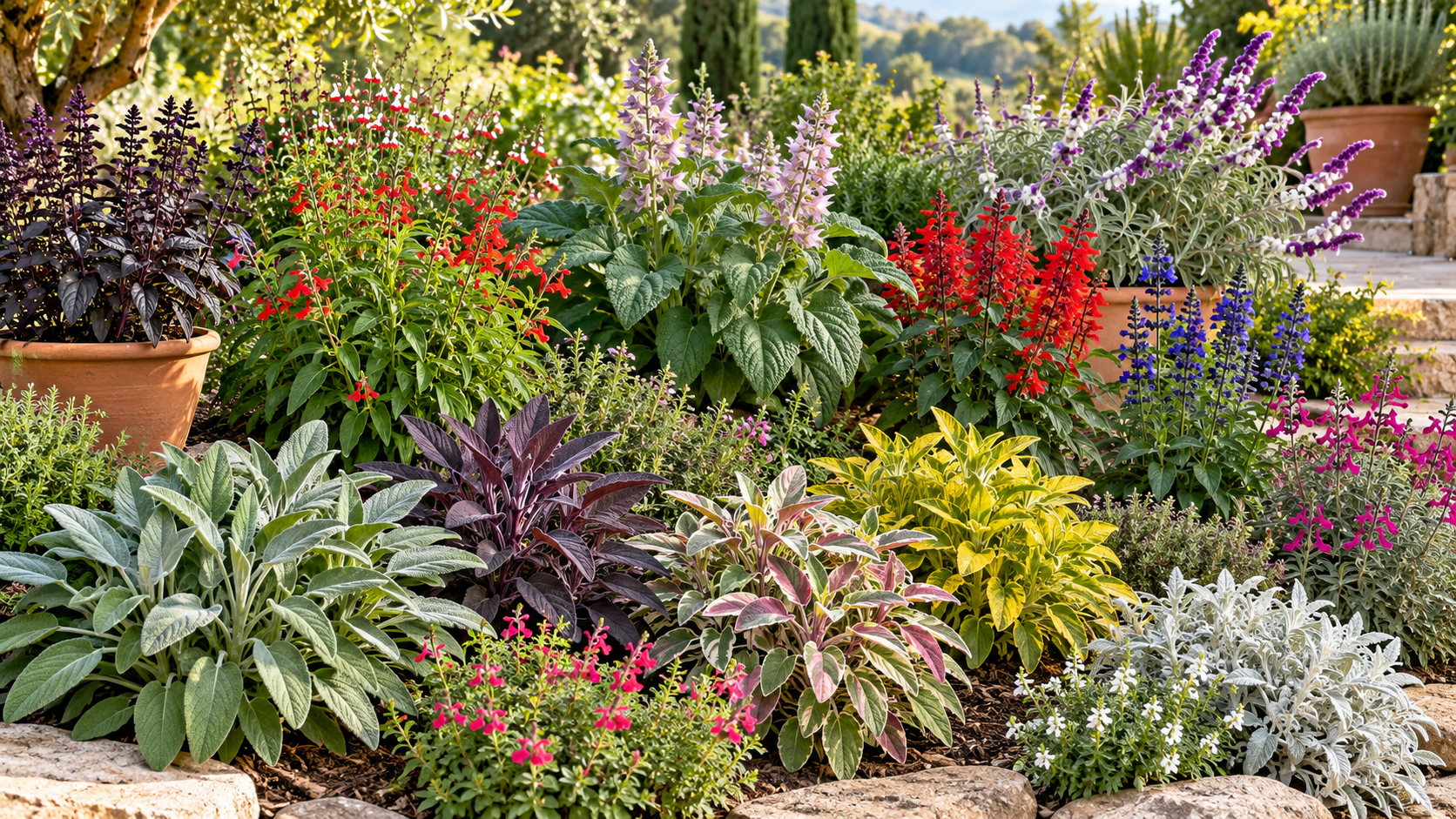
Different types of sage plants can bring flavor, fragrance, colorful flowers, textured foliage, and pollinator activity to a garden. The 15 varieties in this guide range from familiar culinary sage such as Salvia officinalis to ornamental choices such as scarlet sage, Mexican bush sage, and blue anise sage. The right choice depends on whether you want edible leaves, ornamental flowers, fragrance, or a plant suited to your particular growing conditions.
Key Takeaways
- There are many different types of sage plants, and they do not all have the same culinary or garden use.
- Common, purple, tricolor, golden, and Berggarten sage are Salvia officinalis selections suited to culinary-focused gardens.
- Pineapple sage and clary sage add distinctive fragrance, foliage, and flowers to the garden.
- Scarlet sage, autumn sage, Mexican bush sage, and blue anise sage are grown primarily for ornamental value.
- White sage, Cleveland sage, and hummingbird sage have different moisture, light, and climate preferences.
- Sunlight, drainage, mature size, moisture requirements, and winter conditions should guide your selection.
- Always confirm the botanical identity of an unfamiliar sage before considering it for culinary use.
How to Choose the Right Type of Sage Plant
Before choosing from the many sage plant varieties, decide what you want the plant to contribute to your garden. Some sages are grown primarily for flavorful leaves, while others are better suited to ornamental beds, fragrant gardens, or pollinator-focused landscapes.
Your climate and planting location matter just as much as appearance. A sage adapted to hot, dry conditions may perform poorly in a consistently damp bed, while another species may appreciate more moisture or partial shade.
For more ideas about choosing plants for garden conditions, explore our Outdoor Plants guides.
Consider Your Main Goal
| Garden Goal | Sage Types to Consider | Main Feature |
|---|---|---|
| Culinary use | Common, purple, tricolor, golden, Berggarten | Flavorful foliage |
| Fragrance and texture | Greek, pineapple, clary | Aromatic or distinctive foliage |
| Colorful flowers | Scarlet, autumn, Mexican bush, blue anise | Showy blooms |
| Regional or native-style planting | White, Cleveland, hummingbird | Distinctive regional growing habits |
Check Sunlight and Drainage
Many sage plants grow best with abundant sunlight and good drainage, particularly Mediterranean-type culinary sages. However, requirements vary across the genus, so do not treat every Salvia exactly like common garden sage.
Hummingbird sage, for example, differs from dry-climate sages because it is better suited to partial shade and moderate moisture.
Think About Winter Conditions
Cold tolerance also differs between species. Some sage plants can remain outdoors through suitable winters, while tender varieties may require seasonal protection or container growing.
Check the needs of the exact species and compare them with your local climate before planting it permanently outdoors.
15 Different Types of Sage Plants at a Glance
| Sage Plant | Botanical Name | Primary Use | Notable Feature |
|---|---|---|---|
| Common Garden Sage | Salvia officinalis | Culinary | Classic gray-green leaves |
| Purple Sage | Salvia officinalis ‘Purpurascens’ | Culinary / ornamental | Purple young foliage |
| Tricolor Sage | Salvia officinalis ‘Tricolor’ | Culinary / ornamental | Green, cream, and pink foliage |
| Golden Sage | Salvia officinalis ‘Icterina’ | Culinary / ornamental | Yellow-green foliage |
| Berggarten Sage | Salvia officinalis ‘Berggarten’ | Culinary | Broad leaves and compact growth |
| Greek Sage | Salvia fruticosa | Culinary / fragrant | Pale aromatic foliage |
| Pineapple Sage | Salvia elegans | Fragrant / ornamental | Pineapple-like fragrance and red flowers |
| Clary Sage | Salvia sclarea | Ornamental / fragrant | Large textured leaves |
| Scarlet Sage | Salvia splendens | Ornamental | Bright red flower spikes |
| Autumn Sage | Salvia greggii | Ornamental | Long flowering season |
| Mexican Bush Sage | Salvia leucantha | Ornamental | Fuzzy purple-and-white flowers |
| Blue Anise Sage | Salvia guaranitica | Ornamental | Deep blue flowers |
| White Sage | Salvia apiana | Regional / ornamental | Silvery foliage |
| Cleveland Sage | Salvia clevelandii | Regional / fragrant | Aromatic gray foliage |
| Hummingbird Sage | Salvia spathacea | Ornamental | Broad leaves and magenta flowers |
Types of Culinary Sage Plants
If cooking is your main reason for growing sage, the Salvia officinalis group provides several useful options. These types of culinary sage combine familiar sage character with differences in foliage color, size, and growth habit.
1. Common Garden Sage (Salvia officinalis)
Common garden sage is the classic culinary sage. It develops textured gray-green foliage and becomes increasingly woody as the plant matures.
Its leaves are traditionally used in savory cooking. Give the plant plenty of suitable light and well-draining soil, particularly because prolonged wet conditions around the roots can create problems.
Best for: Traditional herb gardens and culinary harvesting.
2. Purple Sage (Salvia officinalis ‘Purpurascens’)
Purple sage combines culinary usefulness with colorful foliage. Young leaves emerge in purple shades, giving herb beds and mixed borders more visual contrast than standard green-gray sage.
It can be grown similarly to common sage while also serving as an ornamental edging plant.
Best for: Edible landscapes, herb beds, and colorful borders.
3. Tricolor Sage (Salvia officinalis ‘Tricolor’)
Tricolor sage is one of the most visually distinctive sage plant varieties. Its foliage combines green and cream with pink-toned new growth.
This makes it useful where you want a culinary plant that also contributes ornamental foliage to a container or garden bed.
Provide appropriate drainage and protect the foliage from environmental extremes that cause stress.
Best for: Decorative herb gardens and mixed containers.
4. Golden Sage (Salvia officinalis ‘Icterina’)
Golden sage has yellow-green variegated foliage that stands out against darker herbs. It provides the familiar form of culinary sage with brighter leaf color.
Good light helps maintain attractive growth, while effective drainage prevents the root zone from remaining unnecessarily wet.
Best for: Sunny herb gardens and decorative containers.
5. Berggarten Sage (Salvia officinalis ‘Berggarten’)
Berggarten sage produces broad leaves and has a relatively compact, rounded growth habit. Its substantial foliage makes harvesting straightforward.
Its manageable shape can also make it useful where growing space is limited.
Best for: Culinary gardens, patio containers, and smaller herb beds.
Fragrant and Distinctive Sage Varieties
Not every sage needs to resemble traditional kitchen sage. Some varieties of sage plants stand out because of fragrance, leaf texture, or growth habit.
6. Greek Sage (Salvia fruticosa)
Greek sage develops pale, relatively narrow aromatic foliage and an upright form. It is associated with warm, dry growing conditions and benefits from well-draining soil.
Its foliage has a strong character, making this sage noticeably different from some common garden varieties.
Best for: Sunny, dry herb gardens.
7. Pineapple Sage (Salvia elegans)
Pineapple sage is easy to recognize by the sweet fragrance released from its bright green foliage when brushed or crushed.
It also produces red flowers, adding ornamental value later in the growing season. Compared with dry Mediterranean sages, its moisture requirements can differ, so care should be based on the species rather than on generic sage advice.
Best for: Fragrant gardens, colorful borders, and gardeners wanting something different from common sage.
8. Clary Sage (Salvia sclarea)
Clary sage develops large, wrinkled leaves at the base and tall flower stalks above them. Its broad foliage gives it a bolder texture than many compact culinary sages.
Give the plant enough room for its mature growth. It may behave as a biennial or short-lived perennial and can self-seed under suitable conditions.
Best for: Informal gardens where foliage texture and tall flower structure are desirable.
Ornamental Sage Plants for Flowers and Garden Color
Many ornamental sage plants are grown primarily for their flowers rather than as kitchen herbs. They can add strong reds, purples, blues, and pinks to garden beds while also increasing floral diversity.
9. Scarlet Sage (Salvia splendens)
Scarlet sage produces vivid flower spikes and a relatively dense bedding habit. Bright red forms are particularly recognizable, although ornamental selections can vary.
In climates where it cannot survive winter conditions, it may be grown seasonally rather than treated as a permanent perennial.
Best for: Flower beds, borders, and containers.
10. Autumn Sage (Salvia greggii)
Autumn sage has relatively small leaves, woody stems, and a long season of colorful flowers. Blooms can add shades such as red, pink, and white to sunny landscapes.
Its preference for bright, relatively dry conditions makes it a useful choice for appropriate sunny borders.
Best for: Sunny ornamental beds and long-season flower displays.
11. Mexican Bush Sage (Salvia leucantha)
Mexican bush sage stands out for its arching habit and fuzzy purple-and-white flower spikes. It can become a substantial garden plant, so provide enough room rather than crowding it between smaller specimens.
Winter management depends on local temperatures and growing conditions.
Best for: Large ornamental borders and late-season flower displays.
12. Blue Anise Sage (Salvia guaranitica)
Blue anise sage develops tall stems topped with deep blue flowers. Its height can make it useful toward the middle or back of a planting bed.
Unlike Mediterranean sages that are often associated with lean, dry conditions, this species can have different soil and moisture preferences.
Best for: Taller ornamental plantings and blue-flowered garden schemes.
Native and Regional Sage Plants
Some different types of sage plants are especially associated with particular regional growing conditions. Matching these plants to an appropriate climate is more effective than assuming that every sage will thrive in the same soil and exposure.
13. White Sage (Salvia apiana)
White sage is notable for silvery-white aromatic foliage and tall flowering stems. Its pale leaves create strong contrast against greener plants.
This sage is associated with hot, dry conditions and fast-draining soil. It is therefore not a good candidate for a garden that remains wet or has poorly draining heavy soil.
Best for: Appropriate hot, dry landscapes with excellent drainage.
14. Cleveland Sage (Salvia clevelandii)
Cleveland sage forms a rounded shrub with strongly scented gray-green foliage. Its fragrance makes it particularly noticeable near areas where people can appreciate the plant without disturbing its growth.
Provide a sunny, well-drained site and enough room for airflow around the mature shrub.
Best for: Dry landscapes, fragrant gardens, and suitable regional plantings.
15. Hummingbird Sage (Salvia spathacea)
Hummingbird sage looks noticeably different from many dry-climate sages. It has broader foliage, a lower clumping growth habit, and magenta flower spikes.
It also differs in site preference. Rather than requiring the same exposed conditions as desert-adapted species, it is suited to partial shade and moderate moisture according to the growing approach outlined in this guide.
Best for: Partly shaded ornamental areas where a broad-leaved Salvia is desired.
How to Tell Different Types of Sage Plants Apart
Sage plant identification can become confusing because plants within the Salvia genus vary greatly in foliage, flowers, mature size, fragrance, and growth habit.
Look at Leaf Shape and Color
Common culinary sage typically has textured gray-green foliage, while its cultivars can produce purple, cream, pink, or golden coloration.
Other species look substantially different. White sage has pale silvery foliage, hummingbird sage has broader leaves, and clary sage produces large textured leaves.
Compare the Flowers
Flower color can provide another useful clue. Scarlet sage is associated with vivid red flower spikes, Mexican bush sage has distinctive purple-and-white blooms, and blue anise sage produces deep blue flowers.
Observe the Growth Habit
Some culinary sages remain relatively compact and woody, while ornamental species can develop tall flowering stems or much larger shrubby forms.
Growth habit can help narrow down possibilities, but it should not be used alone to make a definitive identification.
Use the Botanical Name Before Harvesting
Do not assume that every plant called “sage” should be used in exactly the same way.
Check the nursery label and botanical name before harvesting an unfamiliar plant. Appearance or fragrance alone should not be treated as confirmation that an unidentified plant is suitable for culinary use.
How to Plant Sage Successfully
Choose the Right Location
Start with the needs of the particular species. Many culinary and dry-climate sages appreciate strong sunlight and good drainage, while some other salvias tolerate or prefer different conditions.
Matching the plant to the location is generally easier than repeatedly trying to modify an unsuitable location after planting.
Use Well-Draining Soil Where the Species Requires It
For Mediterranean-type culinary sages and dry-climate species, drainage is especially important. Avoid creating a planting situation where water remains around the roots for long periods.
Our guide to choosing the right soil mix explains the relationship between moisture retention, drainage, and root aeration.
Give Plants Enough Space
Consider mature size rather than nursery size. Compact culinary sages and large ornamental shrubs should not automatically receive the same spacing.
Good spacing also improves access for pruning, harvesting, and inspecting plants for problems.
Grow Sage in Containers When Useful
Containers can be helpful for compact varieties, small gardens, patios, or plants that need seasonal protection.
Choose a container with functional drainage holes and enough root space for the plant. Avoid oversized pots that hold much more wet growing medium than a small root system can use.
If you are filling a rectangular planter or raised herb bed, our Soil Calculator can help estimate how much soil you need.
How to Water Different Sage Varieties
One of the biggest mistakes is assuming that every Salvia has identical water requirements.
Water New Plants While Roots Establish
Newly planted sage needs appropriate moisture while its root system becomes established. Monitor the soil rather than allowing a recently planted specimen to become severely stressed.
Allow Mediterranean Sage to Dry Appropriately
Established common sage and related Mediterranean-type plants generally should not remain in persistently soggy soil. Check the soil before watering and pay attention to drainage.
If you are unsure how to judge watering needs, our complete plant watering guide explains why conditions matter more than a fixed watering calendar.
Give Moisture-Loving Salvias Different Care
The original selection also includes plants such as pineapple sage, blue anise sage, and hummingbird sage, which should not automatically be managed like dry Mediterranean sage.
This is why species identification matters before establishing a watering routine.
How to Feed Sage Plants
Sage should be fertilized according to the species, soil, and growing conditions rather than simply feeding heavily in an attempt to accelerate growth.
For culinary Mediterranean sages in particular, excessive feeding is unnecessary. Observe plant performance and use an appropriate fertilizer only when needed.
How to Prune and Harvest Sage
Harvest Culinary Sage Carefully
For culinary varieties, harvest healthy foliage with clean cutting tools. Avoid removing so much growth at once that the plant is left severely depleted.
Prune Woody Sage Without Overcutting
As some sages mature, their bases become increasingly woody. The source draft recommends shaping woody sages primarily through green growth rather than making severe cuts into old, leafless stems.
For general technique, see our pruning basics guide.
Remove Damaged Growth
Damaged or unhealthy growth can be removed with clean tools when appropriate. Pruning also provides an opportunity to inspect the plant for pest, disease, or moisture-related problems.
Common Sage Plant Problems
Root Problems
Persistently wet growing conditions can be particularly troublesome for sages adapted to freely draining soils. If a plant declines while its growing medium remains wet, inspect both drainage and root health.
Our guide to identifying, preventing, and treating root rot explains the warning signs in more detail.
Powdery Mildew and Poor Airflow
Crowded plants and unsuitable growing conditions can contribute to foliage problems. Give plants appropriate spacing and maintain airflow around dense growth.
Yellowing Leaves
Yellow foliage does not point to one single cause. Moisture problems, root stress, environmental conditions, aging foliage, and other issues can produce similar symptoms.
Use our guide to yellow leaves on plants when you need help narrowing down the cause.
Which Type of Sage Should You Grow?
| If You Want… | Try… |
|---|---|
| Classic culinary sage | Common garden sage |
| Colorful edible-looking herb-bed foliage | Purple, tricolor, or golden sage |
| Broad culinary foliage | Berggarten sage |
| Strong aromatic character | Greek sage |
| Sweet fragrant foliage | Pineapple sage |
| Large textured leaves | Clary sage |
| Bright red ornamental flowers | Scarlet sage |
| Long-season flowers | Autumn sage |
| Purple-and-white flower spikes | Mexican bush sage |
| Deep blue flowers | Blue anise sage |
| Silvery foliage for a dry site | White sage |
| A fragrant shrubby sage | Cleveland sage |
| A sage for partial shade | Hummingbird sage |
Frequently Asked Questions
What are the most common types of sage plants?
Common garden sage, purple sage, tricolor sage, golden sage, Berggarten sage, pineapple sage, autumn sage, scarlet sage, Mexican bush sage, and several regional Salvia species are among the different sage plants gardeners may encounter. Their uses and growing requirements vary.
What are the best types of sage for cooking?
The Salvia officinalis group is the main culinary-focused group covered in this guide. It includes common garden sage along with purple, tricolor, golden, and Berggarten cultivars.
Are all sage plants edible?
Do not assume that every Salvia or every plant with “sage” in its common name should be used for cooking. Confirm the botanical identity and appropriate culinary use of the exact plant before consuming unfamiliar foliage.
Which types of sage have colorful flowers?
Scarlet sage, autumn sage, Mexican bush sage, blue anise sage, pineapple sage, and hummingbird sage are among the flowering choices covered here. Flower colors and growth habits differ considerably between species.
Which sage grows well in partial shade?
Hummingbird sage (Salvia spathacea) is the main partial-shade option among the 15 varieties in this guide. It differs from many dry, sun-loving sages by favoring a more protected growing environment.
Can sage plants grow in containers?
Yes. Several sage varieties can be grown in containers when the pot provides adequate drainage, suitable growing medium, enough root space, and the light required by that species. Compact culinary varieties can be particularly convenient for patio herb gardens.
Why is my sage plant dying?
Start by checking soil moisture, drainage, light, temperature, and the needs of the exact sage species. Treating every Salvia as a dry Mediterranean herb can cause problems because different species have different requirements.
How do I identify a sage plant?
Look at leaf shape, color, texture, fragrance, flower color, mature growth habit, and the nursery label. These characteristics can provide clues, but confirm the botanical name before using an unfamiliar plant for culinary purposes.
Final Thoughts
Exploring different types of sage plants reveals how diverse the Salvia genus can be. A gardener looking for a classic cooking herb has very different options from someone who wants dramatic flowers, fragrant foliage, or a plant suited to a dry regional landscape.
For culinary planting, common garden sage and its purple, tricolor, golden, and Berggarten forms provide several choices. Pineapple, Greek, and clary sage add distinctive fragrance or foliage, while scarlet, autumn, Mexican bush, and blue anise sage bring ornamental flowers into the garden.
White sage, Cleveland sage, and hummingbird sage further demonstrate why climate and site conditions matter. Instead of treating all sage plants the same, identify the species first and match its sunlight, drainage, moisture, space, and winter needs to your garden.
Once you choose the right variety for the right location, sage can become a useful and attractive part of an herb bed, ornamental border, container display, or larger outdoor planting.