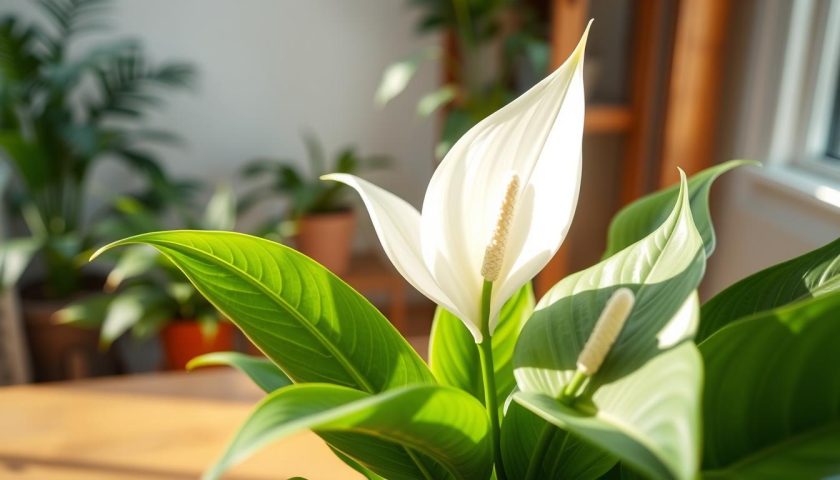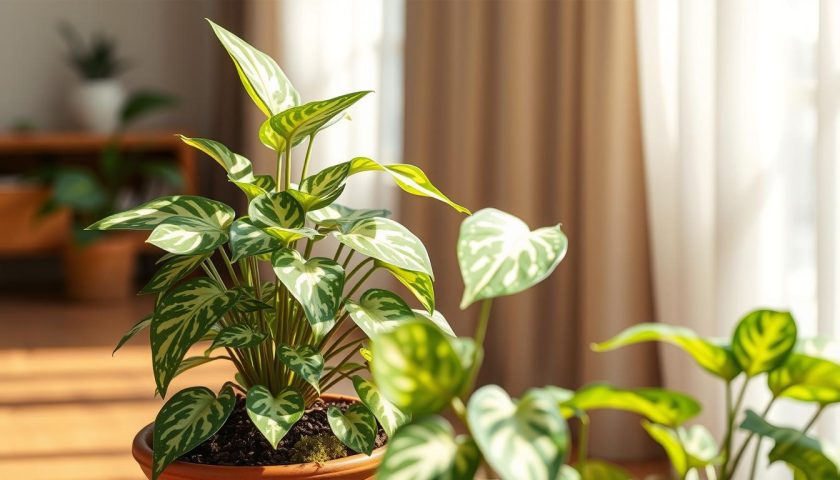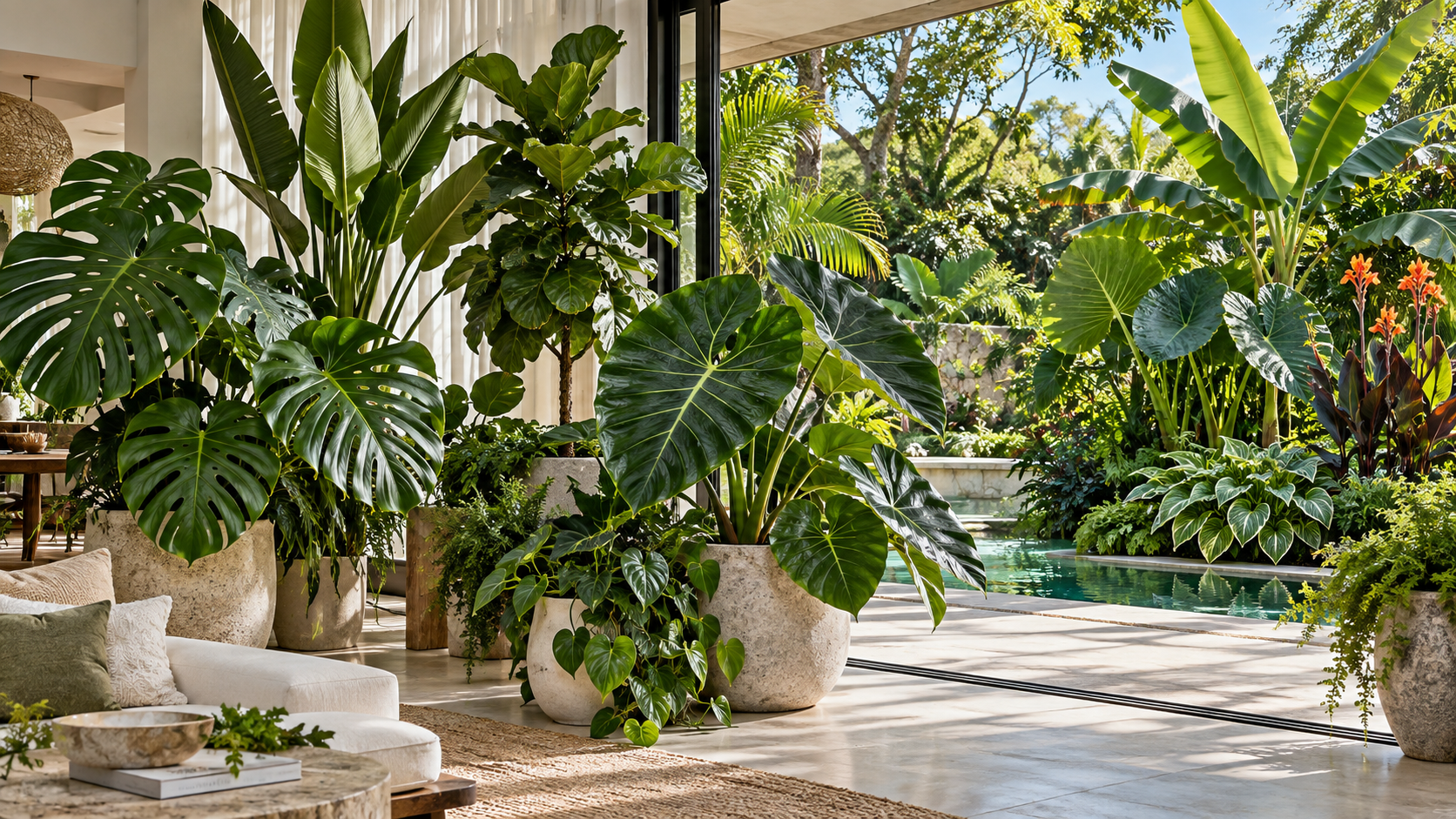
Big plants with big leaves can transform an empty corner, living room, patio, or garden bed with just one dramatic specimen. Some of the best choices include Monstera deliciosa, white bird of paradise, fiddle-leaf fig, elephant ear, Philodendron gloriosum, Japanese aralia, hardy banana, giant rhubarb, canna, hosta, caladium, and other oversized foliage plants. The best plant for your space depends on light, available room, moisture, climate, and whether it will grow indoors or outside.
Key Takeaways
- Big plants with big leaves create strong visual impact indoors and outdoors without requiring a large collection of smaller plants.
- Monstera deliciosa, white bird of paradise, fiddle-leaf fig, Alocasia, and Philodendron gloriosum are standout indoor choices.
- Colocasia, hardy banana, Gunnera, Darmera, canna, and large hostas can create dramatic outdoor displays.
- Always consider mature height and width before choosing an oversized plant.
- Light, drainage, moisture, temperature, and humidity requirements vary significantly between species.
- Some large-leaved plants can be harmful if ingested, so check plant safety when children or pets have access to the growing area.
- Large containers need adequate drainage and enough stability to support tall or top-heavy plants.
How to Choose Big Plants With Big Leaves
The most attractive plant is not necessarily the best plant for your space. Before buying a dramatic specimen, consider where it will grow, how large it can become, and whether you can provide the light and moisture it needs.
If you are mainly interested in indoor statement plants, explore our Indoor Plants guides for more ideas.
Check the Mature Size
A young plant at a nursery may fit comfortably beside a sofa today but become much wider or taller as it matures. Measure available floor space and ceiling height before bringing home particularly large-growing species.
Plants with broad leaves also need enough space around their foliage. Crowding them against walls, furniture, or neighboring plants can make maintenance difficult and reduce airflow.
Match the Plant to Your Light
Light requirements vary considerably among large foliage plants. Some perform best in bright indirect light, while others tolerate partial shade or need several hours of stronger sunlight.
Do not assume that every tropical-looking plant has the same light requirements. Observe the intended location first and then choose a plant suited to those conditions.
For indoor placement, our complete guide to indoor light explains how to understand the light available in different parts of your home.
Consider Water and Humidity
Many tropical plants with oversized leaves appreciate consistent moisture, but that does not mean every large-leaved plant should stay constantly wet.
Container size, growing medium, temperature, humidity, season, and light all influence how quickly soil dries. Check the plant and growing medium rather than following the same rigid watering schedule for every species.
If watering is something you struggle with, see our complete plant watering guide.
Think About Children and Pets
Some dramatic foliage plants are not suitable for unrestricted access around pets or young children. The original plant list includes species such as Brugmansia suaveolens and Ricinus communis that require particular caution.
Research the individual species before bringing it into an accessible home or garden. When necessary, choose an alternative plant rather than relying only on placement to prevent contact.
17 Big-Leaf Plants for Indoor and Outdoor Displays
| Plant | Best Setting | Main Feature | Typical Light Preference |
|---|---|---|---|
| Monstera deliciosa | Indoor | Large split leaves | Bright indirect light |
| Strelitzia nicolai | Indoor | Tall banana-like foliage | Very bright light |
| Ficus lyrata | Indoor | Large fiddle-shaped leaves | Bright light |
| Alocasia macrorrhizos | Indoor / sheltered | Upright elephant-ear leaves | Bright filtered light |
| Philodendron gloriosum | Indoor | Velvety heart-shaped foliage | Bright indirect light |
| Fatsia japonica | Indoor / outdoor | Large glossy palmate leaves | Moderate light / partial shade |
| Colocasia esculenta | Outdoor / container | Large elephant-ear foliage | Sun to partial shade |
| Musa basjoo | Outdoor | Huge banana-like leaves | Bright conditions |
| Gunnera manicata | Outdoor | Enormous architectural foliage | Suitable light with abundant moisture |
| Darmera peltata | Outdoor | Large umbrella-like leaves | Shade / partial shade |
| Canna indica | Outdoor / container | Broad leaves and flowers | Bright conditions |
| Hosta ‘Sum and Substance’ | Outdoor | Huge chartreuse leaves | Shade / partial shade |
| Caladium ‘White Queen’ | Indoor / sheltered outdoor | Patterned foliage | Filtered light |
| Brugmansia suaveolens | Outdoor / large container | Large leaves and trumpet flowers | Bright conditions |
| Ricinus communis | Outdoor | Large star-shaped foliage | Full sun |
| Ligularia dentata ‘Britt-Marie Crawford’ | Outdoor | Dark oversized foliage | Partial shade |
| Tetrapanax papyrifer ‘Rex’ | Outdoor | Massive hand-shaped leaves | Sheltered position |
Best Big Plants With Big Leaves for Indoors
1. Monstera deliciosa
Monstera deliciosa is one of the most recognizable big plants with big leaves. Mature plants develop broad green foliage with characteristic splits and openings, giving them a dramatic tropical appearance.
Indoors, provide plenty of suitable light and enough vertical space for the plant to mature. Monstera is naturally a climber, so larger specimens may benefit from support.
A moss pole for plants can be useful when you want to support climbing indoor foliage rather than allowing stems to spread across the room.
Best for: Living rooms, bright corners, and tropical indoor displays.
2. Strelitzia nicolai
Strelitzia nicolai, commonly grown as a white bird of paradise, provides height as well as large foliage. Its broad banana-like leaves can fill vertical space that smaller houseplants leave empty.
This is a better choice for spacious rooms than tiny shelves or narrow corners. Give it a bright location and enough room for the foliage to spread.
Best for: High ceilings, large windows, and spacious living areas.
3. Ficus lyrata
Ficus lyrata, better known as the fiddle-leaf fig, develops large fiddle-shaped leaves along an upright framework. Its tree-like habit makes it useful when you want an oversized plant without a sprawling climbing form.
Consistency matters. Sudden environmental changes can stress a fiddle-leaf fig, so establish it in a suitable bright location rather than repeatedly moving it around the house.
Best for: Bright living rooms and upright statement displays.
4. Alocasia macrorrhizos
Alocasia macrorrhizos produces impressive upright elephant-ear foliage. Its enormous leaves can create a dramatic tropical effect even when the plant collection around it is relatively small.
Give it suitable warmth, humidity, light, and a growing medium that drains effectively. Large Alocasia leaves should also be inspected regularly for pest problems.
Best for: Warm, bright indoor spaces with room for wide foliage.
5. Philodendron gloriosum
Philodendron gloriosum offers a different look from upright tropical giants. Its large heart-shaped leaves have a velvety appearance, while the plant grows horizontally rather than behaving like a conventional upright tree.
A wider container can therefore make more sense than a narrow, deep decorative pot. Give the growing stem enough room to progress across the surface.
For more general plant-care information, see our Plant Care guides.
Best for: Collectors who want dramatic foliage without an extremely tall plant.
6. Fatsia japonica
Fatsia japonica produces glossy, hand-shaped leaves and can be useful where you want substantial foliage without relying on the brightest indoor position.
Its architectural leaves make it particularly effective as a specimen plant. Appropriate pruning can help control size when space becomes limited.
Best for: Cooler-looking interiors, sheltered spaces, and areas with moderate light.
Best Giant Leaf Plants for Outdoor Gardens
Outdoor giant leaf plants can create an even more dramatic display because they are not restricted by ceiling height. Climate, soil moisture, winter temperatures, and wind exposure become especially important outdoors.
For more outdoor ideas, browse our Outdoor Plants guides.
7. Colocasia esculenta
Colocasia esculenta is famous for its elephant-ear foliage. The large leaves make it an excellent candidate for tropical-style beds, substantial containers, and moist garden areas.
Unlike many houseplants that suffer in constantly wet conditions, Colocasia is commonly associated with moisture-loving planting. However, winter treatment depends heavily on local climate.
Best for: Moist beds, large outdoor containers, and tropical garden designs.
8. Musa basjoo
Musa basjoo produces huge banana-like leaves and can rapidly establish a tropical visual effect during favorable growing conditions.
Large banana leaves can be damaged by strong winds, so a sheltered position helps preserve their appearance. Winter preparation will depend on climate and how the plant is being grown.
Best for: Sheltered tropical-style gardens with enough vertical space.
9. Gunnera manicata
Few garden plants create the same enormous foliage effect as Gunnera. It needs substantial room, making it unsuitable for small beds where its mature spread would overwhelm surrounding plants.
It is also associated with consistently moist growing conditions. Think of it as a major landscape specimen rather than an ordinary border filler.
Best for: Large gardens and damp locations with plenty of space.
10. Darmera peltata
Darmera peltata produces rounded, umbrella-like leaves and suits moisture-retentive garden locations. It offers a different texture from the pointed foliage of elephant ears and bananas.
Its preference for damp conditions makes it useful in garden areas where many conventional plants may struggle.
Best for: Moist shade, waterside-style planting, and rain-garden settings.
11. Canna indica
Canna combines broad tropical-looking foliage with colorful flowers. That combination makes it particularly useful when you want both leaf impact and seasonal blooms.
Cannas can be grown in beds or large containers, with seasonal and winter management depending on climate.
Best for: Bright patios, summer borders, and tropical container displays.
12. Hosta ‘Sum and Substance’
Hosta ‘Sum and Substance’ is a useful option when you want very large foliage without creating a tropical full-sun garden. Its broad chartreuse leaves make a strong statement in suitable shaded conditions.
Keep an eye on leaf damage and provide the moisture conditions appropriate for healthy growth.
Best for: Shade gardens and large leafy borders.
Large-Leaved Plants for Containers and Flexible Displays
13. Caladium ‘White Queen’
Caladium ‘White Queen’ provides oversized decorative foliage without needing the permanent footprint of a huge tree or shrub. Its pale leaves and contrasting veins make it particularly useful when foliage color matters as much as size.
It prefers warm conditions and filtered light. Because caladium grows from tubers, seasonal treatment differs from that of evergreen tropical houseplants.
Best for: Sheltered patios, seasonal containers, and bright decorative foliage.
14. Brugmansia suaveolens
Brugmansia combines large leaves with pendulous trumpet-shaped flowers. It can be grown as a substantial container specimen where climate and growing conditions allow.
Important: Brugmansia requires serious toxicity awareness. It should not be selected casually for areas where children or animals may have access to plant material.
Best for: Controlled ornamental settings where its safety requirements can be properly managed.
15. Ricinus communis
Ricinus communis, commonly known as the castor bean plant, produces striking star-shaped leaves and can grow rapidly under suitable conditions.
Its visual impact is considerable, but so is the safety concern. The seeds are highly toxic, making this a poor choice for many family gardens and areas accessible to pets or children.
Best for: Carefully controlled ornamental gardens where toxicity risks are fully understood.
16. Ligularia dentata ‘Britt-Marie Crawford’
This Ligularia cultivar adds dark foliage to a list otherwise dominated by green tropical leaves. Its large leaves provide contrast against lighter green plants and flowering perennials.
It performs better where soil moisture remains suitable and harsh midday conditions do not excessively stress the foliage.
Best for: Moist partial-shade borders and dark-foliage combinations.
17. Tetrapanax papyrifer ‘Rex’
Tetrapanax ‘Rex’ produces enormous hand-shaped leaves and can create a striking tropical-looking backdrop outdoors.
Give it enough room and consider how vigorous growth will be managed before planting. A sheltered location can also help protect the broad foliage from wind damage.
Best for: Large tropical-style borders and dramatic outdoor backdrops.
Best Big-Leaf Plants by Growing Situation
| If You Need… | Plants to Consider |
|---|---|
| A dramatic indoor focal point | Monstera, Strelitzia, Ficus lyrata |
| Velvety collector foliage | Philodendron gloriosum |
| Huge elephant-ear foliage | Alocasia, Colocasia |
| A tropical outdoor backdrop | Musa basjoo, Tetrapanax, Canna |
| Large leaves for shade | Hosta, Darmera, Ligularia |
| Very large moisture-loving foliage | Gunnera, Colocasia, Darmera |
| Colorful foliage | Caladium, Ligularia |
| A large climbing houseplant | Monstera deliciosa |
How to Plant Big Leafy Plants Successfully
Measure Before Buying
Measure the available height and width rather than judging a plant by its nursery size. Remember that large foliage itself occupies considerable room even when stems remain relatively compact.
Choose a Stable Container
Large plants can become top-heavy. Select a container that provides enough root space and stability while still having functional drainage holes.
If you are unsure how much potting medium a rectangular planter requires, use our Soil Calculator to estimate the volume before filling it.
Use the Right Potting Mix
There is no single perfect soil recipe for every plant in this list. A moisture-loving Colocasia and a container-grown plant requiring greater aeration should not automatically receive identical treatment.
Start with the needs of the individual species. Our soil mix guide explains how drainage, moisture retention, and aeration affect different plants.
Do Not Plant Too Deeply
Follow appropriate planting depth for the species. For conventional container plants, avoid unnecessarily burying stems or crowns that were previously above the growing medium.
Acclimate Plants to Stronger Light
A plant grown in protected nursery conditions can be stressed by an abrupt move into intense outdoor sunlight. When a species is being moved to stronger light, make the transition gradually rather than immediately exposing tender foliage to dramatically different conditions.
How to Care for Big Plants With Big Leaves
Water According to the Plant, Not the Calendar
Avoid statements such as “water every seven days” for a mixed group of plants. Soil moisture changes according to species, pot size, light, temperature, season, humidity, and growing medium.
Instead, learn how quickly each plant uses water and check the growing medium before watering.
Keep Drainage Working
For container-grown plants that require free drainage, make sure excess water can leave the pot. Decorative outer pots should also be checked so water does not remain trapped around the inner container.
Persistent excess moisture can contribute to root problems. See our guide to identifying and preventing root rot for more information.
Feed During Active Growth When Appropriate
Fertilizer requirements vary between species and growing conditions. Follow appropriate guidance for the individual plant and fertilizer rather than assuming every large plant needs heavy feeding.
Excess fertilizer is not a shortcut to bigger leaves.
Keep Large Leaves Clean Indoors
Broad indoor leaves can accumulate visible dust. Gently cleaning them with a soft damp cloth also gives you an opportunity to inspect foliage for pests or damage.
Prune Damaged Growth When Necessary
Remove dead or badly damaged foliage using clean tools when appropriate for the plant. Avoid unnecessarily removing healthy leaves simply to make the plant look more symmetrical.
Our pruning basics guide covers general pruning principles.
Provide Support Where Needed
Some large plants are climbers, while others become top-heavy. Monstera may benefit from climbing support, and large outdoor foliage may benefit from a sheltered position where strong winds are less likely to damage leaves.
Common Problems With Large-Leaved Plants
Yellow Leaves
Yellow foliage is a symptom rather than a diagnosis. Watering problems, root stress, light conditions, natural leaf aging, pests, and other factors can all contribute.
Start by checking recent care and growing conditions. Our yellow leaves on plants guide can help narrow down possible causes.
Brown or Crispy Leaf Edges
Brown edges can occur for several reasons, including moisture stress and environmental conditions. Do not automatically assume low humidity is responsible without checking the rest of the plant and its care history.
Leaves Drooping
Drooping can indicate water stress, root problems, temperature stress, or environmental change. Check the growing medium before immediately adding more water.
Spider Mites and Other Pests
Large foliage gives you plenty of surface area to inspect. Check both sides of leaves, stems, and new growth when you notice discoloration, stippling, sticky residue, webbing, or unusual decline.
Root Rot
Root problems are particularly important in oversized containers because large volumes of growing medium may remain wet longer than expected.
If you suspect trouble, compare the roots with our guide to healthy roots vs. root rot.
Indoor vs Outdoor Big-Leaf Plants
The distinction matters because an impressive outdoor specimen is not automatically a practical houseplant.
Monstera, Strelitzia, fiddle-leaf fig, Philodendron gloriosum, and suitable Alocasia are more naturally associated with indoor statement planting in climates where outdoor conditions are unsuitable.
Gunnera, Darmera, large hostas, Musa basjoo, and Tetrapanax make more sense as outdoor landscape plants when local conditions support them.
Plants such as Fatsia, Colocasia, canna, and caladium can be more flexible depending on climate, season, and how they are being grown.
Winter Care for Giant Leaf Plants
Cold tolerance varies dramatically across this list. Do not apply one overwintering method to every species.
Tender container plants may need protection before freezing conditions arrive, while some outdoor perennials naturally die back and return when conditions improve.
Before overwintering any plant, identify the species and consider your local winter conditions. Outdoor hardiness is especially important when selecting permanent garden specimens.
Frequently Asked Questions
What are the best big plants with big leaves for indoors?
Monstera deliciosa, Strelitzia nicolai, Ficus lyrata, Alocasia macrorrhizos, Philodendron gloriosum, and Fatsia japonica are among the most dramatic large-leaved plants to consider indoors when you can provide their required space, light, and care.
Which plant has very large leaves?
Gunnera, elephant ears such as Colocasia and Alocasia, Tetrapanax, banana plants, and mature Monstera are all known for producing impressive large foliage. Their final leaf size depends on species, maturity, and growing conditions.
What big plants with big leaves can grow outdoors?
Outdoor options in this guide include Colocasia esculenta, Musa basjoo, Gunnera manicata, Darmera peltata, Canna indica, Hosta ‘Sum and Substance’, Ligularia, and Tetrapanax. Suitability depends on local climate and growing conditions.
What large-leaved plants are good for shade?
Hostas, Darmera, Ligularia, and Fatsia are among the plants in this guide associated with shaded or partly shaded growing conditions. Exact light requirements still vary by plant and climate.
Can I grow giant leaf plants in pots?
Yes. Many large-leaved plants can grow in containers when the pot provides adequate root space, stability, drainage, and an appropriate growing medium. Monstera, Strelitzia, Alocasia, Colocasia, canna, caladium, and several other plants in this guide can be container grown.
How do I stop a large plant from tipping over?
Choose a stable container appropriate for the mature plant, provide support when the species requires it, and avoid placing top-heavy outdoor specimens in exposed windy locations. Increasing pot size should be based on root and plant needs rather than simply choosing the largest pot available.
Why are the leaves on my big leafy plant turning yellow?
Yellow leaves can result from several causes, including watering problems, root stress, unsuitable light, pests, environmental changes, or natural aging. Check the soil, roots, light, and recent care before deciding on a treatment.
Do big-leaf plants need high humidity?
Some tropical large-leaved plants appreciate higher humidity, but the plants in this guide do not all have identical humidity requirements. Identify the species first and provide conditions appropriate for that plant.
Are big plants with big leaves safe for pets?
Not all of them. Several popular large-leaved plants require caution around pets, and plants such as Brugmansia and Ricinus present particularly serious toxicity concerns. Always verify the safety of the exact species before placing it where pets or children can access it.
Final Thoughts
Big plants with big leaves can create a bold display with fewer individual plants. The key is choosing a specimen that fits the space after it matures rather than selecting one based only on how it looks at the nursery.
For indoor spaces, Monstera deliciosa, Strelitzia nicolai, fiddle-leaf fig, Alocasia, Philodendron gloriosum, and Fatsia offer several different shapes and growth habits. Outdoors, Colocasia, hardy banana, Gunnera, Darmera, canna, large hostas, Ligularia, and Tetrapanax can produce equally dramatic foliage where conditions are suitable.
Match the plant to your available light, moisture, space, and climate; provide suitable drainage and soil; and adjust care according to the individual species. One well-chosen oversized plant can often make a stronger visual statement than filling the same space with several plants that do not suit the environment.