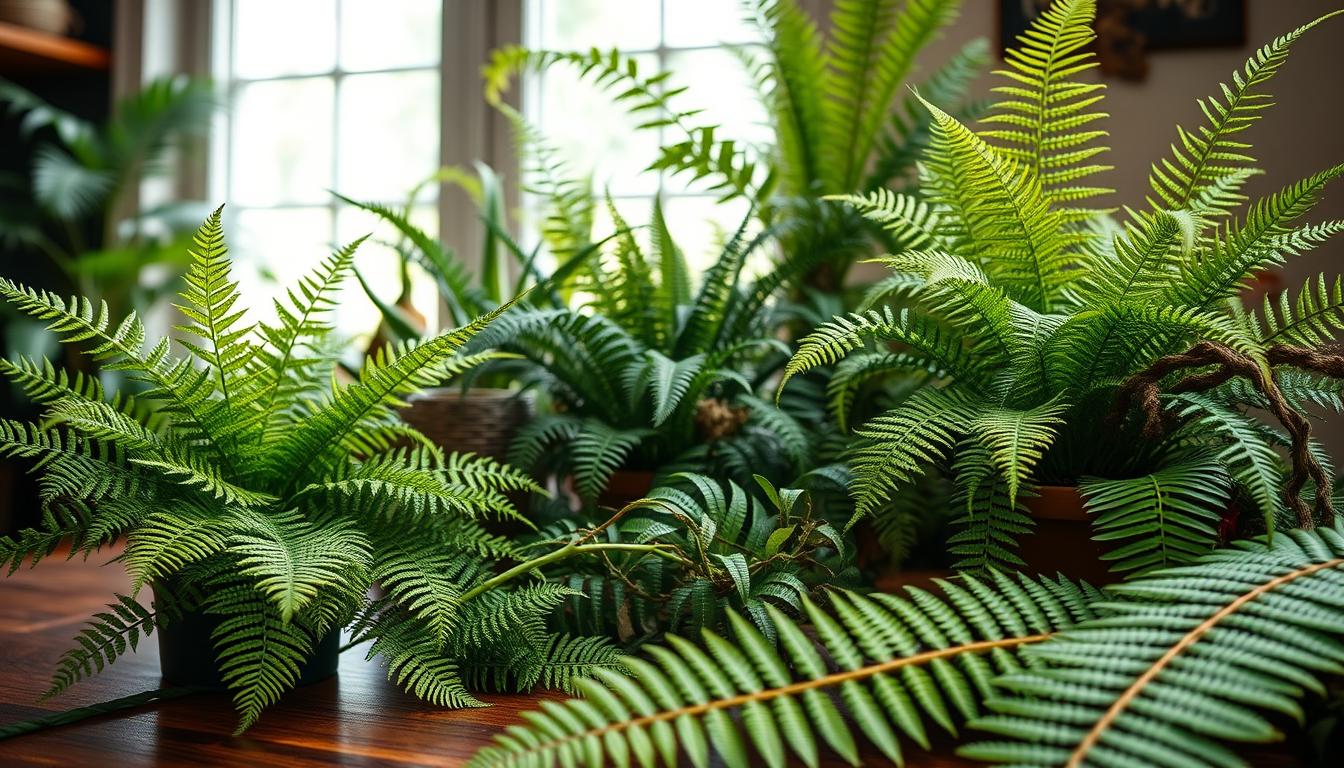
The main types of ferns for gardeners fall into two groups: hardy ferns that live outdoors all year, such as shield ferns, male ferns and the shuttlecock fern, and tender tropical ferns grown as houseplants, such as Boston, bird’s nest and staghorn ferns. I am Sawera Shahid, a botanist at Patch Plants. The RHS notes that ferns are ancient plants, dating back more than 360 million years, and that they reproduce by spores rather than flowers or seeds. That long history explains their huge variety of shapes and textures.
This guide lists 21 types of ferns, 10 for the garden and 11 for indoors, with the conditions each one needs. It then covers how to grow ferns indoors and out, how to propagate them, and which ferns are safe around pets.
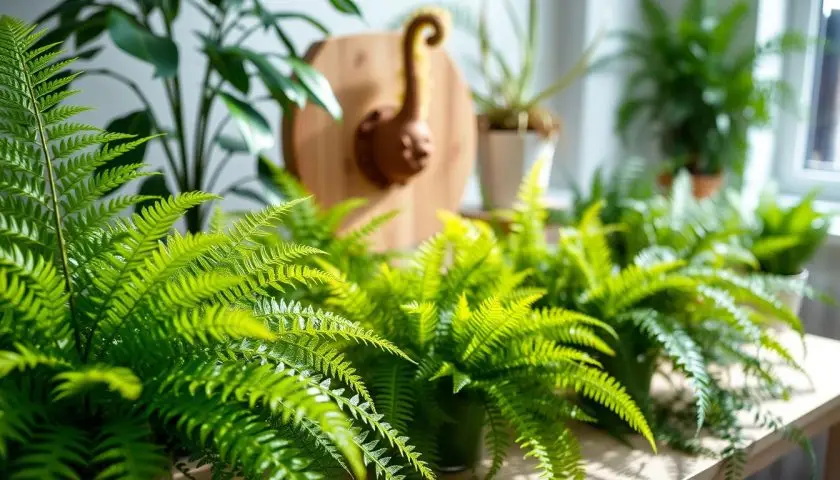
Types of Ferns at a Glance
| Fern | Where | Height | Best For |
|---|---|---|---|
| Aleutian maidenhair | Outdoors | 30–60cm | Moist shade by a north wall |
| Hard fern | Outdoors | 30–45cm | Shady, lime-free soil |
| Japanese lace fern | Outdoors | 80cm | Shady borders, evergreen |
| Autumn fern | Outdoors | 60cm | Moist shade, coloured new fronds |
| Shuttlecock fern | Outdoors | 1.2m | Moist soil, larger gardens |
| Sensitive fern | Outdoors | 30–45cm | Wet soil, pond edges |
| Cinnamon fern | Outdoors | 90cm | Clumps with cinnamon spring fronds |
| Welsh polypody | Outdoors | 40cm | Walls and limy rocks, sun or light shade |
| Hard shield fern | Outdoors | 40–60cm | Small shady spaces |
| Crested male fern | Outdoors | 50–100cm | Shade gardens |
| Boston fern | Indoors | 25cm–1m+ | Hanging baskets, humid rooms |
| Bird’s nest fern | Indoors | Up to 45cm | Easy, north-facing windows |
| Holly fern | Indoors | Up to 60cm | Dry air and low light |
| Southern maidenhair | Indoors | 15–50cm | High humidity, steady moisture |
| Staghorn fern | Indoors | 1m+ | Mounted on boards |
| Rabbit’s foot fern | Indoors | 60cm+ | Baskets with furry rhizomes |
| Squirrel’s foot fern | Indoors | 30–45cm | Hanging baskets |
| Kangaroo paw fern | Indoors | 30cm tall, wide-spreading | Pots and baskets |
| Button fern | Indoors | 30–45cm | Small spaces |
| Cretan brake fern | Indoors | 15–30cm | Easy, compact |
| Hart’s tongue fern | Indoors or out | 15–30cm leaves | Cool rooms or shady gardens |
Outdoor heights come from the RHS list of award-winning starter ferns; indoor sizes come from Clemson Extension’s indoor ferns guide.
10 Types of Ferns for the Garden
Most types of ferns sold for gardens are hardy, according to the RHS, and survive UK winters outdoors without protection. All ten below hold the RHS Award of Garden Merit.
1. Aleutian maidenhair (Adiantum aleuticum)
Wiry black stems carry swirls of fronds with pairs of small leaflets, arching like a frilly umbrella. The RHS suggests moist but well-drained soil at the foot of a north wall. It grows to 30 to 60cm with a hardiness rating of H6. It is the hardy cousin of the indoor maidenhairs, covered in our maidenhair fern care guide.
2. Hard fern (Blechnum spicant)
An evergreen fern with slender, dark fronds of tough leaflets. Fertile fronds stand upright in the centre and fade to brown as spores develop. The RHS notes it suits moist, well-drained, shady sites but dislikes lime, so choose it for neutral to acid soil. Height 30 to 45cm, H6.
3. Japanese lace fern (Polystichum polyblepharum)
This evergreen forms a neat shuttlecock of glossy, dark green fronds, and young fronds are yellowish with golden, hair-like scales. It grows to about 80cm and is fully hardy (H7). The RHS recommends it for shady borders and woodland-style planting.
4. Autumn fern (Dryopteris erythrosora)
Also called the copper shield fern, it has new spring fronds that open pink or red before maturing to glossy dark green, and the cultivar ‘Brilliance’ has especially bright colour. The RHS lists it as evergreen, about 60cm tall and H4, and suited to moist shade.
5. Shuttlecock fern (Matteuccia struthiopteris)
Also called the ostrich fern, this is one of the most dramatic types of ferns, forming tall shuttlecocks of fresh green fronds to about 1.2m. The RHS warns that it insists on moisture and sends out runners that produce new crowns up to 45cm away, so it suits larger gardens. H5.
6. Sensitive fern (Onoclea sensibilis)
One of the best types of ferns for wet ground, this deciduous fern has fronds that die back at the first autumn frost. New fronds often emerge pinkish and mature to a slightly bluish green. The RHS recommends it for wet conditions in sun or shade, including pond margins, where its rhizomes help to stabilise the soil. Height 30 to 45cm, H6.
7. Cinnamon fern (Osmunda cinnamomea)
This fern forms tight clumps of upright green shuttlecocks. In spring, cinnamon-brown spore-bearing fronds appear in the centre, which gives it its name. The RHS lists it at about 90cm tall, H6.
8. Welsh polypody (Polypodium cambricum ‘Cambricum’)
Unlike most ferns, this one is happy in full sun or light shade. It creeps over rocks and walls on tough brown rhizomes, and its thin, sharply divided fronds appear in July and August and stay attractive until spring. The RHS recommends it for limy rocks and walls. Height 40cm, H7.
9. Hard shield fern (Polystichum aculeatum)
Among the neatest types of ferns for small gardens, this evergreen rarely spreads, usually forming a single crown of neatly divided, dark green, arching fronds. The RHS suggests it for shade gardens and small spaces. Height 40 to 60cm, H7.
10. Crested male fern (Dryopteris filix-mas ‘Cristata’)
A deciduous fern that forms a neat rosette of upright or arching fronds up to 60cm long, with crested tips. The RHS lists it at 50 to 100cm, fully hardy (H7) and ideal for shade gardens. The RHS notes that many Dryopteris cope with dry shade once established, which makes them useful under trees.
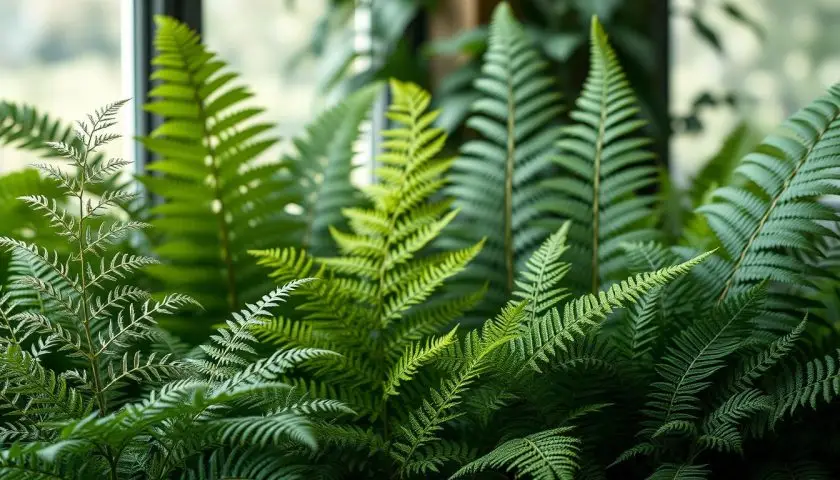
11 Types of Ferns for Indoors
Indoor types of ferns are mostly tropical and need warmth and humidity. Clemson Extension notes that most do well at about 16 to 21°C (60 to 70°F) by day, with nights about 5 to 6°C (10°F) cooler.
11. Boston fern (Nephrolepis exaltata)
The classic hanging-basket fern. Clemson Extension gives a size of 25cm to more than 1m (10in to 3ft+), bright indirect or filtered light, barely moist compost and high humidity. Cultivars include ‘Bostoniensis’, ‘Compacta’, ‘Fluffy Ruffles’ and the lacy ‘Verona’. See our full Boston fern care guide.
12. Bird’s nest fern (Asplenium nidus)
Clemson Extension calls it easy, with broad, soft, undivided fronds that form a vase shape up to about 45cm (18in) tall. It suits a north-facing window and likes evenly moist compost. University of Missouri notes that it can cope with drier conditions than most other ferns.
13. Holly fern (Cyrtomium falcatum)
One of the toughest indoor types of ferns. Clemson Extension describes glossy, toothed fronds like holly leaves, up to about 60cm (24in), and notes that it tolerates dry air, low light and draughts. It is a good choice if other ferns have struggled in your home.
14. Southern maidenhair (Adiantum capillus-veneris)
With very delicate fronds, this is one of the most beautiful indoor ferns and one of the trickiest. Clemson Extension notes that maidenhairs need constantly moist compost and around 50% humidity, and that a north-facing window is ideal. Brown edges are a sign of dry air.
15. Staghorn fern (Platycerium bifurcatum)
Staghorn ferns grow on bark or boards rather than in soil. Clemson Extension describes grey-green, antler-like fronds and tan basal fronds that the plant uses to attach itself. It needs bright, indirect light, a mounting material that stays moist and very high humidity. Plants can exceed 1m (3ft).
16. Rabbit’s foot fern (Polypodium aureum)
Also sold as blue star fern, this has leathery fronds on furry rhizomes that creep over the surface of the pot. Clemson Extension recommends bright, indirect light, barely moist compost and keeping the rhizomes unburied. ‘Mandaianum’ has bluish-green, twisted fronds.
17. Squirrel’s foot fern (Davallia trichomanoides)
Another fern with furry, creeping rhizomes, which makes it a natural for hanging baskets. Clemson Extension gives a height of 30 to 45cm (12 to 18in), feathery dark green fronds, and a preference for a north-facing window with compost kept barely moist.
18. Kangaroo paw fern (Microsorum diversifolium)
Clemson Extension describes leathery, dark green fronds on creeping rhizomes, reaching about 30cm (1ft) tall and spreading 90cm to 1.2m (3 to 4ft) wide. It likes a bright north window and compost that is moist but not wet.
19. Button fern (Pellaea rotundifolia)
One of the most unusual types of ferns, the button fern has round, leathery leaflets on arching stems, 30 to 45cm (12 to 18in) long. Clemson Extension suggests bright indirect or filtered light, with some winter sun, and compost kept moist but not wet. It is a good choice for shelves and small spaces.
20. Cretan brake fern (Pteris cretica)
Clemson Extension lists it as easy, at 15 to 30cm (6 to 12in), and ideal for a north-facing window with barely moist compost. ‘Albo-lineata’ has cream stripes along each leaflet, while ‘Wilsonii’ has finely divided tips.
21. Hart’s tongue fern (Asplenium scolopendrium)
Hart’s tongue has strap-shaped, leathery leaves 15 to 30cm (6 to 12in) long, and ‘Crispum’ has frilled edges. Clemson Extension notes it prefers cool conditions of about 4 to 16°C (40 to 60°F) indoors, with even moisture and less water in winter. It is also a hardy garden fern, so it is one of the few types of ferns that can live indoors or out.
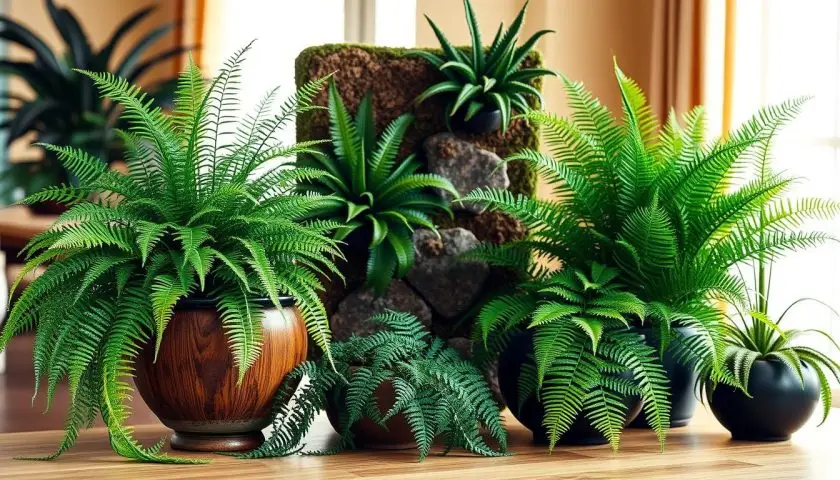
How to Grow Ferns Outdoors
The RHS advice for garden ferns is straightforward:
- Position: most prefer light or dappled shade and can take some sun if the soil stays moist.
- Soil: rich in organic matter such as garden compost or leafmould. Most prefer neutral to alkaline soil, but a few, such as hard fern, need acid conditions.
- Planting: spring or autumn, so roots establish before extremes of temperature.
- Watering: water new ferns regularly for at least their first year, at the roots rather than over the crown.
- Mulching: mulch annually in spring with garden compost or well-rotted manure.
- Tidying: remove dead or tattered fronds in spring before new fronds unfurl, and cut back deciduous types in winter.
For containers, the RHS suggests a mix of three parts peat-free multipurpose compost, one part peat-free John Innes No 3 and one part horticultural grit. If you want ferns for brighter spots, see our guide to ferns for full sun, and for shady corners, our list of shade-loving plants for outdoors.
How to Grow Ferns Indoors
Clemson Extension’s advice for indoor ferns covers five main points:
- Light: moderate, indirect light, with a north-facing window ideal. Direct sun through south- or west-facing windows scorches fronds.
- Humidity: household air is often too dry for fine-leaved ferns, especially in winter. Grouping plants or standing pots on a humidity tray helps.
- Watering: never let ferns dry out completely, but do not leave water sitting in the pot.
- Compost: a porous, fast-draining organic mix that resembles forest soil.
- Feeding: half-strength liquid houseplant feed once a month from April to September, and none in winter.
University of New Hampshire Extension adds a useful rule: ferns with tough, leathery leaves, such as holly and bird’s nest ferns, cope better with dry indoor air, while feathery types do best where humidity is higher. Bathrooms with good light suit many indoor types of ferns; see our guide to plants for the shower.
How to Propagate Ferns
The RHS says division is the easiest method for most types of ferns. For ferns with creeping rhizomes, cut sections 5 to 7.5cm long in spring, each with a bud and some roots. For clump-forming ferns, split the crowns apart in spring with two forks back to back. Some ferns, such as soft shield fern, form small bulbils along the frond that can be pegged down to root. Growing from spores is possible but slow; the RHS notes plants are usually ready to plant out after one to two years.
Common Problems With All Types of Ferns
| Problem | Likely Cause | What to Do |
|---|---|---|
| Brown frond tips | Dry air or dry soil (RHS, Clemson) | Raise humidity; water more evenly |
| Rotting crown | Waterlogged soil or water on the crown (RHS) | Improve drainage; water at the roots |
| Scorched, pale fronds | Direct sun | Move to indirect light or shade |
| Chewed young fronds | Slugs and snails (RHS) | Check and remove in spring |
| Wilting container ferns | Vine weevil grubs (RHS) | Check roots for C-shaped grubs |
| Sticky fronds, small bumps | Scale insects (Clemson) | Remove by hand or with a water spray |
Clemson Extension warns that some pesticides can injure ferns, so test any product on a few fronds first.
Are Ferns Safe for Pets?
Many true types of ferns are considered safe. The ASPCA lists Boston fern as non-toxic to dogs and cats. Be careful with plants that are called ferns but are not: the ASPCA lists asparagus fern (Asparagus densiflorus), which is related to lilies and asparagus rather than ferns, as toxic to dogs, cats and horses. If you are unsure about a particular plant, check the ASPCA list or contact your vet or the ASPCA Animal Poison Control Center at (888) 426-4435 (a consultation fee may apply). Our guide to making your plants cat-friendly has more tips.

Frequently Asked Questions
What are the easiest types of ferns to grow indoors?
Holly fern, bird’s nest fern and Cretan brake fern are among the easiest, according to Clemson Extension. Leathery-leaved ferns cope better with dry indoor air than feathery ones.
Which ferns grow in full sun?
Most ferns prefer shade, but a few tolerate sun if the soil stays moist. The RHS recommends Welsh polypody for full sun or light shade on walls and rocks, and sensitive fern for wet soil in sun or shade.
Do ferns need a lot of water?
Ferns like steady moisture but not waterlogging. Water new garden ferns regularly in their first year, and never let indoor ferns dry out completely.
Are ferns evergreen?
Some are and some are not. Hard fern, Japanese lace fern and hard shield fern are evergreen, while sensitive fern and male fern are deciduous and die back in winter.
Is the asparagus fern a real fern?
No. Asparagus fern is related to asparagus and lilies, not true ferns, and the ASPCA lists it as toxic to dogs, cats and horses.
Final Thoughts
As a botanist, I find ferns endlessly interesting because they are survivors from long before flowering plants existed. Matching the right types of ferns to the right place, whether a shady wall, a pond edge or a humid bathroom, is the whole secret to growing them well.
Patch Plants guides set out to explain the plant science behind each choice, so you can pick ferns that thrive rather than just survive. For more foliage plants for low light, browse our guide to low-light house plants.
Sources: RHS, 10 award-winning starter ferns; RHS, How to grow ferns; Clemson Extension, Indoor Ferns; UNH Extension, Do ferns make good houseplants?; University of Missouri, Ferns; ASPCA, Asparagus Fern.

About the author
Sawera Shahid is a botanist with an MPhil in Botany and 5+ years of writing about plants. As founder and lead writer of Patch Plants, she writes practical, science-backed guides on indoor plants, outdoor gardens and plant problems, checked against RHS and university extension advice.