The best shade-loving plants for outdoor gardens are hostas, ferns, hellebores, astilbe, bleeding heart, heuchera and epimedium for borders, plus hydrangeas, mahonia and sarcococca for shrubby structure. For pots and hanging baskets in shade, begonias, fuchsias, impatiens and heucheras give the most color. Match each plant to your type of shade (dappled, partial, full or dry) and enrich the soil with compost, and a shaded corner can be one of the lushest parts of the garden.
Shade is not a problem to fix; it is a growing condition. Many woodland plants have broad, thin leaves that capture low light efficiently, and their flowers often last longer out of hot sun. This guide explains the types of shade, the best perennials, shrubs and container plants for each, and how to prepare the soil so they thrive.
At Patch Plants, botanist Sawera Shahid writes our outdoor guides with the same rule as our houseplant ones: match the plant to the conditions it evolved in. Most shade lovers come from woodland floors with cool, leafy, moisture-holding soil, and recreating that is half the job. You can read more about our approach on the About Patch Plants page.
Key Takeaways
- Shade comes in several types: dappled, partial (3–6 hours of sun), full (under 3 hours) and dry shade under trees.
- Hostas, ferns, hellebores, astilbe and heuchera are the backbone of most shade borders.
- Hydrangea, mahonia, sarcococca and viburnum add structure, flowers and winter interest.
- Begonias, fuchsias, impatiens and heucheras are the best choices for shaded pots and hanging baskets.
- Dry shade under trees is the hardest spot; epimedium, cyclamen and some ferns cope best.
- Hellebores, ferns and epimedium are rarely eaten by deer; hostas are a favourite, so protect them.
- Dig in compost or leaf mould before planting and mulch every year.
Understanding the Types of Shade
Matching plants to your exact shade is the most important decision in a shade garden. University of Minnesota Extension defines part shade as about 3 to 6 hours of sunlight a day and full shade as less than 3 hours, with deep shade receiving almost none.
| Type of shade | What it means | Typical spots | Good plant groups |
|---|---|---|---|
| Dappled shade | Moving, filtered light through a tree canopy | Under open, deciduous trees | Most woodland perennials, ferns, hellebores |
| Partial shade | About 3–6 hours of direct sun, often morning sun only | East-facing beds, beside fences | Astilbe, hydrangea, heuchera, foxglove |
| Full shade | Less than 3 hours of direct sun | North-facing walls, under dense trees | Hostas, ferns, sarcococca, mahonia |
| Dry shade | Shade plus dry soil from tree roots or overhangs | Under mature trees, beside walls and eaves | Epimedium, hardy cyclamen, some ferns |
Morning sun is gentler than afternoon sun, so an east-facing spot with 4 hours of morning light suits more shade plants than a west-facing one with the same hours. Watch your garden through a full day, ideally in summer, before choosing plants. If you also have sunny spots, compare our guides to outdoor plants that like direct sunlight and ferns that handle more sun.
Best Shade-Loving Perennials

Perennials come back every year, slowly filling space and creating the layered, woodland look that makes shade gardens special.
1. Hostas
Hostas are the classic shade plant, with leaves in blue-grey, gold, cream-edged and every shade of green, from tiny 10 cm mounds to giants over 1 m across. Blue-leaved types keep their colour best in shade, while gold types colour up better with a little morning sun.
- Light: Partial to full shade
- Soil: Moist, rich, well drained
- Reliable varieties: ‘Halcyon’ (blue-grey), ‘Sum and Substance’ (large, gold), ‘Frances Williams’ (blue-green with gold edges), ‘June’ (gold with blue-green margins)
- Watch out for: slugs, snails and deer, which all love hostas
Some hostas, such as Hosta plantaginea, have fragrant white flowers in late summer, but most are grown for their leaves. Pair hostas with ferns and astilbe for a classic contrast of broad and feathery foliage.
2. Astilbe
Astilbe produces feathery plumes in white, pink, red and purple above fern-like leaves, mostly from early to late summer. It is one of the brightest flowers for partial shade, but it needs moisture: in dry soil the leaves crisp and the plumes are short-lived.
- Light: Partial shade; some morning sun helps flowering
- Soil: Consistently moist, rich in organic matter
- Varieties: ‘Fanal’ (deep red), ‘Bridal Veil’ (white), ‘Purple Rain’ (purple), ‘Bressingham Beauty’ (pink)
Leave the dried flower heads in place over winter; they add structure and frost interest. For combining shade and sun plants across the seasons, see our guide to creating a colorful garden for all seasons.
3. Hellebores
Hellebores (Helleborus) flower from late winter into spring, with nodding blooms in cream, pink, purple, green and near-black, just when little else is in flower. Most have leathery, evergreen leaves.
- Light: Dappled or partial shade, ideally under deciduous trees
- Soil: Rich, well drained; they cope with drier soil once established
- Care tip: cut off old, tatty leaves in late winter so the new flowers are visible
Hellebores are rarely eaten by deer or rabbits, and all parts are toxic if eaten, so keep children and pets from chewing them. Our guide to the Christmas rose (Helleborus niger) covers the earliest-flowering type, and our list of winter plants for outside suggests companions.
4. Hardy Ferns
Hardy ferns add texture and movement all season, and many need very little care. Good choices include:
- Dryopteris erythrosora (autumn fern): coppery-red new fronds that mature to deep green
- Athyrium niponicum var. pictum (Japanese painted fern): silver fronds with burgundy stems
- Polystichum setiferum (soft shield fern): evergreen in most winters
- Osmunda regalis (royal fern): a large, dramatic fern up to 1.5 m for moist or boggy soil
Smaller ferns, especially Japanese painted ferns, also do well in pots on shady patios.
5. Bleeding Heart (Lamprocapnos spectabilis)
Bleeding heart has arching stems hung with heart-shaped pink-and-white or pure white flowers in spring. It needs partial to full shade and moist, rich soil. It usually dies back after flowering in early summer, so plant hostas or ferns next to it to fill the gap.
6. Foxglove (Digitalis purpurea)
Foxgloves add height, with 1–1.5 m spires of tubular purple, pink, white or cream flowers in early summer. They are biennial: they grow leaves in the first year and flower in the second, then usually die, but they self-seed freely. Bumblebees love the flowers. All parts are poisonous, so avoid planting them where young children or pets might chew them.
7. Heuchera (Coral Bells)
Heucheras are grown for their leaves, in caramel, burgundy, silver, lime and near-black, which add color to shade beds all year. They suit partial shade with a little morning sun and are excellent in pots.
8. Epimedium (Barrenwort)
Epimedium forms low, weed-suppressing clumps with delicate spring flowers and heart-shaped leaves that often colour in spring and autumn. It is one of the best plants for dry shade under trees once established.
9. Pulmonaria (Lungwort)
Pulmonaria has silver-spotted leaves and spring flowers that open pink and turn blue. It is an early source of nectar for bees and suits moist, partial to full shade.
For more pollinator-friendly ideas, see our guides to pollinator-friendly plants for urban spaces and designing a wildlife-friendly garden.
Shade-Tolerant Shrubs
Shrubs give shade gardens permanent structure, privacy and a backdrop for perennials and bulbs.
Hydrangea
Hydrangeas are the showiest flowering shrubs for partial shade, with large flower heads from mid to late summer. Mophead and lacecap hydrangeas (Hydrangea macrophylla) do best with morning sun and afternoon shade; their flowers turn blue in acidic soil and pink in alkaline soil. Panicle hydrangeas (H. paniculata) take more sun but still flower in partial shade, and oakleaf hydrangeas (H. quercifolia) add rich autumn leaf colour. Water them well in dry spells, because hydrangeas wilt quickly.
Mahonia
Mahonia (Mahonia japonica and Mahonia × media) is an evergreen shrub with bold, spiny leaves, fragrant yellow flowers from late autumn to late winter, and blue-black berries that birds eat. It copes with full shade and is rarely browsed by deer thanks to its prickly leaves.
Sarcococca (Sweet Box)
Sarcococca is a compact evergreen with tiny white flowers in mid to late winter that have a strong, sweet scent. It grows well in full shade and is ideal beside paths and doors, where you will notice the fragrance.
Viburnum and Camellia
Many viburnums tolerate partial shade and offer spring flowers, autumn colour or berries. Camellias flower in late winter and spring and prefer partial shade, shelter from cold winds and acidic soil; morning sun on frosted buds can damage the flowers, so a west- or north-facing position is often best.
Shade-Loving Plants for Pots and Hanging Baskets
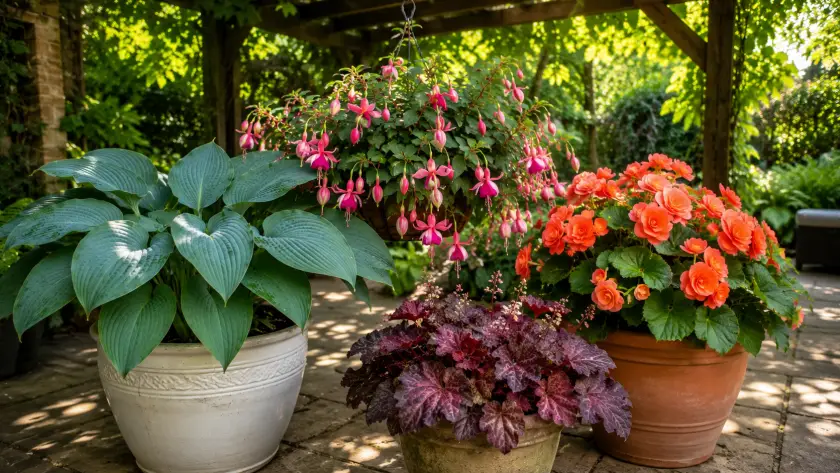
The right container plants can turn a gloomy, shaded patio or balcony into a lush outdoor room.
Flowering Container Plants for Shade
- Begonias: Wax begonias (Begonia semperflorens) and tuberous begonias flower from early summer to the first frost in partial shade. Trailing tuberous types such as ‘Illumination’ are excellent in hanging baskets.
- Fuchsias: Trailing fuchsias are classic plants for shady hanging baskets, with dangling two-tone flowers all summer. Hardy types can stay in the ground in mild areas; tender types need frost protection.
- Impatiens (busy Lizzies): Flower non-stop in partial to full shade. Where impatiens downy mildew has been a problem, choose resistant varieties or New Guinea impatiens.
Foliage Container Plants for Shade
- Hostas: grown in large pots (40 cm or more), they look elegant and are easier to protect from slugs.
- Ferns: Japanese painted ferns and smaller Dryopteris keep their shape all season.
- Heucheras: give year-round foliage color in mixed planters.
Pots dry out faster than beds, even in shade, so check them often in summer. For more container ideas, see our guides to shade garden pots, plants in pots in shade, container garden plants for shade, small plants that like shade and the best plants for container gardening on patios. Our complete watering guide and article on the worst times to water your plants help with container watering.
Plants for Difficult Shade
Dry Shade Under Trees
Dry shade is the hardest condition, because tree roots take most of the water and the canopy blocks rain. Improve the soil with compost, plant small, water new plants regularly for their first year, and mulch well. Plants that cope best include:
- Epimedium: one of the most reliable dry-shade ground covers
- Hardy cyclamen (Cyclamen hederifolium and C. coum): flower in autumn and late winter, then rest through dry summers
- Ferns such as Dryopteris once established
- Ivy (Hedera helix): a tough evergreen ground cover in Europe, but it is invasive in some regions, including parts of North America, so check local guidance before planting; see our English ivy care guide
Deer-Resistant Plants for Shade
No plant is completely deer-proof, but these are rarely browsed: hellebores, ferns, epimedium, foxgloves, astilbe, pulmonaria and mahonia. Hostas, by contrast, are a deer favourite and need fencing or repellents in rural gardens.
Houseplants That Can Summer Outdoors in Shade
Many houseplants enjoy a summer outdoors in a sheltered, shady spot, as long as night temperatures stay above about 12–15°C. Good candidates include pothos, snake plants, ZZ plants and peace lilies. Move them gradually, keep them out of direct sun and heavy rain, check for pests, and bring them back in before nights turn cold.
Shade Plants by Season

| Season | Shade plants for interest |
|---|---|
| Late winter | Hellebores, sarcococca, mahonia, Cyclamen coum, snowdrops |
| Spring | Primroses, pulmonaria, bleeding heart, wood anemones, bluebells, epimedium |
| Summer | Astilbe, foxgloves, hydrangeas, hostas, begonias, fuchsias, impatiens |
| Autumn | Cyclamen hederifolium, oakleaf hydrangea colour, autumn fern, heuchera |
In the UK, choose the native English bluebell (Hyacinthoides non-scripta) rather than the Spanish bluebell, which hybridises with it. For more cold-season plants, see our guide to outdoor plants that survive British winters.
How to Prepare Soil for a Shade Garden
Most shade perennials evolved on woodland floors, where fallen leaves create deep, crumbly, moisture-holding soil. Recreating that is the single best thing you can do for a shade garden.
- Dig in 5–10 cm of well-rotted compost or leaf mould before planting.
- Make leaf mould by collecting autumn leaves in bags or a wire bin and leaving them to rot for one to two years.
- Mulch every spring with 5–7 cm of compost, leaf mould or bark to keep moisture in and weeds down.
- Under trees, plant small and avoid piling soil over tree roots; feed lightly in spring, because roots compete for nutrients.
Our soil mix guide covers potting mixes for shade containers, and our guide to keeping outdoor plants alive covers watering and feeding through the year.
Wildlife Value of Shade Gardens

Shade gardens can be valuable for wildlife. Hellebores and pulmonaria provide early nectar for bumblebee queens; foxgloves feed bumblebees in summer; mahonia berries feed birds in winter; and leaf litter and dense planting shelter insects, frogs and other small creatures. Our guide to native plants that thrive in your region explains why local species often support the most wildlife.
Shady patios can attract mosquitoes in summer. Scented plants alone will not stop bites, but reducing standing water and adding a few aromatic plants can help; see our guide to shade plants that repel mosquitoes.
Frequently Asked Questions
What are the best shade-loving plants for an outdoor garden?
Hostas, ferns, hellebores, astilbe and heuchera are the most reliable perennials, and hydrangea, mahonia and sarcococca are the best shrubs. Together they give foliage, flowers and structure from ground level upward, through every season.
What flowers grow well in full shade?
In full shade, try impatiens, wax begonias, bleeding heart, hellebores, pulmonaria and hardy cyclamen. Most flowering plants bloom better with a few hours of morning sun, so use foliage plants such as hostas and ferns in the darkest spots.
What are the best plants for shady pots and hanging baskets?
Begonias, fuchsias and impatiens give the most flowers, while hostas, ferns and heucheras add foliage interest. Use large pots with drainage holes and check them often, because containers dry out quickly even in shade.
What evergreen plants grow in shade?
Mahonia, sarcococca, many hellebores, soft shield fern (Polystichum setiferum), epimedium and some heucheras stay attractive through winter in shady gardens.
Which shade plants do deer avoid?
Deer rarely eat hellebores, ferns, epimedium, foxgloves, astilbe, pulmonaria or mahonia. No plant is completely deer-proof, and hostas are a favourite, so protect them in rural gardens.
Final Thoughts
A shaded garden can be the coolest, calmest and most layered part of your outdoor space. Start by working out what kind of shade you have, enrich the soil with compost or leaf mould, and build around a few reliable plants: a hosta, a fern and an astilbe for summer, hellebores and sarcococca for winter, and begonias or fuchsias for shady pots. You can browse all our outdoor plant guides and our list of low-maintenance outdoor plants for more ideas.