Pruning basics become easier when you understand why to cut, where to make each cut, and when a plant can recover. Whether you are trimming a leggy pothos, removing dead leaves from a houseplant, or shaping a flowering shrub, careful pruning can improve a plant’s structure, appearance, and long-term health.
To prune plants correctly, first identify dead, damaged, diseased, or overcrowded growth. Choose sharp, clean tools, check the right season for your plant, and make precise cuts at a healthy node, bud, lateral branch, or branch collar. Start lightly rather than removing a large amount of healthy growth at once.
This beginner-friendly plant pruning guide covers nine practical steps, the best times to prune different plants, pruning tools, heading versus thinning cuts, flowering shrubs, houseplant pruning, and common mistakes. You will also learn how to avoid damaging tree trunks, encourage fuller foliage, and care for plants after pruning.
What Is Pruning?
Pruning is the selective removal of plant parts, including stems, branches, leaves, buds, or spent flowers, to achieve a specific purpose. Gardeners prune to remove unhealthy growth, guide plant shape, maintain clearance, control size, or encourage particular types of growth.
Pruning is not simply cutting everything back to make a plant smaller. Every cut changes the plant’s structure and may affect future branching or flowering.
The basic rule is simple: identify the reason for a cut before making it. If a stem is healthy, well positioned, and not interfering with the plant’s growth or its surroundings, it may not need pruning at all.
The Royal Horticultural Society’s beginner pruning guide explains that many ornamental trees and shrubs need only occasional pruning for shape, health, vigor, or size management.
Key Takeaways
- Start with dead, damaged, diseased, crossing, or rubbing stems before making cosmetic cuts.
- Use sharp tools matched to the thickness of the stem or branch.
- For many soft-stemmed houseplants, cut just above a healthy node to encourage suitable branching.
- For woody tree branches, preserve the natural branch collar rather than cutting flush against the trunk.
- Spring-flowering shrubs that bloom on old wood are generally pruned soon after flowering.
- Many summer-flowering shrubs that bloom on new wood can be pruned in late winter or early spring.
- Thinning cuts remove entire unwanted stems, while heading cuts shorten stems and can stimulate branching below the cut.
- Avoid heavy pruning during drought, extreme heat, freezing weather, or severe plant stress unless an urgent safety or disease issue requires action.
- Large, hazardous, elevated, or utility-line-adjacent branches should be handled by qualified professionals.
Pruning Basics at a Glance
| Pruning Question | Beginner-Friendly Answer |
|---|---|
| Why prune? | Remove damaged growth, improve structure, manage shape, or encourage suitable new shoots |
| Where should you cut? | Above a healthy node or bud, back to a lateral branch, or just outside the branch collar |
| When should you prune? | According to plant species, flowering habit, climate, and growth stage |
| What tools do you need? | Clean scissors, bypass pruners, loppers, or a pruning saw depending on stem size |
| How much should you remove? | Only enough to meet a clear objective; begin conservatively |
| Can pruning improve bushiness? | Yes, heading or pinching can encourage branching in suitable plants |
| Should all plants be pruned in spring? | No; timing differs by species and flowering season |
| Should pruning wounds be painted? | Usually not; certain local disease-prevention recommendations are exceptions |
Why Is Pruning Important for Plants?
Pruning has several practical benefits, but not every plant needs regular cutting. The best outcome depends on choosing the right technique for the specific plant.
Remove Dead, Damaged, or Diseased Growth
Removing broken stems and dead branches can reduce hazards and improve appearance. Carefully removing diseased material may also reduce infection sources when the disease and appropriate sanitation procedure are understood.
However, pruning does not cure every plant disease. Affected plants may need further diagnosis and changes to their growing conditions.
Improve Plant Structure
Crossing branches can rub against one another and damage bark. Selective pruning removes competing growth and gives retained branches enough space to develop.
For young trees, early structural pruning can reduce the likelihood of weak branch arrangements becoming larger problems later.
Encourage Fuller Growth
Cutting or pinching the growing tip of some plants reduces the dominance of the terminal bud. This can encourage dormant buds farther down the stem to develop into side shoots.
Not all plants respond in the same way. A pothos vine, a clumping snake plant, and a mature conifer have different growth patterns.
Support Flowering
Correct pruning may encourage growth that carries future flowers. Incorrect timing, however, can remove buds before they open.
This is why the difference between plants that flower on old wood and those that flower on new wood is essential.
Maintain Size and Safe Clearance
Pruning can prevent branches from obstructing paths, windows, or walkways. It should not be used to force a naturally very large plant into a permanently unsuitable location.
Choosing a plant whose mature size fits the space often reduces the amount of future pruning needed.
How to Prune Plants in 9 Easy Steps
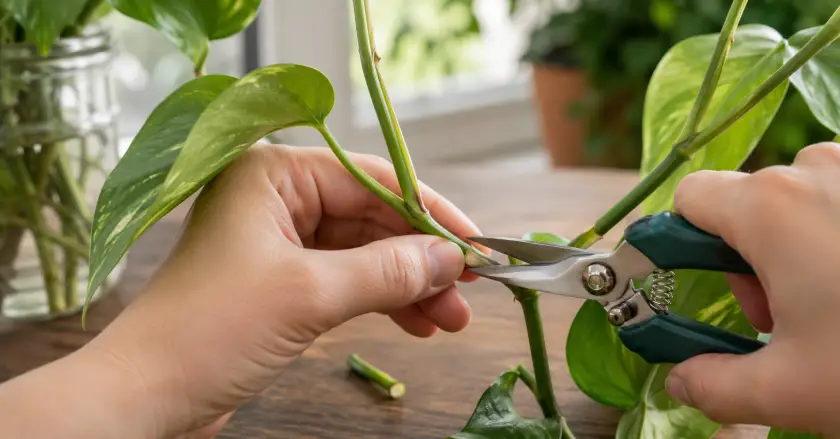
These steps provide a general method for pruning common houseplants and small garden plants. They are not a substitute for species-specific advice or professional tree work.
Step 1: Identify Your Plant Before Cutting
Start with the botanical name or a reliable plant identification. Different plants respond differently to pruning.
For example, a climbing pothos may branch after a suitable stem cut, while a snake plant leaf will not branch in the same way. Some shrubs regrow well from old wood, whereas others may fail to regenerate after severe cutting.
Identify whether the plant is a vine, clumping perennial, flowering shrub, evergreen, succulent, or tree.
Step 2: Decide Why You Are Pruning
Look at the entire plant and define your purpose before picking up the shears.
Common reasons include:
- Removing dead or broken growth
- Taking out visibly diseased stems
- Reducing crossing and rubbing branches
- Encouraging a fuller shape
- Controlling overly long vines
- Removing spent flowers
- Maintaining safe clearance around pathways
If you are unsure why a healthy branch should be removed, leave it until you understand the plant’s natural growth habit.
Step 3: Check the Correct Pruning Season
Before significant pruning, confirm whether the plant flowers on old or new wood and whether it is currently under environmental stress.
Some houseplants can be lightly groomed throughout the year, but stronger shaping is often best during active growth. Outdoor flowering shrubs may have a specific seasonal window.
The pruning calendar later in this guide provides a practical starting point.
Step 4: Select the Right Tools
Use fine scissors for small, soft stems and bypass hand pruners for many woody stems. Loppers and pruning saws are designed for larger material.
Do not force a thick branch into a tool that is too small. Crushing or tearing the stem can create unnecessary damage.
Wear suitable gloves and eye protection when needed, especially around thorny shrubs, irritating sap, or woody branches.
Step 5: Remove Dead or Damaged Material First
Begin with clearly dead leaves, broken stems, and other obvious problems.
For a houseplant, a fully dead leaf may be removed near the base of its leaf stalk without damaging healthy tissue. For a woody plant, trace the dead branch back to a suitable junction or branch collar.
If damage is extensive or disease is suspected, identify the problem before making numerous cuts.
Step 6: Remove Crossing or Crowded Growth
Look for branches or stems that rub together, grow inward, or compete for the same space.
Where appropriate, remove the less favorably positioned branch back to its origin. This is called a thinning cut.
Thin carefully so the plant retains enough foliage and its natural shape is not unnecessarily distorted.
Step 7: Make the Correct Cut
For many soft-stemmed plants, cut a short distance above a healthy node or leaf joint where new growth can emerge.
For small woody shoots, a cut roughly 1/4 inch above an appropriate bud is a useful general reference, although the correct distance varies with stem thickness and plant type.
For a tree branch, make the final removal cut just outside the branch collar. Never cut flush against the trunk simply to make the surface look smooth.
Use the cutting technique described in the next section for your plant.
Step 8: Step Back and Check the Shape
After a few cuts, examine the plant from several angles.
Check whether the remaining branches have an appropriate balance and whether your original pruning objective has been met.
Avoid removing additional healthy growth just because the plant looks temporarily uneven. It may respond with new shoots during the next growing period.
Step 9: Clean Up and Provide Proper Aftercare
Remove fallen leaves and cuttings, clean the tools, and maintain suitable watering and light.
Do not automatically water heavily or apply extra fertilizer after pruning. The plant’s needs depend on its growing conditions and how much foliage remains.
Monitor for healthy new growth and signs of unexpected decline over the following weeks.
Where to Cut When Pruning Plants
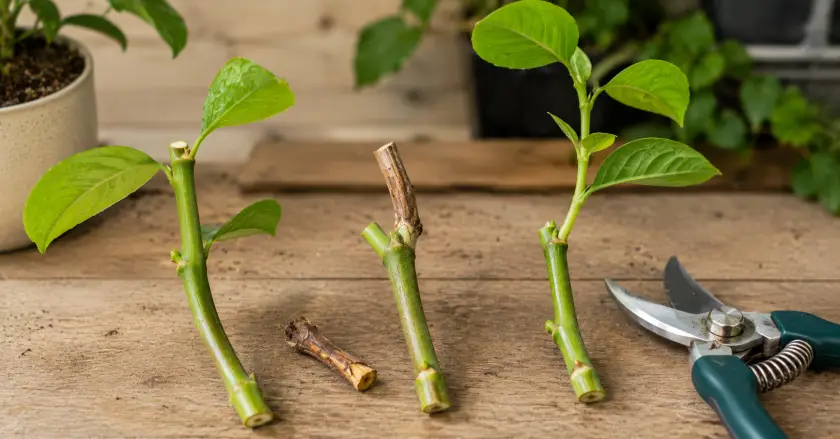
Where to cut when pruning depends on whether you are working with a soft green stem, a woody shrub, or a tree branch.
Cutting Above a Leaf Node
A node is the point on a stem where a leaf, branch, or bud attaches.
On many houseplants, cutting just above a healthy node can stimulate branching from buds below the cut.
This is especially useful for vining species such as pothos and heartleaf philodendron.
Do not cut so close that the node is damaged or leave an unnecessarily long bare stub above it.
Cutting Above an Outward-Facing Bud
When shaping suitable woody shrubs, an outward-facing bud can guide the general direction of new growth.
Locate a healthy bud pointing away from the center of the plant and make a clean cut a short distance above it.
This is most useful when the species responds predictably to heading cuts.
Removing a Branch at the Branch Collar
The branch collar is the slightly swollen area of tissue at the base of many woody branches where they join a larger branch or trunk.
To remove a branch, make the final cut just beyond this collar, leaving the parent stem’s tissue intact.
Never remove the collar with a flush cut, and do not leave a long branch stub.
The University of Minnesota Extension’s tree and shrub pruning guide explains why preserving the branch collar supports more effective wound closure.
How to Remove a Heavy Branch With the Three-Cut Method
A heavy branch can tear bark away from the trunk if you attempt to remove it with one cut.
The three-cut method reduces the weight of the branch before the final precise removal cut.
- First cut: Make an undercut on the underside of the branch, away from the trunk and outside the branch collar.
- Second cut: Make a cut slightly farther out from the trunk, working downward until the outer portion of the branch separates.
- Third cut: Remove the remaining stub just beyond the branch collar, without cutting into the trunk.
For small, accessible branches within your ability and with no hazard below, this is a useful technique to understand. For large limbs, work at height, branches under unusual tension, or anything near structures or utility lines, hire a qualified arborist.
Do not attempt tree work near power lines. Contact the utility provider or an appropriately qualified professional.
Basic Pruning Techniques Every Beginner Should Know
| Technique | What It Does | Typical Use |
|---|---|---|
| Thinning | Removes a stem or branch at its origin | Reducing crowding and crossing growth |
| Heading | Shortens a stem above a bud or side shoot | Managing shape and encouraging suitable branching |
| Pinching | Removes a small, soft growing tip | Encouraging bushiness in some herbs and houseplants |
| Deadheading | Removes spent flowers | Tidying and sometimes encouraging repeat blooms |
| Renewal pruning | Removes selected old stems from an established shrub | Supporting younger replacement growth in suitable species |
| Reduction pruning | Shortens a larger branch back to an appropriate lateral | Managing size while retaining suitable structure |
Thinning Cuts
Thinning removes an entire selected branch or stem at a suitable origin.
For shrubs, this may mean removing an older stem at the base. For trees, thinning generally means removing a branch just outside its collar.
Thinning can open crowded plant structures to more light and airflow without forcing dense new shoots at every cut.
Heading Cuts
Heading shortens a shoot instead of removing it completely.
In many plants, it encourages new growth below the cut. However, repeated heading can create dense outer growth that shades the plant’s interior.
Use heading thoughtfully rather than cutting every branch to the same length.
Pinching
Pinching removes the tender tip of a developing stem.
This technique can encourage branching in suitable herbs, flowers, and soft-stemmed houseplants.
For example, pinching a young basil stem above an appropriate leaf node can encourage additional shoots, provided the plant has enough healthy leaves remaining.
Deadheading
Deadheading removes flowers after they fade.
Some repeat-flowering plants produce more blooms when spent flowers are removed. Other plants naturally flower only once per season or are worth leaving for decorative seed heads and wildlife.
The RHS guide to deadheading plants describes how to remove spent blooms above appropriate buds, leaves, or side shoots.
Renewal Pruning
Renewal pruning removes some of the older stems from a shrub to encourage younger growth.
It works well for certain multi-stemmed deciduous shrubs but should not be applied indiscriminately to evergreens, conifers, or plants that do not regenerate from old wood.
For an established shrub, gradual renewal may be safer than removing nearly all the growth at once.
When Is the Best Time to Prune Plants?
The best time to prune depends on the plant’s species, flowering habit, local climate, and purpose of pruning.
Dead or hazardous growth may require prompt attention. More substantial shaping should generally be timed for when the plant can respond well.
Pruning Calendar for Common Plant Groups
| Plant Type | Typical Pruning Window | Important Note |
|---|---|---|
| Many deciduous shade trees | Late dormant season | Species-specific disease precautions may change timing |
| Spring-flowering shrubs on old wood | Soon after flowering | Winter pruning can remove flower buds |
| Summer-flowering shrubs on new wood | Late winter to early spring | Timing varies by species and climate |
| Many foliage houseplants | Spring or early active growth | Light grooming may be done when needed |
| Repeat-flowering annuals | During flowering season | Deadhead when appropriate |
| Herbs such as basil | During healthy active growth | Pinch growing tips while retaining sufficient foliage |
| Overgrown shrubs | Species-specific renovation window | Some tolerate severe renewal; others do not |
| Evergreens and conifers | Species-specific | Some will not regrow from older bare wood |
When to Prune Spring-Flowering Shrubs
Many spring-flowering shrubs produce their flower buds on stems that grew in an earlier season. These are described as flowering on old wood.
Pruning in late winter can remove the flower buds before they open.
For many of these shrubs, the better approach is to prune soon after the flowering display finishes.
Examples often include:
- Lilac
- Forsythia
- Azalea
- Rhododendron
- Mock orange
- Many spring-flowering viburnums
Check the specific species and cultivar before pruning, particularly if flowering time varies locally.
When to Prune Summer-Flowering Shrubs
Many summer-flowering shrubs bloom on shoots formed during the current growing season. These are described as flowering on new wood.
Such shrubs can often be pruned in late winter or early spring before vigorous new growth begins.
Examples include:
- Smooth hydrangea (Hydrangea arborescens)
- Panicle hydrangea (Hydrangea paniculata)
- Some summer-flowering spireas
- Beautyberry
- Summersweet
The Penn State Extension guide to pruning flowering shrubs explains the differences between spring- and summer-blooming plants and why their pruning schedules vary.
Special Case: Hydrangeas
Hydrangeas are not all pruned at the same time.
Smooth and panicle hydrangeas generally flower on new wood, while oakleaf hydrangeas flower on old wood. Many bigleaf hydrangeas flower mainly on old wood, although some reblooming cultivars also flower on new growth.
Identify the hydrangea type before removing healthy stems, especially if preserving next season’s flowers is your main goal.
When to Prune Houseplants
Spring and periods of active growth are usually practical times to prune many houseplants.
Light grooming, such as removing a completely dead leaf, may be appropriate whenever needed.
For heavy shaping, consider whether the plant currently has enough light, healthy roots, and suitable temperatures to support new growth.
When to Avoid Heavy Pruning
- During severe drought or heat stress
- During hard freezes or immediately before damaging cold
- When the plant has significant root rot or unresolved decline
- Immediately after major transplant stress, unless necessary
- When pruning would remove the next flower display from an old-wood bloomer
- During disease-sensitive periods for particular tree species
Some trees have special pruning restrictions to reduce disease transmission. For example, oak wilt precautions vary by region. Check local university extension recommendations rather than assuming every tree should be pruned in the same season.
How Much Should You Prune at One Time?
There is no single removal percentage that is appropriate for all plants.
A vigorous herb may tolerate repeated tip pinching. An established flowering shrub may respond well to selective renewal pruning. A slow-growing houseplant or stressed tree may be harmed by comparatively small amounts of unnecessary cutting.
For beginners, a conservative approach is best:
- Start with dead, damaged, or clearly unwanted growth.
- Keep enough healthy foliage to support the plant.
- Do not remove large amounts of living tissue without understanding the species.
- Use staged pruning for many overgrown plants.
- Pause and reassess after several cuts.
The common advice to remove no more than about one-quarter or one-third of growth can be a useful cautionary reminder in certain situations, but it is not a universal horticultural rule.
The correct amount depends on plant health, species, structural needs, age, and pruning purpose.
How to Prune Indoor Plants Correctly
Indoor plant pruning often involves removing yellow leaves, trimming leggy vines, shaping oversized growth, or removing damaged stems.
Unlike outdoor trees, most small houseplants can be maintained with clean scissors or fine pruning snips.
How to Prune Pothos and Philodendron
These trailing plants can often be trimmed just above healthy nodes to manage length and encourage suitable new branching.
- Identify an overly long healthy vine.
- Locate a node near the point where you want to shorten it.
- Use clean scissors to cut just above the retained node.
- Remove visibly dead or damaged sections.
- Use suitable cuttings for propagation if desired.
- Provide sufficient light so new growth does not become leggy again.
Read our pothos care guide and Philodendron care guide for species-specific care.
How to Prune Monstera
Monstera can produce long stems and large leaves, particularly when grown without adequate support or light.
Remove severely damaged foliage and shorten suitable stems at appropriate nodes when size control is needed.
Be careful to distinguish stems, leaves, petioles, and aerial roots. Avoid damaging the main growth point or removing excessive foliage.
Our Monstera care guide provides more detailed information.
How to Prune Snake Plants and ZZ Plants
These plants generally do not need frequent shaping.
For snake plant, remove a severely damaged or dead leaf near its base rather than expecting a cut leaf tip to branch into new leaves.
For ZZ plant, a damaged stalk can be removed near its origin when necessary.
Their natural growth patterns differ from trailing vines, so aggressive stem-shortening techniques used on pothos do not apply in the same way.
See our snake plant care guide and ZZ plant care guide.
How to Prune Peace Lilies
Remove dead flower stalks and fully yellow or damaged leaves near their base, avoiding the surrounding healthy foliage.
Peace lilies grow in clumps, so extensive heading cuts on healthy leaves are generally not an appropriate shaping method.
Read our peace lily care guide for additional care tips.
How to Prune String of Pearls
String of pearls has delicate trailing stems that can be shortened to manage length or remove damaged growth.
Healthy cuttings may be rooted back into the same pot to help fill sparse areas. Improve light at the crown if the plant repeatedly becomes bare on top.
For specific guidance, visit our string of pearls care guide.
How to Prune Garden Shrubs and Outdoor Plants
Outdoor pruning requires additional attention to weather, flowering habits, natural plant shape, and the size of the branches involved.
Pruning Flowering Shrubs
Determine whether the shrub flowers on old or new wood before cutting healthy flowering stems.
Remove broken, dead, or rubbing branches first. Then thin older growth if the species benefits from renewal pruning.
Avoid shearing naturally open shrubs into dense balls unless you are deliberately maintaining a suitable formal hedge.
Pruning Perennials and Flowers
Many herbaceous perennials can be deadheaded, tidied, or cut back according to their growth cycle.
Some plants benefit from cutting back after flowering, while others provide valuable seed heads for birds and other wildlife.
Deadheading is optional for plants that are not expected to rebloom or where seed collection and wildlife value are priorities.
Pruning Trees
For trees, structural safety and preservation of branch collars are especially important.
Young trees may benefit from carefully planned structural pruning, but mature trees should not be topped or repeatedly subjected to large unnecessary cuts.
Hire a qualified arborist for large limbs, unstable trees, branches over buildings, work requiring climbing, or branches close to utility lines.
Pruning After Wind or Storm Damage
After a storm, check whether branches are broken, hanging, or under tension.
Small, easily accessible damaged growth may be manageable with suitable hand tools. Large or suspended limbs can move unpredictably and should be left to professionals.
For gardens exposed to coastal wind, see our coastal and windy garden plants guide.
Pruning Tools for Beginners
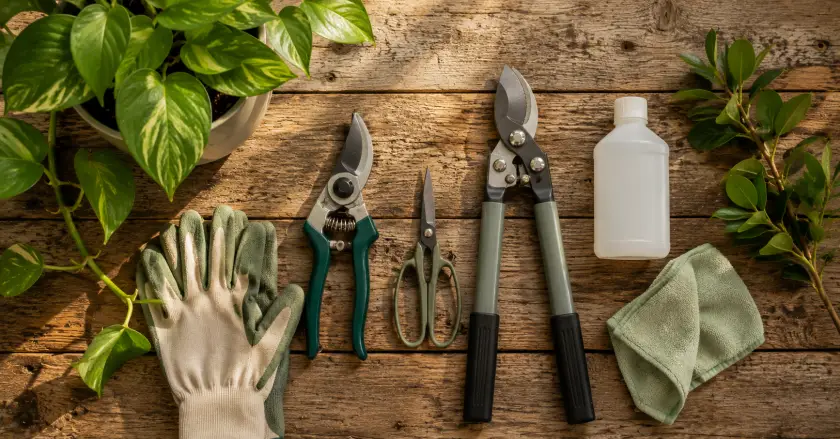
You do not need a large collection of expensive tools to learn pruning basics. A few sharp, appropriate tools can handle most small plants and shrubs.
| Tool | Best Use | Safety Consideration |
|---|---|---|
| Fine pruning scissors | Houseplant leaves and thin soft stems | Keep blades clean and avoid forcing thick stems |
| Bypass hand pruners | Small live woody stems | Use within the manufacturer’s cutting capacity |
| Anvil pruners | Some dead or brittle stems | May crush living tissue more readily than bypass pruners |
| Loppers | Thicker, accessible shrub branches | Use suitable leverage without overextending |
| Pruning saw | Woody branches too large for pruners | Avoid high-risk tree work and falling-branch hazards |
| Gardening gloves | Thorny or irritating plants | Choose appropriate protection |
| Eye protection | Woody and potentially spring-loaded stems | Protect against flying debris |
The University of Maryland Extension guide to pruning tools recommends sharp tools that create clean cuts and highlights the advantages of bypass pruners for live woody stems.
How to Clean and Disinfect Pruning Shears
Clean tools help make better cuts and reduce the risk of transferring certain pathogens between plants.
Disinfection is especially important when working with suspected infectious disease.
Five Steps for Tool Maintenance
- Remove soil, sap, and plant debris from the blades.
- Wash or wipe away visible contamination before disinfecting.
- When disease transmission is a concern, disinfect according to appropriate product and extension guidance.
- Dry the tool thoroughly to reduce corrosion.
- Sharpen and lubricate moving parts when required.
University of Maryland Extension identifies 70% alcohol as an option for disinfecting pruning equipment when there is a risk of spreading infection. If using a diluted bleach solution, follow appropriate safety guidance because bleach can corrode tools.
Do not mix disinfecting chemicals. Follow the product label and ensure appropriate ventilation and safe handling.
Should You Disinfect After Every Cut?
Routine cleaning is helpful, but the level of disinfection depends on the task and disease risk.
When cutting visibly diseased tissue, cleaning and disinfecting between appropriate cuts or before moving to another plant can help avoid transferring pathogens.
If a plant has a serious unexplained disease, consult species-specific extension guidance before performing extensive pruning.
Pruning vs. Trimming vs. Deadheading
These gardening terms overlap, but understanding their typical purposes can help you choose the right technique.
| Term | Meaning | Example |
|---|---|---|
| Pruning | Selective removal of plant growth for structure, health, or size | Removing crossing shrub branches |
| Trimming | Usually lighter, often cosmetic shaping | Keeping a formal hedge tidy |
| Deadheading | Removing spent flowers | Cutting faded flowers above suitable leaves |
| Pinching | Removing a soft growing tip | Encouraging branching in a young basil plant |
Trimming and pruning are sometimes used interchangeably in ordinary conversation, but selective pruning is generally more precise than shearing an entire plant into shape.
How to Prune Dead, Yellow, and Brown Leaves
Removing unattractive leaves can improve a plant’s appearance, but remember that leaf damage is often a symptom rather than the original problem.
Completely Dead Leaves
A fully dead leaf can usually be removed near the base of its stalk without injuring healthy stems or nearby growing points.
Use clean scissors rather than forcefully pulling attached material from the plant.
Yellow Leaves
If a leaf is fully yellow and unlikely to recover, it may be removed for appearance and hygiene.
However, repeated yellowing requires investigation. Excess moisture, insufficient light, pests, damaged roots, and natural aging can all play a role.
Read our yellow leaves troubleshooting guide for diagnosis.
Brown Leaf Tips
When only the tip has dried and the rest of the leaf is healthy, you can trim the brown portion cosmetically with clean scissors.
Leave a small margin rather than cutting far into healthy green tissue. Trimming does not repair the underlying cause.
Damaged but Mostly Green Leaves
If a leaf still has substantial healthy green tissue, removing it may not be necessary.
Consider whether it continues to support photosynthesis and whether the damage is spreading or associated with disease.
Our leaf curl and browning guide explains additional symptoms.
How to Prune Leggy and Overgrown Plants
A plant becomes leggy when stems grow long with widely spaced leaves or insufficient branching. Low light is a common cause, especially indoors.
Step 1: Check the Growing Conditions
If a houseplant is stretching toward the window, improve its light before pruning heavily.
Without sufficient light, new shoots may become just as leggy as the old growth.
Step 2: Identify Suitable Nodes
On plants that branch from stem nodes, select healthy nodes below the area you want to shorten.
Step 3: Cut Conservatively
Shorten suitable stems without removing an excessive amount of healthy foliage.
Step 4: Propagate Healthy Cuttings
Some vines can be propagated from healthy stem cuttings. This can be useful for replacing sparse growth or filling a planter.
For practical instructions, read our houseplant propagation guide.
Step 5: Monitor the New Growth
Look for healthier leaf spacing and appropriate branching as the plant recovers.
For very overgrown shrubs, gradual renewal over more than one season may be appropriate. Do not assume every plant can recover from cutting back to bare old wood.
Can Pruning Hurt or Kill a Plant?
Yes. Pruning is a controlled form of physical injury, and incorrect pruning can weaken a plant or permanently damage important growth points.
Problems are more likely when a gardener:
- Removes too much live growth at once
- Cuts into the branch collar or main stem
- Leaves long dead stubs
- Uses blunt tools that crush stems
- Removes flower buds at the wrong season
- Severely cuts a species that does not regenerate from old wood
- Prunes a highly stressed plant without addressing the original problem
- Ignores local tree-disease precautions
Small, well-planned cuts are generally easier for a plant to respond to than unnecessary large wounds.
Should You Seal or Paint Pruning Cuts?
For most ordinary pruning cuts, commercial wound paint or sealant is not recommended.
Woody plants do not heal wounds in the same way people do. They compartmentalize damaged tissues and gradually form new tissue around the wound.
Proper cutting technique and preservation of the branch collar are generally more important than applying a coating.
There are exceptions for particular disease-management situations. Some regions recommend prompt wound treatment on oak trees to help reduce oak wilt transmission risk when pruning during sensitive periods cannot be avoided.
Follow local extension advice for these exceptions. Do not apply wound sealants routinely to all trees and shrubs.
What Should You Do After Pruning?
After pruning, the goal is to maintain suitable growing conditions while the plant responds.
Aftercare Checklist
- Remove diseased or damaged debris appropriately.
- Clean and store pruning tools.
- Keep the plant in suitable light.
- Water according to actual soil moisture.
- Avoid heavy unnecessary fertilizer applications.
- Protect stressed plants from extreme temperatures.
- Monitor new growth, pests, and remaining foliage.
- Delay further major shaping if the plant appears weak.
Pruning does not automatically mean a plant needs more water. In some cases, removing foliage can temporarily reduce water use.
If the plant remains unhealthy after pruning, review watering, root health, pests, and lighting. Our plant rescue guide provides a systematic starting point.
Common Pruning Mistakes to Avoid
| Mistake | Why It Matters | Better Approach |
|---|---|---|
| Pruning without identifying the plant | Species respond differently | Check species and growth habit first |
| Removing too much live foliage | May weaken the plant | Prune conservatively |
| Cutting into a branch collar | Damages parent-stem tissue | Cut just outside the collar |
| Leaving long branch stubs | Stubs can die back and decay | Cut to a proper bud, lateral, or collar |
| Using blunt pruners | May crush or tear tissue | Sharpen and match tools to stem size |
| Pruning old-wood bloomers in winter | Can remove flower buds | Prune after flowering when appropriate |
| Shearing every shrub | May create dense outer growth and bare interiors | Use selective thinning when suitable |
| Pruning leggy plants without fixing light | New growth may remain weak | Correct lighting and then prune |
| Pruning hazardous tree branches yourself | Falling limbs and utility lines are dangerous | Hire a qualified arborist |
| Applying wound paint to every cut | Usually unnecessary | Follow plant-specific and local disease guidance |
Beginner Pruning Checklist
Use this simple checklist before making major cuts:
- Confirm the plant’s identity.
- Check whether it is healthy enough for pruning.
- Understand its flowering habit and the correct season.
- Identify dead, damaged, diseased, or unwanted stems.
- Choose an appropriate sharp cutting tool.
- Locate the correct node, bud, lateral branch, or branch collar.
- Make a clean, purposeful cut.
- Step back and reassess before making additional cuts.
- Clean the tools and provide suitable aftercare.
Frequently Asked Questions About Pruning Basics
What are the basic rules of pruning plants?
The basic pruning rules are to identify the plant, have a clear reason for each cut, use clean sharp tools, remove dead or damaged growth first, and cut at suitable nodes, buds, lateral branches, or branch collars. Avoid excessive pruning and choose the appropriate season for the species.
When is the best time to prune plants?
The best time depends on the species. Many houseplants respond well to pruning during active spring growth. Many spring-flowering shrubs are pruned after blooming because they flower on old wood. Many summer-flowering shrubs can be pruned in late winter or early spring because they flower on new wood.
Where should you cut a plant stem when pruning?
For many leafy stems, cut just above a healthy node or bud to encourage suitable growth below the cut. For woody tree branches, remove the branch just outside the branch collar without leaving a long stub or cutting into the trunk. The correct position depends on the type of plant and the purpose of pruning.
How much of a plant can you safely prune at once?
There is no universal safe percentage for every plant. The amount depends on species, age, health, season, and pruning purpose. Beginners should remove only the growth necessary to achieve a clear objective and avoid severe cutting unless the species and conditions support it.
What is the difference between pruning, trimming, and deadheading?
Pruning is the selective removal of leaves, stems, or branches for health, shape, growth, or size management. Trimming usually describes lighter cosmetic shaping, while deadheading means removing spent flowers. All three techniques can be useful when matched to the right plant.
Final Thoughts on Pruning Basics
Learning pruning basics is not about removing as much growth as possible. It is about understanding how a plant grows and choosing the smallest useful number of well-placed cuts.
Begin with dead, damaged, diseased, or crossing growth. Check the correct season, use sharp tools, preserve important nodes and branch collars, and avoid cutting large amounts of healthy foliage without a good reason.
For houseplants, light pruning and better growing conditions can encourage a fuller appearance. For shrubs, flowering time and growth habit determine the best approach. For trees, structural safety and appropriate professional care are essential.
Start slowly, observe how the plant responds, and use that experience to build confidence.
Continue learning with our houseplant propagation guide, complete watering guide, and beginner-friendly indoor plants guide.