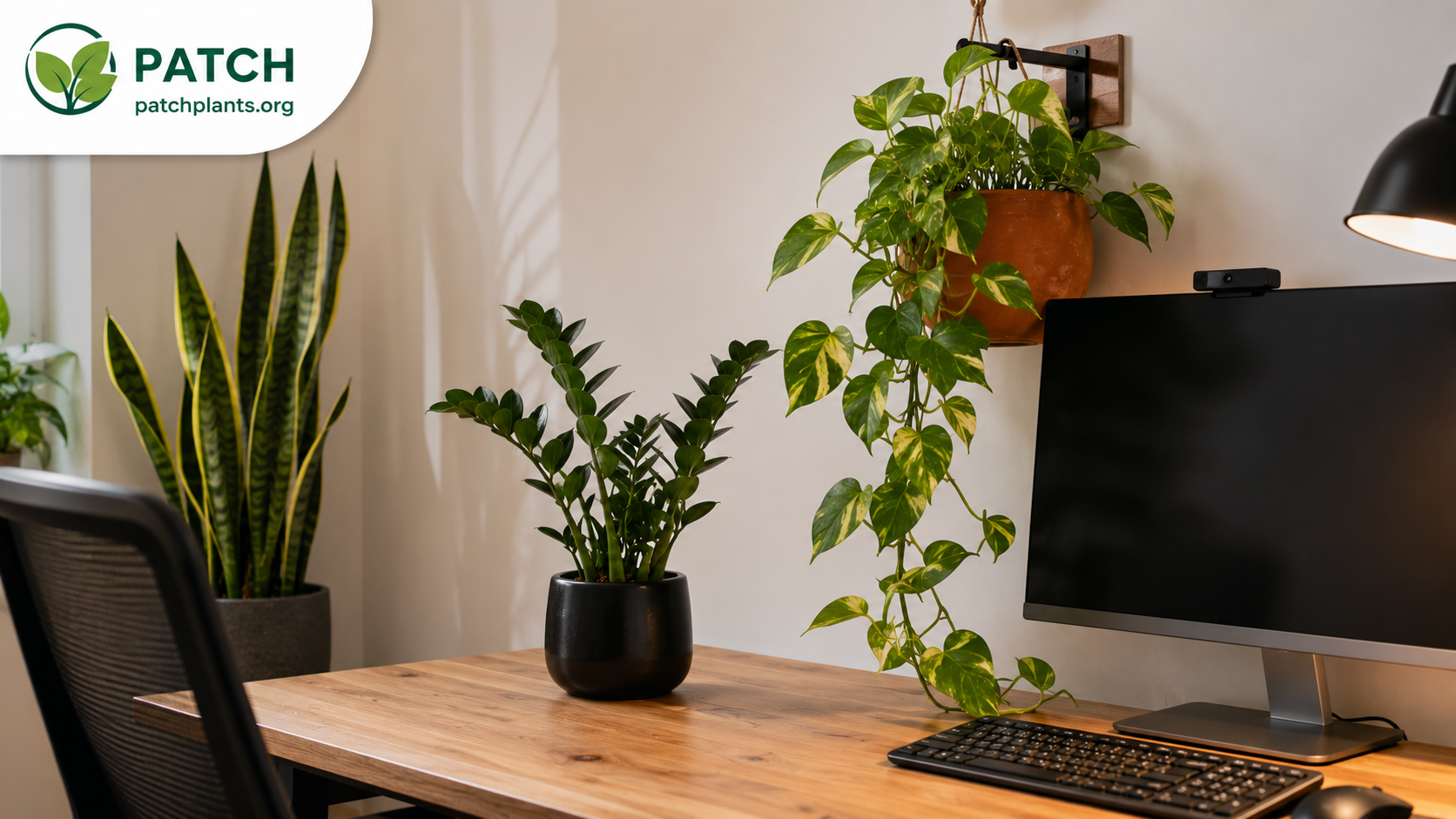
The best office plants for fluorescent light are ZZ plant, snake plant, cast iron plant, green Chinese evergreen, pothos, heartleaf philodendron, and dracaena. These shade-tolerant species can live on overhead office lighting alone. Fluorescent and LED office lights do power photosynthesis, but they are weak at desk height and switch off at night and on weekends, so plants grow slowly, use less water, and need fewer waterings than at home.
Key Takeaways
- Office lights work for plants, but intensity drops quickly with distance. A plant close to a light or a window grows far better than one in the middle of a dim room.
- ZZ plant, snake plant, and cast iron plant are the safest choices for windowless offices.
- Peace lily keeps healthy leaves under office lights but rarely flowers without brighter light.
- Rubber plant, money tree, haworthia, and Christmas cactus need a window or a desk lamp to do well.
- Overwatering is the most common way office plants die. In low light they dry out slowly, so always check the soil first.
- A small LED grow bulb in a desk lamp on a timer can keep plants healthy through lights-off nights and weekends.
- Spider plant, cast iron plant, parlor palm, money tree, haworthia, and Christmas cactus are listed as non-toxic to cats and dogs.
Can Plants Really Grow Under Fluorescent Light?
Yes, but only certain plants, and slowly. Fluorescent tubes and the LED panels that have replaced them in many offices give off light plants can use for photosynthesis. The problem is not the type of light but the amount.
- Intensity: Offices are often lit to roughly 300–500 lux at desk height, about 30–50 foot-candles. That sits at or below the bottom of what the University of Minnesota Extension describes as low light for houseplants (about 50–250 foot-candles). Only true low-light plants cope with this.
- Distance: Light weakens quickly as it travels. A plant on a filing cabinet near a ceiling panel gets noticeably more than one on the floor.
- Hours: Office lights may run 50–60 hours a week and then switch off for nights, weekends, and holidays. Plants on a timer at home often get more total light in a week.
A free light-meter app on your phone gives a rough reading. If a spot reads well under 500 lux, stick to the toughest plants below or add supplemental light.
Office Plants for Fluorescent Light at a Glance
| Plant | Office Lights Only? | Best Spot | Pets (ASPCA) |
|---|---|---|---|
| ZZ plant | Yes, best choice | Desk or floor | Can irritate if chewed |
| Snake plant | Yes | Desk or floor | Toxic |
| Cast iron plant | Yes | Floor or shelf | Non-toxic |
| Chinese evergreen (green/silver) | Yes | Desk or floor | Toxic |
| Pothos | Yes | Shelf or trailing | Toxic |
| Heartleaf philodendron | Yes | Shelf or trailing | Toxic |
| Peace lily | Leaves yes; flowers need more light | Desk or floor | Toxic |
| Dracaena | Yes | Floor | Toxic |
| Parlor palm | Yes, close to lights | Desk or floor | Non-toxic |
| Spider plant | Survives; better with more light | Shelf or hanging | Non-toxic |
| Haworthia | No, needs a window or lamp | Desk | Non-toxic |
| Christmas cactus | Survives; needs more light to flower | Desk | Non-toxic |
| Money tree | No, needs a window | Desk or floor | Non-toxic |
| Rubber plant | No, needs a window | Floor | Toxic |
Pet safety is based on the ASPCA toxic and non-toxic plants list.
Best Office-Friendly Plants for Fluorescent Lighting

Tough Enough for Windowless Offices
1. ZZ Plant
ZZ plant (Zamioculcas zamiifolia) is the most reliable plant for an office with no windows. Its underground rhizomes store water, its glossy leaves tolerate very low light, and it grows slowly enough to keep a tidy shape on a desk for years.
Water only when the soil is almost completely dry, which under office lights may be every three to six weeks. See our ZZ plant care guide.
2. Snake Plant
Snake plant (Dracaena trifasciata, formerly Sansevieria) tolerates low light, dry air, and long gaps between waterings. Compact types like ‘Hahnii’ suit desks, while taller forms make striking floor plants.
Let the soil dry fully between waterings. Overwatering is the only reliable way to kill it. See our snake plant care guide and tall snake plant varieties.
3. Cast Iron Plant
Cast iron plant (Aspidistra elatior) earned its name in dim Victorian hallways. It tolerates deep shade, irregular watering, and dry air, and it is pet-safe. It grows slowly, so buy a plant close to the size you want.
Water when the top half of the soil is dry.
4. Chinese Evergreen
Chinese evergreen (Aglaonema) brings patterned leaves to low light. Dark green and silver varieties tolerate office lighting best, while pink and red types need brighter conditions. Keep it away from cold air-conditioning drafts.
Water when the top few centimetres of soil are dry. For more colourful options, see colorful foliage indoor plants.
5. Pothos
Pothos (Epipremnum aureum) trails from shelves, cabinets, and desk dividers and keeps growing under office lights. Plain green types cope with low light better than heavily variegated ones, which may lose some of their pattern.
Water when the top few centimetres dry, and trim long vines to keep it full.
6. Heartleaf Philodendron
Heartleaf philodendron (Philodendron hederaceum) behaves much like pothos, with soft, heart-shaped leaves on trailing stems. It is forgiving and grows predictably under artificial light. See our philodendron care guide.
7. Dracaena
Dracaenas such as corn plant (Dracaena fragrans) and dragon tree (Dracaena marginata) are the best tall floor plants for office lighting, adding height and structure to corners. They are sensitive to fluoride and salts, so brown tips are common with tap water. Use filtered water if tips keep browning. See our dracaena care guide.
8. Peace Lily
Peace lily (Spathiphyllum) keeps healthy, glossy leaves under office lights and droops clearly when it needs water, which makes it easy to manage. It usually needs brighter light near a window to produce its white flowers. See our peace lily care guide.
9. Parlor Palm
Parlor palm (Chamaedorea elegans) is one of the few palms that tolerates low light, and it is pet-safe. It does best placed fairly close to ceiling lights or a window. Keep it away from heating and AC vents to avoid brown tips. See our parlor palm care guide.
Better With Some Window Light or a Desk Lamp
10. Spider Plant
Spider plant (Chlorophytum comosum) survives office lighting and is non-toxic, but it grows fuller, with more baby plantlets, in brighter light. A high shelf near a light or window suits it well. See our spider plant care guide.
11. Haworthia
Haworthia is a small, pet-safe succulent that copes with less light than most succulents, but under ceiling lights alone it gradually stretches and pales. Keep it on a desk near a window or under a desk lamp, and water only when the soil is completely dry. See our succulent care guide.
12. Christmas Cactus
Christmas cactus (Schlumbergera) is a forest cactus that tolerates moderate indoor light and is pet-safe. It will survive under office lights, but it needs brighter light plus long, uninterrupted nights in autumn to set flower buds. See our Christmas cactus indoor care guide.
13. Money Tree
Money tree (Pachira aquatica) is a popular, pet-safe office gift, but it needs bright indirect light and tends to drop leaves in dim spots. Place it near a window. See our money tree care guide.
14. Rubber Plant
Rubber plant (Ficus elastica) makes a bold floor plant with glossy leaves, but it needs medium to bright light from a window. Under ceiling lights alone it often loses lower leaves and grows leggy. Wipe the large leaves monthly to remove dust.
Which Office Plant Should You Choose?

| Your Office | Best Choices |
|---|---|
| No windows, ceiling lights only | ZZ plant, snake plant, cast iron plant, green Chinese evergreen |
| Small desk or cubicle | Compact ZZ plant, ‘Hahnii’ snake plant, pothos, small Chinese evergreen |
| Desk with a lamp | Add haworthia, parlor palm, or spider plant |
| Near a window | Any plant on this list, including money tree, rubber plant, and Christmas cactus |
| Tall corner plant | Dracaena, tall snake plant, large ZZ plant |
| Office with pets or children | Cast iron plant, parlor palm, spider plant, money tree, haworthia |
| Forgetful or rarely in the office | ZZ plant, snake plant, cast iron plant |
For a wider selection of workspace plants, see our 35 best office plants. Working from home? Our guide to improving your home office with plants covers layouts and placement.
How to Give Office Plants More Light
- Move plants closer to the light. A shelf or cabinet near a ceiling panel or window beats a low desk corner or the floor.
- Use a desk lamp. Put a full-spectrum LED grow bulb in an ordinary desk lamp about 30–45 cm (12–18 in) above the plant.
- Add a timer. Set the lamp to run 10–12 hours a day, including weekends, so plants are not left in the dark for long stretches. Check your workplace’s rules on electrical devices first.
- Keep leaves clean. Office air-handling systems leave fine dust that blocks light. Wipe leaves with a damp cloth every few weeks. See how to clean plant leaves.
- Rotate the pot every couple of weeks so the plant grows evenly.
For more on light levels, see our guide to indoor light and low light house plants.
Caring for Office Plants

Watering
Plants under office lights use water slowly, so they need far less than you might expect. Push a finger 3–5 cm into the soil before watering. Water only when it feels dry at that depth, then let the pot drain and empty any saucer. Snake plant and ZZ plant may need water only every few weeks. See our complete watering guide and signs you are overwatering.
Weekends and Holidays
Choose drought-tolerant plants if nobody waters over long breaks. Water thoroughly a day or two before a long closure if the soil is dry, and never leave pots standing in water.
Air Conditioning, Heating, and Humidity
Air conditioning and heating dry the air and create drafts. Keep plants out of direct vent airflow, and group them together to slightly raise local humidity. Avoid moisture-loving plants such as calathea and ferns in dry offices. See our humidity hacks.
Feeding
Office plants grow slowly and need little fertilizer. Feed lightly with a diluted balanced fertilizer a few times in spring and summer, and not at all in winter.
Troubleshooting Office Plants
| Problem | Likely Cause | Fix |
|---|---|---|
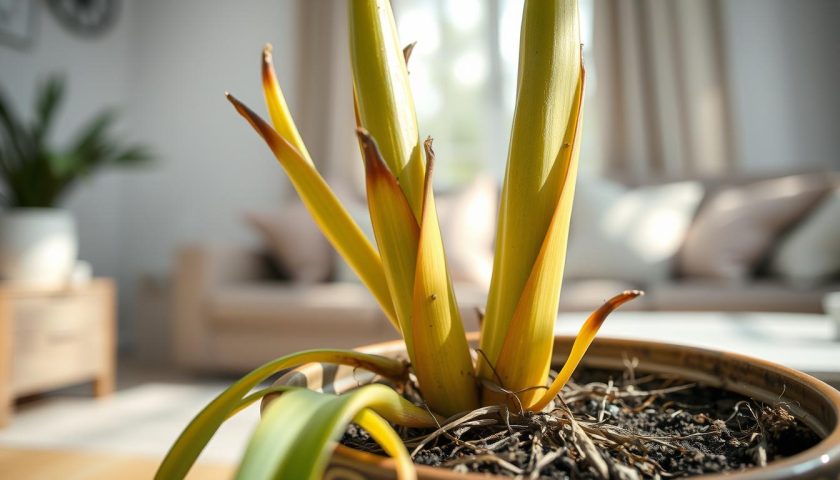
| Yellow leaves, wet soil | Overwatering in low light | Water less; check drainage |
| Leggy stems leaning one way | Too little light | Move closer to light; add a lamp |
| Brown tips | Dry air, salts, or fluoride (dracaena, spider plant) | Move away from vents; use filtered water |
| Drooping | Dry soil, or rotting roots in wet soil | Check soil before watering |
| Faded variegation | Low light | Choose plain green varieties or add light |
| Dusty, dull leaves | HVAC dust | Wipe leaves every few weeks |
For more help, see yellow leaves on plants and leaf curl, browning and droop.
What Plants Can and Cannot Do for an Office
Workplace studies have linked plants with higher reported wellbeing, satisfaction, and a more pleasant environment, which is a good reason to add them. However, a few potted plants do not meaningfully clean office air. A peer-reviewed review found that normal building ventilation removes indoor air pollutants far faster than potted plants (PubMed summary). Enjoy office plants for the way they look and feel, not as air purifiers. Read more in our guide to air-purifying plants.
Common Office Plant Mistakes
- Watering on a weekly schedule instead of checking the soil.
- Buying bright-light plants such as succulents, fiddle leaf fig, or monstera for a dim office.
- Placing plants under vents or next to heaters.
- Using pots without drainage holes.
- Forgetting about long weekends, when plants sit in the dark and may need water.
- Ignoring pet and child safety in shared or family-friendly workplaces.
Frequently Asked Questions
Can plants grow under fluorescent light alone?
Yes, shade-tolerant plants can. ZZ plant, snake plant, cast iron plant, green Chinese evergreen, pothos, heartleaf philodendron, and dracaena can live on office lighting alone. They grow slowly because office light is weak at desk height and switches off at night, so place them as close to the lights as practical.
What is the best plant for an office with no windows?
ZZ plant is the most reliable, followed by snake plant and cast iron plant. All three tolerate very low light and long gaps between waterings. If you have pets around, choose cast iron plant, which the ASPCA lists as non-toxic.
Do LED office lights work for plants like fluorescent lights?
Yes. Modern LED office panels and fluorescent tubes both give off light plants can use. What matters most is how bright the light is where the plant sits and how many hours it stays on. A desk lamp with an LED grow bulb on a timer helps in dim spots.
How often should I water office plants?
There is no fixed schedule. Office plants in low light dry out slowly, so check the soil 3–5 cm down and water only when it is dry at that depth. Snake plant and ZZ plant may need water only every three to six weeks; pothos and peace lily more often.
Which office plants are safe for pets?
Cast iron plant, parlor palm, spider plant, money tree, haworthia, and Christmas cactus are listed as non-toxic to cats and dogs by the ASPCA. Snake plant, pothos, philodendron, peace lily, Chinese evergreen, dracaena, and rubber plant are toxic if chewed.
Final Thoughts
The best office plants for fluorescent light are the tough, shade-tolerant species: ZZ plant, snake plant, cast iron plant, Chinese evergreen, pothos, philodendron, and dracaena. Place them as close to the light as you can, water only when the soil is dry, and keep them out of vent drafts.
If your office is especially dim, a small LED grow bulb on a timer widens your choices. Start with one easy plant, see how it responds to your space, and build from there.