🌿 Key Takeaways
- Spider plant care is genuinely beginner-friendly — Chlorophytum comosum tolerates low light, irregular watering, inconsistent humidity, and occasional neglect better than almost any other houseplant
- Chlorophytum spider plant care centers on three rules — bright indirect light, water when the top inch of soil is dry, and never allow roots to sit in standing water
- Spider plant care indoors is remarkably forgiving — this plant communicates its needs clearly and recovers quickly from both overwatering and underwatering mistakes
- Are spider plants easy to care for? Yes — they are consistently ranked among the easiest houseplants available, producing cascading spiderettes (baby plants) that beginners can propagate freely
- Curly spider plant care (Chlorophytum comosum ‘Bonnie’) follows identical principles to standard varieties but grows more compactly — perfect for smaller spaces and hanging baskets
- Bonnie spider plant care and Hawaiian spider plant care are the two most popular compact varieties — both tolerate lower light and more irregular watering than many houseplants
- Spider plant care in winter requires reduced watering frequency and minimal fertilizing — the plant rests during shorter days and lower temperatures
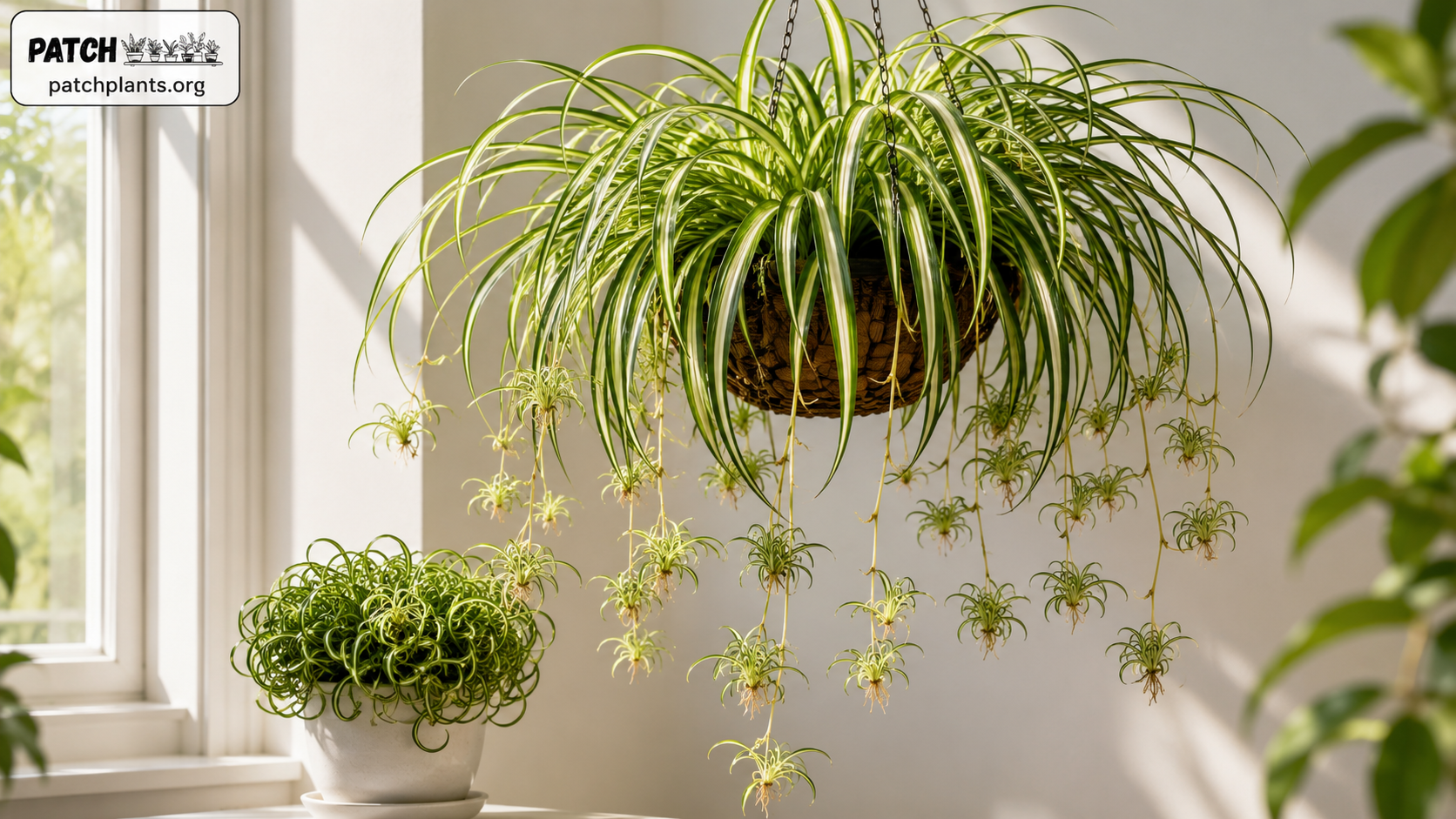
- Hanging spider plant care — the most popular display method — allows spiderettes to cascade dramatically, making it one of the most visually rewarding hanging basket plants available
- How to care for spider plant babies (spiderettes): leave attached until they develop small roots, then snip and place in water or moist potting mix to propagate new plants for free
- Spider plants are completely non-toxic to cats and dogs — making them the ideal pet-safe choice for any household
- Browse our full indoor plant care guides for companion plant ideas that pair beautifully with spider plant displays
Why Spider Plant Is One of the Most Loved Houseplants of All Time
Spider plant care has been guiding gardeners for decades — because Chlorophytum comosum was one of the first houseplants to be widely cultivated indoors, and it remains one of the most popular precisely because it delivers everything a houseplant owner could want. It is beautiful, forgiving, fast-growing, pet-safe, air-purifying, and endlessly generous with the cascading spiderettes it produces throughout the growing season.
How to care for a spider plant is one of the most searched plant care questions online — and the good news for anyone asking is that the answer is genuinely simple. This is not a plant that demands precise humidity levels, filtered water, or specialist potting media. It is a plant that tolerates real home conditions — the slightly too-dark corner, the missed watering, the dry radiator air of a British winter — and keeps growing.
Chlorophytum spider plant care covers several varieties — the classic variegated Chlorophytum comosum ‘Vittatum’ with its central cream stripe, the curly spider plant (‘Bonnie’) with its distinctive spiralling leaves, the Hawaiian spider plant with its solid green leaves edged in cream, and several other cultivars — all sharing the same fundamental care requirements.
This complete spider plant care guide covers everything — light, watering, soil, humidity, feeding, repotting, spider plant care in winter, outdoor spider plant care, hanging spider plant care, and the full guide to how to care for spider plant babies.
Spider Plant Varieties — Complete Guide
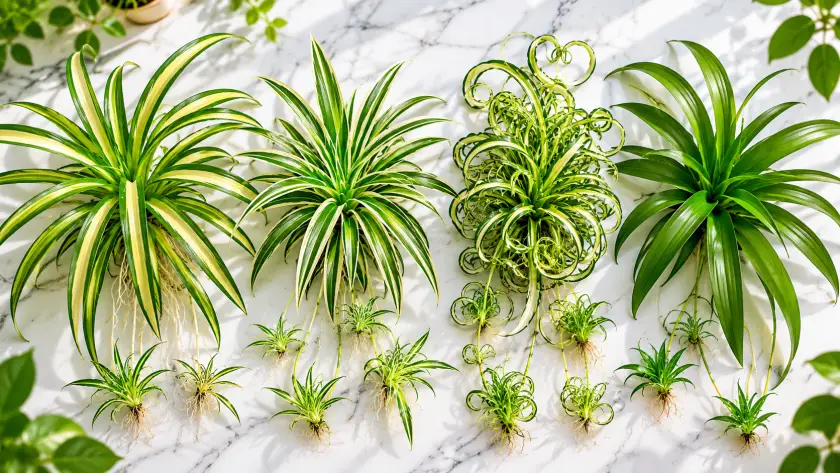
Standard Variegated Spider Plant (Chlorophytum comosum ‘Vittatum’)
The most common spider plant variety — long arching green leaves with a central cream-white stripe running their entire length. This is the variety most people picture when they think of spider plants and the most widely available in garden centres and supermarkets.
Vittatum produces the most spiderettes of any spider plant variety — cascading long stolons bearing baby plants that root readily in water or soil. Its variegation is stable and consistent regardless of light levels — though brighter light intensifies the cream coloring.
Reverse Variegated Spider Plant (Chlorophytum comosum ‘Variegatum’)
Opposite of Vittatum — green center stripe with cream-white margins on each leaf. The visual impact is similar but the leaf pattern is reversed. Slightly slower growing than Vittatum but equally forgiving of imperfect care.
Curly Spider Plant — Bonnie Variety
Curly spider plant care (Chlorophytum comosum ‘Bonnie’) covers one of the most distinctive spider plant cultivars — its leaves spiralling and curling rather than arching straight, creating a dramatically different visual texture. Bonnie spider plant care follows identical principles to standard varieties but the plant grows more compactly — reaching 20–30cm rather than the 45–60cm of standard varieties.
Bonnie spider plant care advantages:
- More compact — perfect for smaller spaces, desks, and windowsills
- Excellent for hanging spider plant care — curling leaves create beautiful cascading texture
- Same extraordinary tolerance of neglect as standard varieties
- Produces curly spiderettes — distinctive and attractive in propagation displays
Hawaiian Spider Plant
Hawaiian spider plant care covers Chlorophytum comosum ‘Hawaiian’ — a solid green variety without the typical cream variegation. Its uniform deep green leaves are slightly more tolerant of lower light than variegated varieties — as the full green leaf has more chlorophyll available for photosynthesis in dim conditions.
Hawaiian spider plant care is the lowest-maintenance of all mainstream spider plant varieties — its solid green coloring requires less light to maintain, making it excellent for positions away from bright windows.
Spider Lily Plant Care
Spider lily plant care (Hymenocallis) — note this is a different plant entirely from spider plant (Chlorophytum). Spider lily is a bulbous plant with strap-like leaves and dramatic white fragrant flowers, grown outdoors in warmer climates or as a conservatory plant. It requires full sun, very different watering, and is not related to Chlorophytum spider plants.
Complete Spider Plant Care Guide
Spider Plant Care at a Glance
| Care Factor | Spider Plant Requirement |
|---|---|
| Light | Bright to medium indirect — tolerates low |
| Watering | Top inch dry — every 7–10 days summer |
| Temperature | 13–27°C — avoid frost |
| Humidity | Adaptable — tolerates dry indoor air |
| Soil | General potting mix + perlite |
| Fertilizer | Monthly spring/summer half strength |
| Pot | Any with drainage holes |
| Pet Safety | Non-toxic to cats and dogs ✅ |
Spider Plant Light Requirements
Spider plant care indoors light requirements are among the most flexible of any popular houseplant — the plant genuinely adapts to a wide range of light conditions without the dramatic decline that affects more light-demanding species.
Light by position:
| Position | Spider Plant Response |
|---|---|
| Bright indirect (near window) | Best growth, most spiderettes, sharpest variegation |
| Medium indirect | Good growth, consistent variegation |
| Low light (north-facing room) | Slower growth, variegation may fade slightly |
| Direct sun | Leaf scorch and bleaching — avoid |
Variegation and light: Variegated varieties (‘Vittatum’, ‘Variegatum’) maintain their cream coloring better in brighter indirect light. In low light, new leaves may emerge greener — moving to a brighter position reverses this gradually.
Hawaiian spider plant care light note: solid green varieties tolerate lower light than variegated — their full chlorophyll content gives them more photosynthetic capacity per leaf area.
For understanding and optimising light levels for spider plant care indoor and all other houseplants, our complete guide to indoor light covers light measurement, grow light supplementation, and room-by-room optimization.
How to Care for a Spider Plant — Watering
How to care for a spider plant watering correctly is the most important care skill — though spider plants are significantly more forgiving of watering errors than most popular houseplants.
Watering rules:
- Water when the top inch of soil feels dry to the touch
- Water thoroughly — until water flows from drainage holes
- Empty saucers within 30 minutes — never allow roots in standing water
- Reduce frequency by 50% in winter
Spider plant care indoor seasonal watering:
- Spring/Summer: Every 7–10 days — check soil before every watering
- Autumn: Every 10–14 days — reducing as temperatures cool
- Spider plant care in winter: Every 14–21 days — the plant rests and uses significantly less water
Brown leaf tips — the most common spider plant care issue — are almost always caused by fluoride in tap water rather than watering frequency. Use rainwater, filtered water, or tap water left in an open container for 24 hours to eliminate fluoride-related browning.
Our guide on signs you are overwatering and how to correct it covers the complete diagnosis process. For optimal timing, our guide on worst times to water your plants explains why morning watering produces consistently healthier results.
For a complete watering system that covers spider plants and all other houseplants, our complete watering guide is the definitive resource.
Best Soil for Spider Plant Care
Spider plant care soil must balance moisture retention with drainage — spider plants need consistent moisture but are highly susceptible to root rot in waterlogged conditions.
Best spider plant potting mix:
2 parts general potting mix 1 part perliteThis combination retains adequate moisture between waterings while draining sufficiently to prevent root rot. Our complete soil mix guide covers exact ratios for spider plants and every other houseplant type.
Spider Plant Temperature and Humidity
Spider plant care indoors temperature tolerance is wide — one of the reasons this plant thrives in so many different home environments:
- Ideal: 18–24°C
- Minimum: 7°C — cold damage begins below this threshold
- Avoid: Frost, cold drafts from windows, and hot air from radiators positioned directly below the plant
Humidity: Spider plants adapt to a wide humidity range — tolerating the dry air of heated homes without the crispy leaf tips that affect more tropical species. Occasional misting benefits the plant but is not essential.
For humidity management that benefits spider plants and moisture-loving companion plants, our guides on humidity hacks for happy plants and DIY humidity tray guide cover practical solutions.
Spider Plant Care Tips — Fertilizing
Spider plant care tips for feeding:
- Monthly balanced liquid fertilizer at half strength from April through September
- Stop feeding completely October through March
- Over-fertilizing causes brown leaf tips and excessive salt buildup — flush soil with water if white crust appears on soil surface
For complete fertilizing guidance, our guide on fertilizing indoor vs outdoor plants covers spider plant-specific feeding schedules and seasonal adjustments.
Spider Plant Care in Winter — Seasonal Adjustments
Spider plant care in winter requires specific adjustments as days shorten and temperatures drop:
Watering: Reduce to every 14–21 days — check soil thoroughly before watering. Cold, wet soil causes root rot far faster than in summer conditions.
Light: Move closer to windows as natural light intensity reduces through winter months. South or west-facing windowsills provide the most light during short winter days.
Temperature: Keep above 10°C — spider plants placed on cold windowsills in winter can suffer cold damage even if the room itself is adequately heated.
Feeding: Stop completely from October through March. Feeding during winter rest promotes soft, weak growth susceptible to pest damage.
Spiderette production: Spider plants produce fewer or no spiderettes during winter — this is normal and not a cause for concern. Production resumes with increasing light and warmth in spring.
For complete seasonal plant care guidance, our guide on outdoor plants that survive British winters without fuss covers winter care principles applicable to indoor plants spending summer outdoors.
Hanging Spider Plant Care — Display Guide
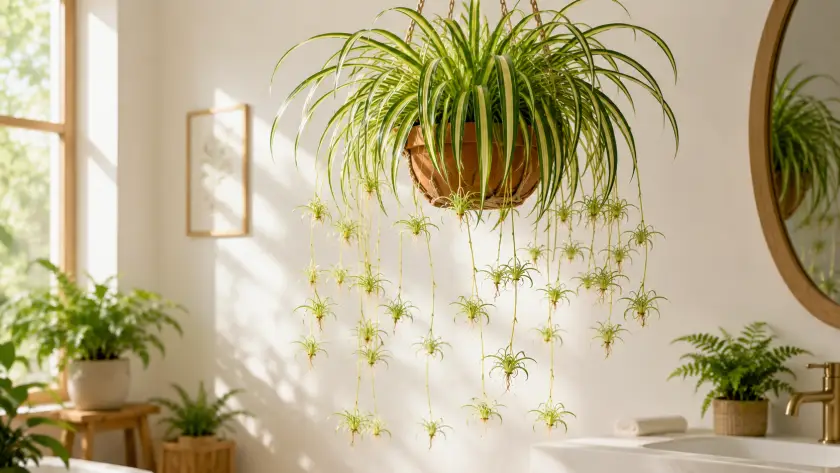
Hanging spider plant care is the most popular and rewarding way to display spider plants — allowing their naturally arching stems and cascading spiderettes to hang freely in dramatic trailing displays.
Best positions for hanging spider plants:
- Bright indirect light positions — near but not in direct sun from east or west-facing windows
- Bathroom ceilings — where natural light and ambient humidity benefit growth
- Stairwells with natural light — where long trailing stems can develop fully
- Living room corners with hanging hooks — creating dramatic ceiling-height displays
Hanging spider plant care specific tips:
- Hanging baskets dry faster than floor pots — check moisture every 5–7 days
- Water by lowering the basket to water at soil level — or use a long-spout watering can
- Mist spiderettes occasionally — they absorb atmospheric moisture
- Rotate the basket quarterly — encouraging even growth rather than one-sided leaning toward light
For hanging plant display inspiration and companion plants that work alongside spider plants in ceiling and shelf displays, our guides on low-light hanging plants for shelves, showers, and ceilings and trailing plants that look stunning on shelves and bookcases cover the best hanging and trailing plant combinations.
Outdoor Spider Plant Care — Can Spider Plants Go Outside?
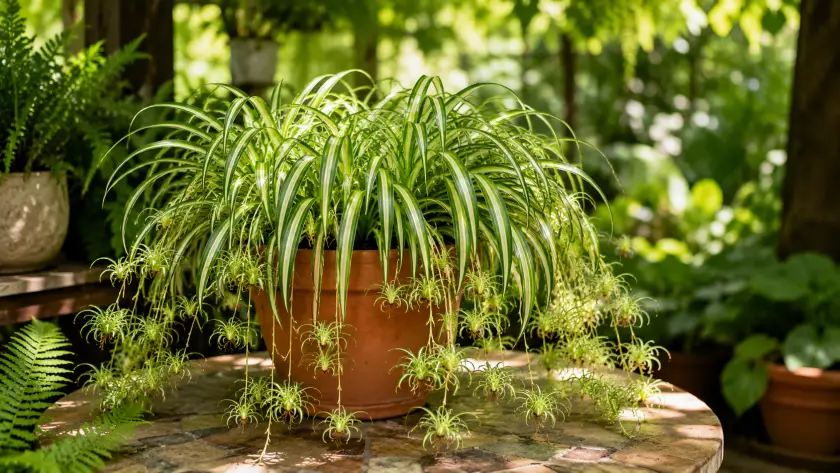
Spider Plant Care Outside and Outdoors
Outdoor spider plant care and spider plant care outside — yes, spider plants can spend summer outdoors in the UK and similar temperate climates, benefiting from natural humidity, air circulation, and indirect outdoor light.
Spider plant care outdoors guidelines:
- Move outdoors after last frost — typically late May in the UK
- Position in sheltered partial shade — never direct summer sun which causes rapid bleaching
- Water more frequently outdoors — summer heat and wind dry soil faster than indoor conditions
- Bring indoors before first autumn frost — typically September–October
Spider plant care outdoors benefits:
- Natural humidity promotes lush, vigorous growth
- Increased light (even in shade) accelerates spiderette production
- Air circulation reduces pest risk
- Outdoor placement often triggers abundant flowering (small white flowers) on established specimens
For guidance on transitioning houseplants between indoor and outdoor spider plant care positions, our guide on best plants for container gardening on patios covers container management for indoor plants spending summer outside.
How to Care for Spider Plant Babies (Spiderettes)
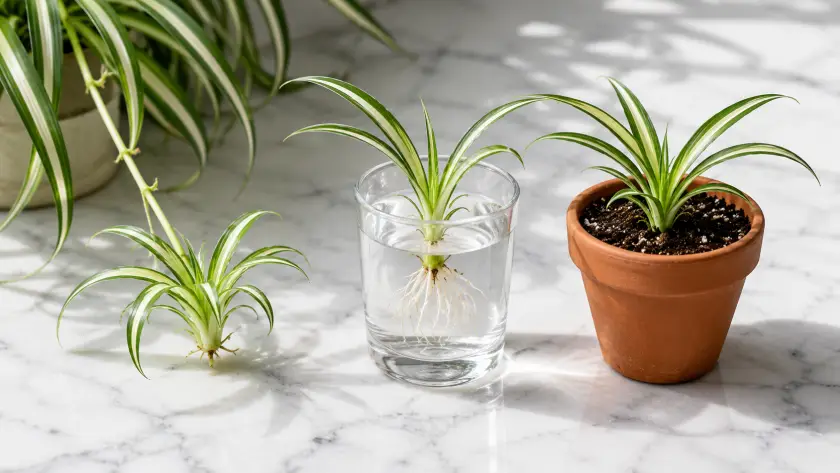
Spider Plant Babies — Complete Propagation Guide
How to care for spider plant babies is one of the most rewarding aspects of spider plant ownership — these cascading miniature plants are produced prolifically throughout the growing season and propagate with extraordinary ease.
What are spiderettes? Spider plants produce long stolons (runners) from the base of the plant — at the end of each stolon, a miniature plantlet (spiderette) develops. Each spiderette has tiny developing roots at its base, which eventually root if they contact soil or water.
How to Care for Spider Plant Babies — Propagation Methods
Method 1 — Water propagation (easiest):
- Select a spiderette with visible small root nubs at its base
- Snip the stolon connecting it to the parent plant
- Place in a glass of water — submerging the root area but keeping leaves above water
- Change water every 7 days
- Transfer to potting mix once roots reach 2–3cm
- Water gently and place in bright indirect light
Method 2 — Soil propagation (fastest establishment):
- While spiderette is still attached to parent, press into a small pot of moist potting mix beside the parent plant
- Pin down with a small U-shaped wire or bend stolon to hold contact with soil
- Keep soil consistently moist
- Snip stolon connecting to parent after 3–4 weeks when spiderette is rooting independently
Method 3 — Leave attached (lowest effort): Let spiderettes hang freely — they develop independently and can be removed at any point once they reach a reasonable size (5cm+). Simply snip and propagate using either method above.
For complete propagation guidance covering spider plants and all other houseplant types, our guide on how to propagate houseplants easily at home covers water and soil propagation in full detail.
Are Spider Plants Easy to Care For?
Are spider plants easy to care for? Yes — genuinely and without caveat. Spider plants consistently rank among the easiest houseplants available for several specific reasons:
Clear communication: Spider plants visibly communicate their needs — leaves pale when underlit, droop when thirsty, and develop brown tips when water quality is poor. These signals are clear and early — giving owners time to correct problems before permanent damage occurs.
Rapid recovery: Unlike more sensitive houseplants, spider plants recover quickly from both overwatering and underwatering — bouncing back within days of corrective action.
Pest resilience: Spider plants are naturally less attractive to the most common houseplant pests — spider mites, fungus gnats, and mealybugs all cause less damage on spider plants than on more sensitive tropical species.
Pet safety: Complete non-toxicity to cats and dogs eliminates the anxiety of pet-plant interaction — spider plants are among the few popular houseplants that require no special positioning for pet safety. Our cat-friendly plants guide and dog-friendly plants guide confirm spider plants as top-recommended pet-safe choices.
For the full range of easy houseplants that pair well with spider plants in beginner collections, our guide on best indoor plants for beginners covers the 25 most forgiving houseplants including spider plant.
Spider Plant Care — Troubleshooting Common Problems
| Problem | Most Likely Cause | Solution |
|---|---|---|
| Brown leaf tips | Fluoride in tap water | Switch to rainwater or filtered water |
| Pale, washed-out color | Too much direct sun | Move to indirect light position |
| Yellow leaves | Overwatering | Check soil — reduce watering frequency |
| No spiderettes | Insufficient light or winter rest | Move to brighter position or wait for spring |
| Limp, drooping leaves | Underwatering or root rot | Check soil moisture and drainage |
| White crusty soil | Mineral buildup from tap water | Flush with filtered water |
| Leggy growth | Insufficient light | Move closer to window or add grow light |
For comprehensive leaf symptom diagnosis, our guide on leaf curl, browning, and droop — what your plant is telling you covers every visible spider plant leaf symptom.
For plants that have declined severely, our step-by-step guide on how to revive a dying plant covers emergency recovery applicable to spider plants. For root rot treatment, our root rot guide covers the complete rescue process.
Repotting Spider Plants
Spider plants grow quickly when well-established — their fleshy, water-storing roots filling pots rapidly and sometimes pushing out of drainage holes within a single growing season.
Signs repotting is needed:
- Roots visibly emerging from drainage holes
- Plant wilting rapidly despite regular watering
- Soil drying within 24 hours of watering
- Pot visibly distorted by root pressure
Repotting guidance: Move up only 2–3cm in pot diameter — over-potting spider plants leads to soil staying wet too long. Spring is the ideal repotting time. Our complete repotting guide and repotting mistakes to avoid cover the full process.
Displaying Spider Plants — Room by Room
Spider plant care indoors works beautifully in every room:
Bathroom: Spider plants love the ambient humidity of bathrooms with natural light — their cascading stems framing mirrors and shelves beautifully. Our guide on best plants for your bathroom covers spider plant as one of the top bathroom recommendations.
Bedroom: Spider plants are one of the most recommended bedroom plants — non-toxic, air-purifying, and visually calming. Our guide on decorating your bedroom with plants covers bedroom spider plant placement.
Home office: Spider plant’s air-purifying properties and low maintenance make it ideal for home offices. Our guide on improving your home office with plants covers office spider plant displays.
Living room: Large mature spider plants with multiple cascading spiderettes create dramatic living room displays — particularly effective in hanging baskets or high shelves where stems can trail fully. Our guide on how to create an indoor jungle without overcrowding covers positioning spider plants within larger mixed collections.
Kitchen: Spider plants thrive in kitchen positions — the natural humidity from cooking benefits growth. Our guide on how to style indoor plants by room covers kitchen and hallway spider plant display styling.
Spider Plant Air Purification
Spider plants were among the plants identified in the original NASA Clean Air Study as effective air purifiers — removing formaldehyde, xylene, toluene, and carbon monoxide from indoor air. While modern research has refined our understanding of the quantities involved, spider plants remain consistently recommended for improving indoor air quality.
For comprehensive air-purifying plant guidance including spider plant’s specific contributions, our guide on air-purifying indoor plants that actually work covers the most effective air-purifying houseplants and the science behind their performance.
Frequently Asked Questions
How to Care for a Spider Plant — The Complete Answer?
How to care for a spider plant in four rules: bright to medium indirect light (never direct sun), water when the top inch is dry (every 7–10 days in summer), use general potting mix with perlite, and use rainwater or filtered water to prevent brown tips. Beyond these basics, spider plant care requires very little — this is one of the most genuinely forgiving houseplants available.
Are Spider Plants Easy to Care For?
Are spider plants easy to care for? Yes — absolutely. Spider plants tolerate low light, irregular watering, dry air, and temperature fluctuations better than most popular houseplants. They communicate their needs clearly through visible signals and recover quickly from care mistakes. They are non-toxic to pets, produce free new plants via spiderettes, and thrive in almost every room in the house.
How to Care for Curly Spider Plant?
Curly spider plant care (Chlorophytum comosum ‘Bonnie’) follows identical principles to standard spider plant care — same light, watering, soil, and feeding requirements. The only differences are its more compact size (20–30cm rather than 45–60cm) and its distinctively curling, spiralling leaves. Bonnie spider plant care is particularly excellent for hanging spider plant care — its curling leaves create beautiful textural interest in hanging baskets.
How to Care for Spider Plant Babies?
How to care for spider plant babies (spiderettes): select a spiderette with visible root nubs, snip the connecting stolon, and place either in water until roots reach 2–3cm or directly into moist potting mix. Keep in bright indirect light and consistent moisture during establishment. Full propagation guidance is in our how to propagate houseplants guide.
Can Spider Plants Go Outside?
Outdoor spider plant care and spider plant care outside — yes, spider plants thrive outdoors in summer in sheltered partial shade positions. Move outdoors after last frost (late May in UK), position away from direct sun, water more frequently than indoors, and bring back inside before first autumn frost (September–October). Spider plant care outdoors produces faster growth and abundant spiderette production.
What Is the Best Watering Frequency for Spider Plant Care Indoors?
Spider plant care indoors watering — check every 5–7 days using the finger test. Water when the top inch is dry — typically every 7–10 days in spring and summer, every 14–21 days in spider plant care in winter. Use rainwater or filtered water to prevent the brown leaf tips that fluoride in tap water causes over time.
Is Hawaiian Spider Plant Care Different?
Hawaiian spider plant care follows the same principles as standard spider plant care — same watering, light, soil, and feeding requirements. The main difference is that Hawaiian spider plants (solid green without cream variegation) tolerate slightly lower light than variegated varieties, as their full green leaves contain more chlorophyll per leaf area for photosynthesis in dim conditions.
Related Guides on Patch Plants
- 🌿 Pothos Plant Care Guide — Complete Variety Guide
- 🌱 ZZ Plant Care Guide — Every Variety Complete
- 🐍 Snake Plant Care Guide — Complete Sansevieria Tips
- 🌸 Peace Lily Care Guide — Complete Spathiphyllum Tips
- 🌿 Monstera Plant Care Guide — Every Variety Complete
- 🌱 Best Indoor Plants for Beginners — 25 Easy Picks
- 🐱 How to Make Your Plants Cat-Friendly
- 🐕 How to Make Your Plants Dog-Friendly
- 🌿 Trailing Plants That Look Stunning on Shelves
- 🌱 Low-Light Hanging Plants for Shelves and Ceilings
- 💡 Complete Guide to Indoor Light and Grow Lights
- 💧 Complete Watering Guide for Healthy Thriving Plants
- 💧 Worst Times to Water Your Plants
- 🌿 Signs You Are Overwatering
- 🪴 Best Soil Mix for Every Plant Type
- 🔬 Root Rot — How to Identify, Prevent and Treat It
- 🌿 How to Repot a Plant — Complete Guide
- 🌿 Repotting Mistakes to Avoid
- 🌱 How to Propagate Houseplants Easily at Home
- 🍃 Why Your Plant Leaves Are Turning Yellow
- 🌿 Leaf Curl, Browning and Droop
- 🌿 How to Revive a Dying Plant
- 🌱 Air-Purifying Indoor Plants That Actually Work
- 🌿 Humidity Hacks for Happy Plants
- 💦 DIY Humidity Tray for Indoor Plants
- 🏠 Best Plants for Your Bathroom
- 🛏️ Decorate Your Bedroom With Plants
- 🏢 Improve Your Home Office With Plants
- 🌿 How to Create an Indoor Jungle
- 🌱 Browse All Indoor Plant Guides
Final Thoughts
Spider plant care rewards every level of plant owner — from the complete beginner looking for their first houseplant to the experienced collector who appreciates a reliable, beautiful, and endlessly generous plant that asks very little in return.
How to care for spider plants ultimately comes down to observation and restraint — check the soil before watering, provide bright indirect light, use clean water, and leave the plant space to grow at its own rhythm. In return, spider plants deliver year-round beauty, cascading spiderettes for free propagation, genuine air-purifying benefits, and complete safety for every member of the household including cats and dogs.
Are spider plants easy to care for? Without question — they are one of the most forgiving, most communicative, and most rewarding houseplants available at any price point. Start with one spider plant, learn its signals, propagate its spiderettes, and discover why this remarkable plant has been a beloved houseplant for generations.
According to the Royal Horticultural Society, Chlorophytum comosum has been awarded the RHS Award of Garden Merit — recognition of its exceptional performance, reliability, and value as a houseplant that delivers consistent results across a wide range of indoor growing conditions. 🌿