15 Popular Houseplant with Patterned Leaves bring color, texture, and personality into a home without relying on flowers. From silver-striped Calathea leaves and pink-spotted polka dot plants to the striking purple foliage of Persian shield, decorative houseplants can transform an ordinary room into a vibrant indoor garden.
However, choosing a beautiful plant is only the beginning. Different species have different requirements for sunlight, soil moisture, humidity, temperature, and maintenance. Some are forgiving enough for beginners, while others require consistent attention.
This guide explores 15 patterned-leaf houseplants, explains their unique foliage, and provides practical advice on selecting, growing, and displaying them. You will also find a complete comparison table, pet-safety considerations, common growing problems, and answers to frequently asked questions.
Key Takeaways
- Patterned-leaf houseplants offer stripes, spots, colorful veins, marbled variegation, and metallic foliage.
- Chinese evergreens, watermelon peperomias, and many Tradescantia varieties are relatively approachable choices for beginners.
- Calatheas, prayer plants, stromanthes, and Rex begonias often require closer attention to moisture and humidity.
- Most colorful foliage plants grow best in suitable indirect light, although crotons generally need particularly bright conditions.
- Always check soil moisture before watering rather than following the same schedule for every species.
- Not every patterned houseplant is safe for cats or dogs.
- Group plants with compatible care requirements to create displays that are attractive and easier to maintain.
What Are Patterned-Leaf Houseplants?
Patterned-leaf houseplants are indoor plants grown primarily for the distinctive colors, markings, or textures of their foliage. Their leaves may have contrasting veins, stripes, dots, marbled patterns, or sections of different colors.
These markings can arise from natural pigmentation, differences in chlorophyll distribution, genetics, or structural characteristics of the leaf.
Some varieties feature green and cream variegation, while others display pink, red, purple, silver, or yellow markings.
Why Choose Houseplants With Patterned Leaves?
Many foliage plants remain visually interesting throughout the year, even when they are not flowering.
Patterned leaves also provide contrast when combined with solid-green houseplants. A silver-striped Calathea beside a dark-green rubber plant, for example, creates a display with differences in shape, texture, and color.
For additional inspiration, explore our unusual indoor plants guide.
How to Choose the Best Patterned-Leaf Houseplant
Before buying a houseplant with patterned leaves, evaluate the conditions in your home. A plant that looks spectacular at a nursery may struggle if the available light, watering routine, or humidity is unsuitable.
1. Evaluate Your Available Light
Consider how much natural light enters your room throughout the day.
Many decorative foliage plants prefer bright indirect light. However, Chinese evergreens can tolerate moderately lower light levels, while crotons require brighter conditions to develop their characteristic colors.
Low-light tolerance does not mean a plant can grow indefinitely in a room without sufficient illumination.
2. Match the Plant to Your Watering Routine
If you occasionally forget to water, choose a plant that can tolerate the growing medium drying somewhat between waterings.
Watermelon peperomia and established rubber plants may suit this approach better than moisture-sensitive Calatheas or Fittonias.
3. Consider Indoor Humidity
Many tropical foliage plants appreciate moderate to high humidity.
Calatheas and stromanthes can develop dry leaf margins in very dry homes. A properly maintained humidifier may help where indoor air is consistently dry.
4. Check Mature Size and Growth Habit
Compact nerve plants work well on desks and shelves. Crotons and variegated rubber plants can become larger statement specimens, while Tradescantia grows as a spreading or trailing plant.
5. Consider Pet and Child Safety
Some colorful houseplants contain irritating substances or are toxic if ingested.
Before introducing a plant into a home with pets, check its exact botanical identity against a reliable veterinary toxicity resource, such as the ASPCA Toxic and Non-Toxic Plants database.
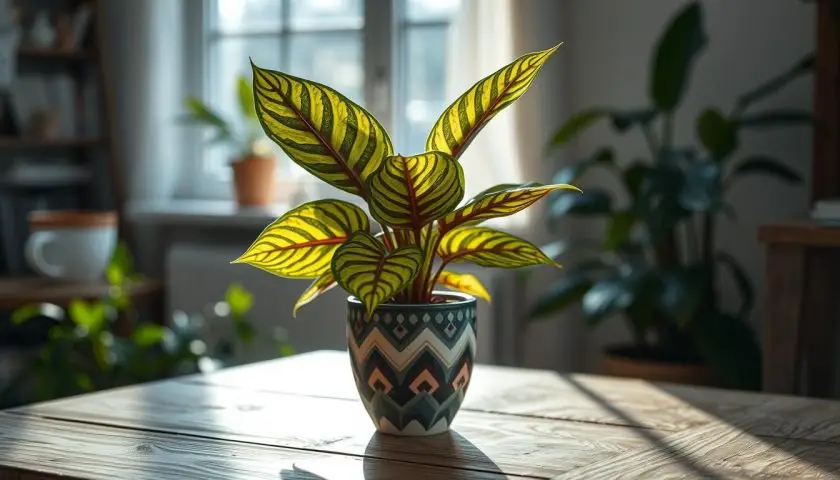
15 Beautiful Patterned-Leaf Houseplants for Your Home
The following 15 plants offer a wide variety of colors, leaf shapes, and growth habits. Use the care descriptions to select species that match your space and experience.
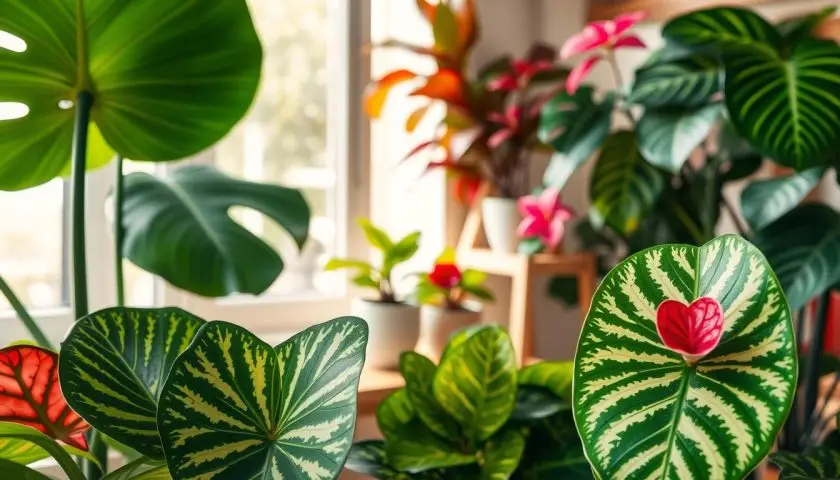
1. Calathea Orbifolia — Elegant Silver-Striped Leaves
Goeppertia orbifolia, widely sold as Calathea orbifolia, is known for its broad, rounded leaves decorated with alternating shades of green and silver.
The symmetrical striping creates a sophisticated appearance that works particularly well in neutral interiors.
Care Requirements
- Light: Medium to bright indirect light.
- Water: Maintain relatively even moisture without leaving soil saturated.
- Humidity: Benefits from moderately high humidity.
- Soil: Moisture-retentive but well-aerated container mix.
- Growth habit: Upright, spreading clump.
Common problem: Dry, crispy leaf edges may develop due to inconsistent watering, dry air, or accumulated salts.
Best placement: A living room or bedroom with filtered natural light and stable indoor conditions.
2. Rattlesnake Plant — Wavy Leaves With Purple Undersides
The rattlesnake plant (Goeppertia insignis, frequently sold under the older name Calathea lancifolia) features elongated, wavy green leaves marked with darker oval spots.
Its purple leaf undersides make it particularly attractive from different viewing angles.
Care Requirements
- Light: Medium to bright indirect light.
- Water: Keep the growing medium moderately moist, not waterlogged.
- Humidity: Higher humidity is often beneficial.
- Temperature: Stable, comfortably warm indoor conditions.
- Growth habit: Upright foliage clump.
Like other prayer-plant relatives, its leaves may change position between day and night.
Best placement: A bright bathroom with an appropriate window or a room with consistent humidity.
3. Prayer Plant — Colorful Veins and Moving Leaves
The prayer plant (Maranta leuconeura) is famous for its decorative leaf veins and the way its foliage changes position in response to daily light cycles.
Depending on the variety, leaves may feature red veins, dark patches, pale green bands, or contrasting undersides.
Care Requirements
- Light: Medium to bright indirect light.
- Water: Keep moderately moist, allowing a slight surface drying when appropriate.
- Humidity: Prefers a more humid environment.
- Soil: Loose mix that retains some moisture.
- Growth habit: Low-growing and spreading.
Prayer plants make attractive additions to shelves, low planters, and plant stands.
Persistent crispy edges or curling may indicate moisture or environmental stress rather than one specific problem.
4. Nerve Plant — Tiny Leaves With Bright Contrasting Veins
The nerve plant (Fittonia albivenis) is a compact tropical plant with intricate white, pink, or red veins spreading across its foliage.
Its small size makes it useful for desks, terrariums, and compact indoor displays.
Care Requirements
- Light: Medium indirect light.
- Water: Avoid prolonged drying; check soil frequently.
- Humidity: Appreciates relatively high humidity.
- Soil: Moisture-retentive, well-draining mix.
- Growth habit: Low, compact, spreading.
Fittonias may wilt noticeably when the growing medium becomes too dry. A mildly dehydrated plant can sometimes recover after appropriate watering, but repeated severe wilting should be avoided.
Best placement: A small desktop arrangement or suitable planted terrarium.
5. Polka Dot Plant — Pink, Red, and White Spotted Leaves
The polka dot plant (Hypoestes phyllostachya) produces cheerful foliage covered in small spots or splashes of color.
Popular varieties feature pink, red, or white markings on green backgrounds.
Care Requirements
- Light: Bright indirect light for compact growth and attractive color.
- Water: Water when the growing medium begins drying appropriately.
- Humidity: Moderate humidity is useful.
- Pruning: Pinch growing tips to encourage branching.
- Growth habit: Compact and bushy when maintained.
Insufficient light may encourage elongated, leggy stems. Regular pinching and appropriate lighting can help maintain a fuller appearance.
Best placement: A brightly lit shelf or colorful mixed container display.
6. Croton — Multicolored Yellow, Orange, Red, and Green Foliage
Crotons (Codiaeum variegatum) are among the most striking colorful houseplants, with leaves displaying combinations of yellow, green, orange, red, and sometimes purple tones.
Leaf shapes and markings vary considerably between cultivars.
Care Requirements
- Light: Very bright light; some direct sunlight may be beneficial when the plant is properly acclimated.
- Water: Maintain suitable moisture while allowing partial drying.
- Humidity: Moderate or higher humidity can be helpful.
- Temperature: Protect from cold drafts and sudden changes.
- Growth habit: Upright shrub-like plant.
Crotons can drop leaves after sudden changes in temperature, location, or watering. Stable conditions are important.
Pet safety: Crotons should be kept away from pets that may chew the foliage.
Read our croton tree care guide for more growing advice.
7. Chinese Evergreen — Beautifully Variegated Foliage for Beginners
Chinese evergreens (Aglaonema species and cultivars) are popular for their attractive foliage and relative adaptability to indoor conditions.
Depending on the variety, leaves may feature silver, cream, pink, or red patterns.
Care Requirements
- Light: Medium indirect light; some green and silver varieties tolerate lower light.
- Water: Allow the upper growing medium to dry somewhat between waterings.
- Humidity: Usually adaptable to ordinary household humidity.
- Soil: Well-draining indoor potting mix.
- Growth habit: Upright, clumping.
Highly colorful red or pink cultivars often need brighter indirect light than darker green forms to maintain vigorous growth.
Pet safety: Chinese evergreens contain insoluble calcium oxalates and are unsafe for pets to chew.
Best placement: A bedroom, living room, or office with suitable indirect light.
8. Rex Begonia — Metallic Swirls and Decorative Leaf Textures
Rex begonias, commonly sold as Begonia rex-cultorum hybrids, have some of the most elaborate foliage patterns available in indoor gardening.
Their leaves may contain silver, green, pink, burgundy, and purple markings arranged in spirals, bands, or irregular patches.
Care Requirements
- Light: Bright indirect light.
- Water: Avoid extreme drying and waterlogged conditions.
- Humidity: Appreciates moderate to higher humidity with suitable airflow.
- Soil: Airy mix with reasonable moisture retention.
- Growth habit: Compact to spreading, depending on cultivar.
Rex begonia leaves can be delicate. Avoid rough handling and prolonged wetness on foliage when conditions encourage leaf spotting or disease.
Best placement: A decorative shelf away from strong direct sunlight.
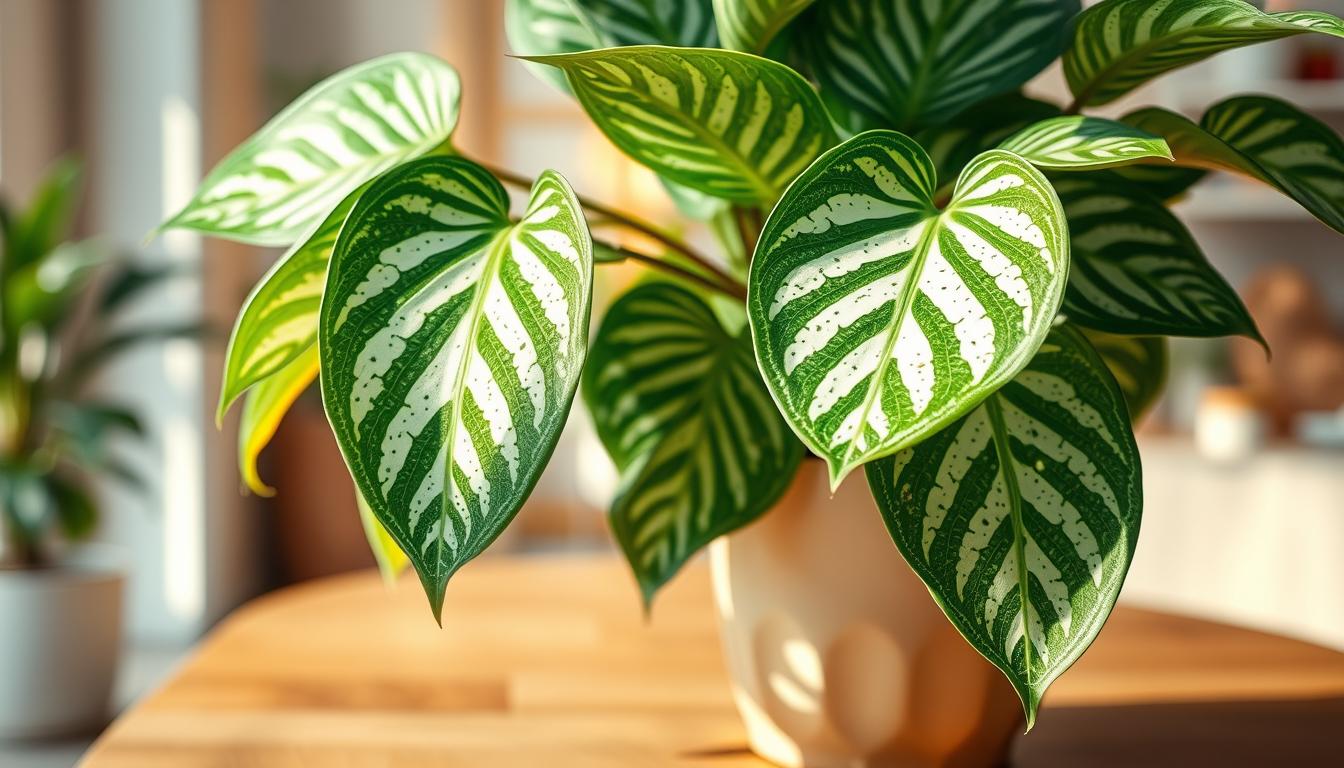
9. Watermelon Peperomia — Round Leaves With Silver Stripes
The watermelon peperomia (Peperomia argyreia) is named for its rounded leaves marked with silver and dark-green stripes resembling watermelon skin.
Its compact growth makes it an excellent option for small spaces.
Care Requirements
- Light: Bright indirect light.
- Water: Allow some drying between thorough waterings.
- Humidity: Moderate household humidity is often suitable.
- Soil: Loose, well-draining potting medium.
- Growth habit: Compact, rounded clump.
Watermelon peperomia has somewhat succulent leaves and can be vulnerable to root problems when the growing medium remains persistently wet.
Best placement: A desk, coffee table, or well-lit shelf.
10. Persian Shield — Iridescent Purple Foliage
Persian shield (Strobilanthes dyerianus) produces striking purple foliage with a metallic appearance and dark contrasting veins.
It provides a dramatic alternative to more traditional green houseplants.
Care Requirements
- Light: Bright indirect light or suitably acclimated gentle sunlight.
- Water: Maintain reasonably consistent moisture.
- Humidity: Benefits from moderately humid conditions.
- Temperature: Warm conditions without cold exposure.
- Pruning: Pinching can promote branching.
Insufficient light may produce weak growth, while harsh conditions can damage the leaves.
Best placement: A bright, warm room where the foliage can receive adequate light.
11. Zebra Plant — Deep Green Leaves With Bright White Veins
The zebra plant (Aphelandra squarrosa) is valued for its glossy green leaves with striking white veins.
Under suitable conditions, it may also produce showy yellow flower bracts.
Care Requirements
- Light: Bright indirect light.
- Water: Maintain appropriate moisture without saturation.
- Humidity: Benefits from higher humidity.
- Temperature: Consistently warm indoor conditions.
- Growth habit: Upright tropical plant.
Rapid leaf drooping, crispy margins, or leaf drop may occur when watering or indoor conditions fluctuate significantly.
Best placement: A bright room where humidity and temperature remain relatively stable.
12. Tradescantia Zebrina — Silver, Green, and Purple Striped Leaves
Tradescantia zebrina, also called the inch plant or wandering dude, is a fast-growing trailing plant known for its striped foliage.
Its leaves typically feature silver-green bands and purple coloration, particularly on their undersides.
Care Requirements
- Light: Bright indirect light; suitable gentle direct light can support coloration.
- Water: Allow the growing medium to dry somewhat between waterings.
- Humidity: Generally adaptable to normal indoor humidity.
- Pruning: Trim long stems to encourage branching.
- Growth habit: Trailing and spreading.
In insufficient light, stems may stretch and foliage can lose some of its vivid coloration.
Best placement: A hanging planter, elevated shelf, or trailing arrangement.
Tradescantia sap may irritate sensitive skin, and chewing the plant can cause problems for pets.
13. Variegated Rubber Plant ‘Tineke’ — Cream, Green, and Pink Leaves
The variegated rubber plant (Ficus elastica ‘Tineke’) features large, leathery leaves patterned with green, cream, and occasional pink tones.
Its upright shape makes it suitable for creating a dramatic focal point in a room.
Care Requirements
- Light: Bright indirect light to support healthy variegated growth.
- Water: Allow the upper portion of the growing medium to dry between waterings.
- Humidity: Ordinary household humidity is often suitable.
- Soil: Well-draining container medium.
- Growth habit: Upright, tree-like plant over time.
Variegated forms generally need more light than many solid-green rubber plants. However, sudden exposure to intense direct sunlight may scorch the leaves.
Pet safety: Rubber plant latex can irritate skin and is not safe for pets to ingest.
14. Triostar Stromanthe — Pink, Cream, and Green Variegation
Triostar stromanthe, commonly sold as Stromanthe ‘Triostar’, features beautiful green, cream, and pink foliage with colorful undersides.
Its striking variegation makes it a popular statement plant among collectors.
Care Requirements
- Light: Bright indirect light.
- Water: Maintain fairly even moisture without sogginess.
- Humidity: Moderate to high humidity is beneficial.
- Temperature: Stable warmth with protection from drafts.
- Growth habit: Upright clump.
Brown edges may develop when the plant experiences prolonged dry conditions, excessive fertilizer salts, or unsuitable environmental conditions.
Best placement: A well-lit room with stable humidity and filtered natural light.
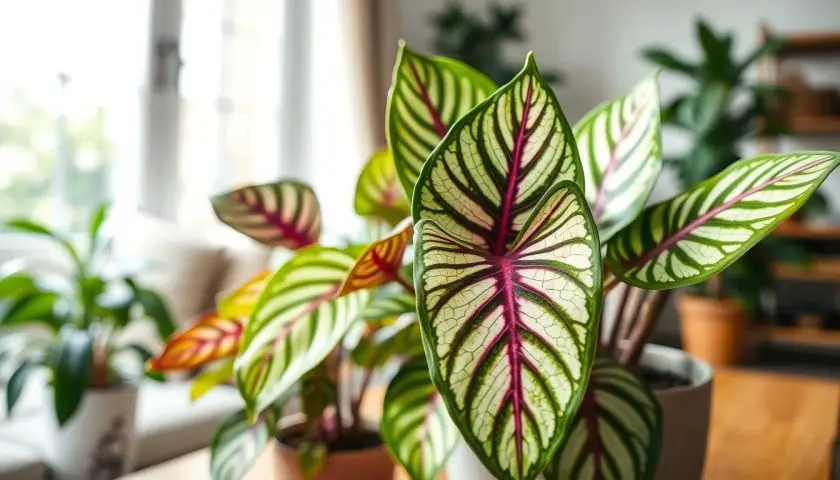
15. Caladium — Heart-Shaped Leaves in Pink, White, Red, and Green
Caladiums, including cultivars commonly associated with Caladium bicolor, are grown for their colorful, heart-shaped foliage.
The leaves may have dramatic red centers, white backgrounds, pink veining, or intricate green margins.
Care Requirements
- Light: Bright indirect light for most indoor situations.
- Water: Maintain appropriate moisture while actively growing.
- Humidity: Appreciates warm, moderately humid conditions.
- Temperature: Protect from cold temperatures.
- Growth habit: Seasonal foliage emerging from tubers.
Caladiums may enter a natural dormancy period, during which leaves decline and watering requirements decrease substantially.
Do not mistake every seasonal decline for a care failure. Follow cultivar-appropriate tuber storage guidance when dormancy begins.
Pet safety: Caladiums contain irritating calcium oxalate crystals and should be kept away from pets and children who might chew them.
Patterned-Leaf Houseplants: Complete Comparison Table
The table below compares all 15 plants according to light preference, watering requirements, care difficulty, and approximate growth habit.
| Houseplant | Light | Watering Preference | Care Level | Growth Habit |
|---|---|---|---|---|
| Calathea orbifolia | Medium–bright indirect | Relatively even moisture | Moderate–demanding | Upright, spreading |
| Rattlesnake plant | Medium–bright indirect | Moderately moist | Moderate | Upright |
| Prayer plant | Medium–bright indirect | Consistent moderate moisture | Moderate | Low, spreading |
| Nerve plant | Medium indirect | Avoid prolonged drying | Moderate | Compact |
| Polka dot plant | Bright indirect | Water as medium begins drying | Easy–moderate | Bushy |
| Croton | Very bright | Moderate moisture | Moderate | Upright |
| Chinese evergreen | Medium indirect; some lower light | Partial drying | Easy | Upright |
| Rex begonia | Bright indirect | Moderate moisture | Moderate–demanding | Compact, spreading |
| Watermelon peperomia | Bright indirect | Some drying between waterings | Easy–moderate | Compact |
| Persian shield | Bright indirect | Reasonably even moisture | Moderate | Upright |
| Zebra plant | Bright indirect | Moderate, consistent moisture | Demanding | Upright |
| Tradescantia zebrina | Bright indirect | Partial drying | Easy | Trailing |
| Rubber plant ‘Tineke’ | Bright indirect | Partial drying | Easy–moderate | Upright |
| Triostar stromanthe | Bright indirect | Fairly even moisture | Moderate–demanding | Upright |
| Caladium | Bright indirect | Moist during active growth | Moderate | Seasonal clump |
Note: These categories are general guidelines. Actual watering intervals depend on pot size, soil composition, root development, season, light, and temperature.
Which Patterned Houseplants Are Best for Different Rooms?
Choosing the right plant for a room involves more than appearance. Consider window light, available space, airflow, and the amount of care you can provide.
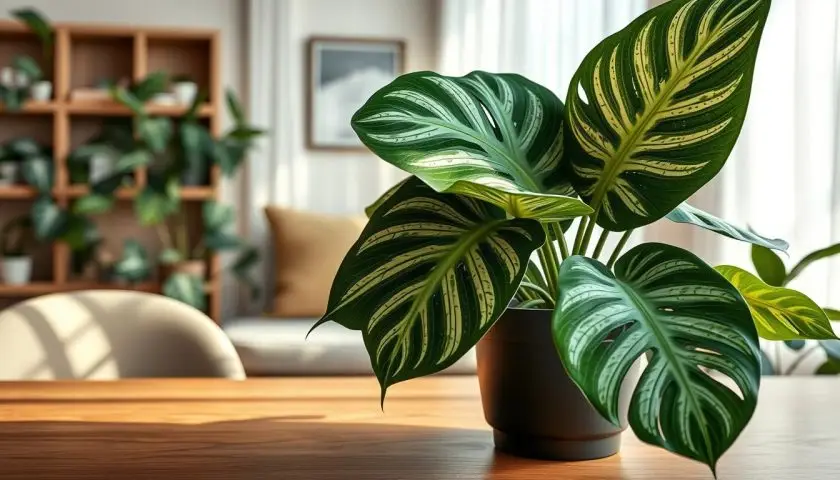
Best for Lower-Light Rooms
Chinese evergreen is among the more adaptable options for moderate or relatively low indirect light.
However, highly variegated cultivars may need more light than solid-green types, and no houseplant thrives in complete darkness.
Explore our low-light houseplants guide for more suitable choices.
Best for Small Desks and Shelves
Watermelon peperomia, nerve plant, and polka dot plant can be good choices where surface space is limited.
Choose a container proportional to the plant and avoid placing foliage against heating or air-conditioning vents.
Best for Hanging Baskets
Tradescantia zebrina creates an attractive trailing display and responds well to occasional pruning.
Prayer plants can also spread attractively in containers positioned on suitable elevated surfaces.
Best for Bright Living Rooms
Variegated rubber plants, crotons, and Persian shield can provide bold color where adequate light is available.
Remember that a bright room may still contain shaded corners where these plants receive insufficient light.
Best for Humid Bathrooms
Calathea orbifolia, rattlesnake plant, prayer plant, and Triostar stromanthe can benefit from a sufficiently humid room.
However, the bathroom must provide adequate light. Humidity alone cannot compensate for insufficient photosynthesis.
How to Maintain Colorful Patterns on Indoor Leaves
Leaf patterns depend on the plant’s genetics and growing conditions. While proper care may support stronger growth and healthier coloration, not every faded or variegated leaf can change its markings.
Provide Suitable Light
Too little light can lead to slow growth, long stems, and reduced vigor. Some plants may also produce foliage with less intense coloration.
Excessive direct light can cause bleaching or scorched patches.
Match lighting to the species rather than assuming every patterned plant needs the same amount.
Use Supplemental Grow Lights When Necessary
A suitable grow light can support houseplants in rooms with insufficient natural light.
Follow the fixture manufacturer’s guidance regarding distance, duration, and plant coverage. Avoid placing high-intensity lights too close to sensitive foliage.
For additional instructions, read our complete guide to indoor light.
Rotate Plants When Appropriate
Rotating containers periodically can help reduce strongly one-sided growth in some species.
However, plants that react poorly to frequent movement or have established climbing supports may need a more consistent orientation.
Watering Patterned-Leaf Houseplants Correctly
Watering is one of the most important parts of patterned foliage care, but it cannot be reduced to a single weekly schedule.
Check the Root Zone Before Watering
Feel the growing medium beneath the surface, use the pot’s weight as an additional clue, and consider the needs of the particular species.
Water thoroughly when appropriate and allow excess to drain.
Understand Differences Between Plant Groups
| Plant Group | General Watering Approach | What to Avoid |
|---|---|---|
| Calatheas and stromanthes | Maintain reasonably even moisture | Severe drought and waterlogging |
| Prayer plants and Fittonia | Monitor more frequently for drying | Repeated wilting |
| Peperomias | Allow some drying before watering again | Persistently saturated roots |
| Rubber plants | Allow an appropriate portion of the medium to dry | Excessive watering in low light |
| Crotons | Maintain suitable moisture with drainage | Sudden extreme moisture changes |
| Caladiums | Water during active growth; reduce during dormancy | Keeping dormant tubers excessively wet |
Adjust for Seasonal Changes
Many indoor plants use less water when light levels and growth rates decrease, although heated homes and grow lights can change this pattern.
Check actual soil conditions rather than automatically reducing watering by a fixed percentage.
See our houseplant watering guide and overwatering warning signs.
Best Soil, Humidity, and Temperature for Patterned Foliage
Choose a Well-Draining Potting Medium
Many tropical foliage plants benefit from a growing medium that retains appropriate moisture while allowing oxygen to reach the roots.
A quality indoor potting mix may be sufficient. Ingredients such as perlite, bark, or coco coir can be useful when adjustments are needed.
However, exact ratios should depend on the plant and the characteristics of the starting mix.
Read our best soil mix guide for further advice.
Improve Humidity for Sensitive Plants
If Calatheas, stromanthes, or Fittonias regularly develop dry edges in very dry indoor conditions, evaluate room humidity with a hygrometer.
A properly maintained humidifier can help create a more suitable environment.
Pebble trays and occasional misting generally produce less reliable, sustained changes in air humidity.
See our indoor humidity tips.
Protect Foliage From Temperature Extremes
Many tropical decorative plants perform best in comfortably warm, relatively stable indoor temperatures.
Avoid placing sensitive leaves against cold window glass or directly beneath hot-air vents.
Potting, Pruning, and Propagating Patterned Houseplants
Choose Containers With Drainage Holes
Drainage holes help excess water escape. When using a decorative cachepot, keep the plant in a draining inner container and empty accumulated water after watering.
Repot When Necessary
Repot when roots become severely crowded, the growing medium deteriorates, or drainage problems cannot otherwise be corrected.
Choose a slightly larger container rather than an unnecessarily oversized one.
For further guidance, see our plant repotting guide.
Clean Leaves Carefully
Dust buildup can reduce the amount of light reaching leaf surfaces and make pest detection more difficult.
For smooth, sturdy leaves, use a soft, slightly damp cloth.
For delicate, hairy, or highly textured foliage, follow species-specific cleaning guidance and avoid vigorous rubbing.
Skip unnecessary leaf-shine products, particularly on sensitive foliage.
See our safe leaf-cleaning guide.
Prune Leggy Plants
Polka dot plants, Tradescantia, and Persian shield may benefit from selective pruning or pinching to encourage branching.
Use clean tools and avoid removing excessive healthy growth from stressed plants.
Propagate According to the Species
Tradescantia and many polka dot plants can be propagated from suitable stem cuttings.
Some prayer-plant relatives can be divided during repotting, while Rex begonias may be propagated by appropriate leaf or stem methods depending on the cultivar.
Propagation techniques are not interchangeable across every species.
Explore our houseplant propagation guide.
Pet Safety: Which Patterned Houseplants Require Caution?
When choosing colorful houseplants for homes with pets, botanical identification matters. Common names can be misleading, and closely related plants do not necessarily share identical toxicity classifications.
| Plant | Pet-Safety Consideration |
|---|---|
| Calathea orbifolia | Generally listed as non-toxic to cats and dogs |
| Rattlesnake plant | Generally regarded as non-toxic |
| Prayer plant | Generally listed as non-toxic |
| Nerve plant | Generally listed as non-toxic |
| Watermelon peperomia | Generally listed as non-toxic |
| Chinese evergreen | Toxic if chewed; contains insoluble calcium oxalates |
| Croton | Can cause gastrointestinal and skin irritation |
| Rex begonia | Toxic; particularly important to prevent ingestion |
| Rubber plant ‘Tineke’ | Irritating latex; prevent pet ingestion |
| Caladium | Toxic; contains calcium oxalate crystals |
| Tradescantia zebrina | May cause skin or gastrointestinal irritation |
This table is a general screening guide, not a complete veterinary toxicity assessment for every cultivar. Verify exact species names through the ASPCA plant toxicity database before purchasing.
Even plants classified as non-toxic may cause digestive upset if eaten in significant quantities.
For more household safety ideas, read our cat-friendly plant guide and dog-friendly plant guide.
Troubleshooting Common Patterned-Leaf Plant Problems
Different species can develop similar symptoms, so diagnosis should begin with an examination of moisture, light, roots, and recent changes.
| Symptom | Possible Causes | First Action |
|---|---|---|
| Brown leaf edges | Dry air, inconsistent watering, salts, root stress | Review moisture, humidity, and fertilizer use |
| Faded patterns | Insufficient light, excessive sun, aging foliage | Evaluate light and new growth |
| Yellow leaves | Overwatering, underwatering, aging, root problems | Check soil and roots if needed |
| Wilting in wet soil | Root dysfunction or poor aeration | Inspect drainage and root health |
| Leaf curling | Moisture stress, heat, drafts, pests | Check growing conditions |
| Sudden leaf drop | Environmental change, cold damage, root problems | Review recent changes |
| Sticky leaves or fine webbing | Possible insect or mite infestation | Inspect leaf undersides and stems |
Brown and Crispy Leaf Edges
Brown edges may appear when sensitive foliage experiences low humidity, inconsistent watering, excessive salts, or damaged roots.
Do not assume that misting is always the solution. Check the potting medium and overall plant condition first.
Faded or Washed-Out Leaf Patterns
Inadequate light may affect vigor and coloration in some plants. Excessive direct sunlight can also bleach or scorch leaves.
Adjust light gradually and evaluate the appearance of new foliage.
Yellow Leaves
Yellow leaves may develop from natural aging, watering problems, insufficient light, or root dysfunction.
If the growing medium remains saturated, investigate drainage and root condition.
Our yellow leaves guide explains additional causes.
Wilting Despite Moist Soil
Wilting in wet soil can indicate that roots are not functioning properly.
Examine whether the medium is waterlogged or compacted. Inspect roots when symptoms are persistent or severe.
For further help, read our root rot warning signs guide.
Leaf Curling and Crispy Patches
Temperature stress, underwatering, pests, and other conditions may contribute to curling.
See our leaf curling, browning, and drooping guide.
Sudden Leaf Drop After Purchase
Plants may react to major changes in light, humidity, temperature, and watering after being brought home.
Keep conditions appropriate and relatively stable while watching for signs of continuing decline.
Common Mistakes When Growing Patterned-Leaf Houseplants
Watering Every Plant on the Same Day
Different species and container sizes dry at different rates. Always check each plant before watering.
Placing Every Variegated Plant in Strong Sunlight
Some colorful foliage needs bright conditions, but sensitive species can scorch under excessive direct exposure.
Ignoring Humidity Differences
Calatheas and stromanthes may react differently to dry indoor air than rubber plants or peperomias.
Using Decorative Pots Without Drainage
Water trapped at the base of a container can create persistent root problems.
Applying Too Much Fertilizer
Additional fertilizer does not automatically increase leaf color. Excess nutrients may increase soluble salts and damage roots.
Applying Leaf-Shine Products to Sensitive Foliage
Delicate, textured, or hairy leaves may be damaged by unsuitable cleaning methods or products.
Ignoring Mature Size and Pet Safety
A small nursery plant may eventually outgrow its display space, and some species can cause problems if pets chew them.
How to Create a Colorful Houseplant Display
A successful display combines attractive foliage with compatible growing conditions.
Combine Different Leaf Patterns
Mix boldly striped foliage with spotted and marbled varieties.
For example, a watermelon peperomia provides rounded silver-striped leaves, while a prayer plant offers smaller foliage with colorful veins.
Use Different Plant Heights
Place an upright rubber plant behind smaller containers and add a trailing Tradescantia on a nearby shelf.
This arrangement creates depth without requiring every plant to share one crowded container.
Group Plants With Compatible Needs
Position moisture-loving Calatheas and prayer plants in suitable locations where they receive similar light and environmental conditions.
Keep plants with more drought-tolerant watering preferences in separate containers so each can receive appropriate care.
Choose Pots That Complement the Foliage
Neutral white, cream, or terracotta containers often provide a simple background for highly colorful foliage.
Use containers with suitable drainage even when decorative outer pots are involved.
Avoid Overcrowding
Leave enough space for leaves to expand, for air to circulate, and for plants to receive adequate light.
Read our indoor jungle styling guide for additional ideas.
Weekly Care Checklist for Patterned-Leaf Houseplants
| Care Task | When to Check | Goal |
|---|---|---|
| Check soil moisture | Before each watering | Avoid drought and waterlogging |
| Inspect foliage | Weekly | Identify damage or pests |
| Review light exposure | When seasons change | Maintain suitable light |
| Check humidity | When indoor air becomes dry | Support sensitive foliage |
| Clean leaves | As dust accumulates | Maintain clean, healthy foliage |
| Review fertilizer use | During active growth | Avoid overfeeding |
| Inspect roots and drainage | When watering or growth changes | Identify root crowding or poor drainage |
Frequently Asked Questions About Patterned-Leaf Houseplants
1. What are the best patterned-leaf houseplants for beginners?
Chinese evergreens, watermelon peperomias, and Tradescantia zebrina can be relatively approachable choices when their light and watering requirements are met. Calatheas and some begonias typically need closer moisture and humidity management.
2. Which patterned houseplants grow in low light?
Some Chinese evergreen cultivars tolerate lower indirect light better than many colorful tropical plants. However, highly variegated varieties may need brighter conditions, and very dark rooms generally require supplemental lighting.
3. Why are my patterned houseplant leaves turning brown?
Brown edges may develop from inconsistent watering, dry air, fertilizer salts, unsuitable light, or root problems. Check the growing medium and environmental conditions before deciding on a treatment.
4. How often should I water patterned-leaf houseplants?
Watering frequency depends on the plant species, container size, soil type, light, and season. Moisture-sensitive plants such as Fittonia may need more frequent checks, while watermelon peperomia usually benefits from some drying between waterings.
5. Are patterned-leaf houseplants safe for cats and dogs?
Some are generally regarded as non-toxic, including prayer plants, many Calatheas, Fittonias, and watermelon peperomias. Others, such as Chinese evergreen, croton, and caladium, require caution. Verify the exact plant against the ASPCA toxicity database.
6. Why are my colorful houseplant leaves losing their patterns?
Leaf appearance can be influenced by genetics, maturity, and growing conditions. Insufficient light may reduce vigor or coloration in some varieties, while strong direct sun can bleach tissue. Some variegation patterns are genetically fixed and cannot be restored through care changes.
7. How do I keep patterned foliage looking bright and healthy?
Choose suitable light, water according to each plant’s needs, use an appropriate potting medium, protect foliage from temperature extremes, and manage humidity when necessary. Clean leaves gently and monitor new growth for signs of stress.
Conclusion: Bring Color Home With Patterned-Leaf Houseplants
Patterned-leaf houseplants offer a simple way to introduce color, texture, and visual interest into your home. Whether you love the silver stripes of Calathea orbifolia, the playful spots of a polka dot plant, or the bold leaves of a variegated rubber plant, there is a suitable decorative foliage option for many indoor environments.
The key is matching the plant to your space rather than choosing based on appearance alone.
Consider light, watering habits, humidity, mature size, and pet safety before bringing a new houseplant home. Start with a manageable species, observe its response to your growing conditions, and expand your collection gradually.
For more inspiration, browse our indoor plants collection and discover additional foliage plants that complement your home.
With thoughtful placement and consistent species-specific care, these 15 colorful houseplants can remain attractive additions to your indoor garden for years to come.