

🌿 Key Takeaways
- A wildlife-friendly garden does not require large space — even a balcony, courtyard, or small front yard can support bees, butterflies, and birds with the right plant choices
- Native plants are the single most effective foundation of any wildlife-friendly garden — they provide food and shelter perfectly matched to local species without requiring chemical support
- Sustainable gardening and wildlife support are the same goal — reducing chemicals, composting, conserving water, and choosing native plants all benefit both the garden and the creatures that depend on it
- Pollinator plants like lavender, coneflowers, and echinacea are the fastest way to attract bees and butterflies to any outdoor space
- A bird-friendly garden needs three things — shelter (dense shrubs), food (seed-bearing and berry plants), and water (even a simple dish)
- Sustainable gardening practices — no pesticides, composting, permeable surfaces, and water conservation — multiply the positive impact of every wildlife planting decision
- How to create a sustainable garden in a small yard starts with one pot of nectar-rich flowers, one water source, and one native plant — small actions compound into meaningful habitat
- Browse our full outdoor plant guides for plant selection guidance applicable to wildlife-friendly garden design
Why Designing a Wildlife-Friendly Garden Matters More Than Ever
Every outdoor space — no matter how small — has the potential to become something more than decorative. A wildlife-friendly garden is not about grandeur or acreage. It is about intention. It is about asking a simple question: what can this space offer to the creatures that share our environment?
We are living through a period of accelerating habitat loss. Cities expand across former green corridors. Agricultural monocultures replace diverse wildflower meadows. Hedgerows disappear from field boundaries. Ponds are filled. And in this shrinking landscape, garden spaces — however modest — have become genuinely important refuges for the species that depend on them.
The numbers make the case clearly. In the UK alone, there are an estimated 24 million private gardens covering approximately 433,000 hectares — more land than all the national nature reserves combined. If even a fraction of these gardens implemented wildlife-friendly garden principles, the cumulative impact on biodiversity would be extraordinary.
But the encouragement here is not guilt — it is possibility. Designing a wildlife-friendly garden is not about sacrificing beauty or structure. Some of the most visually stunning garden designs are simultaneously the most wildlife-productive. And the changes required — choosing native plants, adding a water source, reducing or eliminating pesticides, leaving some structural complexity in planting — are achievable in any garden, in any size space, at any budget level.
This complete guide covers everything — from understanding why sustainable gardening and wildlife support are the same goal, to specific garden design principles, the best pollinator plants, bird-friendly garden strategies, butterfly garden design, water features, and the practical sustainable gardening practices that make every planting decision more impactful.
Small Yards, Big Impact — Why Size Does Not Limit Wildlife Value
The Myth of the Large Garden Requirement
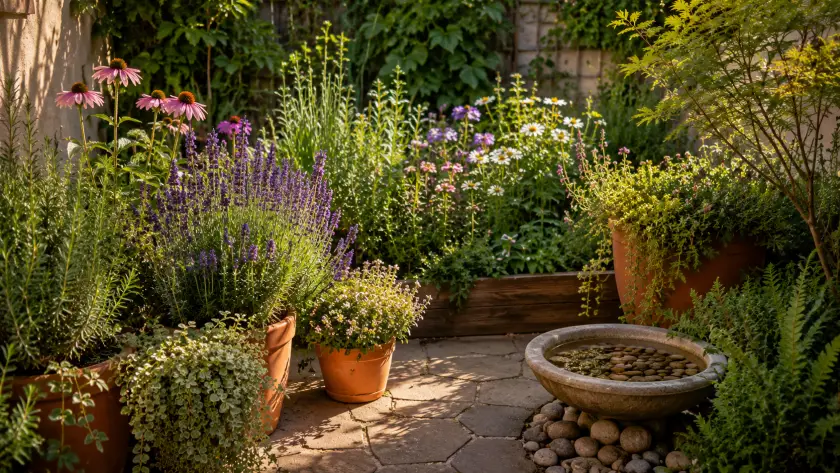
The most persistent barrier to wildlife gardening is the belief that meaningful habitat requires significant space. This is simply not true. Wildlife-friendly garden principles scale down to any size — from a quarter-acre suburban plot to a 2-metre square courtyard, a balcony lined with containers, or even a window box.
What small spaces can provide:
Food: A single pot of pollinator plants — lavender, echinacea, or borage — provides nectar for dozens of bee and butterfly species. The foraging range of a honeybee is up to 3km — meaning your single pot is part of a much larger feeding network that extends far beyond your garden boundary.
Shelter: A dense shrub in a corner — even a single hawthorn or native shrub rose in a large container — provides nesting sites and shelter for small birds. A pile of leaves or a stack of logs tucked in a corner provides overwintering habitat for hedgehogs, beetles, and beneficial insects.
Water: A single shallow dish of water — with stones or pebbles for insects to land safely — is meaningful habitat in itself. Bees, butterflies, and small birds all use water sources regularly, and a reliable garden water source becomes a consistent destination in the local wildlife’s daily range.
Connectivity: Perhaps most importantly, small gardens contribute to wildlife corridors — the connected networks of green spaces through which wildlife moves between larger habitat areas. Your small front yard is not isolated — it is one node in a constellation of green spaces that together form the urban and suburban wildlife network. Our guide on native plants that thrive in your region covers exactly how regionally appropriate plant choices maximise your garden’s contribution to local wildlife networks.
Front Yard Flower Gardens as Wildlife Habitat
Front yard flower garden designs are among the most impactful small-space wildlife gardening opportunities available. Front gardens — often currently devoted to paving, gravel, or lawn — are highly visible and directly connected to the street-level wildlife corridor.
Converting even a portion of a front yard to garden flower garden planting with native plants and pollinator plants creates:
- Immediate visible impact for neighbours and passersby — inspiring others to follow
- Direct connection to street-level pollinator corridors
- Reduced surface water runoff compared to paved alternatives
- Cooling effect that reduces urban heat island temperatures
Front yard flower garden design for wildlife works best with structural plantings — compact shrubs, ornamental grasses, and tall perennials — that provide visual interest from the street while delivering genuine wildlife habitat value. Our guide on creating a colorful garden for all seasons covers exactly how to design visually stunning front yard flower garden displays that simultaneously support wildlife year-round.
Garden Design Principles for Wildlife — Complete Guide
Garden Design for Wildlife — The Core Framework
Wildlife-friendly garden design differs from conventional garden design in one fundamental way: it considers the needs of non-human users as primary design requirements rather than afterthoughts. Every planting decision, every structural choice, every maintenance practice is evaluated not just for human aesthetic impact but for its value to local wildlife.
This does not mean gardens must look wild or unkempt. The most successful wildlife-friendly garden designs are beautiful, structured, and clearly intentional — they simply use different plants and leave different types of complexity than conventional gardens.
Principle 1 — Layer Your Planting
Natural habitats are layered — canopy trees above, understory shrubs below, herbaceous plants at ground level, and ground cover at the base. Each layer provides different habitat opportunities for different species. Wildlife-friendly garden design replicates this layering:
Canopy layer (if space allows): A single native tree — even a compact species like a rowan, crab apple, or silver birch in a large garden — provides nesting sites, bark habitat for insects, and seasonal food from flowers, berries, and seeds.
Shrub layer: Dense native shrubs provide nesting shelter for birds, overwintering sites for insects, and seasonal food from flowers and berries. Hawthorn, blackthorn, native roses, and elder are the most wildlife-productive shrub choices for UK gardens.
Herbaceous layer: Pollinator plants and native wildflowers provide the critical nectar, pollen, and seed resources that most wildlife visitors actually depend on.
Ground layer: Low ground cover plants — native violets, wild strawberries, clover in lawn areas — provide food and shelter for ground-dwelling insects and small mammals.
For inspiration on using layered planting principles in garden design, our guide on how to design a wildlife-friendly garden works alongside our color themes for your outdoor garden guide to create displays that are both visually stunning and genuinely wildlife-productive.
Principle 2 — Choose Native Plants
Native plants are the cornerstone of effective wildlife-friendly garden design — not because exotic plants are harmful, but because native species have co-evolved with local wildlife over thousands of years. The result is an extraordinarily complex web of relationships:
- Native oaks support over 280 species of insects compared to fewer than 5 for many exotic alternatives
- Native wildflowers provide pollen and nectar in the specific forms that native bee species can most efficiently use
- Native berry-producing shrubs ripen at the times when migrating and resident birds most need the calories
Native plants also require significantly less maintenance than many exotics — adapted to local climate, soil conditions, and rainfall patterns, they need no supplemental watering once established, no soil amendment, and no chemical support. Our guide on native plants that thrive in your region and why they matter covers the specific native plant selections for different regional conditions.
Principle 3 — Create Habitat Complexity
A natural garden contains varied structure — not just plants, but the spaces between them, the dead wood within them, the seed heads left standing on them, and the leaf litter beneath them. Each element of structural complexity provides habitat for different species:
Dead wood: Logs and branches left to decay provide habitat for stag beetles, wood-boring insects, fungi, mosses, and the woodpeckers and nuthatches that feed on them.
Leaf litter: A layer of fallen leaves in a quiet corner provides overwintering habitat for hedgehogs, slow worms, beneficial ground beetles, and countless invertebrates.
Standing seed heads: Seed heads of echinacea, rudbeckia, teasel, and ornamental grasses left through winter provide food for finches and other seed-eating birds.
Stone piles: A simple pile of stones in a sunny corner provides basking habitat for lizards and shelter for ground beetles and toads.
Principle 4 — Reduce or Eliminate Pesticides
Sustainable gardening practices begin with eliminating or dramatically reducing pesticide use. This is non-negotiable in genuine wildlife-friendly garden design — systemic insecticides in particular (including neonicotinoids that persist in plant tissues and pollen) cause direct harm to the very pollinators that wildlife gardens are designed to support.
Natural pest management alternatives:
- Companion planting: Growing plants that naturally deter specific pests alongside vulnerable crops — our guide on plants that keep bugs away without chemical repellents covers the most effective companion planting combinations
- Encouraging predatory insects: Ladybirds, lacewings, ground beetles, and hoverflies are all highly effective aphid predators — a wildlife-friendly garden that supports these beneficial species manages pest populations naturally
- Physical barriers: Netting, copper tape, and fleece protect vulnerable plants without chemical intervention
- Tolerance: Some pest damage is acceptable — caterpillar damage on leaves, for example, supports the bird populations that eat those caterpillars. Our guide on how to keep pests away from outdoor plants covers organic pest management strategies compatible with wildlife-friendly garden principles.
Principle 5 — Add Water
Water is the single most undervalued element of wildlife-friendly garden design. Every garden — regardless of size — can and should provide some form of water access for wildlife:
Mini pond (the gold standard): Even a small container pond — a half barrel, an old sink, or a purpose-built lined hole — provides habitat for frogs, toads, newts, dragonflies, water beetles, and numerous other aquatic species. A garden with a pond supports dramatically more wildlife than one without. Our guide on garden and pond covers pond integration in garden design.
Bird bath: A shallow dish raised off the ground — changed regularly to prevent mosquito breeding — provides drinking and bathing water for birds year-round.
Bee water station: A shallow dish with stones or marbles allows bees to access water without drowning — critical during dry periods when natural water sources become scarce.
Rain garden: A planted depression designed to collect and slowly absorb surface water — providing moisture for plants while reducing runoff and creating consistently moist habitat conditions that benefit amphibians and moisture-loving insects.
Pollinator Plants — The Heart of Wildlife-Friendly Gardens
Best Pollinator Plants for UK Gardens
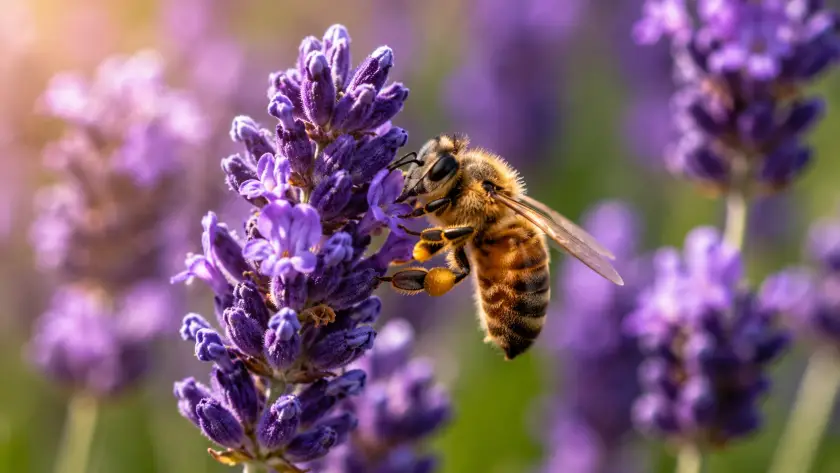
Pollinator plants are the foundation of any wildlife-friendly garden — providing the nectar and pollen that bees, butterflies, moths, and hoverflies depend on. Choosing pollinator plants that bloom across the full growing season ensures a continuous food supply from the first warm days of February through to late autumn.
Best pollinator plants by season:
Spring Pollinator Plants (February–May)
- Crocus: Among the earliest nectar sources of the year — critical for queen bumblebees emerging from winter dormancy
- Pulmonaria: Long tubular flowers particularly accessible to long-tongued bumblebees
- Fruit tree blossom: Apple, pear, and cherry blossom provide mass nectar events
- Hawthorn: One of the most wildlife-productive native plants — masses of spring blossom followed by autumn berries
- Alliums: Spherical flower heads covered with small flowers — accessible to a wide range of pollinator species
Summer Pollinator Plants (June–September)
- Lavender: The most bee-attractive plant available — virtually every bee species visits lavender in full bloom
- Echinacea (Coneflower): Long-blooming summer perennial with large landing platforms accessible to bumblebees, honeybees, and butterflies
- Borage: Star-shaped blue flowers with exceptionally high nectar content — one of the most productive individual pollinator plants available
- Verbena bonariensis: Tall, airy purple flowers loved by butterflies — particularly peacock and small tortoiseshell
- Rudbeckia: Golden yellow daisy flowers from July through October providing late-season nectar and winter seed heads
- Phacelia: Lavender-blue flowers producing extraordinary volumes of pollen — highly attractive to all bee species
Autumn Pollinator Plants (September–November)
- Asters: The most important late-season pollinator plants available — providing critical nectar when most other flowers have finished
- Ivy: Often overlooked, ivy flowers in autumn are an extraordinary nectar source — producing nectar into November when almost nothing else is available
- Sedum: Flat-topped flower heads covered with small flowers, supporting the last butterfly and bee activity of the season
- Helenium: Rich orange and red daisy flowers from August into October — particularly attractive to late bumblebee species
For comprehensive guidance on pollinator plants that work in container gardening and small space situations, our guide on pollinator-friendly plants for urban outdoor spaces covers the most effective pollinator plants for gardens of every size.
Herbs as Pollinator Plants
Planting gardens with culinary herbs is one of the most rewarding dual-purpose strategies in wildlife-friendly garden design — the same herbs that provide kitchen harvests are among the most productive pollinator plants available when allowed to flower:
- Thyme: Small flowers that carpet low-growing mats — extraordinarily attractive to bees when in bloom
- Rosemary: Winter-to-spring flowering — providing nectar at a critical time when few other plants are available
- Mint: Our guide on mosquito repellent plants identifies mint as one of the best dual-purpose plants — deterring mosquitoes while attracting beneficial pollinators when flowering
- Chives: Purple pompom flowers loved by bees — one of the most productive pollinator herbs available
- Borage: Edible flowers and extraordinary pollinator value — one of the most recommended additions to any wildlife-friendly garden
For comprehensive guidance on growing edible plants alongside pollinator plants in garden design, our guide on edible flowers to grow in your outdoor garden covers the best edible-ornamental combinations that simultaneously support pollinators.
Bird-Friendly Garden Design — Attracting and Supporting Garden Birds
How to Create a Bird-Friendly Garden
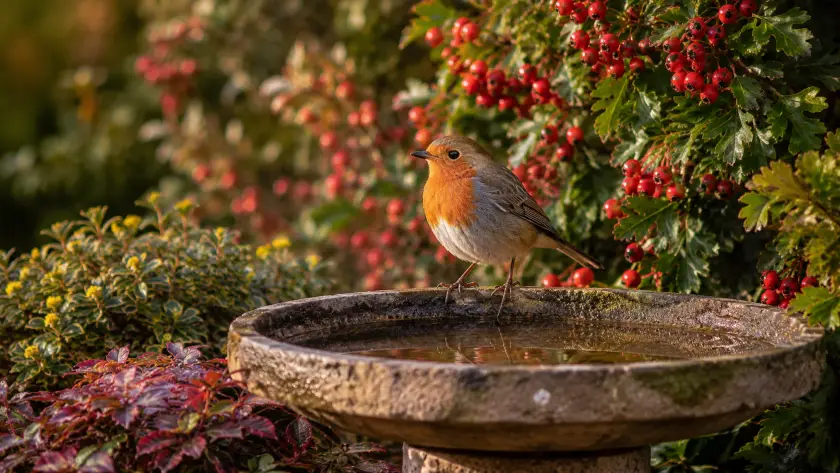
A bird-friendly garden requires three fundamental elements — food, water, and shelter. Understanding what specific bird species need for each element allows garden design choices that support the widest possible range of visitors.
Food Plants for Garden Birds
Seed-bearing plants:
- Sunflowers: Reliable, productive seed heads that feed finches, tits, and sparrows through autumn and winter
- Rudbeckia and echinacea: Seed heads left standing through winter provide food for goldfinches and siskins
- Teasel: Architectural seed heads — one of the most reliable goldfinch-attracting plants available
- Ornamental grasses: Seed heads provide food for seed-eating birds from late summer through winter — and the grass clumps provide nesting material in spring
Berry-bearing shrubs (the most important bird food plants):
- Hawthorn (Crataegus monogyna): The single most important native berry-bearing shrub for garden birds — berries are consumed by thrushes, blackbirds, fieldfares, and redwings
- Elder (Sambucus nigra): Black berries in late summer attract up to 50 bird species — one of the most productive wildlife shrubs available
- Rowan (Sorbus aucuparia): Vivid orange-red berries consumed rapidly by thrushes in autumn
- Cotoneaster: Dense, persistent red berries that provide food through winter — particularly valuable during hard frost periods
Shelter Plants for Garden Birds
Dense shrubs and hedges provide the shelter, nesting sites, and safe movement corridors that garden birds need year-round:
Best shelter plants for garden birds:
- Hawthorn hedge: The most wildlife-productive hedging plant available — dense, thorny (predator protection), spring blossom for pollinators, and autumn berries for birds
- Holly: Evergreen shelter year-round, red berries for winter bird food, and nesting sites used by blackbirds, thrushes, and robins
- Native rose species: Dense, thorny structure for nesting, summer flowers for pollinators, and rose hips for birds
Bird Baths and Water Sources
Fresh water is as important as food and shelter in a bird-friendly garden. A consistent, reliable water source becomes a regular destination in the local bird population’s daily routine:
Bird bath placement: Position 1–2 metres from dense cover — close enough for birds to retreat quickly from predators, but not so close that cats can launch ambush attacks. Change water every 2–3 days to prevent algae and mosquito breeding.
Winter water: Bird baths frequently freeze in cold weather — check and replenish daily during frost periods. A small floating ball prevents complete freezing in mild frost conditions.
Butterfly Garden Design — Creating a Complete Butterfly Habitat
How to Design a Butterfly Garden
Butterfly garden design requires thinking about the complete butterfly lifecycle — not just the nectar-feeding adult stage, but also the larval (caterpillar) stage that most garden design ignores entirely.
A complete butterfly garden has two layers:
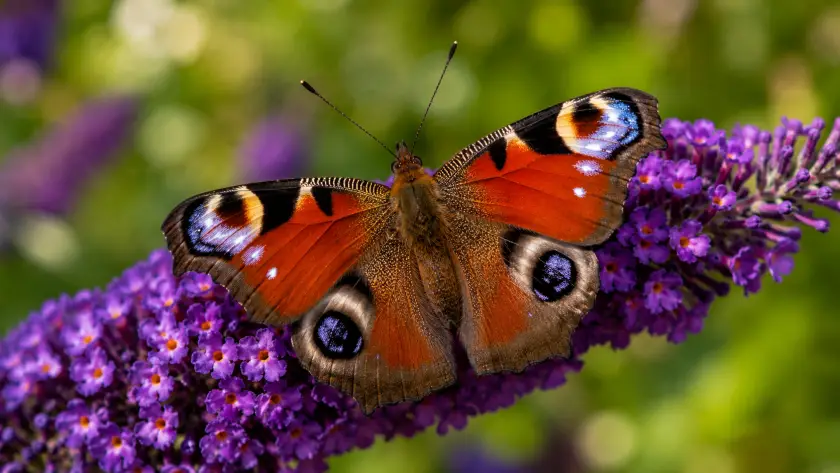
Adult nectar plants: Butterflies need nectar-rich flowers with accessible landing platforms — flat-topped or open flowers that allow butterflies to land and feed easily. The best adult nectar plants include buddleja (the classic butterfly bush), verbena bonariensis, lavender, asters, and sedum.
Larval host plants: Without the specific plant species on which their eggs hatch and caterpillars feed, butterflies cannot complete their lifecycle. Common UK butterfly species and their larval host plants:
| Butterfly Species | Larval Host Plant |
|---|---|
| Small tortoiseshell | Stinging nettles (Urtica dioica) |
| Peacock | Stinging nettles |
| Red admiral | Stinging nettles |
| Orange tip | Garlic mustard, lady’s smock |
| Common blue | Bird’s foot trefoil |
| Holly blue | Holly, ivy |
| Brimstone | Buckthorn |
| Green-veined white | Hedge mustard, garlic mustard |
The nettles revelation: A small patch of stinging nettles in a sunny, sheltered corner is the single most wildlife-productive plant you can include in a UK wildlife-friendly garden — supporting small tortoiseshell, peacock, comma, and red admiral caterpillars, as well as numerous aphid-feeding insects that in turn support birds. Position nettles in an out-of-the-way corner where they can establish without becoming invasive.
Sustainable Gardening — Practices That Multiply Wildlife Value
What Is Sustainable Gardening?
What is sustainable gardening? It is an approach to garden management that works with natural systems rather than against them — reducing chemical inputs, conserving water, building soil health, and making choices that have positive rather than negative impacts on the broader ecosystem.
Sustainable gardening and wildlife-friendly garden design are not separate concepts — they are the same goal expressed differently. Every sustainable gardening practice simultaneously improves wildlife habitat:
What Is a Sustainable Garden — Core Practices
How to create a sustainable garden through specific daily and seasonal practices:
Composting: A garden compost heap is one of the most wildlife-productive features you can add to any wildlife-friendly garden — providing habitat for slow worms, grass snakes, hedgehogs (that sometimes nest in compost heaps in autumn), countless invertebrates, and the beneficial fungi and bacteria that improve soil health for plants.
Sustainable gardening practices around composting: compost all garden waste including spent plants, fallen leaves, and vegetable kitchen scraps. Apply annually to garden beds — improving soil structure, water retention, and nutrient content without chemical fertilizers.
Water Conservation: Sustainable gardening water practices — using water butts to collect rainwater, mulching to reduce evaporation, and choosing drought-tolerant native plants once established — reduce garden water use while simultaneously creating better growing conditions for wildlife-supporting plants. Our guide on top drought-resistant plants covers the most drought-tolerant native plants and pollinator plants for water-wise wildlife-friendly garden design.
No-Dig Gardening: The no-dig approach — adding compost to the soil surface rather than digging it in — preserves the complex structure of soil ecology that supports earthworms, ground beetles, and the fungal networks that connect plant root systems. Disturbing soil through digging destroys these networks and releases stored carbon.
Leaving the Garden Alone in Autumn: Sustainable gardening practices in autumn include resisting the urge to cut everything back and “tidy up.” Leaving seed heads standing, leaving leaf litter in place, and not cutting back herbaceous perennials until late winter provides:
- Winter food for seed-eating birds
- Overwintering habitat for beneficial insects in hollow stems
- Frost-catching structural beauty that extends garden interest through winter
For specific guidance on sustainable gardening practices through the seasonal calendar, our guide on best low-maintenance outdoor plants for busy gardeners covers low-intervention approaches that naturally align with sustainable gardening principles.
Garden Landscaping for Wildlife — Practical Elements
Garden Landscaping — Choosing Wildlife-Friendly Materials and Structures
Garden landscaping choices extend beyond plants to the hard surfaces, structures, and features that form the physical framework of the garden:
Permeable surfaces: Replace impermeable concrete or tarmac paths and paved areas with permeable alternatives — gravel, bark chips, permeable block paving, or stepping stones through low ground cover planting. Permeable surfaces allow rainwater to infiltrate naturally, recharging groundwater, reducing runoff, and maintaining the moist soil conditions that support earthworms, amphibians, and soil invertebrates.
Raised garden design: Raised garden ideas and raised garden design using timber-framed raised beds create additional habitat value — the timber edges provide habitat for insects, the height difference creates varied microclimates, and the improved drainage suits a wider range of pollinator plants than waterlogged flat ground.
Wildlife-specific structures:
- Bee hotels: Bundles of hollow stems or drilled timber blocks provide nesting sites for solitary bee species
- Hedgehog highways: Small gaps (13cm × 13cm) at the base of garden boundaries allow hedgehogs to move between gardens
- Swift boxes and nest boxes: Mounted on walls or trees, providing nesting sites for species that have lost traditional nesting opportunities
- Log piles: Decaying wood stacked in a shaded corner provides habitat for stag beetles, wood-boring insects, fungi, and the birds that feed on them
Landscape Garden Design — Structure and Wildlife Value Combined
Landscape garden design that achieves both visual impact and wildlife value uses the same structural principles but makes different plant choices:
Formal structure with wildlife planting: Clipped native hedges (hawthorn, yew, hornbeam) provide formal structure and definition while delivering exceptional wildlife habitat value. This approach suits formal garden landscape styles without compromising wildlife productivity.
Naturalistic planting: Prairie-style mixed perennial and grass plantings — using both native and non-invasive exotic species — create the visual complexity of natural meadows while providing exceptional wildlife habitat through extended bloom seasons and structural seed heads.
For comprehensive garden landscaping guidance that combines visual impact with wildlife value, our guide on how to design a wildlife-friendly garden works alongside our garden landscape design guide to create outdoor spaces that are simultaneously beautiful and genuinely productive for local wildlife.
Fruit and Vegetable Gardens as Wildlife Habitat
Fruit and Veg Gardens — Productive and Wildlife-Friendly
Fruit and vegetable garden growing is one of the most compatible activities with wildlife-friendly garden design — because food growing depends on the very pollinators and beneficial predatory insects that wildlife-friendly garden principles support.
Fruit and veg garden wildlife integration:
Fruit trees as wildlife habitat: Even a single apple tree in a small garden provides spring blossom for pollinators, summer and autumn fruit for birds and mammals, bark habitat for insects, and nesting sites in mature specimens. Crab apples are particularly wildlife-productive — their fruit persists through winter, feeding birds long after other food sources have been exhausted.
Vegetable garden companion planting: Growing pollinator plants among vegetables — borage beside tomatoes, phacelia between brassica rows, nasturtiums throughout — attracts the pollinating insects that improve vegetable yields while simultaneously providing wildlife habitat. Our guide on grow your own — easiest outdoor edible plants for beginners covers the best edible plants to grow alongside wildlife-supporting companion plants.
Garden and pond combination: A wildlife pond beside a vegetable garden creates a self-supporting ecosystem — frogs and toads that breed in the pond feed extensively on slugs and other garden pests, providing free organic pest control.
A wildlife-friendly garden can also use plants that repel mosquitoes naturally, including lavender, rosemary, mint, lemon balm, basil, and marigolds. These plants add scent and colour while supporting a more balanced outdoor space.
Seasonal Wildlife Garden Calendar
Planting a Garden — Season by Season Wildlife Actions
Planting a garden for wildlife requires different actions in each season — building on previous seasons’ work and preparing for the next:
Spring — Planting Gardens for the Season Ahead
Planting gardens priorities in spring:
- Plant native plants and pollinator plants as weather warms — spring planting allows full establishment before summer
- Sow wildflower seeds directly into prepared soil — annual wildflower mixes establish quickly and provide summer-long pollinator support
- Install bird nest boxes before nesting season begins — most garden birds begin nesting from March onward
- Set up bee hotels in a sunny, sheltered position — facing south or southeast, 1–2 metres above ground
- Plant a garden pond or water feature — spring is the ideal time before amphibian breeding season peaks
For a complete spring planting calendar, our guide on outdoor plants that survive British winters without fuss covers spring transition planting for both ornamental and wildlife-focused garden designs.
Summer — Managing the Wildlife Garden at Peak Season
Going gardening activities in summer for maximum wildlife benefit:
- Deadhead selectively — remove spent flowers from plants that do not produce wildlife-valuable seed heads, but leave seed heads on rudbeckia, echinacea, and teasel
- Maintain water sources — top up bird baths and bee water stations regularly during dry periods
- Observe and identify — summer is the best time to identify which wildlife species are using your garden, informing future planting decisions
- Leave lawn areas unmown in designated areas — even a small patch of longer grass provides habitat for grasshoppers, slow worms, and the birds that feed on them
Autumn — Preparing the Wildlife Garden for Winter
Going gardening in autumn:
- Leave seed heads standing — do not cut back perennials that provide winter bird food
- Plant spring-flowering pollinator plants (bulbs) for the following year
- Create or enlarge compost heaps — autumn leaf fall provides ideal carbon material
- Plant native shrubs and hedging — autumn planting allows root establishment before winter
Winter — Planning the Wildlife Garden’s Future
Planting gardens planning in winter:
- Research and order seeds for the following season — native wildflower mixes, pollinator plants, and vegetable companions
- Plan new features — pond, raised beds, compost area, or structural planting
- Observe winter wildlife visitors — which birds are using the garden, which areas provide shelter
Room for Indoor Plants in a Wildlife Garden Philosophy
How Indoor Plants Connect to Wildlife Gardening Values
The values that drive wildlife-friendly garden design — attention to plant needs, observation of growth and health, understanding of ecological relationships — translate directly to indoor plant care. The same mindset that makes someone an effective wildlife gardener makes them an effective houseplant owner.
For indoor plants that connect philosophically to wildlife gardening values:
Our guide on air-purifying indoor plants that actually work covers species that improve indoor air quality — the indoor equivalent of the ecosystem services that wildlife-friendly garden plants provide outdoors.
The Feng Shui indoor plants guide covers indoor plant placement for positive energy flow — a philosophy that shares much with the wildlife-friendly garden approach of creating spaces that work with natural systems rather than against them.
For indoor plants that should you talk to — building the observation habit that makes both indoor plant care and wildlife garden management more effective — our guide on should you talk to your plants covers the science of plant-human interaction applicable to both indoor and outdoor growing.
Frequently Asked Questions
Can I Really Create a Wildlife-Friendly Garden in a Tiny Yard?
Yes — absolutely. Even a 2-metre square courtyard, a balcony, or a window box can support pollinators, birds, and beneficial insects with the right pollinator plants and a water source. A single pot of lavender attracts bees. A shallow water dish attracts birds. A native wildflower window box supports multiple butterfly species. Small yards create meaningful wildlife habitat when sustainable gardening principles are applied — size is far less important than intention and plant choice.
What Are the Best Native Plants to Start With?
Native plants to start with for maximum immediate wildlife impact: hawthorn (shrub or hedge), any native wildflower mix, lavender, echinacea, rudbeckia, and a berry-bearing shrub such as elder or cotoneaster. These six plant types cover pollinators (spring through autumn), birds (berries and seeds), and structural habitat (shrub cover) — the complete foundation of a wildlife-friendly garden in any size space. Our guide on native plants that thrive in your region covers regionally specific native plant recommendations.
How Do I Attract Birds Without Feeders?
A bird-friendly garden without feeders relies on three things: seed-bearing plants (sunflowers, teasel, rudbeckia, ornamental grasses left through winter), berry-bearing shrubs (hawthorn, elder, cotoneaster), and a consistent water source. These three elements attract a wider range of bird species than supplementary feeders alone — because they provide food in the forms birds are naturally adapted to find and process.
What Is Sustainable Gardening and Why Does It Matter?
What is sustainable gardening? It is a garden management approach that works with natural systems — reducing chemical inputs, building soil health through composting, conserving water, and choosing plants that support local wildlife. Sustainable gardening matters because conventional garden management practices — pesticides, peat compost, non-native monocultures, impermeable surfaces — collectively damage the local ecosystem. Sustainable gardening practices reverse this impact, turning gardens from ecological liabilities into genuine wildlife assets.
How Do I Create a Butterfly Garden?
A butterfly garden requires both adult nectar plants and larval host plants. For adult nectar: buddleja, verbena bonariensis, lavender, asters, and sedum. For larvae: native nettles (small tortoiseshell, peacock, red admiral), garlic mustard (orange tip), and bird’s foot trefoil (common blue). A butterfly garden without host plants supports adult feeding only — include host plants to support the complete butterfly lifecycle.
Will a Wildlife-Friendly Garden Look Messy?
No — wildlife-friendly garden design and visual beauty are entirely compatible. The most effective approach uses structured native hedging and defined plant beds to create visual order, while including the complexity (seed heads, some areas of longer grass, a log pile in a corner) that provides wildlife habitat. Garden design principles of layering, repetition, and seasonal interest all apply equally to wildlife-focused gardens. Many of the most visually striking gardens are simultaneously the most wildlife-productive.
What Are the Best Sustainable Gardening Practices to Start With?
Sustainable gardening practices to implement immediately: stop using pesticides (the single most impactful change), start a compost heap, add a water source for wildlife, replace one area of paving or lawn with native plants and pollinator plants, and leave seed heads standing through winter rather than cutting back in autumn. These five practices implemented in any order collectively transform a conventional garden into a wildlife-friendly garden within a single season.
Related Guides on Patch Plants
- 🌸 Pollinator-Friendly Plants for Urban Outdoor Spaces
- 🌿 Native Plants That Thrive in Your Region — Why They Matter
- 🌈 Create a Colorful Garden for All Seasons
- 🌱 Edible Flowers to Grow in Your Outdoor Garden
- 🌵 Top Drought-Resistant Plants for Low-Water Gardens
- 🌿 Best Low-Maintenance Outdoor Plants for Busy Gardeners
- 🌱 Grow Your Own — Easiest Outdoor Edible Plants for Beginners
- 🦟 Mosquito Repellent Plants — Best Natural Deterrents
- 🐛 Plants That Keep Bugs Away Without Chemical Repellents
- 🌿 How to Keep Pests Away from Outdoor Plants
- ❄️ Outdoor Plants That Survive British Winters Without Fuss
- 🌱 Color Themes for Your Outdoor Garden
- 🌱 Browse All Outdoor Plant Guides
Final Thoughts
A wildlife-friendly garden is one of the most meaningful things any outdoor space can be — not because it requires sacrifice of beauty or effort, but because it adds a dimension of purpose that purely decorative gardening cannot provide. When a bumblebee finds your lavender, when a goldfinch lands on your teasel seed head in January, when a frog appears in your new pond — these moments connect your garden to something much larger than itself.
Sustainable gardening is not a compromise. It produces more beautiful, more resilient, more interesting gardens than the pesticide-dependent, chemically maintained alternatives. Native plants are not second-best choices — they are the plants that have defined this landscape for thousands of years, that have co-evolved with the insects, birds, and mammals that make any garden feel genuinely alive.
Start with one change. Plant one pollinator plant. Add one water source. Leave one patch of seed heads standing through winter. Then add another. The wildlife will respond faster than you expect — because they are already looking for exactly what you are offering. Every garden that joins the network makes the whole network stronger.
According to the Royal Horticultural Society, gardens collectively represent one of the most significant wildlife habitat networks in the UK — making individual garden wildlife decisions collectively among the most impactful conservation actions available to ordinary people. 🌿
[…] multiple pest types simultaneously while contributing visual interest and biodiversity. See our wildlife-friendly garden guide for how to balance pest control with pollinator […]
[…] outdoor display guidance, our guides on pollinator-friendly plants for urban outdoor spaces and designing a wildlife-friendly garden cover container gardening for wildlife in […]
[…] more context on how outdoor plant choices affect local wildlife, our how to design a wildlife-friendly garden guide covers the broader principles of urban wildlife gardening alongside pollinator […]
[…] Wildlife-friendly garden guide […]