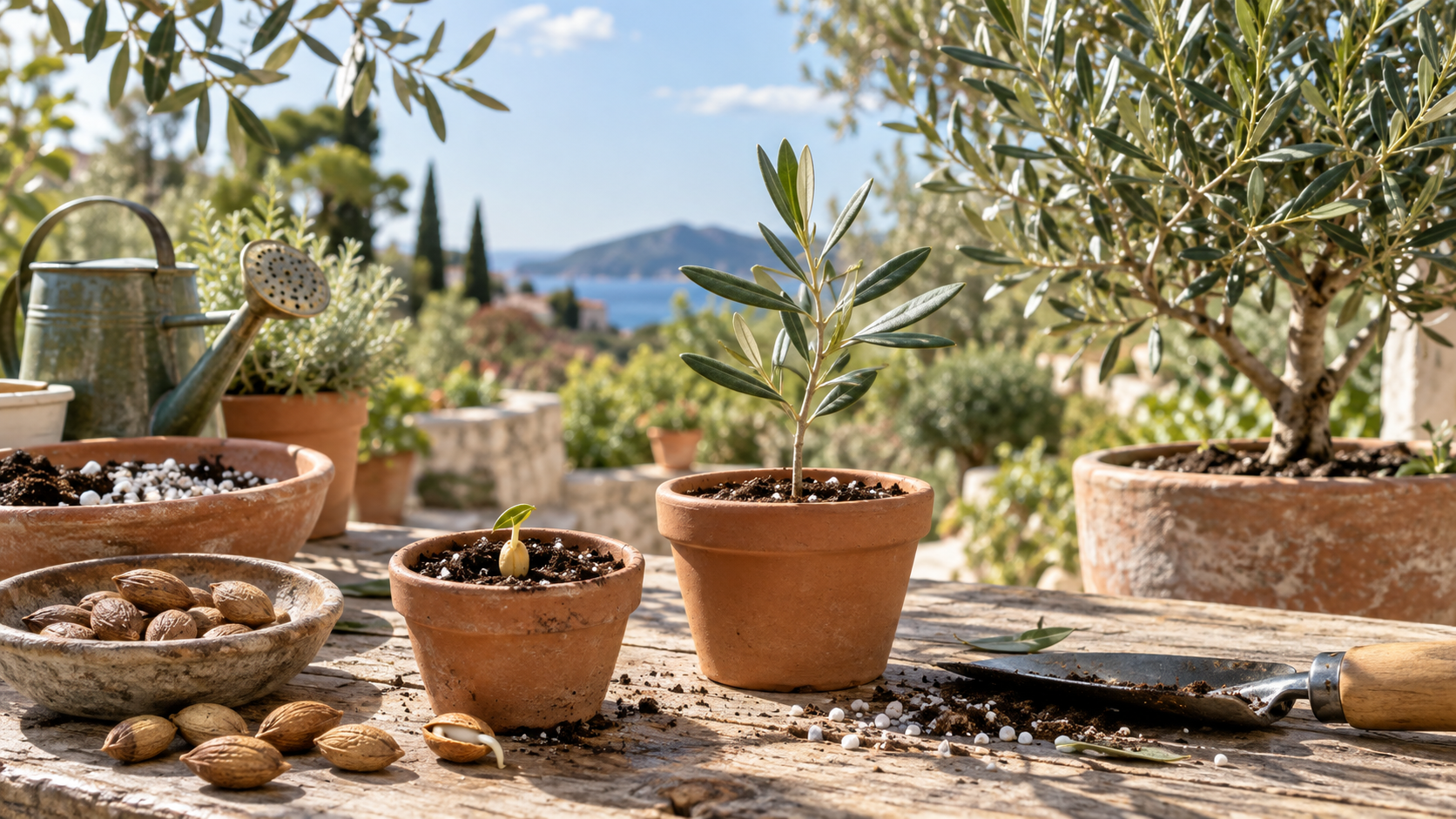
Growing an olive tree from seed requires patience. Germination can be slow and uneven, and a seed-grown tree may take years to mature enough to flower or produce fruit. It may also develop differently from the tree that produced the original olive.
This beginner-friendly guide explains how to grow olive plant seeds in nine practical steps. You will learn how to select and prepare seeds, choose a growing medium, manage germination, care for seedlings, transplant young trees, and troubleshoot common problems.
For more beginner-friendly growing advice, explore our Outdoor Plants guides and Plant Care guides.
QUICK ANSWER
How Do You Grow Olive Plant Seeds?
Start with viable olive plant seeds from mature, unprocessed fruit. Remove the fruit flesh completely, inspect the pits for damage, carefully prepare the hard outer coat, and soak the prepared seeds before planting.
Plant the seeds in small containers with drainage holes and a fast-draining growing medium. Keep the medium evenly moist without making it waterlogged and provide suitable warmth during germination.
Once seedlings emerge, provide appropriate light and airflow. As they become established, transplant them carefully and continue managing light, moisture, nutrition, and container size as they grow.
PATCH PLANTS SUMMARY
Key Takeaways for Olive Plant Seeds
- Choose viable seeds from mature, unprocessed olives.
- Remove all remaining fruit material before germination.
- Prepare the hard outer seed coat carefully without damaging the inside.
- Use small containers with functional drainage holes.
- Plant in an airy, fast-draining growing medium.
- Maintain consistent moisture without saturating the soil.
- Expect germination to be slow and sometimes uneven.
- Provide suitable light once seedlings emerge.
- Remember that seed-grown olive trees can differ from their parent tree.
Olive Plant Seeds: What to Know Before You Start
Before planting olive plant seeds, it is important to understand what makes growing an olive tree from seed different from buying an established nursery plant.
A seed-grown tree is not guaranteed to reproduce the exact characteristics of its parent. Seedlings can vary in eventual size, growth habit, and fruit characteristics.
For beginners, this means the project is best viewed as an opportunity to grow and observe an olive tree rather than a quick way to reproduce a specific cultivar.
Can Olive Plant Seeds Produce Fruit?
They can eventually develop into mature trees capable of flowering and potentially producing fruit, but patience is essential. Seed-grown trees may take several years to reach sufficient maturity.
Even if your tree eventually fruits, its olives may differ from the fruit that supplied the original seed.
Are Store-Bought Olive Seeds Suitable?
Pits removed from processed eating olives are generally poor choices. Heat, curing, pickling, salt, and other processing can affect the living material inside the pit.
Fresh, mature, unprocessed fruit or seeds obtained specifically for growing provide a more appropriate starting point.
Step 1: Choose Viable Olive Plant Seeds
Success with olive plant seeds begins before anything goes into the soil. Seed quality influences whether germination is possible in the first place.
Select Seeds From Mature Fruit
Start with seeds from fully mature olives. Fruit harvested too early may contain seeds that have not developed sufficiently.
Freshness also matters. Seeds exposed to unsuitable storage conditions, excessive heat, or deterioration may have reduced viability.
Inspect Every Seed
Look carefully at each pit before preparation.
A healthy candidate should feel firm and should not show obvious deep cracks, fuzzy mold, insect holes, or severe physical damage.
Start More Than One Seed
Not every apparently healthy olive seed will germinate successfully. Starting several suitable seeds can improve your chances of obtaining at least one strong seedling.
Keep Expectations Realistic
Growing from seed involves natural variation. The resulting tree may not develop exactly like its parent, particularly in eventual size, growth pattern, and fruit characteristics.
Step 2: Clean and Prepare Olive Plant Seeds for Germination
Proper preparation of olive plant seeds helps create better conditions for germination while reducing problems caused by leftover fruit material.
Remove the Fruit Flesh Completely
Begin by removing all remaining olive flesh from around the pit.
Fruit residue left in a warm, moist environment can encourage mold and other unwanted microbial growth.
Wash the Seeds Carefully
Use water to soften remaining fruit material and gently clean the outside of the pit with a soft brush or rough cloth.
Avoid aggressive pressure that could crack the pit or damage the seed inside.
Inspect the Cleaned Seeds Again
Once clean, inspect each pit again. Damage that was hidden beneath fruit material may now be easier to see.
Discard severely cracked, moldy, or insect-damaged seeds.
Scarify the Hard Outer Coat Carefully
The hard outer structure around the seed can restrict water penetration. The source growing method uses careful scarification to help moisture reach the seed.
Lightly work on the outer layer with suitable material such as sandpaper. The objective is not to grind deeply into the pit or expose and injure the embryo.
Soak Olive Plant Seeds Before Planting
After preparation, soak the seeds in room-temperature water for approximately 24 to 48 hours.
A floating seed should not automatically be treated as dead. Overall seed condition is more useful than relying on floating or sinking alone.
Step 3: Plant Olive Plant Seeds in the Right Growing Medium
The growing medium surrounding olive plant seeds should provide both moisture and air. A heavy, constantly saturated mixture can create poor conditions for germination and developing roots.
Choose Small Containers With Drainage
A small container around 3 to 4 inches wide can provide adequate starting space for an individual seed.
More importantly, make sure the container has functional drainage holes. Excess water needs somewhere to escape.
Prepare a Fast-Draining Growing Medium
The source method combines seed-starting mix with perlite and coarse sand to improve aeration and drainage.
Rather than focusing only on a rigid recipe, aim for a medium that holds useful moisture without becoming compacted or remaining saturated.
Read our complete soil mix guide to understand drainage, aeration, and moisture retention.
FREE PATCH PLANTS TOOL
Preparing a Larger Planter for Your Olive Tree?
If your seedling eventually moves into a rectangular planter, use our free Soil Calculator to estimate how much growing medium you need.
You can then use our potting mix guide to understand how soil structure affects drainage and root health.
Plant Each Seed Carefully
The source method places each seed approximately half an inch deep, with its slightly pointed end facing upward.
Cover the seed with the growing medium without heavily compacting the surface.
Label the Containers
Record the planting date and seed source. Labeling becomes especially useful when you are testing several seeds because germination may not happen at the same time.
Moisten the Medium Gently
After planting olive plant seeds, gently moisten the growing medium.
Avoid immediately flooding the container. You want even moisture around the seed without creating a saturated root zone.
Step 4: Give Olive Plant Seeds Warmth and Consistent Moisture
Once planted, olive plant seeds need steady conditions and patience. Constantly changing their environment or repeatedly disturbing the soil can make an already slow process more difficult to manage.
Keep the Growing Medium Evenly Moist
Monitor the growing medium and add water gently when needed.
A spray bottle can help moisten the surface without disturbing recently planted seeds. Bottom watering can also allow moisture to move upward through the medium without a heavy stream hitting the surface.
For more help judging moisture correctly, read our complete watering guide.
Avoid Waterlogged Soil
Consistent moisture does not mean constantly saturated soil.
If water remains trapped around the seed, conditions can favor deterioration instead of healthy germination.
Our overwatering guide explains how excessive moisture can affect plants and their roots.
Maintain Suitable Warmth
The uploaded growing method recommends warm conditions for germinating olive seeds. If the growing area is cool, a suitable seedling heat mat can help maintain steadier warmth.
Keep containers away from cold drafts and abrupt temperature changes.
Wait Patiently for Germination
Olive plant seeds may take several weeks or even months to germinate, and different seeds can emerge at different times.
Do not dig repeatedly into the growing medium to check them. Maintain suitable conditions and monitor the containers for visible signs of germination.
Step 5: Care for Olive Plant Seedlings After Germination
When olive plant seeds finally produce green shoots, your care priorities begin changing. The goal is now to help delicate seedlings develop healthy foliage, stems, and roots.
Increase Airflow Gradually
If you used a humidity cover during germination, do not leave seedlings indefinitely in stagnant, condensation-heavy conditions.
Gradually increasing airflow can reduce excess moisture around emerging foliage.
Provide Bright Light
New seedlings need suitable light as soon as they emerge.
A seedling receiving insufficient light may become pale, thin, stretched, or noticeably tilted toward the strongest light source.
If natural indoor light is limited, a suitable grow light can provide more consistent illumination.
Use our indoor light guide to better understand how plants respond to different light conditions.
Thin Crowded Olive Plant Seedlings
If several seedlings emerge in the same small container, they can begin competing for root space, light, and moisture.
When removing an unwanted seedling could disturb nearby roots, cutting the weaker seedling near soil level can be gentler than pulling it out.
Rotate Containers for Balanced Growth
Seedlings growing beside a window naturally lean toward stronger light.
Rotate containers periodically to encourage balanced development, while remembering that severe stretching indicates the light itself may be inadequate.
Introduce Fertilizer Conservatively
Do not rush to fertilize newly emerged seedlings.
Once true leaves have developed and the plant is actively growing, a suitable balanced fertilizer can be introduced carefully according to its label.
Excess fertilizer can damage sensitive young roots, so more is not automatically better.
Step 6: Transplant Olive Plant Seedlings Into Larger Pots
Healthy olive plant seedlings eventually need additional root space. Transplanting at the right stage allows continued development without placing a tiny seedling into an unnecessarily large volume of wet growing medium.
Look for an Established Root System
Wait until the seedling shows clear signs of development, including true leaves, a stronger stem, and roots capable of holding much of the existing growing medium together.
Choose the Next Container Carefully
Select a pot only moderately larger than the current container.
A very large container surrounding a small root system with excessive wet growing medium can make moisture management more difficult.
Use a Well-Draining Potting Medium
Continue prioritizing drainage as the plant moves into a larger container.
If you need to estimate the volume for a rectangular planter, use the Patch Plants Soil Calculator.
Protect the Root Ball
Turn the existing container carefully and support the plant near its base without pulling it upward by the stem.
Handle the root ball gently and avoid unnecessarily breaking apart fine roots.
Water After Transplanting
Water after transplanting to settle the growing medium around the roots.
Afterward, monitor moisture before watering again rather than automatically adding water every day.
Step 7: Give Young Trees From Olive Plant Seeds Proper Light and Water
As olive plant seeds develop into established seedlings and young trees, light becomes increasingly important for compact, sturdy growth.
Provide Strong Light
Place the young tree where it can receive the strongest suitable light available.
If indoor natural light is insufficient, supplemental lighting can help prevent stretched, weak growth.
Acclimate Trees Before Strong Outdoor Sun
A tree raised indoors should not be moved abruptly into intense outdoor conditions.
Gradually increasing outdoor exposure helps the plant adjust to stronger sunlight, wind, and changing temperatures.
Check Soil Before Watering
Do not use a rigid watering schedule.
Check the growing medium before adding water. Allowing some drying between waterings can help prevent the roots from remaining constantly saturated.
Water Thoroughly When Needed
When the plant genuinely needs water, apply enough to moisten the root zone and allow excess moisture to escape through the drainage holes.
Never leave a container sitting indefinitely in accumulated drainage water.
Maintain Reasonable Airflow
Avoid keeping young trees in persistently stagnant, damp conditions.
Reasonable air movement around foliage can help create a healthier growing environment.
Step 8: Maintain Trees Grown From Olive Plant Seeds
Once olive plant seeds have become established young trees, the project moves from germination into long-term maintenance.
Prune Only After the Tree Is Established
Do not heavily prune a very young seedling simply to force a particular shape.
As the tree establishes, weak, damaged, crossing, or unwanted shoots can be evaluated and removed carefully.
Our pruning basics guide covers useful principles for making cleaner, more purposeful pruning decisions.
Feed During Active Growth
Use fertilizer to support healthy growth rather than trying to force rapid development.
A suitable balanced fertilizer can be applied according to its label during active growth. Avoid excessive nitrogen or unnecessarily frequent feeding.
Repot as Roots Fill the Container
Watch the drainage holes and root ball for evidence that the tree is filling its current container.
When repotting becomes necessary, move up gradually rather than choosing an excessively oversized pot.
Inspect Leaves and Stems
Regularly examine foliage, leaf undersides, stems, and new growth.
The uploaded source identifies scale insects, spider mites, and aphids among pests worth watching for on developing olive trees.
Use Research-Based Olive Growing Information
For additional research-based information on olive cultivation and tree management, see the University of California Agriculture and Natural Resources olive tree guidance.
Step 9: Troubleshoot Olive Plant Seeds and Set Fruiting Expectations
The final part of growing olive plant seeds is learning how to recognize problems while keeping realistic expectations about the tree’s development.
Why Are Olive Plant Seeds Not Germinating?
Poor germination can result from several factors, including old or damaged seeds, excess moisture, cold conditions, and inadequate drainage.
Remember that germination may also simply be slow. Seeds planted at the same time do not necessarily emerge together.
Why Are Olive Seedling Leaves Turning Yellow?
Yellow leaves can have more than one cause, so examine the whole growing environment before making changes.
Check soil moisture, drainage, roots, light conditions, and recent changes in care.
Our yellow leaves guide can help you work through common causes systematically.
Why Is My Olive Seedling Leggy?
Tall, thin, weak growth often points toward inadequate useful light.
Move the plant toward more suitable light or improve supplemental lighting gradually rather than making an abrupt environmental change.
Why Is My Olive Seedling Drooping?
Do not assume every drooping plant needs additional water.
Check the moisture level first. Also consider root health, drainage, temperature, recent transplanting, and sudden environmental changes.
If the entire plant is declining, follow our step-by-step plant rescue guide.
Watch for Root Problems
Persistently saturated growing medium can contribute to unhealthy root conditions.
If you suspect root damage, use our root rot identification and treatment guide to investigate further.
When Can the Young Olive Tree Move Outdoors?
Move an indoor-raised tree outdoors gradually rather than exposing it immediately to strong sun, wind, and temperature fluctuations.
Long-term outdoor suitability depends on your local climate. In colder areas, container growing can make it easier to move the tree into protected conditions when necessary.
How Long Before a Seed-Grown Olive Tree Produces Fruit?
Trees grown from olive plant seeds require patience. It can take years for a seed-grown tree to mature enough to flower and potentially produce olives.
Even then, fruit characteristics may differ from the parent because seedlings are genetically variable.
| Problem | Possible Cause | What to Check |
|---|---|---|
| No germination | Old seed, excess moisture, cold conditions | Seed quality, warmth and drainage |
| Yellow leaves | Possible moisture or root stress | Soil moisture, drainage, roots and light |
| Leggy growth | Insufficient useful light | Window position or supplemental lighting |
| Drooping | Water or environmental stress | Moisture, roots, temperature and recent changes |
Common Mistakes When Growing Olive Plant Seeds
- Using pits from heavily processed olives.
- Leaving fruit flesh attached to the seed.
- Damaging the inside while scarifying the hard outer layer.
- Using containers without drainage holes.
- Keeping the growing medium constantly saturated.
- Giving newly emerged seedlings insufficient light.
- Expecting every seed to germinate at the same time.
- Overfertilizing young seedlings.
- Moving a tiny seedling directly into a very large container.
- Exposing indoor-grown seedlings suddenly to harsh outdoor conditions.
- Expecting a seed-grown tree to be identical to its parent.
Olive Plant Seeds Care Checklist
- Start with viable, mature, unprocessed seeds.
- Clean away all remaining fruit material.
- Inspect each seed for obvious damage.
- Prepare the hard outer layer carefully.
- Soak prepared seeds before planting.
- Use containers with drainage holes.
- Choose an airy, well-draining growing medium.
- Maintain moisture without waterlogging the soil.
- Provide suitable warmth during germination.
- Give emerging seedlings appropriate light.
- Transplant only after seedlings become established.
- Increase light gradually as young trees mature.
- Inspect roots, foliage, and stems regularly.
- Expect slow growth and a long wait for possible fruiting.
KEEP LEARNING WITH PATCH PLANTS
Help Your Olive Seedling Grow Stronger
Continue learning through our Outdoor Plants guides and use the Plant Care library whenever your developing tree shows signs of stress.
Before moving your tree into a rectangular planter, use the Soil Calculator to estimate how much growing medium you need. You can also review our soil mix guide when planning drainage and aeration.
For moisture-related problems, see our watering guide, overwatering guide, and root rot guide.
Frequently Asked Questions About Olive Plant Seeds
Can I grow a tree from olive plant seeds?
Yes. Viable seeds from mature, unprocessed olives can germinate and develop into olive seedlings. The process can be slow, and not every seed will necessarily germinate.
Can I grow olive plant seeds from store-bought olives?
Pits from processed eating olives are generally poor choices because curing, cooking, pickling, heat, or other processing may damage the living seed. Fresh, mature, unprocessed olives provide more suitable planting material.
Should I soak olive plant seeds before planting?
The preparation method used in this guide includes soaking prepared seeds in room-temperature water for approximately 24 to 48 hours before planting.
How long do olive plant seeds take to germinate?
Germination may take several weeks or even months. Olive seeds can germinate unevenly, so seeds planted together may not emerge at the same time.
What growing medium is best for olive plant seeds?
Use an airy, fast-draining growing medium that retains enough moisture for germination without remaining waterlogged. The container should also have functional drainage holes.
Why are my olive plant seeds not germinating?
Possible causes include poor seed viability, damaged seeds, excessive moisture, cold growing conditions, or inadequate drainage. Germination can also simply take a long time.
Why are my olive plant seedlings tall and weak?
Tall, thin, stretched seedlings may need stronger light. Improve the light environment gradually while continuing to monitor moisture and temperature.
When should olive plant seedlings be transplanted?
Wait until seedlings have developed true leaves, stronger stems, and an established root system before moving them into a slightly larger container.
Can olive plant seedlings grow indoors?
Young olive trees can be maintained in containers indoors when they receive suitable light, drainage, moisture management, and airflow. Their light requirements become increasingly important as they grow.
Why are my olive seedling leaves turning yellow?
Yellow leaves can result from different forms of stress. Check moisture, drainage, root condition, light, and recent environmental changes before deciding what needs to be corrected.
Will trees grown from olive plant seeds produce fruit?
A seed-grown olive tree may eventually flower and produce fruit, but reaching maturity can take years. The resulting fruit may also differ from the parent tree.
Will olive plant seeds grow true to the parent tree?
Not necessarily. Seed-grown olive trees can show genetic variation, so their mature size, growth habit, and fruit characteristics may differ from those of the parent tree.
Final Thoughts on Growing Olive Plant Seeds
Growing olive plant seeds is a long-term project that rewards patience more than speed. Start with suitable seeds, remove the fruit material carefully, prepare the hard outer layer, and give the seeds an airy growing medium with appropriate warmth and moisture.
Once olive plant seeds germinate, shift your attention toward good light, careful watering, airflow, root development, and gradual transplanting. Avoid trying to accelerate growth with excessive fertilizer or unnecessarily large containers.
Most importantly, enjoy the process. Your seed-grown tree may not look or fruit exactly like its parent, and maturity may take years. Watching a small seed gradually become an established olive tree is the real reward of the project.
Continue learning with Patch Plants, browse our Outdoor Plants guides, explore the Plant Care library, or use our Soil Calculator when preparing a rectangular planter for your growing tree.