🌿 Key Takeaways
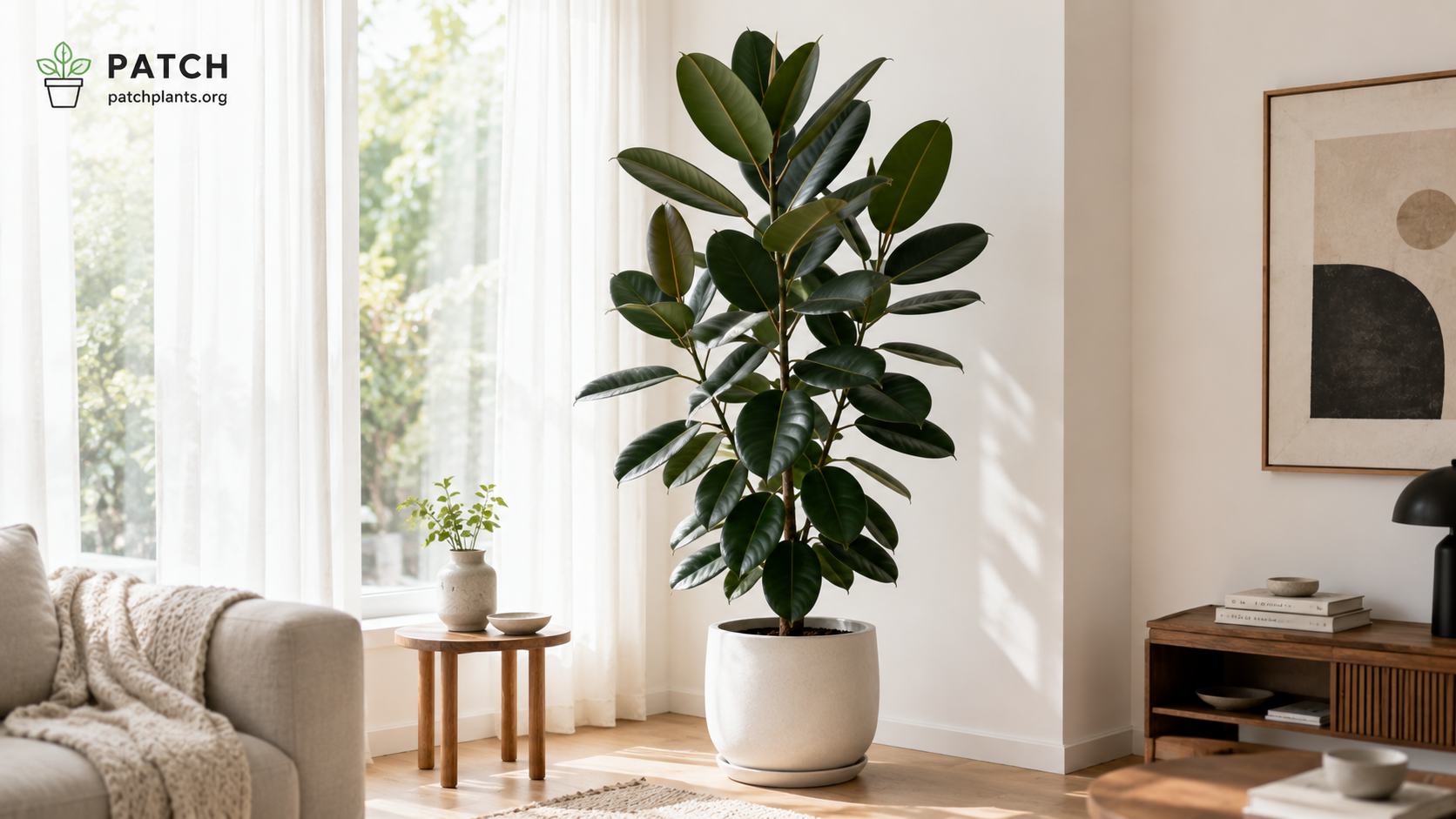
- Rubber plant (Ficus elastica) is a low-maintenance statement houseplant with large glossy leaves — thrives in bright indirect light, moderate watering, and standard home temperatures
- Rubber plant care fundamentals: bright indirect light 6+ hours daily, water when top 5cm dry (weekly typically), maintain 40–50% humidity, keep temperatures 15–27°C year-round
- Rubber tree plant vs baby rubber plant are completely different species — Ficus elastica (rubber tree) grows 2+ metres indoors with large leaves, while Peperomia obtusifolia (baby rubber) stays compact at 30cm maximum
- Rubber plant dropping leaves indicates either overwatering (most common — yellowing before drop), underwatering (brown crispy before drop), or environmental shock from temperature changes or relocation
- How to propagate rubber plant: stem cuttings root in water or soil in 4–8 weeks — take 15cm cuttings with 2–3 leaves, root in water until 5cm roots develop, then pot in soil
- Pruning rubber plant controls height and encourages branching — cut main stem in spring just above leaf node, milky sap flows (wear gloves), new shoots emerge from cut point within weeks
- Variegated rubber plant varieties (Tineke, Ruby, Burgundy) need brighter light than solid green varieties to maintain variegation — lower light causes reversion to solid green
- Rubber plant toxic to cats and dogs — contains latex sap causing mouth irritation, drooling, and digestive upset if chewed, rarely serious but uncomfortable for pets
- Burgundy rubber plant (Ficus elastica ‘Burgundy’) features dark burgundy-black leaves when mature — new growth emerges bright red before darkening, needs bright light to maintain deep coloring
- Rubber plant indoor care is simpler than outdoor — stable temperatures, controlled watering, and protection from pests make indoor specimens easier to maintain than outdoor plants in most climates
- Browse our full indoor plant care guides for similar large statement plants alongside complete care instructions
Understanding Rubber Plant — Ficus Elastica vs Baby Rubber Plant
The Confusion Between Two Different Plants
Rubber Tree Plant (Ficus elastica):
- Large tree species from tropical Asia
- Grows 2–3 metres tall indoors, 30+ metres in native habitat
- Thick glossy leaves 15–30cm long
- Woody stems producing milky white latex sap
- Available in green, variegated, burgundy, and ruby varieties
Baby Rubber Plant (Peperomia obtusifolia):
- Compact succulent-like peperomia from Central/South America
- Stays under 30cm tall and wide
- Small thick leaves 5–10cm long
- Succulent stems storing water
- Different care needs — less water, more tolerant of neglect
This guide focuses primarily on Ficus elastica rubber plant — the large statement plant with dramatic foliage. Baby rubber plant care differs significantly as a compact succulent-type species.
For understanding distinctions between similar-looking houseplants, our guide on 20 oversized indoor plants covers large statement species including rubber plant alongside care comparisons.
Rubber Plant Care Fundamentals — Light, Water, Humidity, Temperature
Rubber Plant Light Requirements
Rubber plant thrives in bright indirect light — the single most important factor determining growth rate, leaf size, and overall plant health. In its native tropical Asian forests, Ficus elastica grows as an understory to mid-canopy tree receiving filtered bright light through surrounding vegetation.
Best light for rubber plant:
- Bright indirect light — 3–5 metres from south-facing window or directly in front of sheer-curtained window
- East-facing windows — ideal natural light without hot afternoon sun
- Filtered sun — tolerates 2–3 hours morning direct sun from east windows
- Avoid afternoon sun — west and south direct sun scorches leaves
Signs of incorrect light:
Too little light:
- Slow or no new growth during spring and summer
- New leaves significantly smaller than older leaves
- Leggy growth with long gaps between leaves
- Lower leaves yellowing and dropping
- Variegated varieties reverting to solid green
Too much direct light:
- Brown scorched patches on leaves
- Leaves bleached pale green or yellow
- Crispy dry leaf edges
- Leaf drop from sun stress
Variegated rubber plant and burgundy rubber plant varieties require brighter light than solid green varieties to maintain their distinctive coloring. Lower light causes variegated forms to produce solid green leaves as the plant prioritizes chlorophyll production over ornamental pigmentation.
For comprehensive indoor light guidance applicable to all houseplants, our complete guide to indoor light covers measuring light levels, optimizing window positioning, and using supplemental grow lights.
How to Water Rubber Plant Correctly
Rubber plant care centers on correct watering — the most common cause of rubber plant problems. Ficus elastica needs consistent moisture without waterlogging, which means allowing the top portion of soil to dry between thorough waterings.
Correct rubber tree plant watering:
- Check soil before watering — insert finger 5cm into soil. If dry at that depth, water thoroughly. If moist, wait 2–3 days and check again.
- Water thoroughly when needed — add water until flowing freely from drainage holes, ensuring entire root ball moistens.
- Empty saucers immediately — never allow pot to sit in standing water. This is the fastest route to root rot.
- Seasonal adjustment — water every 5–7 days typically in summer, every 7–10 days in winter when growth slows.
Signs of incorrect watering:
Overwatering rubber plant:
- Rubber plant dropping leaves — yellowing before falling
- Multiple leaves yellowing from all parts of plant
- Soft mushy stems near soil
- Foul smell from soil indicating root rot
- New growth wilting despite wet soil
Underwatering rubber plant:
- Rubber plant losing leaves — browning and crisping before dropping
- Leaves drooping and curling
- Soil pulling away from pot edges
- Lower leaves turning brown and crispy
- Rapid leaf drop from water stress
CRITICAL: Rubber plant dropping leaves is the primary symptom of watering problems — yellowing drop indicates overwatering, while brown crispy drop indicates underwatering. Correct diagnosis determines the solution.
For complete watering guidance covering soil moisture checking and seasonal adjustments, our complete watering guide explains the principles of consistent moisture management. Our guide on signs you are overwatering specifically addresses overwatering symptoms common in rubber plants.
Rubber Plant Humidity and Temperature
Ficus rubber plant adapts well to average home humidity (30–50%) but performs better with increased humidity (40–60%) matching its tropical origins.
Humidity for rubber plant:
- Tolerates low humidity — unlike many tropical plants, survives standard home conditions
- Prefers 40–60% humidity — encourages larger leaf growth and reduces brown edges
- Increase humidity — humidifier, pebble trays, grouping with other plants
- Mist leaves — optional for cleaning dust rather than humidity (minimal humidity benefit)
Temperature requirements:
- Ideal range: 18–27°C year-round
- Minimum: 15°C — below this causes leaf drop and growth cessation
- Maximum: 30°C+ tolerated if humidity maintained
- Avoid cold drafts — from windows, doors, air conditioning
- Avoid hot drafts — from heating vents, radiators
Rubber plant dropping leaves from temperature stress: sudden temperature drops below 15°C or cold drafts from windows cause rapid leaf yellowing and drop even with correct watering.
Rubber Plant Varieties — Burgundy, Variegated, Ruby, and More
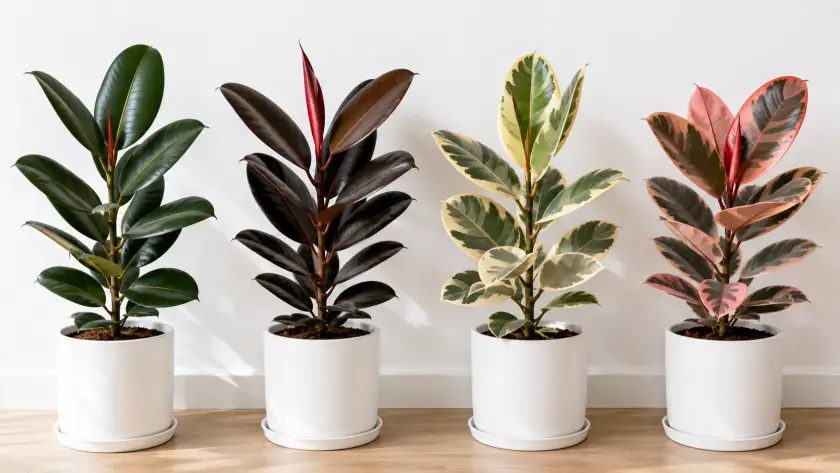
Popular Ficus Elastica Varieties
Rubber plant varieties offer dramatic foliage colors beyond standard green — each with slightly different care requirements and visual appeal.
1. Standard Green Rubber Plant (Ficus elastica ‘Robusta’)
Characteristics:
- Large glossy dark green leaves
- Most tolerant of lower light
- Fastest growing variety
- Easiest for beginners
Care advantage: Solid green varieties photosynthesize most efficiently allowing them to tolerate lower light and recover faster from stress than variegated varieties.
2. Burgundy Rubber Plant (Ficus elastica ‘Burgundy’)
Burgundy rubber plant creates dramatic effect with deep burgundy-black mature foliage and bright red new growth.
Characteristics:
- Mature leaves dark burgundy to near-black
- New growth emerges bright red
- Leaf undersides burgundy-red creating color when backlit
- Requires bright light to maintain deep coloring
Care requirements:
- Brighter light than green varieties — burgundy pigmentation requires more light
- Lower light causes leaves to appear more green than burgundy
- Otherwise identical care to standard rubber plant
3. Variegated Rubber Plant (Ficus elastica ‘Tineke’)
Variegated rubber plant features cream, white, and gray patterns on green leaves creating elegant marbled appearance.
Characteristics:
- Cream and gray variegation on green background
- Pink-red tones on new growth and stems
- Each leaf pattern unique
- Slower growing than solid green varieties
Care requirements:
- Bright indirect light essential — variegation requires more light than green varieties
- Lower light causes reversion — new leaves emerge solid green without variegation
- More sensitive to overwatering than green varieties
- Otherwise standard rubber plant care
4. Ruby Rubber Plant (Ficus elastica ‘Ruby’)
Ruby rubber plant combines variegation with pink and red tones creating striking multi-colored foliage.
Characteristics:
- Pink, red, cream, and green variegation
- New growth intensely pink-red
- Most colorful rubber plant variety
- Slowest growing due to limited chlorophyll
Care requirements:
- Very bright indirect light — needs maximum light to maintain colors
- Lower light causes severe reversion to green
- Most demanding variety in terms of light needs
- Otherwise identical to standard care
For guidance on other colorful foliage houseplants, our guide on colorful foliage indoor plants that aren’t just green covers variegated and colored varieties across multiple species.
How to Propagate Rubber Plant — Complete Guide
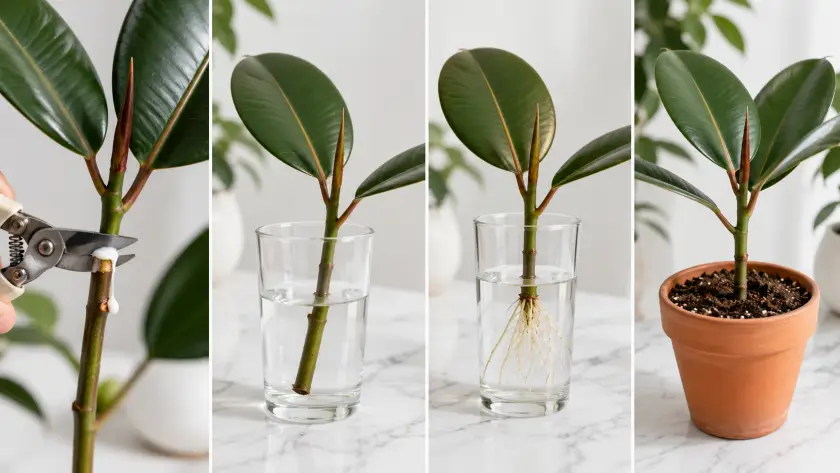
Rubber Plant Propagation Methods
How to propagate rubber plant successfully uses stem cuttings rooted in water or soil. Ficus elastica roots reliably from cuttings taken during spring and summer growth period.
When to propagate rubber plant:
- Spring (March–May) — best timing for fastest rooting
- Summer (June–August) — also successful
- Avoid autumn/winter — slow rooting, higher failure rate
Water Propagation Method (Easiest)
How to propagate a rubber tree plant in water:
Step 1: Take cutting
- Choose healthy stem with 2–3 leaves
- Cut 15–20cm section just below leaf node
- Use clean sharp scissors or knife
- Milky white sap flows — this is normal latex sap
Step 2: Prepare cutting
- Remove lowest leaf exposing bare node
- Rinse cut end to stop sap flow
- Allow to air dry 10–15 minutes before placing in water
Step 3: Root in water
- Place cutting in clean glass or jar with 5–7cm water
- Position so only bottom node submerged — not leaves
- Place in bright indirect light
- Change water every 3–4 days to keep fresh
Step 4: Monitor root development
- Roots appear in 2–4 weeks typically
- Ready to pot when roots reach 5–7cm (4–8 weeks total)
- Multiple roots stronger than single root
Step 5: Pot rooted cutting
- Plant in 10–12cm pot with well-draining soil
- Water thoroughly and keep soil consistently moist first 2 weeks
- Reduce to normal watering schedule once established
Propagating rubber plant success rate: 70–80% with proper timing and conditions. Spring propagation far more successful than winter attempts.
For general propagation guidance covering multiple plant types, our guide on how to propagate houseplants easily at home provides step-by-step instructions for water and soil propagation methods.
Soil Propagation Method (Alternative)
Propagate rubber plant directly in soil skips the water-rooting stage but requires more attention to moisture levels.
Soil propagation steps:
- Take cutting as described above
- Dip cut end in rooting hormone powder (optional but helpful)
- Plant in small pot with moist well-draining potting mix
- Water thoroughly and cover with clear plastic bag creating humidity tent
- Keep soil consistently moist (not waterlogged) for 4–8 weeks
- Remove plastic once new growth appears indicating rooting success
Rubber plant propagation note: Ficus elastica cannot be propagated from single leaves alone — the cutting must include stem section with at least one leaf node. Leaf cuttings without stem will not root.
Pruning Rubber Plant — Height Control and Shaping
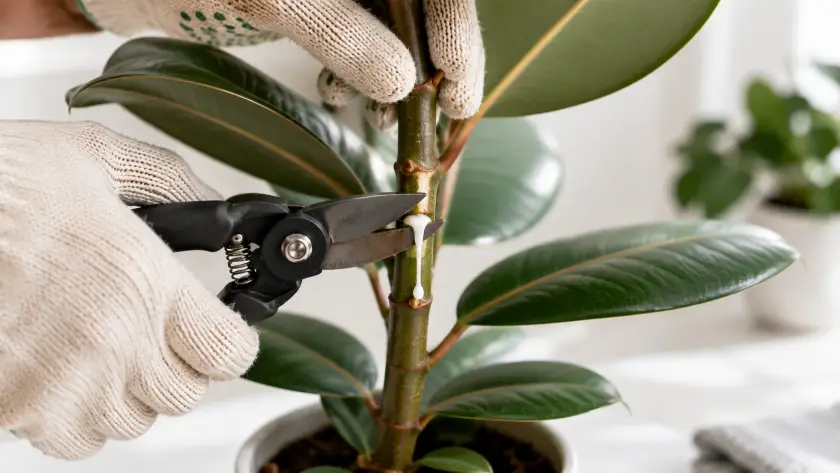
How to Prune Rubber Plant for Best Results
Pruning rubber plant controls height, encourages branching, and maintains desired shape. Rubber tree plant naturally grows as single upright stem — pruning creates the bushier multi-branched form popular in interior design.
When to prune rubber plant:
- Spring (March–May) — ideal timing before active growth
- Remove damaged leaves any time of year
- Prune for shape and height control in early spring
Pruning for Height Control
How to prune a rubber tree plant to control height and encourage branching:
Step 1: Plan cut location
- Identify desired height
- Find leaf node (bump where leaf attaches) just above that height
- Plan cut 1–2cm above the node
Step 2: Make clean cut
- Use sterilized sharp pruning shears
- Cut straight across stem just above node
- Milky white sap flows — this is normal latex
Step 3: Manage sap
- Wear gloves — sap can irritate skin
- Wipe sap with damp cloth
- Sap stops flowing naturally within minutes
- Sprinkle cinnamon powder on cut (optional) to seal
Step 4: Expect new growth
- New shoots emerge from cut point within 2–4 weeks
- Usually 2–3 new branches develop from single cut
- Creates bushier multi-stemmed plant
Pruning rubber plant height: never remove more than 1/3 of plant height in single pruning session. Multiple moderate prunings over several seasons less stressful than one drastic cut.
Rubber tree plant pruning the top encourages side branching. Without pruning, Ficus elastica grows as tall single stem reaching ceiling height.
Removing Individual Leaves
How to prune rubber plant damaged or yellowing leaves:
- Cut leaf stem at base where it meets main stem
- Use clean sharp scissors
- Remove yellowing leaves before they drop naturally
- Sap flows from cut — wipe clean
Rubber plant losing leaves from natural aging: lowest (oldest) leaves eventually yellow and drop naturally as plant directs energy to new growth. This is normal — remove yellowing leaves to maintain appearance.
Rubber Plant Dropping Leaves — Diagnosis and Solutions
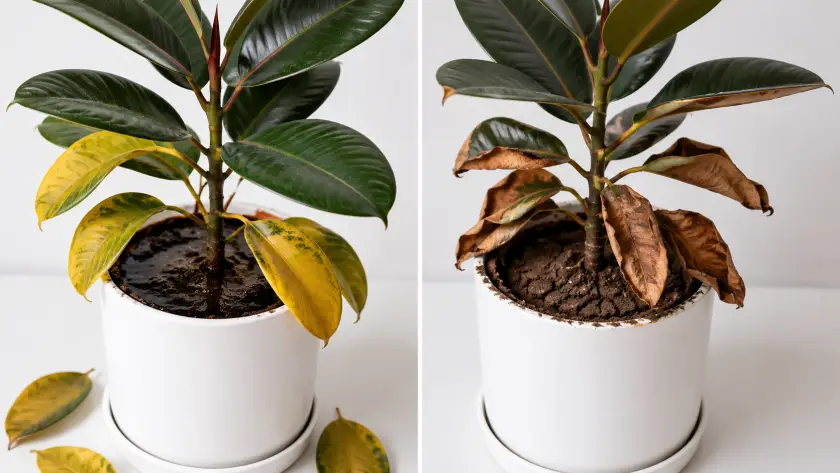
Why Is My Rubber Plant Dropping Leaves?
Rubber plant dropping leaves is the most common problem rubber plant owners encounter — and the cause varies significantly depending on leaf appearance before dropping and environmental factors.
1. Overwatering — Most Common Cause
Symptoms:
- Leaves yellowing before dropping
- Multiple leaves affected throughout plant
- Soil stays wet 7+ days after watering
- Mushy stems near soil
- Leaves drop while still partially green
Solution:
- Reduce watering frequency immediately
- Allow soil to dry more between waterings
- Check drainage holes — ensure not blocked
- Improve soil drainage if staying wet too long
- Remove severely damaged roots if root rot present
Prevention: Water only when top 5cm soil dry. Overwatering kills more rubber plants than any other cause.
2. Underwatering
Symptoms:
- Leaves turning brown and crispy before dropping
- Lower leaves affected first
- Soil very dry and pulling from pot edges
- Leaves curl before dropping
- Rapid leaf drop after severe drying
Solution:
- Water thoroughly until draining from holes
- Establish consistent watering schedule
- Check soil moisture more frequently
- Increase watering frequency if needed
Prevention: Check soil weekly. Rubber plant losing leaves from drought stress is preventable with regular moisture monitoring.
3. Environmental Shock
Symptoms:
- Sudden leaf drop after moving plant
- Leaf drop after temperature drop
- Multiple leaves dropping within days
- No obvious watering problem
Common triggers:
- Moving plant to new location
- Cold draft from windows or doors
- Temperature drop below 15°C
- Sudden light change
Solution:
- Minimize moves — leave plant in consistent location
- Protect from drafts
- Maintain stable temperatures above 15°C
- Allow 2–4 weeks for plant to adjust to necessary moves
Prevention: Ficus elastica dislikes being moved. Choose permanent location carefully before placing large specimens.
For emergency care when rubber plant dropping leaves severely, our guide on how to revive a dying plant covers triage steps for plants in crisis.
4. Natural Leaf Drop
Symptoms:
- Oldest (lowest) leaves yellow and drop occasionally
- Only 1–2 leaves affected at a time
- New growth continues normally at top
- Plant otherwise healthy
Explanation: Natural aging — oldest leaves eventually yellow and drop as plant directs energy to new growth. This is normal and not concerning.
Action: Remove yellowing leaves before they drop to maintain appearance. No intervention needed.
Rubber Plant Toxic to Cats and Dogs
Is Rubber Plant Toxic to Pets?
Rubber plant toxic to cats and dogs — yes, Ficus elastica contains latex sap that causes mouth and digestive irritation if chewed or ingested.
Toxicity symptoms in pets:
- Immediate mouth irritation causing drooling
- Pawing at mouth
- Vomiting and diarrhea in some cases
- Difficulty swallowing
- Rarely serious but uncomfortable
Are rubber plants toxic to cats question: all parts of Ficus elastica contain irritating latex sap — leaves, stems, and milky sap. The large accessible leaves at floor level make this plant particularly tempting to curious pets.
Are rubber plants toxic to dogs: same toxicity applies — latex sap causes mouth and digestive irritation.
Making homes pet-safe with rubber plants:
- Place on high stands beyond pet reach
- Use deterrent sprays around pot base
- Provide pet-safe plants as alternatives
- Monitor pets during introduction period
Severity: While toxic, rubber plants toxic to cats and dogs rarely cause serious harm — most pets learn to avoid the plant after one unpleasant chewing experience due to immediate mouth irritation.
For comprehensive pet-safe plant guidance, our guides on how to make your plants cat-friendly and how to make your plants dog-friendly cover non-toxic alternatives and safety strategies.
Rubber Plant Indoor Care — Soil, Fertilizing, Repotting
Best Soil for Rubber Plant
Rubber plant requires well-draining soil preventing waterlogging while retaining sufficient moisture between waterings.
Best soil mix for rubber plant:
Option 1 — Commercial Mix:
- Quality houseplant potting mix
- Add 20% perlite for improved drainage
- Mix thoroughly before potting
Option 2 — Custom Blend:
- 60% potting soil or coco coir
- 20% perlite or pumice
- 20% orchid bark or compost
Drainage essential: Rubber tree plant care indoor depends on well-draining soil. Heavy waterlogged soil causes root rot and rubber plant dropping leaves from overwatering.
For complete soil guidance covering drainage testing and amendments, our complete soil mix guide explains creating well-draining mixes for all houseplant types.
Fertilizing Rubber Plant
Rubber plant care includes regular feeding during growing season supporting rapid growth and large leaf development.
Fertilizing schedule:
- Spring–Summer: Feed every 4 weeks with balanced liquid fertilizer at half strength
- Autumn: Reduce to every 6–8 weeks
- Winter: Stop feeding completely — plant rests
Best fertilizer for rubber plant:
- Balanced liquid (NPK 10-10-10 or similar)
- Dilute to half recommended strength
- Apply to pre-watered soil — never dry soil
Signs of over-fertilizing:
- Brown crispy leaf tips and edges
- White crusty deposit on soil surface
- Rubber plant losing leaves from fertilizer burn
Signs of under-fertilizing:
- New leaves smaller than older leaves
- Pale yellowish-green coloring
- Very slow growth during spring and summer
For complete fertilizing guidance, our guide on fertilizing indoor vs outdoor plants covers seasonal feeding schedules and nutrient requirements for all houseplants.
Repotting Rubber Plant
Rubber tree plant care includes repotting every 1–2 years as roots fill current pot.
When to repot rubber plant:
- Roots growing through drainage holes
- Roots circling soil surface
- Water running straight through without absorbing
- Plant hasn’t been repotted in 2+ years
- Spring (March–May) is best timing
How to repot rubber plant:
- Choose pot one size larger (5cm diameter increase)
- Prepare fresh well-draining soil mix
- Water plant 24 hours before repotting
- Remove from pot carefully — tip sideways and slide out
- Inspect roots — remove any black mushy roots (rot)
- Position in new pot at same depth as before
- Fill around sides with fresh soil
- Water thoroughly and empty saucer
- Don’t fertilize for 6–8 weeks — fresh soil contains nutrients
Rubber plant dropping leaves after repotting: normal stress response lasting 2–4 weeks. Maintain consistent care — new growth resumes once roots establish.
For complete repotting guidance, our how to repot a plant guide covers step-by-step process. Our guide on repotting mistakes to avoid addresses common errors causing post-repotting stress.
Rubber Plant Problems and Solutions
Brown Spots on Rubber Plant Leaves
Brown spots indicate fungal/bacterial infection or physical damage.
Fungal/bacterial spots:
- Brown or black spots with yellow halos
- Spots spread and merge
- Caused by overwatering and poor air circulation
Solution:
- Remove affected leaves
- Reduce watering frequency
- Improve air circulation
- Never mist leaves — water on foliage promotes infection
Physical damage:
- Brown dry spots from direct sun
- Brown edges from low humidity
- Isolated spots from mechanical damage
Solution:
- Move away from direct afternoon sun
- Increase humidity
- Handle plant carefully
Sticky Leaves on Rubber Plant
Sticky substance on leaves indicates pest infestation or natural guttation.
Pests (honeydew secretion):
- Scale insects — brown bumps on stems and leaf undersides
- Mealybugs — white cotton-like masses
- Aphids — tiny green/black insects on new growth
Solution:
- Wipe leaves with damp cloth removing pests
- Spray with diluted neem oil or insecticidal soap
- Repeat weekly until pests eliminated
Natural guttation:
- Clear sticky droplets on leaf tips
- Harmless natural process
- Wipe clean with damp cloth
Yellowing Leaves on Rubber Plant
Yellow leaves indicate multiple possible causes — pattern reveals diagnosis.
Lower leaves yellowing: Natural aging or slight underwatering — normal if only 1–2 leaves affected.
Multiple leaves yellowing: Overwatering most likely — check soil moisture and drainage.
Yellowing with green veins: Nutrient deficiency (iron or magnesium) — feed with balanced fertilizer.
Sudden yellowing: Temperature stress, relocation shock, or severe overwatering.
For complete yellowing diagnosis, our guide on why your plant leaves are turning yellow covers the diagnostic process and solutions.
Frequently Asked Questions
How do you care for a rubber plant?
Rubber plant care: bright indirect light 6+ hours daily, water when top 5cm dry (weekly typically), maintain 40–50% humidity, keep temperatures 18–27°C, use well-draining soil, fertilize monthly spring-summer only, and repot every 1–2 years in spring.
Why is my rubber plant dropping leaves?
Rubber plant dropping leaves from overwatering (most common — yellowing before drop), underwatering (browning before drop), temperature drops below 15°C, cold drafts, or moving plant to new location. Diagnose by checking soil moisture and environmental conditions — correct the underlying cause to stop leaf drop.
How do you propagate a rubber plant?
How to propagate rubber plant: take 15–20cm stem cuttings with 2–3 leaves in spring, root in water for 4–8 weeks until roots reach 5–7cm long, then plant in small pots with well-draining soil. Milky white sap flows when cutting — this is normal latex. Success rate 70–80% with proper timing.
Are rubber plants toxic to cats?
Rubber plants toxic to cats — yes, Ficus elastica contains latex sap causing mouth irritation, drooling, vomiting, and digestive upset if chewed. While uncomfortable, toxicity is rarely serious. Place rubber plants on high stands beyond pet reach or choose non-toxic alternatives for homes with curious cats.
How do you prune a rubber plant?
How to prune rubber plant: cut main stem just above leaf node in spring using sterilized pruning shears. Milky white sap flows from cut (wear gloves). New shoots emerge from cut point within 2–4 weeks creating bushier multi-branched growth. Never remove more than 1/3 of plant height in single pruning.
What is the difference between rubber plant and baby rubber plant?
Rubber plant (Ficus elastica) is large tree species growing 2+ metres indoors with 15–30cm glossy leaves. Baby rubber plant (Peperomia obtusifolia) is compact succulent-like plant staying under 30cm with small 5–10cm leaves. Different species, different care requirements despite similar common names.
Why is my rubber plant losing leaves?
Rubber plant losing leaves: overwatering if leaves yellow before dropping, underwatering if leaves brown and crisp before dropping, environmental shock from temperature changes or relocation, or natural aging of oldest lower leaves. Check soil moisture and environmental stability to diagnose cause.
Related Guides on Patch Plants
- 💡 Complete Guide to Indoor Light
- 💧 Complete Watering Guide for Healthy Plants
- 🪴 Best Soil Mix for Every Plant Type
- 🌱 How to Repot a Plant
- 🌿 Repotting Mistakes to Avoid
- 🌱 How to Propagate Houseplants Easily
- 💧 Fertilizing Indoor vs Outdoor Plants
- 🍃 Why Your Plant Leaves Are Turning Yellow
- 🌿 Leaf Curl, Browning and Droop
- 💧 Signs You Are Overwatering
- 🌿 How to Revive a Dying Plant
- 🐾 How to Make Your Plants Cat-Friendly
- 🐾 How to Make Your Plants Dog-Friendly
- 🌿 Fiddle Leaf Fig Care Guide
- 🌿 Monstera Care Guide
- 🌸 Peace Lily Care Guide
- 🐍 Snake Plant Care Guide
- 🌿 Pothos Care Guide
- 🌱 ZZ Plant Care Guide
- 🌱 Spider Plant Care Guide
- 💰 Money Tree Care Guide
- 🌿 20 Oversized Indoor Plants
- 🌿 Colorful Foliage Indoor Plants
- 🌱 Browse All Indoor Plant Guides
Final Thoughts
Rubber plant care rewards minimal effort with dramatic results — glossy architectural foliage reaching impressive heights with only basic attention to light, water, and temperature. The Ficus elastica stands among the most forgiving large houseplants available, tolerating occasional neglect while still producing spectacular growth when conditions suit.
The key to successful rubber tree plant care is consistency rather than complexity. Consistent bright indirect light positioning, consistent watering when soil dries properly, and consistent protection from temperature extremes and drafts produce healthy specimens that thrive for decades. Problems like rubber plant dropping leaves typically result from environmental inconsistency — sudden moves, temperature swings, or erratic watering — rather than difficult care requirements.
Understanding the difference between Ficus elastica rubber plant and baby rubber plant (Peperomia obtusifolia) prevents confusion and ensures proper care for whichever species you own. The large dramatic rubber tree plant and compact succulent-like baby rubber require fundamentally different approaches despite sharing a common name.
Rubber plant varieties from solid green ‘Robusta’ to dramatic burgundy rubber plant and elegant variegated rubber plant offer options for every aesthetic preference. Variegated and colored varieties demand brighter light to maintain their distinctive appearance, but otherwise follow the same straightforward care principles as standard green forms.
The rubber plant indoor performs reliably as a statement floor plant, architectural accent, or green focal point in any room with adequate light. Its tolerance of average home humidity, adaptability to standard temperatures, and resistance to most pests make it ideal for plant owners seeking maximum visual impact from minimum maintenance investment.
According to the Royal Horticultural Society, Ficus elastica thrives in bright indirect light with moderate watering and standard indoor temperatures — making it one of the most reliable large houseplants for beginners and experienced growers alike when basic environmental needs are consistently met. 🌿