🌿 Key Takeaways
- Fiddle leaf fig (Ficus lyrata) is a stunning but demanding houseplant — requires bright indirect light, consistent watering, high humidity, and stable temperatures for best growth
- Fiddle leaf fig care fundamentals: bright filtered light 6+ hours daily, water when top 2 inches of soil dry, maintain 40–60% humidity, keep temperatures 15–24°C year-round
- Brown spots on fiddle leaf fig indicate either bacterial/fungal infection from overwatering, or edema from inconsistent watering — diagnosis determines whether to reduce watering or improve consistency
- Fiddle leaf fig watering is the most critical care factor — water thoroughly when the top 2 inches dry, empty saucers immediately, and never allow complete drying or constant moisture
- How often to water fiddle leaf fig: every 7–10 days in summer, every 10–14 days in winter — always check soil moisture rather than following rigid schedules
- Fiddle leaf fig light requirements: bright indirect light for 6+ hours daily — tolerates some direct morning sun but burns in hot afternoon sun
- Fiddle leaf fig brown spots from bacterial infection: dark brown spots with yellow halos spreading rapidly — remove affected leaves, reduce watering, improve air circulation
- Fiddle leaf fig soil must be well-draining — commercial houseplant mix with added perlite, or custom blend of 60% potting soil, 20% perlite, 20% bark
- Fiddle leaf fig fertilizer: balanced liquid feed at half strength every 2–4 weeks spring through summer only — stop feeding October through February
- Repotting fiddle leaf fig: every 1–2 years in spring — move up one pot size when roots circle the drainage holes
- Fiddle leaf fig propagation: stem cuttings in water or soil root in 4–8 weeks — take 15cm cuttings with 2–3 leaves from healthy stems
- Fiddle leaf fig pruning: prune in spring to control height, encourage branching, or remove damaged growth — clean cuts just above leaf nodes
- Fiddle leaf fig toxic to cats and dogs — contains calcium oxalate crystals causing mouth irritation, drooling, and digestive upset if chewed
- Humidifier for fiddle leaf fig significantly improves leaf health — maintain 40–60% humidity to prevent brown edges and encourage large leaf development
- Browse our full indoor plant care guides for similar statement plants alongside complete care instructions
Why Fiddle Leaf Fig Care Feels Challenging
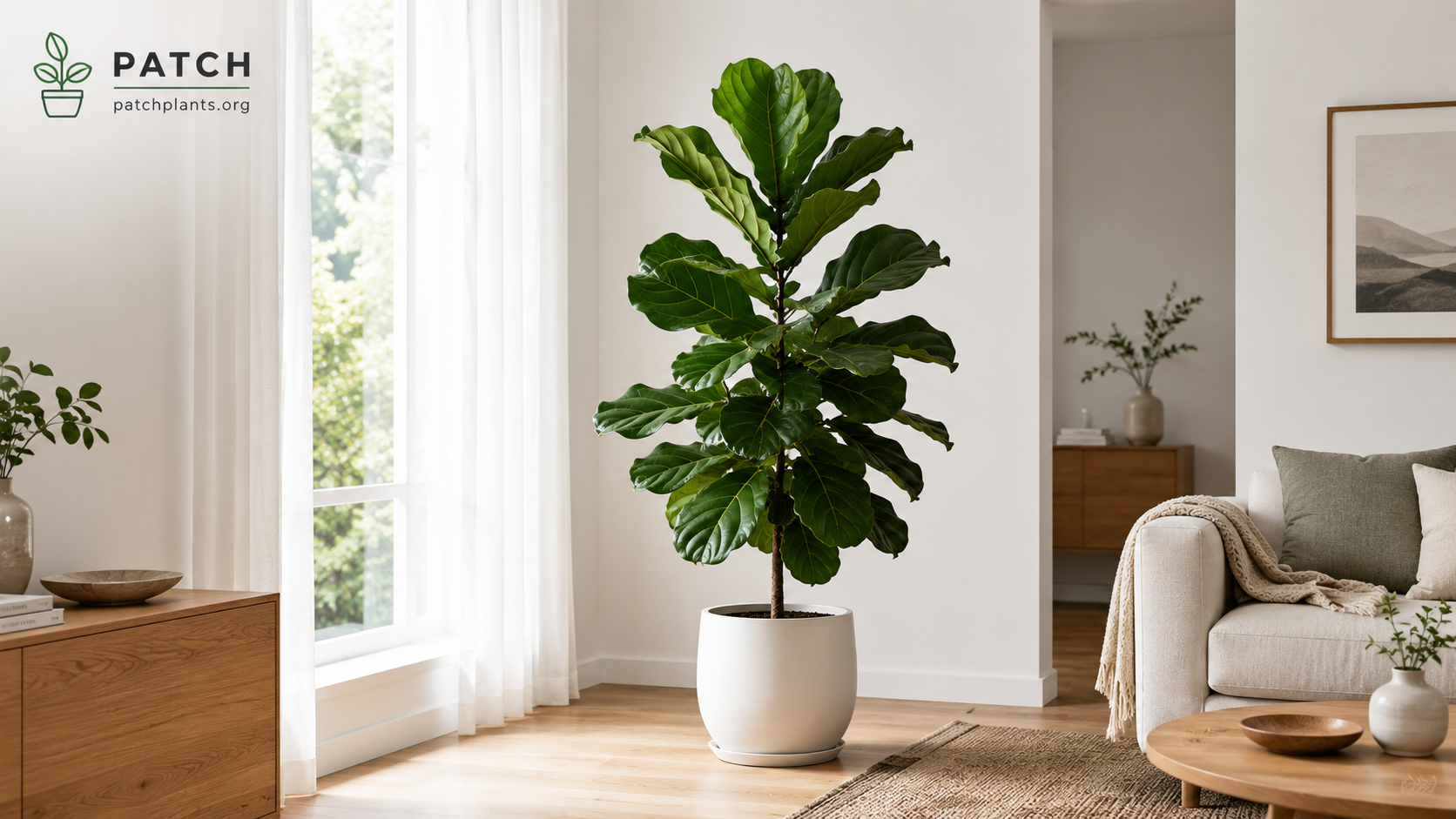
Fiddle leaf fig (Ficus lyrata) has earned its reputation as both the most beautiful and most temperamental houseplant in modern interior design. Those enormous violin-shaped leaves — sometimes reaching 40cm long — create architectural drama no other plant can match. But that dramatic appearance comes with equally dramatic care requirements.
The fiddle leaf fig tree is native to tropical West African rainforests — growing as an understory tree beneath the canopy where it receives bright filtered light, consistent warmth, high humidity, and regular rainfall. Successfully growing fiddle leaf fig indoor means replicating those conditions as closely as possible inside homes that are typically too dark, too dry, and too variable in temperature.
This is why fiddle leaf fig care feels difficult — the plant has narrow tolerance ranges for its key requirements. Too much water and roots rot. Too little and leaves drop dramatically. Inconsistent watering causes brown spots. Low light produces weak leggy growth. Dry air creates brown leaf edges. Move the plant and it throws a tantrum by dropping leaves.
But understanding these specific needs — and meeting them consistently — transforms the fiddle leaf fig plant from a frustrating challenge into a rewarding long-term companion. This guide covers every aspect of how to care for fiddle leaf fig — from choosing the right location to diagnosing and solving the most common problems that send these plants into decline.
Fiddle Leaf Fig Light Requirements — The Foundation of Care
How Much Light Does Fiddle Leaf Fig Need?
Fiddle leaf fig light requirements are non-negotiable — this plant needs bright indirect light for at least 6 hours daily to maintain health and produce those spectacular large leaves. In its native habitat, the fiddle leaf fig grows beneath rainforest canopy receiving dappled bright light throughout the day.
Best light conditions for fiddle leaf fig indoor:
- Bright indirect light from east or west-facing windows — ideal for balanced growth without leaf burn
- Filtered south-facing light — acceptable if sheer curtains diffuse direct sun, particularly during intense summer months
- Morning direct sun — tolerated well for 2–3 hours from east windows
- Avoid afternoon sun — hot direct sunlight through south or west windows causes brown scorched patches on leaves
Signs of incorrect light for fiddle leaf fig:
Too little light:
- New leaves significantly smaller than mature leaves
- Long gaps (internodes) between leaves on stems — weak leggy growth
- Leaning dramatically toward light source
- Leaf drop from lower sections despite proper watering
- Slow or no new growth during spring and summer
Too much direct light:
- Brown dry patches on leaves — usually on sections receiving direct sun
- Bleached or faded appearance on exposed leaves
- Leaves developing papery texture before browning
Rotating fiddle leaf fig for even growth: Rotate the pot 90 degrees every week to ensure all sides receive equal light exposure — this prevents lopsided growth and encourages balanced canopy development.
For guidance on optimizing indoor light for all houseplants, our complete guide to indoor light covers measuring light levels, choosing positions, and using supplemental lighting effectively. For fiddle leaf fig indoor specifically, aim for the brightest position in your home that does not include hot direct afternoon sun.
Fiddle Leaf Fig Watering — The Most Critical Care Factor
How to Water Fiddle Leaf Fig Correctly
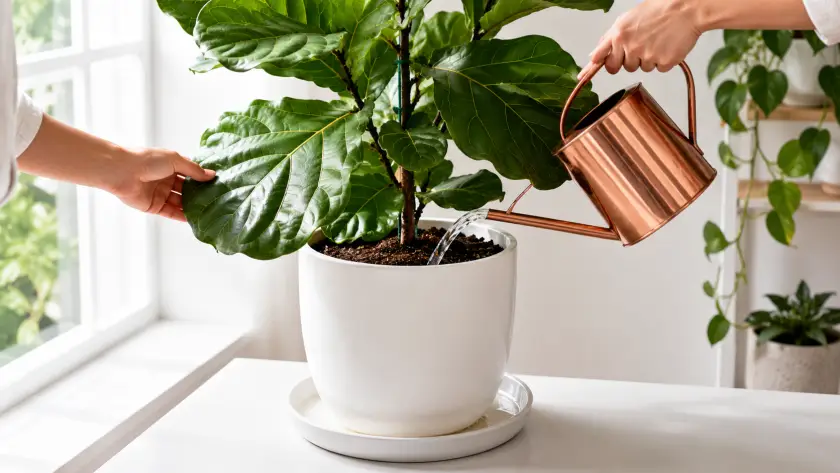
Fiddle leaf fig watering is the single most important — and most commonly mismanaged — aspect of care. The fiddle leaf fig needs consistent moisture without waterlogging, which means allowing the top portion of soil to dry between waterings while keeping the root zone hydrated.
Correct fiddle leaf fig watering technique:
- Check soil moisture before watering — insert your finger 5cm into the soil. If dry at that depth, water thoroughly. If still moist, wait 2–3 days and check again.
- Water thoroughly when needed — add water until it flows freely from drainage holes. This ensures the entire root ball is moistened, not just the surface.
- Empty saucers immediately — never allow the pot to sit in standing water. This is the fastest route to root rot.
- Water quality matters — fiddle leaf fig is sensitive to chlorine and fluoride in tap water. Let tap water stand overnight before use, or use filtered or rainwater for best results.
How often to water fiddle leaf fig:
- Summer (growing season): Every 7–10 days typically — check soil before each watering
- Winter (dormant period): Every 10–14 days typically — plant uses less water in cooler darker months
- Climate variables: Humidity, temperature, light levels, and pot size all affect watering frequency
CRITICAL: Never follow rigid watering schedules. Soil drying rate varies with season, weather, pot size, and plant size. Always check soil moisture before watering — this single habit prevents most fiddle leaf fig watering problems.
Signs of incorrect watering:
Underwatering fiddle leaf fig:
- Leaves drooping dramatically — becoming soft and limp
- Leaf edges turning brown and crispy
- Rapid leaf drop from lower sections
- Soil pulling away from pot edges
Overwatering fiddle leaf fig:
- Brown spots on fiddle leaf fig with yellow halos — indicating bacterial infection
- Leaves yellowing and dropping from all sections
- Soft mushy stems near soil line
- Foul smell from soil — indicating root rot
For complete watering guidance that complements fiddle leaf fig watering principles, our complete watering guide covers soil moisture checking techniques, drainage requirements, and seasonal adjustments. Our guide on signs you are overwatering specifically addresses the overwatering symptoms that commonly affect fiddle leaf fig plants.
Brown Spots on Fiddle Leaf Fig — Diagnosis and Treatment
Understanding Fiddle Leaf Fig Brown Spots
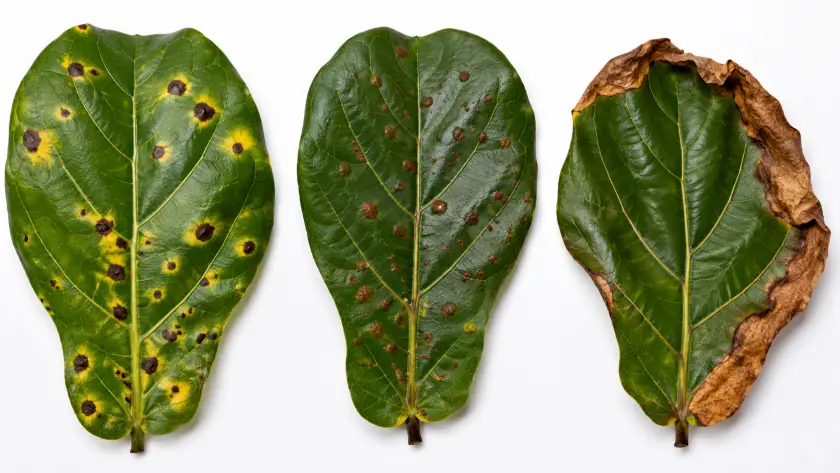
Brown spots on fiddle leaf fig are the most common and most distressing problem owners encounter — and the cause varies significantly depending on spot appearance, location, and progression pattern.
Three main causes of fiddle leaf fig brown spots:
1. Bacterial Infection — The Most Serious
Appearance: Dark brown to black spots with distinct yellow halos, typically appearing on middle-aged and older leaves first. Spots spread rapidly and can merge into large dead patches.
Cause: Bacterial leaf spot (often Xanthomonas species) enters through leaf pores or wounds when leaves remain wet for extended periods. Fiddle leaf fig brown spots from bacterial infection are aggravated by overwatering, poor air circulation, and water splashing on leaves.
Treatment for bacterial fiddle leaf fig brown spots:
- Remove severely affected leaves completely — cut at the base with sterilized pruning shears
- Reduce watering frequency immediately — allow soil to dry more between waterings
- Improve air circulation around the plant — space away from walls and other plants
- Never mist leaves or allow water to sit on foliage
- Sterilize tools between cuts — bacterial infection spreads easily
Prevention: Water soil only, never spray or mist the fiddle leaf fig, ensure good air flow, and avoid overwatering.
2. Edema — From Inconsistent Watering
Appearance: Reddish-brown spots or patches without yellow halos, typically on lower/older leaves. Spots feel slightly raised or corky to touch. Pattern appears scattered rather than spreading.
Cause: Edema occurs when roots take up water faster than leaves can transpire it — causing cells to burst and leaving brown damaged tissue. This happens with very inconsistent watering — severe drying followed by heavy watering, or overwatering in low light conditions.
Treatment for edema-related brown spots:
- Establish consistent watering schedule — check soil regularly
- Water when top 5cm dry, but before soil becomes completely dry
- Ensure pot has excellent drainage
- Damaged leaves will not recover but new growth should be spot-free with consistent care
3. Physical Damage and Sunburn
Appearance: Brown dry patches usually appearing on leaf tips, edges, or on sections receiving direct sun. Brown areas feel papery and dry.
Cause: Direct hot sun causes scorching. Low humidity causes brown crispy edges. Physical damage from handling or pets creates isolated brown patches.
Treatment:
- Move fiddle leaf fig away from direct afternoon sun
- Increase humidity around plant — humidifier, pebble tray, or grouping with other plants
- Trim brown damaged sections with sterilized scissors — will not spread but looks unsightly
For complete diagnosis of leaf problems including yellowing, wilting, and browning, our guides on why your plant leaves are turning yellow and leaf curl, browning, and droop cover the diagnostic process for distinguishing between different causes of similar symptoms.
Fiddle Leaf Fig Soil — Drainage Is Everything
Best Soil for Fiddle Leaf Fig
Fiddle leaf fig soil must prioritize drainage while retaining sufficient moisture between waterings. The fiddle leaf fig tree roots require oxygen — waterlogged compacted soil causes root rot far more often than any other problem.
Best soil mix for fiddle leaf fig:
Option 1 — Commercial Mix (easiest):
- Quality houseplant potting mix
- Add 20–30% perlite or pumice for improved drainage
- Mix thoroughly before potting
Option 2 — Custom Blend (best performance):
- 60% high-quality potting soil or coco coir
- 20% perlite or pumice (for drainage and aeration)
- 20% orchid bark (adds structure, prevents compaction)
Fast draining soil for fiddle leaf fig is essential — the mix should drain freely when watered but still feel slightly moist 2–3 days after watering. If soil stays wet for a week after watering, drainage is insufficient.
Soil for fiddle leaf fig should not include:
- Heavy garden soil — too dense for containers
- Soil labeled “moisture-retaining” — holds too much water
- Pure peat moss — becomes hydrophobic when dry and compacts over time
Signs of incorrect soil:
Soil too heavy/poor drainage:
- Water pools on surface rather than absorbing
- Soil stays wet for 7+ days after watering
- Brown spots on fiddle leaf fig from root rot
Soil too light/drains too fast:
- Water runs straight through pot without absorbing
- Fiddle leaf fig dropping leaves from chronic underwatering despite frequent watering
Potting soil for fiddle leaf fig commercial recommendations: Miracle-Gro Indoor Potting Mix, Westland Houseplant Potting Mix, or any quality brand labeled for houseplants — always add extra perlite regardless of brand for improved drainage.
For complete soil guidance covering mix components, drainage testing, and soil-related problems, our complete soil mix guide explains the principles of creating well-draining mixes for all houseplant types.
Fiddle Leaf Fig Fertilizer — Feeding for Maximum Growth
When and How to Fertilize Fiddle Leaf Fig
Fiddle leaf fig fertilizer supports the rapid growth and enormous leaf production that makes this plant so spectacular — but only during the active growing season when the plant can actually use the nutrients provided.
Best fertilizer for fiddle leaf fig:
- Balanced liquid fertilizer (NPK 10-10-10 or similar)
- Diluted to half the recommended strength
- Applied every 2–4 weeks during spring and summer only
Fertilizing fiddle leaf fig schedule:
- Spring (March–May): Resume feeding — start at quarter strength, increase to half strength by May
- Summer (June–August): Full feeding schedule — every 2–4 weeks at half strength
- Autumn (September–October): Reduce frequency — monthly maximum
- Winter (November–February): Stop completely — plant is dormant
How to apply fiddle leaf fig fertilizer:
- Water the plant normally first — never apply fertilizer to dry soil
- Mix liquid fertilizer at half the package recommended strength
- Water with fertilizer solution until it drains from holes
- Empty saucer after 15 minutes
Fiddle leaf fig plant food note: all fertilizer products labeled “plant food” function the same as products labeled “fertilizer” — the terms are interchangeable. Choose balanced formulations for general fiddle leaf fig feeding.
Signs of incorrect fertilizing:
Over-fertilizing:
- Brown crispy leaf tips and edges
- White crusty deposit on soil surface
- Sudden leaf drop despite correct watering
Under-fertilizing:
- New leaves noticeably smaller than old leaves
- Pale yellowish-green leaf color rather than rich dark green
- Very slow or no new growth during spring and summer
Fertiliser for fiddle leaf fig (UK spelling) products available in UK garden centres include Miracle-Gro Indoor Plant Food, Baby Bio Houseplant Food, and Westland Houseplant Feed — all work well for fiddle leaf fig when used at half strength during the growing season.
For complete fertilizing guidance covering NPK ratios, organic options, and feeding schedules for all houseplants, our complete guide to fertilizing indoor vs outdoor plants explains the principles of houseplant nutrition and seasonal feeding adjustments.
Repotting Fiddle Leaf Fig — When and How
How to Repot Fiddle Leaf Fig Successfully
Repotting fiddle leaf fig every 1–2 years maintains healthy root growth and prevents the plant becoming rootbound — which limits growth and increases vulnerability to watering problems.
When to repot fiddle leaf fig:
- Roots growing through drainage holes
- Roots circling the soil surface
- Water running straight through pot without absorbing
- Plant hasn’t been repotted in 2+ years
- Spring (March–May) is the best timing
How to repot a fiddle leaf fig:
- Choose new pot — one size larger than current pot (5cm diameter increase maximum). Pot must have drainage holes.
- Prepare fresh soil — use well-draining mix (see Soil section above). Have soil ready before removing plant from old pot.
- Water plant — water thoroughly 24 hours before repotting. This makes root ball easier to handle.
- Remove from pot — tip pot sideways and slide plant out carefully. If stuck, run a knife around inside edge of pot.
- Inspect roots — healthy roots are firm and white/light brown. Remove any black mushy roots with sterilized scissors — these are rotted.
- Position in new pot — add 5cm fresh soil to bottom. Place plant at same depth as before. Fill around sides with fresh soil.
- Water thoroughly — water until draining from holes. Empty saucer after 15 minutes.
- Don’t fertilize — fresh soil contains nutrients. Wait 6–8 weeks before resuming normal fertilizing schedule.
Repotting a fiddle leaf fig stress: fiddle leaf fig dropping leaves for 2–4 weeks after repotting is normal stress response. Don’t panic — new growth will resume once roots establish in fresh soil.
How to repot fiddle leaf fig without disturbing roots too much: if the plant is healthy and you are simply moving to a larger pot, keep the root ball intact rather than teasing roots apart — this minimizes transplant shock.
For complete repotting guidance covering timing, pot sizing, and post-repotting care, our complete repotting guide covers the step-by-step process for all houseplants. Our guide on repotting mistakes to avoid specifically addresses the common errors that stress plants during repotting.
Fiddle Leaf Fig Pruning — Shaping and Maintenance
How to Prune Fiddle Leaf Fig for Best Shape
Fiddle leaf fig pruning controls height, encourages bushier growth, removes damaged sections, and shapes the plant into the form you want. The fiddle leaf fig tree naturally grows as a single trunk with leaves along its length — pruning creates the branched multi-stem form popular in interior design.
When to prune fiddle leaf fig:
- Spring (March–May) is ideal timing — active growth allows quick recovery
- Remove damaged or diseased leaves any time of year
- Prune for shape in early spring before new growth flush
How to prune a fiddle leaf fig:
1. Removing damaged leaves:
- Cut at the base where leaf stem meets main stem
- Use sterilized sharp pruning shears or scissors
- Remove leaves with large brown areas, bacterial spots, or pest damage
2. Pruning for height control:
- Cut main stem just above a leaf node (the bump where leaf attaches)
- Makes a clean straight cut — don’t leave a long stub above the node
- New growth will emerge from the cut point — usually 2–3 new shoots
3. Encouraging branching:
- Notching fiddle leaf fig — make small notch (5mm deep) just above leaf node without cutting through stem. This triggers growth hormones without major pruning.
- Alternatively: cut the top 15–30cm from main stem to force multiple new shoots from below the cut
How to prune a fiddle leaf fig plant without shocking it: never remove more than 20% of the plant’s foliage in a single pruning session. Multiple moderate prunings over several months are far less stressful than one aggressive pruning.
How to trim fiddle leaf fig for maintenance: trim brown leaf edges with sterilized scissors — cut just inside the brown area leaving a thin brown edge rather than cutting into healthy green tissue which would create a new brown edge.
Cutting back fiddle leaf fig dramatically: if a leggy fiddle leaf fig has lost all lower leaves, you can cut it back to 30–60cm height in spring. New shoots will emerge from nodes on the remaining stem within weeks, creating a bushier multi-stemmed plant.
Fiddle Leaf Fig Propagation — Growing New Plants
How to Propagate Fiddle Leaf Fig Successfully
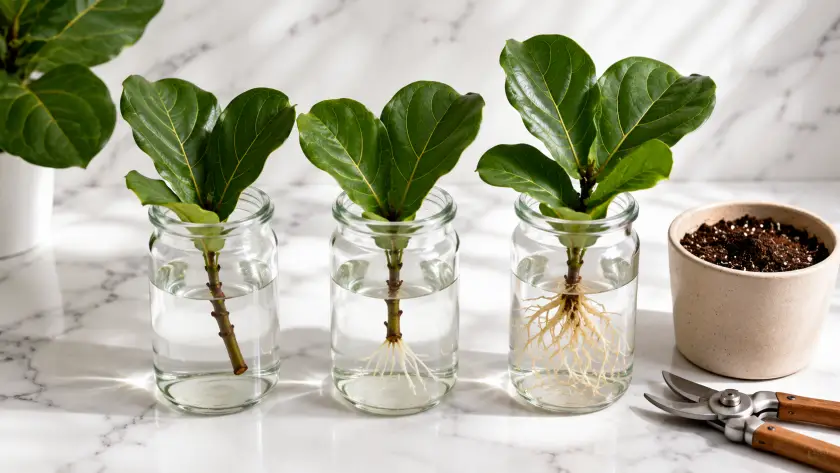
Fiddle leaf fig propagation from stem cuttings is straightforward — the fiddle leaf fig roots reliably in water or directly in soil with proper conditions.
How to propagate fiddle leaf fig:
Step 1: Take cuttings in spring
- Choose healthy stems with 2–3 leaves
- Cut 15–20cm sections just below a leaf node
- Use clean sharp scissors or pruning shears
- Remove the lowest leaf to expose a node
Step 2: Root in water (easiest method)
- Place cutting in clean glass or jar with 5cm water
- Position so only the bottom node is submerged — not leaves
- Place in bright indirect light
- Change water every 3–4 days to keep fresh
- Roots appear in 2–3 weeks, ready to pot when 5cm long (4–8 weeks total)
Step 3: Pot rooted cuttings
- Plant in small pot (10–12cm) with well-draining soil
- Water thoroughly and keep soil consistently moist for first 2 weeks
- Reduce to normal watering schedule once established
Alternative: propagate fiddle leaf fig in soil
- Dip cut end in rooting hormone powder (optional but helpful)
- Plant in small pot with moist well-draining potting mix
- Cover with clear plastic bag to maintain humidity
- Keep soil moist (not waterlogged) for 4–8 weeks
- Roots establish without being visible — test by gently tugging after 6 weeks
Propagating a fiddle leaf fig success rate: stem cuttings root successfully 70–80% of the time with proper conditions. Spring and summer propagation is far more successful than autumn or winter attempts.
How to propagate a fiddle leaf fig from single leaves: does not work — fiddle leaf fig cannot regenerate from leaf cuttings alone. The cutting must include a portion of stem with at least one leaf node.
For general propagation guidance covering multiple methods and plant types, our guide on how to propagate houseplants easily at home provides step-by-step instructions and troubleshooting for common propagation problems.
Fiddle Leaf Fig Humidity — Critical for Leaf Health
Humidifier for Fiddle Leaf Fig — Is It Worth It?
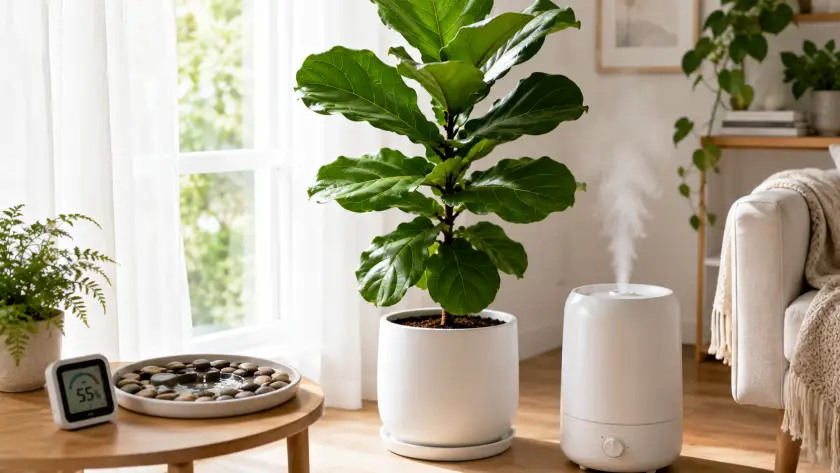
Humidifier for fiddle leaf fig significantly improves leaf health — the fiddle leaf fig is native to tropical rainforests with 60–80% humidity, while most homes maintain 30–40% humidity especially during winter heating months.
Signs of low humidity on fiddle leaf fig:
- Brown crispy leaf edges
- Leaves developing crunchy texture
- New leaves emerging smaller than they should
- Leaf edges curling inward
How to increase humidity for fiddle leaf fig:
1. Humidifier (best solution):
- Position cool-mist humidifier 1–2 metres from plant
- Maintain 40–60% humidity (check with hygrometer)
- Run during day when plant is actively photosynthesizing
- Particularly important during winter heating season
2. Pebble tray:
- Fill wide shallow tray with pebbles
- Add water to just below top of pebbles
- Place fiddle leaf fig pot on pebbles (not in water)
- Evaporating water increases humidity in immediate area
3. Grouping plants:
- Plants release moisture through transpiration
- Grouping multiple plants creates localized high-humidity microclimate
- Most effective with several plants in close proximity
4. What NOT to do:
- Don’t mist fiddle leaf fig leaves — water sitting on leaves promotes bacterial infection and brown spots on fiddle leaf fig
- Misting provides only temporary humidity increase (minutes) while creating disease risk
Humidity hacks for fiddle leaf fig: our humidity hacks guide covers multiple methods for increasing household humidity without expensive humidifiers.
Fiddle Leaf Fig Dropping Leaves — Causes and Solutions
Why Is My Fiddle Leaf Fig Dropping Leaves?
Fiddle leaf fig dropping leaves or fiddle leaf fig leaves dropping is the plant’s primary stress response — triggered by multiple possible causes that require different solutions.
Common causes of fiddle leaf fig leaf drop:
1. Watering problems (most common):
- Underwatering: Leaves drop from bottom up, soil very dry, leaves crispy before dropping
- Overwatering: Leaves yellow before dropping, soil stays wet, possibly brown spots on fiddle leaf fig
- Solution: Correct watering frequency, improve drainage if needed
2. Environmental change:
- Moving plant to new location
- Sudden temperature drop
- Dramatic light change
- Solution: Minimize moves, maintain stable environment
3. Drafts and temperature fluctuation:
- Cold drafts from windows or air conditioning
- Hot air from heating vents
- Solution: Move away from vents and drafty windows
4. Root problems:
- Rootbound plant with exhausted soil
- Root rot from overwatering
- Solution: Repot in spring, trim rotted roots if found
5. Shock from repotting:
- Normal temporary response to repotting
- Usually stops after 2–4 weeks
- Solution: Maintain consistent care, don’t panic
How to stop fiddle leaf fig leaves drooping and dropping: identify the specific cause above and correct it. Once corrected, leaf drop typically stops within 1–2 weeks. New growth resumes once the plant feels secure in stable conditions.
For emergency care when fiddle leaf fig dropping leaves severely, our guide on how to revive a dying plant covers triage steps for plants in crisis.
Fiddle Leaf Fig Toxic to Cats and Dogs
Is Fiddle Leaf Fig Toxic to Cats?
Fiddle leaf fig toxic to cats and dogs — yes, the fiddle leaf fig contains calcium oxalate crystals that cause mouth and digestive irritation if chewed or eaten.
Toxicity symptoms in pets:
- Immediate mouth irritation and pawing at mouth
- Excessive drooling
- Difficulty swallowing
- Vomiting and diarrhea in some cases
- Rarely serious but uncomfortable for pets
Is fiddle leaf fig toxic to cats question: all parts of the plant contain irritating calcium oxalate crystals — leaves, stems, and sap. The large leaves at pet-height make this plant particularly accessible to curious cats.
Making homes safe:
- Place fiddle leaf fig on high stands or shelves beyond pet reach
- Use deterrent sprays around the base to discourage investigation
- Provide cat-safe plants as alternatives — spider plant, Boston fern
- Monitor pets during introduction period
Fiddle leaf fig cats and fiddle leaf fig toxic to dogs note: while toxic, severity is usually mild — most pets learn to avoid the plant after one unpleasant chewing experience. The irritation is immediate and unpleasant enough to discourage repeat attempts.
For comprehensive guidance on pet-safe plant choices, our guide on how to make your plants cat-friendly covers pet safety strategies and alternative plant options that pose no toxicity risk.
Fiddle Leaf Fig Indoor Plant Styling
Where to Display Fiddle Leaf Fig House Plant
The fiddle leaf fig house plant and fiddle leaf fig houseplant work beautifully as statement plants in multiple room settings — their architectural form and enormous leaves create instant visual impact.
Best rooms for fiddle leaf fig indoor:
Living rooms: Classic placement near bright windows as focal point. The fiddle leaf fig tree suits high-ceiling living spaces where its vertical growth has room to develop.
Home offices: Positioned near east or west-facing windows for natural light. The fiddle leaf fig indoor plant improves air quality and reduces stress during work hours. Our guide on improving your home office with plants covers optimal office plant positioning.
Bedrooms: Acceptable in bright bedrooms with adequate window light. Our guide on how to decorate your bedroom with plants covers plant selection for bedroom environments.
NOT recommended: Bathrooms (usually insufficient light), dark hallways, windowless rooms.
For room-specific plant styling guidance, our guide on how to style indoor plants by room covers positioning principles for every room type.
Comparison: Real vs Artificial Fiddle Leaf Fig
Real Fiddle Leaf Fig Tree vs Fake Fiddle Leaf Fig
Fake fiddle leaf fig tree, faux fiddle leaf fig tree, and artificial fiddle leaf fig tree have become popular alternatives for low-light spaces where real fiddle leaf fig tree real cannot survive.
Real vs artificial fiddle leaf fig comparison:
| Factor | Real | Artificial |
|---|---|---|
| Light needed | Bright indirect essential | Any location |
| Maintenance | Regular watering, feeding, cleaning | Occasional dusting |
| Cost | £30–150 initial | £80–300+ for quality |
| Growth | Grows and changes | Static appearance |
| Air purification | Yes | No |
| Lifespan | Decades with care | 5–10 years before fading |
Fake fiddle leaf fig and faux fiddle leaf fig plant quality varies dramatically — cheap artificial plants look obviously plastic, while high-quality silk or latex versions from premium suppliers are difficult to distinguish from real plants at casual glance.
Artificial fiddle leaf fig plant best use: dark corners, low-light offices, rental properties where care is impractical, or supplementing real plants in low-light areas.
Frequently Asked Questions
How often should you water fiddle leaf fig?
How often to water fiddle leaf fig: every 7–10 days in summer, every 10–14 days in winter — but always check soil moisture rather than following rigid schedules. Water thoroughly when the top 5cm of soil feels dry. Empty saucers immediately after watering to prevent root rot.
What causes brown spots on fiddle leaf fig?
Brown spots on fiddle leaf fig are caused by bacterial infection (dark spots with yellow halos from overwatering), edema (reddish spots from inconsistent watering), or physical damage (dry brown patches from sunburn or low humidity). Treatment depends on identifying the specific cause.
How do you care for fiddle leaf fig?
How to care for fiddle leaf fig: provide bright indirect light 6+ hours daily, water when top 5cm dry, maintain 40–60% humidity, keep temperatures 15–24°C, use well-draining soil, fertilize every 2–4 weeks spring through summer only, and repot every 1–2 years in spring.
Is fiddle leaf fig toxic to pets?
Fiddle leaf fig toxic to cats and dogs — yes, contains calcium oxalate crystals causing mouth irritation, drooling, and digestive upset if chewed. Place beyond pet reach on high stands or shelves. Toxicity is uncomfortable but rarely serious.
How do you propagate fiddle leaf fig?
How to propagate fiddle leaf fig: take 15–20cm stem cuttings with 2–3 leaves in spring, root in water for 4–8 weeks until roots reach 5cm long, then plant in small pots with well-draining soil. Maintain bright indirect light and consistent moisture during rooting period.
When should you repot fiddle leaf fig?
Repotting fiddle leaf fig: every 1–2 years in spring (March–May) when roots grow through drainage holes or circle the pot surface. Move up one pot size only (5cm diameter increase). Don’t fertilize for 6–8 weeks after repotting as fresh soil contains nutrients.
Why is my fiddle leaf fig dropping leaves?
Fiddle leaf fig dropping leaves from watering problems (most common), environmental changes like moving location, cold/hot drafts, root problems, or normal shock after repotting. Identify the specific cause and correct it — leaf drop typically stops within 1–2 weeks of correction.
Related Guides on Patch Plants
- 🌿 Complete Watering Guide for Healthy Plants
- 💡 Complete Guide to Indoor Light
- 🪴 Best Soil Mix for Every Plant Type
- 🌱 How to Repot a Plant
- 🌿 Repotting Mistakes to Avoid
- 🌱 How to Propagate Houseplants Easily
- 🔬 What Is Root Rot
- 🍃 Why Your Plant Leaves Are Turning Yellow
- 🌿 Leaf Curl, Browning and Droop
- 💧 Signs You Are Overwatering
- 🌿 How to Revive a Dying Plant
- 💧 Fertilizing Indoor vs Outdoor Plants
- 💨 Humidity Hacks for Your Plants
- 🐾 How to Make Your Plants Cat-Friendly
- 🐾 How to Make Your Plants Dog-Friendly
- 🌿 Monstera Care Guide
- 🌿 Pothos Care Guide
- 🌱 ZZ Plant Care Guide
- 🌸 Peace Lily Care Guide
- 🐍 Snake Plant Care Guide
- 🌱 Spider Plant Care Guide
- 🌵 Aloe Vera Care Guide
- 💰 Money Tree Care Guide
- 🎄 Christmas Cactus Care Guide
- 🌱 Best Indoor Plants for Beginners
- 🏢 Improve Your Home Office with Plants
- 🏠 Decorate Your Bedroom with Plants
- 🏠 How to Style Indoor Plants by Room
- 🏢 Office Plants That Survive Fluorescent Lighting
- 🌿 Oversized Indoor Plants
- 🌱 Browse All Indoor Plant Guides
Final Thoughts
Fiddle leaf fig care demands attention, consistency, and patience — but the reward is one of the most architecturally dramatic houseplants available. The fiddle leaf fig is not a beginner plant, but neither is it impossibly difficult once you understand its specific requirements.
The key to successful fiddle leaf fig plant care is consistency rather than intensity. Consistent bright light, consistent watering schedules checked by soil moisture rather than calendar dates, consistent humidity, and consistent temperatures produce far better results than sporadic attention or overcorrection attempts.
How to care for a fiddle leaf fig successfully: establish the right conditions initially (bright indirect light, well-draining soil, appropriate pot size), then maintain those conditions consistently. The fiddle leaf fig rewards stability and predictability with spectacular growth — those enormous glossy leaves expanding to their full dramatic potential.
Problems like brown spots on fiddle leaf fig and fiddle leaf fig dropping leaves are usually symptoms of environmental inconsistency rather than fundamental care failures. Correct the underlying issue — whether watering, light, or humidity — and the plant will recover and resume healthy growth.
The fiddle leaf fig tree is an investment in long-term plant keeping. With proper care, a small fiddle leaf fig houseplant purchased today can grow into a magnificent 2-metre indoor tree over 5–10 years — providing architectural beauty and satisfaction that few other plants can match.
According to the Royal Horticultural Society, Ficus lyrata thrives best in bright indirect light with consistent moisture and high humidity — making environmental stability the single most important factor in successful fiddle leaf fig cultivation for long-term health and maximum leaf size. 🌿