To care for a philodendron, give it bright, indirect light, water when the top 3–5 cm of potting mix is dry, and keep it warm, ideally between about 18 and 27°C. Use a loose, fast-draining mix, feed lightly in spring and summer, and never let the pot sit in water. Most philodendrons are easy plants, but variegated types need more light, and all of them are toxic to cats and dogs.
This guide covers the most popular philodendron varieties, the care they share, how to propagate them, and how to fix common problems. The advice is based on how these plants grow in the wild: most are climbers from the shaded floor and trunks of tropical American forests.
At Patch Plants, guides are written by botanist Sawera Shahid, MPhil Botany. Philodendrons are some of the plants she recommends most often to new plant owners, because they show clear signs when something is wrong and recover well once the problem is fixed. You can find more easy plants in our indoor plant care guides.
Key Takeaways
- Philodendrons like bright, indirect light. Green types cope with less light; variegated types need more.
- Water when the top 3–5 cm of mix is dry. Overwatering is the most common cause of problems.
- A chunky, well-draining mix with bark or perlite keeps roots healthy.
- Climbing types grow bigger leaves when they have a moss pole or other support.
- Stem cuttings with at least one node root easily in water or moist mix.
- All philodendrons are toxic to cats and dogs, so keep them out of reach of pets.
Understanding Philodendron: The Ultimate Houseplant Genus
Philodendron is a large genus in the arum family, Araceae. Plant databases list roughly 500 or more species, all native to tropical Mexico, Central America and South America. The name comes from the Greek words for “love” and “tree”, because many species climb trees using aerial roots.
For home growers, philodendrons fall into two groups:
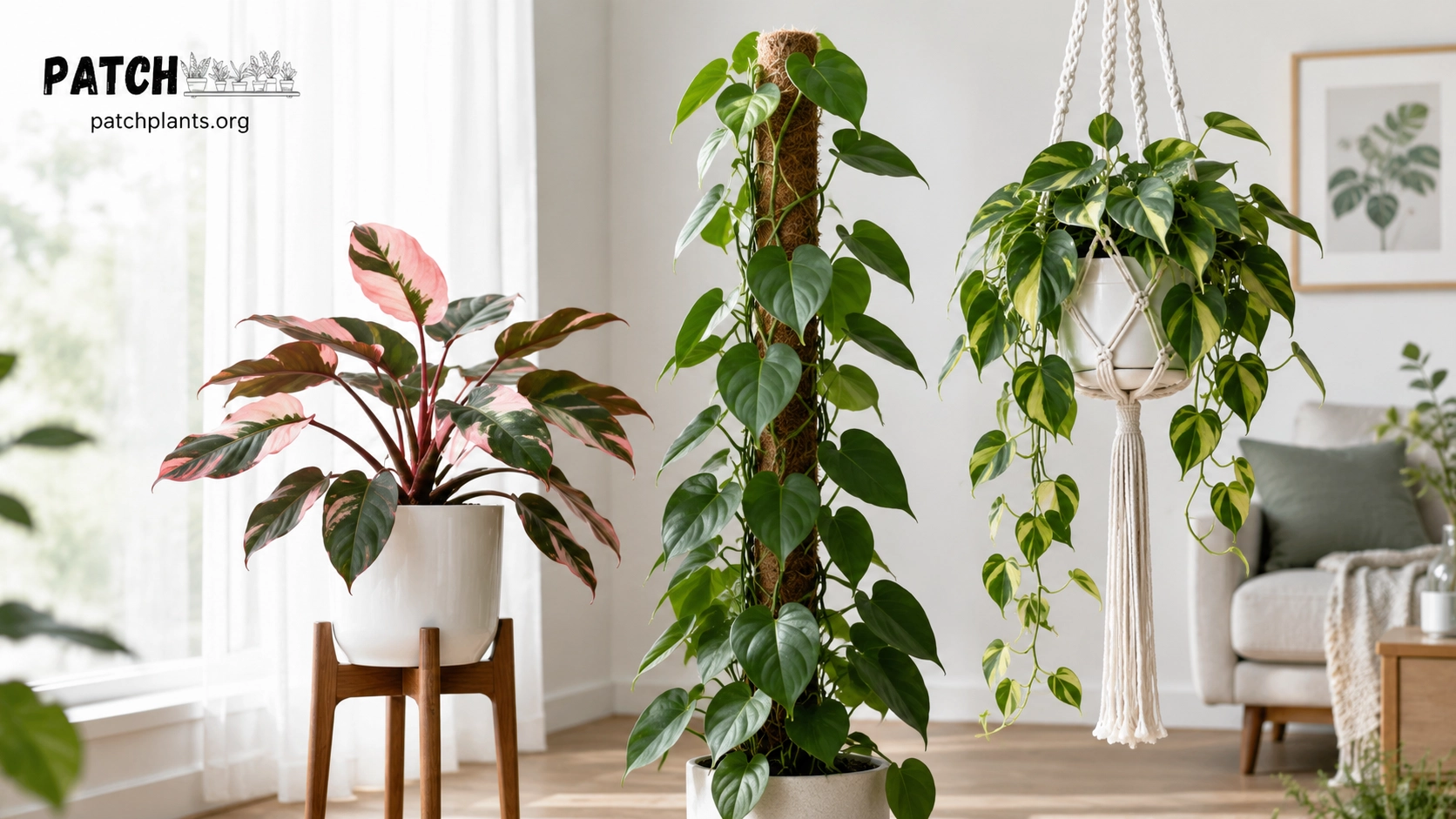
- Climbing or trailing types, such as the heartleaf philodendron, ‘Brasil’ and the velvet-leaved form often sold as ‘Micans’. They grow long stems with aerial roots. Grown up a pole, they usually make larger leaves. Left to trail, the leaves stay smaller.
- Self-heading or upright types, such as ‘Birkin’, ‘Prince of Orange’ and the large split-leaf philodendron. They grow from a central crown and do not need support.
If you want more trailing plants for shelves and baskets, see our guide to low-light hanging plants.
Popular Philodendron Varieties: Complete Species Guide
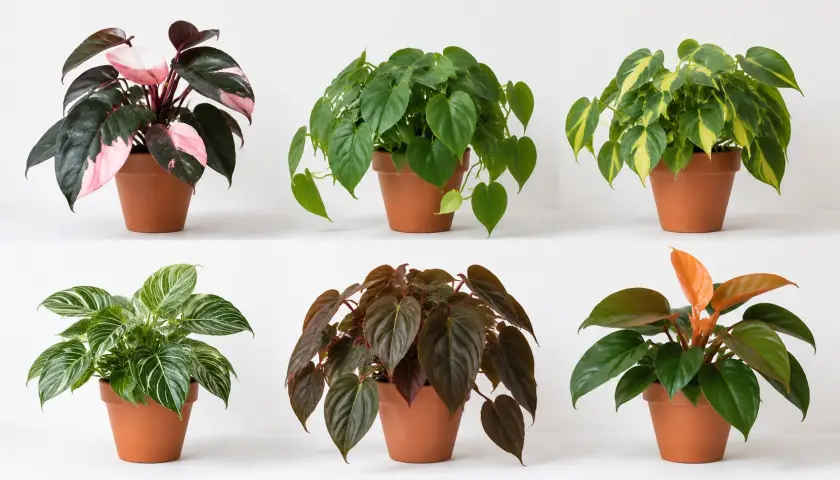
Pink Princess Philodendron — The Crown Jewel
‘Pink Princess’ is a cultivar of Philodendron erubescens. It has dark green to almost black leaves with pink patches. The pink areas have little or no chlorophyll, so the plant grows more slowly than green philodendrons.
Care:
- Light: Bright, indirect light. Too little light leads to fewer pink patches.
- Variegation: The pink pattern is unstable. A leaf can be mostly green, mostly pink or a mix.
- Pruning: If a stem starts producing only dark green leaves, cut it back to a node with good variegation.
- Watch for: All-pink leaves look striking but cannot make much food for the plant, and they often brown and die early.
If you like the colour but not the price, other P. erubescens cultivars with red stems or coppery new leaves are easier to find. Our guide to colourful foliage plants has more ideas.
Heartleaf Philodendron — The Indestructible Beginner Variety
The heartleaf philodendron (Philodendron hederaceum) is one of the easiest houseplants you can grow. It has glossy, heart-shaped leaves on long stems that trail or climb.
Why it suits beginners:
- It copes with lower light, though it grows faster in bright, indirect light.
- It recovers well if you forget to water once in a while.
- It grows quickly and fills space fast.
- Cuttings root easily.
Care: Water when the top 5 cm of mix is dry. Keep it at about 18–27°C. Let it trail from a shelf or train it up a moss pole for bigger leaves. For other forgiving plants, see our list of the best indoor plants for beginners, and for placement ideas, our guide to styling plants by room.
Philodendron Brasil — Vibrant Yellow-Green Variegation
‘Brasil’ is a variegated form of the heartleaf philodendron. Each leaf has a stripe or splash of lime and yellow through the middle. It needs the same care as the plain green form, with one difference: it needs more light to keep its colour.
Care:
- Light: Bright, indirect light. In low light, new leaves often come out plain green.
- Water: When the top 5 cm of mix is dry.
- Pruning: Cut plain green stems back to a node with variegated leaves. A green stem will not turn variegated later.
Philodendron Birkin — White Pinstriped Self-Header
‘Birkin’ is a compact, upright philodendron. Its dark green leaves have fine cream to white pinstripes. It does not climb, so it suits a table or shelf.
Care:
- Light: Bright, indirect light. In low light, the stripes fade and the stems stretch.
- Water: When the top 3–5 cm of mix is dry.
- Size: It usually stays small indoors, often around 60 cm tall.
- Variegation: It can produce plain green or reddish leaves. This is normal for this unstable variegation. Remove fully reverted growth if you want to keep the stripes.
Philodendron Micans — Velvet Burgundy Leaves
The plant sold as “Micans” is now classed as a velvet-leaved form of Philodendron hederaceum. Its small, heart-shaped leaves feel soft and look bronze to burgundy with a green sheen, depending on the light.
Care:
- Light: Bright, indirect light deepens the colour.
- Water: When the top 3 cm of mix is dry.
- Display: It trails well from a basket or shelf. Place it where light shines across the leaves to show off the velvet texture.
Split Leaf Philodendron — Identification Confusion
“Split leaf philodendron” is a common name for two different plants:
- Monstera deliciosa: Not a philodendron. Its leaves have splits and holes, and it climbs with aerial roots. This is the plant most shops sell under this name. See our monstera care guide.
- Tree philodendron (Philodendron bipinnatifidum, also sold as ‘Selloum’): A large, upright plant with deeply lobed leaves but no holes.
Check the leaves before you follow any care guide, because the two plants grow quite differently.
Tree Philodendron (Philodendron Selloum/Bipinnatifidum)
The tree philodendron is the giant of the group. Indoors, it can reach 1.5–2 metres tall and wide, with big, deeply cut leaves. Some botanists now place it in a separate genus, Thaumatophyllum, but it is still sold as a philodendron.
Care:
- Light: Bright, indirect light. It also handles some gentle direct sun.
- Space: Give it at least 1.5 metres of room. It is not a plant for a small flat.
- Water: When the top 5 cm of mix is dry.
For other large statement plants, see our guide to oversized indoor plants.
Philodendron Gloriosum — Creeping Velvet Beauty
Philodendron gloriosum is a creeper. Its stem crawls along the surface of the soil rather than climbing. The large, velvety, heart-shaped leaves have bold pale veins.
Care:
- Light: Bright, indirect light.
- Pot: Use a wide, shallow pot or long planter so the stem has room to crawl. Keep the creeping stem on top of the mix, not buried.
- Humidity: It prefers higher humidity, around 60% or more. Dry air can damage the velvet leaves.
Additional Popular Varieties
- ‘Prince of Orange’: Upright. New leaves open bright orange and turn green as they age.
- ‘Moonlight’: Upright and compact, with bright lime-green leaves.
- ‘White Knight’ and ‘White Princess’: Variegated with white. Both need bright light and have unstable variegation.
- ‘Painted Lady’: A climber with yellow-green speckled leaves.
- P. verrucosum: Velvety leaves with bright veins. Needs high humidity, so it suits experienced growers.
- ‘Xanadu’: A compact, upright plant with deeply lobed leaves.
- ‘Ring of Fire’: A collector’s plant with irregular, colourful new leaves.
Complete Philodendron Care Guide — Universal Requirements
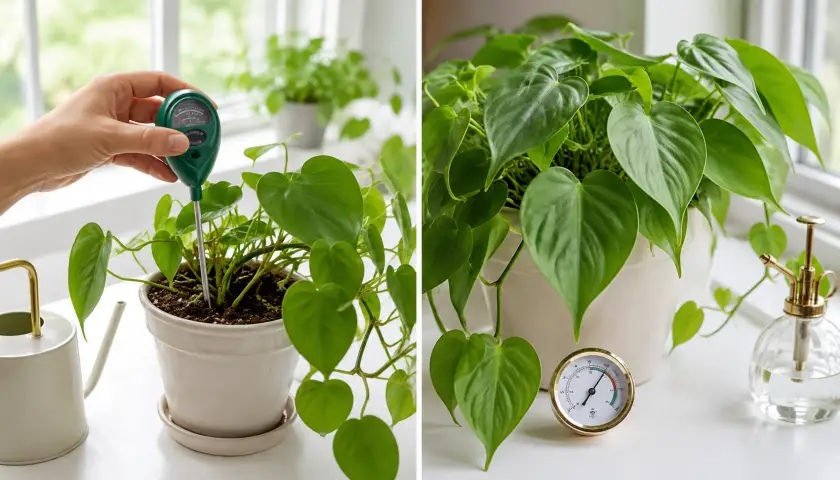
| Need | What philodendrons like |
|---|---|
| Light | Bright, indirect light; variegated types need the brightest spot |
| Water | When the top 3–5 cm of mix is dry |
| Temperature | About 18–27°C; keep above about 15°C |
| Humidity | Normal room humidity for most; 60%+ for velvet types |
| Soil | Loose, well-draining mix with bark or perlite |
| Feeding | Diluted balanced liquid feed in spring and summer |
| Pets | Toxic to cats and dogs |
Light Requirements for Philodendron
In the wild, most philodendrons grow under a forest canopy. They get bright light that is filtered through leaves. Indoors, a spot near an east-facing window, or a little back from a south- or west-facing window, works well. A sheer curtain helps soften strong sun.
- Too little light: Long gaps between leaves, small new leaves, slow growth and fading variegation.
- Too much direct sun: Pale, bleached patches, yellow scorch marks and crispy brown edges.
Our complete guide to indoor light explains how to judge the light in each room.
Watering Philodendron Plants
Push a finger 3–5 cm into the mix. If it feels dry, water slowly until water runs from the drainage holes. Empty the saucer after 15 minutes. In warm months, this often means watering every week or so. In winter, the plant may need water only every two weeks or less. Let the mix guide you rather than the calendar.
- Signs of overwatering: Many yellow leaves at once, soft stems, soggy mix and a musty smell.
- Signs of underwatering: Drooping leaves, crisp edges and mix pulling away from the pot.
Overwatering causes more philodendron problems than anything else. Our guide to signs of overwatering shows what to look for, and the complete watering guide covers the basics.
Humidity Requirements
Philodendrons come from humid forests, but most common types cope well with normal room humidity. Velvet-leaved types, such as ‘Gloriosum’ and P. verrucosum, are the exception. They do best at around 60% humidity or higher.
To raise humidity, group plants together, use a humidifier, or grow them in a bright bathroom. Pebble trays help only a little. Our guide to humidity hacks has more low-cost ideas, and our list of bathroom plants includes other humidity lovers.
Soil Mix for Philodendron
Philodendron roots need air as well as water. In nature, many grow on tree bark or in loose leaf litter. A heavy, dense mix stays wet for too long and can lead to root rot.
A simple mix:
- 2 parts good houseplant potting mix
- 1 part orchid bark
- 1 part perlite
A ready-made “aroid mix” also works well. Avoid garden soil and pure peat. For more detail, see our guide to the best soil mix for every type of plant.
Fertilizing Philodendron
Feed with a balanced liquid houseplant fertiliser at half strength every 3–4 weeks in spring and summer. Feed less in autumn and stop in winter, when growth slows. Always water first, then feed, so you do not burn dry roots.
Pale new leaves and slow growth in summer can mean the plant needs feeding. Our guide to fertilising indoor and outdoor plants explains how often to feed.
Propagating Philodendron: Easy Stem Cutting Method
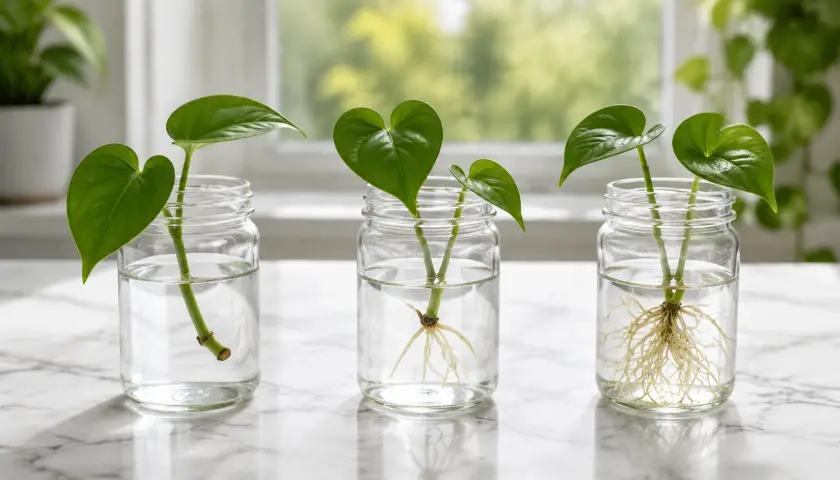
Climbing philodendrons are some of the easiest houseplants to propagate. Upright types can also be propagated, but it is slower.
- Find a node. A node is the small bump where a leaf joins the stem. Roots grow from here.
- Cut. Use clean, sharp scissors. Cut just below a node so each piece has one or two nodes and at least one leaf.
- Root in water or mix. In water, keep the node under water and the leaves above it. Change the water every few days. In mix, push the node just under the surface and keep the mix lightly moist.
- Wait. Roots usually appear in about 2–4 weeks in bright, indirect light and warmth.
- Pot up. Move water cuttings into mix once the roots are a few centimetres long.
For variegated plants, take cuttings from stems with good variegation. For more methods, see our guide on how to propagate houseplants.
Common Philodendron Problems and Solutions
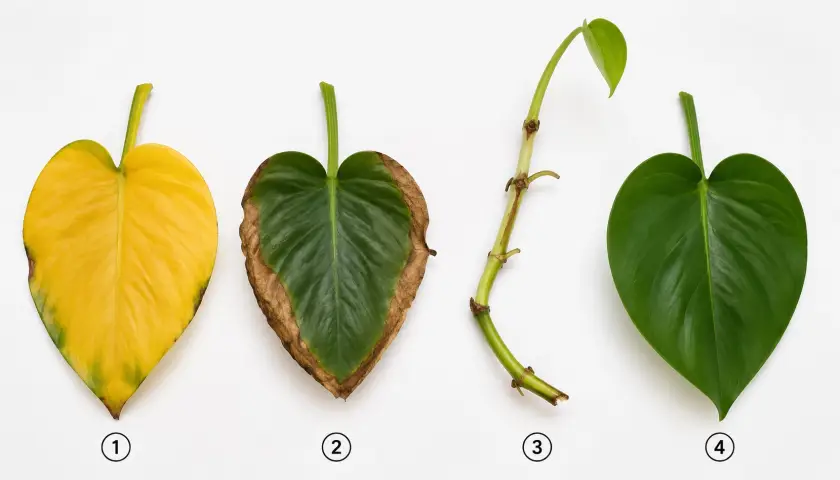
Yellow Leaves on Philodendron
- One old leaf at the bottom turns yellow: Normal ageing. Remove it.
- Several leaves turn yellow and the mix stays wet: Overwatering. Let the mix dry more between waterings and check the drainage.
- Yellow leaves with crispy edges and dry mix: Underwatering. Water more thoroughly.
- New leaves are pale all over: The plant may need feeding.
Our guide on why plant leaves turn yellow covers each cause in more detail.
Brown Leaves and Edges
Crispy brown edges usually point to dry air or uneven watering. Soft brown patches can mean cold damage or a leaf spot disease from wet leaves. If leaves turn brown and yellow together, check the roots. Healthy roots are firm and white or tan. Rotten roots are dark and mushy and need cutting away before you repot in fresh mix. See our guide to leaf curl, browning and droop.
Leggy Growth and Small Leaves
Long, bare stems and small leaves mean the plant needs more light. Move it to a brighter spot, trim leggy stems just above a node, and give climbing types a moss pole.
Variegation Reverting to Green
Variegated types can make plain green leaves, especially in low light. Give them more light and cut green stems back to a node with variegated leaves.
Pests
Watch for spider mites (fine webbing and speckled leaves), mealybugs (white, cottony spots), scale (brown bumps on stems) and thrips. Isolate the plant, wipe or rinse the leaves, and treat with insecticidal soap or another product labelled for houseplants. Check the plant again every week until the pests are gone.
Repotting Philodendron Plants
Repot every one to two years, or when roots grow out of the drainage holes. Spring is the best time. Choose a pot only 2–5 cm wider than the old one. A much bigger pot holds extra wet mix that roots cannot use.
Ease the plant out, loosen circling roots, and set it at the same depth in fresh mix. Water well and keep it out of strong sun for a week or two. Our guides on how to repot a plant and repotting mistakes to avoid walk you through each step.
Philodendron Plant Toxicity and Pet Safety
All philodendrons should be treated as toxic to pets. The ASPCA lists heartleaf philodendron and tree philodendron as toxic to dogs and cats. The plants contain insoluble calcium oxalate crystals. Chewing them can cause mouth pain, swelling, drooling, vomiting and trouble swallowing. The sap can also irritate human skin.
Keep philodendrons out of reach of pets and children. If you think a pet has eaten part of one, contact your vet or an animal poison helpline. For safer choices, see our guides to cat-friendly plants and dog-friendly plants.
Styling Philodendron in Different Spaces
Living Room Philodendron Displays
A heartleaf or ‘Brasil’ trailing from a high shelf softens a room. A tree philodendron makes a bold floor plant if you have the space.
Office Philodendron Options
Heartleaf philodendrons cope well with offices, as long as they get some daylight or bright artificial light. See our list of office-friendly plants for more.
Bedroom Philodendron Placement
A compact ‘Birkin’ or ‘Moonlight’ suits a bedside table near a bright window. For more ideas, see our guide to decorating your bedroom with plants.
Frequently Asked Questions
What is the easiest Philodendron to care for?
The heartleaf philodendron (Philodendron hederaceum). It copes with lower light, recovers from the odd missed watering and roots easily from cuttings.
How often should I water my Philodendron?
Water when the top 3–5 cm of mix is dry. That is often about once a week in summer and less often in winter, but the mix is a better guide than the calendar.
Why is my Philodendron turning yellow?
Overwatering is the most common cause. A single old leaf yellowing at the base is normal. Several yellow leaves with wet mix mean the plant needs less water and better drainage.
Can Philodendron grow in low light?
Green climbing types, such as the heartleaf philodendron, cope with lower light but grow slowly and get leggy. Variegated types need bright, indirect light to keep their colour.
Is Philodendron toxic to cats and dogs?
Yes. The ASPCA lists philodendrons as toxic to cats and dogs because they contain insoluble calcium oxalate crystals. Keep them out of reach and contact a vet if your pet chews one.
Related Plant Care Guides
- Pothos care guide
- Monstera care guide
- Snake plant care guide
- ZZ plant care guide
- Spider plant care guide
- Rubber plant care guide
- How to revive a dying plant
Final Thoughts
Philodendrons are popular for good reason. Most need only bright, indirect light, a loose mix and careful watering. Start with a heartleaf or ‘Brasil’, learn how it responds to light and water, then move on to velvet or variegated types once you feel confident. For more detail on the genus, the RHS philodendron growing guide is a good next read.

About the author
Sawera Shahid is a botanist with an MPhil in Botany and 5+ years of writing about plants. As founder and lead writer of Patch Plants, she writes practical, science-backed guides on indoor plants, outdoor gardens and plant problems, checked against RHS and university extension advice.