🌿 Key Takeaways
- Pothos plant care is genuinely beginner-friendly — this trailing vine tolerates low light, irregular watering, and neglect better than almost any other houseplant available
- Golden pothos care requires bright indirect light for the most vivid yellow-green variegation — in low light, leaves revert to solid green
- Neon pothos care needs brighter light than most varieties to maintain its electric lime-green coloration — the brightest indirect light available in your home
- Satin pothos care (Scindapsus pictus) differs from true pothos — it prefers slightly more humidity and less direct sun than golden pothos
- Marble queen pothos care requires the brightest indirect light of all pothos varieties to maintain its distinctive cream-and-green marbled variegation
- Pothos plant care indoor centers on three rules — bright indirect light, water only when top 2 inches are dry, and well-draining potting mix
- Pothos (Epipremnum aureum) is toxic to cats and dogs — keep out of reach of pets or choose non-toxic alternatives
- Browse our full indoor plant care guides for companion plant ideas that pair beautifully with pothos displays
Why Pothos Is the World’s Most Popular Houseplant
Ask any experienced plant owner which single plant they would recommend to an absolute beginner, and the answer is almost always the same: pothos. The Epipremnum aureum — known variously as devil’s ivy, money plant, and hunter’s robe — has earned this universal recommendation through a combination of extraordinary resilience, genuine visual beauty, remarkable variety, and a tolerance for imperfect care that no other widely available houseplant can match.
Pothos plant care is so forgiving that this vine has been documented surviving in conditions that would kill virtually any other houseplant — fluorescent office lighting, weeks without water, root-bound pots, inconsistent humidity, and temperature fluctuations that would stress most tropical species into decline. Yet given even moderately good care — adequate light, regular watering when soil dries, and any reasonable potting mix — pothos responds with vigorous trailing growth, increasingly large leaves, and the kind of lush, cascading display that transforms any room into a genuinely beautiful green space.
This complete pothos care guide covers everything — from the exact light, watering, soil, and humidity requirements of all major pothos varieties to propagation, repotting, pest management, and troubleshooting the most common problems. Whether you are growing your first golden pothos on a kitchen windowsill or building an extensive collection that includes neon pothos, satin pothos, marble queen pothos, and rarer varieties, this guide gives you everything you need to keep every plant thriving.
Pothos Plant — Botanical Identity and Natural Habitat
What Is Pothos? — Epipremnum Aureum
Pothos (Epipremnum aureum) is a tropical vine in the family Araceae — the same plant family that includes monstera, peace lily, and philodendron. Native to the Solomon Islands in the South Pacific, pothos in its natural habitat grows as a forest floor vine that climbs tree trunks using adhesive aerial roots, ascending toward the forest canopy where light is more abundant.
This natural growth habit explains several key pothos plant care characteristics:
- It tolerates low light because forest floors are naturally shaded
- It thrives in humidity because tropical forests are consistently humid
- It grows as a trailer or climber because it is genetically programmed to reach toward better light
- Its leaves enlarge dramatically when given support to climb — mimicking its natural ascent up tree trunks
Pothos vs Devil’s Ivy — Same Plant, Different Names
Pothos is commonly called devil’s ivy — a name earned from its extraordinary resilience. The “devil’s” reference acknowledges that this plant is virtually impossible to kill — it stays green even in near-complete darkness, earning the nickname through its seemingly supernatural ability to survive conditions that would kill any other plant.
Other common names include hunter’s robe, silver vine, money plant, and taro vine — reflecting the plant’s widespread cultivation across different cultures and regions.
Pothos Varieties — Complete Guide
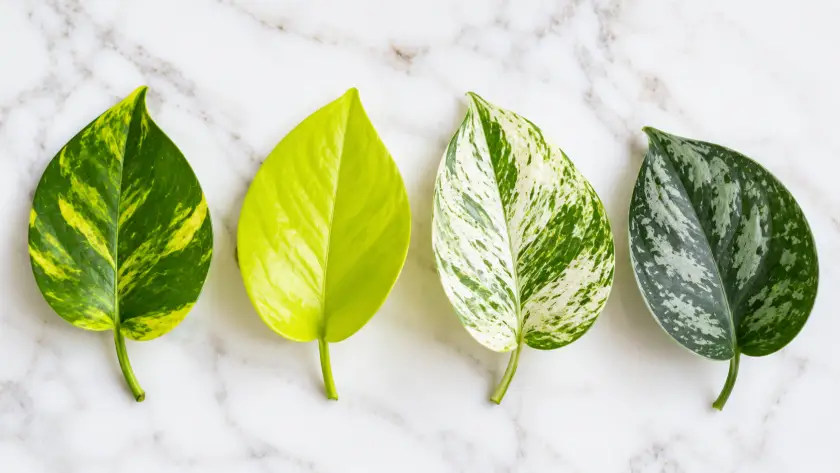
Golden Pothos — The Most Popular Variety
Golden pothos (Epipremnum aureum) is the most widely grown and most immediately recognizable pothos variety — its heart-shaped leaves patterned in green and yellow-gold variegation are one of the most familiar houseplant sights worldwide.
Golden pothos care specifics:
- Light: Bright indirect light for best variegation — tolerates lower light but loses yellow coloration
- Leaf size: Typically 10–15cm indoors, potentially much larger with climbing support
- Growth rate: Fast — one of the fastest-growing pothos varieties
- Variegation stability: Stable in good light, reverts to green in low light
- Best for: Beginners, trailing displays, shelves, hanging baskets
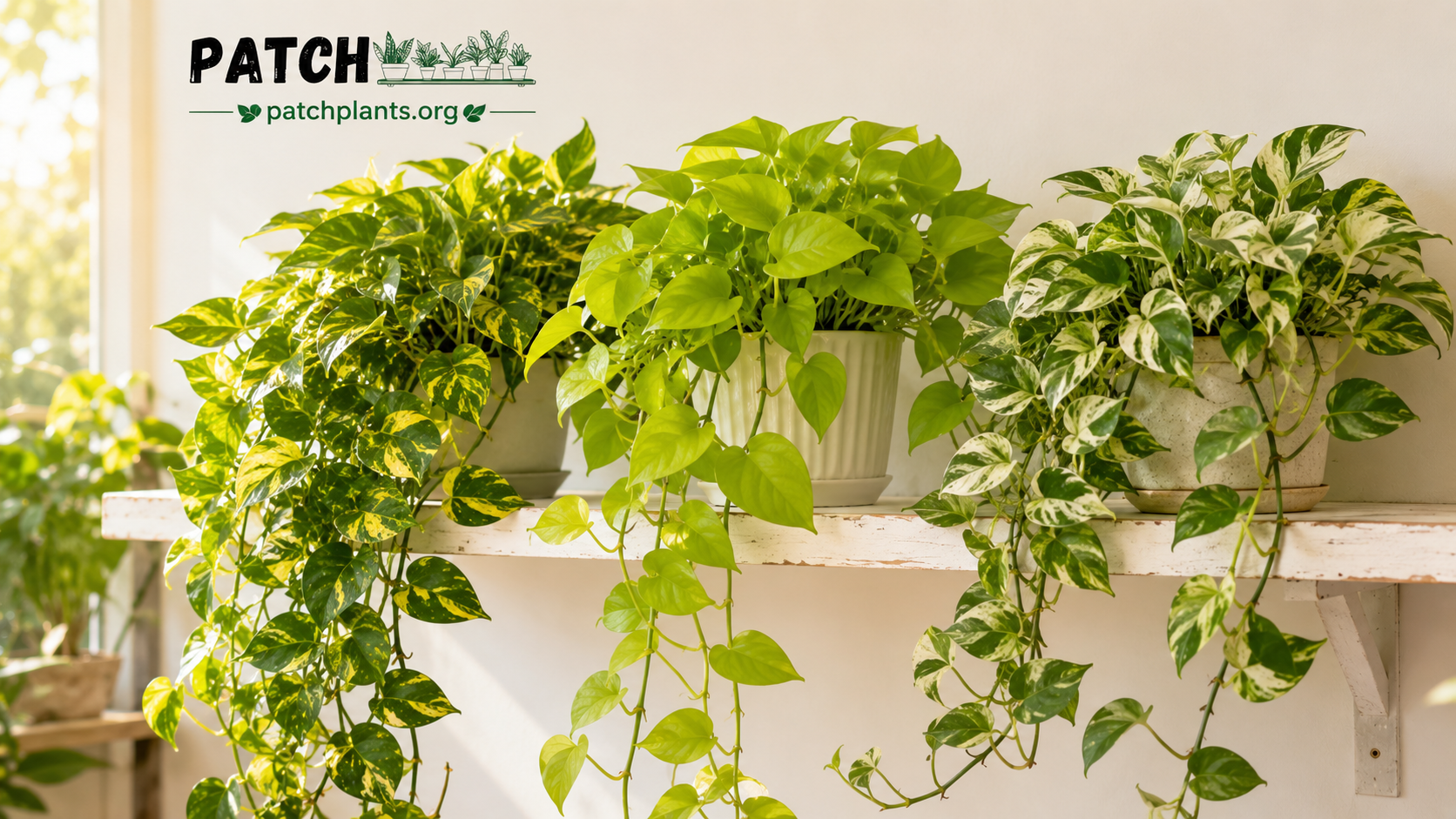
For ideas on displaying golden pothos in cascading shelf displays, our guide on trailing plants that look stunning on shelves and bookcases covers golden pothos alongside the best companion trailing plants.
Neon Pothos — The Most Vivid Variety
Neon pothos care is slightly more demanding than golden pothos — this variety’s extraordinary electric lime-green coloration requires significantly more light to maintain at its full intensity.
Neon pothos care specifics:
- Light: Bright indirect light — needs more light than golden pothos to maintain neon coloration
- Leaf color: Uniform electric lime-green — no variegation, but the color itself is extraordinary
- Growth rate: Fast — similar to golden pothos
- Low light behavior: Leaves become darker, duller green — losing the distinctive neon quality entirely
- Best for: Bright rooms, east or west-facing windowsills, offices with good natural light
Neon pothos care tip: Position within 1 metre of a bright window for maximum color intensity. Our complete guide to indoor light covers exactly how to measure and optimize light levels for neon pothos care and all other light-demanding pothos varieties.
Marble Queen Pothos — The Most Striking Variegated Variety
Marble queen pothos care is the most demanding of the mainstream pothos varieties — its exceptional cream-and-green marbled variegation comes at the cost of slower growth and higher light requirements.
Marble queen pothos care specifics:
- Light: Brightest indirect light available — heavy cream variegation means less chlorophyll, requiring maximum light for adequate photosynthesis
- Growth rate: Slower than golden or neon — high variegation reduces photosynthetic capacity
- Variegation: Cream, white, and green in irregular marble patterns — each leaf uniquely patterned
- Low light behavior: Produces more green, less cream — losing its distinctive marble appearance
- Best for: Bright rooms, south-facing windowsills with filtered light, statement displays
Marble queen pothos care light requirement is higher than any other mainstream pothos variety — because the cream and white portions of leaves contain no chlorophyll and cannot photosynthesize. The plant must generate enough energy from its green portions alone to support the entire leaf — requiring significantly more light intensity than fully green varieties.
Satin Pothos — The Velvet-Leaved Variety
Satin pothos care differs from true pothos care in important ways — satin pothos (Scindapsus pictus) is not actually a true Epipremnum pothos despite sharing the common name. It belongs to the closely related Scindapsus genus and has slightly different care requirements.
Satin pothos care specifics:
- Light: Bright indirect light — more sensitive to direct sun than golden pothos
- Leaf texture: Velvety, matte surface with silver satin-like patches — distinctly different from the glossy leaves of true pothos
- Humidity: Prefers higher humidity than true pothos — 50–60% ideal
- Growth rate: Slower than true pothos varieties
- Watering: Allow soil to dry more thoroughly between waterings than true pothos
- Best for: Humid rooms, bathrooms with natural light, terrariums
Satin pothos care humidity requirement makes it an excellent bathroom plant — our guide on the best plants for your bathroom identifies satin pothos as one of the most visually striking bathroom plant choices for humid bathroom environments.
Other Pothos Varieties
Jessenia pothos: Similar to marble queen but with yellow-green rather than cream variegation — slightly faster growing and more tolerant of lower light than marble queen.
Manjula pothos: Patented variety with broader leaves and cream, white, and green variegation — slower growing than golden pothos but extraordinarily beautiful.
Cebu blue pothos (Epipremnum pinnatum): Blue-silver juvenile leaves that develop fenestrations (natural holes) when mature — one of the most unusual pothos varieties available.
Pearls and jade pothos: Smaller leaves with white and green variegation plus distinctive green flecking on white portions — compact and slower growing than most varieties.
N’Joy pothos: Small, distinctly bicolor leaves in white and green — lacks the marbling of marble queen, instead showing clean delineation between white and green portions.
Complete Pothos Plant Care Guide
Pothos Care at a Glance
| Care Factor | Pothos Requirement |
|---|---|
| Light | Bright indirect — tolerates low light |
| Watering | Every 1–2 weeks — when top 2 inches dry |
| Temperature | 18–29°C (65–85°F) |
| Humidity | 50–70% ideal — tolerates lower |
| Soil | Well-draining potting mix + perlite |
| Fertilizer | Monthly in spring/summer — diluted |
| Pot | Any pot with drainage holes |
| Toxicity | Toxic to cats and dogs |
Pothos Light Requirements
What Light Does Pothos Need?
Pothos plant care light requirements are one of the most misunderstood aspects of growing this plant. The common description of pothos as a “low light plant” is technically accurate but misleading — pothos survives in low light, but it thrives in bright indirect light.
Light levels and pothos behavior:
| Light Level | Pothos Behavior |
|---|---|
| Bright indirect (1–2m from bright window) | Fast growth, vivid variegation, large leaves |
| Medium indirect (2–3m from window) | Moderate growth, some variegation fading |
| Low light (3m+ from window) | Slow growth, reversion to green, smaller leaves |
| Direct sun | Leaf scorch — bleached patches, brown edges |
| No natural light | Survival only — no meaningful growth |
Variegated varieties need more light: Golden pothos care, marble queen pothos care, and neon pothos care all require brighter light than solid green varieties — because the non-green portions of variegated leaves contain little or no chlorophyll. The plant must generate all its energy from its green leaf portions, making adequate light even more critical.
Signs of insufficient light:
- Stems becoming long and leggy with widely spaced leaves
- Variegated varieties reverting to solid green
- Extremely slow or stopped growth
- Small new leaves compared to older growth
Our complete guide to indoor light covers exactly how to measure light levels and use grow lights to supplement natural light for pothos plant care indoor in darker homes.
Pothos Watering — How and When
How to Water Pothos Correctly
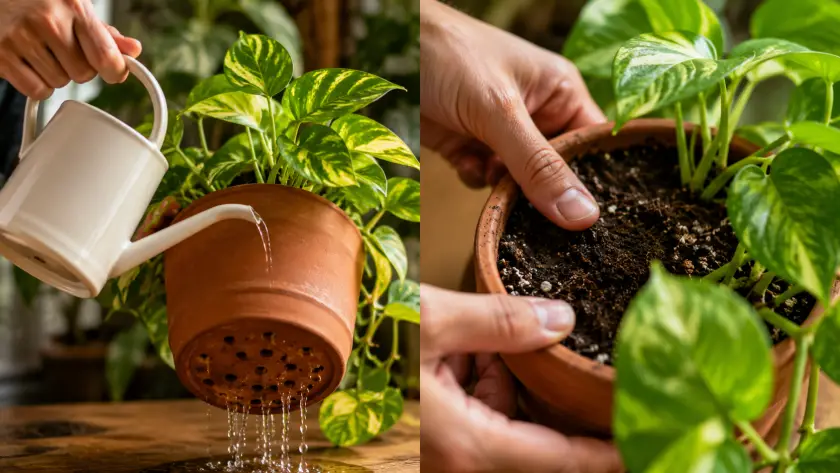
Pothos plant care watering is simple when you follow one rule: water only when the top 2 inches of soil are completely dry. This rule applies to all pothos varieties — though satin pothos care benefits from allowing slightly more soil depth to dry before watering.
Step-by-step watering for pothos:
- Push your finger 2 inches into the soil
- If dry at 2 inches — water thoroughly
- Water slowly until water flows from drainage holes
- Allow to drain completely — never leave in standing water
- Return to its position and do not water again until the top 2 inches are dry again
Seasonal watering frequency:
- Spring and summer (active growth): Every 7–10 days typically
- Autumn: Every 10–14 days
- Winter: Every 14–21 days — growth slows, water use decreases
Water quality: Pothos is sensitive to fluoride and chlorine in tap water over time — causing brown leaf tips. Use filtered water or allow tap water to sit uncovered for 24 hours before use.
Never water in the evening — our guide on the worst times to water your plants explains exactly why morning watering produces consistently healthier results for pothos and all tropical houseplants.
Overwatering Pothos — The Most Common Mistake
Overwatering is far more dangerous than underwatering for pothos. Signs you are overwatering your pothos:
- Yellow leaves — particularly lower, older leaves
- Mushy or soft stems at the base
- Persistently wet soil that never dries within 7 days
- Musty or unpleasant soil odor
- Root rot visible when unpotted
Our guide on signs you are overwatering and how to correct it covers the complete overwatering correction process for pothos and all tropical houseplants.
Underwatering Pothos — The Easier Problem
Pothos communicates underwatering clearly and recovers quickly when corrected. Signs of underwatering:
- Wilting or drooping stems and leaves
- Dry, pulling-away-from-pot-edges soil
- Crispy, brown leaf edges
- Entire plant looks limp and deflated
Water thoroughly — pothos typically perks up within 2–4 hours of watering when underwatered. Our complete watering guide for healthy thriving plants covers the complete watering system for pothos and every other houseplant type.
Best Soil for Pothos
Pothos plant care indoor soil requirements are straightforward — well-draining, loose potting mix that retains light moisture without staying waterlogged.
Best pothos soil mix:
2 parts general purpose potting mix 1 part perlite Optional: small amount of coco coirThis combination drains well enough to prevent root rot while retaining sufficient moisture between waterings. Our comprehensive soil mix guide for every plant type covers the exact pothos soil recipe alongside soil mixes for every other houseplant category.
What to avoid:
- Heavy, dense potting compost — retains too much moisture
- Garden soil — compacts in containers, introduces pests
- Pure cactus mix — drains too fast, pothos dries out too quickly
- Any soil without perlite — drainage is always improved for pothos
Pothos Temperature and Humidity
Temperature Requirements
Pothos thrives in standard indoor temperatures and tolerates a wide range:
- Ideal: 18–29°C (65–85°F)
- Minimum: Above 10°C (50°F) — cold damage begins below this
- Maximum tolerance: Around 35°C (95°F) with adequate humidity
- Avoid: Cold drafts, air conditioning vents blowing directly on the plant, windowsills in winter where glass conducts cold
Humidity for Pothos
Pothos plant care indoor humidity requirements are moderate — this tropical vine prefers 50–70% relative humidity but tolerates the lower humidity of typical heated or air-conditioned homes far better than many tropical houseplants.
Signs of insufficient humidity:
- Brown, crispy leaf tips and edges
- Leaves curling inward
- Slowed growth during otherwise active seasons
Humidity solutions for pothos:
- Group multiple plants together — transpiration from grouped plants raises local humidity
- Pebble tray with water — evaporation raises immediate local humidity
- Position in naturally humid rooms — bathrooms and kitchens provide higher ambient humidity
Our guide on humidity hacks for keeping plants happy without a humidifier and how to build a DIY indoor humidity tray cover the most effective humidity solutions for pothos plant care indoor in dry environments.
Satin pothos care humidity note: Scindapsus pictus varieties need higher humidity than true pothos — aim for 60%+ for best growth and to prevent leaf edge browning.
Fertilizing Pothos
Pothos plant care fertilizing needs are moderate — pothos is not a heavy feeder but responds visibly to regular feeding during the growing season.
Fertilizing schedule:
- Spring: Begin monthly feeding with balanced liquid fertilizer (10-10-10 or 20-20-20) at half strength
- Summer: Continue monthly — increase to full strength if growth is vigorous
- Autumn: Reduce to every 6-8 weeks
- Winter: Stop feeding entirely — pothos is resting
Signs of nutrient deficiency:
- Pale, washed-out leaf color despite adequate light
- Slow growth even in good light conditions
- Small new leaves compared to older growth
Signs of over-fertilizing:
- Brown, crispy leaf edges and tips
- White salt crust visible on soil surface
- Yellowing that does not correspond to overwatering pattern
Our guide on fertilizing indoor vs outdoor plants — what’s the difference covers complete fertilizing schedules and techniques for pothos plant care indoor and all tropical houseplant varieties.
Pothos Repotting — When and How
When to Repot Pothos
Pothos is a fast grower that needs repotting every 12–18 months when young and actively growing. Signs that repotting is needed:
- Roots emerging from drainage holes
- Soil drying within 24–48 hours of thorough watering
- Roots visibly circling on the soil surface
- Plant becoming unstable or top-heavy
For complete repotting guidance including the correct technique for pothos and all houseplant types, our complete repotting guide covers every step from root inspection through transplant shock recovery.
How to Repot Pothos
- Choose a new pot 2–3cm wider than the current one
- Prepare fresh potting mix with perlite
- Water thoroughly 24 hours before repotting
- Remove from old pot and inspect roots — trim any brown or mushy roots
- Position in new pot at the same depth
- Fill around roots with fresh mix and water thoroughly
- Place in bright indirect light for 2 weeks during recovery
Post-repotting: Expect 1–2 weeks of slower growth as roots establish. Our guide on repotting mistakes to avoid covers the most common pothos repotting errors — particularly going up too many pot sizes at once.
How to Propagate Pothos — Complete Guide
Pothos Propagation — The Easiest Method
Pothos is one of the most rewarding houseplants to propagate — stem cuttings root readily in both water and soil, producing new plants within 2–4 weeks with minimal effort or equipment.
Water Propagation — The Most Visible Method
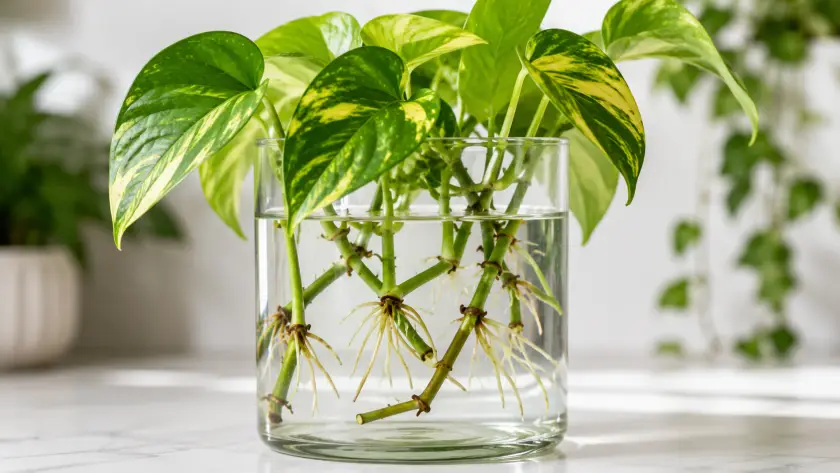
Step-by-step water propagation:
- Choose a healthy stem with at least 3–4 leaves
- Cut just below a node — the small brown bump on the stem where roots will emerge
- Remove the lowest 1–2 leaves to expose the node
- Place the cutting in clean water — submerging the node but keeping leaves above water
- Position in bright indirect light
- Change water every 5–7 days
- Roots develop in 2–4 weeks — transfer to potting mix when roots reach 3–5cm
Water propagation tip: Adding a small piece of willow branch to the propagation water releases natural rooting hormone — speeding root development in pothos and most other tropical cuttings.
Soil Propagation — The Most Direct Method
- Prepare a small pot with moist potting mix
- Take cuttings as above — 3–4 leaves, node exposed at the base
- Dip the cut end in rooting hormone powder (optional but helpful)
- Insert the cutting 2–3cm deep into the moist mix
- Keep soil consistently moist — not wet — for the first 3–4 weeks
- Place in bright indirect light
- New leaf growth confirms successful rooting — usually 3–5 weeks
For complete propagation guidance covering water, soil, and division methods for pothos and all major houseplant types, our guide on how to propagate houseplants easily at home is the definitive resource.
Pothos Yellow Leaves — Diagnosis and Solutions
Why Are My Pothos Leaves Turning Yellow?
Pothos yellow leaves are the most common problem reported by pothos owners — and almost always indicate one of a small number of easily correctable causes:
Overwatering (Most Common Cause): Yellow leaves that start from the bottom of the plant upward, combined with persistently moist soil, indicate overwatering. Allow soil to dry more thoroughly between waterings and check that drainage holes are unobstructed. Our guide on why your plant leaves are turning yellow covers the complete diagnostic process for distinguishing overwatering yellowing from other causes.
Insufficient Light: Yellow leaves distributed throughout the plant — rather than specifically at the base — combined with leggy, stretched growth indicate insufficient light. Move to a brighter position or add supplemental grow lighting.
Nutrient Deficiency: Yellowing with green veins remaining (interveinal chlorosis) indicates nutrient deficiency — most commonly nitrogen or iron. Resume or increase fertilizing frequency.
Root Rot: Yellowing combined with mushy stems at the base and a foul soil smell indicates root rot requiring immediate repotting and root treatment. Our guide on root rot — how to identify, prevent and treat it covers the complete root rot rescue process for pothos.
Natural Leaf Aging: Occasional yellowing of the oldest, lowest leaves is completely normal — pothos naturally sheds its oldest leaves as new growth extends the trailing stems. One or two yellowing lower leaves per month requires no corrective action.
Pothos Trailing Displays — Styling and Placement
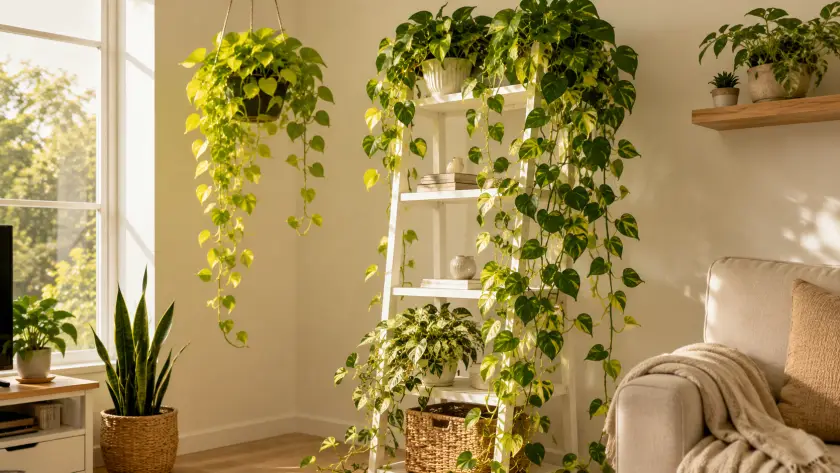
How to Display Pothos for Maximum Impact
Pothos is at its most visually impressive when its natural trailing habit is allowed to express itself fully — long stems cascading from shelves, hanging baskets, or elevated positions create the lush, jungle-like displays that make this plant one of the most photographed houseplants available.
Best display positions for pothos:
High shelves: Pothos on high shelves trailing downward creates dramatic vertical green curtains — particularly impressive when multiple long-stemmed plants are grouped at different shelf heights. Our guide on trailing plants that look stunning on shelves and bookcases covers optimal shelf positioning for maximum trailing plant impact.
Hanging baskets: Classic and effective — hanging baskets allow pothos to trail in all directions simultaneously, creating globe-like cascading displays. Our guide on low-light hanging plants for shelves, showers, and ceilings covers hanging basket display options for pothos in different light conditions.
Climbing with support: Given a moss pole, trellis, or wall-mounted support, pothos grows upward and produces dramatically larger leaves — mimicking its natural growth habit. Climbing pothos in a well-lit corner creates a genuine indoor statement plant.
Room dividers: Large trailing pothos can be used as natural room dividers — positioned on high shelves above doorways or on room divider shelving units to create flowing green curtains. Our guide on indoor plants that double as natural room dividers covers pothos as a room divider plant in detail.
Room-specific pothos placement:
Bedroom: Pothos performs night-time oxygen production through CAM-like respiration — making it excellent for bedrooms. Our guide on decorating your bedroom with plants covers bedroom pothos display positions.
Home office: One of the best office plants available — tolerates fluorescent and artificial lighting better than most tropical species. Our guide on improving your home office with plants covers pothos alongside the most effective office plant varieties. Our dedicated guide on office-friendly plants that survive fluorescent lighting specifically identifies pothos as the top performer under artificial office lighting conditions.
Bathroom: Pothos loves bathroom humidity and tolerates the lower light of many bathroom positions well. Our guide on the best plants for your bathroom includes pothos as one of the most recommended bathroom plant choices.
Kitchen: Near a bright kitchen window with humidity from cooking — ideal conditions for pothos. Our guide on fancy kitchen plants covers kitchen pothos display ideas that combine practical herb growing with decorative trailing plant displays.
Is Pothos Toxic to Cats and Dogs?
Pothos Toxicity — Important Pet Safety Information
Pothos contains calcium oxalate crystals — insoluble compounds that cause immediate oral irritation, burning, swelling, and digestive upset if ingested by cats or dogs. Pothos toxicity is rarely life-threatening but causes significant discomfort and requires veterinary attention if symptoms are severe.
Symptoms of pothos ingestion in pets:
- Immediate drooling and pawing at the mouth
- Vomiting
- Difficulty swallowing
- Swelling of mouth and tongue
- Lethargy
Pet safety with pothos:
- Position on genuinely inaccessible high shelves or in rooms pets cannot enter
- Never leave cut pothos stems where pets can access them — the sap is particularly irritating
- Consider replacing with pet-safe trailing alternatives in pet households
For complete guidance on pet-safe plant selection and creating a home where both plants and pets coexist safely, our guides on cat-friendly plants and dog-friendly plants give comprehensive lists of non-toxic alternatives to pothos for pet-owning households.
Pet-safe pothos alternatives with similar trailing habit:
- Spider plant (Chlorophytum comosum) — non-toxic, trailing, easy care
- Swedish ivy (Plectranthus australis) — non-toxic trailing plant
- Hoya species — non-toxic, trailing, beautiful waxy flowers
- Boston fern — non-toxic, dramatic trailing fronds
Pothos as an Air-Purifying Plant
Does Pothos Purify Air?
Pothos is consistently listed among the most effective houseplants for indoor air quality improvement — appearing in the original NASA Clean Air Study as one of the most efficient species for removing benzene, formaldehyde, xylene, and toluene from indoor air.
While the NASA study was conducted in sealed chamber conditions rather than typical room conditions, subsequent research has confirmed that pothos does absorb volatile organic compounds (VOCs) through its leaves and roots — with larger, more mature specimens providing greater air-cleaning capacity.
For a comprehensive assessment of air-purifying plants and which species provide the most measurable benefits in typical home conditions, our guide on air-purifying indoor plants that actually work ranks pothos among the top air-purifying houseplants available.
Pothos Problems — Complete Troubleshooting
Common Pothos Problems and Solutions
| Problem | Most Likely Cause | Solution |
|---|---|---|
| Yellow leaves (base of plant) | Overwatering | Let soil dry more, check drainage |
| Yellow leaves (throughout plant) | Insufficient light | Move to brighter position |
| Brown leaf tips | Low humidity or fluoride in water | Increase humidity, use filtered water |
| Brown patches on leaves | Direct sun exposure | Move away from direct sun |
| Leggy, stretched growth | Insufficient light | Brighter position or grow lights |
| Variegation fading to green | Too little light | More bright indirect light |
| Wilting with moist soil | Root rot | Emergency repot, remove affected roots |
| Wilting with dry soil | Underwatering | Water thoroughly |
| White crusty soil surface | Mineral buildup | Flush with filtered water |
| Mushy stems at base | Severe root rot | Urgent repotting |
Pothos Leaf Curl and Drooping
Leaf curl and drooping in pothos almost always indicates a watering problem — either too much or too little. Our guide on leaf curl, browning, and droop — what your plant is telling you decodes all visible leaf symptoms in pothos specifically.
Reviving a Severely Struggling Pothos
For pothos that have declined beyond simple corrective measures — severely root-bound, root-rotted, or extremely dehydrated specimens — our step-by-step guide on how to revive a dying plant covers the complete emergency rescue process applicable to pothos.
Golden Pothos Care vs Other Varieties — Quick Comparison
| Feature | Golden Pothos | Neon Pothos | Marble Queen | Satin Pothos |
|---|---|---|---|---|
| Light need | Medium-bright | Bright | Brightest | Medium-bright |
| Growth rate | Fast | Fast | Slow-medium | Slow-medium |
| Watering | Standard | Standard | Standard | Slightly less |
| Humidity | Moderate | Moderate | Moderate | Higher |
| Difficulty | Easiest | Easy | Moderate | Moderate |
| Toxicity | Toxic | Toxic | Toxic | Toxic |
| Best for | Beginners | Bright rooms | Statement plant | Humidity lovers |
Frequently Asked Questions
How to Care for a Pothos Plant — The Basics?
How to care for a pothos plant follows three core rules: provide bright indirect light, water only when the top 2 inches of soil are completely dry, and use well-draining potting mix with perlite. Beyond these basics, pothos plant care indoor is remarkably forgiving — this plant tolerates missed waterings, lower light, and inconsistent care better than almost any other houseplant available.
How Often Should I Water Pothos?
Pothos plant care watering frequency varies by season — every 7–10 days in spring and summer, every 10–14 days in autumn, every 14–21 days in winter. Always use the finger test — push 2 inches into the soil and water only when completely dry at that depth. Never water on a fixed schedule without checking soil first.
Why Is My Golden Pothos Losing Its Yellow Color?
Golden pothos care variegation maintenance requires adequate light. When golden pothos is placed in insufficient light, it redirects its limited photosynthetic resources — producing more chlorophyll (green) at the expense of the yellow pigmentation. Move to a brighter indirect light position and new growth will gradually restore the yellow-green variegation. Existing all-green leaves will not re-varieagate, but new leaves will emerge correctly colored.
What Is the Best Light for Neon Pothos?
Neon pothos care light requirement is the most specific of all mainstream pothos varieties. Position within 1 metre of a bright east or west-facing window — or in a south-facing window with a sheer curtain to filter the most intense midday sun. In lower light, neon pothos loses its electric lime-green intensity and becomes a duller, darker green — still healthy but no longer displaying its distinctive characteristic.
How Do I Propagate Pothos?
Pothos propagates easily through stem cuttings. Cut just below a node — the small brown bump on the stem — ensuring the cutting has at least 3–4 leaves. Remove the lowest leaf to expose the node, then place in either water (changing weekly) or moist potting mix. Roots develop in 2–4 weeks. For complete step-by-step guidance, our houseplant propagation guide covers pothos propagation in full detail.
Is Pothos Toxic to Cats?
Yes — pothos contains calcium oxalate crystals that cause oral irritation, vomiting, and digestive upset in cats and dogs if ingested. Symptoms are rarely life-threatening but require veterinary attention if severe. Our guide on cat-friendly plants gives complete guidance on pet-safe pothos alternatives and safe plant placement strategies for pet-owning households.
What Is the Difference Between Satin Pothos and Regular Pothos?
Satin pothos care differs from true pothos (Epipremnum aureum) because satin pothos is actually Scindapsus pictus — a closely related but botanically distinct plant. Key differences: satin pothos has velvety, matte leaves with silver patches rather than glossy green leaves; it grows more slowly; it prefers slightly higher humidity; and it needs to dry out more thoroughly between waterings than true pothos.
How Long Can Pothos Go Without Water?
Pothos is among the most drought-tolerant tropical houseplants — a well-established plant in a correctly sized pot can typically survive 2–4 weeks without water in moderate temperatures before showing significant stress. In cool winter conditions with limited light, pothos may survive 4–6 weeks without water. However, extended drought causes root damage and leaf loss — regular watering when soil is dry always produces better results than testing the plant’s drought limits.
Related Guides on Patch Plants
- 🌿 Trailing Plants That Look Stunning on Shelves and Bookcases
- 🌱 Low-Light Hanging Plants for Shelves, Showers and Ceilings
- 🐱 How to Make Your Plants Cat-Friendly
- 🐕 How to Make Your Plants Dog-Friendly
- 🌸 Air-Purifying Indoor Plants That Actually Work
- 💡 Complete Guide to Indoor Light and Grow Lights
- 💧 Worst Times to Water Your Plants
- 🔬 Root Rot — How to Identify, Prevent and Treat It
- 🪴 Best Soil Mix for Every Plant Type
- 🌿 How to Propagate Houseplants Easily at Home
- 🌱 How to Repot a Plant — Complete Guide
- 🍃 Why Your Plant Leaves Are Turning Yellow
- 💦 Humidity Hacks for Happy Plants
- 🌱 Browse All Indoor Plant Guides
Final Thoughts
Pothos plant care rewards everyone — from the absolute beginner keeping their very first houseplant to the experienced collector building an extensive variety display. Its extraordinary resilience gives beginners the confidence that comes from successfully growing something beautiful. Its variety diversity — from the classic golden pothos to the electric neon pothos, the elegant marble queen, and the velvety satin pothos — gives collectors something genuinely interesting to pursue.
How to care for a pothos plant ultimately comes down to observation and restraint. Observe the light your available positions offer and match your pothos variety accordingly. Restrain yourself from watering before the soil is genuinely dry. These two practices, applied consistently, produce pothos plants that trail magnificently, variegation that stays vivid, and growth that rewards every care effort you invest.
Start with a golden pothos if this is your first. Let it trail. Watch it grow. Add a neon pothos when you are ready for something more demanding. Then a marble queen when you want the most beautiful. Build a collection that spans the full range of what this extraordinary plant can be — because pothos, in all its forms, is genuinely one of the greatest plants in the world.
According to the Royal Horticultural Society, Epipremnum aureum is among the most recommended houseplants for all experience levels — combining genuine visual impact, extraordinary resilience, and the most accessible care requirements of any widely available tropical houseplant. 🌿