Key Takeaways
- African violet care requires bright indirect light — an east or north-facing windowsill is ideal, direct sun scorches leaves and prevents flowering
- Always water African violets from the bottom — place the pot in room temperature water for 30 minutes, then drain completely; never pour water onto the leaves or crown
- African violet care indoors requires consistent warmth between 18–24°C — cold draughts and temperatures below 15°C cause leaf damage, browning, and stop flowering
- Feed every two weeks with a high-phosphorus African violet fertiliser during the growing season — phosphorus drives flower production; nitrogen-heavy feeds produce leaves at the expense of blooms
- African violets need high humidity but dry leaf surfaces — place on a pebble humidity tray and never mist directly as water on the fuzzy leaves causes brown spots
- African violet care problems are almost always caused by one of four issues: cold water on leaves, insufficient light, incorrect feeding, or being severely rootbound
- African violets bloom almost continuously year-round when given correct care — removing spent flowers promptly encourages the next flowering cycle
- Propagation from leaf cuttings is simple and reliable — a single leaf placed in moist compost produces a new plant within eight to twelve weeks
- Slightly rootbound conditions encourage flowering — repot only when roots completely fill the pot, into a container just one size larger
- African violets are non-toxic to humans but are listed as mildly irritating to cats and dogs — position accordingly in pet-owning households
Introduction
African violets (Saintpaulia ionantha) are among the most rewarding flowering houseplants available — compact, long-lived, and capable of blooming almost continuously year-round when given the right care. Their velvety purple, pink, white, and bicolour flowers and attractive rosette of fuzzy dark green leaves make them one of the most visually distinctive of all indoor plants.
Despite their reputation for being fussy, African violet care is not complicated once you understand their specific requirements. They need consistent conditions rather than intensive attention — the right light position, correct watering technique, appropriate feeding, and stable warmth. Get these fundamentals right and African violets reward you with months of near-continuous flowering.
This complete African violet care guide covers everything from light and watering to soil, feeding, repotting, propagation, and troubleshooting the most common African violet care problems. Whether you are caring for your first African violet or trying to revive one that has stopped flowering, this guide has everything you need.
African violets are one of the best compact flowering plants for windowsills and desks. For more flowering indoor plant options, our 23 blooming indoor plants guide covers a wide range of indoor flowering varieties. For the best plants for beginners including African violets, our best indoor plants for beginners guide provides excellent starting recommendations.
African Violet: Plant Overview
African violets are native to the cloud forests of Tanzania and Kenya in East Africa — not the African savannah as their name might suggest. In their natural habitat they grow in the dappled shade of rocky outcrops and forest floors, receiving bright indirect light filtered through tree canopies, consistent warmth, and high ambient humidity. Understanding this native habitat explains almost all of their care requirements.
Modern African violets are cultivated hybrids of Saintpaulia ionantha and related species, developed over decades to produce the enormous range of flower colours, forms, and leaf variegations available today. Standard varieties form rosettes 20–30cm across. Miniature and semi-miniature varieties suit smaller windowsills and reach only 8–15cm across. Trailing varieties suit hanging positions.
African violets are perennial plants that can live for many years with correct care. Well-maintained specimens regularly reach ten or more years of age, continuing to bloom reliably throughout. They are one of the few houseplants that genuinely reward long-term commitment with improving rather than declining performance as they mature.
African Violet Care: Light Requirements
Light is the most critical factor in African violet care — it determines whether the plant flowers freely, barely at all, or not at all. Getting the light position right is the single most impactful step in caring for African violets.
Best Light Position for African Violets
African violets need bright indirect light — the kind of light found on or near an east or north-facing windowsill where they receive plenty of brightness without direct sun rays touching the leaves. An east-facing window provides gentle morning sun and bright indirect light through the day — close to ideal African violet conditions.
A north-facing windowsill provides consistent bright indirect light without any direct sun — also excellent for African violet care, particularly in summer when south and west-facing windows become too intense.
The practical test: if you can comfortably read a book by the light in the position without turning on artificial lights, it is bright enough for African violets. If shadows are sharp and well-defined, it may be receiving direct sun — move slightly away from the window.
For guidance on assessing light levels accurately in any indoor position, our complete guide to indoor light covers light measurement and plant placement in detail.
What Happens with Too Much or Too Little Light
Too much light / direct sun: Leaves bleach to pale yellow-green, develop brown scorched patches, or curl downward. Flowers fade quickly and the plant looks stressed. Move further from the window or filter light with a sheer curtain.
Too little light: The plant produces abundant dark green leaves but no flowers, or produces flowers that open poorly and drop quickly. Leaves stretch toward the light source, disrupting the flat rosette form. Move to a brighter position — this is the most common reason African violets stop flowering.
In winter when natural light levels drop significantly, African violets benefit from supplementary grow light — a standard LED plant light positioned 15–20cm above the plant for 12–14 hours per day maintains flowering through the darker months.
African Violet Care: Watering
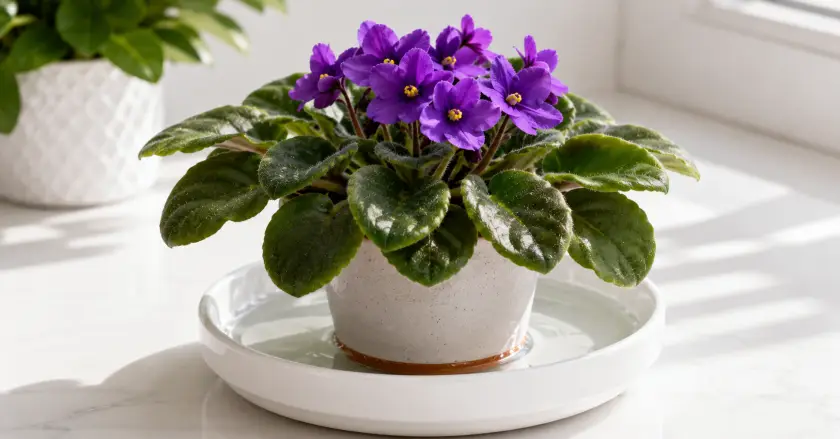
Watering is where most African violet care goes wrong — and the specific watering requirements of African violets differ significantly from most other houseplants. Understanding why they need bottom watering prevents the most common and damaging African violet care mistakes.
Why Bottom Watering is Essential
African violet leaves are densely covered with fine hairs. When cold water or any water contacts these hairs, it causes chlorophyll damage — resulting in the characteristic pale yellow or brown ring spots that appear on African violet leaves after top watering. Additionally, water pooling in the crown (the central growing point where leaves emerge) causes crown rot — one of the most common causes of African violet death.
Bottom watering completely eliminates both risks by delivering water to the roots without any contact with the leaves or crown.
How to Bottom Water African Violets
- Check the top inch of soil — water when it feels dry to the touch, typically every seven to ten days
- Fill a saucer or shallow container with room temperature water — never cold water directly from the tap
- Place the African violet pot in the water and allow to absorb for 20–30 minutes
- Remove the pot and allow to drain completely — do not allow the plant to sit in standing water after watering
- Return to its usual position
The water temperature is important — cold water causes the same leaf spotting as top watering splash. Allow tap water to reach room temperature before use, or use water that has been sitting overnight.
For broader watering guidance across all houseplant types, our complete guide to watering tips covers technique and frequency for different plant categories. Our signs you are overwatering guide helps identify overwatering symptoms specific to compact flowering plants like African violets.
How Often to Water African Violets
Most African violets need watering every seven to ten days in normal indoor conditions — more frequently in summer heat or very bright light, less frequently in winter or lower light. The soil moisture level is a more reliable guide than a fixed schedule — always check before watering rather than watering on a fixed calendar basis.
The soil should feel slightly moist at the root level but should never be soggy or waterlogged. Overwatering African violets causes root rot — covered in our root rot guide — which presents as limp, soft stems at the base, yellowing lower leaves, and a plant that wilts despite moist soil.
African Violet Care: Soil and Potting
African violets need a specific growing medium — their roots are fine and sensitive, requiring excellent aeration and drainage with some moisture retention. Standard potting compost is too dense and moisture-retaining for healthy African violet root development.
Best Soil Mix for African Violets
The ideal African violet growing medium is a lightweight, well-draining mix with good aeration. A purpose-formulated African violet compost is the simplest option — available from most garden centres. If making your own mix, combine equal parts standard potting compost, perlite (for drainage and aeration), and coarse vermiculite (for moisture retention without compaction).
The resulting mix should be light enough that water drains through it within seconds of application and should never compact into a solid mass when wet. Our best soil mix guide covers growing medium selection for different plant types including African violets and other compact flowering houseplants.
Pot Size and Type
African violets perform best in slightly small pots — a container roughly one third the diameter of the plant’s leaf span. Oversized pots hold excess moisture that is not absorbed by the relatively small root system, increasing root rot risk significantly.
Plastic pots retain moisture longer than terracotta, which suits African violets’ preference for even soil moisture. Self-watering pots are particularly well-suited to African violet care as they deliver water from below automatically — our self-watering pots guide covers their use and limitations in detail.
Always ensure pots have drainage holes — without drainage, bottom watering creates permanently waterlogged conditions that cause root rot.
African Violet Care: Temperature and Humidity
African violets are tropical plants that need consistent warmth and relatively high humidity — two conditions that reflect their native East African cloud forest habitat.
Temperature Requirements
The ideal temperature range for African violet care is 18–24°C — typical comfortable room temperature for most homes. African violets tolerate temperatures up to around 27°C but perform better at the lower end of this range. Temperatures below 15°C cause leaf damage, blackening of leaf edges, and complete cessation of flowering.
Cold draughts are particularly damaging — even brief exposure to cold air from an open window, air conditioning vent, or exterior door causes immediate leaf spotting and can trigger extended non-flowering periods. Site African violets away from all sources of cold air movement.
Humidity Requirements
African violets prefer humidity levels of 50–70% — significantly higher than typical indoor air in centrally heated homes in winter, which commonly falls to 30–40% humidity. Low humidity causes brown leaf edges, flower bud drop, and reduced flowering frequency.
The best way to increase humidity for African violets without wetting the leaves is a pebble humidity tray — a shallow tray of pebbles filled with water placed underneath the pot. As water evaporates from the tray surface it raises the local humidity around the plant without any water contacting the leaves. Our DIY humidity tray guide covers construction and use in detail.
Do not mist African violet leaves directly — the fuzzy leaf surface holds water droplets against the leaf, causing the same ring spotting as cold tap water contact. Our humidity hacks guide covers alternative humidity-raising methods suitable for African violets.
African Violet Care: Feeding
Feeding is essential for sustained African violet flowering — a plant that is not regularly fed will eventually exhaust the nutrients in its potting compost and reduce or stop flowering entirely.
What Fertiliser to Use
African violets need a high-phosphorus fertiliser specifically formulated for flowering plants — the NPK ratio should emphasise phosphorus (the middle number) over nitrogen. Phosphorus drives flower production; nitrogen drives leaf growth. Many standard houseplant fertilisers are nitrogen-heavy and will produce lush foliage at the expense of flowers in African violets.
Purpose-formulated African violet liquid fertiliser is the most convenient option. A balanced flowering plant fertiliser (such as 10-30-20 NPK or similar) also works well. For general guidance on feeding different plant types including flowering houseplants, our fertilising indoor vs outdoor plants guide covers fertiliser selection and application in detail.
Feeding Schedule
During the active growing season (spring through early autumn), feed African violets every two weeks at half the recommended dose — African violets are sensitive to fertiliser burn and respond better to regular light feeding than occasional heavy application. Reduce to monthly feeding in winter when growth naturally slows. Do not feed a dry plant — always water first, then feed after the plant has had time to absorb moisture.
African Violet Care: Repotting
African violets need repotting periodically but actually flower best when slightly rootbound — a plant with roots filling its pot redirects energy into flower production rather than root and leaf expansion. This means repotting should happen when clearly needed rather than on a fixed schedule.
When to Repot African Violets
Repot African violets when roots are visibly growing out of drainage holes, when the plant has developed a pronounced neck (a bare stem between the soil surface and the lowest leaves — caused by the lowest leaves dropping over time), or when the growing medium has deteriorated and no longer drains freely — typically every 12–18 months.
Our how to repot a plant guide covers the full repotting process. Our repotting mistakes guide covers the specific errors most common with compact flowering plants including choosing an oversized pot and repotting at the wrong time of year.
How to Deal with African Violet Neck
A pronounced neck — a bare stem section between the soil surface and the leaf rosette — is a common African violet care issue that develops as older lower leaves are removed over time. Correct it at repotting by setting the plant deeper in its new pot, burying the neck in fresh compost up to the base of the lowest leaves. The buried neck section produces new roots within a few weeks, refreshing the root system and improving the plant’s appearance.
African Violet Propagation
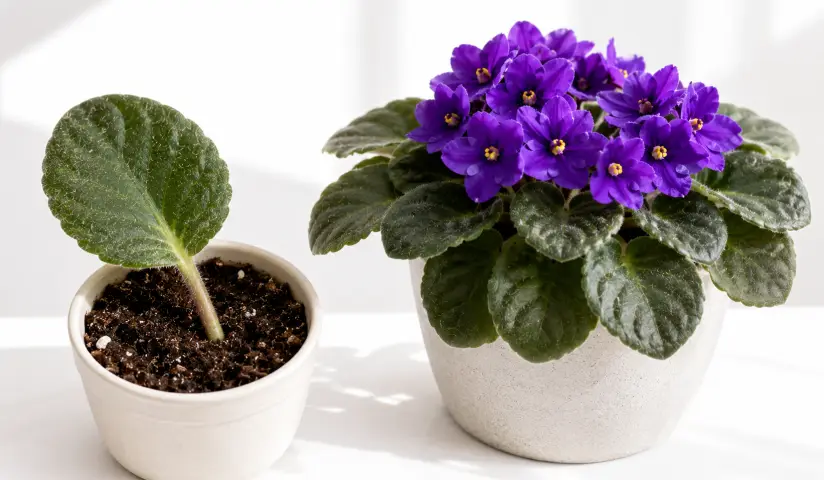
African violets are among the easiest houseplants to propagate — a single healthy leaf reliably produces a new plant within eight to twelve weeks. Propagation by leaf cutting is the standard method and requires no specialist equipment.
How to Propagate African Violets from Leaf Cuttings
- Select a healthy, mature leaf from the middle of the rosette — not the oldest outer leaves or the youngest central ones
- Cut the leaf stem at an angle, leaving approximately 3–4cm of stem attached
- Insert the stem into a small pot of moist African violet compost or a 50/50 mix of perlite and compost at a 45-degree angle
- Cover loosely with a clear plastic bag or place in a propagator to maintain humidity — do not seal completely
- Place in bright indirect light at 20–22°C — the same conditions as a mature African violet
- Small plantlets emerge at the base of the leaf stem within 6–8 weeks
- When plantlets have two or three leaves of their own, separate gently and pot individually into small pots of African violet compost
For more propagation guidance across different plant types, our how to propagate houseplants guide covers leaf cutting, stem cutting, and division methods in detail.
African Violet Care Problems: Troubleshooting
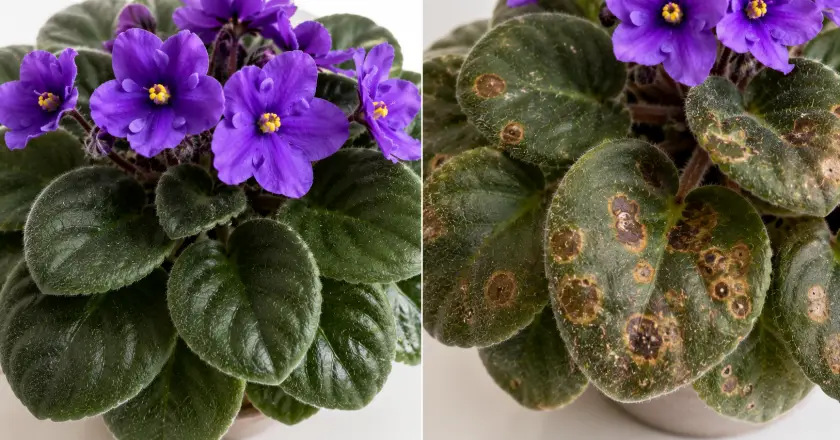
Most African violet care problems are caused by one of a handful of correctable issues. Identifying the cause correctly is the key to effective treatment.
African Violet Not Flowering
The most common African violet care problem. Causes in order of likelihood:
- Insufficient light: The most common cause — move to a brighter indirect light position
- Wrong fertiliser: High-nitrogen feed produces leaves not flowers — switch to high-phosphorus African violet fertiliser
- Too rootbound: Severely rootbound plants can stop flowering — repot into a slightly larger container
- Temperature too low: Consistent temperatures below 18°C reduce or stop flowering — move to a warmer position
- Age of plant: Very old plants sometimes reduce flowering — rejuvenate by taking leaf cuttings and starting fresh plants
Our 23 blooming indoor plants guide covers the flowering requirements of African violets alongside other compact indoor bloomers.
Brown Spots on African Violet Leaves
Ring-shaped brown or pale yellow spots on African violet leaves almost always indicate cold water contact — water splashed on the leaves during top watering, cold misting, or cold draughts hitting damp leaves. Switch to consistent bottom watering with room temperature water. Affected leaves do not recover but new growth will be spot-free once the cause is corrected. Our leaf curl, browning and droop guide covers all leaf spot types and their causes.
African Violet Leaves Turning Yellow
Yellowing African violet leaves indicate overwatering, insufficient light, or nutrient deficiency. Check soil moisture — if consistently wet, reduce watering frequency and ensure drainage is adequate. Check the light position — a plant in too little light develops pale yellow-green leaves before losing leaves entirely. If watering and light are correct, begin a regular feeding programme. Our why plant leaves turn yellow guide covers full diagnosis.
African Violet Leaves Wilting or Limp
Limp, soft, or collapsed leaves despite moist soil indicate root rot — caused by overwatering or poor drainage. Remove from the pot, inspect roots, cut away any brown mushy roots with clean scissors, repot into fresh African violet compost, and reduce watering frequency significantly. Our root rot guide covers full treatment. If leaves wilt despite dry soil — simply water using the bottom watering method described above.
African Violet Crown Rot
Crown rot — soft, blackening tissue at the central growing point — is caused by water sitting in the crown, typically from top watering. It is often fatal. If caught early, carefully remove all rotted tissue with a clean knife, dust with cinnamon (a natural antifungal), allow to dry for 24 hours, and repot. Prevention — consistent bottom watering — is far more effective than treatment.
African Violet Pests
African violets are susceptible to mealybugs (white cottony deposits at leaf joints and on stem bases), cyclamen mites (causing distorted, small, and densely clustered new growth), and occasionally thrips (causing silvery streaking on flowers and leaves). Mealybugs respond well to isopropyl alcohol applied with a cotton bud. Cyclamen mites are more difficult to treat — affected leaves should be removed and the plant isolated immediately. Our plants that keep bugs away guide covers broader pest prevention strategies. Our pest management guide covers treatment approaches for common houseplant pests.
African Violet Leaves Curling
Downward-curling leaves indicate cold draughts, overwatering, or cyclamen mite damage. Upward-curling leaves suggest the plant is receiving too much direct light. Identify the cause from the context — check temperature and light position first before treating for pests. Our leaf curl guide covers all curling scenarios in detail.
African Violet Care: Seasonal Adjustments
African violet care requires minor seasonal adjustments to maintain year-round flowering performance.
Spring and summer: Move African violets slightly away from south-facing windows as light intensity increases to prevent scorching. Increase watering frequency as warmer temperatures dry the compost faster. Increase feeding frequency to every two weeks. Watch for pests — warmer temperatures accelerate pest development. Our garden calendar 2026 covers seasonal houseplant care tasks month by month.
Autumn and winter: Central heating reduces humidity significantly — ensure the pebble tray is kept topped up. Reduce feeding to monthly. Monitor light levels — shorter days may necessitate supplementary grow lighting to maintain flowering. Keep well away from cold windowpanes and draughts. Our humidity hacks guide covers winter humidity management.
African Violet Care: Display and Styling
African violets suit a wide range of indoor display positions — their compact size makes them versatile and their near-continuous flowering provides consistent colour in positions where most plants offer only foliage interest.
They work particularly well on east or north-facing windowsills, on plant shelves with grow lighting, as desk plants in home offices and workplaces, and in bathroom positions with adequate indirect light where the naturally higher humidity suits their requirements. Our how to style indoor plants by room guide covers display strategies for different room types including positions that suit African violets. Our improve home office with plants guide covers desk and workspace plant choices including compact flowering varieties.
African violets also work beautifully in bedroom positions — their quiet presence and year-round flowering make them among the most rewarding bedroom plants available. Our bedroom plants guide covers the best plants for bedroom display including African violets.
For the best office desk plants including African violets, our 35 best office plants guide covers the full range of suitable compact plants for workplace environments. For bathroom plant displays where the humidity suits African violet care, our 33 best plants for your bathroom guide covers the full range of bathroom-suitable plants.
Are African Violets Safe for Pets?
African violets are listed as non-toxic to humans. Regarding pets, they are considered mildly irritating to cats and dogs if ingested — not severely toxic but potentially causing mild stomach upset. Position African violets out of reach of pets as a precaution, particularly cats who may be attracted to the fuzzy leaf texture. Our cat-friendly plants guide and dog-friendly plants guide cover pet-safe plant selection in detail for households with animals.
Article Summary
| Care Factor | African Violet Requirements |
|---|---|
| Light | Bright indirect — east or north-facing window, never direct sun |
| Watering | Bottom water with room temperature water when top inch is dry — every 7–10 days |
| Temperature | 18–24°C — no cold draughts, never below 15°C |
| Humidity | 50–70% — pebble tray, never mist leaves directly |
| Soil | African violet compost or lightweight perlite-enriched mix |
| Feeding | High-phosphorus fertiliser every 2 weeks spring–autumn, monthly winter |
| Repotting | Every 12–18 months when rootbound — pot one size up only |
| Propagation | Leaf cuttings in moist compost — plantlets in 6–8 weeks |
| Common problems | Brown spots (cold water), not flowering (light/feeding), root rot (overwatering) |
| Pet safety | Mildly irritating to cats and dogs — keep out of reach |
Related Guides
- 23 Blooming Indoor Plants to Brighten Your Home
- Best Indoor Plants for Beginners
- Complete Guide to Watering Tips
- Signs You Are Overwatering
- What Is Root Rot?
- How to Propagate Houseplants
- Leaf Curl, Browning and Droop Guide
- Why Plant Leaves Turn Yellow
- Humidity Hacks Guide
- Best Soil Mix Guide
- How to Repot a Plant
- 33 Best Plants for Your Bathroom
Final Thoughts
African violet care rewards patience and consistency more than complexity. Once the specific requirements are understood — bottom watering, bright indirect light, consistent warmth, regular high-phosphorus feeding — these remarkable plants almost care for themselves, producing near-continuous flowers through every season of the year.
A well-tended African violet is one of the most satisfying houseplants to grow — compact enough for the smallest windowsill, colourful enough to brighten the darkest winter day, and long-lived enough to become a genuine fixture in a home over many years. Few flowering houseplants offer this combination of low footprint, reliable performance, and genuine beauty.
According to the Royal Horticultural Society, African violets remain one of the most popular and widely grown flowering houseplants worldwide — their combination of near-continuous flowering, compact size, and wide colour range making them uniquely suited to modern indoor plant keeping.
Bottom water consistently. Give them bright indirect light. Feed every two weeks. And enjoy one of the most reliably beautiful flowering plants available for indoor growing.
Frequently Asked Questions
How do you care for African violets indoors?
African violet care indoors requires bright indirect light on an east or north-facing windowsill, bottom watering with room temperature water every seven to ten days, temperatures of 18–24°C, high humidity from a pebble tray, and feeding every two weeks with a high-phosphorus fertiliser during the growing season. Avoid cold draughts, direct sun, and any water contact with the leaves or crown.
How often should African violets be watered?
Water African violets every seven to ten days using the bottom watering method — place the pot in room temperature water for 30 minutes, then drain completely. Check the soil before watering — water when the top inch feels dry. Never pour water onto leaves or into the crown. Our complete watering guide covers bottom watering technique in detail.
Why is my African violet not blooming?
The most common reasons African violets stop blooming are insufficient light, incorrect feeding (too much nitrogen), being severely rootbound, or temperatures consistently below 18°C. Move to a brighter indirect light position, switch to a high-phosphorus African violet fertiliser, and check whether repotting is needed. Our 23 blooming indoor plants guide covers flowering requirements for African violets alongside other indoor bloomers.
Are African violets easy to care for?
African violets are moderately easy to care for once their specific requirements are understood. Bottom watering, indirect bright light, consistent warmth, and regular phosphorus-rich feeding are simple to provide consistently. The most common care mistakes — top watering, cold draughts, and insufficient light — are all easily avoided once you know what to watch for.
Can African violets grow outdoors?
African violets are tender tropical plants that cannot tolerate frost or temperatures below 10°C. In temperate climates they are grown as permanent indoor houseplants. In very warm, frost-free climates they can be grown outdoors in deep shade but perform best and most reliably as indoor plants. For outdoor flowering plant options, our pollinator-friendly plants guide covers a wide range of outdoor flowering plants suited to different conditions.