A successful carnivorous plant terrarium setup begins with understanding the unusual needs of insect-eating plants. Sundews, butterworts, pitcher plants, and Venus flytraps may look perfect together in a glass container, but they do not all require the same water levels, lighting, temperature, or seasonal care.
The good news is that beginners can create an attractive indoor carnivorous garden without expensive equipment. Choosing compatible plants, using low-mineral water, selecting the correct growing medium, and providing suitable lighting are more important than decorative stones or a complicated glass enclosure.
However, one common mistake can ruin an otherwise beautiful terrarium: treating every carnivorous plant like a permanently wet tropical bog plant. Some species need constantly moist roots, others prefer airy substrates, and temperate species may require a cool winter dormancy period.
This carnivorous plant terrarium setup guide explains nine practical steps for building your first display. You will also learn which plants to choose, how to maintain moisture and airflow, whether to feed insects, and how to avoid mold, mineral buildup, and damaged traps.
How Do You Set Up a Carnivorous Plant Terrarium?
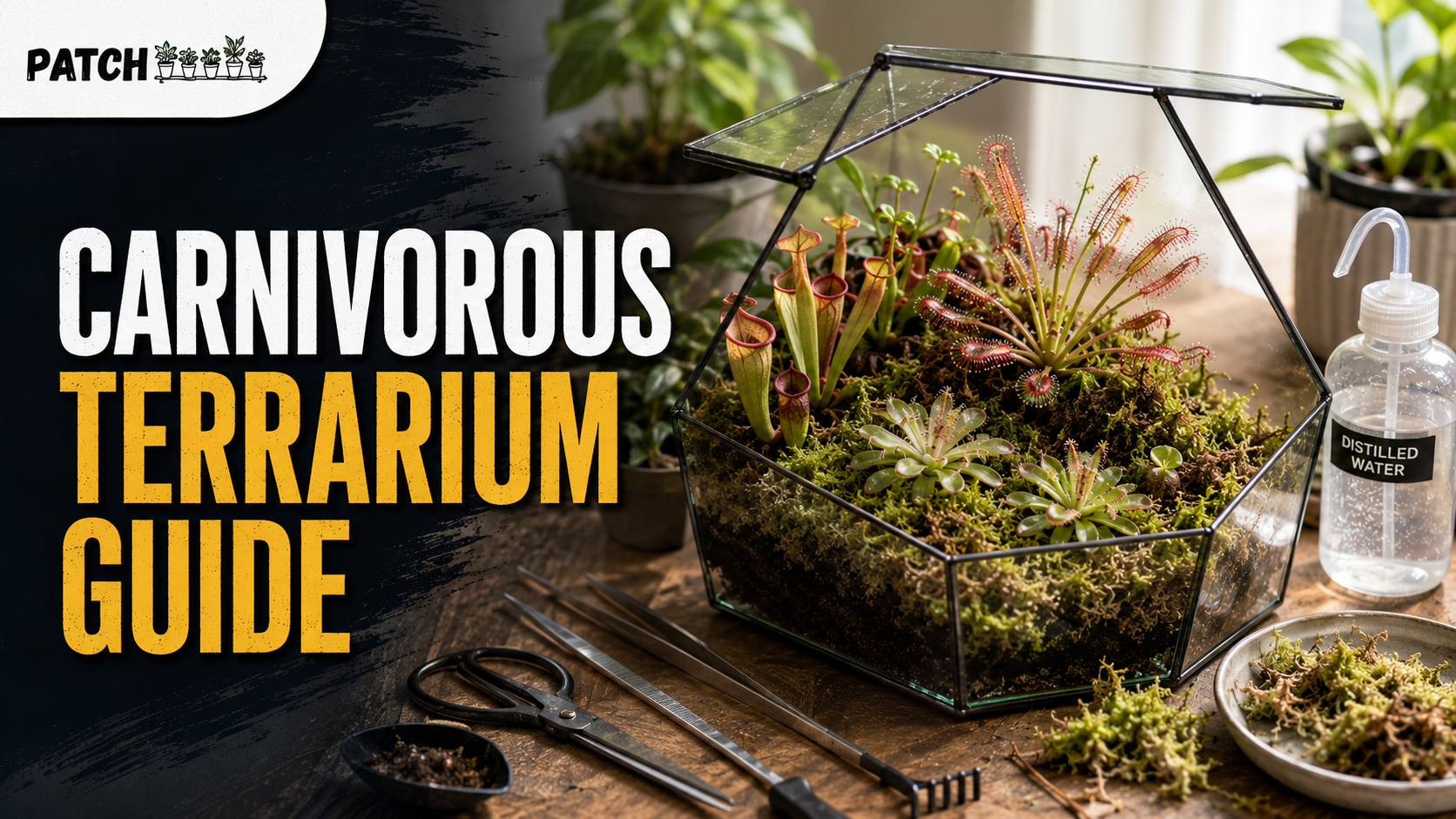
To set up a carnivorous plant terrarium, choose an open or ventilated container, select compatible species, prepare an appropriate nutrient-poor growing medium, moisten it with distilled or reverse-osmosis water, plant carefully, provide adequate light, and maintain the correct moisture level for each species.
For a first project, a ventilated display containing a few individual pots is often easier to manage than planting several unrelated species directly into one shared substrate.
A Cape sundew, Drosera capensis, is a practical beginner choice. Selected tropical sundews and bladderworts can also work, while Mexican butterworts may need a separate, better-drained planting area. Small tropical pitcher plants can be displayed in ventilated environments but should not be kept permanently waterlogged.
Venus flytraps and many temperate pitcher plants need seasonal dormancy, so they are usually better suited to appropriately managed pots or outdoor bog-style containers than permanently warm decorative terrariums.
For general growing principles, consult the Royal Horticultural Society carnivorous plant growing guide.
Key Takeaways
- Choose compatible species before selecting a container or growing medium.
- A beginner carnivorous plant terrarium should provide suitable light, low-mineral water, appropriate substrate, and manageable airflow.
- Cape sundews are among the more forgiving starter plants for bright indoor displays.
- Some butterworts need a mineral-rich but low-nutrient growing medium and drier seasonal conditions rather than constantly saturated bog soil.
- Tropical pitcher plants such as Nepenthes generally need an airy root environment and should not sit in deep standing water.
- Venus flytraps and temperate Sarracenia usually require seasonal dormancy.
- Distilled water, suitable collected rainwater, and reverse-osmosis water are reliable choices for mineral-sensitive species.
- Normal potting soil, fertilizer-enriched compost, and ordinary houseplant feeding routines are unsuitable for most carnivorous plants.
- Glass containers can overheat in direct sunlight, so lighting and temperature must be managed together.
- Plants generally do not need regular manual insect feeding when they receive suitable light and growing conditions.
- Regular inspection for mold, damaged traps, water quality, and overcrowding helps keep displays healthy.
What Is a Carnivorous Plant Terrarium?
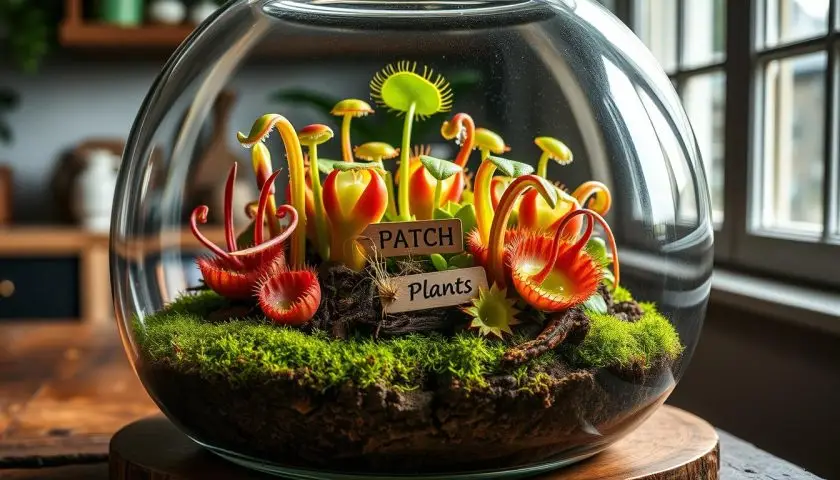
A carnivorous plant terrarium is an indoor growing display designed for plants that capture and digest small prey.
It may use a glass container, open aquarium, ventilated enclosure, or collection of pots placed together within a decorative display.
Some growers use enclosed systems to maintain humidity, while others successfully grow carnivorous plants in open trays or near bright windows.
The best arrangement depends on the plants themselves.
A true terrarium does not have to be completely sealed. For beginners, an open or ventilated container makes it easier to monitor moisture, remove dead foliage, and prevent overheating.
However, a closed container is not automatically unsuitable for every species. Certain tropical plants can grow in carefully managed enclosed environments when light, temperature, condensation, and disease risks are controlled.
Why Are Carnivorous Plants Different From Ordinary Houseplants?
Carnivorous plants evolved specialised structures that help them obtain nutrients from captured organisms.
Many come from habitats where mineral nutrients in the growing medium are limited.
For example, sundews catch prey using sticky tentacles, Venus flytraps have snap traps, and pitcher plants use modified leaves that trap small animals.
Capturing prey supplements their mineral nutrition.
However, they still obtain energy through photosynthesis and require appropriate light, water, and root conditions.
This is why adding more insects cannot compensate for insufficient lighting.
The International Carnivorous Plant Society’s guide to digestion explains how different carnivorous plants break down prey and absorb nutrients.
Essential Supplies for a Carnivorous Plant Terrarium
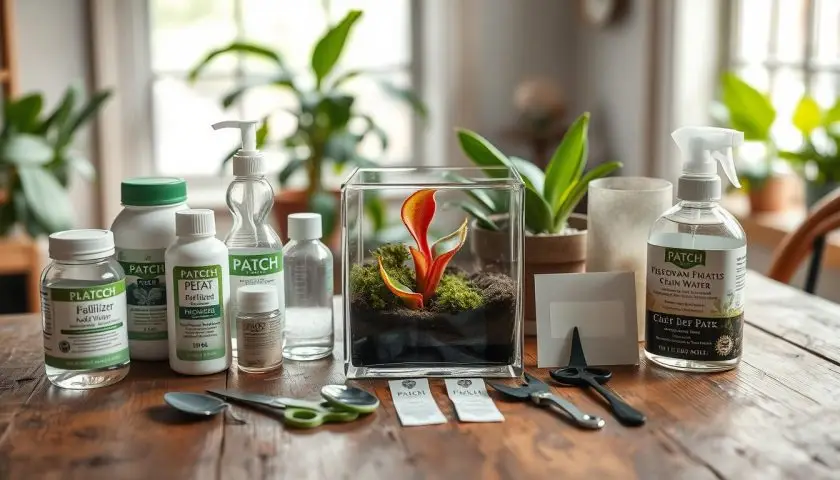
Gather the right materials before planting. A simple setup using a few suitable plants is easier to maintain than a crowded display containing incompatible species.
| Supply | Purpose | Recommended Beginner Choice |
|---|---|---|
| Container | Holds or displays plants | Open aquarium or ventilated terrarium |
| Individual pots | Allow different moisture requirements | Clean plastic pots with drainage holes |
| Water | Maintains root-zone moisture | Distilled, reverse-osmosis, or suitable rainwater |
| Growing medium | Supports roots without excessive nutrients | Species-appropriate carnivorous plant mix |
| Plants | Creates the living display | Compatible beginner-friendly species |
| Lighting | Supports photosynthesis and trap development | Suitable grow light or sufficiently bright window |
| Water tray | Supplies moisture to suitable bog plants | Shallow tray with manageable water level |
| Tools | Allows careful planting and maintenance | Clean tweezers, scissors, and small scoop |
| Thermometer | Helps identify dangerous heat buildup | Small indoor thermometer |
Important: Not every item is necessary for every plant. For example, Nepenthes may be grown in an airy potting medium without the standing-water tray used for many bog-growing sundews.
Best Carnivorous Plants for Terrariums
Plant selection is the most important part of the project.
The five groups below appear frequently in carnivorous plant collections, but their individual species have different growing requirements.
1. Tropical and Subtropical Sundews
Botanical group: Drosera species.
Sundews produce leaves covered with specialised glands that release sticky droplets. Small insects become trapped when they contact these surfaces.
Several subtropical species are popular with beginners because they can grow under suitable indoor lights without a cold winter dormancy.
Cape sundew, Drosera capensis, is a particularly useful starter plant.
Other species sometimes grown in terrariums include Drosera spatulata and Drosera aliciae.
- Light: Bright light, appropriate to the species.
- Water: Low-mineral water; many common bog-growing sundews prefer consistently moist media.
- Medium: Suitable unfertilized carnivorous plant substrate.
- Humidity: Moderate to high, depending on species and acclimatization.
- Dormancy: Cape sundew does not normally require a cold winter dormancy.
- Best use: Beginner terrariums and bright indoor growing trays.
Care tip: Healthy sundews often produce glistening mucilage, but temporary loss of dew can occur after repotting or during environmental stress.
Do not assume that humidity alone will fix a sundew that is receiving inadequate light.
The International Carnivorous Plant Society’s growing environments guide provides further indoor growing ideas.
2. Butterworts
Botanical group: Pinguicula species and hybrids.
Butterworts produce rosettes of leaves covered in sticky secretions that capture small insects.
They are attractive plants for compact indoor displays and some produce colourful flowers.
However, butterworts are not all identical.
Mexican butterworts, cold-temperate butterworts, and other species can have very different growing cycles.
Some Mexican species grow in relatively mineral-rich habitats, including limestone environments, and may produce smaller succulent-like leaves during a seasonal resting period.
- Light: Bright indirect light or appropriate gentle sun.
- Water: Depends strongly on species and seasonal growth phase.
- Medium: Often a more open, mineral-containing mix for Mexican varieties.
- Humidity: Suitable humidity with adequate airflow.
- Dormancy: Certain species have a drier succulent phase; temperate types may require winter rest.
- Best use: Small separate pots within a terrarium display.
Care tip: Do not automatically place Mexican butterworts in the same permanently saturated substrate used for bog-growing sundews.
UC Davis Botanical Conservatory explains the different cultural requirements of butterworts, including seasonal changes in some Mexican species.
3. Small Tropical Pitcher Plants
Botanical group: Nepenthes species and hybrids.
Tropical pitcher plants develop specialised leaves with hanging pitcher-shaped traps.
These plants can make a striking display in a larger ventilated enclosure.
However, many Nepenthes eventually produce long vines and can outgrow a small tabletop terrarium.
They generally need an airy root environment and should not be treated like permanently flooded bog plants.
- Light: Bright filtered light, depending on species.
- Water: Low-mineral water; keep the medium suitably moist without constant saturation.
- Medium: Airy, nutrient-poor substrate appropriate for the species.
- Humidity: Often benefits from moderate to high humidity.
- Temperature: Depends on whether the plant is a highland, intermediate, or lowland type.
- Best use: Larger ventilated display or hanging pot.
Care tip: Select a beginner-friendly species or hybrid and research its mature size before placing it in a terrarium.
North Carolina State Extension recommends suitable easy-to-grow Nepenthes hybrids for indoor cultivation.
4. Bladderworts
Botanical group: Utricularia species.
Bladderworts are unusual carnivorous plants that capture tiny prey using specialised bladder traps.
Terrestrial species can grow through suitable moist substrates, often producing delicate flowers above the surface.
They may be attractive additions to a compatible carnivorous plant display.
However, aquatic, terrestrial, and epiphytic bladderworts have very different growing requirements.
- Light: Depends on species.
- Water: Many terrestrial types need consistently moist conditions.
- Medium: Suitable low-nutrient substrate for the selected species.
- Humidity: Species-specific.
- Best use: Specialist or mixed displays with compatible plants.
Care tip: Choose a specific terrestrial species rather than purchasing an unidentified bladderwort for a general terrarium.
5. Venus Flytraps
Botanical name: Dionaea muscipula.
Venus flytraps are famous for their snap traps, which close when trigger hairs are stimulated in the correct sequence.
They are popular with beginners, but they are not the easiest long-term choice for a warm indoor terrarium.
Venus flytraps need strong light, low-mineral water, suitable growing media, and a seasonal period of dormancy.
Constant warmth and an unchanging indoor growing environment may interfere with their normal annual cycle.
- Light: Strong light, with suitable sun or effective grow lighting.
- Water: Low-mineral water; maintain appropriate growing-season moisture.
- Medium: Unfertilized carnivorous plant growing mix.
- Dormancy: Requires an appropriate cool seasonal rest.
- Best use: Managed open bog containers or suitably maintained pots.
Care tip: Do not repeatedly trigger traps for entertainment. Trap closure has a physiological cost, and repeated unnecessary triggering can reduce useful trap activity.
See the NC State Extension Venus flytrap profile for additional growing requirements.
Which Carnivorous Plants Can Grow Together?
| Plant | Water Needs | Seasonal Rest | Beginner Terrarium Suitability |
|---|---|---|---|
| Cape sundew | Consistently moist | No cold dormancy normally needed | Good starting choice |
| Other tropical sundews | Species-specific | Varies | Choose carefully |
| Mexican butterwort | Moisture varies with growth phase | Some have drier succulent phase | Better in separate pot |
| Terrestrial bladderwort | Often consistently moist | Species-specific | Suitable with compatible species |
| Nepenthes | Moist but airy roots | No typical cold bog dormancy | Better in separate pot or large enclosure |
| Venus flytrap | Moist during growth | Cool winter dormancy required | Not ideal for permanent warm terrarium |
| Temperate Sarracenia | Moist bog conditions during growth | Seasonal dormancy required | Usually better in outdoor bog-style pot |
Beginner recommendation: If you want to grow more than one type, start with separate pots placed together in a ventilated display. This allows you to adjust watering and replace growing media without disturbing every plant.
9 Easy Steps for a Carnivorous Plant Terrarium Setup
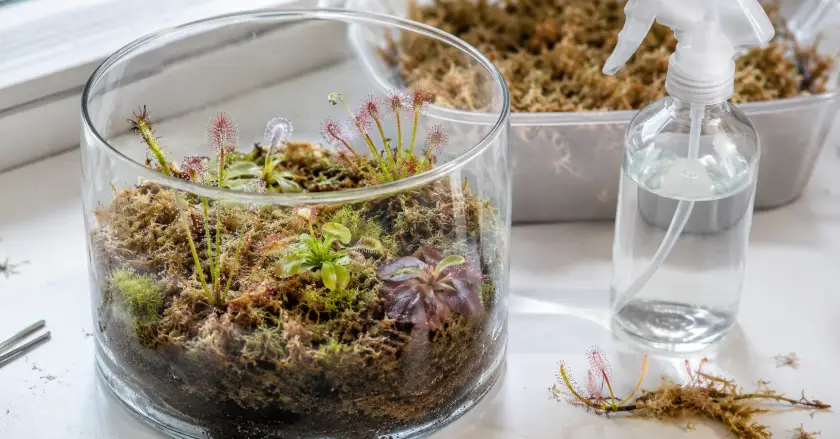
Step 1: Choose Compatible Carnivorous Plants
Start by choosing the plants you want to grow.
For a beginner, one or two Cape sundews can make an attractive project without introducing conflicting care requirements.
If you want multiple species, compare their light, water, temperature, and dormancy needs.
Avoid placing tropical Nepenthes, a Mexican butterwort, and a Venus flytrap directly into one shared saturated substrate.
Step 2: Select an Open or Ventilated Container
Choose a glass bowl, aquarium, or terrarium with enough room for plant growth and access for maintenance.
An open container is often easier for beginners to manage because it allows better temperature control and inspection.
Ventilated enclosures can also work where humidity-loving species require additional protection from dry indoor air.
Do not place a glass container in intense direct sunlight without monitoring internal temperatures.
The glass may retain heat and cause damaging temperature increases.
Step 3: Decide Between Individual Pots and a Shared Planting Bed
Individual pots: Best when plants have different watering requirements or when you are still learning their needs.
Shared planting bed: Suitable when all selected plants have compatible root-zone and seasonal requirements.
For most beginners, removable pots offer greater flexibility.
They also make repotting, inspecting roots, and managing pests easier.
Step 4: Prepare the Correct Growing Medium
Carnivorous plants generally need growing media that supply relatively few mineral nutrients.
Suitable options for particular species may include unfertilized sphagnum moss, specialist carnivorous plant mixes, silica sand, and other carefully selected ingredients.
However, no single mix is ideal for all carnivorous plants.
For example, bog-growing sundews often prefer moisture-retaining media, while Mexican butterworts may benefit from a more mineral-based mix that drains well.
Nepenthes typically require a more open substrate with good root aeration.
Do not use ordinary nutrient-rich potting soil, compost, manure, or fertilizer-enriched garden mix.
The Royal Horticultural Society also describes specialist peat-free carnivorous plant growing media, including sustainably produced sphagnum-based options.
Step 5: Moisten the Medium With Low-Mineral Water
Use distilled water, reverse-osmosis water, or suitable collected rainwater.
Mineral-heavy tap water can gradually introduce unwanted dissolved salts into the growing medium.
Boiling tap water does not reliably remove its dissolved mineral content.
Moisten the growing medium to the level appropriate for your chosen plants.
For bog-growing sundews, the mix may need to remain consistently damp.
For other species, the root zone must stay moist without remaining waterlogged.
Step 6: Plant Carefully Without Burying Crowns
Handle plants gently, especially those with delicate leaves, traps, or roots.
Position the plant at an appropriate planting depth and avoid burying the growing point beneath heavy moss or compacted substrate.
If using separate pots, keep them stable and leave enough room to remove them for maintenance.
Do not crowd the container simply to create a full-looking display immediately.
Step 7: Add Suitable Moss and Minimal Decoration
Sphagnum moss may be useful for suitable species, but it should not cover crowns or sensitive traps.
Decorative materials must not release unwanted minerals or chemicals into the growing medium.
Avoid fertilized moss products, painted gravel, and unidentified materials that may alter water chemistry.
Remember that decorations are optional. Healthy plants provide most of the visual interest.
Step 8: Install Suitable Lighting
Place the terrarium where the plants receive adequate light without overheating.
A suitable grow light can provide more controllable lighting than a distant window.
Lighting duration and intensity depend on the species and whether it requires a seasonal rest.
For many actively growing tropical indoor carnivorous plants, a consistent daily grow-light period of approximately 12 to 14 hours may be a useful starting point, adjusted according to plant response and equipment.
Do not apply this year-round schedule to temperate species that require seasonal dormancy.
Use our complete indoor light guide for general lighting principles.
Step 9: Establish a Monitoring and Maintenance Routine
After planting, observe the terrarium rather than repeatedly changing the environment.
Check moisture, trap condition, new growth, airflow, and temperature.
Remove decaying plant material when appropriate.
Watch for mold and overcrowding, and adjust growing conditions if problems persist.
Healthy plants may take time to adapt after repotting or being moved into a new growing environment.
Open vs Closed Carnivorous Plant Terrariums
| Feature | Open or Ventilated | Closed or Mostly Sealed |
|---|---|---|
| Air circulation | Usually easier to maintain | May require active monitoring or ventilation |
| Humidity | Closer to room conditions | Often remains higher |
| Watering | Usually easier to inspect | Moisture can accumulate |
| Temperature | Generally easier to control | Can rise quickly under strong light |
| Mold risk | Often easier to manage | May increase when conditions remain stagnant |
| Best for | Beginners and adaptable species | Carefully selected humidity-loving plants |
Practical recommendation: Start with an open or ventilated terrarium unless you have selected species with specific reasons for requiring a more enclosed environment.
Even an open terrarium still needs adequate light and species-appropriate watering.
Best Soil for Carnivorous Plant Terrariums
Growing media affect root aeration, moisture retention, mineral exposure, and plant stability.
Different carnivorous plants evolved in different environments, so choosing the right substrate is essential.
Sphagnum Moss
Sphagnum moss is used for many carnivorous plants because it can hold moisture while providing a fibrous structure.
Use clean, suitable material from a reliable source.
Sustainably produced sphagnum may also form part of a peat-free carnivorous plant mix.
Sphagnum Peat-Based Mixes
Some traditional growing mixes contain unfertilized sphagnum peat with suitable sand or perlite.
However, peat extraction has environmental consequences, and gardeners can consider suitable peat-free alternatives.
Always match the product to the actual plant.
Silica Sand and Other Inert Materials
Appropriately prepared silica sand can help alter drainage and structure in certain mixes.
Do not use builder’s sand, unknown decorative gravel, or materials that may contain unwanted salts or reactive minerals without checking suitability.
Mexican Butterwort Substrates
Some Mexican butterworts prefer a more mineral-based substrate than typical bog plants.
Their medium should allow moisture control and adequate root aeration.
Species-specific requirements may include a seasonal reduction in watering when succulent-like leaves develop.
Nepenthes Substrates
Many Nepenthes benefit from airy growing media that retain some moisture but do not remain saturated.
Use a mix recommended for the selected species or hybrid rather than treating a Nepenthes pot as an aquatic bog container.
Watering Carnivorous Plants Correctly
Water quality is one of the most important factors in successful carnivorous plant care.
Which Water Is Best?
Distilled water, reverse-osmosis water, and clean collected rainwater are reliable options for many mineral-sensitive species.
If you want to use tap water, test its dissolved mineral content and confirm that the level is suitable for the exact plant.
Do not assume water becomes mineral-free after boiling, leaving it overnight, or filtering it through an ordinary household taste filter.
Should Carnivorous Plants Sit in Water?
Some bog-growing plants, including many common sundews, can be grown with a shallow tray of appropriate water during active growth.
Other species do not respond well to continuously saturated roots.
Nepenthes and many Mexican butterworts require different watering approaches.
For a mixed display, separate pots allow individual water management.
How Often Should You Water?
There is no universal daily or weekly schedule.
Check the growing medium and consider temperature, light, container size, airflow, and plant species.
Bog-growing species may need continuous moisture, while plants with a seasonal resting phase may require less water.
Our complete plant watering guide explains the principles of moisture management.
Lighting Requirements for Carnivorous Plant Terrariums
Many carnivorous plants require more light than beginners expect.
Insufficient light can lead to weak growth, reduced trap production, or poor coloration.
Natural Window Light
A bright window may be suitable for some species.
However, glass containers can trap heat when exposed to intense direct sunlight.
Monitor the temperature inside the enclosure, especially during warm weather.
LED Grow Lights
A properly selected LED grow light can help provide predictable lighting indoors.
Follow the manufacturer’s recommended height and operating duration.
Too little light may limit growth, while excessive intensity or heat can damage foliage.
Recognizing Light Problems
Possible signs of inadequate light include weak elongated growth, reduced trap colour, or fewer pitchers.
Scorched leaves and overheating may indicate excessive intensity or poor temperature control.
Different species show stress in different ways, so diagnose the growing environment as a whole.
Temperature, Humidity and Airflow
Temperature
The correct temperature depends on the plant’s original habitat.
Tropical species may need warmth, while temperate species require seasonal cooling.
Some Nepenthes prefer different daytime and nighttime temperatures, particularly highland varieties.
Choose plants that suit the temperature conditions you can realistically maintain.
Humidity
Higher humidity may support suitable tropical carnivorous plants.
However, high humidity is not a universal solution to every growing problem.
Some adaptable species grow well in ordinary indoor conditions when acclimatized properly.
Airflow
Air movement can help reduce stagnant conditions and allow foliage to dry appropriately.
Good airflow is particularly helpful where high humidity and dead organic material increase fungal risks.
Do not use strong fans that dry out sensitive plants excessively.
Do Carnivorous Plants Need to Eat Insects?
Carnivorous plants capture prey to obtain additional nutrients, but they do not need to be fed daily.
Plants with healthy traps may catch small insects on their own.
Some indoor plants can remain healthy for long periods without frequent manual feeding when they receive suitable light and growing conditions.
Can You Feed Them Insects?
Species-specific supplemental feeding may be possible, but it should be approached cautiously.
Use only appropriate prey and avoid feeding damaged or inactive traps.
Do not overfeed or place oversized insects into small traps.
Can You Feed Them Meat or Human Food?
No. Do not use hamburger, cheese, cooked meat, or household food scraps.
These materials are unsuitable for normal carnivorous plant feeding and may decay.
Should You Use Regular Houseplant Fertilizer?
For beginners, do not apply ordinary houseplant fertilizer to carnivorous plant roots or add fertilizer-enriched potting media.
Some experienced growers use carefully controlled specialist feeding techniques for certain species, but those methods are not necessary for this beginner setup.
The RHS carnivorous plant guide recommends avoiding ordinary additional fertilization for most species.
Understanding Carnivorous Plant Dormancy
Dormancy is a period when a plant slows or temporarily stops active growth in response to seasonal environmental changes.
Not all carnivorous plants have the same dormancy cycle.
Venus Flytrap Dormancy
Venus flytraps require seasonal rest under appropriately cooler conditions and changing daylight.
Keeping them permanently warm with unchanged lighting can interfere with healthy long-term development.
Plan for the dormant season before purchasing one for an indoor display.
Temperate Pitcher Plant Dormancy
Many Sarracenia species also follow an annual dormancy cycle.
They are often easier to manage in appropriate outdoor bog-style pots or cool growing spaces than in a permanently warm tropical terrarium.
Tropical Sundews
Cape sundew usually does not need a cold winter dormancy and can remain active in suitable indoor growing conditions.
However, not every sundew is tropical or follows the same growth cycle.
Mexican Butterwort Seasonal Changes
Some Mexican butterworts form compact succulent-like rosettes during a seasonal drier period.
When this occurs, watering requirements may change substantially.
Check the exact species rather than treating every butterwort as a constantly wet bog plant.
Common Carnivorous Plant Terrarium Problems
| Problem | Possible Cause | What to Check |
|---|---|---|
| Mold on medium or dead leaves | Stagnant moisture, decaying material, or poor airflow | Ventilation and cleanliness |
| Sundew loses sticky droplets | Light, humidity, water, or transplant stress | Actual growing conditions |
| Brown traps | Natural ageing, environmental stress, or other problems | New growth and root conditions |
| Nepenthes stops forming pitchers | Low light, unsuitable humidity, or temperature stress | Species-specific growing requirements |
| Leaves stretch toward the light | Possibly insufficient lighting | Grow-light intensity and positioning |
| Plants decline after tap-water use | Possible mineral accumulation | Water quality and growing-medium condition |
| Butterwort rosette changes shape | Possible normal seasonal growth change | Species and rest cycle |
| Venus flytrap slows in winter | Possible normal dormancy | Seasonal conditions and rhizome health |
| Green algae develops | Persistent moisture and light | Surface conditions and water management |
| Plant crown rots | Excess moisture, unsuitable substrate, or disease | Planting depth, drainage, and root health |
How to Prevent Mold
Remove dead plant material, avoid unnecessary crowding, and maintain suitable ventilation.
If mold continues to spread, check whether the medium remains excessively wet for the chosen species.
Do not apply general household fungicides without confirming that the product is appropriate for the plant and growing environment.
What Causes Brown Traps?
Individual traps naturally age and eventually die.
However, widespread browning can also indicate problems with heat, water quality, root conditions, light, or disease.
Look for healthy new growth and assess the overall condition of the plant.
Why Is My Sundew Not Producing Dew?
Possible causes include inadequate light, environmental stress, dry conditions, or recent transplanting.
Some species may require specific humidity and temperature conditions.
Do not assume misting alone will solve the issue.
Why Are My Pitcher Plants Not Producing Pitchers?
Nepenthes may stop producing pitchers when light, humidity, temperature, or general growing conditions are unsuitable.
Plants may also need time to adjust after moving to a new environment.
Check the exact species or hybrid before changing conditions.
For general plant recovery advice, explore our plant rescue guide.
Carnivorous Plant Terrarium Maintenance Checklist
| Task | When to Check | Why It Matters |
|---|---|---|
| Growing-medium moisture | Regularly, depending on conditions | Prevents inappropriate drying or saturation |
| Water supply | Before every watering | Limits unwanted dissolved minerals |
| Lighting | When growth or seasons change | Supports photosynthesis and trap development |
| Ventilation | Regularly | Reduces stagnant conditions |
| Dead leaves and traps | As needed | Improves cleanliness |
| Temperature | Especially during hot or cold spells | Prevents temperature-related injury |
| Mold and pests | During routine inspection | Allows early intervention |
| Root space and mature size | Periodically | Prevents overcrowding |
| Dormancy requirements | Before seasonal changes | Supports species with annual rest cycles |
Creative Carnivorous Plant Terrarium Ideas
1. Cape Sundew Display
Grow one or more compatible Cape sundews in a bright, ventilated container.
This provides an interesting display of sticky traps while keeping care relatively straightforward.
2. Separate-Pot Mixed Collection
Arrange several carnivorous plants in their own suitable pots within a larger display.
This allows you to maintain separate substrates and watering routines.
Use this approach when species have different root-zone requirements.
3. Mexican Butterwort Collection
Choose compatible Mexican butterwort species or hybrids and grow them in appropriate well-draining media.
Monitor seasonal changes and reduce watering when the selected species requires it.
4. Nepenthes Display
Use a suitably sized ventilated enclosure for a compact tropical pitcher plant.
Allow enough space for hanging pitchers and future vine development.
Keep its roots in an airy substrate rather than deep standing water.
5. Bright Bog-Style Sundew Bowl
Choose compatible bog-growing sundews and a suitable shallow planting arrangement.
Use appropriate low-mineral water and maintain species-specific moisture levels.
If the container has no drainage holes, monitor water accumulation particularly carefully.
Common Beginner Mistakes to Avoid
- Mixing unrelated species: Tropical pitcher plants, temperate flytraps, and Mexican butterworts may require different conditions.
- Using ordinary potting soil: Standard fertilizer-enriched mixes may damage sensitive carnivorous plants.
- Using mineral-heavy tap water: Dissolved salts can accumulate over time.
- Assuming every species needs acidic bog soil: Some butterworts grow in different mineral environments.
- Keeping Nepenthes roots submerged: Tropical pitcher plants generally require better root aeration than bog-growing sundews.
- Sealing the container without monitoring it: Excess heat, condensation, and stagnant conditions may develop.
- Using inadequate light: Insufficient light can reduce healthy growth and trap production.
- Allowing glass containers to overheat: Strong sunlight can raise enclosed temperatures quickly.
- Ignoring dormancy: Venus flytraps and many temperate pitcher plants need seasonal rest.
- Manually triggering traps: Repeated unnecessary closure can stress plants.
- Overfeeding insects: Large or frequent prey can damage traps or cause decay.
- Adding houseplant fertilizer: Normal feeding routines are inappropriate for beginners growing carnivorous plants.
- Crowding young plants: Leave sufficient room for mature growth and maintenance.
- Using unverified decorative materials: Some rocks or additives may change water chemistry.
- Repotting too frequently: Unnecessary disturbance may cause temporary stress.
Frequently Asked Questions About Carnivorous Plant Terrariums
What are the best carnivorous plants for a beginner terrarium?
Cape sundew, Drosera capensis, is a useful beginner choice because it can grow indoors with adequate light, appropriate low-mineral water, and suitable growing media. Certain other tropical sundews and terrestrial bladderworts may also work. Mexican butterworts and Nepenthes can be grown in appropriate displays, but their root-zone and seasonal requirements differ.
Can Venus flytraps grow in a closed terrarium?
Venus flytraps are not ideal for permanently warm, closed terrariums because they require strong light and seasonal winter dormancy. They are usually better grown in appropriately managed open bog-style containers or individual pots where their annual cycle can be maintained. A sealed glass jar may also become dangerously hot in direct sunlight.
What soil should I use for a carnivorous plant terrarium?
Use a low-nutrient growing medium suitable for the exact species. Many bog-growing sundews can grow in specialist sphagnum-based mixes, while Nepenthes often need an airier substrate. Certain Mexican butterworts prefer more mineral-based, well-draining media. Avoid ordinary potting soil, compost, manure, and fertilizer-enriched growing mixes.
Can I water carnivorous plants with tap water?
Distilled water, reverse-osmosis water, and suitable collected rainwater are safer choices for many mineral-sensitive carnivorous plants. Tap water may contain dissolved minerals that accumulate in the substrate. If using tap water, test its mineral content and verify that it is suitable for the particular species. Boiling water does not reliably remove dissolved minerals.
Do carnivorous plants need insects or fertilizer to survive indoors?
Carnivorous plants obtain energy through photosynthesis and capture prey mainly to supplement mineral nutrition. Healthy plants do not require daily insect feeding. Some species can be fed occasionally using appropriate methods, but beginners should avoid overfeeding and should not use human food. Ordinary houseplant fertilizer should not be applied to their roots.
Conclusion
A successful carnivorous plant terrarium setup depends on choosing suitable plants and understanding their individual growing conditions.
Start with an easy species such as Cape sundew, use a low-nutrient medium appropriate for that plant, and provide reliable low-mineral water and sufficient light.
For mixed displays, individual pots make it easier to manage different watering and growing-medium requirements. Mexican butterworts, Nepenthes, and Venus flytraps should not automatically receive the same care as bog-growing sundews.
Monitor temperature, humidity, airflow, and signs of healthy new growth. Avoid ordinary potting soil, unnecessary fertilizer, excessive insect feeding, and overcrowded glass containers.
With the right species and a manageable care routine, even a small indoor setup can provide a rewarding introduction to carnivorous plants.
For related growing guidance, read our indoor lighting guide, soil mix guide, and rare and unusual houseplants.