House plants with white flowers can bring an elegant, fresh look to almost any indoor space. From the glossy leaves and white spathes of peace lilies to fragrant jasmine blossoms and long-lasting orchid flowers, these plants combine attractive foliage with beautiful floral displays.
However, not every white flowering houseplant is equally easy to grow. Some, including moth orchids, African violets, and white kalanchoes, can be manageable for beginners when their basic needs are met. Others, such as gardenia, Arabian jasmine, and Stephanotis, usually require brighter light, more consistent growing conditions, and additional attention to flower production.
There are also important differences in bloom structure and pet safety. Peace lilies and anthuriums have white spathes surrounding their true flowers, while orchids and jasmine produce more familiar petal-like blooms. Several popular flowering plants contain substances that can harm cats or dogs if chewed.
This guide explores 17 beautiful house plants with white flowers, including their botanical names, light requirements, watering needs, fragrance, flowering habits, and care difficulty. You will also learn how to encourage reblooming, prevent brown flowers, choose suitable pots, and select plants for different rooms.
What Are the Best House Plants With White Flowers?
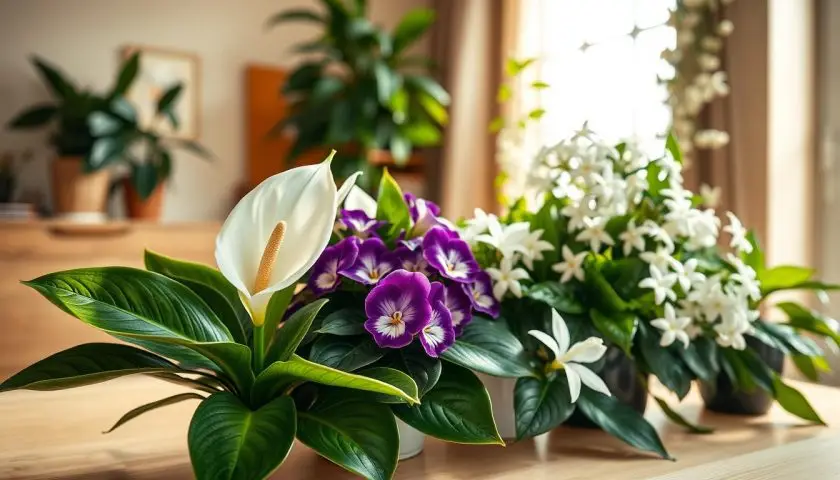
The best house plants with white flowers include peace lily, moth orchid, white anthurium, gardenia, Arabian jasmine, white African violet, white calla lily, white kalanchoe, Hoya bella, Hoya carnosa, Stephanotis, white Christmas cactus, white tuberous begonia, white gloxinia, Cape primrose, Amazon lily, and white Persian violet.
For beginners, moth orchids, white kalanchoes, African violets, and suitable Christmas cactus hybrids are practical choices. Peace lilies can be easy to maintain as foliage plants, although producing their white spathes usually requires brighter indirect light than merely keeping their leaves healthy.
For fragrance, consider gardenia, Arabian jasmine, Stephanotis, Amazon lily, or mature flowering Hoyas. For small shelves, white African violets, Cape primroses, Persian violets, and compact kalanchoes are useful options.
Before choosing a plant, match its light requirements, flowering cycle, and mature size to the conditions inside your home.
Key Takeaways
- House plants with white flowers vary greatly in light, moisture, humidity, and flowering requirements.
- Most flowering houseplants need bright indirect light or suitable supplemental lighting to produce consistent blooms.
- Peace lilies and white anthuriums display white spathes surrounding their small true flowers.
- Moth orchids are popular for elegant, long-lasting blooms, while white kalanchoes provide compact flowering displays.
- Gardenia, Arabian jasmine, Stephanotis, Amazon lily, and some Hoyas are valued for fragrance.
- White African violets, Cape primroses, gloxinias, and Persian violets suit smaller indoor spaces.
- Some plants flower seasonally or require a rest period, including Christmas cactus, tuberous begonia, and gloxinia.
- Watering must match the species; orchids, succulents, tropical aroids, and flowering vines should not receive identical treatment.
- Peace lilies, anthuriums, calla lilies, gardenias, and kalanchoes present pet-safety concerns.
- Pet-friendlier choices include correctly identified moth orchids, African violets, Hoya carnosa, and Christmas cactus.
Quick Comparison: 17 White Flowering Indoor Plants
| Plant | Botanical Name | Preferred Light | Best Feature | Care Level |
|---|---|---|---|---|
| 1. Peace Lily | Spathiphyllum hybrids | Medium to bright indirect | White spathes | Easy to moderate |
| 2. Moth Orchid | Phalaenopsis hybrids | Bright indirect | Long-lasting flowers | Easy to moderate |
| 3. White Anthurium | Anthurium andraeanum hybrids | Bright indirect | Glossy foliage and spathes | Moderate |
| 4. Gardenia | Gardenia jasminoides | Bright filtered light | Strong fragrance | Challenging |
| 5. Arabian Jasmine | Jasminum sambac | Bright light and some sun | Sweetly scented flowers | Moderate to challenging |
| 6. White African Violet | Streptocarpus (Saintpaulia) hybrids | Bright indirect | Compact repeat flowers | Easy to moderate |
| 7. White Calla Lily | Zantedeschia species and hybrids | Bright light | Elegant white spathes | Moderate |
| 8. White Kalanchoe | Kalanchoe blossfeldiana cultivars | Bright light | Long seasonal bloom | Easy |
| 9. Hoya Bella | Hoya lanceolata subsp. bella | Bright indirect | Small star-shaped blooms | Moderate |
| 10. Hoya Carnosa | Hoya carnosa | Bright indirect | Waxy flower clusters | Easy to moderate |
| 11. Stephanotis | Stephanotis floribunda | Very bright light | Fragrant climbing flowers | Challenging |
| 12. White Christmas Cactus | Schlumbergera cultivars | Bright indirect | Seasonal holiday blooms | Easy to moderate |
| 13. White Tuberous Begonia | Begonia Tuberhybrida Group | Bright filtered light | Large decorative flowers | Moderate |
| 14. White Gloxinia | Sinningia speciosa hybrids | Bright indirect | Velvety trumpet flowers | Moderate |
| 15. Cape Primrose | Streptocarpus hybrids | Bright indirect | Extended flower displays | Easy to moderate |
| 16. Amazon Lily | Eucharis amazonica | Bright filtered light | Fragrant white clusters | Moderate |
| 17. Persian Violet | Exacum affine white forms | Bright filtered light | Small white flowers | Moderate |
Care levels are general comparisons. The actual difficulty depends on the growing environment, cultivar, seasonal conditions, and the grower’s experience.
How to Choose the Right White Flowering Houseplant
Start With Available Light
Light is one of the most important factors affecting flowering indoors.
Many indoor plants can survive in relatively low light but produce few flowers under those conditions.
The Iowa State University Extension guide to flowering houseplants explains that most flowering houseplants need direct or bright indirect light, often more than ordinary foliage plants.
If your room has limited natural light, choose a more adaptable species and consider suitable supplemental grow lighting.
Consider Temperature and Humidity
Gardenias, anthuriums, orchids, and several other tropical flowering plants appreciate suitable humidity and stable temperatures.
However, higher humidity should not mean constantly wet roots.
A humidifier may help when indoor air is unusually dry, while adequate ventilation can reduce prolonged condensation on foliage and flowers.
Think About the Flowering Season
Some white flowering houseplants bloom repeatedly under suitable conditions.
Others flower during particular seasons, require shorter days or temperature changes, or enter a resting period after blooming.
Christmas cactus, tuberous begonia, gloxinia, and some other species require more attention to their natural seasonal cycle.
Understand White Spathes vs True Petals
Peace lilies, anthuriums, and calla lilies have conspicuous spathes that surround a flower-bearing structure called a spadix.
What looks like a single large white flower is therefore botanically different from the individual flowers of jasmine, gardenia, or orchids.
This difference does not reduce their decorative value, but it helps explain why some displays remain attractive for many weeks.
Check Pet Safety Before Buying
Some popular flowering houseplants are harmful if ingested by cats or dogs.
Species identification matters because common names can refer to different plants.
Check the ASPCA Toxic and Non-Toxic Plants database before introducing an unfamiliar plant into a pet-accessible room.

17 Best House Plants With White Flowers
1. Peace Lily: Best for Elegant White Spathes
Botanical name: Spathiphyllum species and hybrids.
Peace lily is one of the most recognizable house plants with white flowers, although its showy white structure is a spathe rather than a conventional flower with petals.
The glossy green leaves and pale spathes create an elegant display in modern living rooms, offices, and bedrooms.
Peace lilies can tolerate less light than many flowering houseplants, but reliable flowering generally requires sufficient bright indirect light.
- Light: Medium to bright indirect light for healthy growth and flowering.
- Water: Maintain suitable moisture while avoiding waterlogged roots.
- Soil: Well-draining, moisture-retentive indoor potting mix.
- Fragrance: Usually not grown primarily for fragrance.
- Best use: Living rooms, bright bathrooms, and offices.
- Pet safety: Toxic to cats and dogs if chewed.
Flowering tip: If your peace lily produces healthy leaves but no spathes, assess its light exposure before adding fertilizer.
For more advice, see our peace lily care guide and peace lily watering guide.
2. Moth Orchid: Best for Long-Lasting White Flowers
Botanical name: Phalaenopsis species and hybrids.
White moth orchids produce elegant flowers along arching spikes.
They are popular in homes and offices because individual flower spikes can remain attractive for an extended period under suitable conditions.
Unlike ordinary soil-grown houseplants, many Phalaenopsis orchids naturally grow as epiphytes and require a suitable airy root environment.
- Light: Bright indirect light.
- Water: Water according to the condition of the growing medium and allow drainage.
- Soil: Appropriate orchid bark or another suitable orchid medium.
- Fragrance: Depends on species and hybrid; many common white hybrids have little scent.
- Best use: Bright shelves, tables, and windowsills.
- Pet safety: ASPCA lists Phalaenopsis orchids as non-toxic to cats and dogs.
Flowering tip: After blooms fade, continue suitable orchid care rather than discarding the plant. Healthy specimens may rebloom when light, temperature, and growing conditions are appropriate.
See our orchid care guide.
3. White Anthurium: Best for a Modern White Display
Botanical name: White cultivars of Anthurium andraeanum and related hybrids.
White anthuriums produce glossy green leaves and attractive white spathes surrounding a central spadix.
Their sculptural appearance works well in minimalist rooms and contemporary interiors.
They generally need brighter indirect light to flower well, although harsh direct sunlight may scorch leaves.
- Light: Bright indirect light.
- Water: Maintain moderate moisture, allowing appropriate drying between waterings.
- Soil: Airy, well-draining aroid mix.
- Fragrance: Usually not the main attraction.
- Best use: Bright rooms, plant stands, and suitable bathrooms.
- Pet safety: Toxic to cats and dogs if ingested.
Flowering tip: Maintain stable warmth, appropriate humidity, and adequate light. Avoid leaving the roots in dense, persistently wet soil.
Explore our anthurium care guide.
4. Gardenia: Best for Strong White Floral Fragrance
Botanical name: Gardenia jasminoides.
Gardenia produces glossy evergreen foliage and beautiful creamy-white flowers with a distinctive fragrance.
It is among the most rewarding white flowering houseplants for scent, but it can be demanding indoors.
Gardenias prefer bright filtered light, suitable humidity, acidic potting medium, and consistent growing conditions.
Sudden changes in temperature or moisture may cause flower buds to drop before opening.
- Light: Bright filtered light; avoid excessive harsh sun.
- Water: Keep the medium appropriately moist but not saturated.
- Soil: Acidic, well-draining ericaceous potting medium.
- Fragrance: Strong and sweet.
- Best use: Bright rooms and suitable conservatories.
- Pet safety: ASPCA classifies gardenia as toxic to cats and dogs.
Flowering tip: Keep watering and temperature reasonably consistent when buds are developing. Avoid moving the plant repeatedly.
The Royal Horticultural Society gardenia growing guide provides detailed advice about acidic compost, light, warmth, and humidity.
5. Arabian Jasmine: Best for Sweetly Scented Indoor Flowers
Botanical name: Jasminum sambac.
Arabian jasmine produces small white flowers with a strong, sweet fragrance.
It is attractive in bright indoor rooms, sunny windows, and warm conservatories.
Unlike many foliage plants, Arabian jasmine generally needs substantial light to flower successfully indoors.
Its stems can be pruned and trained to maintain an attractive shape.
- Light: Very bright light with suitable direct sun.
- Water: Water according to moisture needs during active growth.
- Soil: Fertile, well-draining container mix.
- Fragrance: Strong and sweet.
- Best use: Bright windows and fragrance-focused displays.
- Pet safety: True Jasminum species are listed as non-toxic by ASPCA.
Flowering tip: Provide sufficient sunlight and avoid keeping the plant in a dim room, where it may develop weak growth with fewer flowers.
Always confirm the botanical name because plants sold as jasmine may belong to unrelated genera.
6. White African Violet: Best for Compact Flowering Shelves
Botanical group: White-flowered African violet cultivars, traditionally called Saintpaulia and now included within Streptocarpus.
White African violets are compact plants with fuzzy leaves and clusters of delicate flowers.
They are suitable for desks, shelves, small apartments, and windowsills with gentle light.
Under favourable conditions, African violets can produce repeated flowering displays.
- Light: Bright indirect light or suitable grow lighting.
- Water: Maintain appropriate moisture while keeping the crown from remaining wet.
- Soil: Light, well-draining African violet mix.
- Fragrance: Usually minimal.
- Best use: Small shelves, desks, and windowsills.
- Pet safety: ASPCA lists African violets as non-toxic to cats and dogs.
Flowering tip: Maintain suitable light and avoid cold water remaining on leaves, which can contribute to spotting.
For more guidance, read our African violet care guide.
7. White Calla Lily: Best for Sculptural Seasonal Blooms
Botanical group: Zantedeschia species and hybrids, including Zantedeschia aethiopica.
White calla lilies are known for elegant white spathes surrounding a flower-bearing spadix.
They create a distinctive display in decorative containers and bright indoor spaces.
Many calla lilies are grown as seasonal flowering plants and have a natural resting period.
Watering requirements change as active growth ends and dormancy begins.
- Light: Bright light, with suitable gentle sun depending on cultivar.
- Water: Maintain appropriate moisture during active growth, then adjust during dormancy.
- Soil: Suitable well-draining potting medium.
- Fragrance: Generally not their main feature.
- Best use: Seasonal statement pots.
- Pet safety: Toxic to cats and dogs if chewed.
Flowering tip: If foliage naturally declines after flowering, check the variety’s dormancy requirements rather than assuming the plant has permanently died.
Important: Calla lilies are not true Lilium lilies. However, they still contain irritating calcium oxalates and should be kept away from pets.
8. White Kalanchoe: Best for a Low-Maintenance Flowering Display
Botanical name: White-flowered cultivars of Kalanchoe blossfeldiana.
White kalanchoes are compact flowering succulents that produce clusters of small blooms.
They are popular because of their attractive display and comparatively simple watering requirements.
These plants generally perform best in bright positions and should not remain in constantly wet growing media.
- Light: Bright light, with some appropriate direct sunlight.
- Water: Allow the growing medium to dry suitably between waterings.
- Soil: Well-draining succulent mix.
- Fragrance: Usually minimal.
- Best use: Sunny shelves and compact decorative displays.
- Pet safety: Kalanchoe species are toxic to cats and dogs.
Flowering tip: Reblooming may require suitable short-day conditions, depending on the cultivar and its growing cycle.
See our succulent care guide for general growing principles.
9. Hoya Bella: Best for Delicate Star-Shaped Flowers
Botanical name: Hoya lanceolata subsp. bella, often sold as Hoya bella.
Hoya bella produces small, star-shaped flowers with white outer petals and contrasting central structures.
Its fine, trailing stems make it attractive in hanging pots and elevated shelves.
It is generally more delicate than some thicker-leaved Hoyas and benefits from appropriate moisture, drainage, and bright filtered light.
- Light: Bright indirect light.
- Water: Water as the growing medium dries appropriately; avoid prolonged drought or saturation.
- Soil: Airy, well-draining mix.
- Fragrance: May be lightly fragrant.
- Best use: Hanging planters and raised shelves.
- Pet safety: Verify the precise species; do not assume every plant sold as Hoya has an identical safety listing.
Flowering tip: Maintain appropriate light and avoid unnecessary disturbance of healthy flowering growth.
For related guidance, read our Hoya care guide.
10. Hoya Carnosa: Best for Waxy White Flower Clusters
Botanical name: Hoya carnosa.
Hoya carnosa is a climbing or trailing plant known for thick leaves and rounded clusters of wax-like flowers.
Depending on the cultivar, its flowers may appear white, cream, pale pink, or white with a pinkish centre.
Mature plants may produce fragrant flowers when grown in appropriate light.
- Light: Bright indirect light with suitable gentle sun.
- Water: Allow appropriate drying between waterings.
- Soil: Airy, free-draining mix.
- Fragrance: Some plants produce a noticeable sweet scent.
- Best use: Hanging baskets, trellises, and shelves.
- Pet safety: ASPCA lists Hoya carnosa as non-toxic to cats and dogs.
Flowering tip: Avoid routinely removing persistent flowering spurs, known as peduncles, because flowers may form again from these structures.
For styling ideas, explore our trailing houseplants guide.
11. Stephanotis: Best for Fragrant White Climbing Flowers
Botanical name: Stephanotis floribunda.
Stephanotis is a tropical climber known for glossy leaves and clusters of fragrant, tubular white flowers.
It is also called Madagascar jasmine, although it is not a true member of the genus Jasminum.
This flowering vine can be trained around a hoop, trellis, or other suitable support.
Stephanotis usually performs best in a bright location with stable warmth and suitable humidity.
- Light: Very bright light, with direct sun managed according to conditions.
- Water: Maintain appropriate moisture during active growth.
- Soil: Well-draining, moisture-retentive potting mix.
- Fragrance: Strong and sweet.
- Best use: Bright conservatories and supported indoor displays.
- Pet safety: ASPCA includes Madagascar jasmine among pet-friendlier flowers, but prevent chewing.
Flowering tip: Avoid sudden changes in temperature, moisture, or positioning while buds develop.
The RHS Stephanotis plant profile describes its fragrant flowers and climbing growth habit.
12. White Christmas Cactus: Best for Seasonal Winter Flowers
Botanical group: White-flowered Schlumbergera cultivars and hybrids.
White Christmas cacti provide beautiful seasonal flowers on segmented, trailing stems.
They are epiphytic tropical cacti rather than desert cacti, so their growing requirements differ from those of many drought-adapted succulents.
Plants sold as Christmas cactus may belong to different Schlumbergera groups, including Thanksgiving cactus hybrids, and flowering time can vary.
- Light: Bright indirect light.
- Water: Water when the growing medium has dried appropriately.
- Soil: Airy, well-draining potting mix.
- Fragrance: Usually minimal.
- Best use: Winter displays, hanging pots, and windowsills.
- Pet safety: ASPCA lists Christmas cactus as non-toxic to cats and dogs.
Flowering tip: Suitable cooler nights and shorter-day conditions can help initiate buds in many cultivars. Avoid unnecessary environmental changes once buds form.
Read the RHS Christmas cactus guide and our Christmas cactus care tips.
13. White Tuberous Begonia: Best for Large Decorative Flowers
Botanical group: White-flowered cultivars of the Begonia Tuberhybrida Group.
Tuberous begonias produce attractive flowers in many colours, including white.
Their soft petals and abundant blooms make them popular as seasonal display plants.
They generally need suitable bright filtered light, good airflow, and a careful watering routine.
Many tuberous begonias enter dormancy after their growing season.
- Light: Bright filtered light; avoid harsh midday sun.
- Water: Keep appropriately moist during growth, then reduce as dormancy begins.
- Soil: Well-draining, moisture-retentive mix.
- Fragrance: Depends on cultivar.
- Best use: Seasonal indoor displays and sheltered bright areas.
- Pet safety: Begonias contain compounds that can harm pets; tubers present particular concerns.
Flowering tip: Remove spent flowers where appropriate and maintain airflow to reduce conditions favourable to fungal disease.
14. White Gloxinia: Best for Velvety Trumpet Flowers
Botanical name: White-flowered cultivars of Sinningia speciosa.
Florist gloxinia is known for large, velvety, trumpet-shaped flowers and soft foliage.
Despite its common name, this popular flowering houseplant belongs to Sinningia, not the botanical genus Gloxinia.
Its attractive blooms make it popular for gift plants and seasonal tabletop displays.
- Light: Bright indirect light.
- Water: Maintain suitable moisture during active growth, avoiding prolonged wetness on leaves.
- Soil: Light, well-draining potting medium.
- Fragrance: Usually not a main feature.
- Best use: Decorative tables and bright shelves.
- Pet safety: Check the exact botanical species with a trusted pet-toxicity reference.
Flowering tip: Some florist gloxinias naturally enter a resting period after flowering. Reduce watering according to their growth cycle rather than discarding the tuber immediately.
15. Cape Primrose: Best for Repeated White Blooms
Botanical group: White-flowered Streptocarpus hybrids.
Cape primroses produce attractive flowers above soft, green foliage.
They are useful for bright shelves and windowsills where large flowering shrubs would be impractical.
Under suitable conditions, many hybrids can flower for extended periods.
- Light: Bright indirect light.
- Water: Allow the upper potting medium to dry appropriately before watering.
- Soil: Light, free-draining potting medium.
- Fragrance: Varies by cultivar, usually not the main attraction.
- Best use: Bright shelves and compact plant collections.
- Pet safety: Confirm the selected hybrid before making pet-safety assumptions.
Flowering tip: Protect the foliage from harsh direct sun and remove spent flower stalks when suitable.
16. Amazon Lily: Best for Fragrant White Flower Clusters
Botanical name: Eucharis amazonica.
Amazon lily produces glossy leaves and clusters of white, often fragrant flowers.
It is a tropical bulbous plant that can be grown indoors where conditions are appropriately warm and bright.
However, flowering may be inconsistent if the plant lacks suitable seasonal growing conditions or is disturbed unnecessarily.
- Light: Bright filtered light.
- Water: Maintain appropriate moisture during active growth and adjust during any natural resting period.
- Soil: Well-draining, organic-rich medium.
- Fragrance: Sweetly fragrant flowers.
- Best use: Warm rooms and sheltered indoor displays.
- Pet safety: Treat as potentially harmful if ingested and keep away from pets.
Flowering tip: Avoid repeated repotting and maintain conditions appropriate for established bulbs.
Amazon lily is not a true Lilium lily, but its common name should not be used as proof that it is safe for pets.
17. Persian Violet: Best for Small White Seasonal Flowers
Botanical name: White-flowered forms of Exacum affine.
Persian violet is usually associated with purple or violet flowers, but white-flowered forms also exist.
The plant forms a compact display of small flowers above green foliage.
It is commonly grown as a short-lived flowering houseplant rather than a permanent large indoor specimen.
- Light: Bright filtered light.
- Water: Maintain appropriate moisture without waterlogging.
- Soil: Well-draining potting medium.
- Fragrance: May be lightly fragrant.
- Best use: Small shelves and seasonal decorative pots.
- Pet safety: Verify the exact plant and cultivar using a botanical-name-based reference.
Flowering tip: Choose a clearly identified white-flowered cultivar when purchasing, since blue and violet forms are more familiar in cultivation.
The Royal Horticultural Society’s Persian violet profile confirms that the species may produce white, pink, blue, or purple flowers.
Best House Plants With White Flowers by Room
| Room or Location | Recommended Plants | What to Consider |
|---|---|---|
| Bright living room | Orchid, Hoya, anthurium, jasmine | Useful daylight and stable temperatures |
| Bedroom | Orchid, African violet, peace lily | Light, fragrance sensitivity, and pet safety |
| Bathroom with window | Peace lily, anthurium, orchid | Humidity does not replace light |
| Office desk | African violet, Cape primrose, kalanchoe | Compact pot and suitable lighting |
| Sunny window | Jasmine, kalanchoe, gardenia | Manage harsh sun and heat |
| Hanging planter | Hoya bella, Hoya carnosa, Christmas cactus | Secure fixture and watering access |
| Bright plant stand | Calla lily, gloxinia, Amazon lily | Flowering cycle and adequate clearance |
For additional styling inspiration, see our room-by-room plant styling guide.
Which White Flowering Indoor Plants Are Easiest for Beginners?
Beginner-friendly flowering plants should be relatively adaptable and have care requirements that suit ordinary indoor conditions.
Best Starting Choices
- Moth orchid: A practical choice when the growing medium, watering, and light are suitable.
- White kalanchoe: Useful for a bright window and growers who prefer a drier succulent mix.
- White African violet: Compact and suitable for consistent indoor lighting.
- White Christmas cactus: Attractive seasonal flowers with a manageable care routine.
- Cape primrose: Suitable for bright filtered light and compact displays.
- Peace lily: Relatively easy foliage care, although flowering requires adequate light.
Gardenia and Stephanotis are usually better for growers who can provide more controlled conditions.
For more beginner ideas, explore our indoor plants for beginners.
Fragrant House Plants With White Flowers
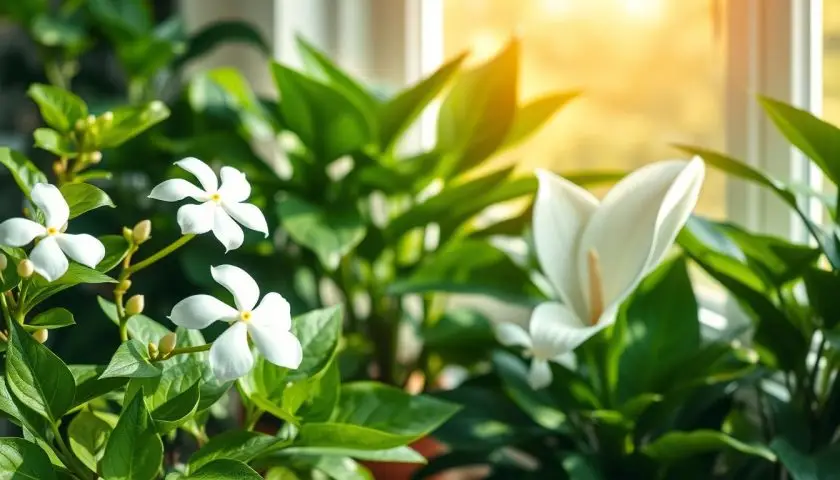
Fragrant white flowering houseplants can make an indoor space particularly inviting.
However, fragrance strength differs among species and cultivars.
| Plant | Fragrance | Best Conditions |
|---|---|---|
| Gardenia | Strong, rich floral scent | Bright filtered light, warmth, humidity |
| Arabian Jasmine | Strong, sweet fragrance | Very bright light and appropriate sun |
| Stephanotis | Strong, sweet fragrance | Bright light and stable warmth |
| Amazon Lily | Fragrant flowers | Warmth and filtered light |
| Hoya Carnosa | Sweet scent in some cultivars | Bright indirect light and maturity |
Place fragrant plants where their scent can be enjoyed without overwhelming small rooms or people sensitive to strong smells.
For related choices, read our fragrant indoor plants guide.
White Flowering Houseplants for Bright and Low-Light Rooms
Best for Bright Indirect Light
Moth orchids, white anthuriums, African violets, Hoyas, Cape primroses, and gloxinias are good candidates for suitable bright filtered conditions.
Check how much light reaches the actual plant position rather than assuming every windowsill is equally bright.
Best for Some Direct Sun
Arabian jasmine, white kalanchoe, and certain other flowering plants appreciate stronger light.
However, plants should be acclimatized gradually if moving from greenhouse shade into direct sunlight.
What About Low-Light Rooms?
Peace lilies are comparatively adaptable to lower indoor light, but flowering may become limited.
Most other white flowering houseplants perform better with brighter light.
If your room is consistently dim, a suitable grow light may support flowering more effectively than fertilizer alone.
Read our indoor lighting guide for more information.
Small House Plants With White Flowers
Compact flowering plants are especially useful for shelves, desks, windowsills, and apartments where floor space is limited.
Good choices include white African violets, Cape primroses, Persian violets, compact kalanchoes, white gloxinias, and smaller moth orchid hybrids.
Choose pots with suitable drainage and avoid placing plants where flowers will be constantly brushed or damaged.
Our tiny apartment plant guide provides additional space-saving ideas.
How to Care for White Flowering Indoor Plants
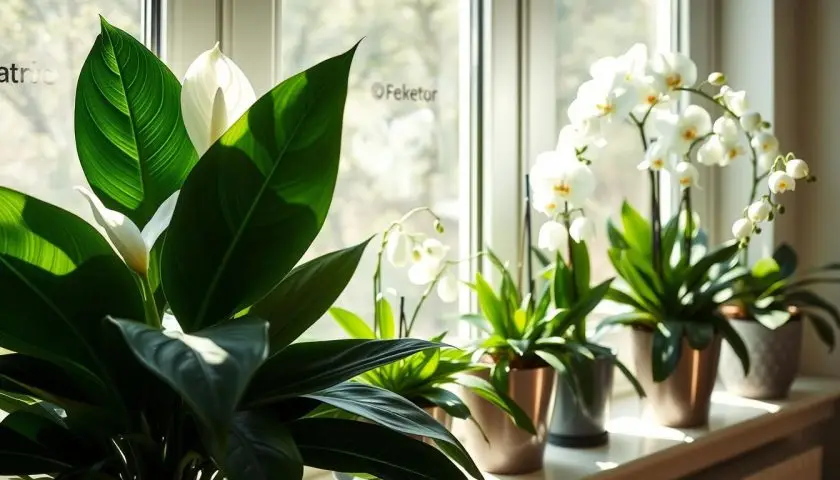
Provide Enough Light
Flower production requires adequate energy from photosynthesis.
Many houseplants maintain healthy green foliage under conditions that are insufficient for reliable flowering.
If a plant consistently fails to bloom, check light exposure and its natural flowering cycle before changing fertilizer.
Water According to the Plant
There is no universal weekly watering schedule for all white flowering houseplants.
Gardenias and peace lilies generally require a different moisture balance from kalanchoes and many Hoyas.
Orchids also need watering based on their specialised growing medium and root environment.
For more advice, read our complete houseplant watering guide.
Maintain Suitable Humidity
Some tropical flowering plants appreciate moderate to high humidity.
If indoor air is very dry, a suitable humidifier may help.
Repeated misting is not an effective long-term substitute for stable ambient humidity and may leave delicate petals wet.
Use the Correct Fertilizer
Most flowering houseplants benefit from appropriate fertilization during active growth.
However, extra nutrients cannot compensate for unsuitable lighting or unhealthy roots.
Use a fertilizer appropriate for the species and follow the product label.
For related information, see our indoor versus outdoor fertilizing guide.
Remove Spent Flowers Carefully
Removing spent blooms can improve appearance and reduce decaying material around the plant.
However, flower removal methods differ.
Do not automatically cut the persistent flowering spurs of Hoyas, because some species can produce new flowers from these structures.
Keep Growing Conditions Stable
Some flowering plants react poorly to sudden changes in light, temperature, moisture, or placement.
Gardenia and Stephanotis may drop developing buds under stressful conditions.
Christmas cactus may also lose buds following significant environmental changes.
Best Soil and Pots for White Flowering Houseplants
| Plant Group | Recommended Growing Medium | Main Concern |
|---|---|---|
| Peace lily and anthurium | Airy, moisture-retentive indoor mix | Poor drainage and root stress |
| Phalaenopsis orchid | Suitable orchid bark or orchid medium | Poor root aeration and crown moisture |
| Kalanchoe | Free-draining succulent mix | Excess water retention |
| Gardenia | Acidic, well-draining ericaceous medium | Unsuitable pH and moisture stress |
| Jasmine and Stephanotis | Well-draining, suitable moisture-retentive mix | Drying extremes and root saturation |
| African violet and Cape primrose | Light, free-draining growing mix | Wet crowns and poor drainage |
| Hoya | Airy mix with adequate drainage | Persistent root-zone saturation |
| Gloxinia and tuberous begonia | Light, well-draining mix | Watering during dormancy |
Choose pots with drainage holes and avoid containers excessively large for the root system.
For further information, read our best soil mix guide.
If you are repotting several flowering plants, the PatchPlants Soil Calculator can help estimate how much potting mix you need.
How to Make White Flowering Houseplants Bloom Again
1. Check the Natural Flowering Cycle
Some plants bloom seasonally and should not be expected to flower continuously.
For example, Christmas cactus may depend on specific seasonal conditions, while tuberous begonias and gloxinias can enter rest periods.
2. Improve Light Where Necessary
Insufficient light is a common reason a healthy-looking plant fails to bloom.
Move the plant gradually to a more suitable position or consider appropriate grow lighting.
3. Follow Species-Specific Watering Needs
Both drought stress and overwatering may interfere with flower production.
Check the roots and growing medium before changing the watering routine.
4. Fertilize Appropriately
Plants need nutrients during active growth, but excessive fertilizer can harm roots or encourage weak growth.
Do not assume a high-phosphorus bloom booster is necessary for every flowering houseplant.
5. Respect Seasonal Rest Periods
Some species require shorter days, cooler temperatures, or altered moisture conditions before another flowering cycle.
Research the specific species and cultivar rather than applying one rest routine to every plant.
Why Are White Flowers Turning Brown?
White petals and spathes show marks and discolouration clearly.
Brown flowers do not always mean the entire plant is unhealthy.
| Symptom | Possible Cause | Recommended Check |
|---|---|---|
| Flowers gradually brown | Normal ageing | Look for healthy new growth |
| Brown edges on petals | Heat, moisture stress, or natural ageing | Light, temperature, and watering |
| Spotted white flowers | Water damage, pests, or fungal disease | Flower surface and airflow |
| Buds drop before opening | Environmental stress or unsuitable conditions | Moisture, temperature, and recent changes |
| Healthy leaves but no flowers | Insufficient light, immaturity, or wrong season | Species flowering requirements |
| Yellow leaves and fading blooms | Watering or root stress, ageing, or other causes | Soil moisture and root condition |
Normal Flower Ageing
Flowers have a limited lifespan.
When a white bloom reaches the end of its natural display, browning and wilting are normal.
Remove spent flowers as appropriate for the species.
Water Damage and Poor Airflow
Some delicate petals develop marks after water remains on their surfaces.
Avoid repeatedly wetting flowers, particularly in poorly ventilated rooms.
Temperature and Light Stress
Harsh sunlight through glass, cold drafts, and abrupt changes in growing conditions may damage blooms.
Review the plant’s position before assuming it needs additional fertilizer.
For broader troubleshooting, read our leaf browning and drooping guide.
Common Pests on White Flowering Indoor Plants
Flowering houseplants can develop pest problems, especially when stressed or placed close to other infested plants.
Watch for these common pests:
- Mealybugs: White cottony clusters near stems, leaves, and flower joints.
- Spider mites: Fine webbing and speckled foliage.
- Aphids: Small insects around buds and fresh shoots.
- Thrips: Scarring, distorted buds, and damaged flowers.
- Scale insects: Small attached bumps on leaves or stems.
- Fungus gnats: Small flies often associated with moist potting media.
Inspect new plants before adding them to your collection.
If you notice pests, isolate the affected plant where practical and identify the pest before selecting a treatment.
Use products only when they are appropriate for the particular plant and labelled for the intended use.
Are White Flowering Houseplants Safe for Cats and Dogs?
Pet safety varies considerably among the plants in this guide.
Some species contain insoluble calcium oxalate crystals that irritate the mouth and digestive tract.
Others contain different compounds that can cause gastrointestinal or other symptoms when ingested.
| White Flowering Plant | Pet-Safety Guidance |
|---|---|
| Peace Lily | Toxic to cats and dogs |
| Moth Orchid | ASPCA lists Phalaenopsis as non-toxic |
| White Anthurium | Toxic to cats and dogs |
| Gardenia | ASPCA lists as toxic |
| Arabian Jasmine | True Jasminum species listed as non-toxic |
| African Violet | ASPCA lists as non-toxic |
| Calla Lily | Toxic to cats and dogs |
| Kalanchoe | Toxic to cats and dogs |
| Hoya Bella | Confirm species-specific safety |
| Hoya Carnosa | ASPCA lists as non-toxic |
| Stephanotis | ASPCA includes Madagascar jasmine among pet-friendlier flowers |
| Christmas Cactus | ASPCA lists as non-toxic |
| Tuberous Begonia | Potentially harmful; especially tubers |
| Gloxinia | Verify exact botanical identity |
| Cape Primrose | Verify exact botanical identity |
| Amazon Lily | Treat as potentially harmful if ingested |
| Persian Violet | Check species-specific guidance |
The ASPCA identifies peace lilies as toxic, while Phalaenopsis orchids are listed as non-toxic.
Even non-toxic plants may cause mild digestive upset if an animal eats large quantities.
If your pet ingests a potentially toxic plant or develops concerning symptoms, contact your veterinarian promptly.
For more advice, see our cat-friendly plant guide and dog-friendly plant guide.
How to Style White Flowering Plants Indoors
White flowers can complement a wide range of interior colour palettes.
Minimalist Living Rooms
Choose a white orchid, peace lily, or anthurium in a simple ceramic planter.
Allow enough visual space around the plant for its flower display to stand out.
Small Apartments
Use white African violets, Cape primroses, or compact kalanchoes on bright shelves.
Avoid overcrowding small surfaces with multiple pots.
Bright Windowsills
White kalanchoe, jasmine, and suitable Hoyas can create attractive displays where their light requirements are met.
Watch for excessive heat near glass.
Hanging Planters
Hoya bella, Hoya carnosa, and white Christmas cactus can provide cascading foliage and flowers.
Use a secure hanging fixture and make watering access convenient.
Fragrance-Focused Areas
Gardenia, Arabian jasmine, and Stephanotis may suit bright seating areas where their fragrance can be appreciated.
Avoid placing strongly scented flowers in cramped spaces if anyone is sensitive to fragrance.
Common Mistakes With House Plants With White Flowers
- Keeping flowering plants in deep shade: Many need more light to bloom than to maintain foliage.
- Using the same watering schedule for every species: Orchids, succulents, and tropical shrubs have different requirements.
- Assuming white spathes are ordinary petals: Peace lily, anthurium, and calla lily have different flower structures.
- Ignoring a plant’s flowering season: Some species require seasonal rest or particular light conditions.
- Overfertilizing to force flowers: Extra nutrients cannot replace adequate light or a natural bloom cycle.
- Keeping roots waterlogged: Poor drainage may cause root injury.
- Frequently moving plants with developing buds: Some species respond by dropping buds.
- Misting delicate flowers heavily: Persistent moisture may contribute to spotting and disease.
- Discarding dormant bulbs or tubers: Some seasonal plants naturally rest after flowering.
- Removing Hoya flower spurs: Some Hoyas flower repeatedly from the same structures.
- Assuming every white flower is pet-safe: Confirm botanical names and toxicity.
- Using unsuitable potting mixes: A moth orchid and a gardenia do not need the same substrate.
- Ignoring insects on buds: Thrips and other pests can damage flower development.
Frequently Asked Questions About House Plants With White Flowers
What are the best house plants with white flowers for beginners?
Good beginner choices include moth orchids, white kalanchoes, white African violets, white Christmas cactus, and Cape primrose. Peace lilies are also comparatively easy to maintain as foliage plants, although they need enough indirect light for reliable flowering. Choose a plant based on the light and watering conditions you can provide.
Which white flowering indoor plants can grow in low light?
Peace lilies can tolerate relatively low light, but they usually flower better in medium to bright indirect light. Most other white flowering indoor plants need brighter conditions. If the room is too dim for flowering, a suitable grow light can help. Low-light tolerance should not be confused with reliable blooming in darkness.
What are the best fragrant house plants with white flowers?
Gardenia, Arabian jasmine, Stephanotis, Amazon lily, and certain Hoyas are popular fragrant white flowering houseplants. Gardenia and Stephanotis are more demanding indoors, while suitable Hoyas may be easier once established. Fragrance intensity varies by species, cultivar, flowering stage, and growing conditions.
Why are my white indoor flowers turning brown?
White flowers may turn brown because of normal ageing, unsuitable watering, heat, sun scorch, dry air, water remaining on petals, pests, or disease. Examine the plant’s leaves, roots, and new growth before diagnosing the cause. If only older flowers fade while the rest of the plant remains healthy, natural flower ageing is likely.
How can I encourage white flowering houseplants to bloom again?
Provide sufficient light, follow the plant’s watering and fertilizer requirements, and understand its natural flowering season. Some plants, including Christmas cactus, require suitable seasonal changes, while tuberous begonias and gloxinias may enter a resting period. Avoid excessive fertilizer and sudden changes while buds are forming.
Conclusion
House plants with white flowers can bring elegant colour, interesting textures, and sometimes beautiful fragrance to indoor spaces.
For simple decorative blooms, start with moth orchids, African violets, white kalanchoes, or suitable Christmas cactus cultivars. For tropical foliage and white spathes, peace lilies and anthuriums are attractive choices.
Gardenia, Arabian jasmine, Stephanotis, Amazon lily, and Hoyas offer fragrant options, while Cape primrose, Persian violet, and gloxinia can brighten smaller displays.
Remember that the best flowering plant is the one suited to your home. Adequate light, species-appropriate watering, good drainage, and an understanding of natural flowering cycles matter more than choosing a plant solely for its appearance.
For more inspiration, explore our blooming indoor plants guide, indoor plants with orange flowers, indoor plants with red flowers, and indoor plants collection.

About the author
Sawera Shahid is a botanist with an MPhil in Botany and 5+ years of writing about plants. As founder and lead writer of Patch Plants, she writes practical, science-backed guides on indoor plants, outdoor gardens and plant problems, checked against RHS and university extension advice.