🌿 Key Takeaways
- Calathea plant varieties feature some of the most dramatic leaf patterns in the houseplant world — painted stripes, feathered markings, and bold undersides in pink, burgundy, silver, and cream making them true living artwork
- Calathea plant care centers on three non-negotiable requirements: bright indirect light for pattern retention, consistent soil moisture without waterlogging, and 50–60% humidity minimum for tropical health
- Calathea plants belong to the Marantaceae family and are closely related to Maranta and Stromanthe — all sharing prayer plant movement folding leaves upward at night
- Calathea prayer plant behavior (nyctinasty) sees leaves fold upward at dusk and open at dawn — a fascinating natural response to light changes unique to this plant family
- Peacock plant Calathea (Calathea makoyana) displays intricate oval markings resembling peacock feathers — one of the most visually stunning varieties available for indoor growing
- Rattlesnake Calathea plant (Calathea lancifolia) features long wavy-edged leaves with dark oval spots on bright green — one of the easiest Calathea varieties for beginners
- Calathea plant leaves curling indicates underwatering, low humidity, or cold temperatures — the earliest visible stress signal requiring immediate attention before permanent damage
- Are Calathea plants toxic to cats — No! Calathea is completely non-toxic to cats, dogs, and humans making it one of the safest colorful foliage plants for pet households
- Calathea indoor plant success depends on water quality — fluoride and chlorine in tap water cause brown leaf tips requiring filtered, rainwater, or tap water left standing 24 hours
- Browse our complete indoor plant care guides for detailed growing instructions covering every houseplant variety
Understanding Calathea: The Living Painting Plant
Calathea plant represents one of the most visually spectacular genera in the houseplant world — leaves displaying patterns so intricate, precise, and colorful that they genuinely appear hand-painted. Native to tropical Americas, primarily Brazil, these plants evolved under dense rainforest canopy where dappled light filtered through leaves of taller trees.
This evolutionary origin explains every calathea plant care requirement: the preference for bright indirect rather than direct sun (canopy-filtered light), the demand for high humidity (rainforest moisture levels), and the need for consistent soil moisture (tropical rainfall patterns). Understanding these natural conditions makes Calathea care logical rather than mysterious.
Calathea plants now include approximately 60 species plus numerous cultivated varieties offering extraordinary diversity in leaf patterns, sizes, and colors. The genus name derives from Greek “kalathos” meaning basket — referencing how indigenous peoples wove the large leaves into baskets and other items.
The famous calathea prayer plant movement represents one of the most fascinating plant behaviors observable at home. Leaves fold upward at dusk responding to fading light through changes in water pressure in specialized cells at leaf bases. By dawn, leaves open again flat — this daily rhythm continues throughout the plant’s life and indicates healthy, well-cared-for specimens. A Calathea that stops moving its leaves typically signals stress requiring care adjustments.
For additional colorful foliage options complementing Calathea displays, our guide on colorful indoor plants covers 10 stunning varieties.
Popular Calathea Varieties — Complete Species Guide
Calathea Orbifolia — The Silver Circle Beauty
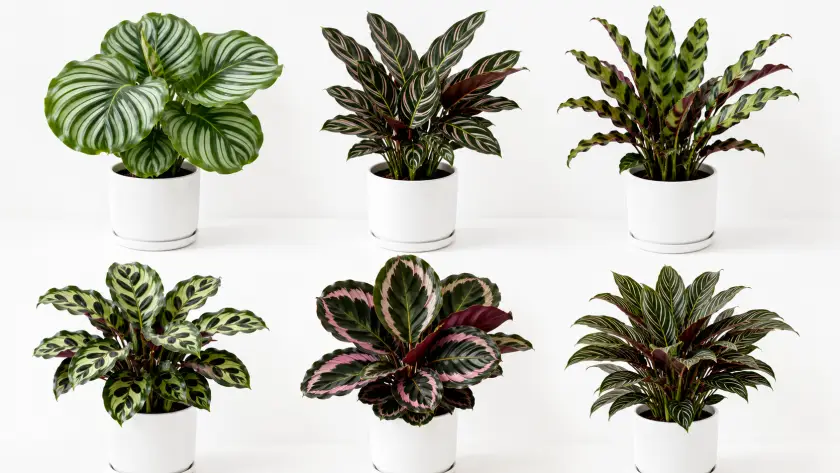
Calathea orbifolia plant ranks as one of the most sought-after varieties — large round leaves displaying alternating silver-green and dark green stripes creating bold geometric patterns reaching 30cm diameter.
Why Calathea orbifolia impresses:
- Largest leaves of common Calathea varieties
- Bold silver and green stripe pattern
- Architectural presence in large spaces
- More tolerant of inconsistent care than other varieties
Calathea orbifolia care:
- Light: Bright indirect — never direct sun which scorches silver markings
- Water: When top 2cm dries — more frequently than smaller varieties
- Humidity: 50–60% minimum — brown edges appear below 40%
- Size: Reaches 60–90cm tall and wide at maturity
Challenge: Orbifolia grows large requiring substantial space and consistent humidity. Best positioned in bathrooms or humid rooms.
Calathea Ornata — The Pink Pinstripe
Calathea ornata plant features dark green leaves with precise pink or white pinstripes running parallel from midrib to leaf edges — one of the most elegant patterns in the Calathea family.
Calathea ornata plant care:
- Light: Moderate to bright indirect — pink pinstripes fade in low light
- Water: Consistent moisture — top 2cm dry between waterings
- Humidity: 60%+ preferred for maintaining crisp pinstripe definition
- Size: 60cm tall typically
Calathea ornata varieties:
- Calathea ornata ‘Sanderiana’: white pinstripes
- Calathea ornata ‘Roseolineata’: pink pinstripes on young leaves
- Both display burgundy-pink undersides
Rattlesnake Calathea Plant — The Beginner-Friendly Option
Rattlesnake calathea plant (Calathea lancifolia, also calathea lancifolia plant) provides the easiest introduction to Calathea care — long narrow wavy-edged leaves with dark oval spots on bright green, purple undersides.
Why rattlesnake plant calathea suits beginners:
- More forgiving of inconsistent watering than other varieties
- Tolerates slightly lower humidity (40%+ adequate)
- Fast growing — fills spaces quickly
- Dramatic leaf movement visible easily due to long narrow leaves
- Widely available and affordable
Calathea lancifolia rattlesnake plant care:
- Light: Moderate to bright indirect
- Water: When top 2–3cm dry — weekly typically
- Humidity: 40–60% (more tolerant than most)
- Size: Reaches 75cm tall making it one of taller varieties
Peacock Plant Calathea — Makoyana’s Feathered Leaves
Peacock plant calathea (Calathea makoyana, also calathea makoyana plant) earns its name from oval markings resembling peacock feathers — light green background with dark green oval spots, cream and green on top, purple and pink on undersides.
Calathea makoyana peacock plant characteristics:
- Intricate peacock feather oval patterns
- Striking purple-pink undersides visible during evening prayer movement
- Medium size 30–60cm
- More dramatic coloring than many varieties
Care requirements:
- Light: Moderate indirect — sensitive to direct sun
- Water: Consistently moist soil essential
- Humidity: 60%+ absolutely essential
- Temperature: 18–27°C — no cold drafts
Medallion Calathea Plant — The Rosette Pattern
Medallion calathea plant (Calathea roseopicta ‘Medallion’) displays large oval leaves with pink feather patterns on deep green, burgundy undersides creating rich color contrast.
Calathea medallion plant care:
- Light: Bright indirect essential for pink pattern retention
- Water: When top 2cm dry — consistent schedule
- Humidity: 60%+ essential
- Size: 30–60cm compact growth habit
Calathea medallion plant care challenge: Pink medallion patterns fade significantly in low light — bright indirect positioning is non-negotiable for this variety.
Calathea Lutea Plant — The Dramatic Giant
Calathea lutea plant grows dramatically larger than most houseplant varieties — banana-like leaves reaching 1 metre long with waxy blue-green surfaces used traditionally for food wrapping and basketry.
Characteristics:
- Enormous leaves to 1 metre long
- Waxy blue-green upper surface
- Bold tropical statement plant
- More drought-tolerant than smaller varieties
Calathea Freddie Plant — The Striped Compact Variety
Calathea freddie plant (Calathea concinna ‘Freddie’) features narrow light green leaves with dark green feather-stripe patterns — more compact and slightly more tolerant than demanding varieties.
Care essentials:
- Light: Moderate to bright indirect
- Water: Consistent moisture
- Humidity: 50–60%
- Size: 40–60cm compact and bushy
Complete Calathea Plant Care Guide
Light Requirements for Calathea Plant
Calathea plant care light requirements balance between adequate brightness for pattern retention and protection from direct sun causing leaf scorch and bleaching.
Ideal Calathea light conditions:
- Bright indirect light: 1–3 metres from east or north-facing windows — ideal for most varieties
- Filtered bright light: Direct south or west window with sheer curtain — good alternative
- Moderate indirect light: Acceptable for rattlesnake and freddie varieties — others will fade
Signs of too much light:
- Leaf edges browning and crisping
- Colors bleaching pale or washed out
- Pink or silver markings fading
- Dry soil unusually quickly
Signs of insufficient light:
- Patterns fading — pink/silver reducing, dark green taking over
- Prayer movement slowing or stopping
- Slow growth even during spring and summer
- Leggy pale new growth
Calathea light hack: East-facing windows provide perfect morning light intensity for most varieties. The gentler morning sun delivers adequate brightness without afternoon intensity causing leaf damage.
For complete indoor light guidance, our complete guide to indoor light covers measuring light levels and optimizing positioning for sensitive plants.
Watering Calathea Plants Correctly
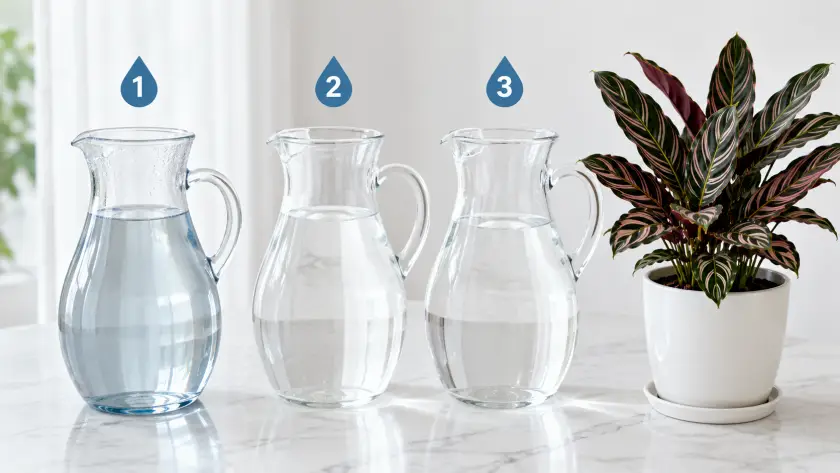
Water represents the most critical — and most commonly mismanaged — aspect of calathea plant care. Both overwatering and underwatering cause visible damage quickly.
Calathea watering fundamentals:
- Check soil moisture by inserting finger 2cm deep
- Water when top 2cm feels dry but soil below remains slightly moist
- Water thoroughly until draining from holes
- Empty saucers after 15 minutes — never allow standing water
- Reduce frequency in winter — every 10–14 days typically
Water quality matters enormously:
Calathea plants suffer significantly from fluoride and chlorine in standard tap water — leaf tips turn brown and crispy despite correct watering frequency.
Best water options for Calathea:
- Filtered water (Brita or similar)
- Rainwater (ideal — naturally soft and free from additives)
- Distilled water (pure but lacks minerals)
- Tap water left standing 24 hours (chlorine dissipates but fluoride remains)
Overwatering signs:
- Yellowing leaves throughout plant
- Mushy soft stems at base
- Mold growing on soil surface
- Root rot — brown mushy roots
Underwatering signs:
- Calathea plant leaves curling inward (first visible sign)
- Brown crispy leaf edges spreading inward
- Prayer movement becoming sluggish
- Soil pulling away from pot edges
For complete watering guidance, our complete watering guide covers moisture management for all tropical plants. Our guide on signs you’re overwatering covers recognizing and correcting the most common Calathea killer.
Humidity Requirements for Calathea House Plants
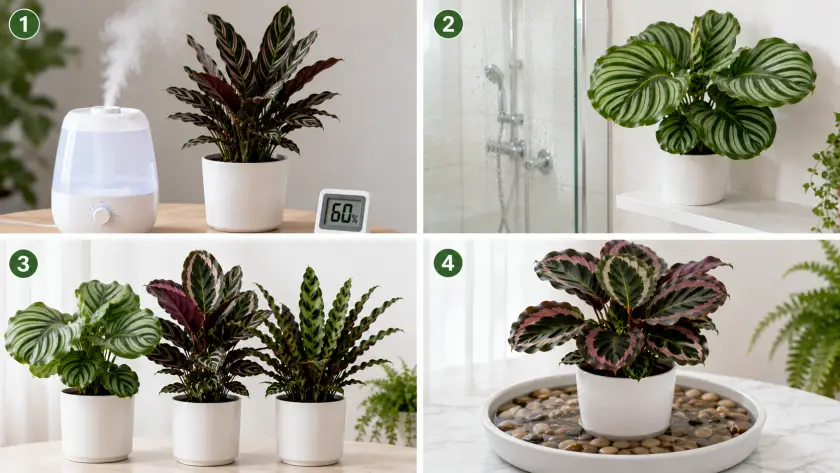
Calathea house plant success depends fundamentally on adequate humidity — the single most important environmental factor separating thriving from struggling specimens.
Humidity requirements by variety:
- 60%+ essential: Calathea orbifolia, Calathea makoyana, Calathea ornata, Calathea medallion
- 50–60% preferred: Calathea freddie, most standard varieties
- 40–50% tolerated: Calathea lancifolia (rattlesnake) — most forgiving
Typical home humidity: 30–40% — insufficient for most calathea indoor plant varieties
Increasing humidity effectively:
Humidifier (most effective): Position cool-mist humidifier 1–2 metres from plants maintaining 60%+ measured with hygrometer. Most reliable solution for demanding varieties.
Bathroom placement: Steamy shower rooms provide naturally high humidity — ideal for Calathea. Our guide on best plants for your bathroom covers positioning strategies for humidity-loving plants.
Plant grouping: Multiple plants together create localized humidity through collective transpiration. Group Calathea with other tropical plants for microclimate benefits.
Pebble trays: Fill wide shallow trays with pebbles, add water to just below pebble tops, place pots on pebbles (not in water). Evaporating water increases immediate surrounding humidity.
Avoid misting: Misting leaves provides temporary humidity increase measured in minutes while promoting fungal disease on damp foliage. Ineffective for sustained humidity management.
For comprehensive humidity solutions, our guide on humidity hacks covers affordable techniques for tropical plant care.
Temperature Requirements
Calathea plant care temperature management prevents cold damage affecting appearance and health.
Ideal temperature: 18–27°C year-round
Minimum temperature: 15°C — below this causes leaf damage and growth cessation
Temperature dangers:
- Cold drafts from windows in winter cause immediate leaf damage
- Air conditioning vents create cold dry air harmful to Calathea
- Outdoor temperatures below 15°C cause permanent leaf damage
Positioning: Keep Calathea away from exterior walls in winter, air conditioning vents, and drafty windows. Consistent warmth matters more than occasional temperature highs.
Soil Mix for Calathea Plants
Calathea plant care requires moisture-retentive but well-draining soil — preventing both drought stress and waterlogging.
Ideal Calathea soil mix:
- 40% quality potting soil
- 30% peat moss or coco coir (moisture retention)
- 20% perlite (drainage)
- 10% worm castings (gentle nutrition)
Commercial alternatives:
- African Violet mix (moisture-retentive, suitable structure)
- Quality potting soil amended with perlite (3:1 ratio)
- Aroid mix adjusted with extra peat for moisture retention
Avoid:
- Cactus/succulent mix (too fast-draining — causes drought stress)
- Heavy garden soil (waterlogging leads to root rot)
- Pure peat moss (compacts when dry, water-repellent)
For complete soil guidance, our guide on best soil mix for every plant type covers custom mixes for tropical plants.
Fertilizing Calathea Plants
Calathea plant care fertilizing requires gentle approach — too much fertilizer causes leaf tip burn and salt buildup.
Fertilizing schedule:
- Spring–Summer: Every 4 weeks with balanced liquid fertilizer at quarter strength
- Autumn: Every 6–8 weeks reducing gradually
- Winter: Stop completely — plants rest
Best fertilizer for Calathea:
- Balanced liquid fertilizer (NPK 10-10-10)
- Dilute to QUARTER recommended strength (Calathea more sensitive than most plants)
- Apply to pre-watered soil only — never dry soil
- Flush soil with plain water every 2–3 months to remove salt buildup
Signs of over-fertilizing:
- Brown crispy leaf tips and edges
- White crusty deposit on soil surface
- Yellowing leaves with brown tips
For complete fertilizing guidance, our guide on fertilizing indoor vs outdoor plants covers seasonal feeding schedules.
Repotting Calathea Plants
Calathea plants need repotting every 1–2 years when roots fill container.
Signs repotting needed:
- Roots growing from drainage holes
- Water runs straight through without absorbing
- Growth significantly slowed
- Plant drying out very quickly
Repotting process:
- Choose pot only 5cm larger — too large causes waterlogging
- Use fresh moisture-retentive soil mix
- Spring repotting for fastest recovery
- Water thoroughly after repotting
- Expect 2–4 weeks adjustment period with reduced growth
Calathea repotting caution: Avoid disturbing roots unnecessarily. Calathea recovers slowly from root disturbance — handle gently and minimize root inspection during repotting.
For complete repotting guidance, our guide on how to repot a plant covers step-by-step techniques. Our guide on repotting mistakes to avoid prevents common Calathea repotting errors.
Propagating Calathea Plants
Calathea plant propagation differs from most houseplants — stem cuttings do NOT work. Division during repotting represents the only reliable propagation method.
Calathea division steps:
1. Timing:
- Propagate during spring repotting
- Plant should be actively growing
- Avoid propagating stressed or sick plants
2. Remove from pot:
- Water plant day before to reduce transplant stress
- Gently remove from pot tipping sideways
- Shake or rinse excess soil from roots
3. Identify divisions:
- Look for natural clumping — separate root clusters with distinct stems
- Each division needs minimum 2–3 stems with roots attached
- Avoid single-stem divisions — poor survival rate
4. Separate divisions:
- Use clean sharp scissors or hands to separate root clusters
- Work gently — avoid tearing roots unnecessarily
- Each section needs healthy root system
5. Plant divisions:
- Pot each division in appropriate moisture-retentive mix
- Water thoroughly
- Position in high humidity environment
- Expect 2–4 weeks before new growth resumes
For complete propagation guidance, our guide on how to propagate houseplants covers division techniques for clumping tropical plants.
Are Calathea Plants Toxic to Cats and Dogs?
Are calathea plants toxic to cats? No — Calathea plant safe for cats, dogs, and humans makes it one of the most pet-friendly colorful foliage plants available.
Calathea plant toxic to cats — FALSE. Calathea is listed as non-toxic by ASPCA for both cats and dogs. All varieties including orbifolia, ornata, lancifolia, and makoyana are completely safe.
Why Calathea is perfect for pet households:
- Non-toxic to cats (ASPCA confirmed)
- Non-toxic to dogs
- Non-toxic to humans
- No skin irritation from sap
Pet-safe colorful alternatives:
- Stromanthe Triostar (pink and green — non-toxic)
- Maranta (prayer plant — non-toxic)
For comprehensive pet-safe plant guidance, our guides on cat-friendly plants and dog-friendly plants cover complete non-toxic plant selection.
Troubleshooting Common Calathea Problems
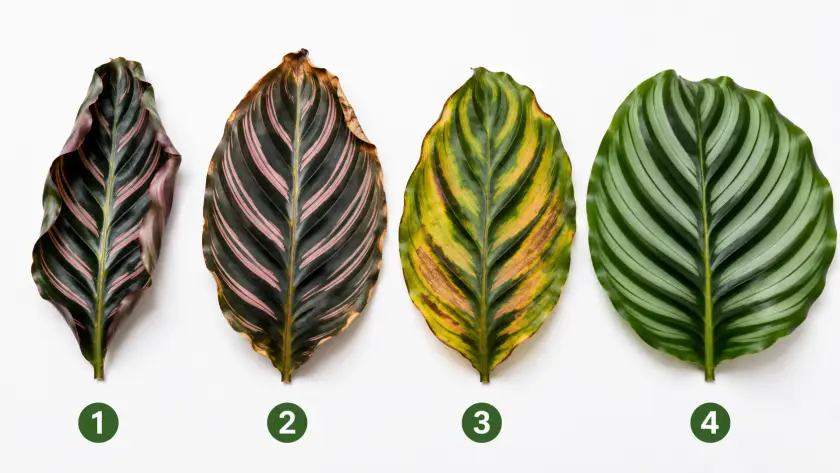
Calathea Plant Leaves Curling
Calathea plant leaves curling represents the most common and earliest visible stress signal.
Causes of Calathea leaf curling:
Underwatering (most common):
- Leaves curl inward protecting moisture
- Soil dry below 2cm depth
- Solution: Water thoroughly and increase frequency
Low humidity:
- Leaves curl edges inward
- Soil moisture adequate but air too dry
- Solution: Increase humidity to 50%+ immediately
Cold temperatures:
- Leaves curl and lose color
- Plant near drafty window or AC vent
- Solution: Move to warmer stable location
Root bound:
- Cannot absorb adequate water despite regular watering
- Roots filling pot completely
- Solution: Repot to next size container
Brown Leaf Tips and Edges
Brown tips represent the second most common calathea plant care problem.
Causes:
Hard water/fluoride (most common):
- Brown crispy tips only
- Appears despite correct watering
- Solution: Switch to filtered or rainwater
Low humidity:
- Brown crispy edges spreading inward
- Solution: Increase humidity to 60%+
Over-fertilizing:
- Brown tips with white soil crust
- Solution: Flush soil, reduce fertilizer concentration
Underwatering:
- Brown edges plus curling
- Solution: Increase watering frequency
Yellow Leaves
Calathea plants develop yellow leaves from several causes.
Overwatering:
- Multiple leaves yellowing
- Soil stays wet for 7+ days
- Solution: Reduce watering, improve drainage
Natural aging:
- Single lower leaves yellowing one at a time
- Normal process — redirect energy to new growth
- Solution: Remove yellow leaves, continue normal care
Nutrient deficiency:
- Overall pale yellow appearance
- Slow growth
- Solution: Resume gentle fertilizing schedule
For complete yellow leaf diagnosis, our guide on why your plant leaves are turning yellow covers every cause. Our guide on leaf curl, browning, and droop provides additional troubleshooting.
Prayer Movement Stopping
Calathea prayer plant movement stopping indicates stress.
Causes:
- Insufficient light (most common)
- Overwatering
- Root rot preventing water movement
- Extreme temperature stress
Solution: Diagnose primary issue (light, water, or temperature) and correct. Prayer movement typically resumes within 1–2 weeks of improved conditions in mild cases.
Pests on Calathea Plants
Calathea plants attract specific pests due to high humidity preferences.
Common pests:
Spider mites (most common):
- Fine webbing on leaf undersides
- Tiny red/brown dots moving on leaves
- Cause: Low humidity — spider mites thrive in dry air
- Solution: Increase humidity, wipe leaves with neem oil solution
Mealybugs:
- White cottony clusters in leaf joints
- Solution: Remove manually with alcohol-dipped cotton, treat with neem oil
Fungus gnats:
- Small flies around soil
- Larvae damage roots in wet soil
- Solution: Allow soil to dry slightly more, use sticky traps
Styling Calathea Plants by Room
Bathroom Calathea Placement
Calathea indoor plant thrives in bathroom humidity — steamy shower rooms provide naturally high moisture levels ideal for demanding varieties.
Best bathroom Calathea:
- Calathea orbifolia (large dramatic leaves)
- Calathea lancifolia (tolerant, fast-growing)
- Calathea ornata (elegant pinstripes)
Our guide on best plants for your bathroom covers bathroom-specific positioning strategies.
Living Room Calathea Display
Position calathea house plant 1–3 metres from east-facing windows or filtered south/west windows. Pair with solid green plants for balanced displays.
Complementary plants for Calathea displays:
- Snake Plant — structural green contrast
- Monstera — large green background
- Pothos — trailing green complement
For complete styling guidance, our guide on how to style indoor plants by room covers positioning principles.
Bedroom Calathea Benefits
Calathea plants suit bedrooms — non-toxic, humidity-increasing, and visually calming. Prayer movement provides natural light indicator showing day/night cycles.
Our guide on how to decorate your bedroom with plants covers bedroom plant selection and positioning.
Frequently Asked Questions
How do you care for a Calathea plant?
Calathea plant care requires bright indirect light (1–3 metres from windows), watering when top 2cm dries using filtered or rainwater, maintaining 50–60% humidity minimum, temperatures between 18–27°C, and gentle fertilizing at quarter strength every 4 weeks during spring and summer. The three most critical factors are humidity, water quality, and consistent moisture.
Why is my Calathea plant leaves curling?
Calathea plant leaves curling most commonly indicates underwatering — check soil moisture and water thoroughly if dry below 2cm. Low humidity causes curling even with adequate soil moisture — increase to 50%+ using humidifier or bathroom placement. Cold temperatures from drafts also cause curling requiring relocation away from windows and AC vents.
Are Calathea plants toxic to cats?
No — Calathea plants toxic to cats is a myth. ASPCA confirms all Calathea varieties are completely non-toxic to cats, dogs, and humans. This makes Calathea one of the safest colorful foliage plants for pet households, unlike many other dramatic foliage plants containing toxic compounds.
What is the easiest Calathea to care for?
Rattlesnake calathea plant (Calathea lancifolia) ranks as easiest for beginners — more tolerant of lower humidity (40%+ adequate), forgiving of inconsistent watering, and fast-growing. The Calathea freddie plant also suits beginners with compact growth and moderate humidity requirements compared to demanding varieties like orbifolia and ornata.
Why does my Calathea have brown tips?
Brown tips on calathea house plant most commonly result from fluoride or chlorine in tap water — switch to filtered or rainwater immediately. Low humidity causes brown edges spreading inward requiring humidity increase to 60%+. Over-fertilizing creates brown tips with white soil crust requiring soil flushing and fertilizer reduction.
How often should I water my Calathea?
Water calathea plants when top 2cm of soil dries — typically every 5–7 days in summer, every 7–10 days in winter. Always check soil moisture before watering rather than following rigid schedules. Use filtered water or rainwater to prevent fluoride damage. Water thoroughly until draining from holes, then empty saucer after 15 minutes.
How do you increase humidity for Calathea?
Increase humidity for calathea indoor plant using cool-mist humidifier maintaining 60%+ measured with hygrometer (most effective), bathroom placement near steamy showers, grouping with other tropical plants for microclimate benefits, or pebble trays with water below pot level. Avoid misting which provides temporary relief while promoting fungal disease on wet leaves.
Related Plant Care Guides
- 🌈 Colorful Indoor Plants Guide
- 🌿 Air Purifying Plants Guide
- 🌿 Monstera Care Guide
- 🌿 Pothos Care Guide
- 🌸 Peace Lily Care Guide
- 🐍 Snake Plant Care Guide
- 🕷️ Spider Plant Care Guide
- 🌱 ZZ Plant Care Guide
- 🌿 Rubber Plant Care Guide
- 🌿 Fiddle Leaf Fig Care Guide
- 💡 Complete Indoor Light Guide
- 💧 Complete Watering Guide
- 💨 Humidity Hacks Guide
- 💧 Fertilizing Indoor vs Outdoor
- 🌱 Best Soil Mix Guide
- 🌱 How to Repot a Plant
- ⚠️ Repotting Mistakes to Avoid
- 🌱 How to Propagate Houseplants
- 🍃 Why Leaves Turn Yellow
- 🌿 Leaf Curl, Browning, Droop Guide
- 💧 Signs of Overwatering
- 🆘 How to Revive a Dying Plant
- 🐾 Cat-Friendly Plants Guide
- 🐾 Dog-Friendly Plants Guide
- 🛁 Best Bathroom Plants
- 🏠 Style Indoor Plants by Room
- 🛌 Decorate Bedroom with Plants
- 🌿 Best Indoor Plants for Beginners
- 🌿 Low-Light Hanging Plants
- 🌿 35 Low-Maintenance Plants
- 📂 Browse All Indoor Plants
Final Thoughts
Calathea plant care rewards patient growers with some of the most spectacular foliage available in the indoor plant world. The painted stripes of calathea ornata plant, the peacock feathers of calathea makoyana peacock plant, and the bold circles of calathea orbifolia plant create living artwork that no other houseplant genus matches for sheer visual drama.
The reputation for difficulty surrounding calathea plants often deters beginners — unnecessarily. While demanding more attention than Snake Plant or Pothos, Calathea care becomes logical once the tropical origins are understood. High humidity replicates rainforest moisture. Filtered water avoids fluoride sensitivity evolved in soft tropical rainfall. Consistent soil moisture mirrors equatorial rainfall patterns. Understanding these reasons transforms care from mysterious rules into sensible responses to the plant’s natural habitat.
The calathea prayer plant movement adds an interactive dimension unavailable in static houseplants. Watching leaves fold upward at dusk and open at dawn creates genuine connection with the plant’s biological rhythms — a daily reminder that plants are living organisms responding to their environment. This movement also provides instant health feedback: active prayer indicates healthy happy plants, while stillness signals stress requiring investigation.
Calathea plant toxic to cats concerns often arise — reassuringly unfounded. All Calathea varieties remain completely safe for cats, dogs, and humans making them ideal for pet households seeking dramatic colorful foliage without toxicity risks. This pet safety combined with visual impact makes Calathea particularly valuable for plant collectors with curious animals.
Starting with rattlesnake calathea plant or calathea freddie plant builds care confidence before attempting demanding calathea orbifolia or calathea ornata plant care. Master humidity management with tolerant varieties, establish filtered water routines, and develop consistent watering schedules — then expand to more sensitive varieties as confidence grows.
The investment in proper calathea indoor plant care pays extraordinary aesthetic dividends. Few houseplants generate more admiration from visitors than a healthy, vibrant Calathea displaying full leaf patterns and active prayer movement — living proof that the most spectacular plants reward dedicated care.
According to the Royal Horticultural Society, Calathea plants require consistently high humidity of at least 50% to maintain leaf health, with brown leaf tips and edges indicating humidity levels falling below tropical requirements — confirming that humidity management represents the single most important factor separating thriving from struggling specimens in home environments. 🌿