To grow a healthy calathea, give it bright to medium indirect light, keep the soil evenly moist but never soggy, use rainwater, distilled or filtered water, and keep humidity around 50–60% at a steady 18–27°C (64–80°F). Most calathea problems, especially brown edges and curling leaves, come from dry air, drying out between waterings, or minerals in hard tap water.
Calatheas are worth that extra attention. Their striped, feathered and painted leaves are some of the most striking foliage you can grow indoors, and many of them fold their leaves upward each evening like a prayer plant. This guide covers the care every calathea needs, then explains how popular varieties such as orbifolia, ornata, rattlesnake and peacock differ.
Here at Patch Plants, our guides are written by botanist Sawera Shahid (MPhil Botany), and calatheas are a good example of why the science matters: once you know they evolved on humid, shaded rainforest floors, almost every care rule makes sense. You can read more about how we research and update our guides on our About Patch Plants page.
Calathea Care at a Glance
| Care factor | What calatheas need |
|---|---|
| Light | Bright to medium indirect light; no direct midday or afternoon sun |
| Water | Keep evenly moist; water when the top 2 cm (about 1 in) is dry |
| Water type | Rainwater, distilled or filtered water if your tap water is hard or fluoridated |
| Humidity | 50–60% or higher; very dry air causes brown, crispy edges |
| Temperature | 18–27°C (64–80°F); keep above 15°C (59°F) and away from draughts |
| Soil | Moisture-retentive but airy mix with coir or peat-free compost plus perlite |
| Feeding | Quarter- to half-strength balanced liquid feed every 4 weeks, spring to summer |
| Propagation | Division in spring; stem cuttings do not root |
| Pets | Generally listed as non-toxic to cats and dogs |
What Is a Calathea?
Calatheas belong to the Marantaceae, or prayer plant family, alongside Maranta and Stromanthe. They come from tropical Central and South America, where they grow under the forest canopy in warm, humid air and filtered light. That habitat explains their needs: indirect rather than direct sun, steady moisture and high humidity.
Botanists have moved most popular calatheas into the genus Goeppertia, so you may see Goeppertia orbifolia or Goeppertia makoyana on labels. Garden centres still sell them as calatheas, and the care is the same either way.
Calatheas are also known for nyctinasty, the daily leaf movement that gives prayer plants their name. A small, flexible joint at the base of each leaf (the pulvinus) changes its water pressure as light fades, lifting the leaves upward at night and lowering them again in the morning. A calathea that suddenly stops moving its leaves is often stressed, usually by low light, cold or root problems. Its close cousin, the lemon lime prayer plant, behaves the same way.
Popular Calathea Varieties
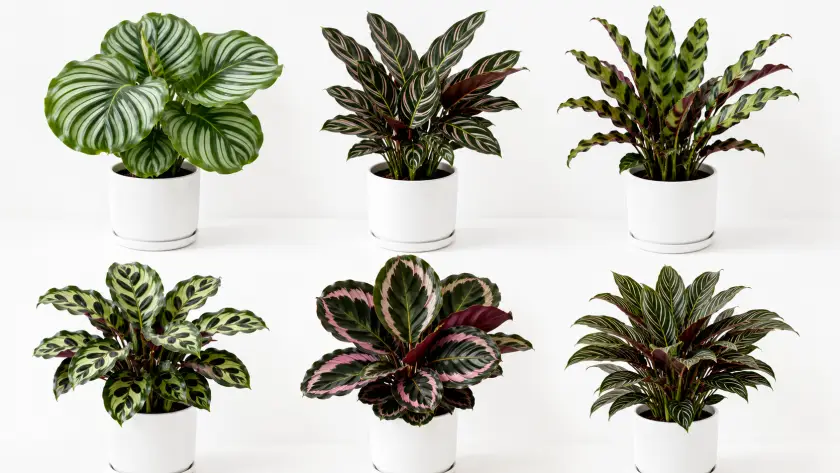
All calatheas share the same basic needs, but some are far more forgiving than others. Use this table to choose the right one for your home.
| Variety | Leaf look | Typical indoor size | Difficulty |
|---|---|---|---|
| Rattlesnake (Calathea lancifolia) | Long, wavy leaves with dark spots; purple undersides | 45–75 cm | Easiest |
| Freddie (Calathea concinna ‘Freddie’) | Pale green leaves with dark feather stripes | 40–60 cm | Easy |
| Peacock plant (Calathea makoyana) | Feather-like oval markings; purple-pink undersides | 30–60 cm | Moderate |
| Medallion (Calathea roseopicta ‘Medallion’) | Round leaves with silver-pink feathering; burgundy undersides | 30–60 cm | Moderate |
| Pinstripe (Calathea ornata) | Dark leaves with fine pink or white pinstripes | 40–60 cm | Demanding |
| Orbifolia (Calathea orbifolia) | Large round leaves with silver-green bands | 60–90 cm | Demanding |
Rattlesnake Calathea (Calathea lancifolia)
The rattlesnake calathea is the best choice for beginners. Its long, narrow leaves have wavy edges, dark green oval spots and purple undersides that show clearly when the leaves lift at night. It copes better than most calatheas with average room humidity (around 40–50%) and the occasional late watering. Give it medium to bright indirect light and water when the top 2–3 cm of soil is dry.
Calathea Freddie
‘Freddie’ is a compact, bushy calathea with pale green leaves marked by darker feather-shaped stripes. It is fairly tolerant and suits shelves and side tables. Keep it in moderate to bright indirect light and aim for 50–60% humidity.
Peacock Plant (Calathea makoyana)
The peacock plant has some of the most intricate markings of any calathea: thin, pale green leaves with dark oval patches that look like feathers, and purple-pink undersides. Its thin leaves dry out quickly, so it needs consistently moist soil and about 60% humidity. Avoid direct sun, which scorches the delicate leaves.
Medallion Calathea (Calathea roseopicta ‘Medallion’)
Medallion has broad, rounded leaves patterned with silvery-pink feathering on deep green, and rich burgundy undersides. The pale markings need bright indirect light to stay vivid; in dim rooms they fade toward plain green. Keep humidity high and the soil evenly moist.
Calathea Ornata (Pinstripe Plant)
Ornata has dark green leaves with fine pink or white lines that look hand-painted. Its pinstripes fade with age and in low light, and its leaf edges brown quickly in dry air, so it needs bright indirect light, 60% or more humidity and soft water. It is beautiful but not the best first calathea.
Calathea Orbifolia
Orbifolia is the largest of the common calatheas, with round leaves up to about 30 cm across banded in silver and green. It needs space, high humidity and very consistent watering; dry air quickly leaves crispy brown margins on its big leaves. A bright bathroom or a spot near a humidifier suits it well.
If you love patterned foliage, our guides to popular houseplants with patterned leaves, plants with pink and green leaves and colorful foliage indoor plants suggest more plants to pair with calatheas.
Calathea Light Requirements
Calatheas need enough light to keep their patterns bright, but direct sun scorches and bleaches the leaves. The best spot is usually 1–2 m from an east-facing window, near a north-facing window, or further back from a south- or west-facing window with a sheer curtain.
Too much light: faded or washed-out colours, crispy brown patches, leaves curling during the brightest part of the day and soil drying out unusually fast.
Too little light: pink or silver markings fading to green, slow growth, small new leaves and leaf movement slowing or stopping.
Rattlesnake and Freddie tolerate medium light better than ornata, medallion or orbifolia. Our guide to indoor light explains how to judge the light in each room.
How to Water a Calathea
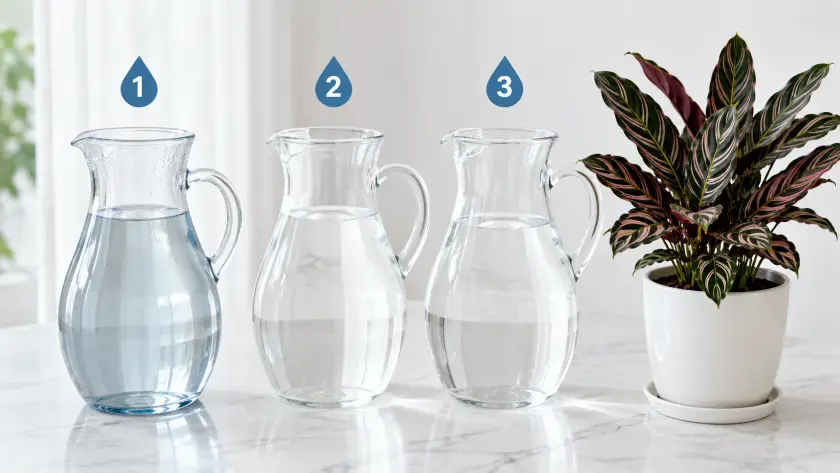
Calatheas like soil that stays evenly moist, like a wrung-out sponge. Water when the top 2 cm (about 1 in) of soil feels dry but the soil below is still slightly damp. In a warm, bright room that is often every 5–7 days in summer; in winter it may be every 10–14 days. Always check the soil rather than watering on a fixed day.
- Push a finger 2 cm into the soil to check moisture.
- Water slowly until it runs from the drainage holes.
- Empty the saucer after 15–20 minutes so the roots never sit in water.
- Use room-temperature water; cold water can shock tropical roots.
Why Water Quality Matters
Calatheas are sensitive to fluoride and to the salts and minerals in hard tap water. Over time these build up in the leaf edges and cause brown, crispy tips even when you water correctly. The North Carolina State Extension profile for the peacock plant (Goeppertia makoyana) recommends rainwater or distilled water for this reason.
Good options include rainwater, distilled water and filtered water. Leaving tap water to stand overnight lets chlorine escape, but it does not remove fluoride, chloramine or hardness minerals, so it helps only a little. Flushing the pot with plenty of rainwater or distilled water every couple of months also washes out built-up salts.
Signs of overwatering: several leaves yellowing at once, soil that stays wet for a week or more, mushy stems at the base and a sour smell. Signs of underwatering: leaves curling inward, crispy brown edges, drooping and soil pulling away from the pot sides.
Our complete watering guide and signs of overwatering guide explain how to get the balance right.
Calathea Humidity Requirements
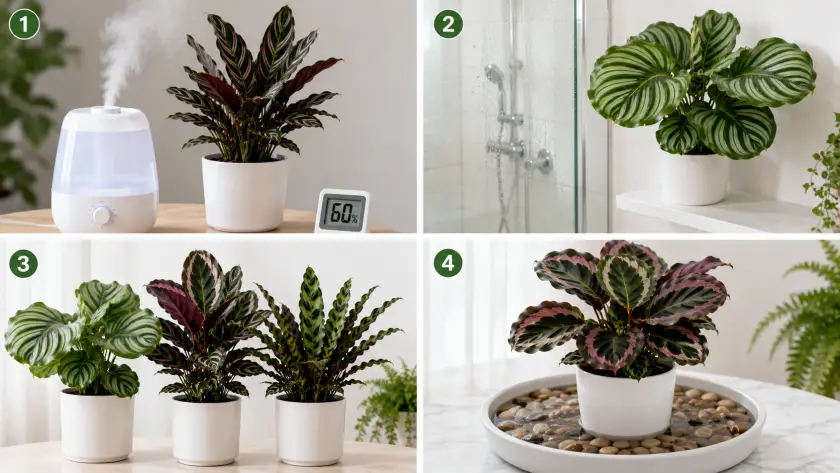
Humidity is the biggest difference between a thriving calathea and a crispy one. Most varieties do best at 50–60% or higher, while many heated homes sit at 30–40% in winter. Thin leaves lose water quickly in dry air, and the leaf edges dry out first.
- 60% or more: orbifolia, ornata, peacock plant and medallion
- 50–60%: Freddie and most other calatheas
- 40–50% tolerated: rattlesnake calathea
The most reliable ways to raise humidity are:
- A humidifier: the most effective option for demanding varieties; use a cheap hygrometer to check the level.
- A bright bathroom: steam from showers keeps the air humid, as long as there is a window for light. See our list of the best plants for your bathroom.
- Grouping plants: plants release moisture through their leaves, so a cluster creates a slightly more humid pocket of air.
- A pebble tray: a tray of wet pebbles under the pot adds a little local humidity; our DIY humidity tray guide shows how.
Misting only raises humidity for a few minutes and can leave water sitting on leaves, so it is not a long-term fix. Our article on misting for plants explains why, and our humidity hacks guide has more ideas.
Temperature for Calatheas
Keep calatheas between 18 and 27°C (64–80°F) all year. Below about 15°C (59°F) growth stops and leaves can curl, spot or yellow. Cold draughts from windows and doors, and hot or cold air from vents and radiators, do more harm than the overall room temperature, so choose a steady spot away from them and keep leaves from touching cold glass in winter.
Best Soil for Calatheas
Calatheas need a mix that holds moisture but still lets air reach the roots. A simple homemade mix is:
- 2 parts good-quality peat-free houseplant compost
- 1 part coco coir
- 1 part perlite
- Optional: a handful of fine orchid bark or worm castings
An African violet mix with extra perlite also works. Avoid cactus mix, which drains too fast, and heavy garden soil, which stays waterlogged. Always use a pot with drainage holes. Our soil mix guide explains each ingredient.
Feeding Calatheas
Calatheas are light feeders and easily burned by strong fertiliser. Feed with a balanced liquid houseplant fertiliser at a quarter to half of the label strength every 4 weeks in spring and summer, and stop in autumn and winter. Always water first and feed onto damp soil.
Brown tips together with a white crust on the soil usually mean too much fertiliser. Flush the pot with plenty of plain soft water and feed less often. Our houseplant fertilizer guide and indoor vs outdoor fertilizing guide cover feeding in more detail.
Repotting a Calathea
Most calatheas need repotting every 1–2 years, in spring. Repot when roots grow out of the drainage holes, water runs straight through without soaking in, or the plant dries out within a couple of days.
- Move up only one pot size, about 2–5 cm wider.
- Handle the roots gently; calatheas recover slowly from root disturbance.
- Use fresh, moisture-retentive mix and water well afterwards.
- Expect slower growth and perhaps some drooping for 2–4 weeks.
Our how to repot a plant guide walks through the steps, and our list of repotting mistakes to avoid explains why oversized pots cause problems.
How to Propagate a Calathea
Calatheas grow from underground rhizomes, so stem or leaf cuttings will not root. Division is the reliable method, ideally in spring when you repot.
- Water the plant the day before so the roots are hydrated.
- Ease the plant out of its pot and gently loosen the soil.
- Look for natural clumps, each with several stems and its own roots.
- Pull or cut the clumps apart with clean hands or a sharp knife, keeping as many roots as possible.
- Pot each division in fresh, moist mix in a pot that just fits its roots.
- Keep the new plants warm, in high humidity and bright indirect light; new growth usually appears within 2–4 weeks.
Avoid making single-stem divisions, which often fail. Our guide on how to propagate houseplants at home covers division and other methods.
Are Calatheas Toxic to Cats and Dogs?
Calatheas are generally considered non-toxic to cats and dogs. The ASPCA lists Calathea species as non-toxic to dogs, cats and horses, and the NC State Extension profile above gives the peacock plant the same rating. That makes calatheas one of the better choices for colourful foliage in pet households.
Non-toxic does not mean pets should eat them: chewing any plant can cause mild vomiting or stomach upset, and leaves with pesticide residue can cause problems. Keep plants where pets cannot graze on them. Our guides on cat-friendly plants and dog-friendly plants share practical tips.
Common Calathea Problems and Fixes
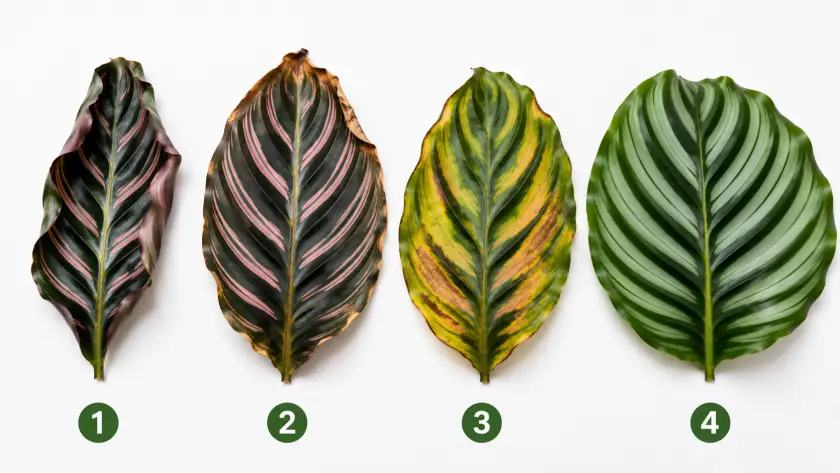
| Symptom | Most likely cause | What to do |
|---|---|---|
| Leaves curling inward | Underwatering, low humidity or cold | Check soil, raise humidity, move away from draughts |
| Brown, crispy tips only | Fluoride, salts or hard tap water | Switch to rain, distilled or filtered water; flush the soil |
| Brown edges spreading inward | Dry air or soil drying out | Raise humidity to 50–60%+; water more consistently |
| Brown tips plus white crust on soil | Too much fertiliser | Flush the pot and feed at quarter strength |
| Several leaves yellowing at once | Overwatering or poor drainage | Let the top of the soil dry; check roots for rot |
| One old lower leaf yellowing | Natural ageing | Trim it off at the base |
| Patterns fading | Too little light (or too much direct sun) | Move to bright, indirect light |
| Leaves no longer fold at night | Low light, cold, overwatering or root damage | Correct the main stress; movement often returns within 1–2 weeks |
| Fine webbing and pale speckles | Spider mites (common in dry air) | Wipe leaves, raise humidity, treat with insecticidal soap |
Calathea Leaves Curling
Curling is usually the first sign of stress. Leaves roll inward to reduce water loss when the soil is too dry, the air is too dry or the plant is cold. Check the soil first; if it is moist, look at humidity and draughts. A root-bound plant can also curl because there is too little soil to hold water.
Brown Tips and Edges
Brown tips alone usually point to water quality or fertiliser salts. Brown edges that spread inward point to dry air or irregular watering. Cut off brown sections with clean scissors, following the leaf’s natural shape, but leave a thin line of brown so you do not cut into healthy tissue.
Yellow Leaves
Several yellow leaves at once, with soil that stays wet, suggest overwatering or root rot; see our guide on identifying and treating root rot. A single old leaf yellowing now and then is normal. Our guides to yellow leaves on plants and leaf curl, browning and droop help you narrow down the cause.
Pests
Spider mites are the most common calathea pest, especially in dry, heated rooms. Look for pale speckling and fine webbing under the leaves. Mealybugs appear as white cottony clusters in leaf joints, and fungus gnats hover around constantly wet soil. Isolate affected plants, wipe the leaves and treat with insecticidal soap or horticultural oil, following the label.
If your calathea is badly struggling, follow our step-by-step plan to revive a dying plant.
Where to Display a Calathea
A bright bathroom is ideal for humidity-loving varieties such as orbifolia and ornata. In living rooms, place calatheas 1–2 m from an east-facing window and pair them with plain green plants such as a monstera or pothos so their patterns stand out. Grouping them with other tropical plants also raises humidity.
Calatheas suit bedrooms too, because they are pet-friendly and their evening leaf movement is calming to watch. See our ideas on decorating your bedroom with plants and styling indoor plants by room. New to houseplants? Start with an easier plant from our list of the best indoor plants for beginners, or browse all our indoor plant guides.
Frequently Asked Questions
How often should I water my calathea?
Water when the top 2 cm of soil is dry, which is often every 5–7 days in summer and every 10–14 days in winter. Always check the soil first, water until it drains, and empty the saucer. Use rainwater, distilled or filtered water if your tap water is hard.
Why are my calathea leaves curling?
Curling usually means the plant is losing water faster than it can take it up. Check whether the soil has dried out, raise humidity to 50–60%, and move the plant away from cold draughts or heaters.
Why does my calathea have brown tips?
Brown tips are most often caused by fluoride, chlorine or minerals in tap water, or by fertiliser build-up. Brown edges that spread inward usually mean the air is too dry. Switch to soft water, flush the soil and increase humidity.
What is the easiest calathea to care for?
The rattlesnake calathea (Calathea lancifolia) is the easiest. It tolerates lower humidity and the odd missed watering better than most. Calathea ‘Freddie’ is another forgiving choice.
Are calatheas safe for cats and dogs?
Yes, calatheas are generally listed as non-toxic to cats and dogs, and the ASPCA lists Calathea species as non-toxic to dogs, cats and horses. Eating any plant can still upset a pet’s stomach, so keep them out of reach.
Final Thoughts
Calatheas have a reputation for being fussy, but their care is logical once you remember where they come from: shaded, humid rainforest floors. Give them bright indirect light, steady moisture, soft water and humid air, and they reward you with spectacular leaves that rise and fall each day. Start with a rattlesnake or Freddie, learn its signals, and then try a peacock plant, ornata or orbifolia.