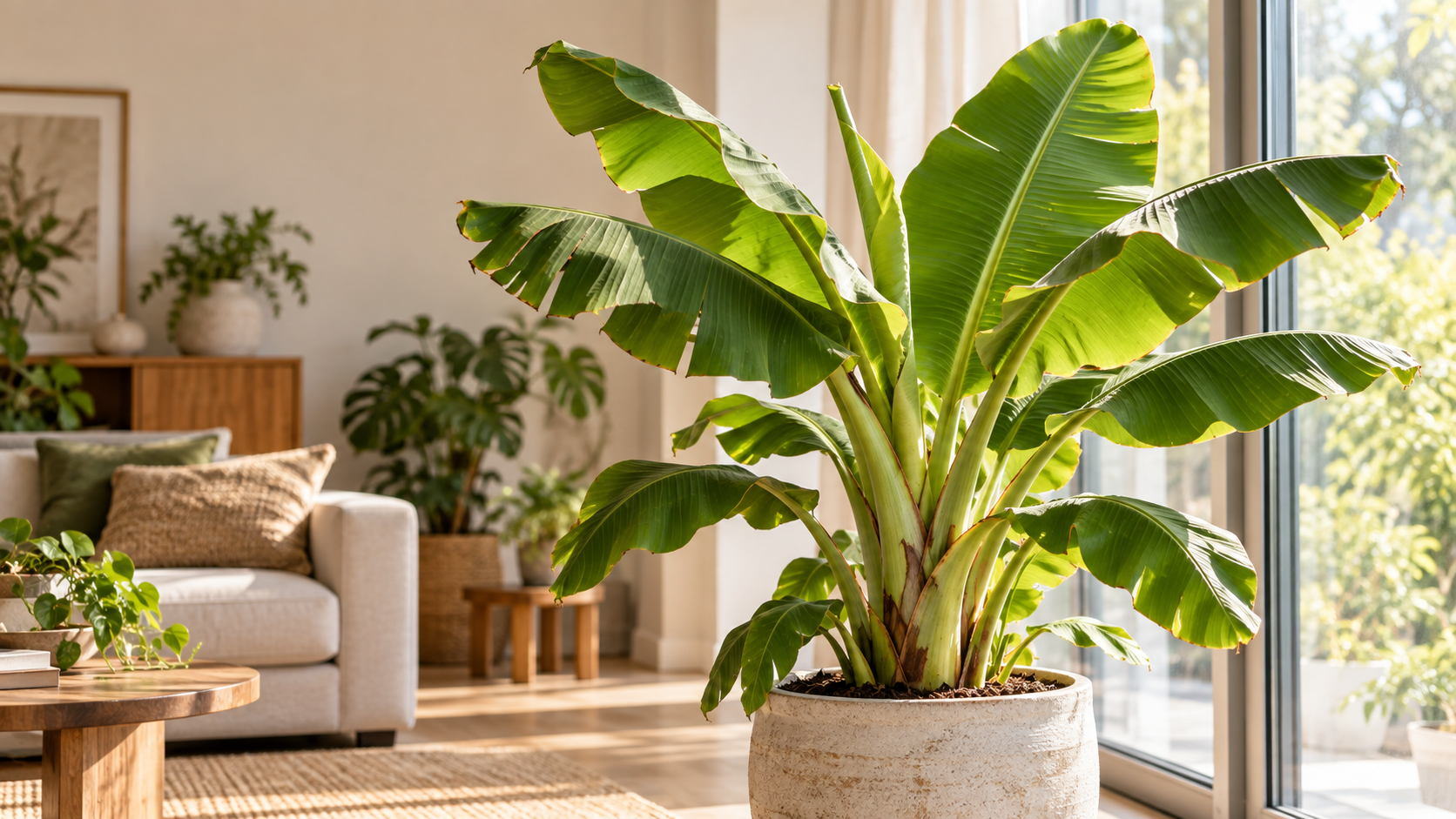
This guide covers 11 practical indoor banana plant care tips, from choosing your first plant to troubleshooting yellow leaves, brown edges, pests, and slow growth.
For more tropical houseplant advice, explore the Indoor Plants guides and our complete Plant Care library.
QUICK ANSWER
How Do You Care for an Indoor Banana Plant?
Give an indoor banana plant strong, consistent light, warm temperatures, evenly moist but never waterlogged soil, and a container with functional drainage holes. Increase humidity when indoor air becomes dry while maintaining gentle airflow around the large leaves.
During active growth, feed according to fertilizer label directions and monitor the roots for signs that the plant needs repotting. Remove fully brown or damaged foliage, keep broad leaves clean, and regularly inspect their undersides for pests.
Indoor fruit production requires demanding conditions, so healthy tropical foliage is a more realistic goal for many home growers.
PATCH PLANTS SUMMARY
Indoor Banana Plant Care: Key Takeaways
- Choose a banana variety that fits your available indoor space.
- Provide strong, consistent light to support large tropical leaves.
- Keep the plant in warm, relatively stable conditions.
- Check soil moisture before watering rather than relying only on a calendar.
- Keep the root zone moist without allowing it to remain waterlogged.
- Use loose potting soil and a container with functional drainage holes.
- Increase humidity in dry indoor conditions while maintaining airflow.
- Feed during active growth according to fertilizer label directions.
- Repot when roots become crowded.
- Remove damaged foliage and keep broad leaves clean.
- Inspect regularly for spider mites, scale, aphids, and other problems.
Why Indoor Banana Plant Care Starts With the Right Variety
Before deciding where to place the plant or how often to water it, consider which banana variety is suitable for your home.
Banana plants can become substantial specimens. Some are more manageable in containers than others, so the available floor space, ceiling height, and light should influence your choice.
Tip 1: Choose a Suitable Indoor Banana Plant Variety
The first step in successful indoor banana plant care is choosing a plant whose mature size works with your indoor environment.
The source highlights Dwarf Cavendish, Super Dwarf Cavendish, and Musa basjoo as examples to compare.
| Variety | Indoor Size Listed in Source | Notable Feature |
|---|---|---|
| Dwarf Cavendish | 6–8 feet | Classic tropical appearance |
| Super Dwarf Cavendish | 3–4 feet | More compact growth |
| Musa basjoo | 8–10 feet | Large, hardy foliage plant |
Inspect the Plant Before Bringing It Home
Look closely at the foliage, stems, and growing medium before buying an indoor banana plant.
Check the undersides of leaves for signs of pests such as spider mites or mealybugs. Also inspect the soil. Waterlogged growing medium or a sour smell may indicate root problems.
Set Realistic Expectations for Indoor Fruit
Many people start growing banana plants indoors hoping to eventually harvest fruit. However, indoor fruiting requires demanding conditions, including strong light, steady warmth, and patience.
For many homes, the enormous tropical foliage is the main attraction. Treat fruit as a bonus rather than the only measure of success.
Tip 2: Give Your Indoor Banana Plant Strong, Consistent Light
Strong light is one of the foundations of indoor banana plant care. Banana plants produce large leaves, and insufficient light can result in weaker or slower growth.
Choose Your Brightest Suitable Window
The source recommends a south- or west-facing window because these exposures can provide strong light for much of the day.
Watch the plant itself. Pale, thin leaves or obvious leaning toward a window can indicate that the current position is not providing enough useful light.
Add a Grow Light When Natural Light Is Limited
If your home does not receive enough natural light, a full-spectrum grow light can supplement the available daylight.
This can be especially useful in apartments, shaded rooms, or during periods when natural daylight becomes limited.
Our complete indoor light guide can help you understand how window direction and distance affect indoor plants.
Acclimate the Leaves to Stronger Sun
A banana plant that has been growing in relatively dim conditions should not be moved abruptly into intense direct sunlight.
The source recommends gradually increasing exposure over roughly two weeks so the leaves have time to adjust.
Watch for Light and Heat Stress
Strong light is useful, but intense heat through glass can damage foliage. Brown, crispy areas can be associated with excessive heat or abrupt exposure to stronger sun.
Adjust the position if necessary rather than automatically assuming every brown area means the plant needs more water.
| Observation | Possible Cause | What to Check |
|---|---|---|
| Pale leaves | Insufficient light | Window exposure and distance |
| Leaning growth | Plant reaching toward light | Overall light distribution |
| Brown crispy areas | Heat or abrupt sun exposure | Afternoon heat and acclimation |
| Small, slow new leaves | Low available light | Need for brighter placement or supplemental light |
Tip 3: Maintain Warm, Stable Temperatures
Bananas are tropical plants, so indoor banana plant care works best when sudden temperature swings are minimized.
The source recommends daytime temperatures around 70°F to 80°F and keeping nighttime conditions above approximately 60°F.
Protect the Plant From Cold Drafts
Avoid placing the plant where cold outdoor air repeatedly reaches the leaves.
During colder weather, foliage pressed against cold window glass may also experience stress.
Keep It Away From Heating and Cooling Vents
Direct blasts from heaters or air-conditioning vents can expose broad banana leaves to sudden temperature and moisture changes.
Choose a stable location instead of repeatedly moving the plant around the room.
Recognize Cold Stress
The source identifies curling or blackened leaves as possible signs of exposure to sudden cold conditions.
If cold stress is suspected, move the plant to a warmer, more stable position and monitor its new growth.
Tip 4: Water According to Soil Moisture
Learning how to care for a banana plant indoors does not mean memorizing a fixed watering day.
Indoor conditions change with temperature, light, plant size, pot size, humidity, and season. Check the growing medium before deciding whether to water.
Test the Soil Before Watering
The source recommends pressing your finger approximately two inches into the potting mix.
If this upper layer feels dry, the plant may be ready for water. If it still feels wet, wait and check again later.
Water the Entire Root Ball
When watering, apply water evenly until excess begins draining from the holes at the bottom of the container.
Then empty standing water from the saucer rather than allowing the pot to remain submerged.
For a more complete explanation, see our guide to watering plants correctly.
Adjust Watering as Growth Changes
The source explains that banana plants generally use more water during warm, active growth and less when cooler conditions and shorter days slow growth.
Use that seasonal pattern as context, but continue checking the actual soil rather than relying only on predetermined intervals.
Avoid Both Extremes
Allowing the plant to become excessively dry can contribute to brown, crispy foliage. Constantly saturated soil, meanwhile, creates conditions that can damage roots.
If you are unsure whether you are giving too much water, review our guide to signs of overwatering.
If root health has already deteriorated, our root rot guide explains what to inspect next.
Tip 5: Use Well-Draining Soil and a Container With Drainage
Healthy roots need access to both moisture and oxygen. That makes the growing medium and container important parts of indoor banana plant care.
Balance Moisture Retention With Drainage
The source recommends a potting mix that holds useful moisture without remaining soggy and suggests materials such as peat moss or coco coir combined with perlite.
The goal is not extremely dry soil. Instead, create a root environment that can retain moisture while allowing excess water to escape.
Our complete soil mix guide explains how drainage, aeration, and moisture retention work together.
Always Use Functional Drainage Holes
Choose a container with drainage holes in the bottom.
A decorative pot without a way for water to escape makes it much harder to maintain healthy root conditions.
Do Not Oversize the Container
A pot that is far larger than the existing root system holds a greater volume of wet growing medium.
The source recommends giving roots room to expand without moving the plant into an unnecessarily oversized container.
Do Not Depend on Gravel to Fix Poor Drainage
The source specifically warns against relying on a gravel layer at the bottom of a pot as a substitute for functional drainage.
Choose a proper container and appropriate growing medium instead.
FREE PATCH PLANTS TOOL
Repotting Your Banana Plant?
A large indoor banana plant can require a surprising amount of potting mix as you move into bigger containers.
For rectangular planters or containers, use the free Patch Plants Soil Calculator to estimate how much soil you need before preparing the new growing space.
Tip 6: Maintain Humidity Around Your Indoor Banana Plant
Humidity is another important part of a successful indoor banana plant care routine.
Broad tropical foliage can develop dry-looking edges when the surrounding indoor air becomes very dry.
Use a Humidifier in Dry Conditions
The source recommends a humidifier as a more consistent approach than occasional misting, particularly when indoor heating dries the air.
Group Compatible Tropical Plants
Placing compatible humidity-loving plants near one another can help create a more humid local environment.
However, leave enough space between them for air movement rather than packing foliage tightly together.
Protect Leaves From Dry Air Blasts
Keep large banana leaves away from direct heating and cooling vents.
Repeated exposure to dry moving air can contribute to damaged leaf edges.
Tip 7: Provide Gentle Air Circulation
Humidity and airflow need to work together. Increasing humidity does not mean keeping the plant in stagnant air.
Leave Space Around the Foliage
Keep the plant slightly away from walls and surrounding plants so air can move around its broad leaves.
Use Gentle Air Movement
The source recommends gentle circulation rather than strong airflow.
A powerful fan directed at a banana plant can dry or physically damage its large leaves.
Avoid Crowded Corners
A tightly packed corner may provide poor airflow around wet foliage and make pest inspection more difficult.
Give the plant enough room to display its leaves without constant contact with walls or neighboring plants.
Tip 8: Fertilize During Active Growth
Banana plants can produce substantial foliage during active growth. Appropriate feeding supports that development.
Use a Complete Fertilizer
The source recommends a balanced, water-soluble fertilizer and specifically advises following the manufacturer’s directions.
Avoid making fertilizer stronger than instructed in an attempt to accelerate growth.
Do Not Fertilize Completely Dry Soil
The source recommends watering before applying fertilizer to very dry growing medium.
This helps avoid exposing dry roots immediately to concentrated fertilizer solution.
Reduce Feeding When Growth Slows
When cooler conditions and shorter days slow active growth, reduce or pause feeding accordingly.
Continuing an aggressive feeding routine while the plant is barely growing can contribute to fertilizer buildup in the potting mix.
Watch for Fertilizer Buildup
White crust on the soil surface or pot can indicate accumulated mineral or fertilizer salts.
Pale foliage and slow growth should not automatically be diagnosed as nutrient deficiency because inadequate light and root problems can produce similar symptoms.
Tip 9: Repot an Indoor Banana Plant When Its Roots Become Crowded
Fast-growing foliage eventually requires a larger root system. Part of long-term indoor banana plant care is recognizing when the existing container is becoming restrictive.
Look for Roots at Drainage Holes
Roots emerging through drainage holes can indicate that the root system has filled much of the available space.
Notice Rapid Soil Drying
If the pot suddenly dries much faster than it did previously under similar conditions, the container may contain a high proportion of roots relative to potting mix.
Check for Circling Roots
If you can safely inspect the root ball, roots circling heavily around the inside of the container are another sign that repotting may be appropriate.
Move Up Gradually
The source recommends selecting a new pot approximately two inches wider than the current container rather than jumping directly to a dramatically oversized pot.
Repot During Active Growth
The source recommends spring or early summer because active growth can help the root system establish in its new growing medium.
After repotting, keep light and temperature relatively stable while the roots settle.
Tip 10: Prune, Clean, and Support Your Banana Plant
Large leaves make an indoor banana plant visually impressive, but those leaves also collect dust and eventually develop normal wear and damage.
Remove Fully Brown or Damaged Leaves
Use clean, sharp tools to remove foliage that has become fully brown or badly damaged.
Cut the damaged leaf stalk carefully without injuring the central growing area where new foliage develops.
For general technique, see our pruning basics guide.
Clean Dust From Broad Leaves
Banana leaves provide a large surface where household dust can accumulate.
Gently wiping them with a soft, damp cloth keeps the foliage clean and helps the plant make better use of available light.
Support a Leaning Plant
Heavy leaves or growth toward a strong light source can sometimes make the plant lean.
The source recommends using a sturdy stake and soft garden tie when structural support is necessary.
Do not tie the plant so tightly that the support cuts into its growing tissue.
Tip 11: Inspect for Pests and Respond to Problems Early
Regular observation is one of the most useful indoor banana plant care habits because large leaves can provide plenty of hiding space for pests.
Inspect Leaf Undersides and Stems
The source specifically identifies spider mites, scale, and aphids as pests to watch for.
Check the undersides of leaves and stems for webbing, sticky residue, unusual bumps, or visible insects.
Isolate an Infested Plant
If you discover a pest problem, separate the affected banana plant from nearby houseplants while you address the infestation.
Rinse the Foliage
The source recommends gently rinsing the plant to physically remove as many pests as possible before using an appropriate treatment.
Use Treatments According to Their Labels
If an insecticidal soap, horticultural treatment, or another pest-control product is required, use a product labeled for the plant and pest and follow its instructions.
Change One Care Factor at a Time
Not every damaged leaf is caused by pests.
Yellow leaves, brown edges, and drooping can also relate to light, water, temperature, humidity, or root conditions.
Instead of changing everything simultaneously, the source recommends adjusting one care factor at a time so you can better identify what helps.
If your plant continues declining, use our step-by-step plant rescue guide.
Indoor Banana Plant Problems and What to Check
| Problem | Possible Factors | What to Check First |
|---|---|---|
| Yellow leaves | Water, light, roots, nutrition | Soil moisture and light |
| Brown leaf edges | Dry air, drought, heat stress | Humidity and soil moisture |
| Drooping | Moisture or root stress | Root-zone moisture |
| Small new leaves | Low light or limited resources | Available light |
| Blackened or curled foliage | Cold stress | Drafts and temperature |
| Fine webbing | Possible spider mites | Leaf undersides |
Yellow foliage has many possible causes, so our yellow leaves guide can help you narrow down the problem before changing the plant’s entire care routine.
Indoor Banana Plant Care Through Changing Seasons
Indoor conditions are more controlled than outdoor weather, but light, temperature, humidity, and plant growth can still change through the year.
During Active Growth
When the plant is producing new foliage quickly, monitor soil moisture closely, provide strong light, and feed according to your fertilizer label.
When Growth Slows
If the plant begins growing more slowly as light and temperature decrease, it may use water and nutrients more slowly as well.
Check the soil before watering and reduce feeding rather than automatically continuing the same active-growth routine.
During Dry Indoor Conditions
Heating can reduce indoor humidity. Keep the plant away from direct heat vents and consider a humidifier if the surrounding air becomes particularly dry.
Common Indoor Banana Plant Care Mistakes
- Choosing a variety that becomes too large for the available space.
- Keeping the plant in a dim corner.
- Moving a shade-grown plant immediately into intense direct sunlight.
- Exposing foliage to cold drafts or direct heating vents.
- Watering on a rigid calendar without checking soil moisture.
- Leaving standing water in the saucer.
- Using a container without drainage holes.
- Moving a small root system into an excessively large pot.
- Using humidity without providing reasonable airflow.
- Continuing heavy feeding while growth has slowed.
- Ignoring leaf undersides when checking for pests.
Indoor Banana Plant Care Checklist
- Choose a variety suited to your available space.
- Inspect new plants for pests before bringing them home.
- Provide strong, consistent light.
- Acclimate foliage gradually when increasing direct sun exposure.
- Maintain warm, relatively stable temperatures.
- Protect the plant from drafts and vents.
- Check soil moisture before watering.
- Water thoroughly and empty the saucer.
- Use loose, well-draining potting mix.
- Always use a container with drainage holes.
- Maintain humidity without creating stagnant conditions.
- Feed according to label directions during active growth.
- Repot when the root system becomes crowded.
- Clean dusty leaves with a soft, damp cloth.
- Remove fully brown or badly damaged foliage with clean tools.
- Inspect leaf undersides and stems for pests.
KEEP LEARNING WITH PATCH PLANTS
Build a Healthier Indoor Plant Collection
Explore more practical advice in our Indoor Plants guides and Plant Care library.
For the root zone, read our soil mix guide and use the Patch Plants Soil Calculator when preparing a suitable rectangular planter.
For moisture problems, see our watering guide, overwatering guide, and root rot guide.
Frequently Asked Questions About Indoor Banana Plant Care
Which banana plant varieties are suitable for growing indoors?
The source highlights Dwarf Cavendish, Super Dwarf Cavendish, and Musa basjoo as varieties to compare. Choose according to the amount of space, ceiling height, and light available in your home.
What are the main benefits of growing an indoor banana plant?
Indoor banana plants are primarily valued for their large, dramatic tropical foliage. They can fill an empty corner with greenery and create a strong botanical focal point even when the plant never produces fruit.
Can an indoor banana plant produce bananas?
Fruit production indoors is possible only under suitable conditions and should not be expected from every plant. The source emphasizes strong light, steady warmth, and patience. For many home growers, attractive foliage is the more realistic goal.
How do I care for a banana plant indoors during winter?
Protect it from cold drafts and heating vents. If cooler conditions and shorter days slow growth, check the soil carefully before watering and reduce or pause feeding according to the plant’s growth.
How much light does an indoor banana plant need?
The source recommends strong, consistent light and suggests south- or west-facing windows. A full-spectrum grow light can supplement natural light when necessary. Plants should be acclimated gradually when moved into significantly stronger direct sun.
How should I water an indoor banana plant?
Check the potting mix before watering. The source recommends testing approximately two inches into the soil. When that upper layer feels dry, water thoroughly until excess drains from the bottom, then empty the saucer.
Why are my indoor banana plant leaves turning brown?
Brown or crispy edges can be associated with dry indoor air, insufficient moisture, heat stress, or abrupt exposure to intense sun. Check the plant’s humidity, soil moisture, temperature, and light conditions before changing its care.
Why are my indoor banana plant leaves turning yellow?
Yellow leaves can have several causes, including watering problems, insufficient light, root stress, or nutrient issues. Check soil moisture and light first, then investigate the roots and feeding routine if the problem continues.
Should I mist an indoor banana plant?
The source notes that occasional misting does not provide the same consistent humidity as a humidifier. If indoor air is very dry, a humidifier can provide steadier moisture around the plant while suitable airflow is maintained.
When should I repot an indoor banana plant?
Consider repotting when roots emerge from drainage holes, circle heavily inside the container, or the growing medium begins drying unusually quickly because the pot contains a dense root system.
What pests commonly affect indoor banana plants?
The source identifies spider mites, scale, and aphids as pests to watch for. Inspect leaf undersides and stems regularly and isolate an affected plant from nearby houseplants while addressing the infestation.
Final Thoughts
Successful indoor banana plant care comes from providing consistent conditions rather than constantly changing the plant’s routine. Strong light, warm temperatures, suitable humidity, well-draining soil, and careful moisture management form the foundation of healthy tropical growth.
As the plant gets larger, pay attention to its roots as well as its leaves. Repot when the existing container becomes crowded, feed during active growth, remove badly damaged foliage, and keep the broad leaves clean.
Most importantly, observe the plant. Yellowing, browning, drooping, slow growth, or pest activity are clues that can help you identify which part of the environment needs attention. Change one factor at a time whenever possible so you can see how the plant responds.
With consistent care, an indoor banana plant can become one of the most dramatic foliage plants in your home. Continue exploring Patch Plants for more indoor plant guides, practical plant care advice, and useful growing tools.