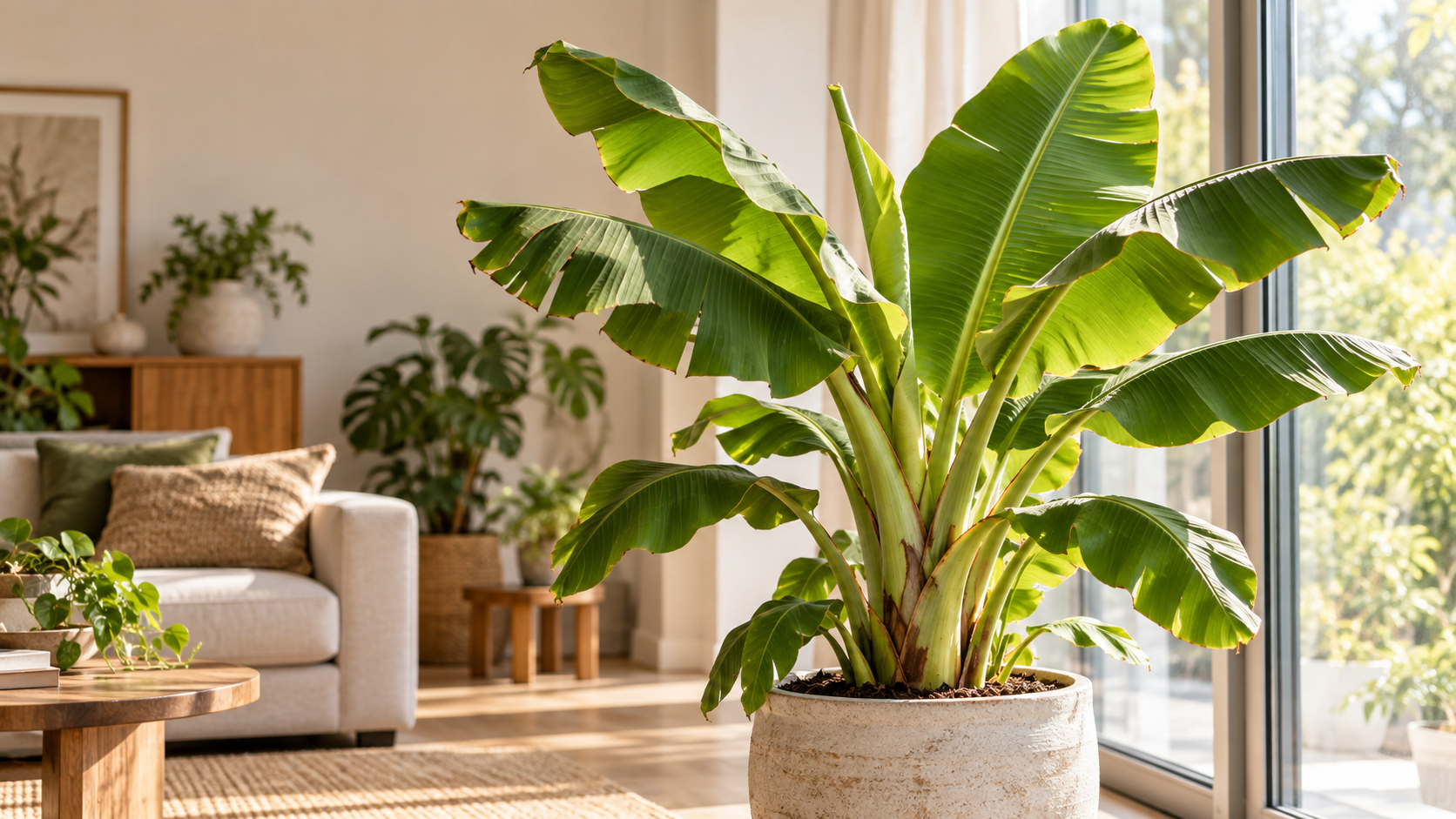
Indoor banana plant care comes down to warmth, as much light as you can give, a free-draining loam-based compost, regular watering in the growing season and a feed every couple of weeks. Bananas are fast, hungry, tropical plants, so they do best in the brightest, warmest spot you have, with water kept steady but never allowed to sit around the roots. Fruit is a bonus, because healthy leaves are the realistic goal indoors.
I am Sawera Shahid, a botanist at Patch Plants. Below I cover choosing a banana, light, temperature, watering, compost, humidity, feeding, repotting, pruning, pests and what to do about brown or yellow leaves.
Choose the Right Banana for Indoor Banana Plant Care
Bananas get big, so the variety you choose decides how easy indoor banana plant care will be. The RHS notes that in a sunny conservatory or heated greenhouse, Musa acuminata ‘Dwarf Cavendish’ is among the types most likely to flower, and that some others such as Musa ornata and Musa lasiocarpa can too.
| Banana | Best For | Note |
|---|---|---|
| Dwarf Cavendish | Bright rooms, conservatories | More compact than standard bananas, but still a large plant |
| Musa ornata and Musa lasiocarpa | Warm, bright conservatories | Listed by the RHS as likely to flower under glass |
| Musa basjoo | Gardens and patio pots | Hardiest species. University of Illinois Extension says it can reach 15 feet, so it is a poor fit for most rooms |
Measure your ceiling height and floor space first. Before buying, check the undersides of leaves for pests and avoid any plant sitting in soggy compost. If you want something that stays in a room longer without so much space, compare it with a bird of paradise or browse our list of big plants with big leaves.
Light for Indoor Banana Plant Care
Give your banana the brightest spot possible. The RHS recommends warmth and sun for all or most of the day, and University of Illinois Extension advises the brightest location possible for container bananas kept indoors. In the northern hemisphere that usually means a south- or west-facing window.
- Move gradually: a plant grown in dimmer light can scorch if it is suddenly put into strong sun through glass, so increase exposure over a couple of weeks.
- Add a grow light: a full-spectrum grow light can supplement daylight in a dim room or in winter.
- Watch the plant: pale leaves, leaning growth and small slow new leaves suggest too little light.
Our complete indoor light guide explains how window direction affects plants.
Temperature and Drafts for Indoor Banana Plant Care
Bananas are tender and must be protected from frost. For good growth and any chance of fruit, the RHS says temperatures should stay above 15°C (60°F), ideally around 27°C (81°F). Keep the plant away from cold windows at night, open doors and heating or air-conditioning vents, which blow dry or cold air across the big leaves. Leaves that curl or blacken after a cold spell are a sign of chill damage.
Watering in Indoor Banana Plant Care
The RHS says container plants need more water in spring and summer, and less in winter, when the compost should be allowed to dry out before watering again. Do not water by the calendar. Push a finger into the compost, and water thoroughly when the upper layer feels dry, until it runs out of the drainage holes. Then empty the saucer so the roots do not sit in water.
- Too little water: brown, crispy leaf edges and drooping. The RHS links brown edges to insufficient water or low humidity.
- Too much water: yellowing, soft stems and a sour smell from the compost.
See our watering guide, signs you are overwatering and our root rot guide.
Compost and Pots for Indoor Banana Plant Care
The RHS recommends a loam-based compost, such as a peat-free John Innes No 3, mixed with about 30% grit by volume for drainage. Use a pot with drainage holes, big enough for the rootball with room to grow. Decorative pots with no holes make roots harder to keep healthy, and a layer of gravel at the bottom is not a substitute for drainage. Our soil mix guide explains how drainage and moisture balance.
When filling a large planter, use the soil calculator to estimate how much compost you need.
Humidity and Airflow for Indoor Banana Plant Care
Dry indoor air can brown the edges of banana leaves. University of Illinois Extension suggests placing plants where humidity is high, or grouping them so they raise humidity around each other. Keep leaves clear of heaters and leave space around the plant so air can move. For ideas, see our humidity hacks and tropical house plants.
Feeding in Indoor Banana Plant Care
Bananas grow quickly, so they need feeding. The RHS suggests mixing a slow-release feed into the compost when planting or repotting, then giving a general-purpose liquid feed through spring and summer at the dose on the packet. Do not make it stronger than instructed, and do not feed very dry compost. Ease off in winter when growth slows. Pale leaves are not always hunger, since low light and root problems look similar. See fertilizing indoor vs outdoor plants.
Repotting a Banana Plant
The RHS advises repotting every spring or every other spring, moving younger plants into a pot 5 to 7.5cm (2 to 3 inches) wider. Once the pot is about 30cm (1ft) across, go up by 10 to 15cm (4 to 6 inches) every two to three years. Signs it is time include roots at the drainage holes, circling roots and compost that dries unusually fast. See how to repot a plant.
Pruning and Cleaning Leaves
The RHS says to remove old or tatty leaves by cutting at the base of the leaf stalk. If the plant is getting too tall, remove the tallest leaves, or cut the stem at any point above 60cm (2ft) from the base. Wipe large leaves with a soft damp cloth to remove dust. See pruning basics and how to clean plant leaves.
Pests
The RHS names mealybugs and red spider mites as the main indoor pests. Check leaf undersides and stems for webbing, sticky residue or white cottony patches. Isolate an affected plant, rinse it off, and use a product labelled for that pest, following its instructions. Change one care factor at a time so you can tell what helped.
Indoor Banana Plant Care Problems
| Problem | Likely Causes | Check First |
|---|---|---|
| Brown leaf edges | Too little water or low humidity | Compost moisture and nearby heaters |
| Yellow leaves | Overwatering, low light, hunger | Drainage and light |
| Small, slow new leaves | Too little light | Move to a brighter spot |
| Curled or blackened leaves | Cold | Drafts and night temperature |
| Webbing on leaves | Red spider mite | Leaf undersides |
If yellowing continues, see our yellow leaves guide, healthy roots vs root rot and how to revive a dying plant.
Can an Indoor Banana Plant Fruit?
Possibly, but do not count on it. The RHS says bananas grown all year in a sunny conservatory or heated greenhouse may flower and produce usually inedible fruit. Fruiting needs a growing season of nine to 15 months above 15°C (60°F), then two to four more months for the fruit to ripen. For most homes, fine foliage is the better goal.
Are Banana Plants Safe for Pets?
The ASPCA lists banana as non-toxic to dogs and cats. Large leaves can still be tempting to chew, so keep them out of reach of pets that dig or nibble. See our cat-friendly and dog-friendly plant guides.
Frequently Asked Questions
How much light does an indoor banana plant need?
As much as you can give it. The RHS recommends sun for all or most of the day, and a south- or west-facing window is the usual choice. A grow light can help in winter.
How often should I water an indoor banana plant?
There is no fixed schedule. Water thoroughly when the upper layer of compost feels dry, more often in spring and summer, and less in winter. Always empty the saucer.
Why are my banana plant leaves turning brown?
Brown edges usually mean too little water or low humidity, according to the RHS. Check the compost, keep leaves away from heaters, and group the plant with others to raise humidity.
When should I repot an indoor banana plant?
Repot in spring, every year or every other year, when roots show at the drainage holes or the compost dries very quickly. Move up 5 to 7.5cm (2 to 3 inches) for a younger plant.
Will my indoor banana plant produce bananas?
It can, but only in very bright, warm conditions over many months, and the fruit is often inedible. Treat it as a bonus and enjoy the foliage.
Final Thoughts
Good indoor banana plant care is steady rather than complicated. As a botanist, my advice is to give your banana the brightest warm spot you have, keep the compost evenly moist in the growing season, feed regularly, and repot before it is root-bound. Change one thing at a time when something looks wrong, and the plant will show you what it needs. For more ideas, explore Patch Plants and our indoor plants section.
Sources: RHS, How to grow banana plants; University of Illinois Extension, Go tropical with ornamental bananas; ASPCA, Banana.