🌿 Key Takeaways
- Fertilizing Indoor vs Outdoor Plants is not the same because indoor pots have limited soil, while outdoor plants receive natural support from rain, worms, microbes, and organic matter.
- Indoor plants usually need a balanced liquid fertilizer at half strength every 2–4 weeks during spring and summer.
- Liquid fertilizer is the easiest option for indoor plants because you can dilute it and adjust feeding based on how the plant responds.
- Natural options like diluted worm castings, compost tea, and banana peel water can give indoor plants gentle nutrition with less risk of fertilizer burn.
- Homemade fertilizers such as eggshell water, diluted coffee grounds, and cooled vegetable cooking water can support plant growth, but they should be used carefully.
- Organic indoor plant fertilizer is often safer for beginners because it releases nutrients slowly and is harder to overuse.
- Slow-release fertilizer and fertilizer sticks are useful for busy plant owners who want steady feeding without frequent applications.
- Plant food and fertilizer usually mean the same thing. Both supply nutrients plants need for healthy growth.
- The best time to fertilize indoor plants is spring through summer. Most houseplants should not be fertilized in autumn and winter.
- Fertilizing Indoor vs Outdoor Plants becomes easier when you understand how often each plant needs nutrients and how much soil support it already has.
- Browse our full indoor plant care guides for plant-specific fertilizing recommendations and complete care advice.
Why Fertilizing Indoor vs Outdoor Plants Is Fundamentally Different
The core difference is soil volume and natural replenishment. Outdoor garden soil is an open, living system — continuously replenished by rainfall, decaying organic matter, earthworms, and soil microorganisms that break down organic compounds into plant-available nutrients. A plant growing in open ground can extend its roots metres in search of nutrients and water. Its soil system is essentially self-refreshing.
Indoor plant fertilizer management operates in an entirely different environment. A houseplant growing in a 15cm pot has access to perhaps 2 litres of soil. When those nutrients are depleted — through plant uptake, watering leaching them out of drainage holes, and natural chemical changes in the potting mix — nothing replenishes them except the plant owner’s deliberate fertilizing.
This is why fertilizing indoor plants requires more precision and more caution than outdoor feeding — the consequences of overfertilizing are immediate and contained, with no open soil system to buffer and dilute excess nutrients.
Understanding this fundamental difference transforms how you approach indoor plant fertilizer — from an optional occasional treat to a critical component of houseplant care that directly determines long-term plant health.
Is Plant Food and Fertilizer the Same Thing?
Is plant food and fertilizer the same? Yes — these terms are used interchangeably across the gardening industry. Both refer to products that supply the three primary macronutrients plants need: nitrogen (N), phosphorus (P), and potassium (K) — displayed on every fertilizer package as the NPK ratio.
What each nutrient does:
- Nitrogen (N): Drives leafy, vegetative growth — essential for the lush green foliage that makes most houseplants attractive
- Phosphorus (P): Supports root development and flowering — higher phosphorus promotes blooming in flowering houseplants
- Potassium (K): Overall plant health and disease resistance — supports water movement within plant tissues
Secondary nutrients that matter for houseplant health: calcium (cell wall development), magnesium (chlorophyll production — its deficiency causes yellowing between leaf veins), and sulphur (protein synthesis).
Micronutrients: Iron, manganese, zinc, copper, boron, and molybdenum — needed in tiny quantities but essential for specific biochemical functions.
For understanding how plant nutrition connects to specific plant problems, our guides on why your plant leaves are turning yellow and leaf curl, browning, and droop cover nutrient deficiency symptoms alongside other common causes.
Best Fertilizer for Indoor Plants — Complete Guide
Types of Indoor Plant Fertilizer
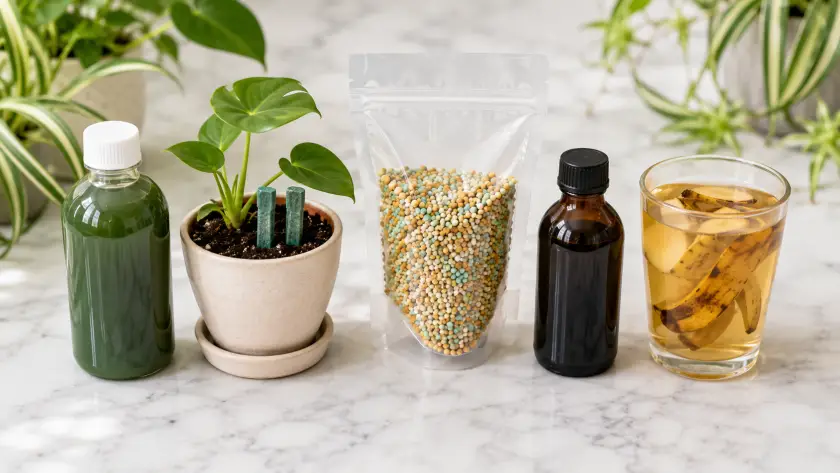
Fertilizer for indoor plants comes in several formats — each with specific advantages depending on your plant collection, lifestyle, and comfort level with plant care.
1. Liquid Fertilizer for Indoor Plants — Best Overall
Liquid fertilizer for indoor plants is the most recommended format for houseplant owners — its water-soluble form allowing precise dilution, immediate availability to roots, and easy adjustment of concentration.
Why liquid fertilizer wins for indoor plants:
- Immediately available to roots — no waiting for slow breakdown
- Precisely dilutable — half-strength or quarter-strength applications are simple
- Easy to flush if over-applied — one thorough watering removes excess
- Visible response within days of correct application
Best liquid fertilizer for indoor plants — look for balanced NPK ratios (10-10-10 or similar) for general houseplant feeding. Specific formulations:
- Balanced liquid fertilizer: For foliage plants — pothos, snake plant, ZZ plant, monstera
- High phosphorus liquid: For flowering plants — peace lily, Christmas cactus
- Balanced liquid fertilizer indoor plants at half strength: The safest universal approach for any houseplant
Liquid fertilizer indoor plants application rule: always water the plant thoroughly before applying liquid fertilizer — applying to dry soil risks root burn as concentrated fertilizer contacts moisture-stressed roots.
2. Slow Release Fertilizer for Indoor Plants — Best for Busy Owners
Slow release fertilizer for indoor plants uses coated granules or compressed spikes that gradually release nutrients over weeks or months — eliminating the need for regular liquid feeding applications.
Fertilizer sticks for indoor plants are the most convenient slow-release format — pushed directly into the soil near the roots and left to dissolve slowly over 2–3 months. They are particularly effective for plants in positions that are easy to forget — office plants, bathroom plants, and hallway displays.
Slow release fertilizer for indoor plants advantages:
- No mixing or measuring — simplified application
- Consistent low-level nutrition — eliminates feast-famine cycles of irregular liquid feeding
- Ideal for holiday periods and busy schedules
Limitation: Less precise than liquid feeding — cannot adjust concentration based on plant response. Risk of localized over-concentration near the spike.
For guidance on low-maintenance plant care approaches that pair well with slow-release feeding, our guide on best indoor plants for beginners covers plant species that perform well with minimal intervention fertilizing.
3. Organic Indoor Plant Fertilizer — Best for Beginners and Sensitive Plants
Organic indoor plant fertilizer and organic indoor fertilizer options provide nutrition through natural compounds — seaweed extracts, fish emulsion, worm castings, and compost-based products — rather than synthetic chemical formulations.
Why organic indoor plant fertilizer is recommended for beginners:
- Significantly harder to over-apply — releases slowly and gently
- Improves soil biology over time — beneficial bacteria and fungi thrive
- No risk of sudden root burn from concentrated synthetic application
- Better for sensitive plants and newly repotted specimens
Best organic fertilizer for indoor plants options:
- Seaweed extract liquid — excellent all-round organic fertilizer with micronutrients
- Worm casting tea — brewed from soaking worm castings in water overnight
- Fish emulsion — highly effective but distinctively aromatic
Natural fertilizer for indoor plants note: organic options work more slowly than synthetic — allow 2–4 weeks to see visible growth response rather than the days typical of liquid synthetic feeding.
4. Homemade and DIY Fertilizer for Indoor Plants
Homemade fertilizer for indoor plants and DIY fertilizer for indoor plants provide free supplemental nutrition from kitchen and garden waste — excellent as a complement to regular fertilizing rather than a complete replacement.
Best homemade fertilizer for indoor plants:
Banana peel water: Soak banana peels in water for 24–48 hours — rich in potassium and phosphorus. Use as occasional watering liquid for flowering houseplants.
Eggshell water: Boil eggshells in water, cool, and use for watering — provides calcium for cell wall development. Particularly beneficial for plants prone to blossom end rot or tip calcium deficiency.
Cooking water: Unsalted water from boiling vegetables contains leached minerals — allow to cool completely before using. Free micronutrient supplement with every meal preparation.
Diluted coffee grounds: Coffee grounds added sparingly to soil or diluted in water provide nitrogen and acidify soil slightly — beneficial for acid-preferring plants. Never use undiluted as this risks mold and pH imbalance.
DIY indoor plant fertilizer note: homemade options supplement but cannot replace a balanced complete fertilizer — they provide individual nutrients rather than the full NPK spectrum that comprehensive plant nutrition requires.
For soil health guidance that complements natural fertilizer for indoor plants approaches, our complete soil mix guide covers soil biology and nutrient retention in potting mixes.
5. House Plant Fertiliser — UK Specific Products
House plant fertiliser (UK spelling) and houseplant fertiliser products available in British garden centres and supermarkets follow the same principles as international products — look for balanced NPK ratios and always apply at half the recommended strength indoors.
Balanced houseplant fertilizer recommendations for UK plant owners: Miracle-Gro Indoor Plant Food, Baby Bio, Westland Houseplant Feed, and Tomorite (primarily for tomatoes but effective for flowering houseplants) are the most widely available quality products.
Indoor plant fertiliser (UK spelling) application in UK conditions: UK homes in winter are particularly cool and dark — stop fertilizing completely by October and do not resume until March–April when daylight hours increase and growth visibly resumes.
When to Fertilize Indoor Plants — Complete Seasonal Guide
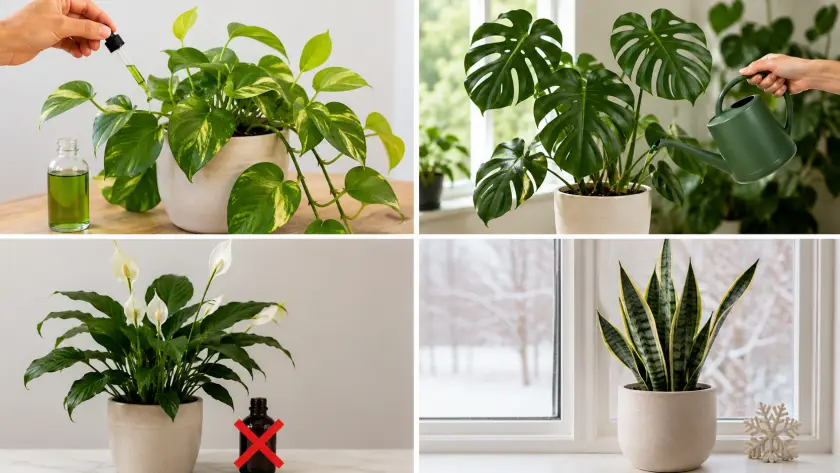
When to Fertilize House Plants — The Seasonal Framework
When to fertilize indoor plants and when to fertilize house plants follows the natural growth rhythm of most houseplants — which are active in spring and summer and resting in autumn and winter.
Indoor plant feeding schedule by season:
| Season | Fertilizing Action |
|---|---|
| Spring (March–May) | Resume feeding — start at quarter strength |
| Summer (June–August) | Full growing season schedule — every 2–4 weeks |
| Autumn (September–October) | Reduce frequency — every 6–8 weeks maximum |
| Winter (November–February) | Stop completely for most species |
How often should you fertilize house plants? Every 2–4 weeks during the active growing season is the standard recommendation for most houseplants. Fast-growing species like pothos and monstera benefit from the more frequent end of this range. Slow growers like ZZ plant and aloe vera need feeding only monthly or less.
How often should I fertilize my potted plants? The same seasonal framework applies — growing season every 2–4 weeks, complete stop in winter. Always check for active growth before fertilizing — if a plant shows no new leaves or stems, it is not actively using nutrients regardless of the season.
How to fertilize indoor plants correctly: water thoroughly first, then apply liquid fertilizer at half the recommended strength. Never apply fertilizer to dry soil.
For complete guidance on the relationship between watering and fertilizing, our complete watering guide covers the watering-before-fertilizing principle and how seasonal watering adjustments connect to fertilizing frequency.
How Often to Fertilize Indoor Plants — By Plant Type
How often to fertilize indoor plants varies by species — matching feeding frequency to growth rate produces the best results:
Monthly (slow growers):
- Snake plant — slow growing, sensitive to over-feeding
- ZZ plant — rhizomes store nutrients, minimal feeding needed
- Aloe vera — drought and nutrient-lean adapted
- Christmas cactus — specific feeding requirements around bloom cycle
Every 2–3 weeks (moderate growers):
- Peace lily — balanced feeding for foliage and flowers
- Spider plant — moderate feeder, responds well to regular light feeding
- Money tree — consistent moderate feeding for best growth
For plant-specific fertilizing guidance across every houseplant type, our complete guide to indoor light covers how light levels affect fertilizer absorption — plants in lower light need significantly less fertilizer than those in bright positions.
Fertilizing Outdoor Plants — How It Differs

Plant Fertilizer Outdoor — The Open System
Plant fertilizer outdoor management operates in the open soil system that indoor fertilizing cannot replicate — with natural replenishment, larger root zones, and seasonal cycles that do much of the nutritional work automatically.
Fertilizer for outdoor plants seasonal schedule:
Spring: Apply balanced slow-release granular fertilizer or general liquid feed as growth begins. This is the most important outdoor fertilizing moment — providing nutrition for the entire growing season’s flower and fruit development.
Summer: Higher phosphorus and potassium feeding for flowering and fruiting plants. Leafy plants continue with balanced feed. Fertilizing veggies in summer — tomatoes, peppers, and cucumbers need consistent potassium-rich feeding from first flower through harvest.
Autumn: Reduce or stop nitrogen feeding — excess nitrogen promotes soft leafy growth vulnerable to frost damage. Low-nitrogen, high-potassium autumn feed hardens plants for winter.
Winter: Generally no feeding — most outdoor plants are dormant and cannot use or process nutrients.
Outdoor plant fertilizer application methods differ from indoor — granular slow-release is more practical at garden scale, liquid feeding through watering cans or hose-end dilutors covers larger areas efficiently.
For outdoor plant guidance that includes fertilizing considerations, our guides on best low-maintenance outdoor plants for busy gardeners, top drought-resistant plants, and create a colorful garden for all seasons cover outdoor feeding principles for specific plant categories.
Fertilizing Veggies — Special Outdoor Considerations
Fertilizing veggies requires different NPK ratios at different growth stages:
- Seedling stage: High nitrogen for rapid leafy growth
- Pre-flowering: Reduce nitrogen, increase phosphorus
- Fruiting stage: High potassium for fruit development and flavor
- Leafy crops (lettuce, spinach, kale): Higher nitrogen throughout
For vegetable fertilizing guidance that complements fertilizing veggies in kitchen gardens, our guide on grow your own easiest outdoor edible plants for beginners covers fertilizing schedules for the most popular edible outdoor plants.
Over-Fertilizing — Signs and Solutions
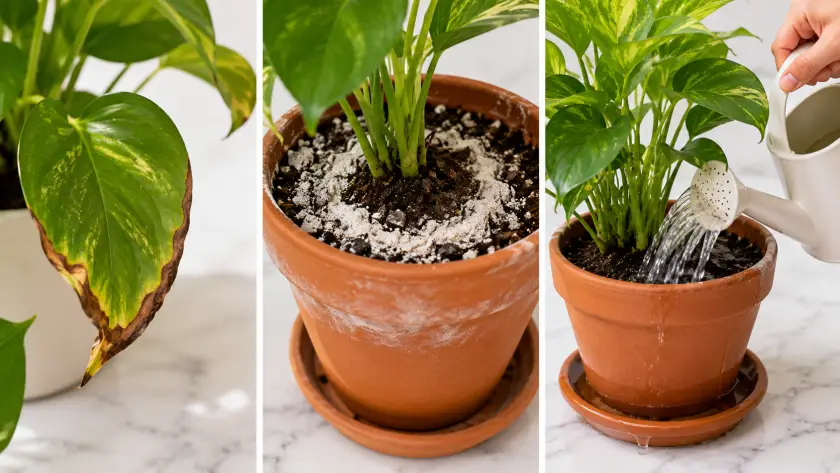
Signs of Over-Fertilizing Indoor Plants
Over-fertilizing is the most common indoor plant fertilizer mistake — and because indoor soil systems cannot buffer excess nutrients the way open garden soil can, the consequences appear quickly:
- Brown leaf tips and edges: The most common overfertilizing symptom — salt accumulation draws moisture away from leaf margins
- White crusty deposit on soil surface: Salt crystallization from fertilizer mineral buildup
- Sudden leaf drop: Plant response to root burn from concentrated nutrients
- Yellow lower leaves: Can indicate nutrient imbalance from excessive feeding
- Wilting despite moist soil: Root damage from fertilizer burn preventing water uptake
Correcting over-fertilizing:
- Flush the soil thoroughly — pour 3–4 times the pot’s volume of plain water through the pot over 30 minutes
- Remove white surface crust before flushing — scrape gently and discard
- Stop fertilizing for 4–6 weeks minimum
- Resume at half the previous concentration
For complete diagnosis of browning and yellowing that may indicate over-fertilizing, our guides on signs you are overwatering and why your plant leaves are turning yellow help distinguish fertilizer problems from watering issues — both can cause similar visible symptoms.
For severely damaged plants requiring emergency care, our guide on how to revive a dying plant covers recovery from fertilizer burn alongside other plant emergencies.
Repotting and Fertilizing — The Important Connection
When Not to Fertilize
When to fertilize indoor plants includes understanding when NOT to feed:
Never fertilize newly repotted plants: Fresh potting mix contains sufficient nutrients for 6–8 weeks — fertilizing immediately after repotting into fresh compost causes fertilizer burn in already-stressed roots.
Never fertilize sick or stressed plants: Fertilizer applied to root-rotted, severely underwatered, or pest-damaged plants adds stress rather than nutrition. Correct the underlying problem first.
Never fertilize dormant plants: Winter-dormant plants cannot process nutrients — feeding in winter promotes weak growth and salt buildup without benefit.
For repotting guidance that includes the post-repotting fertilizing pause, our complete repotting guide covers the 6–8 week fertilizer-free establishment period after repotting. Our guide on repotting mistakes to avoid specifically covers over-fertilizing after repotting as one of the most common post-repotting errors.
Room-Specific Fertilizing Considerations
Fertilizing House Plants by Location
House plant fertilizer needs vary by room — because light levels directly affect fertilizer uptake:
Bright rooms (near windows): Plants in high light photosynthesize faster, grow more rapidly, and use nutrients more quickly — feed at the higher end of the recommended frequency.
Darker rooms (office, hallway): Plants in lower light grow more slowly and use fewer nutrients — feed less frequently and at lower concentration. Our guide on office-friendly plants that survive fluorescent lighting covers fertilizing adjustments for office plants under artificial lighting.
Bathroom plants: High humidity slows soil drying but does not affect nutrient uptake significantly — standard feeding schedule applies. Our guide on best plants for your bathroom covers bathroom-specific care including fertilizing.
Bedroom plants: Lower light and stable temperatures — feed at lower end of recommended frequency. Our guide on decorating your bedroom with plants covers bedroom plant care including nutrition.
Frequently Asked Questions
What Is the Best Fertilizer for Indoor Plants?
Best fertilizer for indoor plants — balanced liquid fertilizer (NPK ratio 10-10-10 or similar) applied at half the recommended strength every 2–4 weeks during spring and summer. Balanced liquid fertilizer indoor plants is the most controllable and forgiving format. For organic preference: seaweed extract liquid or worm casting tea. For convenience: slow-release fertilizer sticks or granules applied every 2–3 months during the growing season.
How Often Should You Fertilize House Plants?
How often should you fertilize house plants? Every 2–4 weeks during the active growing season (spring through summer) for most species. Fast-growing plants like pothos and monstera benefit from every 2 weeks. Slow-growing plants like ZZ plant and aloe vera need monthly or less frequent feeding. Stop completely from October through February for most houseplants.
Is Plant Food the Same as Fertilizer?
Is plant food and fertilizer the same? Yes — plant food and fertilizer are interchangeable terms both referring to products that supply nitrogen, phosphorus, and potassium (NPK) alongside secondary and trace nutrients. The branding differs between manufacturers but the function is identical.
What Is the Best Homemade Fertilizer for Indoor Plants?
Best homemade fertilizer for indoor plants and DIY fertilizer for indoor plants: banana peel water (potassium and phosphorus), diluted worm castings (balanced gentle nutrition), eggshell water (calcium), unsalted vegetable cooking water (trace minerals), and very diluted used coffee grounds (nitrogen, slight acidification). Use these as supplemental additions to regular complete fertilizer rather than replacements.
What Is Natural Fertilizer for Indoor Plants?
Natural fertilizer for indoor plants includes seaweed extract, fish emulsion, worm castings, compost tea, bone meal, and blood meal — all derived from organic sources rather than synthetic chemical manufacturing. Organic indoor plant fertilizer is slower releasing, gentler on roots, improves soil biology over time, and is significantly harder to over-apply than synthetic concentrates.
When Should I Stop Fertilizing Indoor Plants?
When to fertilize indoor plants stops: October for most houseplants in UK conditions — as daylight hours shorten and temperatures cool, plant metabolism slows and nutrient uptake drops dramatically. Fertilizing through winter causes salt buildup, promotes weak growth, and risks root burn in plants that are not actively processing nutrients. Resume carefully in March–April when new growth becomes visible.
Related Guides on Patch Plants
- 💧 Complete Watering Guide for Healthy Thriving Plants
- 🪴 Best Soil Mix for Every Plant Type
- 🌿 How to Repot a Plant — Complete Guide
- 🌿 Repotting Mistakes to Avoid
- 🔬 Root Rot — How to Identify, Prevent and Treat It
- 🍃 Why Your Plant Leaves Are Turning Yellow
- 🌿 Leaf Curl, Browning and Droop
- 🌿 How to Revive a Dying Plant
- 💧 Signs You Are Overwatering
- 💡 Complete Guide to Indoor Light
- 🐍 Snake Plant Care Guide
- 🌿 Pothos Plant Care Guide
- 🌱 ZZ Plant Care Guide
- 🌸 Peace Lily Care Guide
- 🌿 Monstera Plant Care Guide
- 🌵 Aloe Vera Care Guide
- 💰 Money Tree Care Guide
- 🌱 Spider Plant Care Guide
- 🎄 Christmas Cactus Care Guide
- 🌱 Best Indoor Plants for Beginners
- 🌿 Best Low-Maintenance Outdoor Plants
- 🌱 Grow Your Own Edible Plants for Beginners
- 🌈 Create a Colorful Garden for All Seasons
- 🌱 Browse All Indoor Plant Guides
Final Thoughts
Indoor plant fertilizer management is one of the most impactful — and most commonly misunderstood — aspects of houseplant care. The core principle is simple: indoor plants depend entirely on you for nutrition, and they live in a closed soil system where both deficiency and excess have immediate, visible consequences.
Best fertilizer for indoor plants is whatever you will actually use consistently — a quality liquid fertilizer applied at half strength every 2–4 weeks through the growing season, stopped completely in winter. Natural fertilizer for indoor plants and homemade fertilizer for indoor plants provide valuable supplemental nutrition and improve soil health over time.
How often to fertilize indoor plants matters less than getting the seasonal timing right — never feeding through winter, always starting cautiously in spring, and adjusting based on how your specific plants actually respond.
The difference between fertilizing indoor and outdoor plants is ultimately the difference between managing a closed system with precision and working with an open system that nature largely manages itself. Master the indoor side, and your houseplants will reward you with the lush, vigorous, healthy growth that correct nutrition makes possible.
According to the Royal Horticultural Society, houseplants benefit most from regular light feeding during the active growing season rather than occasional heavy applications — with complete cessation of feeding during winter rest periods being equally important as the feeding itself for maintaining long-term plant health. 🌿