🌿 Key Takeaways
- ZZ plant care is genuinely beginner-friendly — Zamioculcas zamiifolia tolerates drought, low light, neglect, and inconsistent care better than almost any other houseplant available
- How to care for ZZ plant follows three simple rules — water only when the entire pot feels dry, provide low to bright indirect light, and never let roots sit in standing water
- ZZ plant care indoors centers on one critical principle: this plant stores water in underground rhizomes and will rot rapidly if overwatered — restraint is always the correct approach
- Raven ZZ plant care follows identical principles to standard ZZ plant but requires slightly brighter indirect light to maintain its dramatic near-black leaf coloration
- Black raven ZZ plant and chameleon ZZ plant are the most dramatic ZZ plant varieties — both are rare, visually extraordinary, and more valuable than standard green varieties
- Is ZZ plant toxic to cats? Yes — ZZ plant contains calcium oxalate crystals toxic to cats and dogs. Keep out of reach of all pets
- Are ZZ plants toxic to dogs? Yes — the same calcium oxalate toxicity applies. Our cat-friendly plants guide covers safe alternatives
- ZZ plant leaves turning yellow almost always indicates overwatering — the single most common ZZ plant care mistake
- Best soil for ZZ plant is well-draining cactus or succulent mix with added perlite — never moisture-retentive standard potting compost
- Can you propagate a ZZ plant? Yes — through leaf cuttings, stem cuttings, or division of rhizomes — all methods work but patience is required as ZZ plant propagates slowly
- Browse our full indoor plant care guides for companion plant ideas that pair beautifully with ZZ plant displays
Why the ZZ Plant Is One of the Most Remarkable Houseplants Available
The ZZ plant (Zamioculcas zamiifolia) occupies a unique position in the houseplant world — simultaneously one of the most visually dramatic, most genuinely low-maintenance, and most forgiving plants available to indoor growers at any experience level. Its architectural glossy dark green leaves, its extraordinary drought tolerance, and its ability to thrive in light conditions that would cause most other plants to decline have made it one of the most recommended houseplants globally over the past two decades.
ZZ plant care is often described as “impossible to kill” — and while this slightly overstates the case, it captures something genuinely true about this plant’s resilience. The ZZ plant evolved in the seasonally dry grasslands and forests of eastern Africa — from Kenya and Tanzania southward through Zimbabwe — where long dry seasons regularly occur. Its survival strategy is elegant: thick, waxy rhizomes underground store water and nutrients, allowing the plant to survive extended drought periods that would kill most other species.
This underground storage system is the foundation of everything that makes ZZ plant care so forgiving for beginners and so rewarding for experienced collectors. It is why ZZ plant care indoors centers almost entirely on restraint — watering less rather than more, providing light without intensity demands, and leaving the plant alone to grow steadily in its own time.
This complete ZZ plant care guide covers everything — from the exact light, watering, and soil for ZZ plant requirements to the specific care differences between raven ZZ plant care, black raven ZZ plant care, and chameleon ZZ plant care, alongside propagation, repotting, troubleshooting ZZ plant leaves turning yellow, and the critical pet safety information every ZZ plant owner needs.
ZZ Plant — Botanical Identity and Natural Habitat
What Is a ZZ Plant? — Zamioculcas Zamiifolia
The ZZ plant (Zamioculcas zamiifolia) is the sole species in the genus Zamioculcas — a monotypic genus in the family Araceae (the same plant family that includes peace lily, monstera, and philodendron). Native to eastern Africa — particularly the seasonally dry environments of Kenya, Tanzania, Malawi, Mozambique, Zimbabwe, and South Africa — the ZZ plant was first described by botanists in 1829 but remained relatively obscure until Dutch nurseries began mass-propagating it for the houseplant trade in the 1990s.
The name “ZZ plant” is simply an abbreviation of its scientific name — Zamioculcas zamiifolia — reflecting how difficult the full botanical name is to remember or pronounce. Other common names include Zanzibar gem, aroid palm, eternity plant, and emerald palm.
Why ZZ Plant Rhizomes Make All the Difference
The defining biological feature of the ZZ plant — and the characteristic that explains every aspect of how to care for ZZ plant correctly — is its underground rhizome system. These thick, fleshy, potato-like underground structures store water and nutrients during periods of drought, allowing the plant to survive weeks or even months without watering.
In its natural eastern African habitat, the ZZ plant experiences distinct wet and dry seasons. During dry periods, the rhizomes sustain the plant entirely — the above-ground stems and leaves may die back completely, but the rhizomes survive and regenerate new growth when rains return. This evolutionary adaptation directly informs ZZ plant care indoors: the plant is physiologically programmed to tolerate drought and physiologically unprepared to tolerate constant moisture.
Understanding this single biological fact resolves every ZZ plant care question that beginners struggle with — why it should not be watered frequently, why best soil for ZZ plant must drain immediately, why ZZ plant leaves turning yellow almost always means too much water rather than too little.
ZZ Plant Varieties — Complete Guide

Standard ZZ Plant — The Classic Form
The standard Zamioculcas zamiifolia produces upright stems 45–90cm tall bearing 6–8 pairs of glossy, dark green, oval leaflets. The waxy surface coating reflects light beautifully — creating the high-gloss appearance that makes ZZ plant one of the most striking foliage plants available.
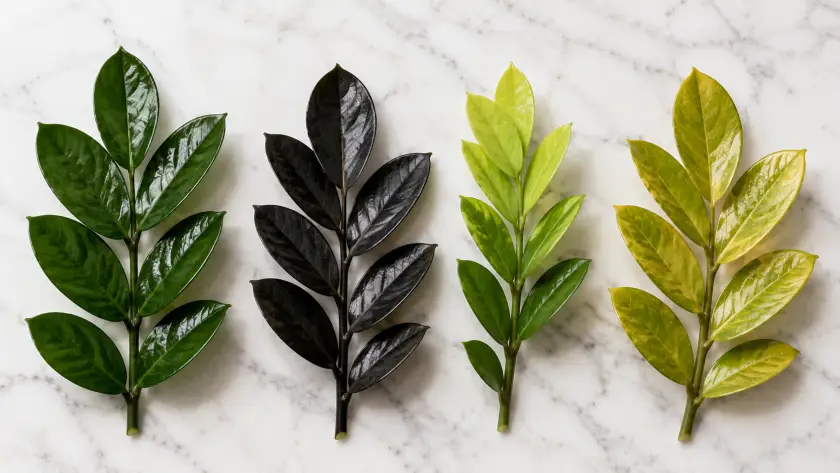
New growth emerges as pale lime-green — sometimes almost yellow — before darkening to the characteristic deep green as leaves mature. This color transition is completely normal and one of the most attractive features of growing ZZ plant — the contrast between new pale growth and established dark leaves creates natural variation within a single plant.
Raven ZZ Plant — The Most Popular Dark Variety
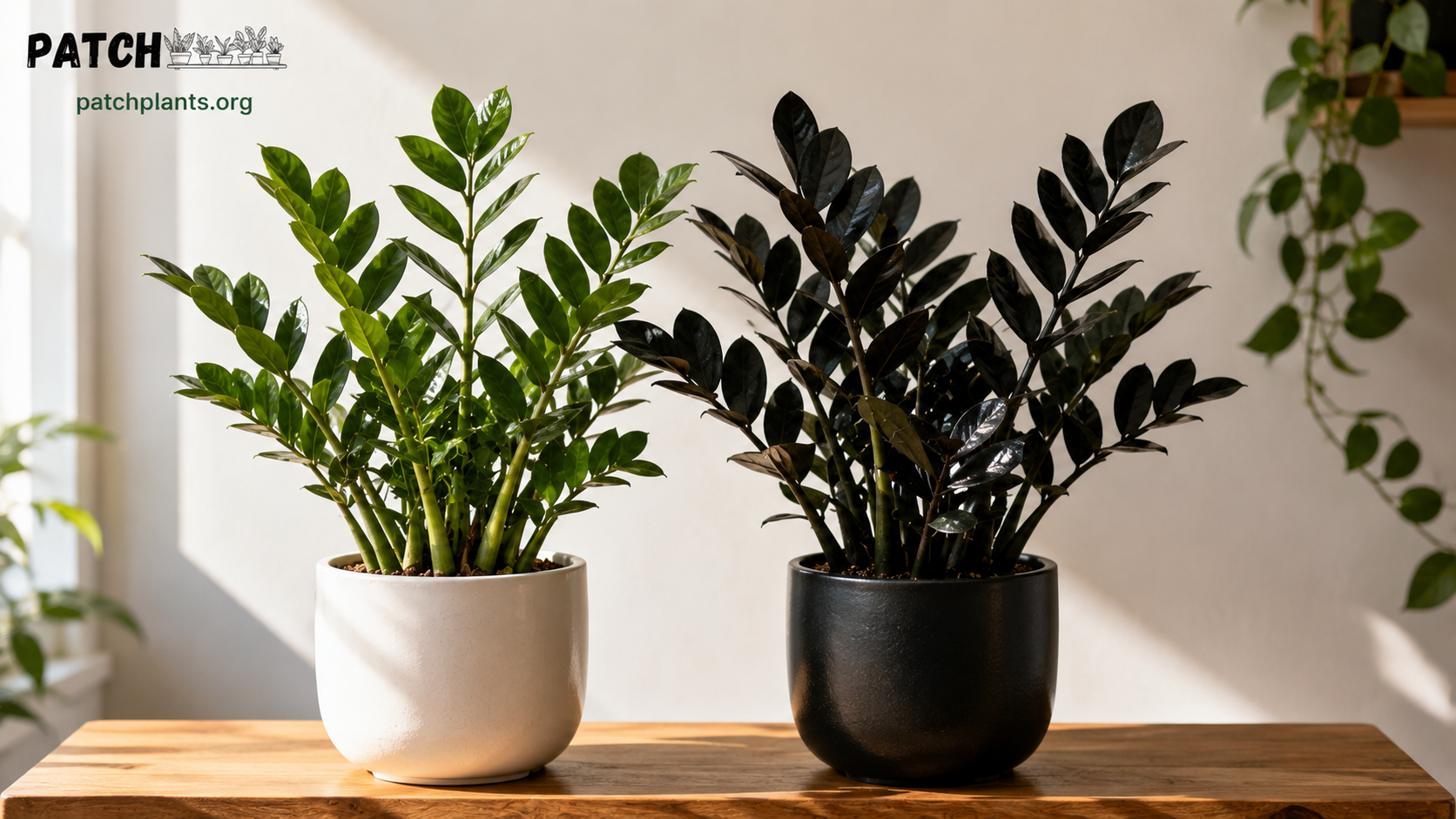
Raven ZZ plant care is the most searched ZZ plant variety question online — because this cultivar’s dramatic near-black leaves create one of the most visually striking houseplant displays available. Zamioculcas zamiifolia ‘Raven’ was introduced commercially around 2019 and has become one of the most sought-after houseplant varieties globally.
Raven ZZ plant care specifics:
- New growth emerges bright lime-green — identical to standard ZZ plant
- Leaves gradually darken over 2–4 weeks as they mature
- Final color is deep purple-black — appearing almost completely black in lower light
- Raven ZZ plant care light requirement is slightly higher than standard ZZ plant — bright indirect light maintains the richest black coloration; lower light causes leaves to remain a dark green rather than true near-black
Raven ZZ plant care is otherwise identical to standard ZZ plant — same watering restraint, same well-draining soil, same low-maintenance approach.
Black Raven ZZ Plant — The Darkest Cultivar
The black raven ZZ plant is sometimes used interchangeably with ‘Raven’ — but more specifically refers to specimens with the deepest, most consistent near-black leaf coloration. The difference is primarily in the light conditions during maturation — black raven ZZ plant specimens grown in consistent bright indirect light develop darker, more uniform black coloration than those in lower light.
Black raven ZZ plant care follows raven ZZ plant care principles exactly — with particular attention to providing the bright indirect light that maximizes the dramatic black coloration that makes this variety so visually extraordinary.
Chameleon ZZ Plant — The Rarest Variety
Chameleon ZZ plant (Zamioculcas zamiifolia ‘Chameleon’) is among the rarest ZZ plant cultivars commercially available — producing leaves that shift color depending on light conditions and age, typically displaying green, yellow-green, and golden tones simultaneously within a single plant.
Chameleon ZZ plant care requirements:
- Brighter indirect light than standard ZZ plant — to maintain the color variation that gives it its name
- Same drought-tolerant watering approach as all ZZ plant varieties
- Slower growing than standard varieties — smaller overall in maturity
- Rarer and more expensive — typically available only from specialist plant retailers
ZZ Plant Varieties — Complete List
ZZ plant varieties available for home growing include:
| Variety | Leaf Color | Light Need | Rarity |
|---|---|---|---|
| Standard ZZ (Z. zamiifolia) | Dark glossy green | Low–bright indirect | Common |
| Raven ZZ (‘Raven’) | Near-black | Bright indirect | Widely available |
| Black Raven ZZ | Deep near-black | Bright indirect | Common |
| Chameleon ZZ (‘Chameleon’) | Variable green-gold | Bright indirect | Rare |
| Zenzi ZZ (‘Zenzi’) | Dark green, compact | Low–bright indirect | Moderately available |
| Lucky White ZZ | Variegated white-green | Bright indirect | Very rare |
For the most comprehensive display of ZZ plant varieties alongside other architectural foliage plants, our guide on colorful foliage indoor plants that aren’t just green covers the full range of dark-leaved, variegated, and unusual foliage plants that pair beautifully with ZZ plant displays.
Complete ZZ Plant Care Guide
ZZ Plant Care at a Glance
| Care Factor | ZZ Plant Requirement |
|---|---|
| Light | Low to bright indirect — tolerates near-darkness |
| Watering | Every 3–4 weeks summer, every 6–8 weeks winter |
| Temperature | 18–26°C (65–79°F) — tolerates down to 8°C |
| Humidity | Low to moderate — tolerates dry indoor air |
| Soil | Cactus mix + perlite — fast draining essential |
| Fertilizer | Optional — monthly spring/summer at half strength |
| Pot | Terracotta or ceramic with drainage holes |
| Toxicity | Toxic to cats and dogs — keep out of reach |
ZZ Plant Light Requirements
ZZ Plant Low Light — The Most Drought-Tolerant Low Light Plant
ZZ plant low light tolerance is one of its most extraordinary characteristics — and the feature that makes it most valuable for office environments, dark hallways, and rooms without adequate natural light. ZZ plant light requirement is the most flexible of any widely available houseplant — it genuinely grows (not just survives) in positions that receive only 25–50 foot-candles of indirect light.
ZZ plant light requirement by position:
| Light Level | ZZ Plant Response |
|---|---|
| Bright indirect (1–2m from window) | Best growth rate, richest color |
| Medium indirect (2–3m from window) | Good growth, excellent for most rooms |
| Low indirect (3m+ from window) | Slow but consistent growth — genuinely tolerant |
| Near-darkness (office fluorescent only) | Very slow growth but survives long-term |
| Direct sun | Leaf scorch — bleaching and browning |
ZZ plant low light performance means it is the go-to recommendation for rooms where other plants fail — dark hallways, north-facing rooms, offices under fluorescent lighting. Our guide on office-friendly plants that survive fluorescent lighting identifies ZZ plant as the top performer under artificial office lighting conditions — surpassing even pothos and snake plant in artificial light tolerance.
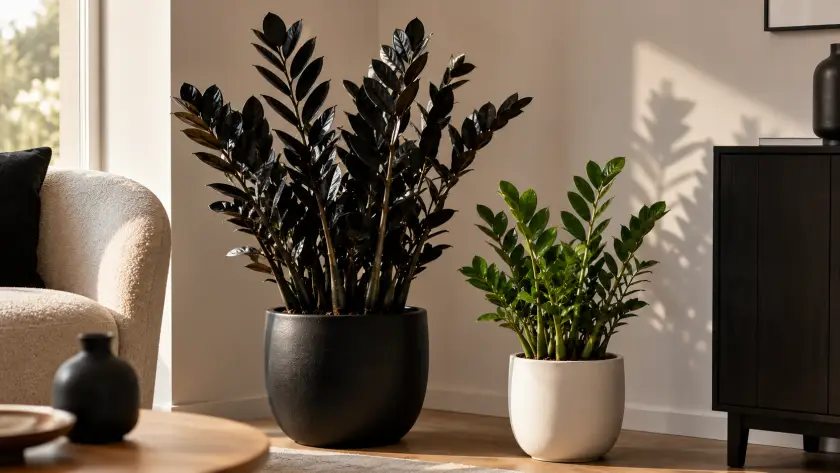
Raven ZZ plant care light note: The ‘Raven’ variety needs slightly more light than standard ZZ plant to develop and maintain its characteristic near-black coloration. Position raven ZZ plant within 1–2 metres of a bright window for the most dramatic black leaf color. In lower light, leaves remain deep green rather than true near-black.
For comprehensive guidance on measuring and optimizing indoor light levels for ZZ plant indoor care and all other low-light houseplants, our complete guide to indoor light covers light measurement, supplemental grow light options, and room-by-room light optimization.
How to Water a ZZ Plant — The Most Critical Care Rule

ZZ Plant Care Watering — Less Is Always More
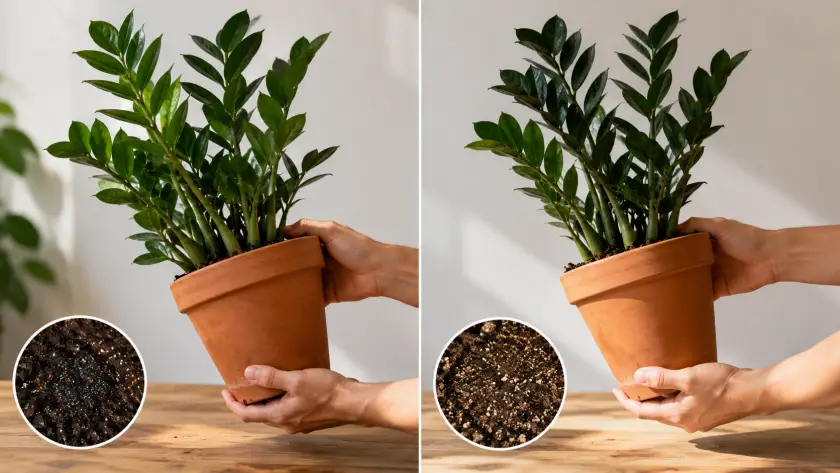
ZZ plant care watering is the single most important — and most frequently mismanaged — aspect of how to care for ZZ plant correctly. The universal rule: the entire pot must feel dry and light before you water again. Not just the top few inches — the entire root zone.
How to water ZZ plant correctly:
- Lift the pot — if it feels light, the soil is dry throughout and watering is needed
- If uncertain, push a wooden skewer deep into the soil — dry soil means no moisture visible on the skewer when removed
- Water slowly and thoroughly — pour until water flows freely from drainage holes
- Allow to drain completely — never leave ZZ plant sitting in standing water
- Do not water again until the pot feels noticeably lighter — usually 3–4 weeks in summer, 6–8 weeks in winter
ZZ plant care seasonal watering frequency:
- Spring and summer (active growth): Every 3–4 weeks — always using the weight test rather than a fixed schedule
- Autumn: Every 4–6 weeks
- Winter (dormancy): Every 6–8 weeks — some growers water even less frequently in cool conditions
Never water ZZ plant on a schedule — seasonal temperature changes, pot size, light levels, and humidity all affect soil drying time dramatically. Always check before watering.
Our guide on the worst times to water your plants explains exactly why morning watering produces consistently healthier results for ZZ plant — and why evening watering creates the stagnant moisture conditions that promote root rot in drought-adapted species.
For a complete watering system covering every indoor plant type, our complete watering guide for healthy thriving plants provides the definitive watering framework for ZZ plant and all other houseplants.
ZZ Plant Overwatering — The Most Common Cause of Decline
Overwatering kills more ZZ plants than any other cause — because the plant’s evolutionary programming for drought tolerance makes it particularly vulnerable to the constantly moist soil conditions that overwatering creates.
Signs of ZZ plant overwatering:
- Yellow leaves appearing throughout the plant — particularly lower, older leaves
- Soft, mushy stems at the base
- Black or brown mushy patches at stem bases
- Foul-smelling soil
- Wilting despite moist soil — the counterintuitive symptom that confuses beginners into watering more
Our guide on signs you are overwatering and how to correct it covers the complete overwatering diagnosis and correction process specifically applicable to drought-tolerant species like ZZ plant.
For emergency treatment when overwatering has progressed to root rot — the most serious consequence of consistently wet soil in ZZ plants — our guide on root rot — how to identify, prevent and treat it covers the complete rescue process including rhizome inspection and treatment.
Best Soil for ZZ Plant — Getting the Foundation Right
What Is the Best Soil for ZZ Plant?
Best soil for ZZ plant and soil for ZZ plant must prioritize drainage above all other qualities — because ZZ plant rhizomes are highly susceptible to rot in moisture-retentive growing media.
Best soil for ZZ plant — DIY recipe:
2 parts cactus or succulent potting mix
1 part perlite
Optional: small amount of coarse sand
This combination drains immediately after watering and dries completely within 7–14 days in normal indoor conditions — exactly the soil behavior that healthy ZZ plant care indoors requires.
Soil for ZZ plant — what to avoid:
- Standard general-purpose potting compost — retains too much moisture
- Peat-heavy mixes — stay wet too long around sensitive rhizomes
- Garden soil — compacts in containers, extremely poor drainage
- Any mix without perlite amendment — ZZ plant needs faster drainage than most commercial mixes provide
For comprehensive guidance on building the perfect soil for ZZ plant and every other houseplant type, our complete soil mix guide covers exact ratios, DIY recipes, and testing methods.
Pot Selection for ZZ Plant
Terracotta is the ideal pot material for ZZ plant — its porous walls wick moisture away from the root and rhizome zone, accelerating the drying between waterings that ZZ plant care requires. Ceramic and plastic pots are acceptable but retain moisture longer — if using plastic, water even less frequently.
The most important pot requirement: drainage holes. A ZZ plant in a pot without drainage will develop root rot regardless of how carefully you water — excess water has nowhere to go and accumulates around the rhizomes.
ZZ Plant Temperature and Humidity
Temperature Requirements
ZZ plant tolerates a wide temperature range — reflecting its adaptation to the variable temperatures of its eastern African native habitat:
- Ideal: 18–26°C (65–79°F)
- Minimum: 8°C (46°F) — cold damage begins below this threshold
- Avoid: Temperature fluctuations from drafts, heating vents, and air conditioning units positioned directly beside the plant
Humidity for ZZ Plant
Unlike most tropical houseplants, ZZ plant tolerates the low humidity of heated or air-conditioned homes without any supplemental humidity management. Its waxy leaf coating reduces moisture loss through transpiration — allowing it to thrive in conditions that cause moisture-loving plants like ferns to develop crispy leaf tips.
ZZ plant care indoors in dry environments: No humidity management needed. This is one of the plant’s most practical advantages for modern heated homes.
For humid room placement options, our guide on the best plants for your bathroom covers ZZ plant as one of the most appropriate low-maintenance bathroom plants.
Fertilizing ZZ Plant
ZZ plant is a very light feeder — its rhizomes store nutrients as well as water, reducing dependence on external nutrient sources.
ZZ plant care fertilizing schedule:
- Spring: Begin monthly feeding with balanced liquid fertilizer at half strength
- Summer: Continue monthly — never exceed half strength for ZZ plant
- Autumn: Stop feeding completely
- Winter: No feeding — the plant rests
Over-fertilizing signs: Brown leaf tip scorching, white mineral crust on soil surface. If these appear, flush the soil thoroughly with plain filtered water and reduce feeding frequency.
Our guide on fertilizing indoor vs outdoor plants — what’s the difference covers the complete feeding schedule and technique for ZZ plant and all other drought-tolerant houseplant types.
When to Repot ZZ Plant
ZZ Plant Repotting — Special Considerations
When to repot ZZ plant requires understanding one important characteristic: ZZ plant actually performs well when slightly pot-bound. Its compact rhizome root system does not require annual repotting like faster-growing tropical species — repotting every 2–3 years is typically sufficient.
Signs that repotting is needed:
- Rhizomes visibly pushing against pot walls or emerging from drainage holes
- Soil drying within 48 hours of thorough watering
- Plant becoming severely top-heavy and unstable
- Roots visibly emerging from the soil surface
ZZ plant repotting timing: Always repot in spring — ZZ plant establishes most rapidly in fresh soil when entering its active growing period. Never repot in winter.
For complete repotting guidance including the specific technique for ZZ plant’s rhizome structure, our complete repotting guide covers every step from root inspection through transplant shock recovery. Our guide on repotting mistakes to avoid covers the most common ZZ plant repotting errors — particularly choosing pots that are too large.
Post-repotting: Do not water ZZ plant for 5–7 days after repotting — allow any root disturbance to heal before moisture contact.
Can You Propagate a ZZ Plant? — Complete Guide

ZZ Plant Propagation Methods
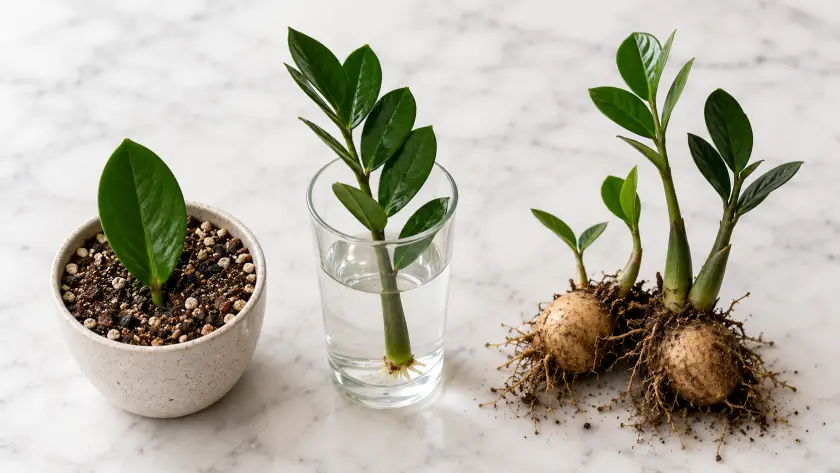
Can you propagate a ZZ plant? Yes — but ZZ plant propagation requires significant patience. This is one of the slowest-propagating common houseplants — rhizome development from leaf or stem cuttings takes months rather than weeks.
Method 1 — Leaf Cutting Propagation
Can you propagate a ZZ plant from a single leaf? Yes — this is the most accessible but slowest method:
- Remove a healthy leaf with a small portion of the leaf stem (petiole) attached
- Allow the cut end to callous for 24 hours in open air
- Insert the calloused petiole end 1–2cm deep into barely moist cactus mix
- Place in bright indirect light at 20–25°C
- Water only when the soil is completely dry — approximately every 3–4 weeks
- A new rhizome forms at the base of the leaf petiole — visible after 3–6 months
- New shoots emerge from the rhizome — confirming successful propagation
Patience required: Leaf cutting propagation of ZZ plant takes 6–9 months to produce a plant of meaningful size. Do not abandon the process due to apparent lack of progress — underground rhizome development is occurring even when nothing is visible above soil.
Method 2 — Stem Cutting Propagation
Stem cuttings (3–4 pairs of leaflets on a single stem) root faster than individual leaf cuttings — typically producing visible new growth within 3–5 months:
- Cut a stem with 3–4 pairs of leaflets using clean scissors
- Allow to callous 24 hours
- Place in water or moist cactus mix — water propagation allows rhizome development monitoring
- Change water every 7–10 days if propagating in water
- Transfer to soil once rhizome is clearly visible at the stem base
Method 3 — Rhizome Division (Fastest Method)
When repotting, ZZ plant rhizomes can be divided — each section with at least one growth point becoming a new plant. This is the fastest propagation method — producing growing plants immediately rather than requiring months of rhizome development from cuttings.
For complete propagation guidance covering all methods applicable to ZZ plant and every other houseplant type, our guide on how to propagate houseplants easily at home covers propagation techniques in full detail.
Do ZZ Plants Bloom? — ZZ Plant Flower Guide
ZZ Plant Flower — Does It Actually Happen Indoors?
Do ZZ plants bloom indoors? Yes — but it is rare and occurs almost exclusively in mature, well-established specimens growing in high-light conditions.
ZZ plant flower characteristics:
- Produces a small, inconspicuous spadix-type flower (typical of the Araceae family)
- The ZZ plant flower is pale green-cream and emerges low at the base of the plant
- Not produced for ornamental value — the ZZ plant is grown entirely for its dramatic foliage
- Flowering typically occurs in summer and autumn in mature specimens
- Do ZZ plants bloom regularly? No — ZZ plant flowers infrequently and unpredictably indoors
To encourage ZZ plant flower development:
- Provide maximum available indirect light
- Maintain consistent temperature without extreme fluctuations
- Allow the plant to become slightly pot-bound before repotting
- Feed with a phosphorus-rich fertilizer (higher middle number) once in early spring
Do ZZ plants bloom as a sign of stress? Occasionally — some plants flower in response to environmental stress as a reproductive survival strategy. If ZZ plant flower appears alongside declining health signs, check watering and soil drainage rather than celebrating the blooming.
Is ZZ Plant Toxic to Cats and Dogs?
ZZ Plant Cats and Dogs — Critical Safety Information
Is ZZ plant toxic to cats? Yes — ZZ plant cats toxicity is confirmed and important. ZZ plant contains calcium oxalate crystals throughout all its tissues — leaves, stems, petioles, and rhizomes. These crystals cause immediate oral irritation, drooling, vomiting, and swelling of the mouth and throat in cats and dogs that ingest any part of the plant.
Are ZZ plants toxic to dogs? Yes — are ZZ plants toxic to dogs is confirmed with the same calcium oxalate toxicity mechanism. Symptoms in dogs mirror those in cats: immediate drooling, pawing at the mouth, vomiting, and lethargy.
ZZ plant toxicity severity: Calcium oxalate toxicity from ZZ plant is generally not life-threatening — but causes significant discomfort and requires veterinary attention if symptoms are severe or persist.
ZZ plant cats and dogs safety guidelines:
- Position ZZ plant on genuinely high shelves or in rooms pets cannot access
- Never leave repotted ZZ plant or removed leaves where pets can investigate
- Wash hands thoroughly after handling ZZ plant before touching pets
- If ingestion is suspected — contact your vet or animal poison control immediately
Safe ZZ plant alternatives for pet households:
For cat-safe alternatives with similar low-maintenance, low-light characteristics, our guide on how to make your plants cat-friendly covers the complete list of non-toxic plants with similar care requirements to ZZ plant.
For dog-safe plant selections including non-toxic alternatives to ZZ plant, our guide on how to make your plants dog-friendly covers pet-safe plant selection for dog households.
ZZ Plant Leaves Turning Yellow — Complete Diagnosis Guide
Why Are My ZZ Plant Leaves Turning Yellow?
ZZ plant leaves turning yellow is the most common problem reported by ZZ plant owners — and the answer is almost always the same: too much water.
Why is my ZZ plant turning yellow — the complete diagnosis:
Overwatering — The Primary Cause (90% of Cases)
ZZ plant leaves turning yellow from the bottom of the plant upward — combined with persistently moist soil — is the classic overwatering pattern. The rhizomes cannot function effectively in consistently wet conditions, reducing nutrient delivery to leaves and causing the characteristic yellowing.
Solution: Stop watering immediately. Allow soil to dry completely. Check drainage holes are unobstructed. If yellowing is severe and soil smells unpleasant, emergency repotting with fresh dry cactus mix may be needed.
Our guide on why your plant leaves are turning yellow covers the complete diagnostic process for distinguishing overwatering yellowing from other causes — essential reading for any ZZ plant owner seeing yellowing leaves.
Natural Leaf Aging — Normal and Expected
Occasional yellowing of the oldest, lowest leaves is completely normal — ZZ plant naturally sheds its oldest leaves as the plant grows. One or two yellowing lower leaves per month requires no corrective action.
Insufficient Light — Occasional Cause
In very low light positions over extended periods, ZZ plant leaves may yellow as photosynthesis becomes insufficient to maintain all existing leaves. Moving to a brighter position resolves this gradually.
Root Rot — Advanced Overwatering
When ZZ plant leaves turning yellow is accompanied by soft, mushy stems at the base and a foul soil smell, root rot has developed. Emergency repotting with complete removal of affected rhizomes and roots is required immediately.
Our guide on root rot — how to identify, prevent and treat it covers the complete ZZ plant root rot rescue process — including how to assess rhizome damage and determine whether the plant can be saved.
ZZ Plant Problems — Complete Troubleshooting
ZZ Plant Problem Diagnosis Table
| Problem | Most Likely Cause | Solution |
|---|---|---|
| Yellow leaves (lower plant) | Overwatering | Stop watering, let dry completely |
| Yellow leaves (throughout) | Severe overwatering or root rot | Emergency repot, inspect rhizomes |
| Brown leaf tips | Low humidity or mineral buildup | Flush soil with filtered water |
| Brown patches on leaves | Direct sun exposure | Move to indirect light position |
| Leaves dropping | Extreme temperature change or overwatering | Stabilize environment, check soil |
| Leggy, stretched growth | Insufficient light | Move to brighter indirect position |
| Mushy stems at base | Root rot from overwatering | Urgent emergency repot |
| Wilting despite moist soil | Root rot — roots cannot deliver water | Emergency repot immediately |
| Slow or stopped growth | Insufficient light or winter dormancy | More light or wait for spring |
| White soil surface crust | Mineral buildup from tap water | Flush with filtered water |
Reviving a Severely Struggling ZZ Plant
For ZZ plants that have declined severely — whether from root rot, extreme drought, or environmental stress — our step-by-step guide on how to revive a dying plant covers the complete emergency rescue process applicable to ZZ plant.
Understanding Leaf Signals
ZZ plant communicates its health status through its leaves. Our guide on leaf curl, browning, and droop — what your plant is telling you decodes every visible leaf symptom in ZZ plant and all other common houseplants.
Displaying ZZ Plant — Room by Room Guide

Where to Display ZZ Plant for Maximum Impact
ZZ plant’s combination of architectural form and low light tolerance makes it one of the most versatile display plants available — working in positions that no other attractive houseplant could tolerate.
Living Room — Statement Floor Plant
A large, mature ZZ plant in a striking ceramic or concrete pot creates a genuine statement floor plant — its upright stems and glossy dark leaves creating architectural drama without demanding attention or care. For a raven ZZ plant or black raven ZZ plant, position in bright indirect light to maintain the dramatic near-black coloration.
For guidance on using ZZ plant as part of a larger indoor plant display, our guide on how to create an indoor jungle without overcrowding covers the plant density and spatial arrangement principles that make ZZ plant most effective in mixed collections.
Our guide on indoor plants that double as natural room dividers covers ZZ plant as one of the most effective architectural room divider plants — its upright growth creating natural spatial definition without requiring maintenance.
Bedroom — Night-Safe Low-Maintenance Plant
ZZ plant is an excellent bedroom plant — it requires minimal attention, tolerates the lower light of most bedroom positions, and adds architectural visual interest without demanding daily observation. Our guide on how to decorate your bedroom with plants for style and calm covers optimal bedroom ZZ plant display positions.
Home Office — The Ultimate Office Plant
ZZ plant is arguably the most recommended office plant available — tolerating fluorescent artificial lighting, inconsistent watering during busy periods, and the dry air of heated office environments better than virtually any other houseplant.
Our guide on improving your home office with plants covers ZZ plant specifically as one of the top home office plant recommendations. Our dedicated guide on office-friendly plants that survive fluorescent lighting identifies ZZ plant as the top performer under artificial office lighting conditions — above even pothos and snake plant.
Dark Hallways and Corridors
ZZ plant’s genuine low-light tolerance makes it one of the few plants that actually thrives in dark hallways and corridors — positions that most other plants would decline in within weeks.
Feng Shui and ZZ Plant
In Feng Shui practice, ZZ plant is considered a powerful plant for absorbing negative energy and purifying the energy of the spaces it inhabits. Its upward-pointing leaves direct positive chi energy upward. Our guide on Feng Shui indoor plants to attract positive energy covers ZZ plant placement within the Bagua energy map for maximum positive energy benefit.
Styling ZZ Plant With Other Species
ZZ plant pairs beautifully with plants that share its low-maintenance aesthetic — snake plant, pothos, and peace lily all complement ZZ plant’s architectural form while requiring similar care approaches.
For guidance on styling ZZ plant within a broader indoor plant collection, our guide on how to style indoor plants by room covers room-by-room plant styling principles applicable to ZZ plant displays in every room type.
ZZ Plant as an Air-Purifying Plant
Does ZZ Plant Purify Air?
ZZ plant was identified in the original NASA Clean Air Study as an effective air-purifying plant — capable of absorbing significant quantities of benzene, xylene, toluene, and ethylbenzene from indoor air. More recent research has confirmed that ZZ plant absorbs CO₂ and produces oxygen throughout the day.
For a comprehensive assessment of air-purifying plants including ZZ plant’s specific contributions to indoor air quality, our guide on air-purifying indoor plants that actually work ranks ZZ plant among the most effective and practically low-maintenance air-purifying houseplants available.
Big ZZ Plant — Growing Large Specimens
How to Grow a Big ZZ Plant
Big ZZ plant specimens — mature plants 90–120cm tall with multiple stems — are among the most dramatic houseplants available. Growing a big ZZ plant requires patience (ZZ plant grows slowly) but very little intensive care.
How to grow a big ZZ plant:
- Choose a pot only 2–3cm wider than the current root zone — ZZ plant grows faster when slightly pot-bound
- Provide the brightest available indirect light — light is the primary growth-rate limiter for ZZ plant
- Feed monthly in spring and summer with half-strength balanced fertilizer
- Repot every 2–3 years into fresh well-draining mix — refreshing nutrients
- Patience — a large mature ZZ plant typically takes 3–5 years to reach impressive proportions
Big ZZ plant display: Large mature specimens work best as solo statement plants in large ceramic or concrete pots — their architectural form is most impactful when not competing with other plants at the same height. Our guide on how to create an indoor jungle without overcrowding covers how to position large statement plants like mature ZZ plant within mixed collections without overcrowding.
ZZ Plant Care Tips — Quick Reference Guide
ZZ Plant Care Tips for Different Experience Levels
ZZ plant care tips for absolute beginners:
- Underwater rather than overwater — when in doubt, wait another week
- Use cactus mix with added perlite — never standard potting compost
- Position in any light except direct sun — ZZ plant truly tolerates almost any indoor light
- Lift the pot before watering — if light, water; if heavy, wait
ZZ plant care tips for intermediate owners:
- Wipe leaves monthly with a damp cloth — glossy leaves photosynthesize more efficiently and look more dramatic when clean. Our guide on how to clean plant leaves without damaging them covers the correct cleaning technique for ZZ plant’s sensitive waxy leaf coating
- Rotate the plant quarterly — ZZ plant grows toward its light source; rotation encourages even growth across all stems
- Use filtered or rainwater — tap water mineral buildup causes leaf tip browning over time
ZZ plant care tips for experienced collectors:
- Try propagating from leaf cuttings — the slow pace is part of the satisfaction
- Consider the raven or chameleon varieties for more dramatic displays
- Use ZZ plant as a contrast plant alongside faster-growing or more colorful species — its glossy dark foliage sets off other plants beautifully
Frequently Asked Questions
How to Care for ZZ Plant — The Complete Answer?
How to care for ZZ plant in three rules: provide low to bright indirect light (never direct sun), water only when the entire pot feels light and dry (every 3–4 weeks in summer, 6–8 weeks in winter), and use well-draining cactus mix with perlite. Beyond these three rules, ZZ plant care requires less attention than almost any other houseplant — the plant’s rhizome storage system makes it extraordinarily self-sufficient.
Why Is My ZZ Plant Turning Yellow?
Why is my ZZ plant turning yellow? Overwatering in 90% of cases. Check soil — if it feels moist, you are watering too frequently. ZZ plant leaves turning yellow from the base of the plant upward with moist soil confirms overwatering. Stop watering immediately, allow to dry completely, and check drainage. If yellowing is rapid and soil smells unpleasant, investigate for root rot using our root rot guide.
What Is the Best Soil for ZZ Plant?
Best soil for ZZ plant is cactus/succulent potting mix with 30% additional perlite. This combination drains immediately after watering and dries completely within 7–14 days — the soil behavior that ZZ plant indoor care requires. Never use standard potting compost — it retains too much moisture around sensitive ZZ plant rhizomes. Our soil mix guide covers exact ratios and DIY recipes.
Is ZZ Plant Toxic to Cats?
Is ZZ plant toxic to cats? Yes — ZZ plant contains calcium oxalate crystals throughout all its tissues that cause immediate oral irritation, drooling, and vomiting in cats. ZZ plant cats should never be allowed to chew any part of the plant. Position on genuinely inaccessible high shelves or in rooms cats cannot enter. Our cat-friendly plants guide covers non-toxic alternatives with similar low-maintenance characteristics.
Are ZZ Plants Toxic to Dogs?
Are ZZ plants toxic to dogs? Yes — the same calcium oxalate toxicity applies to dogs. Symptoms include immediate drooling, pawing at the mouth, vomiting, and lethargy. Contact your vet if ingestion is suspected. Our dog-friendly plants guide covers safe alternatives for dog households.
Can You Propagate a ZZ Plant?
Can you propagate a ZZ plant? Yes — through leaf cuttings, stem cuttings, or rhizome division at repotting time. All methods work but require patience — ZZ plant propagation is among the slowest of any common houseplant, taking 3–9 months to produce meaningful new growth. Rhizome division at repotting is the fastest method. Our propagation guide covers all three ZZ plant propagation methods in detail.
What Are the Different ZZ Plant Varieties?
ZZ plant varieties available for home growing: standard green ZZ plant (most common), Raven ZZ (‘Raven’ — near-black leaves), Black Raven ZZ (deepest black coloration), Chameleon ZZ (rare — variable green-gold tones), and Zenzi ZZ (compact dwarf form). Raven ZZ plant care and black raven ZZ plant care follow identical principles to standard ZZ plant — with slightly higher light requirements to maintain their dramatic dark coloration.
Do ZZ Plants Bloom?
Do ZZ plants bloom indoors? Rarely — ZZ plant produces small, inconspicuous spadix-type flowers at the base of the plant in mature specimens growing in high-light conditions. The ZZ plant flower is not ornamentally significant — this plant is grown entirely for its extraordinary foliage. Flowering typically occurs in summer and autumn and requires no special action from the grower.
When to Repot ZZ Plant?
When to repot ZZ plant: every 2–3 years, or when rhizomes visibly push against pot walls, roots emerge from drainage holes, or soil dries within 48 hours of watering. Always repot in spring. Choose a new pot only 2–3cm wider — ZZ plant performs well when slightly pot-bound. Use fresh cactus mix with perlite and wait 5–7 days before first watering after repotting.
Related Guides on Patch Plants
- 🐍 Snake Plant Care Guide — Complete Sansevieria Tips
- 🌿 Pothos Plant Care Guide — Every Variety Complete
- 🌸 Peace Lily Care Guide — Complete Spathiphyllum Tips
- 🌵 Aloe Vera Care Guide — Complete Home Growing Guide
- 🌱 Best Indoor Plants for Beginners — 25 Easy Picks
- 🐱 How to Make Your Plants Cat-Friendly
- 🐕 How to Make Your Plants Dog-Friendly
- 🌿 Colorful Foliage Indoor Plants That Aren’t Just Green
- 💡 Complete Guide to Indoor Light and Grow Lights
- 💧 Complete Watering Guide for Healthy Thriving Plants
- 💧 Worst Times to Water Your Plants
- 🪴 Best Soil Mix for Every Plant Type
- 🔬 Root Rot — How to Identify, Prevent and Treat It
- 🌿 How to Repot a Plant — Complete Guide
- 🌿 Repotting Mistakes to Avoid
- 🌱 How to Propagate Houseplants Easily at Home
- 🍃 Why Your Plant Leaves Are Turning Yellow
- 🌿 How to Revive a Dying Plant — Step by Step
- 🌱 Leaf Curl, Browning and Droop — What Your Plant Is Telling You
- 🏢 Office-Friendly Plants That Survive Fluorescent Lighting
- 🌿 Air-Purifying Indoor Plants That Actually Work
- 🌿 Feng Shui Indoor Plants for Positive Energy
- 🌱 Browse All Indoor Plant Guides
Final Thoughts
ZZ plant care is one of the most rewarding houseplant experiences available — because the effort required is so minimal compared to the visual impact delivered. This architectural, glossy-leaved survivor from eastern Africa asks almost nothing: occasional water, any light that falls short of direct sun, well-draining soil, and the patience to leave it alone for weeks between interventions.
How to care for ZZ plant ultimately comes down to one word: restraint. Resist the urge to water when the soil looks dry on the surface — wait until the entire pot feels light. Resist the urge to move it to a darker corner just because it tolerates low light — it grows better with more. Resist the urge to repot annually — it performs better with its roots slightly constrained.
Master that restraint, and the ZZ plant will reward you with years — potentially decades — of extraordinary glossy foliage that makes visitors ask what it is, how you keep it so perfect, and where they can get one.
Whether you choose the classic green standard form, the dramatic raven ZZ plant with its near-black leaves, or the extraordinary chameleon ZZ plant with its color-shifting foliage, the care principles remain the same. Understand the rhizome. Respect the drought adaptation. Water less. And watch this remarkable plant grow steadily into one of the most impressive specimens in your collection.
According to the Royal Horticultural Society, Zamioculcas zamiifolia is among the most recommended low-maintenance houseplants available — combining exceptional drought tolerance, genuine architectural beauty, and adaptability to a wider range of indoor conditions than virtually any other widely available houseplant species. 🌿