Despite its unusual appearance, monkey tail cactus care is relatively straightforward when you get the fundamentals right. Plenty of useful light, fast-draining soil, careful watering, good airflow, and a container with drainage can help this cactus develop strong trailing stems.
In this guide, you will learn 11 practical monkey tail cactus growing and care tips, including light, watering, soil, feeding, temperature, pruning, repotting, propagation, seasonal care, and troubleshooting.
For more growing advice, browse the Patch Plants Indoor Plants guides and our Plant Care library.
QUICK ANSWER
How Do You Care for a Monkey Tail Cactus?
Grow monkey tail cactus in plenty of bright light, using a container with drainage holes and a loose, fast-draining cactus or succulent growing medium. Water thoroughly when the mix has dried sufficiently, then allow excess water to drain away.
Avoid keeping the roots continuously wet. Give the trailing stems room to hang freely, provide reasonable airflow, protect the plant from damaging temperature extremes, and increase direct-sun exposure gradually rather than moving it abruptly from shade into intense sunlight.
For additional help, use our indoor light guide, watering guide, and soil mix guide.
PATCH PLANTS SUMMARY
Key Takeaways
- Provide plenty of bright light for compact, healthy growth.
- Introduce stronger direct sunlight gradually.
- Let the growing medium dry appropriately between waterings.
- Never leave the pot sitting in collected water.
- Use a loose cactus or succulent mix with excellent drainage.
- Feed conservatively during active growth rather than on a rigid schedule.
- Protect the cactus from freezing conditions and abrupt temperature changes.
- Prioritize airflow rather than creating excessively humid conditions.
- Give long stems enough room to cascade without being crushed.
- Prune damaged stems with clean tools and propagate healthy cuttings.
- Repot only when the plant or root system actually needs more space.
What Is a Monkey Tail Cactus Plants?
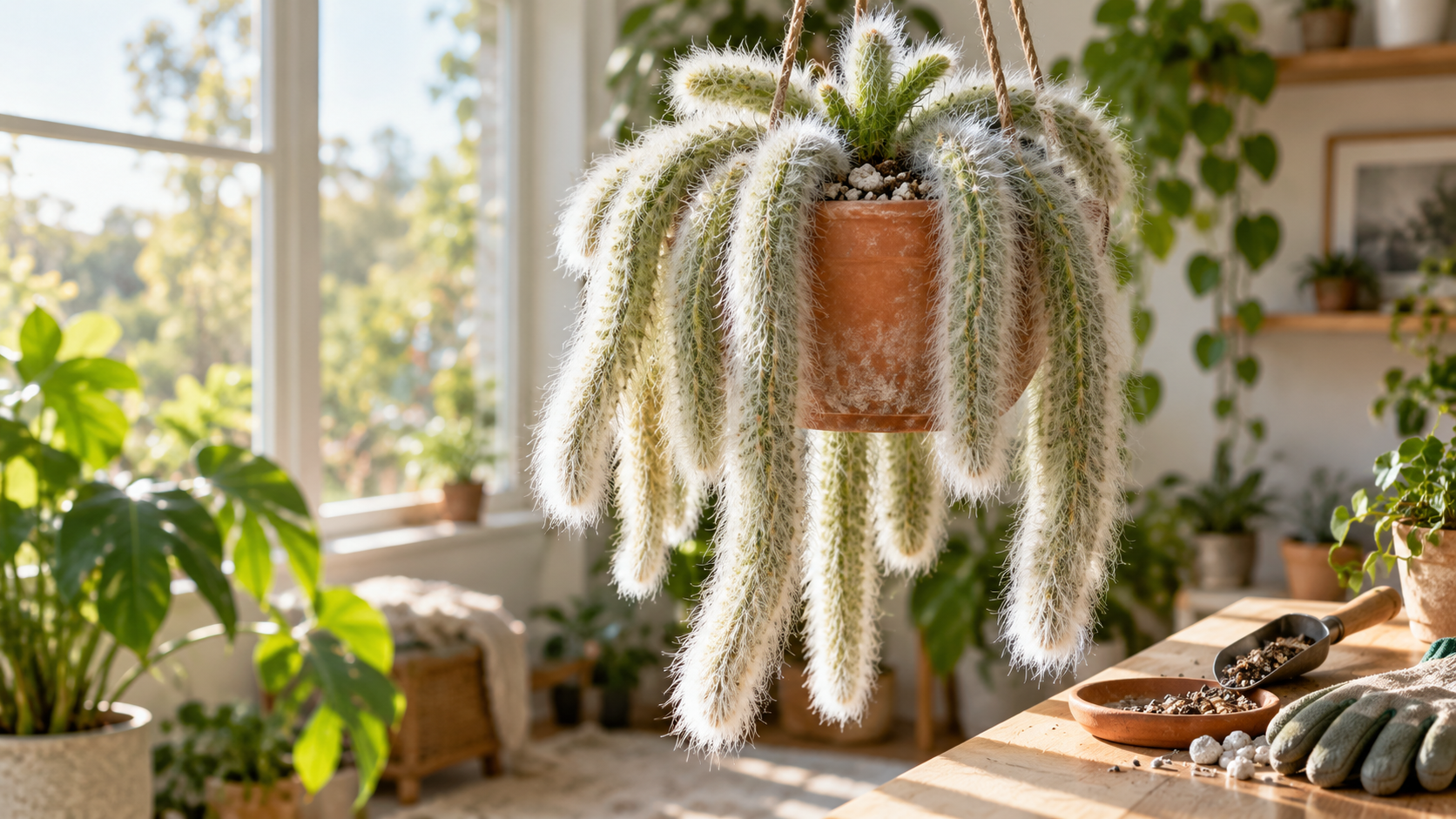
Monkey tail cactus is prized for long trailing stems covered with fine white hairs and spines. As the stems lengthen, they naturally cascade over the sides of their container, making the plant particularly suited to hanging baskets, elevated shelves, and tall plant stands.
The hairy covering may look soft, but the plant should still be handled cautiously because spines can irritate skin.
Monkey Tail Cactus vs. Rat Tail Cactus
Monkey tail cactus can be confused with other trailing cacti, particularly rat tail cactus. The easiest visual clue is its conspicuously fuzzy appearance.
| Feature | Monkey Tail Cactus | Typical Rat Tail Appearance |
|---|---|---|
| Stems | Long, trailing and conspicuously fuzzy | Long and trailing but generally less furry |
| Spines | Dense, pale, hair-like appearance | Typically more visibly spine-like |
| Display | Excellent cascading specimen | Also commonly grown as a trailing cactus |
If you enjoy unusual architectural houseplants, browse our complete Indoor Plants collection.
How to Choose a Healthy Monkey Tail Cactus
Starting with a healthy specimen makes ongoing monkey tail cactus care much easier.
Look for stems that appear firm and structurally sound rather than mushy or collapsing. Inspect the plant closely for suspicious discoloration, damaged areas, and pests hidden among the dense hairs.
Check the Potting Mix
A cactus sitting in dense, continuously wet growing media may already be under root stress. A loose medium and functional drainage are better signs.
Check for Pests
The dense white hairs can make some pests difficult to see. Examine stem junctions and sheltered areas carefully before adding a new plant to your collection.
If you are still developing your indoor collection, see our indoor plants for first-time plant parents.
Set Up the Growing Space Before Bringing Your Cactus Home
A monkey tail cactus becomes increasingly dramatic as its stems lengthen. Plan for that growth before choosing its permanent position.
Use a Stable Container With Drainage
The pot needs functional drainage holes so excess water can escape. Because mature trailing growth can shift the plant’s balance, the container should also be stable enough to support it.
Leave Space for Cascading Stems
A hanging basket, elevated shelf, or tall stand can allow stems to grow downward naturally without repeatedly rubbing against furniture or walls.
Inspect New Plants Before Mixing Collections
Keeping a newly purchased plant separate while you inspect it for pests can reduce the chance of introducing an infestation to established houseplants.
Tip 1: Give Monkey Tail Cactus Plenty of Bright Light
Light is one of the most important parts of monkey tail cactus care. Insufficient light can contribute to thin, weak, stretched growth.
Choose a bright indoor location. Depending on your climate, window direction, season, and the plant’s previous growing conditions, it may also benefit from direct sunlight.
Use our complete indoor light guide to evaluate the available light in your home.
Watch the Plant’s Growth
Compact, sturdy growth is generally a better sign than stems that become unusually thin and elongated while reaching toward a window.
For more sun-tolerant indoor options, explore our guide to house plants that like direct sunlight.
Tip 2: Acclimate the Cactus Before Increasing Direct Sun
A cactus that can tolerate strong light can still become damaged if it is moved abruptly from sheltered indoor conditions into intense direct sunlight.
Increase exposure progressively and observe the stems for signs of stress.
Why Acclimation Matters
Nursery, greenhouse, shipping, and indoor retail conditions can be much dimmer than a sunny home window. Gradual adjustment gives the plant time to adapt.
If you are unsure whether the current location is too dark or bright enough, compare it with the examples in our indoor plant light guide.
Tip 3: Let the Potting Mix Dry Before Watering Again
Monkey tail cactus watering should be based on the condition of the growing medium rather than a fixed weekly calendar.
Allow the mix to dry appropriately before watering again. When water is needed, moisten the root zone thoroughly and let excess water drain from the container.
Never Leave the Pot Standing in Water
If a saucer or decorative outer container collects drainage water, empty it after watering.
Check More Than the Surface
The top of a pot can appear dry while moisture remains deeper around the roots. Check the growing medium rather than judging from surface appearance alone.
Our complete guide to watering plants explains why pot size, soil, temperature, season, and light all influence drying speed.
If you suspect excessive moisture, compare symptoms with our guide to signs you’re overwatering.
Tip 4: Adjust Watering as Growing Conditions Change
The amount of time required for the potting medium to dry can change throughout the year.
A cactus growing actively in bright, warm conditions may use moisture differently from the same plant during cooler, darker conditions.
Avoid Calendar-Based Watering
Do not assume the plant needs water every seven days, every two weeks, or on another permanent schedule.
Instead, check the growing medium each time.
Be Especially Careful During Slower Growth
When growth slows and evaporation decreases, the potting medium may remain moist longer. Continuing a summer watering routine under those conditions can increase the risk of root problems.
Review our plant watering guide whenever seasonal conditions change.
Tip 5: Use a Fast-Draining Cactus Soil Mix
Healthy roots are essential for growing a strong monkey tail cactus. Dense soil that remains saturated for long periods works against that goal.
Choose a loose cactus or succulent medium designed to drain efficiently. Mineral components such as pumice or perlite can be used as part of an appropriate mix to improve drainage and aeration.
For a deeper explanation of soil structure, read our guide to choosing soil mixes for different plants.
Drainage Holes Still Matter
Fast-draining soil cannot compensate for a container that traps all excess water. Use a pot with functional drainage openings.
FREE PATCH PLANTS TOOL
Repotting Into a Rectangular Planter?
If your monkey tail cactus will be displayed in a compatible rectangular planter, use our free Soil Calculator to estimate the amount of growing medium required.
You can use it as a potting mix calculator, soil volume calculator, or simply to estimate how much soil you need.
Then use our soil mix guide to understand drainage and aeration before repotting.
Tip 6: Feed Lightly While the Cactus Is Actively Growing
A monkey tail cactus does not need excessive fertilizer to stay healthy.
If you fertilize, choose a product appropriate for cacti or succulents and follow its label instructions rather than assuming more fertilizer will create faster or healthier growth.
Match Feeding to Active Growth
Feeding is most relevant when the plant is actively growing. When growth slows substantially, fertilizer demand also changes.
Avoid Fertilizing a Severely Stressed Plant
If the cactus is declining because of damaged roots, inappropriate watering, or inadequate light, diagnose that problem before attempting to solve it with additional fertilizer.
Our plant rescue guide provides a systematic approach to declining plants.
Tip 7: Protect Monkey Tail Cactus From Temperature Extremes
Indoor growing conditions should remain reasonably stable. Avoid exposing the cactus to freezing conditions or repeatedly placing it in the direct path of heating and cooling equipment.
Watch Cold Windows
A bright window can provide excellent light while becoming much colder at night during winter. Consider both light and temperature when choosing a permanent position.
Avoid Sudden Environmental Changes
Plants generally adapt more easily when changes in light and temperature happen progressively rather than abruptly.
Tip 8: Prioritize Airflow Instead of Excessive Humidity
Monkey tail cactus does not need the same humid environment as many moisture-loving tropical houseplants.
Good spacing and reasonable airflow around cascading stems can help prevent moisture from lingering unnecessarily around plant tissue.
Do You Need to Mist a Monkey Tail Cactus?
Routine misting is not necessary for basic monkey tail cactus care. Adding moisture to the stems does not replace proper root watering.
Read our guide to misting plants for a broader explanation of what misting does and does not accomplish.
If you also grow humidity-loving houseplants, our houseplant humidity guide explains how their needs can differ.
Tip 9: Give the Trailing Stems Room to Grow
The cascading habit is one of the main reasons people grow monkey tail cactus. Give the stems enough vertical space to develop naturally.
Use a Hanging Basket or Elevated Position
A sturdy hanging planter, tall stand, or elevated shelf can display the stems without forcing them against the floor or furniture.
Rotate Only When It Helps
If light reaches primarily from one direction, occasional rotation can promote more balanced exposure.
There is no need to rotate the container according to a strict monthly schedule if growth is already balanced.
Tip 10: Prune and Propagate Monkey Tail Cactus Carefully
Pruning is not required simply because a stem becomes long. Long cascading growth is part of the plant’s natural appeal.
However, pruning can be useful for removing damaged tissue, managing an awkward stem, or collecting healthy material for propagation.
Use Clean Cutting Tools
Sanitize suitable cutting equipment before pruning and avoid crushing healthy tissue.
For general cutting practices, see our Pruning Basics guide.
Propagating Monkey Tail Cactus From Cuttings
Healthy stem material can be used for propagation. After making a clean cut, allow the cut surface to dry and form a callus before placing it into an appropriate fast-draining propagation medium.
Do Not Keep New Cuttings Saturated
Freshly prepared cactus material is vulnerable to rot when kept excessively wet. Moisture management remains important during propagation.
The principles in our soil mix guide can help when considering drainage and aeration.
Tip 11: Repot Only When the Monkey Tail Cactus Needs It
Do not repot simply because another year has passed. Repot when there is a practical reason, such as root crowding, deteriorated growing medium, drainage problems, or a container that can no longer safely support the trailing plant.
Increase Pot Size Conservatively
A dramatically oversized container holds a larger volume of growing medium around a relatively small root system, potentially slowing drying.
Inspect the Roots
Repotting gives you an opportunity to check root condition. Healthy roots should not be confused with soft, decaying tissue associated with root problems.
If you find suspicious roots, consult our root rot guide before making major changes.
For compatible rectangular containers, use the Patch Plants Soil Calculator to estimate soil volume.
Common Monkey Tail Cactus Problems
Changes in color or stem texture can provide useful clues, but one symptom should not automatically be treated as proof of one specific problem.
| Problem | What to Check | Helpful Guide |
|---|---|---|
| Mushy stem | Moisture, roots and drainage | Root Rot Guide |
| Pale stretched growth | Available light | Indoor Light Guide |
| Shriveled stems | Soil moisture and root condition | Watering Guide |
| Overall decline | Whole growing environment | Plant Rescue Guide |
Mushy or Yellowing Stems
Soft or mushy tissue deserves immediate attention, particularly when the growing medium remains wet for a long period.
Check drainage and roots before adding more water. Our root rot guide explains what deteriorating roots can look like.
Shriveled Monkey Tail Cactus
Shriveling can occur when a cactus lacks usable water, but simply pouring more water into the pot is not always the answer. Damaged roots can prevent a plant from absorbing moisture even when soil is wet.
Check both soil moisture and root health before changing your routine.
Thin, Pale or Stretched Growth
Unusually thin elongated growth can indicate insufficient light. Increase useful light gradually rather than immediately exposing a previously shaded cactus to intense direct sun.
Use our indoor light guide to reassess placement.
Common Monkey Tail Cactus Pests
The dense hairs can hide pests, so inspect the cactus closely rather than relying on a quick glance from across the room.
Mealybugs
Look for suspicious cottony clusters around sheltered areas of the stems.
Scale
Scale may appear as attached bumps on plant tissue.
Spider Mites
Fine webbing or stippled damage can indicate spider mites.
If a newly purchased cactus shows suspicious pests, isolate it from the rest of your indoor plant collection while identifying the problem.
Adjust Monkey Tail Cactus Care Through the Year
Seasonal care should respond to actual growing conditions rather than calendar dates alone.
Spring
As light and active growth increase, monitor the plant for changing water needs and introduce stronger light gradually where appropriate.
Summer
Watch how intense sunlight becomes through glass. A plant that was comfortable earlier in the year can experience very different exposure as sun angle and temperature change.
Fall
As growth slows, check whether the growing medium is taking longer to dry. Adjust watering accordingly.
Winter
Continue providing useful light while being especially cautious about prolonged moisture in cooler or slower-growing conditions.
Our watering guide and indoor light guide can help you adjust as conditions change.
Handle Monkey Tail Cactus Safely
Its fuzzy appearance can make a monkey tail cactus look harmless, but the hairs and spines can still irritate skin.
Use Protection During Repotting and Pruning
Wear appropriate gardening gloves and handle stems carefully when moving, pruning, or repotting the plant.
Choose a Secure Display Location
Long trailing stems can become easy to bump or grab. Place hanging specimens securely and keep prickly plant material away from anyone likely to handle it accidentally.
Clean Up Broken Material
Remove fallen pieces and loose spines after maintenance, and wash your hands after handling the plant.
A Simple Monkey Tail Cactus Care Routine
You do not need to constantly interfere with the plant. Regular observation is usually more useful than repeatedly changing its conditions.
- Check whether the growing medium has dried sufficiently.
- Make sure drainage holes remain functional.
- Inspect fuzzy stems closely for hidden pests.
- Look for stretched growth that could indicate insufficient light.
- Check that cascading stems are not being crushed.
- Watch for soft tissue or unpleasant odors around wet soil.
- Adjust watering as temperature, light, and growth change.
Making one logical care adjustment at a time can also make troubleshooting easier.
KEEP LEARNING
More Indoor Plant Care Resources
- Indoor Plants Guides
- Plant Care Guides
- Complete Indoor Light Guide
- House Plants That Like Direct Sunlight
- Small Low-Light Indoor Plants
- Complete Watering Guide
- Signs You’re Overwatering
- Root Rot Guide
- Best Soil Mix Guide
- Soil Calculator
- Pruning Basics
- Yellow Leaves on Plants
- Misting for Plants
- Houseplant Humidity Hacks
- How to Revive a Dying Plant
- Tropical House Plants
- Tall Snake Plant Guide
- Spider Plant Light Requirements
- Complete Calathea Plant Care Guide
- Best Indoor Plants for Beginners
- Indoor Plants for Tiny Apartments
- Patch Plants
Frequently Asked Questions About Monkey Tail Cactus
How much light does a monkey tail cactus need?
Monkey tail cactus generally performs best with plenty of bright light and can benefit from direct sunlight when properly acclimated. Increase strong sun exposure gradually to reduce the risk of sudden stress.
How often should I water a monkey tail cactus?
Do not water according to a fixed number of days. Check the growing medium and water after it has dried sufficiently. Drying time changes with light, temperature, pot size, season, and soil composition.
What soil is best for monkey tail cactus?
Use a loose, fast-draining cactus or succulent growing medium. Good aeration and efficient drainage help reduce prolonged moisture around the roots.
Can monkey tail cactus grow indoors?
Yes. It can be grown indoors when you can provide sufficient light, good drainage, suitable temperatures, and enough vertical space for the stems to trail.
Why is my monkey tail cactus turning mushy?
Mushy tissue can be associated with rot, particularly when the potting medium remains wet. Inspect moisture, drainage, roots, and affected tissue before watering again.
Why is my monkey tail cactus growing thin?
Thin, elongated growth can indicate insufficient light. Reassess its position and gradually provide stronger illumination where appropriate.
Can you propagate monkey tail cactus from cuttings?
Yes. Healthy stem cuttings can be propagated. Allow the cut surface to callus before placing the cutting in an appropriate fast-draining medium, and avoid excessive moisture while roots develop.
Does monkey tail cactus need high humidity?
High humidity is not normally a requirement for basic monkey tail cactus care. Appropriate airflow and careful moisture management are more important than attempting to create constantly humid conditions.
When should I repot monkey tail cactus?
Repot when there is a practical reason, such as significant root crowding, deteriorated growing medium, drainage problems, or a container that is no longer stable enough for the plant.
Final Thoughts on Monkey Tail Cactus Care
A healthy monkey tail cactus does not need a complicated maintenance routine. Focus on bright light, careful watering, excellent drainage, a suitable container, good airflow, and enough room for its distinctive stems to cascade.
The most useful habit is observation. Check the soil before watering, inspect the stems for pests or soft tissue, and watch new growth for signs that the plant needs more light.
If your cactus begins declining, use our root rot guide, watering guide, and plant rescue guide to investigate the cause before making several care changes at once.
For more growing advice, continue exploring the Indoor Plants category, browse our Plant Care guides, or return to Patch Plants.