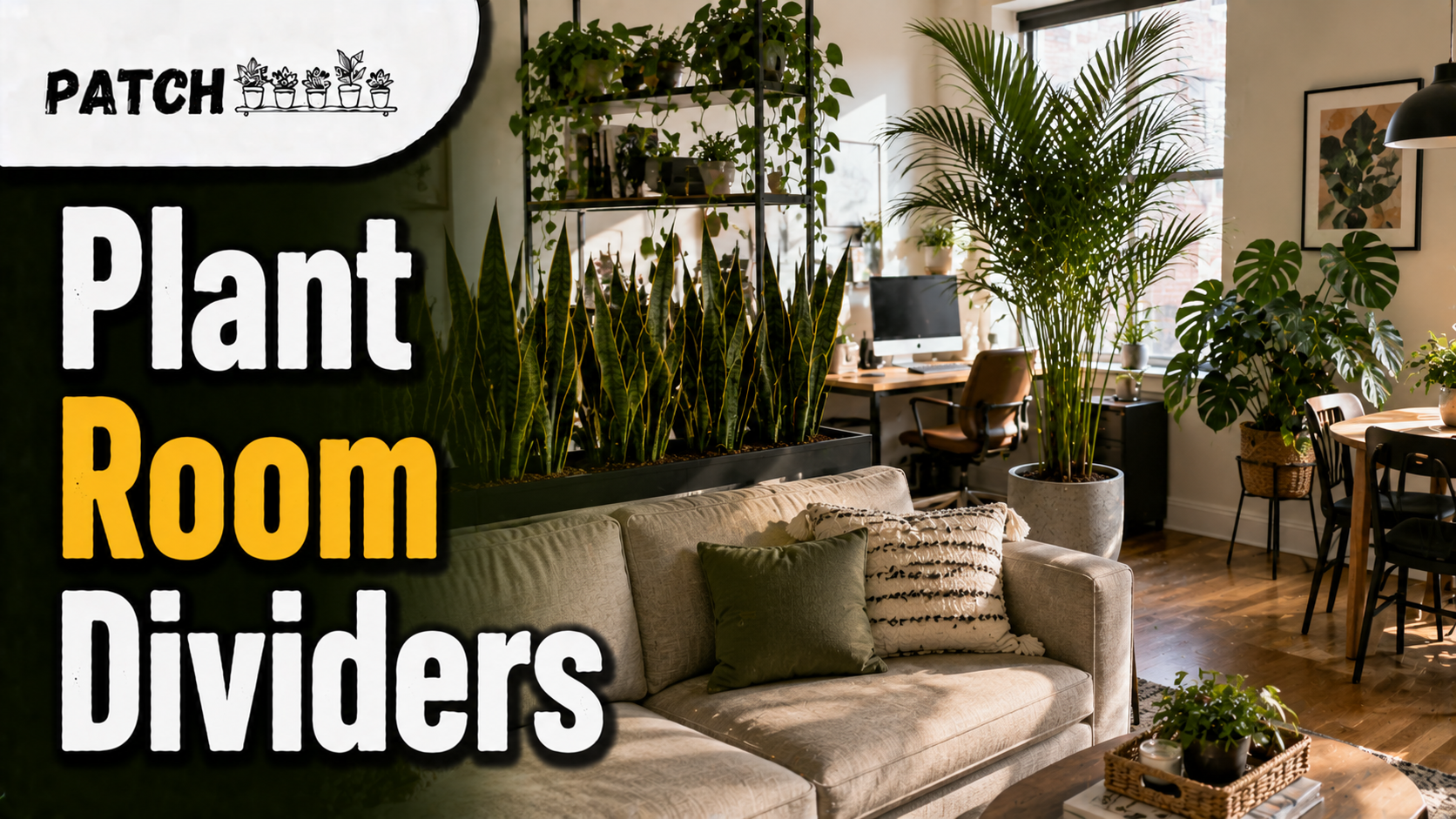
Natural room dividers are a practical way to separate living, dining, sleeping, and working areas without building permanent walls. With the right indoor plants, you can create a green partition that adds texture, softens furniture lines, and makes an open-plan room feel more organized.
Plant room dividers work particularly well in apartments, studio flats, home offices, and shared living spaces. Tall snake plants can mark the edge of a seating area, palms can create a light visual screen, and trailing pothos can transform an open bookcase into a beautiful green boundary.
However, not every indoor plant provides the same amount of privacy. Some plants are tall but narrow, while others grow wide enough to interfere with walkways. Light, watering, mature size, planter stability, and pet safety all influence whether a plant divider will work in your home.
This guide explores 17 indoor plant room-divider ideas, including 16 plant choices and one mixed living-divider design. You will learn which plants work best for privacy, how to build a renter-friendly plant partition, what to consider before buying planters or shelving, and how to maintain a healthy indoor greenery divider.
What Are the Best Natural Room Dividers?
The best natural room dividers include snake plants, areca palms, bamboo palms, Monstera, rubber plants, money trees, Dracaena, bird of paradise, fiddle-leaf figs, pothos, climbing philodendrons, peace lilies, ZZ plants, Hoyas, spider plants, and string of pearls.
For a narrow room divider, use several upright snake plants or suitable Dracaena varieties. For a softer and fuller screen, choose areca palms or bamboo palms. For small apartments, an open bookcase with pothos, Hoyas, spider plants, and other suitable houseplants can divide space without requiring a row of large floor pots.
Where stronger visual separation is required, a combination of stable planters and open shelving generally provides more consistent coverage than a single plant.
Plants can help define different zones, but they are not equivalent to solid partitions for complete visual privacy, sound isolation, or security.
Key Takeaways
- Natural room dividers use plants, planters, stands, or shelving to create flexible boundaries within an indoor space.
- Snake plants and Dracaena provide a narrow, upright appearance suitable for smaller floor areas.
- Areca palms and bamboo palms create fuller screens in rooms with appropriate indirect light.
- Monstera, rubber plants, bird of paradise, and fiddle-leaf figs work as statement plants in larger rooms.
- Pothos, climbing philodendrons, and Hoyas can soften open shelving or suitably supported trellises.
- ZZ plants are useful for lower-light locations, although adequate light is still essential for healthy growth.
- Spider plants and areca palms are among the pet-friendlier choices, according to ASPCA species listings.
- Use stable planters and properly secured shelves to reduce tipping and falling hazards.
- Assess lighting at the actual divider position because plants in the middle of a room may receive less light than plants near windows.
- A layered combination of tall plants, compact foliage, and trailing plants often produces the most practical green partition.
Quick Comparison: 17 Indoor Plant Room-Divider Ideas
| Plant or Divider Idea | Best Light | Privacy Effect | Best Use |
|---|---|---|---|
| 1. Snake Plant | Low to bright indirect | Moderate when grouped | Narrow floor divider |
| 2. Areca Palm | Bright indirect | Moderate to fuller screen | Living-room boundary |
| 3. Bamboo Palm | Medium to bright indirect | Fuller foliage | Home office divider |
| 4. Monstera | Bright indirect | Decorative partial screen | Open-plan living room |
| 5. Rubber Plant | Medium to bright indirect | Partial screen | Minimalist interiors |
| 6. Money Tree | Bright indirect | Light partial screen | Apartment zoning |
| 7. Dracaena | Low to bright indirect, by variety | Moderate when grouped | Narrow spaces |
| 8. Bird of Paradise | Very bright light | Wide architectural screen | Spacious living rooms |
| 9. Fiddle-Leaf Fig | Bright indirect | Decorative screen | Statement room divider |
| 10. Pothos | Medium to bright indirect | Light trailing screen | Open bookcase divider |
| 11. Climbing Philodendron | Medium to bright indirect | Partial vertical screen | Trellis divider |
| 12. Peace Lily | Medium to bright indirect | Low or mid-height boundary | Grouped floor planters |
| 13. ZZ Plant | Low to bright indirect | Moderate when grouped | Office and apartment dividers |
| 14. Hoya | Bright indirect | Light trailing screen | Plant shelf divider |
| 15. Spider Plant | Medium to bright indirect | Light cascading boundary | Tiered plant stands |
| 16. String of Pearls | Bright light | Decorative, minimal privacy | High shelves |
| 17. Mixed Plant Divider | Depends on selected plants | Adjustable coverage | Fuller living partitions |
Important: Privacy descriptions are practical design assessments, not measured opacity ratings. Actual coverage depends on the plant’s size, maturity, pruning, spacing, and container arrangement.
Why Use Indoor Plants as Natural Room Dividers?
Create Separate Zones Without Permanent Walls
In an open-plan room, a single space may have several functions.
You might need an area for dining, working, reading, and relaxing without building separate rooms.
A carefully positioned row of planters or a plant-filled open shelf creates a visible boundary while preserving a more open layout than a solid wall.
Make Apartments Feel More Organized
A studio apartment can benefit from a visual distinction between the bed, desk, and seating area.
Instead of using bulky screens, smaller plants and narrow stands can create separation without taking over the entire floor.
For additional space-saving ideas, explore our best indoor plants for tiny apartments.
Soften Furniture and Architectural Lines
Trailing foliage, large leaves, and arching palm fronds can visually soften shelving, room corners, and furniture.
These features add natural variation to otherwise straight interior lines.
Keep the Layout Flexible
Unlike permanent walls, planters and freestanding plant stands can often be moved when a room’s furniture arrangement changes.
For renters, this flexibility can make plant-based partitions more practical than structural alterations.
Understand the Limits of Plant Dividers
Plants can make separate zones feel more defined, but they do not reliably block sound or provide complete privacy.
A single tall plant might act as a focal point rather than a full visual barrier.
For stronger screening, use several suitably sized plants, stable furniture, or a combination of shelving and foliage.
17 Best Natural Room Dividers With Indoor Plants

1. Snake Plant: Best for Narrow Room Dividers
Botanical name: Dracaena trifasciata, formerly Sansevieria trifasciata.
Snake plants are among the most useful natural room dividers when floor space is limited.
Their long, upright leaves form strong vertical lines without spreading as widely as a mature palm.
One snake plant offers modest separation, but several plants arranged in stable rectangular or individual floor planters can create a more noticeable boundary.
Snake plants tolerate a relatively wide range of indoor light, although adequate indirect light generally supports stronger growth.
- Light: Low to bright indirect light.
- Water: Allow suitable drying between waterings.
- Best placement: Behind sofas, beside desks, and along narrow room boundaries.
- Divider effect: Upright architectural screening.
- Care tip: Avoid keeping the roots constantly wet.
- Pet safety: Toxic to cats and dogs if ingested.
Styling idea: Arrange three to five appropriately sized snake plants along the back of a sofa, leaving enough room for access and future growth.
Read our snake plant care guide for more advice.
2. Areca Palm: Best for an Airy Green Room Divider
Botanical name: Dypsis lutescens.
Areca palms create a softer room-divider effect with their long, arching fronds.
Unlike snake plants, their foliage spreads outward and provides a more layered visual screen.
They work especially well beside a seating area or between living and dining zones in a bright room.
However, areca palms require adequate growing space and generally perform best in bright indirect light.
- Light: Bright indirect light.
- Water: Maintain appropriate moisture without waterlogging.
- Best placement: Living-room boundaries and bright open-plan interiors.
- Divider effect: Soft, leafy screening.
- Care tip: Keep away from harsh drafts and avoid crowding the fronds.
- Pet safety: Listed as non-toxic to cats and dogs by ASPCA.
Styling idea: Use two substantial areca palms on opposite sides of an open passage to frame the transition between zones.
3. Bamboo Palm: Best for a Natural Home Office Screen
Botanical name: Chamaedorea seifrizii.
Bamboo palm grows in attractive clusters of slender stems with green foliage.
Its growth habit makes it useful for creating a tropical screen beside an office desk, reading corner, or living area.
It provides a different appearance from the broad leaves of Monstera or the upright shape of snake plants.
Bamboo palms generally appreciate filtered or indirect light and an appropriate balance of moisture and drainage.
- Light: Medium to bright indirect light.
- Water: Water according to soil moisture, avoiding prolonged saturation.
- Best placement: Home offices and soft room partitions.
- Divider effect: Layered, cane-like foliage.
- Care tip: Allow adequate room for mature growth.
- Pet safety: Verify the exact botanical species before treating any palm as pet-safe.
Styling idea: Place bamboo palm in a stable floor planter beside a work area to soften the view from the adjoining living space.
4. Monstera: Best for a Statement Living Room Divider
Botanical name: Monstera deliciosa.
Monstera is popular for its large leaves, which develop distinctive splits and openings as the plant matures under suitable conditions.
Its broad foliage can create an attractive partial screen between two zones.
However, Monstera is naturally a climbing plant, and unsupported stems may spread unpredictably or lean toward the light.
Providing appropriate support can improve the plant’s shape and make it more practical for indoor room-divider use.
- Light: Bright indirect light.
- Water: Check growing-medium moisture before watering.
- Best placement: Spacious living rooms and open-plan interiors.
- Divider effect: Bold partial screening.
- Care tip: Provide a stable support if stems require it.
- Pet safety: Toxic to cats and dogs if chewed.
Styling idea: Position a mature Monstera beside a lounge chair or console to mark the edge of a seating zone.
Explore our Monstera plant care guide for detailed advice.
5. Rubber Plant: Best for Modern Minimalist Interiors
Botanical name: Ficus elastica.
Rubber plants have glossy leaves and an upright woody growth habit.
They look particularly attractive in modern interiors where a clean silhouette is preferred over very fine or cascading foliage.
A tall rubber plant can provide a visible boundary beside a dining table, desk, or seating area.
However, a single-trunk specimen with foliage concentrated near the top provides less screening close to floor level.
- Light: Medium to bright indirect light.
- Water: Allow the potting medium to dry appropriately between waterings.
- Best placement: Minimalist rooms and bright corners.
- Divider effect: Architectural height with broad foliage.
- Care tip: Keep large leaves free from accumulated dust.
- Pet safety: Harmful if chewed; sap may irritate skin.
Styling idea: Pair a rubber plant with a lower, fuller plant in a separate container to strengthen the visual boundary.
For further care, visit our rubber plant guide.
6. Money Tree: Best for Apartment Zoning
Botanical name: Pachira aquatica.
Money trees offer a decorative trunk and a canopy of palmate leaves.
They can create a gentle boundary between a home office and seating area without appearing as dense as a row of palms.
Money trees often work best as single focal-point plants or part of a mixed arrangement.
Their size depends on growing conditions, container space, and pruning.
- Light: Bright indirect light.
- Water: Allow suitable drying before watering again.
- Best placement: Apartments, living rooms, and office corners.
- Divider effect: Light, tree-like separation.
- Care tip: Avoid waterlogged roots and sudden environmental changes.
- Pet safety: Listed as non-toxic to cats and dogs by ASPCA.
Styling idea: Place a money tree near the edge of a sofa or desk to create height without forming an overly dense barrier.
Read our money tree care guide.
7. Dracaena: Best for Slim Vertical Plant Screens
Botanical examples: Dracaena fragrans and suitable related species.
Dracaena includes several popular indoor foliage plants with upright stems and narrow or broad leaves, depending on the variety.
Some cultivars grow in relatively compact forms that make them useful beside shelves, desks, sofas, and entryways.
Dracaena generally adapts well to suitable indoor conditions, although growth and leaf colour vary according to light.
- Light: Low to bright indirect light, depending on species and cultivar.
- Water: Allow appropriate drying and avoid prolonged saturation.
- Best placement: Narrow room boundaries and office spaces.
- Divider effect: Upright structural screening.
- Care tip: Select cultivars by mature height and leaf spread.
- Pet safety: Many Dracaena species are toxic to cats and dogs.
Styling idea: Use two or three plants of similar mature height to create a clean visual boundary without overcrowding.
See our Dracaena plant care guide for more details.
8. Bird of Paradise: Best for Spacious Open-Plan Rooms
Botanical examples: Strelitzia nicolai and Strelitzia reginae.
Bird of paradise creates strong architectural interest with its large leaves and upright growth habit.
It is most suitable for spacious interiors with abundant light.
Large specimens can create an impressive partial screen between dining and living areas, but their broad leaves may obstruct narrow walkways.
Indoor flowering is not guaranteed, especially when a plant is young or receives insufficient light.
- Light: Very bright light with suitable direct sun after acclimatization.
- Water: Moderate during active growth; avoid waterlogging.
- Best placement: Spacious bright living rooms.
- Divider effect: Broad architectural foliage.
- Care tip: Measure the space needed for mature leaves.
- Pet safety: Potentially harmful if ingested.
Styling idea: Position a bird of paradise slightly behind a sofa rather than directly in a frequently used passage.
Learn more in our bird of paradise care guide.
9. Fiddle-Leaf Fig: Best for a Decorative Interior Boundary
Botanical name: Ficus lyrata.
Fiddle-leaf figs are known for their broad, violin-shaped leaves and striking tree-like appearance.
They can create an attractive visual boundary in a bright living room or office.
However, fiddle-leaf figs are often sensitive to abrupt changes in light, temperature, and watering.
They are better placed in a relatively stable position than repeatedly moved around a room.
- Light: Bright indirect light, with suitable acclimatized sun.
- Water: Water according to soil moisture and growing conditions.
- Best placement: Bright living rooms and seating-area boundaries.
- Divider effect: Statement foliage and height.
- Care tip: Avoid cold drafts and frequent relocation.
- Pet safety: Harmful if ingested; sap can irritate skin.
Styling idea: Use one mature fiddle-leaf fig as an anchor at the edge of a room zone rather than expecting it to form a continuous screen.
Read our fiddle-leaf fig care guide.
10. Pothos: Best for an Open Bookcase Divider
Botanical name: Epipremnum aureum.
Pothos is a popular trailing houseplant with heart-shaped leaves and long stems.
It works especially well on open shelving, bookcases, and plant racks used to separate two areas of a room.
The foliage softens shelf edges and creates a cascading display.
However, a single pothos plant will not create the same privacy as a dense floor-standing screen.
- Light: Medium to bright indirect light; tolerates some lower light.
- Water: Check moisture before watering.
- Best placement: Open shelving and elevated plant stands.
- Divider effect: Trailing greenery around a furniture partition.
- Care tip: Prune long stems to maintain fuller growth.
- Pet safety: Toxic to cats and dogs if ingested.
Styling idea: Arrange pothos near the upper edge of a stable open bookcase, with enough space for stems to hang freely.
For more ideas, see our pothos care guide and trailing plants for shelves.
11. Climbing Philodendron: Best for Vertical Green Screens
Botanical example: Philodendron hederaceum.
Heartleaf philodendron produces trailing or climbing stems with attractive green leaves.
When trained on a stable trellis or other appropriate support, it can contribute to a vertical green divider.
However, it takes time for foliage to cover the support.
A climbing philodendron should not be expected to provide complete privacy immediately after planting.
- Light: Medium to bright indirect light.
- Water: Water when the growing medium has dried appropriately.
- Best placement: Supported trellises and open room dividers.
- Divider effect: Partial vertical foliage screening.
- Care tip: Use a sturdy support and direct new growth gently.
- Pet safety: Toxic to cats and dogs if chewed.
Styling idea: Use several rooted vines around a stable trellis rather than relying on one narrow stem to cover the entire structure.
Read our philodendron care guide for additional information.
12. Peace Lily: Best for a Soft Low Room Divider
Botanical name: Spathiphyllum species and hybrids.
Peace lilies produce attractive green foliage and distinctive white spathes.
They are useful for creating softer low or mid-height boundaries with grouped planters.
Peace lilies tolerate moderate or relatively low indoor light, but flowering usually improves with sufficient filtered light.
They are not generally tall enough to create strong floor-to-ceiling screening.
- Light: Medium to bright indirect light.
- Water: Maintain appropriate moisture without waterlogging.
- Best placement: Grouped containers and low partitions.
- Divider effect: Soft foliage boundary.
- Care tip: Check water needs carefully instead of relying on severe wilting.
- Pet safety: Toxic to cats and dogs if ingested.
Styling idea: Arrange several mature peace lilies in a stable rectangular planter arrangement, ensuring each has suitable root space.
See our peace lily care guide.
13. ZZ Plant: Best for Low-Maintenance Divider Arrangements
Botanical name: Zamioculcas zamiifolia.
ZZ plants are known for their glossy leaflets and upright growth.
They tolerate relatively low indoor light and can be useful in office spaces and apartments where more demanding tropical plants may struggle.
However, lower light typically means slower growth and reduced water use.
Several mature ZZ plants can create a tidy, low or medium-height divider.
- Light: Low to bright indirect light.
- Water: Allow suitable drying between waterings.
- Best placement: Office shelving and narrow room boundaries.
- Divider effect: Upright, glossy foliage.
- Care tip: Avoid overwatering, particularly in dim rooms.
- Pet safety: Toxic to cats and dogs if chewed.
Styling idea: Group ZZ plants in matching low, stable planters along a desk or sofa boundary.
Explore our ZZ plant care guide.
14. Hoya: Best for Trailing Greenery on Room-Divider Shelves
Botanical example: Hoya carnosa.
Hoyas are popular indoor plants with waxy leaves and trailing or climbing growth habits.
They can add greenery to open shelving used as a room partition.
Mature plants may produce decorative flowers under suitable conditions.
However, growth habits differ among Hoya species, and some remain relatively compact.
- Light: Bright indirect light.
- Water: Allow appropriate drying before watering again.
- Best placement: Open shelves and hanging planters.
- Divider effect: Light trailing foliage.
- Care tip: Check the mature habit of the selected species.
- Pet safety: Hoya carnosa is generally considered non-toxic to cats and dogs.
Styling idea: Combine a mature Hoya with upright plants on separate levels of a stable open shelf.
Read our Hoya care guide.
15. Spider Plant: Best for Tiered Plant-Stand Dividers
Botanical name: Chlorophytum comosum.
Spider plants produce long arching foliage and may develop baby plants on slender flowering stems.
These plantlets create an attractive cascading effect when the parent plant sits on an elevated stand.
Spider plants are especially useful for bright shelves and tiered plant displays.
They do not form a dense vertical barrier on their own, but they can add texture to a mixed divider.
- Light: Medium to bright indirect light.
- Water: Water according to potting-medium moisture.
- Best placement: Tiered stands and open shelving.
- Divider effect: Light arching foliage and hanging plantlets.
- Care tip: Allow room for offsets to develop.
- Pet safety: Listed as non-toxic to cats and dogs by ASPCA.
Styling idea: Place spider plants on the upper levels of a tiered stand with suitable heavier plants below.
For care details, see our spider plant care guide.
16. String of Pearls: Best for Decorative Hanging Partitions
Botanical name: Curio rowleyanus, formerly Senecio rowleyanus.
String of pearls produces long, delicate stems with small spherical leaves.
It is ideal for adding a decorative cascading element to a bright shelf or hanging arrangement.
However, it provides very little privacy when used alone.
String of pearls also requires more careful light and watering management than some beginner-friendly foliage plants.
- Light: Bright light, including appropriate gentle sunlight.
- Water: Allow considerable drying between suitable waterings.
- Best placement: Bright upper shelves and secured hanging planters.
- Divider effect: Delicate decorative curtain.
- Care tip: Keep the crown well lit and avoid waterlogged soil.
- Pet safety: Keep away from pets that may chew it.
Styling idea: Place string of pearls near the top of a bright open divider, paired with fuller foliage plants elsewhere in the arrangement.
For more information, see our string of pearls care guide.
17. Mixed Plant Divider: Best for a Complete Green Partition
A mixed plant divider combines several plants with suitable planters, shelving, or supports.
This is a design approach rather than a separate botanical species.
It is often the most effective way to create a green partition because individual plants can contribute different heights, leaf shapes, and levels of visual coverage.
For example, tall snake plants or suitable Dracaena varieties can provide vertical structure, pothos can soften shelves, and spider plants can create arching foliage.
However, only combine plants where their respective light and care requirements can be met.
- Light: Match every plant to its individual location.
- Water: Maintain separate watering routines where needs differ.
- Best placement: Open-plan living rooms, studio apartments, and home offices.
- Divider effect: Adjustable screening through layered foliage.
- Care tip: Use stable shelving and keep every pot accessible.
- Pet safety: Depends on the included plant species.
Styling idea: Place heavier and taller plants in stable lower positions, trailing plants on upper shelves, and compact plants in the middle.
A mixed divider can be rearranged as plants grow or seasonal light conditions change.
Which Natural Room Divider Is Best for Your Space?
The right arrangement depends on whether your main goal is privacy, visual organisation, decoration, or flexibility.
| Your Goal | Best Approach | Recommended Plants |
|---|---|---|
| Define a small apartment zone | Narrow line of pots | Snake plant or Dracaena |
| Soften an open-plan living room | Large focal plant | Areca palm, Monstera, or rubber plant |
| Create a desk background | Stable open shelving | Pothos, spider plant, Hoya |
| Divide a bright spacious room | Large floor plants | Bird of paradise or palms |
| Create a low-light-compatible boundary | Grouped adaptable foliage | ZZ plant or snake plant |
| Create stronger visual privacy | Mixed shelves and plants | Several compatible species |
| Keep furniture movable | Freestanding stand or shelving | Compact and trailing houseplants |
Planters as Room Dividers: How to Choose the Right Setup
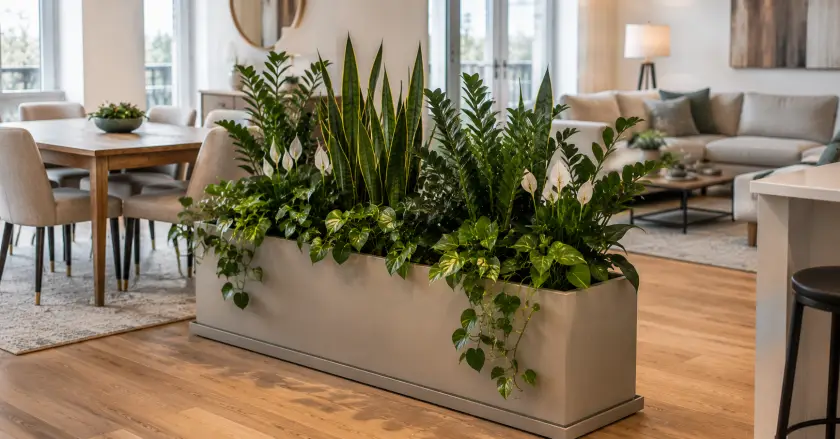
Long Rectangular Planters
Long rectangular planters can create a consistent boundary between living and dining areas.
They work especially well with upright plants that do not spread too widely.
Choose a stable container suitable for the mature plant size and expected watered weight.
Matching Individual Floor Pots
Several matching pots can create a flexible plant divider.
This arrangement is useful for renters because individual plants can be moved without disturbing the entire display.
It also allows each species to receive separate watering and repotting care.
Plant Stands
Tiered stands provide height variation without requiring every plant to grow tall.
Place heavier containers lower down, avoid overloading upper shelves, and confirm the stand is suitable for the total weight.
Open Bookcase Dividers
An open bookcase can provide both storage and plant display space.
Trailing plants may soften the shelf edges, while compact foliage plants create pockets of greenery.
Secure tall freestanding shelving against tipping where necessary, particularly in homes with children or pets.
Rolling Planters
Suitable wheeled planters can make rearranging a room easier.
Use locking wheels where available and avoid placing movable heavy containers on sloped or uneven floors.
Plant Wall Divider vs Planter Divider: What’s the Difference?
A plant wall divider usually relies on a vertical structure, such as a trellis, shelving system, or specially designed living wall.
A planter divider uses individual containers or long planter boxes positioned to define a boundary.
| Feature | Plant Wall Divider | Planter Divider |
|---|---|---|
| Structure | Vertical framework | Floor or shelf-based containers |
| Installation | May require secure mounting | Often freestanding |
| Maintenance | Can be more complex | Usually easier to access |
| Flexibility | Depends on the system | Often easier to rearrange |
| Privacy | Depends on plant coverage | Depends on height and spacing |
| Best for | Dedicated vertical greenery | Renters and flexible interiors |
For most beginners, individual planters or a stable plant-filled shelf provide a simpler starting point than a complex living-wall system.
How to Build a Natural Room Divider Step by Step
Step 1: Decide What You Want to Separate
Identify the main purpose of your divider.
You may want to separate a bed from a living area, create a work zone, define a dining space, or soften an entryway.
Decide whether you need a decorative boundary or meaningful visual screening.
Step 2: Measure the Available Space
Measure the floor area and check the distance required for people to move comfortably around the divider.
Remember to consider the plant’s mature leaf spread, not just the size of its pot.
A large bird of paradise may need considerably more clearance than a row of narrow snake plants.
Step 3: Evaluate Light on Both Sides
Check how much useful light reaches the plants at their intended positions.
A divider placed in the middle of a large room may receive significantly less daylight than plants close to a window.
The University of Minnesota Extension indoor plant lighting guide recommends matching houseplants to the light available and using suitable supplemental lighting when natural light is inadequate.
For further help, explore our complete indoor light guide.
Step 4: Choose Suitable Plants
Select plants based on height, mature width, foliage density, growing conditions, and maintenance requirements.
For example, choose snake plants for narrow vertical lines, palms for a softer screen, or trailing plants for open shelving.
Step 5: Choose Stable Planters and Shelving
Use containers with suitable drainage and supports capable of carrying the plants’ full watered weight.
A heavy floor planter may be more suitable than a lightweight stand for a large mature plant.
Do not position pots where they can be easily pulled, knocked over, or bumped during routine movement.
Step 6: Arrange the Plants
Place taller and structurally important plants first.
Then add mid-height or trailing plants to soften the arrangement.
Leave enough room for new leaves and access during maintenance.
Step 7: Check the View From Both Sides
A natural room divider is usually visible from more than one direction.
Walk around the arrangement and check whether it looks balanced from the adjoining spaces.
Adjust the positions of pots and shelving if the divider appears overly dense on one side.
Step 8: Establish a Maintenance Routine
Check moisture, inspect leaves, clean the area, and prune plants as needed.
As the plants grow, revisit the spacing and stability of the entire arrangement.
Five Practical Room Divider Layouts
Layout 1: Behind-the-Sofa Divider
Place a row of suitable snake plants or Dracaena behind the sofa to define the living area.
This arrangement creates a consistent line without requiring a solid partition.
Make sure plants do not interfere with access behind the furniture.
Layout 2: Open Shelf Between a Living Room and Dining Area
Use an appropriately secured open bookcase with pothos, spider plants, Hoyas, and other suitable foliage plants.
Keep some shelf openings free to preserve a lighter appearance.
Match each plant to the actual light available on its shelf.
Layout 3: Studio Apartment Bed Divider
Use a stable freestanding shelf or suitably sized planters to create a visual boundary around the sleeping area.
Keep emergency exit routes and normal walking space clear.
Choose containers that are easy to maintain without moving heavy furniture every time a plant needs water.
Layout 4: Home Office Privacy Divider
Place a bamboo palm, areca palm, or suitable plant shelf beside a desk.
The greenery can soften the view between the desk and adjoining space, creating a more attractive video-call background.
Keep watering equipment away from electrical cables, monitors, and power strips.
Layout 5: Statement Plant at the Edge of a Living Zone
Choose a large rubber plant, Monstera, money tree, or bird of paradise to define the edge of a seating area.
This provides partial visual separation while preserving an open floor plan.
For more styling inspiration, read our room-by-room indoor plant styling guide.
Real Plants vs Artificial Plants for Room Dividers
Real and artificial greenery have different advantages.
When Real Plants Are Better
Real plants provide natural textures, living growth, and seasonal changes.
They are most suitable where adequate light, maintenance access, and appropriate watering are available.
However, they may lose leaves, outgrow their containers, develop pests, or require replacement.
When Artificial Plants Make Sense
Artificial foliage can be useful in areas without enough light for healthy plant growth.
For example, a windowless hallway or an inaccessible display shelf may not support real plants unless suitable grow lighting is installed.
Artificial materials also need cleaning and must be selected with fire safety and installation requirements in mind.
Combining Real and Artificial Greenery
In some layouts, real plants can be placed near windows while artificial foliage fills locations with inadequate growing conditions.
This approach may preserve the overall decorative effect without expecting real plants to survive in unsuitable positions.
How to Care for Plant Room Dividers
Water Based on Plant Needs
Different divider plants have different watering requirements.
Snake plants and ZZ plants generally need more drying between waterings than some palms or peace lilies.
Check the growing medium and seasonal conditions before adding water.
There is no reliable universal weekly watering schedule for all indoor plant dividers.
See our houseplant watering guide for further advice.
Protect Furniture and Floors
Use appropriate drainage trays and waterproof protection around planters.
Remove accumulated water from saucers rather than allowing pots to stand permanently in runoff.
Where practical, water smaller pots away from furniture and return them after drainage has stopped.
Rotate Plants When Appropriate
Some indoor plants gradually lean toward their main source of light.
Careful rotation may help maintain a more balanced appearance in suitable species.
However, do not rotate or relocate plants unnecessarily if they are sensitive to environmental changes.
Prune Overgrown Growth
Long vines and large leaves may interfere with walkways or neighbouring furniture.
Prune according to the species and its growth habit.
Do not remove large amounts of healthy foliage simply to force a plant into a space that is too small for it.
Keep Leaves Clean
Dust can accumulate on large foliage and reduce the amount of light reaching leaf surfaces.
Gently clean leaves where appropriate, using techniques suitable for the species.
Our guide to cleaning plant leaves explains safe approaches.
Inspect for Pests
Grouped plants should be checked regularly for common pests, including mealybugs, scale insects, and spider mites.
Inspect new plants before adding them to an established arrangement.
If pests appear, identify the cause and follow suitable plant-specific treatment advice.
Choose the Right Soil and Pot Size
Potting media should match the plant’s root and moisture requirements.
Use an appropriately sized container rather than automatically moving every plant into a very large pot.
For additional guidance, explore our potting soil guide.
If you are preparing several planters for a room divider, use the PatchPlants Soil Calculator to estimate how much growing medium you need.
Are Natural Room Divider Plants Safe for Pets?
Several popular indoor plants contain compounds that may cause irritation or poisoning when pets chew their leaves or stems.
This is particularly important for floor-level dividers and hanging vines that may be within reach.
| Plant | Pet-Safety Consideration |
|---|---|
| Snake Plant | Toxic to cats and dogs |
| Areca Palm | ASPCA lists as non-toxic |
| Bamboo Palm | Check exact species; common names overlap |
| Monstera | Toxic if chewed |
| Rubber Plant | Harmful if ingested; irritating sap |
| Money Tree | ASPCA lists as non-toxic |
| Dracaena | Many commonly grown species are toxic |
| Bird of Paradise | Potentially harmful if ingested |
| Fiddle-Leaf Fig | Harmful if ingested; irritating sap |
| Pothos | Toxic if chewed |
| Philodendron | Toxic if chewed |
| Peace Lily | Toxic if chewed |
| ZZ Plant | Toxic if chewed |
| Hoya carnosa | Generally considered non-toxic |
| Spider Plant | ASPCA lists as non-toxic |
| String of Pearls | Prevent access and ingestion |
The ASPCA Toxic and Non-Toxic Plants database provides botanical-name-based information for many indoor plant species.
Check the exact species rather than relying only on common names, especially for plants sold under broad labels such as palm or philodendron.
Even non-toxic plants may cause digestive upset if eaten in large quantities.
If a pet ingests a potentially toxic plant, contact a veterinarian promptly.
For further advice, read our cat-friendly plant guide and dog-friendly plant guide.
Common Problems With Indoor Plant Room Dividers
| Problem | Possible Cause | What to Check |
|---|---|---|
| Plants lean toward a window | Uneven light | Plant position and support |
| Lower leaves drop | Low light, moisture stress, or natural ageing | Growing conditions and root health |
| Yellow leaves | Watering problems, low light, or other stress | Moisture, roots, and recent care |
| Trailing vines become sparse | Insufficient light or limited branching | Light availability and pruning |
| Palms develop brown tips | Water or salt problems, dry air, or other stress | Moisture, water quality, and room conditions |
| Floor around planters becomes wet | Drainage runoff or leaks | Pot, tray, and waterproof protection |
| Plant divider looks uneven | Different growth rates or unsuitable plant choices | Spacing and plant maturity |
| Leaves interfere with walkways | Insufficient clearance | Mature plant size and placement |
| Indoor vines lose colour | Insufficient light or cultivar characteristics | Actual light at plant position |
Common Mistakes to Avoid With Natural Room Dividers
- Choosing plants only for height: Leaf density and mature width also influence screening.
- Ignoring actual light conditions: A room’s middle may be much darker than its windows.
- Using unstable planters: Large plants need secure containers that can support their weight.
- Blocking doors or walkways: A divider should improve layout, not make the room difficult to use.
- Assuming one plant provides complete privacy: Many species offer only partial visual separation.
- Overcrowding shelves: Plants need room for healthy growth and maintenance access.
- Combining incompatible watering needs: Keep plants in separate pots when care requirements differ.
- Allowing water to collect on furniture: Protect shelves and remove excess runoff.
- Ignoring pet toxicity: Many common divider plants are unsafe if chewed.
- Using hanging plants with weak fixtures: Proper support is essential.
- Expecting a living wall to maintain itself: Plant walls need lighting, watering, pruning, and pest inspection.
- Failing to plan for growth: Large palms, Monstera, and bird of paradise may outgrow their initial positions.
- Positioning greenery around electrical equipment: Keep watering and drainage away from power supplies.
- Choosing artificial plants without checking materials: Consider fire safety and cleaning requirements.
Frequently Asked Questions About Natural Room Dividers
What are the best indoor plants for natural room dividers?
Snake plants, areca palms, bamboo palms, Monstera, rubber plants, money trees, Dracaena, and bird of paradise are useful for floor-level room dividers. Pothos, philodendron, Hoyas, and spider plants work well on open shelving. The best choice depends on available light, mature size, desired privacy, and pet safety.
How can I create a natural room divider in a small apartment?
Use narrow planters, an appropriately secured open shelf, or a compact plant stand. A row of snake plants or ZZ plants can mark a room boundary without taking up as much width as a large palm. Keep walkways clear, ensure the plants receive enough light, and use containers that are easy to move and maintain.
Can plants provide privacy without blocking natural light?
Yes. Plants can create partial visual separation while allowing light to pass around and between their leaves. Palms, grouped upright plants, and open shelves with trailing vines provide different levels of screening. However, plants do not offer the same complete privacy or sound isolation as a solid wall.
Which natural room divider plants are better for homes with pets?
Areca palms, money trees, spider plants, and certain accurately identified other species are listed as non-toxic to cats and dogs by ASPCA. However, snake plants, pothos, philodendrons, Monstera, ZZ plants, and peace lilies have toxicity concerns. Always confirm the botanical name and keep even non-toxic plants from being chewed excessively.
How do I maintain a plant room divider indoors?
Choose plants suited to the available light, water according to the species and growing-medium moisture, keep containers stable, and remove excess drainage water. Inspect leaves for pests, clean foliage when needed, prune growth that blocks pathways, and adjust spacing as plants mature. Regular care keeps the divider attractive and safe.
Final Thoughts
Natural room dividers are a flexible way to introduce greenery while creating clearer boundaries between different areas of a home.
Snake plants and Dracaena work well for narrow partitions. Areca palms and bamboo palms offer fuller foliage, while Monstera, rubber plants, bird of paradise, and fiddle-leaf figs make attractive statement dividers in spacious interiors.
For smaller apartments, open shelving filled with pothos, philodendrons, Hoyas, spider plants, and other suitable houseplants can create separation without requiring a large row of floor planters.
Remember that the most successful divider is not necessarily the one with the most plants. Good lighting, stable containers, appropriate maintenance access, and sufficient walking space are more important than packing greenery into every available gap.
Start with one clearly defined area, choose plants suitable for its growing conditions, and expand the arrangement as you learn how the plants develop.
For more inspiration, explore our indoor jungle styling guide, trailing plants for shelves, oversized indoor plants, and statement plants for minimalist interiors.