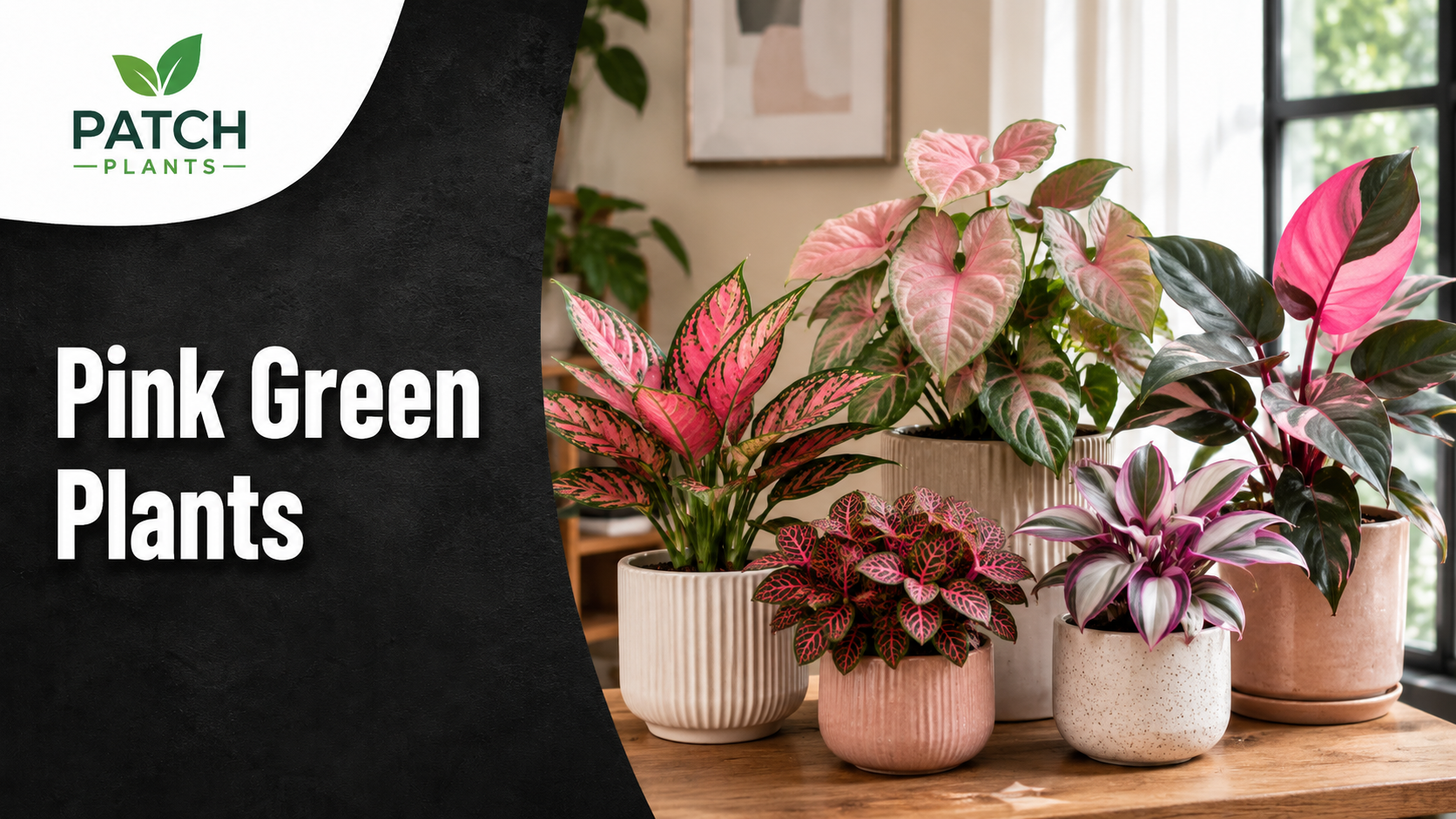
A plant with pink and green leaves can brighten a room without relying on flowers. These plants bring colour through foliage, so they look decorative even when they are not blooming. Some have soft blush patterns, some have bold hot-pink patches, and some mix pink, cream, green, and burgundy in one leaf.
The best choice depends on your light, watering habits, humidity, and experience level. A beginner may do better with pink Aglaonema or Syngonium, while a collector may prefer Philodendron Pink Princess, Caladium, or Stromanthe Triostar. This guide compares the best indoor picks and explains how to keep their colour strong.
Best Picks at a Glance
The easiest plant with pink and green leaves for most homes is usually pink Aglaonema, because it handles normal indoor conditions better than many rare variegated plants. For shelves or hanging displays, try Tradescantia Nanouk or pink Fittonia. For bold statement foliage, choose Philodendron Pink Princess, Caladium, Stromanthe Triostar, or Ficus elastica Ruby.
Key Takeaways
- A plant with pink and green leaves usually needs bright indirect light to keep its colour.
- Low light can make pink leaves fade, turn greener, or grow weaker.
- Harsh direct sun can scorch delicate pink and variegated foliage.
- Beginner-friendly picks include pink Aglaonema, Syngonium, Fittonia, Polka Dot Plant, and Peperomia Ginny.
- Collector-style picks include Pink Princess Philodendron, Caladium, Stromanthe Triostar, and Rex Begonia.
- Most pink and green indoor plants need drainage, steady watering, and careful placement.
- This guide connects naturally with colorful foliage indoor plants, complete indoor light guidance, and complete watering tips.
Why Pink and Green Indoor Plants Are So Popular
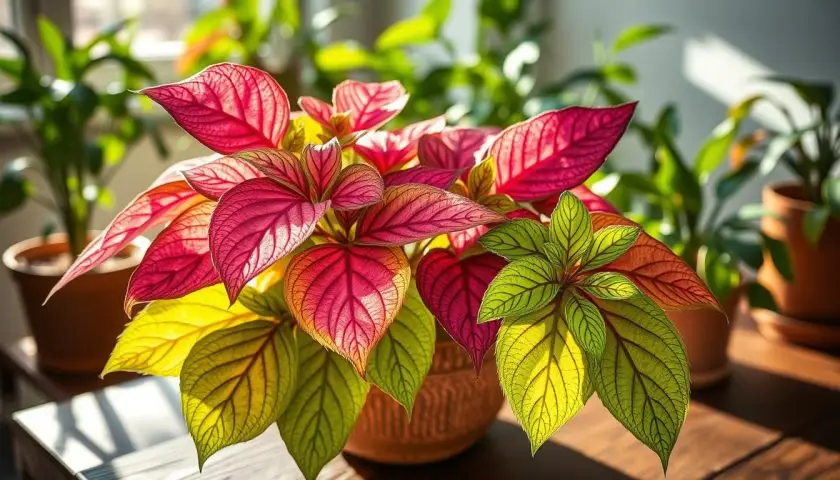
A pink and green indoor plant gives you the softness of flowers with the long-lasting value of foliage. Instead of waiting for blooms, you get colour every day through patterned leaves. That makes these plants useful for bedrooms, home offices, shelves, bathrooms with windows, and bright living room corners.
Pink foliage also pairs well with green plants. A single pink and green houseplant can break up a collection of plain foliage and make a plant shelf feel more styled. In a neutral room, it adds warmth. In a colourful room, it adds personality without looking too heavy.
If you like colourful leaves, you may also enjoy Croton Petra plant care, purple passion plant care, and indoor plants with red flowers.
Plant With Pink and Green Leaves: Best Indoor Comparison
| Plant | Best Feature | Light | Care Level |
|---|---|---|---|
| Pink Aglaonema | Easy pink-green patterned foliage | Medium to bright indirect | Easy |
| Philodendron Pink Princess | Dark leaves with pink variegation | Bright indirect | Moderate |
| Syngonium Pink Allusion | Soft arrowhead leaves with pink tones | Medium to bright indirect | Easy |
| Pink Caladium | Large thin leaves with bright pink centres | Bright filtered | Moderate |
| Pink Fittonia | Pink veining on small leaves | Medium to bright indirect | Easy to moderate |
| Polka Dot Plant | Speckled pink and green leaves | Bright indirect | Easy |
| Tradescantia Nanouk | Trailing pink, green, and cream leaves | Bright indirect | Easy |
| Stromanthe Triostar | Pink, cream, green, and burgundy leaves | Bright indirect | Moderate |
| Calathea Roseopicta | Pink rings and dark patterned foliage | Medium to bright indirect | Moderate |
| Ficus elastica Ruby | Large glossy pink-green leaves | Bright indirect | Moderate |
| Peperomia Ginny | Small leaves with pink edges | Medium to bright indirect | Easy |
| Rex Begonia | Dramatic patterned pink foliage | Bright indirect | Moderate |
| Cordyline Fruticosa | Tropical pink and green upright leaves | Bright light | Moderate |
1. Pink Aglaonema
Pink Aglaonema is one of the best indoor choices if you want a pink and green variegated plant without difficult care. Many varieties have green leaves splashed, spotted, or edged with pink, red, cream, or coral tones.
It is more forgiving than many rare pink houseplants. It can handle medium indoor light, though stronger filtered light usually keeps the colour better. It also tolerates normal home conditions if you avoid overwatering.
Why choose it?
- Good beginner pick.
- Colourful without needing flowers.
- Works on desks, shelves, and side tables.
- More forgiving than many tropical collectors’ plants.
For more easy-care indoor options, read best indoor plants for beginners and low-maintenance plants that thrive.
2. Philodendron Pink Princess
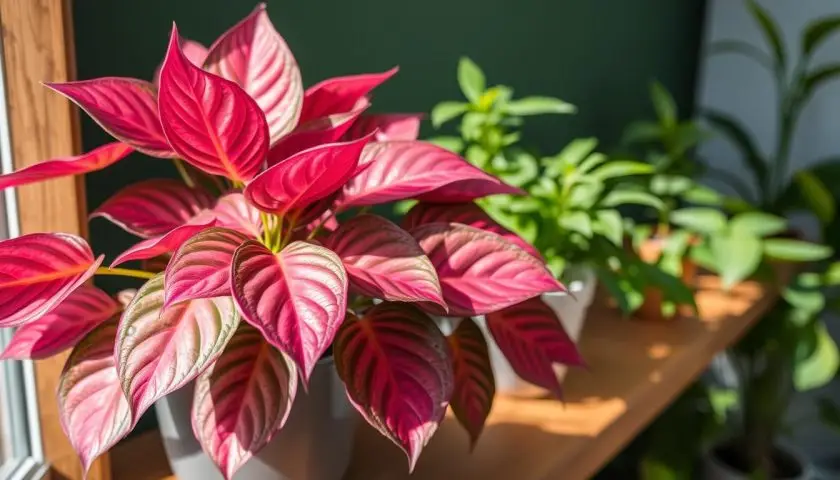
Philodendron Pink Princess is one of the most famous pink and green houseplants. Its leaves are usually dark green to almost black, with pink variegation that can appear as splashes, streaks, or blocks.
This plant is beautiful, but it needs realistic expectations. Every leaf will not be perfectly pink. Some leaves may be mostly green, some may be highly variegated, and some may have balanced colour. The goal is healthy, stable growth, not forcing the plant to produce all-pink leaves.
Best care notes
- Give bright indirect light.
- Use a chunky, well-draining potting mix.
- Support climbing growth with a pole or stake.
- Prune reverted green growth if needed.
- Avoid harsh direct sun that can scorch pink sections.
For climbing and support help, read moss pole for plants and Philodendron care guide.
3. Syngonium Pink Allusion
Syngonium Pink Allusion is a softer, easier choice for people who want pink tones without the drama of rare plants. The arrow-shaped leaves often show pale green, cream, and gentle pink veining.
This plant can stay compact with pruning or trail as it matures. It works well on shelves, desks, and plant stands. It prefers bright indirect light but can handle medium light better than many highly variegated plants.
Best for
- Beginners who want subtle pink foliage.
- Small apartments and shelves.
- Plant parents who like easy propagation.
- Rooms with medium to bright indirect light.
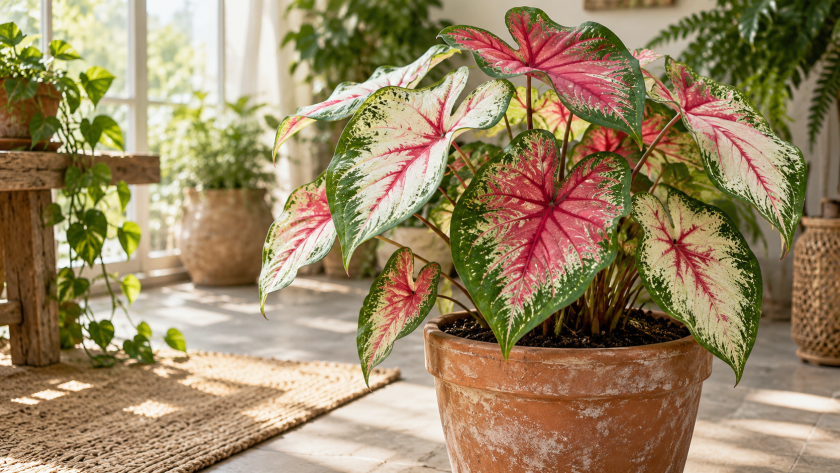
4. Pink Caladium
Caladium is one of the boldest options if you want an exotic plant with pink and green foliage. The leaves can be heart-shaped, thin, and dramatically coloured, with pink centres, green edges, white markings, or red veins.
The main thing to know is that Caladiums are seasonal. Indoors, they may go dormant when conditions change. That does not always mean the plant has died. It may rest and regrow from its tuber later.
Best care notes
- Give bright filtered light.
- Keep soil lightly moist during active growth.
- Avoid cold rooms and cold drafts.
- Expect possible dormancy.
- Use humidity support for better foliage.
For humidity support, read humidity hacks without a humidifier and DIY humidity tray.
5. Pink Fittonia
Pink Fittonia, also called nerve plant, has small green leaves with bright pink, red, or white veining. It is a great choice for terrariums, small pots, and humid rooms with filtered light.
Fittonia is famous for dramatic wilting when it gets too dry. The good news is that it often perks up after watering. Still, repeated drying can weaken the plant, so keep moisture more consistent than you would for snake plants or succulents.
Best for
- Small shelves and desks.
- Terrariums and humid setups.
- People who like detailed leaf patterns.
- Bright bathrooms with real windows.
For bathroom plant ideas, read best bathroom plants, plants for bathroom no light, and bathroom plants for mold.
6. Polka Dot Plant
The Polka Dot Plant, or Hypoestes, is a cheerful pink and green leafed plant with speckled foliage. It is often sold in pink, white, red, or mixed colour forms. Pink varieties look especially bright in small pots.
This plant grows quickly and can get leggy if ignored. Pinch the growing tips often to keep it bushy. If it starts flowering, many growers pinch off the flowers so the plant keeps more energy in its foliage.
Best care notes
- Give bright indirect light.
- Keep soil lightly moist.
- Pinch stems to prevent legginess.
- Refresh from cuttings if the plant becomes sparse.
- Avoid deep shade, which weakens colour.
7. Tradescantia Nanouk
Tradescantia Nanouk is a trailing plant with pink, green, cream, and purple tones. It looks beautiful on shelves and in hanging baskets because the stems spill over the pot.
It needs bright indirect light to keep strong colour. Low light can make the plant stretch and fade. It also dislikes sitting wet for too long, so drainage matters.
Best for
- Hanging baskets.
- Bright shelves.
- Fast-growing plant displays.
- People who enjoy easy stem cuttings.
For more trailing ideas, see trailing plants for shelves and hanging plants for shelves and ceilings.
8. Stromanthe Triostar
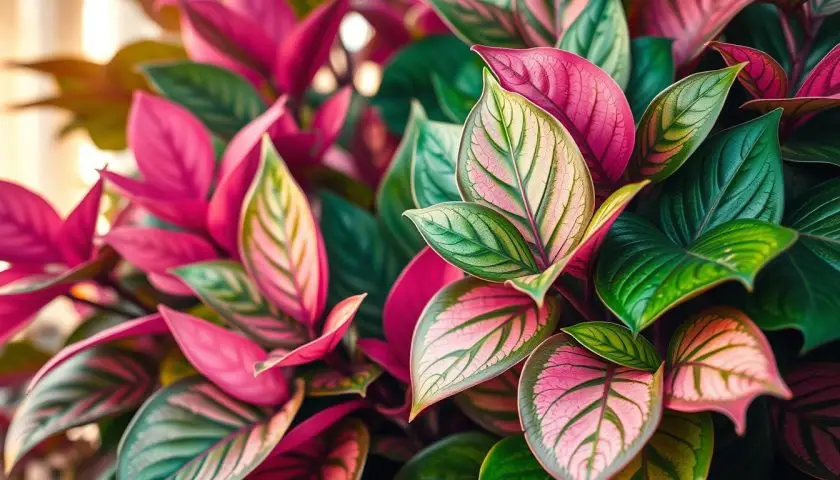
Stromanthe Triostar is one of the most elegant plants with two-tone leaves, though it often has more than two colours. Its foliage mixes green, cream, pink, and burgundy, with a painterly pattern that looks different on every leaf.
It is not the easiest plant, but it is worth growing if you can provide humidity, filtered light, and consistent watering. Dry air, cold drafts, and poor water quality can lead to crispy edges.
Best care notes
- Keep in bright indirect light.
- Avoid direct hot sun.
- Keep soil evenly moist, not soggy.
- Use humidity support.
- Avoid cold drafts and dry heat vents.
9. Calathea Roseopicta
Calathea Roseopicta varieties often have dark green leaves with pink rings, pink striping, or rose-coloured patterns. They are beautiful but can be sensitive, especially in dry air or inconsistent watering.
These plants are best for growers who are willing to watch humidity and moisture. They prefer bright indirect or medium filtered light, but they do not like harsh sun.
Best for
- People who enjoy patterned foliage.
- Bright bathrooms with windows.
- Humid plant rooms.
- Plant parents who already care for tropical foliage.
For similar care, read Calathea care guide.
10. Ficus elastica Ruby
Ficus elastica Ruby, often called the Ruby Rubber Plant, has glossy leaves with cream, green, and pink tones. New growth can look especially colourful in good light.
This is a strong choice if you want a larger indoor plant with pink and green foliage. It needs bright indirect light to keep its colour. In low light, the pink can fade and growth may slow.
Best care notes
- Give bright indirect light.
- Let the top layer of soil dry before watering.
- Use a pot with drainage holes.
- Clean leaves so they can absorb light.
- Avoid sudden location changes.
For more large foliage care, read Rubber Plant care guide and oversized indoor plants.
11. Peperomia Ginny
Peperomia Ginny, also called Peperomia Tricolor or Rainbow Peperomia, has small green and cream leaves edged with pink. It is compact, tidy, and easier than many humidity-loving foliage plants.
This plant is best for desks, shelves, and small rooms. It does not need heavy watering, and it can struggle if the soil stays wet. Treat it more like a semi-succulent houseplant than a thirsty tropical plant.
Best for
- Small spaces.
- Desks and shelves.
- Beginner plant parents.
- People who prefer compact plants.
12. Rex Begonia
Rex Begonia varieties can have pink, green, silver, purple, burgundy, or spiral-patterned foliage. If you want a foliage plant with striking color, Rex Begonia is hard to beat.
The main challenge is moisture balance. Rex Begonias dislike soggy soil but also dislike drying out completely for too long. They also prefer humidity without wet leaves sitting in poor airflow.
Best care notes
- Use bright indirect light.
- Water when the top layer begins to dry.
- Avoid soaking the leaves.
- Use a light, airy potting mix.
- Keep away from cold drafts.
13. Cordyline Fruticosa
Cordyline Fruticosa is a tropical plant with upright leaves that may show pink, red, green, burgundy, or cream. It can look dramatic indoors if your room is bright enough.
This is not the best choice for dark corners. Cordyline usually needs strong filtered light to keep its colour and avoid weak growth. It also prefers warmth and steady moisture.
Best for
- Bright living rooms.
- Sunrooms with filtered light.
- Tropical-style interiors.
- Plant parents who can manage humidity and light.
How to Choose the Right Pink and Green Houseplant
Before buying a pink and green houseplant, match the plant to your room rather than choosing only by colour. Many pink plants look amazing in photos but lose colour in a dark room or struggle in dry air.
Choose by light level
| Your Room | Best Pink and Green Picks | Avoid |
|---|---|---|
| Medium indirect light | Pink Aglaonema, Syngonium, Peperomia Ginny | Caladium, Cordyline, Pink Princess in weak corners |
| Bright indirect light | Pink Princess, Tradescantia Nanouk, Ficus Ruby, Stromanthe | Plants pressed against hot glass |
| Humid bright bathroom | Fittonia, Calathea, Stromanthe | Plants in bathrooms with no real light |
| Dry office | Aglaonema, Peperomia, Syngonium | Calathea and Fittonia without humidity support |
Choose by care level
- Easiest: Pink Aglaonema, Syngonium, Peperomia Ginny, Polka Dot Plant.
- Moderate: Tradescantia Nanouk, Ficus Ruby, Fittonia, Rex Begonia.
- More demanding: Pink Princess Philodendron, Caladium, Stromanthe Triostar, Calathea Roseopicta, Cordyline.
Best Light for Pink and Green Variegated Plants
Most pink and green variegated plants need bright indirect light. Pink, cream, and white parts usually contain less chlorophyll than plain green sections, so the plant still needs enough light to grow well.
Low light often makes the plant stretch, fade, or produce greener leaves. Harsh direct sun can scorch the delicate pale or pink sections. The best spot is usually bright but filtered, such as near an east-facing window or behind a sheer curtain.
Good indoor positions
- Near an east-facing window.
- A few feet back from a bright south-facing window.
- Near a west-facing window with sheer curtains.
- On a bright shelf with a grow light.
- In a sunroom with filtered light.
Signs your plant needs more light
- Pink colour fades or turns greener.
- New leaves are smaller.
- Stems stretch toward the window.
- The plant grows slowly in spring or summer.
- Variegated patterns become weaker.
Signs the light is too strong
- Pink or cream areas turn brown.
- Leaves look bleached or scorched.
- Edges crisp after direct sun exposure.
- The plant wilts near hot glass.
For more help, read complete guide to indoor light, low light house plants, and office-friendly plants for artificial lighting.
Watering a Plant With Pink and Green Leaves
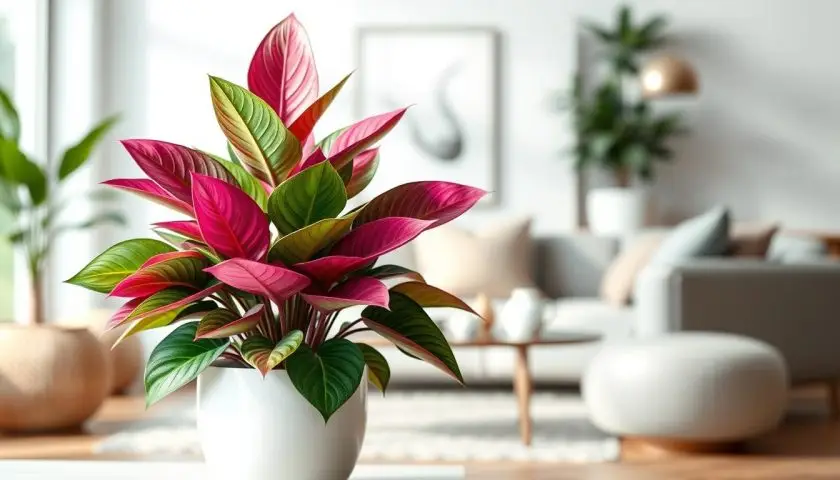
Watering depends on the plant type, but most pink and green indoor plants prefer consistent moisture with drainage. The biggest mistake is treating every colourful plant the same. A Peperomia needs less water than a Fittonia. A Caladium in active growth needs more moisture than a Rubber Plant.
Simple watering routine
- Check the top layer or top inch of soil.
- Water only if the plant type needs it.
- Water evenly until extra water drains out.
- Empty the saucer or outer pot.
- Wait before watering again.
Plants that prefer more even moisture
- Fittonia.
- Calathea Roseopicta.
- Stromanthe Triostar.
- Caladium during active growth.
- Polka Dot Plant.
Plants that prefer drying slightly more
- Peperomia Ginny.
- Ficus elastica Ruby.
- Tradescantia Nanouk.
- Philodendron Pink Princess.
- Aglaonema.
For better watering habits, use complete watering guide, worst times to water plants, and signs you are overwatering.
Best Soil for Pink and Green Indoor Plants
A good potting mix helps roots stay healthy, which keeps colourful foliage looking better. Most pink and green houseplants need a mix that holds some moisture but drains freely.
Basic indoor mix
- 2 parts indoor potting mix.
- 1 part perlite or pumice.
- 1 part fine bark or chunky houseplant mix.
Adjust the mix by plant type
| Plant Type | Soil Adjustment | Reason |
|---|---|---|
| Philodendron, Syngonium, Aglaonema | Add bark and perlite | Better airflow around roots |
| Fittonia, Calathea, Stromanthe | Use moisture-retentive but airy mix | Even moisture without soggy roots |
| Peperomia | Use extra perlite or pumice | Prevents wet soil around delicate roots |
| Caladium | Use rich but draining mix | Supports seasonal leafy growth |
For more support, read best soil mix for every plant type, how to repot a plant, and repotting mistakes to avoid.
Humidity and Temperature for Bright Foliage
Many plants with pink and green leaves are tropical or subtropical. They usually prefer warm rooms and steady humidity. Dry air can cause crispy edges, curled leaves, and pest problems, especially on Calathea, Stromanthe, Fittonia, and Caladium.
Easy humidity methods
- Group plants together.
- Use a small humidifier.
- Place pots above pebble trays without letting roots sit in water.
- Keep plants away from radiators and dry heat vents.
- Use a bright bathroom only if it has natural light.
Temperature tips
- Avoid cold windowsills in winter.
- Keep plants away from air-conditioning blasts.
- Do not place tropical foliage beside exterior doors.
- Avoid sudden moves from warm rooms to cold rooms.
- Keep sensitive plants away from freezing glass.
Fertilizer for Pink and Green Foliage
Fertilizer supports healthy new growth, but it will not fix poor light. If a pink and green plant is fading, improve light first. Then feed lightly during active growth.
Simple feeding routine
- Feed lightly in spring and summer.
- Use a balanced houseplant fertilizer at diluted strength.
- Do not fertilize very dry soil.
- Reduce or stop feeding in winter.
- Flush soil occasionally if salts build up.
Signs of too much fertilizer
- Brown leaf tips.
- White crust on soil.
- Weak or distorted new growth.
- Sudden yellowing after feeding.
For more detail, read fertilizing indoor vs outdoor plants.
How to Keep Pink Leaves Bright
Keeping pink leaves bright is not about one trick. It comes from light, plant genetics, stable care, and pruning when needed. A plant can only show the colour pattern it is genetically able to produce, so choose a good variety first.
What helps colour
- Bright indirect light.
- Clean leaves.
- Stable watering.
- Good root health.
- Regular rotation.
- Pruning plain green reverted growth where appropriate.
What weakens colour
- Low light.
- Overwatering.
- Root rot.
- Dusty leaves.
- Cold drafts.
- Old stressed growth.
For leaf maintenance, read how to clean plant leaves and pruning basics.
Common Problems With Pink and Green Plants
| Problem | Likely Cause | What to Do |
|---|---|---|
| Pink colour fading | Low light or older leaves | Move to brighter filtered light |
| Brown crispy edges | Dry air, harsh sun, inconsistent watering | Improve humidity and adjust light |
| Yellow leaves | Overwatering, poor drainage, low light | Check soil moisture and roots |
| Leggy stems | Weak light or lack of pruning | Increase light and pinch growth |
| Plain green growth | Reversion or low light | Prune if needed and improve light |
| Wilting | Underwatering or root problems | Check soil before watering more |
For troubleshooting, read why plant leaves turn yellow, leaf curl, browning and droop, root rot guide, and how to revive a dying plant.
Common Pests on Colorful Foliage Plants
Colourful foliage plants can attract the same pests as other houseplants. Check undersides of leaves, stems, new growth, and soil surfaces regularly. Pink and pale areas can sometimes hide early damage, so inspect carefully.
Spider mites
Spider mites are common in dry indoor air. They can cause dull leaves, fine webbing, and tiny speckled marks.
Mealybugs
Mealybugs look like small white cottony patches. They often hide around leaf joints and stems.
Aphids
Aphids gather on soft new growth and can leave sticky residue.
Scale
Scale looks like small brown bumps on leaves or stems. It needs repeated checks because it can be stubborn.
Fungus gnats
Fungus gnats usually mean soil is staying too wet. Improve drainage and let the top layer dry more between watering.
For prevention help, use how to keep pests away from plants and plants that keep bugs away.
Propagation Methods for Pink and Green Indoor Plants
Propagation depends on the plant. Some pink and green plants root easily from stem cuttings. Others are better divided or grown from tubers. Highly variegated plants can also produce cuttings with different colour patterns from the parent.
Stem cuttings
Stem cuttings work well for Syngonium, Philodendron, Tradescantia, Fittonia, Polka Dot Plant, and some Peperomia types. Cut below a node, remove lower leaves, and root in water or moist potting mix.
Division
Division works for clumping plants like Aglaonema and some Calathea relatives. Divide only when the plant is healthy and has enough roots.
Tubers
Caladium grows from tubers. If the plant goes dormant, store or rest the tuber properly and restart it when warm conditions return.
Leaf cuttings
Some Peperomia and Rex Begonia types can be propagated from leaf cuttings, but results vary. Stem cuttings or division are usually easier for beginners.
Safety Around Pets and Children
Many pink and green indoor plants are not safe if chewed by pets or children. Philodendron, Syngonium, Aglaonema, Caladium, and some other tropical foliage plants can irritate the mouth or stomach if eaten. Always check plant safety before placing colourful foliage at floor level.
Safety tips
- Keep unsafe plants away from cats, dogs, rabbits, and toddlers.
- Use stable plant stands or closed rooms where needed.
- Pick up fallen leaves quickly.
- Wear gloves when pruning plants with irritating sap.
- Choose pet-safer plants if your pet chews foliage.
For safer home planning, read cat-friendly plant safety and dog-friendly plant safety.
Best Rooms for Pink and Green Plants
| Room | Best Plants | Watch Out For |
|---|---|---|
| Living room | Aglaonema, Ficus Ruby, Pink Princess, Stromanthe | Low-light corners and heater vents |
| Bedroom | Peperomia Ginny, Syngonium, Fittonia | Cold windows in winter |
| Bathroom with window | Fittonia, Calathea, Stromanthe | No-light bathrooms |
| Home office | Aglaonema, Peperomia, Polka Dot Plant | Dry air from AC or heating |
| Bright shelf | Tradescantia Nanouk, Syngonium, Peperomia | Plants drying too fast in small pots |
For styling ideas, read how to style indoor plants by room, decorate your bedroom with plants, and create an indoor jungle without overcrowding.
Common Mistakes to Avoid
| Mistake | What Happens | Better Choice |
|---|---|---|
| Buying only by colour | The plant may not suit your room | Match plant to light and humidity first |
| Putting variegated plants in low light | Pink colour fades and growth weakens | Use bright indirect light |
| Placing leaves in harsh direct sun | Pink and pale areas scorch | Filter sunlight with curtains |
| Watering every plant the same way | Some plants rot while others dry out | Check each plant’s soil and needs |
| Ignoring humidity | Crispy edges and curled leaves | Add humidity support for tropical plants |
| Never pruning leggy plants | Plants become sparse and weak | Pinch or prune during active growth |
Pink and Green Plant Care Checklist
| Task | How Often | What to Check |
|---|---|---|
| Check light | Seasonally | Fading colour, stretching, scorched leaves |
| Check soil moisture | Before watering | Top layer or top inch dryness |
| Empty saucer | After watering | No standing water |
| Rotate pot | Every 1 to 2 weeks | Even colour and balanced growth |
| Clean leaves | Every 2 to 4 weeks | Dust, pests, light access |
| Inspect pests | Weekly | Leaf undersides, stems, new growth |
| Prune | As needed | Leggy, damaged, or reverted growth |
Helpful PATCH Guides for Pink and Green Indoor Plants
Use these related PATCH guides to improve light, watering, soil, styling, humidity, plant safety, and long-term indoor plant care.
Colorful and Statement Plant Guides
- Colorful foliage indoor plants
- Croton Petra plant care
- Purple passion plant care
- Indoor plants with orange flowers
- Indoor plants with red flowers
- Blooming indoor plants
- Oversized indoor plants
- Statement plants for minimalist interiors
Indoor Plant Guides
- Indoor Plants hub
- Best indoor plants for tiny apartments
- Best indoor plants for beginners
- Best indoor plants for first-time plant parents
- Low-maintenance plants that thrive
- Unusual indoor plants
- Rare houseplants
- Air-purifying indoor plants
Light, Water and Soil Guides
- Complete guide to indoor light
- Low light house plants
- Office-friendly plants for artificial light
- Complete watering guide
- Worst times to water plants
- Signs you are overwatering
- Best soil mix guide
- How to repot a plant
- Repotting mistakes to avoid
Problem-Solving Guides
- Plant Care hub
- Root rot guide
- How to revive a dying plant
- Leaf curl, browning and droop
- Why plant leaves turn yellow
- How to clean plant leaves
- Pruning basics
- Fertilizing indoor vs outdoor plants
Humidity, Bathroom and Safety Guides
- Humidity hacks without a humidifier
- DIY humidity tray
- Best bathroom plants
- Plants for bathroom no light
- Bathroom plants for mold
- Cat-friendly plant safety
- Dog-friendly plant safety
Specific Indoor Plant Guides
- Calathea care guide
- Philodendron care guide
- Rubber Plant care guide
- Pothos care guide
- Hoya care guide
- Anthurium care guide
- Orchid care guide
- African Violet care guide
- Dracaena care guide
- Spider Plant care guide
- ZZ Plant care guide
- Snake Plant care guide
Frequently Asked Questions
What is the best plant with pink and green leaves for beginners?
The best beginner choices are pink Aglaonema, Syngonium Pink Allusion, Fittonia, Polka Dot Plant, and Peperomia Ginny. They are easier than many rare variegated plants and can handle normal indoor care better.
Why is my pink and green plant losing its color?
It is usually not getting enough bright filtered light. Move it closer to a bright window gradually, rotate the pot, and check that the plant is not sitting in soggy soil.
Are pink and green variegated plants harder to grow?
Some are harder, but not all. Pink Aglaonema, Syngonium, Peperomia, and Polka Dot Plant are fairly manageable. Pink Princess, Caladium, Stromanthe, and Calathea usually need more careful light, humidity, and watering.
Can a pink and green plant grow in low light?
Some can survive in lower light, especially Aglaonema and Syngonium, but most will show better colour in bright indirect light. Low light often makes pink leaves fade or new growth turn greener.
How often should I water a plant with pink and green leaves?
Water after checking the soil. Most like the top layer or top inch to dry slightly before watering. Fittonia, Calathea, Stromanthe, and active Caladium usually prefer more even moisture.
What is the easiest pink and green houseplant for a desk?
Peperomia Ginny, pink Aglaonema, Polka Dot Plant, and small Syngonium varieties are good desk choices if the desk gets bright indirect light.
Which pink and green plant is best for hanging baskets?
Tradescantia Nanouk is one of the best pink and green trailing plants for hanging baskets. Fittonia and Syngonium can also trail or spill over a pot with time.
Can I propagate pink and green plants?
Yes. Many can be propagated from stem cuttings, including Syngonium, Tradescantia, Philodendron, Fittonia, and Polka Dot Plant. Aglaonema is often easier by division, while Caladium grows from tubers.
Why are the edges turning brown?
Brown edges can come from dry air, underwatering, overwatering, fertilizer buildup, harsh sun, or cold drafts. Check light, soil moisture, humidity, and root health before changing everything.
Are pink and green plants pet-safe?
Some are not pet-safe. Philodendron, Syngonium, Aglaonema, Caladium, and several other colourful foliage plants should be kept away from pets and children who may chew leaves.
Final Thoughts
A plant with pink and green leaves can make an indoor space feel brighter, softer, and more styled. The main secret is choosing a plant that matches your room. If you have medium light and want easy care, start with pink Aglaonema, Syngonium, Peperomia Ginny, or Polka Dot Plant. If you have bright filtered light and enjoy more attentive care, try Pink Princess, Stromanthe, Caladium, Rex Begonia, or Ficus Ruby.
RHS explains that houseplant success depends on matching plants to the right room conditions, including light and humidity, and that direct summer sun can scorch leaves unless filtered: RHS guide to choosing houseplants.
For the best colour, give pink and green foliage bright indirect light, drainage, steady watering, and enough humidity for tropical types. If the plant starts fading, stretching, or crisping, check light and watering before assuming it needs fertilizer.
Final Recap
The best indoor plants with pink and green leaves include pink Aglaonema, Philodendron Pink Princess, Syngonium Pink Allusion, pink Caladium, Fittonia, Polka Dot Plant, Tradescantia Nanouk, Stromanthe Triostar, Calathea Roseopicta, Ficus elastica Ruby, Peperomia Ginny, Rex Begonia, and Cordyline Fruticosa. Most need bright indirect light, a well-draining potting mix, careful watering, and protection from harsh sun. Beginner-friendly picks are Aglaonema, Syngonium, Peperomia, Fittonia, and Polka Dot Plant. More demanding picks need better humidity, stronger filtered light, and steadier care. Choose the plant for your actual room conditions, and the pink colour will be much easier to maintain.