Key Takeaways
- Jade plant care is genuinely beginner-friendly once three fundamentals are in place: a minimum of four hours of direct sun daily, completely dry soil between waterings, and a fast-draining cactus or succulent soil mix — get these right and jade plants thrive for decades with minimal intervention.
- How to care for a jade plant indoors starts with understanding its South African origins — Crassula ovata evolved in arid, rocky terrain with intense sun and infrequent rainfall, and every care requirement it has in the home reflects these natural conditions directly.
- Jade plant care indoors revolves around one critical rule that beginners consistently get wrong — overwatering is by far the leading cause of jade plant death, and less frequent watering always produces healthier results than attempting to keep soil consistently moist.
- Jade plant care tips for long-term success include the annual spring repotting check, quarterly soil flushing to remove fertilizer salt buildup, and seasonal light adjustments to maintain the full sun exposure this plant needs to develop its characteristic thick, glossy foliage.
- Gollum jade plant care and ripple jade plant care follow the same fundamental principles as standard jade plant care but with slightly higher light requirements to maintain their distinctive tubular and ruffled leaf forms — both are excellent collector’s varieties that reward the same basic care approach.
- Jade plant care for flowering requires a specific combination of bright light, a cool winter rest period with reduced watering, and slightly root-bound conditions — mature jade plants (typically 3–5 years old) that experience these conditions reliably produce clusters of tiny pink and white star-shaped flowers in winter.
- Jade plant outdoor care is possible in mild climates where temperatures stay above 10°C year-round — jade plants thrive in outdoor containers during summer months but must be brought inside before the first frost as they have zero cold hardiness.
- Jade plant succulent care follows the same overarching principles as all succulent care — maximum light, minimum water, fast drainage — but jade plants are among the most forgiving succulents available, recovering from occasional neglect remarkably well once underlying conditions are corrected.
- Jade plant bonsai care is one of the most rewarding applications of this plant — its naturally branching woody structure, slow growth, and tolerance of pruning make it one of the most popular starter bonsai subjects, particularly for those wanting the aesthetic without the demanding care of traditional bonsai species.
- Are jade plants easy to care for? Yes — among succulents available for indoor growing, jade is one of the most resilient, longest-lived, and most forgiving options, routinely surviving for 20–30 years or longer in home environments when given adequate light and appropriately infrequent watering.
Introduction
The jade plant has been sitting on windowsills, gracing sunny office desks, and filling plant lovers’ shelves for generations — and for genuinely good reason. Crassula ovata is one of those rare houseplants that combines extraordinary visual appeal with almost legendary longevity and a care requirement list short enough to commit to memory in five minutes. People genuinely pass jade plants between generations. Specimens brought home as small cuttings in the 1970s are still sitting in south-facing windows today, having outlasted furniture, decor trends, and any number of other houseplants that came and went around them.
Understanding jade plant care properly starts with understanding where this plant comes from. Crassula ovata is native to the Eastern Cape and KwaZulu-Natal provinces of South Africa — arid, rocky, semi-desert terrain where rainfall is seasonal and infrequent, sun is intense, and soil is thin, stony, and drains almost immediately after rain. Those distinctive thick, fleshy, coin-shaped leaves are highly efficient water storage vessels evolved for exactly these conditions — storing water during wet periods to sustain the plant through months of drought. Every jade plant care requirement that follows makes complete sense once these origins are understood.
This complete jade plant care guide covers every aspect of growing Crassula ovata successfully — from light and watering through specialist varieties, propagation, bonsai training, and troubleshooting every common problem — with honest, practical advice that applies whether you’re growing a standard jade plant, a gollum jade plant, a ripple jade, or a variegated jade plant. For more succulent and low-maintenance plant options to companion your jade collection, our 35 low-maintenance plants guide covers the best effortless indoor plants available.
Understanding Jade Plant: Origins and Characteristics
Crassula ovata belongs to the Crassulaceae family — a large family of succulent plants that includes sedums, echeverias, and kalanchoes. The genus Crassula encompasses approximately 200 species, but ovata is by far the most widely cultivated, having been introduced to European and American homes as early as the 1800s and gradually becoming one of the most ubiquitous houseplants worldwide.
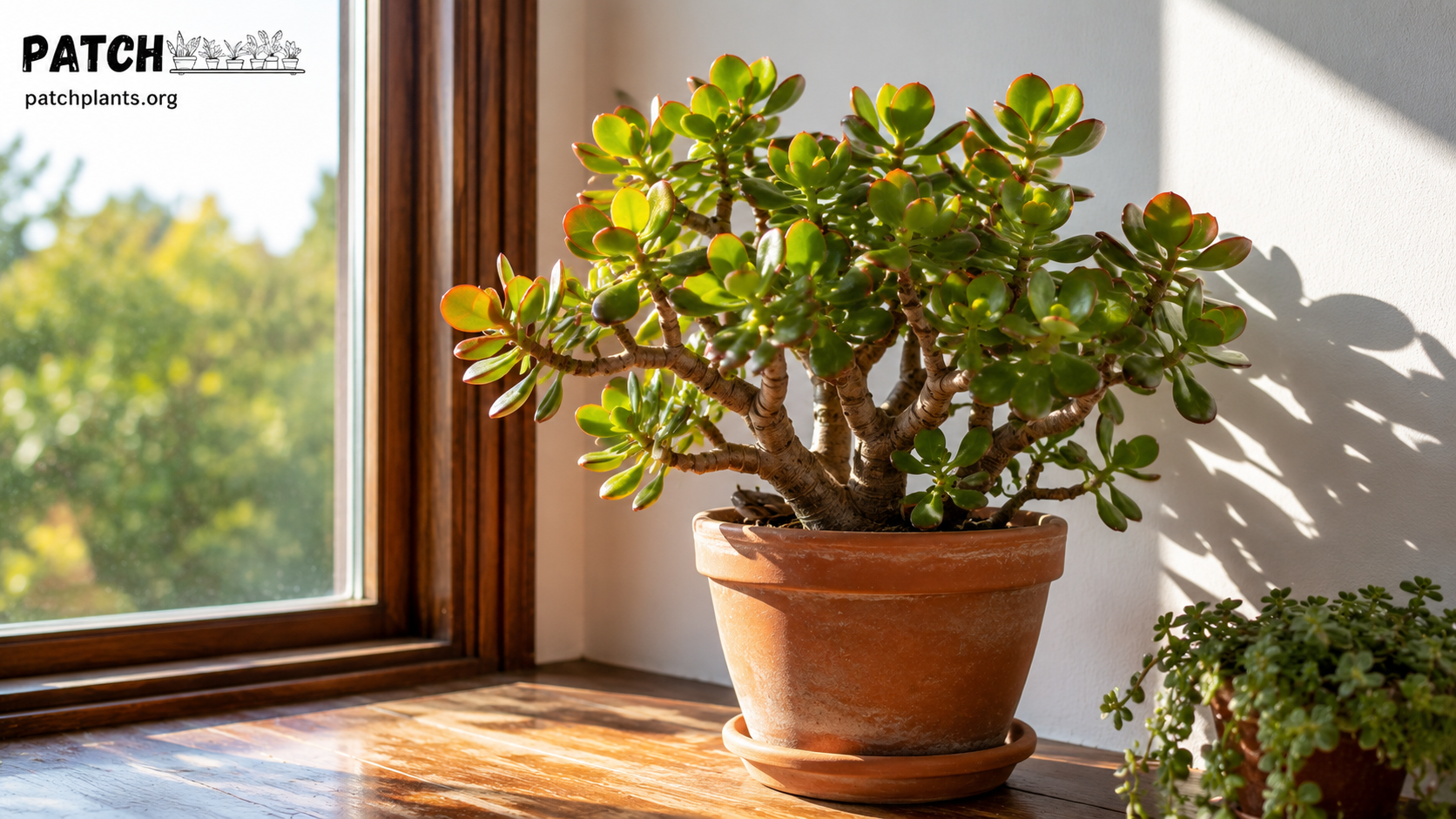
In its natural South African habitat, jade plant grows as a rounded, shrubby perennial reaching 1–3 metres tall — far larger than most indoor specimens ever achieve. Its woody stems develop a distinctive silver-grey bark with age, giving mature plants the appearance of miniature trees rather than typical succulents. This natural tree-like form is what makes jade one of the most popular subjects for bonsai training — its structure already resembles a mature tree in miniature, requiring only patient pruning to refine the silhouette. The name “jade” references the plant’s glossy, jade-green leaves, though red-edged forms develop in high sun conditions, adding warm burgundy tones to leaf margins that make them particularly striking in direct light.
The plant is also known by several common names — money plant, lucky plant, friendship tree, and money tree (though the true money tree is Pachira aquatica — see our money tree care guide for the distinction). In various Asian cultures, jade plant is considered a symbol of good luck and financial prosperity, making it a traditional gift for housewarmings and business openings — a cultural association that has only increased its popularity as an indoor plant over the decades.
Jade Plant Varieties Worth Growing
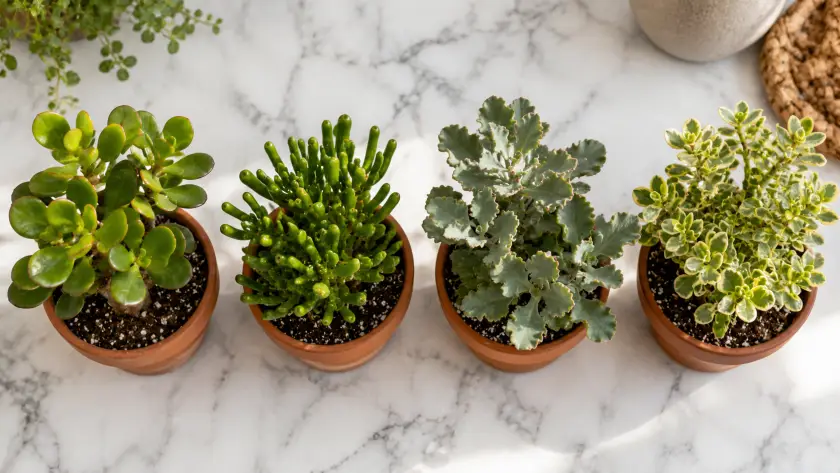
Standard Jade Plant — Crassula Ovata
The classic variety remains the most widely available and arguably the most beautiful in maturity — oval, glossy green leaves with red-tinged margins in bright light, on thick branching stems that develop attractive silver-brown bark over time. Standard jade plant is the most forgiving of all varieties and the ideal starting point for anyone new to how to care for jade plants before attempting specialist cultivars.
Gollum Jade Plant — Crassula Ovata ‘Gollum’
Gollum jade plant care follows identical principles to standard jade but with a more distinctive, conversation-starting form. Crassula ovata ‘Gollum’ produces elongated, tubular leaves with a distinctive sucker-like depression at the tip — resembling small green fingers or, in strong sun, red-tipped tubes that give the plant an almost otherworldly appearance. Named after Tolkien’s creature for the distinctive finger-like leaf shape, Gollum is among the most sought-after jade varieties and responds beautifully to bonsai training.
Ripple Jade — Crassula Arborescens ‘Undulatifolia’
Ripple jade plant care requires the same fundamental approach but this variety produces distinctive wavy-edged, blue-grey leaves with reddish margins — a more architectural, sculptural form than standard jade’s rounded coins. Ripple jade is slightly more sensitive to overwatering than standard varieties, making excellent drainage even more critical, and requires maximum available light to maintain the blue-grey colouration that distinguishes it.
Variegated Jade Plant
Variegated jade plant care demands the highest light levels of any jade variety — variegated leaves contain less chlorophyll than solid green foliage, meaning the plant requires more light intensity to support the same level of photosynthesis. Cream, white, and green patterned leaves make variegated jade one of the most visually striking varieties available, but this beauty comes at the cost of slower growth and less tolerance for suboptimal light conditions than standard forms.
Elephant Bush — Portulacaria Afra
Frequently sold alongside and confused with jade plant, elephant bush (Portulacaria afra) — also called elephant jade plant care specimens by some sellers — is a distinct species with smaller, rounder leaves on reddish stems. Elephant bush jade plant care follows the same fundamental approach as true jade but elephant bush is actually more drought-tolerant, faster-growing, and even better suited to bonsai training due to its smaller leaf size and more flexible stems.
Complete Jade Plant Care Guide
Light Requirements — The Most Important Factor
Jade plant care light requirements are higher than many houseplant guides acknowledge — and insufficient light is the second most common cause of jade plant decline after overwatering. In nature, Crassula ovata grows in full, intense South African sun. Indoors, it needs the brightest available position without compromise.
Ideal light for jade plant:
- South-facing window with direct sun — 4–6 hours daily minimum
- West-facing window — acceptable if genuinely sunny in the afternoon
- East-facing window — marginal; adequate for survival but not for full health and red leaf colouration
- Supplemented with grow lights in darker homes or winter months
Signs of insufficient light:
- Stems becoming long and leggy between leaf nodes
- Leaves losing their glossy appearance and becoming pale green
- New growth small and weak relative to existing leaves
- Plant leaning dramatically toward the light source
- Red leaf margin colouration fading to plain green
Signs of too much harsh light (rare indoors, possible in south-facing conservatories):
- Leaves developing dry, papery brown patches on the sun-facing surface
- Leaves shrinking or shriveling despite adequate watering
Our complete indoor light guide covers exactly how to identify and measure light levels in every room type — essential reading before deciding on a final position for jade plant.
How to Water a Jade Plant Correctly
Watering is where jade plant care most commonly goes wrong — and almost exclusively in one direction. Overwatering kills more jade plants than all other causes combined. Understanding how to care for a jade plant in terms of water means internalising one principle above all others: when in doubt, wait longer.
Jade plant watering schedule:
- Spring and summer (growing season): Water when the top half of the soil is completely dry — typically every 14–21 days depending on pot size, light level, and room temperature
- Autumn: Reduce to every 21–28 days as growth slows
- Winter: Water only every 4–6 weeks — the plant enters semi-dormancy and moisture requirements drop dramatically
- Method: Water thoroughly until draining from the bottom, then empty the saucer completely. Never allow jade plant to sit in standing water.
Reading the plant:
- Firm, plump, glossy leaves: Perfectly hydrated — maintain current schedule
- Slightly soft or slightly wrinkled leaves: Mildly underwatered — water now
- Heavily shriveled, soft leaves: Significantly underwatered — water thoroughly and check roots
- Yellowing leaves with mushy stems: Overwatered — check roots immediately for rot
How often to water jade plant in different conditions: The most reliable approach is never watering on a fixed schedule but checking soil moisture by inserting a finger 3–4cm into the soil. Only water when that depth is completely dry. This accounts for the seasonal, temperature, and light variations that make fixed schedules unreliable.
Our signs of overwatering guide covers the exact symptoms of jade plant overwatering and how to recover a waterlogged specimen before root rot sets in. For comprehensive moisture management across all succulents, our complete watering guide covers seasonal adjustments in detail.
Humidity and Temperature
One of the most welcoming aspects of jade plant care indoors is that this plant actively prefers the dry conditions found in most homes — unlike many tropical houseplants that demand humidity levels above 60%, jade plant is perfectly content at the 30–50% humidity typical of standard indoor environments. No humidifier, no misting, no pebble tray required — and in fact, high humidity combined with poor air circulation creates conditions that promote fungal disease in jade plant.
Temperature requirements:
- Growing season: 18–24°C — standard home temperatures are ideal
- Winter rest: 10–15°C preferred — a cooler winter period encourages the dormancy that promotes spring flowering in mature specimens
- Absolute minimum: 10°C — below this causes cell damage in the water-filled leaves
- Avoid: Cold drafts from windows in winter, air conditioning vents blowing directly on the plant, and outdoor temperatures below 10°C
Jade plant outdoor care in summer: Moving jade plants outside to a sunny patio or balcony during summer months provides the intense, direct sun that indoor growing rarely fully replicates. Begin outdoor placement in a sheltered, partially shaded position and gradually increase sun exposure over 2–3 weeks to prevent sun scorch on leaves adapted to indoor light levels. Return indoors when overnight temperatures consistently drop below 12°C. Our best low-maintenance outdoor plants guide covers outdoor container growing principles that apply directly to jade plant summer placement.
Soil — Fast Drainage Above Everything
Jade plant care soil requirements are non-negotiable — this plant will not survive long-term in standard potting compost that retains moisture for extended periods. The soil must drain immediately and completely after watering, replicating the thin, rocky, rapidly-draining ground of jade plant’s South African habitat.
Ideal jade plant soil mix:
- 50% quality cactus/succulent potting mix
- 30% perlite (improves drainage and aeration dramatically)
- 20% coarse horticultural grit or pumice
Commercial alternatives:
- Pre-mixed cactus and succulent soil used straight — most commercial brands drain adequately for jade plant
- Standard potting compost amended with 40–50% perlite — effective and economical if compost is already available
Always avoid:
- Standard multi-purpose compost without amendment — retains too much moisture
- Heavy garden soil — compact and completely inadequate drainage
- Moisture-retaining tropical plant mixes — designed for exactly the opposite conditions jade plant needs
Our best soil mix guide covers custom soil ratios for every succulent and houseplant type — the jade plant section covers exact mix proportions for both indoor and outdoor container growing.
Fertilizing Jade Plant
Jade plant care instructions for feeding are minimal compared to most houseplants — this is a slow-growing succulent from nutrient-poor rocky soil that reacts poorly to heavy feeding. Over-fertilizing causes salt buildup that burns roots and produces the brown leaf tips and stunted growth that many owners mistake for other problems.
Feeding schedule:
- Spring and summer: Once every 6–8 weeks with balanced liquid fertilizer (NPK 10-10-10) diluted to quarter the recommended strength
- Autumn: Stop feeding as growth slows
- Winter: No feeding — the plant is in semi-dormancy
Application tips:
- Always water the plant the day before fertilizing — never apply fertilizer to dry soil
- Flush soil with plain water every 3 months to clear salt accumulation
- White crusty deposits on soil surface indicate fertilizer salt buildup — flush thoroughly and reduce feeding frequency
Our fertilizing indoor vs outdoor plants guide covers seasonal feeding schedules for succulents including jade plant, with specific guidance on recognising over-fertilizing symptoms.
Jade Plant Repotting
Jade plant care repotting requirements are infrequent — this plant grows slowly, prefers slightly tight conditions, and actually flowers more reliably when mildly root-bound. Repot every 2–3 years, or when roots are clearly emerging from drainage holes or the plant is drying out unusually rapidly.
Signs repotting is needed:
- Roots growing visibly from drainage holes
- Soil drying out within 2–3 days of watering
- Noticeably slowed growth even during spring and summer
- Plant becoming physically unstable in its pot due to top-heavy growth
Repotting process:
- Choose a pot only 3–5cm larger — too large creates excess soil volume that stays wet too long
- Always choose terracotta if possible — it wicks moisture through the walls, improving drainage naturally
- Spring repotting enables fastest recovery
- Allow the plant to settle for one week before resuming watering after repotting
Our how to repot a plant guide covers step-by-step repotting for succulents and our repotting mistakes guide prevents the most common errors that damage jade plant roots during the process.
Jade Plant Propagation
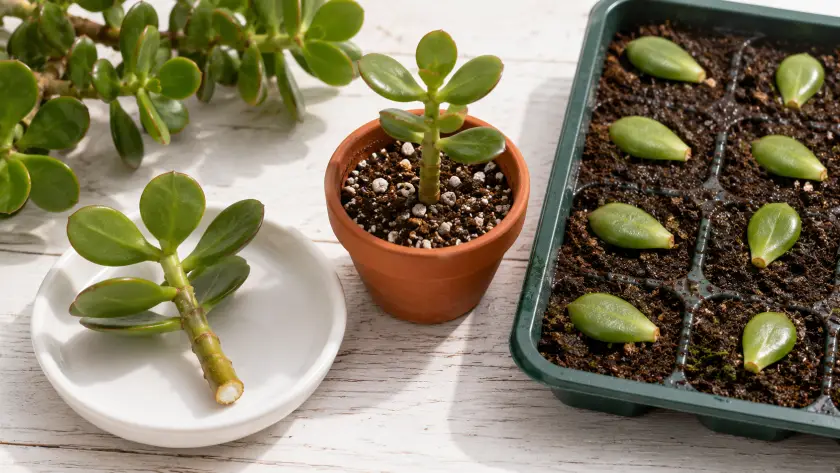
Jade plant is one of the easiest succulents to propagate — both stem cuttings and individual leaves root readily, making it straightforward to create new plants from an existing specimen or to share with friends. Spring and early summer are the best times to propagate when the plant is in active growth.
Stem Cutting Propagation (Most Reliable)
- Step 1: Select a healthy stem 8–12cm long with at least 2–3 sets of leaves
- Step 2: Using clean, sharp scissors, cut cleanly just below a leaf node
- Step 3: Remove the lower 2–3cm of leaves to expose bare stem
- Step 4: Allow the cutting to callous for 24–48 hours — this prevents rot at the cut end
- Step 5: Press the bare stem section into slightly moist cactus mix
- Step 6: Place in bright indirect light and allow soil to dry almost completely between very light mistings
- Step 7: Roots typically develop within 3–6 weeks — gentle resistance when tugged confirms rooting
Leaf Propagation (Slower but Fascinating)
Individual jade plant leaves can be laid flat on moist cactus mix and will gradually produce tiny new plantlets from the base — a slower process than stem cuttings but requiring no cutting tools and producing many plants simultaneously from a single stem’s worth of leaves. Success rates are lower than stem cutting but the process is genuinely fascinating and excellent for beginners exploring propagation for the first time.
Our complete propagation guide covers both methods in full detail alongside water propagation techniques for those who prefer to watch root development before potting.
Jade Plant Bonsai Care

Jade plant bonsai care is one of the most rewarding applications of Crassula ovata — and one of the most accessible entry points into bonsai cultivation for beginners intimidated by traditional bonsai species. Jade plant’s naturally branching woody structure, slow growth, tolerance of pruning, and dramatic bark development with age make it a near-perfect bonsai subject.
Key jade bonsai principles:
- Pot selection: Shallow bonsai tray with excellent drainage — the constrained root space encourages the compact growth and stress-induced red colouring that make bonsai jade plants most beautiful
- Pruning: Remove stems crossing or growing inward using clean, sharp bonsai scissors — always cut just above a leaf node to encourage branching at the cut point
- Timing: Prune in spring to encourage bushy growth from the cut points throughout the growing season
- Wiring: Young stems can be wired carefully to create movement and directional growth — jade wood is brittle, so work gently and check wire every 2–3 weeks to prevent it cutting into bark
- Watering: More frequent than standard jade care due to small pot volume — check every 5–7 days in summer and water when the top 2cm is dry
The goal of jade plant bonsai care is patient refinement over years rather than dramatic reshaping in a single session — each growing season builds a slightly more refined, more beautiful miniature tree that improves continuously with age and skilled care.
Jade Plant Care for Flowering
Most indoor jade plant owners never see their plant flower — not because it won’t, but because the specific conditions that trigger flowering are rarely created unintentionally. Understanding jade plant care for flowering means creating the right combination of conditions that signal to the plant that the time is right.
Conditions required for jade plant flowers:
- Maturity: Most jade plants need to be at least 3–5 years old before flowering is physiologically possible
- Bright light: Maximum available sun throughout the growing season — inadequate light prevents flower bud formation
- Cool winter rest: Temperatures of 10–15°C for 6–8 weeks in autumn/winter trigger flower bud development — move the plant to an unheated room or cool conservatory
- Reduced winter watering: Water only every 5–6 weeks during the cool period — drought stress combined with cool temperatures is the most reliable flowering trigger
- Slightly root-bound: Being mildly root-bound appears to encourage flowering — don’t repot in the year you’re attempting to encourage flowering
When conditions are right, jade plant produces small clusters of star-shaped pink or white flowers in winter — genuinely beautiful and surprising to anyone who has grown jade plant for years without ever seeing it bloom. The flowers are lightly fragrant and last for several weeks.
Troubleshooting Common Jade Plant Problems
Jade Plant Leaves Falling Off
Leaf drop in jade plant almost always indicates one of two problems: overwatering (leaves become swollen, then drop suddenly as roots fail to function) or temperature stress from cold drafts or temperatures below 10°C. Check soil moisture first — if soil has been consistently moist, overwatering is the cause. If soil is dry and leaf drop accompanies cold window proximity, move to a warmer position immediately.
Our leaf curl, browning and droop guide covers every leaf-drop scenario with exact diagnostic questions to identify the correct cause quickly.
Yellow Leaves
Yellow leaves on jade plant most commonly indicate overwatering — the most frequent jade plant problem overall. If multiple leaves are yellowing and the soil feels consistently moist, reduce watering frequency immediately and check roots for brown, mushy rot. A single yellow lower leaf occasionally is normal ageing — remove it and monitor for further yellowing before taking action. Our yellow leaves guide covers every yellowing cause across all plant types.
Leggy, Stretched Growth
Leggy jade plant with long gaps between leaf nodes and weak, thin stems almost always indicates insufficient light. Move to the sunniest available window immediately — a south-facing position with direct sun is ideal. Once moved, the new growth that follows will be compact and healthy, though existing leggy stems won’t reverse. Prune leggy stems to encourage bushier branching from the cut point.
Root Rot
Root rot results from consistently overwatered soil and is the most serious jade plant problem — but it’s recoverable if caught early. Unpot the plant, shake off all soil, and examine roots. Healthy roots are white or tan and firm; rotted roots are brown, black, and mushy. Remove all rotted roots with sterile scissors, allow the plant to dry for 24 hours, then repot in fresh, completely dry cactus mix. Withhold water for one week after repotting. Our revive a dying plant guide covers root rot recovery step-by-step.
Common Pests
Jade plant is relatively pest-resistant but susceptible to mealybugs — white cottony clusters appearing in stem joints and at soil level. Treat with alcohol-dipped cotton swabs to remove manually, followed by neem oil solution applied weekly for 3–4 weeks. Overwatered jade plants also attract fungus gnats — allow soil to dry more thoroughly between waterings to eliminate the consistently moist conditions fungus gnat larvae require.
Pet Safety — Is Jade Plant Toxic?
Jade plant is toxic to cats and dogs — Crassula ovata is listed by the ASPCA as toxic to both species, causing vomiting, lethargy, and incoordination if ingested. The toxic compound is not fully identified but the plant’s effects on cats and dogs are well-documented. Always position jade plants on high shelves or in rooms inaccessible to pets.
For completely non-toxic succulent alternatives that provide similar sculptural interest without toxicity concerns, our cat-friendly plants guide and dog-friendly plants guide cover every safe option across all plant categories. The Christmas cactus and spider plant are completely non-toxic alternatives with similarly easy care requirements.
How to Style Jade Plant by Room
Jade plant’s naturally tree-like structure and glossy foliage make it one of the most versatile styling plants available — working beautifully in contemporary, minimalist, traditional, and botanical interiors with equal ease.
Living room: A mature jade plant in a terracotta or ceramic pot on a bright windowsill creates an immediate focal point — the woody, branching structure reads as sculptural rather than merely decorative. Pair with non-succulent trailing plants like pothos or philodendron for textural contrast. See our room-by-room styling guide for complete living room plant positioning principles.
Home office: Jade plant on a sunny office desk or windowsill provides a structural, low-maintenance companion that requires minimal attention during busy work periods. See our office-friendly plants guide for additional desk and office plant options.
Bedroom: Jade plant works beautifully on a bedroom windowsill — non-demanding care suits the inconsistent attention bedroom plants often receive, and the tree-like silhouette creates a calming visual anchor. Our bedroom plant decorating guide covers exact positioning and companion planting ideas for bedroom plant displays.
Bathroom: Only suitable if the bathroom receives direct sun from a south or west-facing window — jade plant will not thrive in low-light bathrooms regardless of humidity levels. For humid bathroom environments without strong direct sun, our 33 best bathroom plants guide covers plants genuinely suited to those conditions.
For inspiration on building a complete indoor plant display around a jade plant centrepiece, our best indoor plants for beginners guide covers easy companion plants, and our air-purifying indoor plants guide covers functional additions that complement jade’s architectural presence.
Frequently Asked Questions
How do you care for a jade plant? Jade plant care requires a minimum of four hours of direct sun daily in a south or west-facing window, watering only when the top half of the soil is completely dry (typically every 14–21 days in summer, every 4–6 weeks in winter), fast-draining cactus or succulent soil, and temperatures between 18–24°C during the growing season. The three most critical factors in order of importance are adequate light, correct watering frequency, and appropriate soil drainage. Get these three right and jade plants require almost nothing else to thrive for decades.
How often should I water jade plant? Water your jade plant every 14–21 days in spring and summer when the top half of the soil is completely dry, every 21–28 days in autumn, and every 4–6 weeks in winter. Always check soil moisture by touch before watering — jade plant’s storage capacity in its leaves means it tolerates under-watering far better than overwatering. See our complete watering guide for seasonal moisture management for succulents.
Are jade plants easy to care for? Yes — jade plants are among the most forgiving succulents available for indoor growing. They tolerate occasional forgotten waterings, recover from mild drought, and adapt to a range of light conditions (though they truly thrive only in bright direct sun). Their main vulnerability is overwatering — avoid consistently moist soil and jade plants are genuinely difficult to kill. Our 35 low-maintenance plants guide includes jade plant as one of the most reliably effortless indoor plants available.
Why is my jade plant dropping leaves? Jade plant leaf drop most commonly results from overwatering (soft, swollen leaves dropping suddenly), cold drafts or temperatures below 10°C, or sudden environmental changes such as moving the plant to a significantly different location. Check soil moisture first — consistently moist soil indicates overwatering requiring immediate watering reduction and root inspection. If soil is dry and leaves are dropping, check for cold air exposure from nearby windows or exterior walls. See our leaf curl and droop guide for complete leaf drop diagnosis.
How do I get my jade plant to flower? Jade plant care for flowering requires four specific conditions simultaneously: plant maturity of at least 3–5 years, maximum available light throughout the growing season, a cool winter rest period of 10–15°C for 6–8 weeks, and significantly reduced watering during this cool period. Plants that experience these conditions reliably produce clusters of small star-shaped pink or white flowers in winter — one of the most rewarding sights in indoor plant growing.
Can jade plants grow outdoors? Yes — jade plant outdoor care is entirely possible in mild climates where temperatures remain above 10°C year-round. In cooler climates, jade plants benefit from outdoor summer placement in a sheltered, sunny position, then must be returned indoors before the first frost. Introduce outdoor light gradually over 2–3 weeks to prevent sun scorch on leaves adapted to indoor light levels. See our best low-maintenance outdoor plants guide for outdoor container growing principles.
How do I propagate jade plant? Jade plant propagates readily from stem cuttings taken in spring — cut a healthy 8–12cm stem, remove lower leaves, allow the cut end to callous for 24–48 hours, then press into slightly moist cactus mix. Roots develop within 3–6 weeks in bright indirect light. Individual leaves can also be propagated by laying flat on moist cactus mix, though this method is slower with lower success rates. Our complete propagation guide covers both methods in full detail.
Is jade plant toxic to cats and dogs? Yes — jade plant is confirmed toxic to both cats and dogs by the ASPCA, causing vomiting, lethargy, and incoordination if ingested. Always position out of reach of pets. For safe alternatives with similar sculptural interest, see our cat-friendly plants guide and dog-friendly plants guide for completely non-toxic options.
🔗 Related Guides
- 35 Low Maintenance Plants That Thrive
- Best Indoor Plants for Beginners
- Money Tree Care Guide
- Aloe Vera Care Guide
- Christmas Cactus Care Guide
- Snake Plant Care Guide
- ZZ Plant Care Guide
- Pothos Care Guide
- Spider Plant Care Guide
- Peace Lily Care Guide
- Monstera Care Guide
- Philodendron Care Guide
- Calathea Care Guide
- Rubber Plant Care Guide
- Fiddle Leaf Fig Care Guide
- String of Pearls Care Guide
- Air Purifying Indoor Plants
- Colorful Foliage Indoor Plants
- Rare Houseplants Worth Hunting
- Complete Indoor Light Guide
- Complete Watering Guide
- Signs You’re Overwatering
- Humidity Hacks Guide
- Best Soil Mix Guide
- Fertilizing Indoor vs Outdoor
- How to Repot a Plant
- Repotting Mistakes to Avoid
- How to Propagate Houseplants
- Why Leaves Turn Yellow
- Leaf Curl Browning Droop Guide
- How to Revive a Dying Plant
- Cat Friendly Plants Guide
- Dog Friendly Plants Guide
- 33 Best Bathroom Plants
- Style Indoor Plants by Room
- Decorate Bedroom with Plants
- Office Friendly Plants Guide
- Best Low Maintenance Outdoor Plants
- Low Light Hanging Plants
- Browse All Indoor Plants →
- Browse All Plant Care Guides →
Final Thoughts
The jade plant’s enduring popularity across generations of plant owners is no accident. In a world of temperamental, demanding houseplants that respond to every fluctuation in humidity, watering schedule, or light level with yellowed leaves and dropped blooms, jade plant stands apart as a genuinely forgiving, genuinely long-lived companion that rewards consistent basic care with decades of beauty.
How to care for a jade plant ultimately comes down to respecting its origins — remembering that this is a plant from sun-baked, rocky South African terrain where intense light, thin soil, and infrequent rain produced one of the most elegant and resilient plant forms in the world. Give it those conditions indoors — maximum available sun, well-draining gritty soil, and patient infrequent watering — and jade plant will reward you with exactly the kind of unhurried, steadfast growth that turns a small cutting into a treasured decades-long companion.
Whether you’re growing a standard Crassula ovata, a sculptural gollum jade, a bonsai specimen, or a variegated jade plant, the same respect for these origins applies. Understand the plant, meet its genuine needs rather than assumed ones, and jade plant will prove itself to be exactly what generations of plant owners have always known it to be — one of the most rewarding indoor plants available anywhere.
According to the Royal Horticultural Society (RHS), Crassula ovata has received the RHS Award of Garden Merit — confirming its exceptional performance and reliability when grown in appropriate conditions, making it one of the most formally endorsed succulent plants for home growing available. 🌿