Key Takeaways
- Dracaena plant care is genuinely beginner-friendly once three fundamentals are established: bright indirect light for healthy leaf colouration, watering only when the top half of the soil is dry, and fluoride-free water — dracaenas are exceptionally sensitive to fluoride in tap water, which causes the brown leaf tips that frustrate most growers.
- How to care for a dracaena plant starts with understanding that the genus encompasses over 120 species ranging from compact desk plants to statement trees reaching 3 metres — choosing the right variety for your space is as important as understanding the care principles that apply to all of them.
- Dracaena plant indoor care rewards a hands-off approach — this is a plant that thrives on benign neglect far more reliably than on frequent attention, and the most common dracaena care mistake is overwatering a plant that prefers to dry out significantly between waterings.
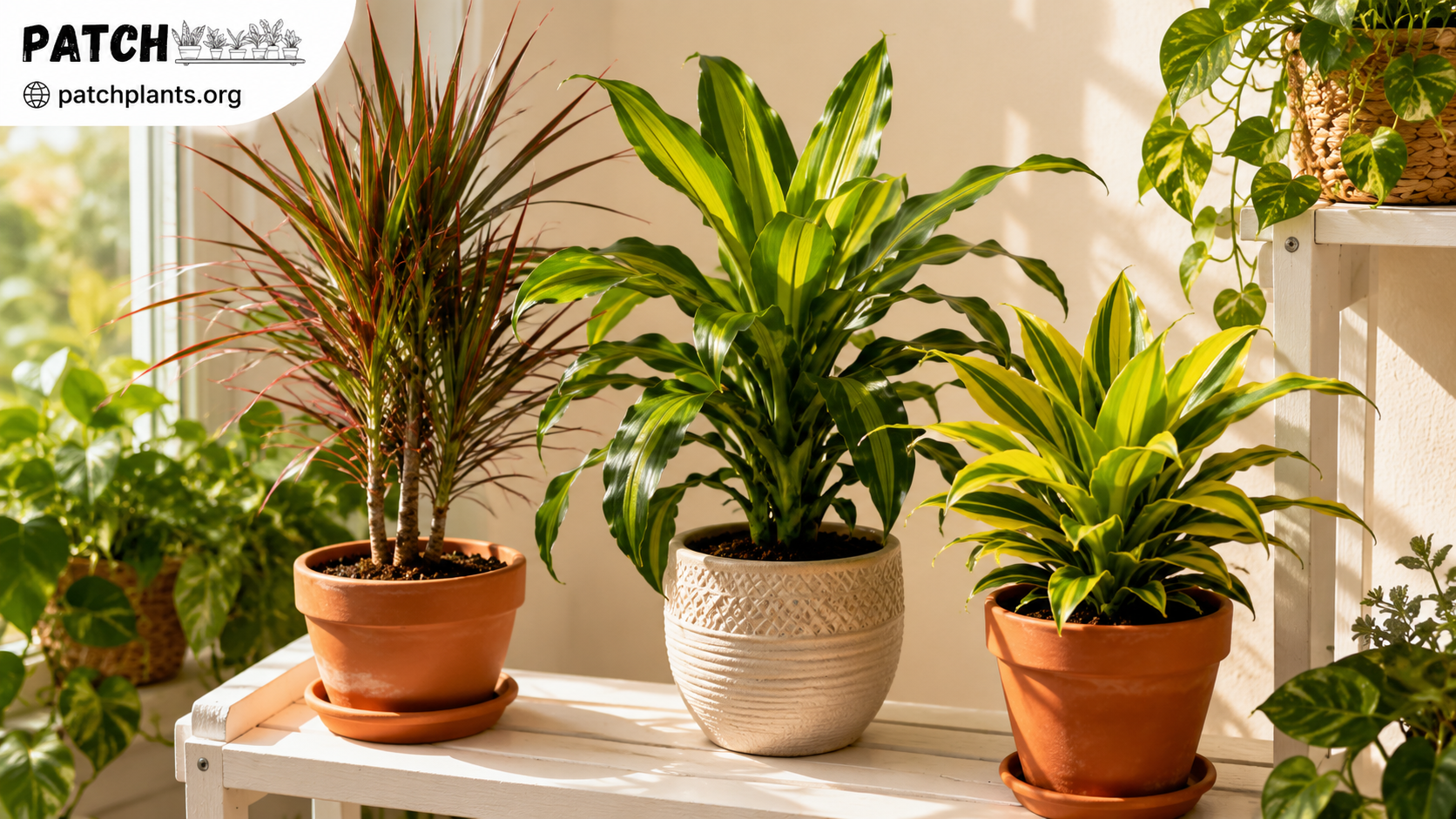
- Dracaena marginata plant care follows the same fundamentals as all dracaenas but with the highest light tolerance of common varieties — its slender, red-edged leaves and dramatic arching canes make it one of the most architecturally striking houseplants available for bright indoor spaces.
- Dracaena fragrans plant care covers the most popular and widely available dracaena variety — the corn plant — with its broad, strappy leaves and remarkably tolerant disposition toward lower light conditions that make it ideal for offices and interior rooms away from windows.
- Dracaena lemon lime plant care requires the same basic approach as standard varieties but benefits from slightly brighter light to maintain the vivid yellow-green variegation that defines this variety — insufficient light causes the bright colouring to fade toward plain green over time.
- Brown leaf tips on dracaena almost always result from one of three causes: fluoride in tap water, low humidity, or fertilizer salt buildup — switching to filtered or rainwater resolves the most common cause immediately without any other changes to care routine.
- Dracaena sanderiana plant care — lucky bamboo — differs significantly from other dracaenas in that it can grow entirely in water, making it one of the most unique and adaptable houseplants available for decorative water-growing displays.
- All dracaena varieties are toxic to cats and dogs — the ASPCA confirms Dracaena species cause vomiting, weakness, and in cats, dilated pupils when ingested, making careful placement essential in any pet-owning household.
- Dracaena plant care tips for long-term success include wiping leaves monthly with a damp cloth to remove dust that accumulates on their broad surfaces, occasional pruning of growing tips to encourage branching, and quarterly soil flushing to prevent mineral salt buildup from fertilizer applications.
Introduction
Dracaena is one of those houseplant genera that rewards closer attention — not because it demands it, but because the closer you look, the more remarkable the variety becomes. What most people think of as a single plant type is actually a genus of over 120 species spanning everything from the compact Dracaena compacta that sits comfortably on a desk, to the majestic Dracaena fragrans reaching ceiling height in a well-lit living room, to the sculptural Dracaena marginata with its dramatic spiralling canes and red-edged sword leaves. Understanding dracaena plant care properly means understanding which variety you have — because while the fundamentals are shared, each variety has specific preferences that make it perform at its best.
The genus originates primarily from Africa, with some species native to southern Asia and tropical regions of the Americas — diverse origins that explain the considerable variation in appearance and specific requirements across the family. What all dracaenas share is an evolutionary background in warm, seasonally dry environments with filtered or indirect light beneath forest canopy — which translates directly into their indoor care requirements. Bright indirect light, infrequent but thorough watering, and protection from cold temperatures cover the majority of dracaena plant care for any variety you’re likely to encounter.
This complete dracaena plant care guide covers every major variety in detail, with specific care instructions for dracaena marginata, dracaena fragrans, dracaena lemon lime, dracaena sanderiana, dracaena reflexa, and more — alongside complete care fundamentals, troubleshooting, pet safety, and styling guidance that applies across the entire genus. For more low-maintenance but visually striking houseplants that complement a dracaena collection, our best indoor plants for beginners guide covers the most rewarding options available.
Dracaena Varieties — Complete Species Guide
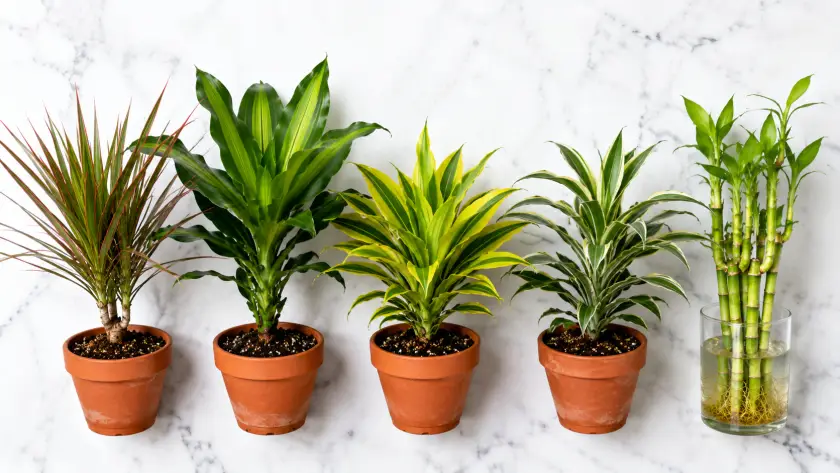
Dracaena Fragrans — The Corn Plant
Dracaena fragrans plant care covers the most widely grown and most forgiving dracaena variety — commonly called the corn plant for its resemblance to maize foliage. Dracaena fragrans produces broad, arching, glossy green leaves from a single central cane, and in the most popular cultivar ‘Massangeana’, the leaves display a yellow central stripe that gives the plant warmth and visual depth.
Dracaena massangeana plant care follows identical principles to standard fragrans but benefits from slightly more light to maintain the yellow variegation — in insufficient light the stripe fades and the plant becomes more uniformly green. This variety is one of the most effective air-purifying indoor plants available, with NASA research confirming its ability to remove formaldehyde, trichloroethylene, and benzene from indoor air.
- Light: Low to bright indirect — one of the most light-tolerant dracaenas
- Best for: Offices, interior rooms, lower-light spaces
Dracaena Marginata — The Dragon Tree
Dracaena marginata plant care covers the most dramatically architectural dracaena available — multiple slender canes topped with rosettes of narrow, dark green leaves edged in deep red. Over years of growth, the canes develop attractive grey-brown bark and lean gracefully in different directions, creating a sculptural presence that few other houseplants match.
How to care for a dracaena marginata plant differs slightly from corn plant care in its higher light preference — marginata performs best in bright indirect to filtered direct light and develops the richest red leaf margins in good light conditions.
Dracaena Lemon Lime
Dracaena lemon lime plant care covers one of the most visually vibrant dracaena varieties — sword-shaped leaves in vivid yellow-green with dark green central stripe and lighter green edges that create a striking tricolour pattern. Lemon lime dracaena plant care requires slightly more attention to light than plain-leaved varieties to maintain the brightness of the yellow-green variegation that defines this cultivar.
Dracaena Reflexa — Song of India
Dracaena reflexa plant care and dracaena song of india plant care cover the same plant — Dracaena reflexa ‘Variegata’ — which produces whorls of narrow leaves with bold cream-yellow margins on a branching, shrubby structure. It’s one of the most ornamental dracaenas available and one of the more demanding in terms of light requirements to maintain its distinctive variegation.
Dracaena Sanderiana — Lucky Bamboo
Dracaena sanderiana plant care covers a genuinely unique dracaena — commonly sold as lucky bamboo despite being completely unrelated to true bamboo. It can grow in water alone, making it one of the most versatile and unusual houseplants available. More on its specific care below.
Dracaena Warneckii
Dracaena warneckii plant care and warneckii dracaena plant care cover Dracaena deremensis ‘Warneckii’ — broad white-striped leaves on an upright, architectural form. One of the most tolerant dracaenas for lower light conditions and one of the best varieties for offices and interior rooms where bright light is unavailable.
Dracaena Compacta
Dracaena compacta plant care covers the smallest commonly available dracaena — dense rosettes of very dark, glossy green leaves on a compact, slow-growing form ideal for desks and smaller spaces. It’s the most shade-tolerant dracaena variety and among the most forgiving for lower-light indoor environments.
Dracaena Janet Craig
Dracaena janet craig plant care covers Dracaena deremensis ‘Janet Craig’ — broad, solid dark green leaves on a sturdy upright cane. One of the toughest, most adaptable dracaenas available, ranking consistently among the most effective air-purifying indoor plants and office-friendly plants that survive fluorescent lighting.
Complete Dracaena Plant Care Guide
Light Requirements
Dracaena plant indoor care light requirements vary more across varieties than almost any other care factor — but all dracaenas share one universal principle: bright indirect light produces the healthiest, most vibrant growth for every variety.
Light by variety:
- Dracaena marginata: Bright indirect to filtered direct — handles more light than most dracaenas
- Dracaena fragrans/massangeana: Low to bright indirect — the most light-flexible variety
- Dracaena lemon lime: Bright indirect — needs good light to maintain yellow-green variegation
- Dracaena reflexa/Song of India: Bright indirect — cream variegation fades without adequate light
- Dracaena compacta: Low to medium indirect — most shade-tolerant variety
- Dracaena warneckii/janet craig: Low to bright indirect — highly adaptable
Signs of insufficient light across all varieties:
- Variegation fading — coloured stripes becoming plain green
- Slow or completely stalled growth during spring and summer
- New leaves emerging smaller and paler than established foliage
- Plant leaning significantly toward the light source
Signs of too much direct light:
- Pale, washed-out leaf patches on surfaces facing the window
- Crispy brown patches on leaf tips and edges
- Soil drying out unusually rapidly
Our complete indoor light guide covers exactly how to measure and optimise light levels for dracaena in every room type.
Watering Dracaena Plants Correctly
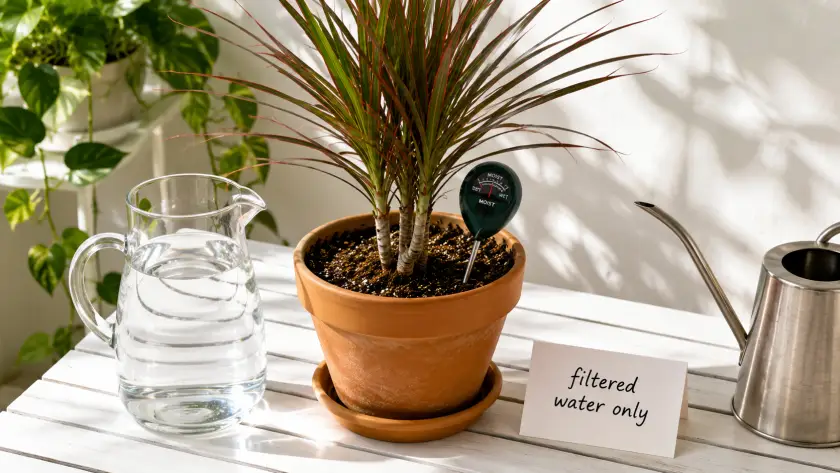
How to care for a dracaena plant in terms of watering follows one principle — less is more. Dracaena plants prefer to dry out significantly between waterings and are considerably more tolerant of mild drought than they are of consistently moist conditions.
Watering schedule:
- Spring and summer: Water when the top half of the soil is dry — typically every 10–14 days depending on pot size and light level
- Autumn: Reduce to every 14–21 days as growth slows
- Winter: Water every 3–4 weeks — semi-dormancy reduces moisture requirements significantly
- Method: Water thoroughly until draining freely from the bottom, empty the saucer completely after 15 minutes
The fluoride problem — the most important dracaena-specific watering consideration:
Dracaena plants are exceptionally sensitive to fluoride in standard tap water — more sensitive than almost any other common houseplant. Fluoride accumulates in leaf tissue and causes the brown leaf tips and crispy edges that are by far the most common dracaena complaint, appearing despite otherwise correct watering frequency and technique.
Best water options for dracaena:
- Filtered water — removes fluoride effectively
- Rainwater — ideal, naturally soft and fluoride-free
- Distilled water — completely pure but lacks trace minerals
- Tap water left standing 24 hours — allows chlorine to dissipate but fluoride remains
Overwatering signs in dracaena:
- Multiple leaves yellowing throughout the plant
- Soft, mushy stems at soil level
- Soil remaining wet for more than 10 days after watering
- Mold growing on soil surface
Underwatering signs:
- Dry, brown crispy leaf tips spreading inward
- Leaves losing their natural glossy appearance
- Soil pulling away from pot edges
Our signs of overwatering guide and complete watering guide cover dracaena moisture management in full detail.
Humidity and Temperature
Dracaena house plant care humidity requirements are moderate — these plants prefer 40–60% humidity, which is higher than many homes achieve naturally but lower than the 60–70% demanded by tropical species like calathea or anthurium. In homes with central heating during winter, a cool-mist humidifier or grouping with other plants helps maintain adequate humidity.
Temperature requirements:
- Ideal range: 18–27°C year-round
- Minimum: 15°C — below this causes growth to stop and leaf damage to appear
- Avoid: Cold drafts from windows in winter, air conditioning vents blowing directly on the plant, temperatures below 10°C at any time
Our humidity hacks guide covers practical solutions for maintaining adequate moisture levels around dracaena without specialist equipment.
Soil Mix for Dracaena
Dracaena plant care soil requirements are straightforward — a well-draining, moderately moisture-retentive mix that doesn’t compact or waterlog. Standard quality potting compost amended with perlite works well for most varieties.
Ideal dracaena soil mix:
- 60% quality potting compost
- 30% perlite (improves drainage and aeration)
- 10% worm castings (gentle slow-release nutrition)
Commercial alternatives:
- Standard multi-purpose potting compost amended with 25-30% perlite — practical and widely available
- African violet mix — suitable moisture-retentive structure for most dracaena varieties
Avoid:
- Heavy garden soil — compacts and causes waterlogging
- Pure peat mixes — become water-repellent when dry
- Cactus mix — too fast-draining for dracaena’s moderate moisture needs
Our best soil mix guide covers exact soil compositions for every dracaena variety.
Fertilizing Dracaena
Dracaena plant care tips for feeding include one important caution — dracaenas are sensitive to over-fertilizing and react to excess nutrients with brown leaf tips and salt crust on the soil surface. Feed lightly during the growing season only.
Feeding schedule:
- Spring and summer: Every 4–6 weeks with balanced liquid fertilizer (NPK 10-10-10) at half the recommended strength
- Autumn: Every 6–8 weeks, reducing gradually
- Winter: Stop completely
Application tips:
- Always water the plant the day before fertilizing — never apply to dry soil
- Flush soil with plain filtered water every 2–3 months to remove accumulated mineral salts
- White crust on soil surface indicates salt buildup — flush thoroughly and reduce feeding frequency
Our fertilizing indoor vs outdoor plants guide covers exact seasonal feeding schedules for dracaena and all common houseplant types.
Dracaena Repotting
Dracaena plant care instructions for repotting are simple — repot every 2–3 years when roots begin emerging from drainage holes or the plant dries out unusually rapidly after watering. Dracaena grows slowly and tolerates being slightly root-bound without adverse effects.
Repotting process:
- Choose a pot only 5cm larger — too large creates excess soil that stays wet too long
- Spring repotting enables fastest recovery
- Handle roots gently — dracaena roots are relatively brittle
- Water thoroughly after repotting and allow 1–2 weeks before resuming normal care
Our how to repot a plant guide and repotting mistakes guide cover every step in detail.
Dracaena Sanderiana — Water Growing Guide
Dracaena sanderiana plant care in water differs completely from soil-grown dracaena care. Lucky bamboo grows entirely in water with only a few pebbles or decorative stones to support the stems.
Water care for dracaena sanderiana:
- Use filtered or distilled water — fluoride sensitivity is even more acute in water-grown specimens
- Change water every 7–10 days to prevent bacterial buildup
- Keep water level covering the roots but not the stems — stems submerged in water rot quickly
- Feed with a very dilute liquid fertilizer (2–3 drops per gallon of water) every 4–6 weeks
- Position in bright indirect light — direct sun causes algae growth in the water container
Soil transition: Lucky bamboo can be transitioned from water to soil if desired — plant in well-draining potting mix and maintain consistent moisture until the plant establishes soil-adapted roots over 3–6 weeks.
Dracaena Propagation
Dracaena plant care propagation is straightforward — stem cuttings root reliably during spring and summer, making it easy to create new plants from a mature specimen or to rejuvenate an old, leggy plant by rooting the healthy top section.
Stem cutting propagation:
- Step 1: Select a healthy stem section 10–15cm long with several nodes
- Step 2: Cut cleanly with sterile scissors — cut the parent plant just above a node to encourage new branching
- Step 3: Allow the cutting to callous for 24 hours
- Step 4: Insert into moist well-draining potting mix or place in water with the cut end submerged
- Step 5: Position in bright indirect light — avoid direct sun on unrooted cuttings
- Step 6: Roots develop within 3–6 weeks — new growth from the stem confirms successful rooting
Cane sections: Older dracaena cane sections (the bare woody stem) can also be laid horizontally on moist soil — small plantlets emerge from the nodes along the cane over 4–8 weeks.
Our complete propagation guide covers both dracaena propagation methods in full detail.
Troubleshooting Common Dracaena Problems
Brown Leaf Tips
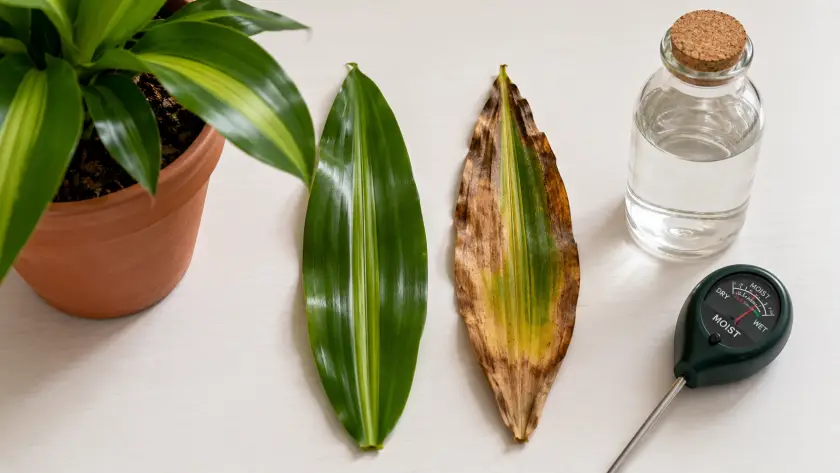
Brown crispy leaf tips are the most common dracaena plant care problem — and almost always caused by fluoride in tap water, low humidity, or fertilizer salt buildup. Check which description fits your situation:
- Brown only at the very tip, spreading slowly: Fluoride in tap water — switch to filtered water immediately
- Brown edges spreading inward: Low humidity — increase to 50%+ using humidifier or pebble tray
- Brown tips with white crust on soil: Fertilizer salt buildup — flush soil thoroughly with filtered water and reduce feeding
- Brown crispy overall: Underwatering — check soil at 5cm depth and water if dry
Yellow Leaves
Yellow leaves on dracaena most commonly indicate overwatering — check whether soil is consistently moist rather than drying between waterings. Multiple yellowing leaves simultaneously with soft stems is an emergency — unpot and inspect roots for rot immediately. Single lower leaves yellowing occasionally is natural ageing — remove and continue normal care. Our yellow leaves guide covers every yellowing cause in detail.
Pale or Fading Variegation
If coloured stripes and variegation are fading toward plain green — insufficient light is almost always the cause. Move to a brighter indirect light position and maintain for 4–6 weeks before assessing improvement. Variegated varieties including dracaena lemon lime, song of india, and warneckii are most susceptible to light-related variegation loss. Our complete indoor light guide covers light optimisation for variegated houseplants.
Leggy Growth
Long bare cane sections with leaf rosettes only at the tips indicate insufficient light over an extended period. Prune the growing tip back to a comfortable height — cut just above a node — to encourage new branching shoots from the cut point. The removed top section can be propagated as a cutting.
Pests
Dracaena is occasionally affected by spider mites (fine webbing on leaf undersides in dry conditions), mealybugs (white cottony clusters in stem joints), and scale (waxy brown bumps on stems). Treat with neem oil solution applied weekly for 3–4 weeks. Spider mites are most common in low-humidity environments — increasing humidity to 50%+ simultaneously prevents reinfestation.
If your dracaena is severely struggling, our revive a dying plant guide covers step-by-step recovery for every common dracaena problem scenario.
Pet Safety — Is Dracaena Toxic?
All dracaena varieties are confirmed toxic to cats and dogs by the ASPCA. Ingestion causes salivation, vomiting, weakness, and in cats specifically, dilated pupils. The toxic compounds are present throughout the plant — leaves, stems, and roots.
Always position dracaena on high shelves or in rooms inaccessible to pets, particularly cats that climb. For completely non-toxic alternatives with similar architectural presence, our cat-friendly plants guide and dog-friendly plants guide cover every safe option. The spider plant and calathea provide similar dramatic foliage without any toxicity concerns.
How to Style Dracaena by Room
Dracaena plant care and display work beautifully in every room type — the genus offers both compact desk varieties and statement floor plants, making it one of the most versatile styling choices in indoor plant collections.
Living room: A tall Dracaena marginata or Dracaena fragrans in a bright corner creates an instantly tropical, architectural presence. Pair with monstera or philodendron for a layered indoor jungle effect. Our 20 oversized indoor plants guide covers how to position large specimen dracaenas for maximum visual impact.
Home office: Dracaena fragrans and janet craig are among the most effective office-friendly plants that survive fluorescent lighting — genuinely tolerant of the lower, artificial light conditions most offices provide.
Bedroom: Dracaena’s air-purifying properties make it particularly valuable in bedrooms. See our bedroom plant decorating guide for positioning and companion planting ideas that combine dracaena with other low-maintenance bedroom plants.
Bathroom: Dracaena varieties that tolerate lower light — compacta, warneckii, janet craig — work well in bathrooms with some natural light. The naturally higher humidity of bathroom environments suits dracaena well, reducing the brown tip problem that affects plants in drier rooms. Our 33 best bathroom plants guide covers positioning principles for dracaena in bathroom environments.
For complete room-by-room display guidance, our how to style indoor plants by room guide covers every space in detail alongside colorful foliage indoor plants that complement dracaena’s varied leaf patterns beautifully.
Frequently Asked Questions
How do you care for a dracaena plant? Dracaena plant care requires bright indirect light (though most varieties tolerate lower light), watering when the top half of the soil is dry (typically every 10–14 days in summer, every 3–4 weeks in winter), filtered water to avoid fluoride brown-tipping, temperatures between 18–27°C, and moderate humidity of 40–60%. The most critical factor for most growers is switching from tap water to filtered water — this single change resolves the brown tip problem that affects most indoor dracaenas.
Why does my dracaena have brown tips? Brown leaf tips on dracaena almost always result from fluoride in tap water (the most common cause), low humidity, or fertilizer salt buildup in the soil. Switch to filtered or rainwater immediately — this resolves fluoride-related browning within a few weeks as new growth emerges clean. If brown tips persist after switching to filtered water, increase humidity to 50%+ using a humidifier or pebble tray. Our leaf curl browning and droop guide covers every browning cause in detail.
How often should I water my dracaena? Water your dracaena every 10–14 days in spring and summer when the top half of the soil is completely dry, every 14–21 days in autumn, and every 3–4 weeks in winter. Always check soil moisture at 3–5cm depth before watering rather than following a fixed schedule — dracaena care varies significantly by variety, pot size, and light level. See our complete watering guide for seasonal moisture management guidance.
What is the difference between dracaena marginata and dracaena fragrans care? Dracaena marginata plant care requires more light than fragrans — marginata performs best in bright indirect to filtered direct light and develops its best red leaf margins in good light. Dracaena fragrans plant care is more light-flexible, tolerating lower light conditions that would cause marginata to become leggy and lose colour. Both share the same watering, soil, and fluoride sensitivity requirements.
Is dracaena toxic to cats and dogs? Yes — all dracaena varieties are confirmed toxic to cats and dogs by the ASPCA. Ingestion causes vomiting, weakness, and in cats specifically, dilated pupils. Position dracaena on high shelves or in rooms inaccessible to pets at all times. For safe non-toxic alternatives, see our cat-friendly plants guide and dog-friendly plants guide.
How do I care for dracaena sanderiana (lucky bamboo)? Dracaena sanderiana plant care in water requires filtered or distilled water changed every 7–10 days, with water level covering roots but not stems. Feed with 2–3 drops of liquid fertilizer per litre of water every 4–6 weeks. Position in bright indirect light — direct sun causes algae in the water container. Fluoride sensitivity is even more pronounced in water-grown lucky bamboo than soil-grown dracaena.
How do I propagate dracaena? Dracaena propagates readily from stem cuttings taken in spring — cut a 10–15cm healthy stem section, allow to callous for 24 hours, then insert into moist well-draining potting mix or suspend in water with the cut end submerged. Roots develop within 3–6 weeks. Older cane sections can also be laid horizontally on moist soil — new plantlets emerge from nodes within 4–8 weeks. See our complete propagation guide.
Why is my dracaena losing its variegation? Fading variegation — stripes turning toward plain green — in dracaena lemon lime, song of india, or warneckii almost always indicates insufficient light. Move to a brighter indirect light position and maintain for 4–6 weeks before assessing whether colour is returning in new growth. Variegation loss is most pronounced when plants are positioned more than 3 metres from any window or in rooms with predominantly north-facing exposure. See our indoor light guide.
Related Guides
- Best Indoor Plants for Beginners
- Air Purifying Indoor Plants
- Office Friendly Plants Guide
- Snake Plant Care Guide
- ZZ Plant Care Guide
- Pothos Care Guide
- Peace Lily Care Guide
- Monstera Care Guide
- Philodendron Care Guide
- Calathea Care Guide
- Spider Plant Care Guide
- Rubber Plant Care Guide
- Fiddle Leaf Fig Care Guide
- Jade Plant Care Guide
- Aloe Vera Care Guide
- Money Tree Care Guide
- Christmas Cactus Care Guide
- String of Pearls Care Guide
- Colorful Foliage Indoor Plants
- 20 Oversized Indoor Plants
- 35 Low Maintenance Plants
- Low Light Hanging Plants
- 33 Best Bathroom Plants
- Complete Indoor Light Guide
- Complete Watering Guide
- Signs You’re Overwatering
- Humidity Hacks Guide
- Best Soil Mix Guide
- Fertilizing Indoor vs Outdoor
- How to Repot a Plant
- Repotting Mistakes to Avoid
- How to Propagate Houseplants
- Why Leaves Turn Yellow
- Leaf Curl Browning Droop Guide
- How to Revive a Dying Plant
- Cat Friendly Plants Guide
- Dog Friendly Plants Guide
- Style Indoor Plants by Room
- Decorate Bedroom with Plants
- Browse All Indoor Plants →
- Browse All Plant Care Guides →
Final Thoughts
Dracaena plant care offers something genuinely rare in the houseplant world — a genus that combines extraordinary visual variety with reliably forgiving care requirements. Whether you’re drawn to the sculptural drama of a tall Dracaena marginata, the broad tropical presence of a Dracaena fragrans massangeana, the vivid colour of a dracaena lemon lime, or the elegant water-grown simplicity of lucky bamboo, the care principles that govern success remain remarkably consistent across all of them.
The single most impactful change most dracaena owners can make is switching from tap water to filtered water — this one adjustment resolves the brown tip problem that affects the majority of indoor dracaenas and immediately improves the appearance of every variety. Pair that with correct watering frequency (less often than instinct suggests), adequate indirect light, and appropriate seasonal adjustments, and dracaena will reward you with years of clean, architectural, genuinely beautiful indoor growing.
According to the Royal Horticultural Society (RHS), dracaena species have received widespread recognition for their exceptional adaptability to indoor growing conditions, making them among the most recommended houseplants for both beginner and experienced growers seeking reliable, long-term indoor garden structure. 🌿