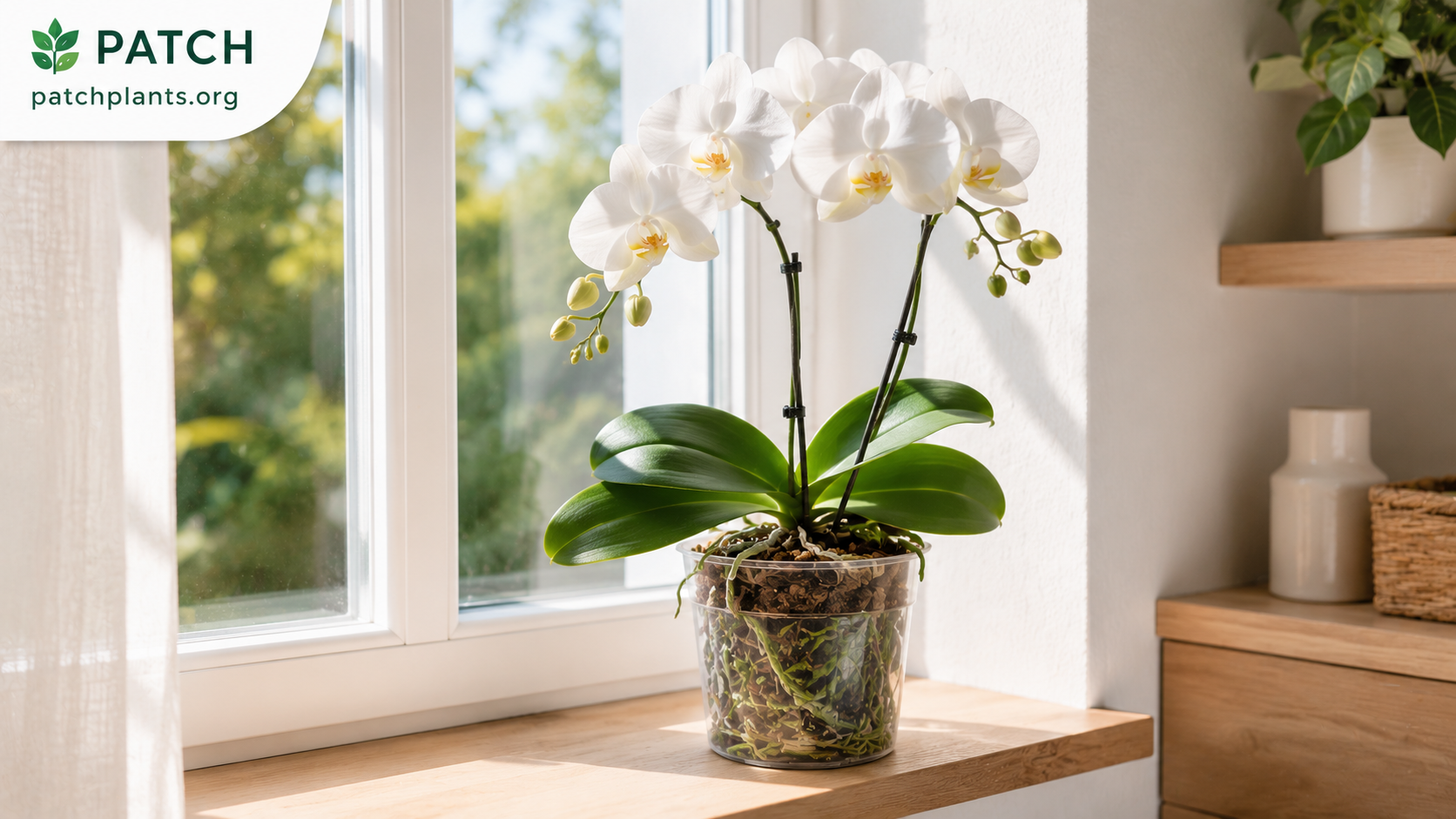
This orchid care guide comes down to five habits: give your orchid bright, indirect light; grow it in chunky orchid bark, not soil; water thoroughly about once a week and let it drain; feed it weakly and regularly; and give it cooler nights in autumn to trigger new flowers. Most orchids that fail indoors are overwatered or kept in the wrong light. Fix those two things and a supermarket moth orchid can rebloom for years.
If you want to know how to care for an orchid without guesswork, this guide focuses on phalaenopsis orchid care first. The phalaenopsis, or moth orchid, is the focus because it is the easiest and most common orchid sold for homes. Later sections cover how dendrobium, cattleya and oncidium orchids differ.
Every Patch Plants guide is researched and written by Sawera Shahid, a botanist with an MPhil in Botany who has spent more than five years writing about plant care. We base our advice on plant science and published extension research rather than trends, so you get steps that actually work on a real windowsill.
Orchid Care Guide at a Glance
| Need | What Phalaenopsis Orchids Want |
|---|---|
| Light | Bright, indirect light; an east window or a filtered south or west window |
| Water | A thorough soak about once a week, then drain completely |
| Growing medium | Medium-grade orchid bark or orchid mix, never potting soil |
| Temperature | Days about 70–80°F (21–27°C), nights around 60–65°F (16–18°C) |
| Humidity | About 40–60% |
| Feeding | Orchid fertilizer at half strength, little and often in the growing season |
| Repotting | About every two years, just after flowering |
| Rebloom trigger | Several weeks of cooler nights (about 55–60°F) in autumn |
Why Orchids Need Different Care
Most indoor orchids, including the phalaenopsis, are epiphytes. In the wild they grow on tree bark, not in soil. Their thick roots hang in the air, catch rain, and then dry quickly in the breeze. They are covered in a silvery layer called velamen that soaks up water like a sponge.
That habit explains nearly every rule in this guide. Orchid roots need air around them, a medium that drains in seconds, a soak followed by drying, and bright but dappled light like a forest canopy. When something goes wrong, the cause is almost always one of those factors.
If you are new to houseplants, our best indoor plants for beginners guide shows where orchids sit alongside other easy plants.
Orchid Light Requirements
Light decides whether an orchid simply survives or actually flowers. According to the Clemson Cooperative Extension orchid factsheet, phalaenopsis are low-light orchids that do best in a bright window with little or no direct sun, such as an east-facing one.
- East window: ideal, with gentle morning sun
- South or west window: fine behind a sheer curtain or set back from the glass
- North window: the plant usually survives but rarely reblooms
Read the Leaves for Light Clues
Leaf color is a reliable guide. Medium olive-green leaves mean the light is right. Very dark green leaves mean too little light, and the plant will be slow to flower. Red-tinged leaves or bleached, papery patches mean too much direct sun.
If your home is dim, a grow light works well. Clemson notes that artificial light running 12 to 16 hours a day can supplement or replace natural light. Our guide to grow lights for indoor plants explains distance and timing, and our complete guide to indoor light shows how to judge your windows through the seasons.
How to Water Orchids
In any orchid care guide, watering is the section that matters most, because it is where most orchid care goes wrong. Overwatering, not underwatering, kills the majority of indoor orchids, because roots sitting in soggy bark cannot breathe and start to rot.
How Often to Water an Orchid
A mature phalaenopsis in bark usually needs a thorough watering about once a week. Plants in small pots, clay pots, or very open bark may need it more often in warm weather. Plants in sphagnum moss need much less, only when the top of the moss feels dry. In cool winter rooms, the gap stretches out.
Check the plant instead of the calendar:
- Silvery-white roots mean the plant is ready for water
- Bright green roots mean it still has moisture, so wait
- A pot that feels much lighter when lifted is usually dry
The Soak-and-Drain Method
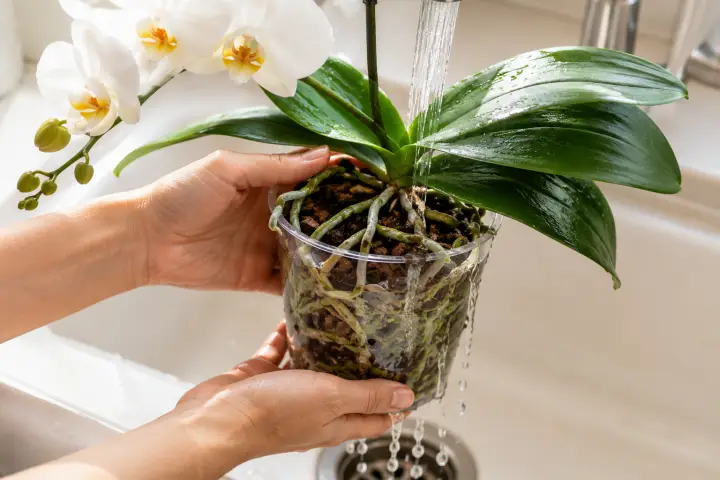
- Take the orchid to the sink in the morning.
- Run lukewarm water slowly through the bark for about 30 seconds until it pours from the drainage holes.
- Let it drain completely for 10–15 minutes.
- Return it to its cachepot only once dripping has stopped. Never leave it standing in water.
Keep water out of the crown, where the leaves meet, because trapped water can cause crown rot. Avoid cold water and ice cubes. The Missouri Botanical Garden phalaenopsis factsheet also advises against salt-softened water.
Our article on the signs you’re overwatering covers early warnings, and the complete guide to watering explains technique for all houseplants.
Rescuing an Overwatered Orchid
Warning signs include limp, yellowing lower leaves, brown or black mushy roots, a sour smell, and wilting even though the bark is wet. Remove the plant from its pot, cut away every soft or hollow root with sterilized scissors, and repot into fresh, dry bark. Our healthy roots vs root rot guide shows what to keep and what to cut, and our root rot guide covers the full treatment.
Humidity and Temperature for Orchids
Humidity
Clemson recommends about 40–60% humidity for most orchids, which many heated homes fall short of in winter. Dry air causes shriveled aerial roots, crisp leaf tips, and buds that drop before opening.
Simple fixes include a pebble tray with the pot sitting above the waterline, grouping plants together, and running a small humidifier in winter. Our DIY humidity tray guide shows how to build one, and our humidity hacks cover other low-cost options. Good air movement matters too, so avoid stuffy, stagnant corners.
Temperature
Phalaenopsis like the same temperatures people do. Missouri Botanical Garden recommends days around 70–80°F (21–27°C) and nights around 60°F (16°C), with a tolerated range of roughly 50–95°F (10–35°C). Clemson suggests keeping nights at 65°F or above for steady growth.
Keep orchids away from radiators, heating vents, air conditioners, and drafty doors. Sudden temperature swings and drafts are a common cause of bud drop. Ripening fruit releases ethylene gas, which can also make buds fall, so keep orchids away from the fruit bowl while they are in bud.
How to Fertilize Orchids
Orchid bark contains very few nutrients, so regular feeding is part of good orchid care. Use a water-soluble orchid fertilizer and follow the “weakly, weekly” approach: a dilute feed little and often during spring and summer.
- Use a balanced orchid feed (such as 20-20-20) at half the label strength
- Apply after watering, never onto dry roots
- Reduce feeding in winter and after flowering until new growth appears
- Flush the pot with plain water about once a month to wash out fertilizer salts
Clemson notes that plants growing in bark often do well on a higher-nitrogen orchid formula, because decomposing bark uses up nitrogen. Overfeeding causes more harm than underfeeding, burning the root tips. For more on choosing products, see our guide to household plant fertilizer and the differences in fertilizing indoor vs outdoor plants.
Orchid Care After Blooming and How to Rebloom
A phalaenopsis bloom usually lasts two to three months. When the last flower drops, the plant is not dying. It simply needs a rest and the right signal to flower again.
What to Do with the Flower Spike
You have two choices:
- Cut near the base: Missouri Botanical Garden recommends this. It lets the plant put its energy into new leaves and roots, and usually leads to a strong rebloom within about a year.
- Cut just above a node: If the spike is still green, cutting above the second node can produce a side spike with a few more flowers sooner. It works best on large, healthy plants, but it does take extra energy from the plant.
If a spike turns brown and dry, cut it off at the base.
How to Trigger Reblooming
The main signal is a temperature drop. Missouri Botanical Garden notes that night temperatures around 55°F (13°C) for several weeks in autumn start new flower spikes. In practice, placing the plant in a cooler room or near (not touching) a cool window in autumn often does the job.
- Keep the plant in bright, indirect light.
- Give it cooler nights, roughly 55–60°F (13–16°C), for about four weeks in autumn.
- Continue watering and light feeding.
- Watch for a new spike emerging from between the lower leaves. It has a mitten-shaped tip, unlike a rounded root tip.
Mistakes After Flowering
The most common mistakes are moving the plant to a darker spot, stopping all care, keeping it in a constantly warm room, and repotting while a new spike is forming. Avoiding these greatly improves your chances of flowers next year.
Repotting Orchids
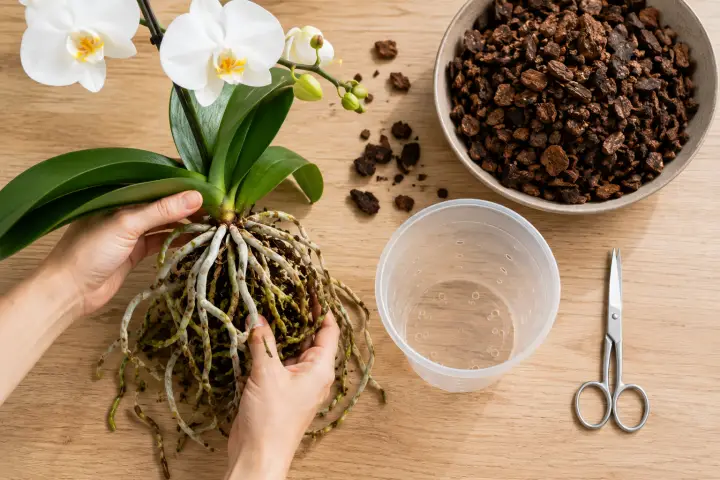
Repotting is the step most often skipped in an orchid care guide, yet it keeps roots healthy. Orchids are not usually repotted because they have outgrown the pot. They are repotted because bark breaks down over time into fine, soggy material that suffocates the roots. Missouri Botanical Garden recommends repotting about every two years, or sooner if the bark decomposes, just after flowering ends.
Signs Your Orchid Needs Repotting
- The bark has broken down and looks like compost
- The medium stays wet for many days
- Roots are brown, mushy, or hollow
- The plant is wobbly or climbing out of the pot
How to Repot an Orchid Step by Step
- Soak fresh medium-grade orchid bark in water for a few hours.
- Choose a pot only slightly larger than the root mass, with good drainage. Clear plastic pots let you watch the roots; clay pots dry faster.
- Ease the plant out and gently tease away all old bark.
- Trim dead, mushy, or hollow roots with sterilized scissors. Keep firm, healthy ones.
- Set the plant so the base of the lowest leaf sits just at the bark surface.
- Fill around the roots with fresh bark, tapping the pot to settle it.
- Wait about a week before the first full watering.
Our how to repot a plant guide covers general technique, and our list of repotting mistakes to avoid is worth reading first. To understand why bark works so differently from soil, see the best soil mix for every type of plant.
Types of Orchids and Their Care Differences
The rest of this orchid care guide applies mainly to phalaenopsis, but other popular orchids need a few adjustments.
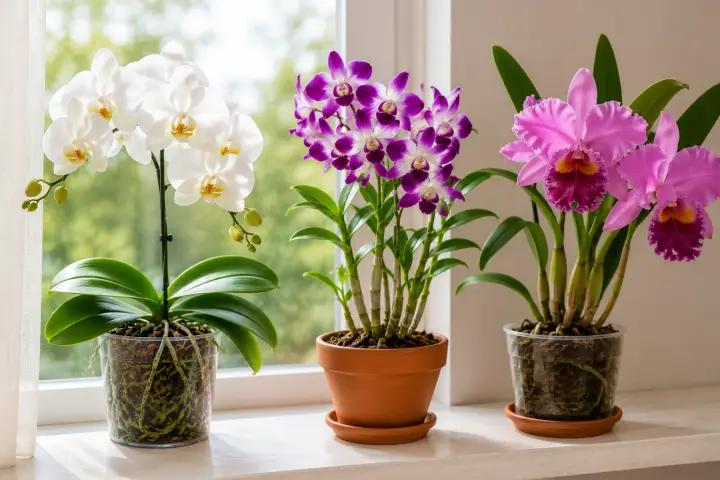
Phalaenopsis (Moth Orchid)
The best orchid for beginners. It tolerates average home conditions, needs the least light of the common types, and usually reblooms once a year with the care in this guide.
Dendrobium
A large and varied group. Most need brighter light than phalaenopsis, and many need a cooler, drier rest in winter with much less water before they will flower.
Cattleya
Known for large, often fragrant flowers. Cattleyas need much brighter light than moth orchids, including some direct morning sun, plus good air movement and drying between waterings.
Oncidium (Dancing Lady Orchid)
These produce sprays of small, often yellow flowers. They like bright, indirect light, intermediate temperatures, and regular watering during active growth.
Common Orchid Problems and Solutions
Yellow Leaves
One yellowing bottom leaf at a time is normal aging. Several yellow leaves, or yellowing with soft roots, usually means overwatering. Bleached, pale patches point to too much sun. Our guide on why plant leaves turn yellow walks through the full diagnosis.
Wrinkled, Limp Leaves
Leathery, wrinkled leaves mean the plant is not taking up enough water. That can be underwatering, but it is often damaged roots from rot that can no longer absorb water. Check the roots before adding more water.
Bud Blast
Buds that yellow and drop before opening are usually caused by cold drafts, sudden temperature changes, very dry air, ethylene from fruit, or moving the plant while in bud. Keep budding orchids in one stable spot.
Brown Spots and Leaf Damage
Dry, bleached patches are sunscorch. Soft, water-soaked spots that spread quickly suggest a bacterial or fungal rot; cut out affected tissue with sterilized tools and keep water off the leaves. Our leaf curl, browning and droop guide helps read other symptoms.
Pests
Mealybugs (white, cottony clusters) and scale (small brown bumps) are the most common orchid pests. Wipe them away with a cotton swab dipped in rubbing alcohol and repeat weekly until they are gone. In hot, dry rooms, watch for spider mites on plants, which leave fine webbing and speckled leaves.
No New Flowers
The usual causes are too little light and no cool autumn nights. Move the plant to a brighter, filtered window first, then follow the rebloom steps above. A recently repotted or recovering plant may also need a full growing season before it flowers.
Where to Place Orchids in Your Home
Choose the spot for light and stability first:
- Living room: often the best choice, with large windows and steady temperatures
- Bedroom: cooler nights can help trigger reblooming if the window is bright
- Bathroom: extra humidity suits orchids, but only if there is a window; see our best plants for your bathroom
- Home office: long-lasting flowers brighten a desk near a window; our office-friendly plants list has more ideas
- Kitchen: fine with good light, but keep orchids away from the stove and fruit bowl
For styling ideas by room, see our guide to styling indoor plants by room. Orchids also pair well with plants that like similar filtered light and humidity, such as a peace lily or a calathea. Grouping them helps raise humidity around all three.
Phalaenopsis orchids are widely regarded as non-toxic to cats and dogs, but chewed leaves and flowers can still upset a pet’s stomach, and plant labels are not always accurate. Our guides to cat-friendly plants and dog-friendly plants explain how to keep a pet-safe home.
Frequently Asked Questions
How often should I water my orchid?
A phalaenopsis in bark usually needs a thorough soak about once a week, then full drainage. Check the roots first: silvery roots need water, while green roots mean you should wait. Water less in cool winter conditions.
Why is my orchid not reblooming?
The most common causes are too little light and no cooler nights. Move it to a bright east window or a filtered south window, then give it several weeks of nights around 55–60°F (13–16°C) in autumn.
What is the best potting mix for orchids?
Use a medium-grade orchid bark or commercial orchid mix, never regular potting soil. Bark lets air reach the roots and drains quickly. Replace it about every two years as it breaks down.
Should I cut the orchid stem after the flowers fall?
Yes. Cutting near the base lets the plant rebuild and usually gives a strong rebloom within a year. On a large, healthy plant, you can instead cut a green spike just above a node to try for a quicker side spike.
Why are my orchid leaves turning yellow?
A single yellow bottom leaf is normal aging. Several yellow leaves usually point to overwatering and root rot, while pale, bleached patches mean too much direct sun. Check the roots first.
Final Thoughts
Good orchid care is about copying the plant’s natural home: bright filtered light, airy bark, a thorough soak followed by drying, gentle regular feeding, and cooler autumn nights. Follow the steps in this orchid care guide and your phalaenopsis can flower again year after year.
Browse more easy houseplants in our indoor plants collection.