Key Takeaways
- Boston fern care centres on three non-negotiable requirements — consistently moist but never waterlogged soil, high humidity above 50%, and bright indirect light — making it one of the most rewarding but genuinely humidity-dependent houseplants available for indoor growing.
- How to care for a boston fern starts with understanding its origins as a tropical understorey plant from humid forests across Florida, Central America, and South America, where it evolved in warm, consistently moist air with filtered canopy light rather than direct sun exposure.
- Boston fern care indoors is most challenging in winter when central heating dramatically reduces indoor humidity — the same dry air that makes homes warm and comfortable creates exactly the conditions that cause boston fern fronds to yellow, brown at the tips, and drop leaves prolifically.
- Boston fern care outdoors is genuinely excellent during the warmer months — outdoor humidity levels, rainfall, and naturally filtered light under a covered porch or dappled tree canopy replicate the fern’s natural conditions far more closely than any indoor environment typically can.
- Boston fern winter care requires the most active management of any season — moving the plant away from radiators, running a humidifier nearby, reducing watering slightly to match lower light levels, and checking regularly for spider mites that thrive in the dry winter conditions boston ferns find so stressful.
- How to take care of a boston fern includes regular misting as a temporary humidity measure, but misting alone is insufficient for true humidity management — it raises moisture in the immediate air around the plant for minutes at most, and a humidifier or pebble tray provides genuinely more effective sustained relief.
- Boston fern care tips for long-term success include using filtered or rainwater rather than fluoride-heavy tap water, fertilizing lightly only during the growing season, and removing browned or yellowed fronds promptly to direct the plant’s energy toward healthy new growth.
- Curly boston fern care (Nephrolepis exaltata ‘Fluffy Ruffles’) follows the same fundamentals as standard boston fern but with slightly more light required to maintain the distinctive ruffled frond texture that makes this variety particularly sought-after.
- Boston sword fern care (Nephrolepis cordifolia) is marginally less demanding than the standard boston fern in terms of humidity requirements — making it the better choice for environments where maintaining 50%+ humidity is difficult or impractical year-round.
- Are boston ferns easy to take care of? They’re honest plants — they communicate clearly when conditions aren’t right and respond visibly when care improves. With the right humidity setup in place, boston fern plant care is genuinely manageable and produces extraordinarily beautiful cascading fronds that no other common houseplant matches.
Introduction
Few houseplants create quite the visual impression that a healthy, well-grown boston fern does. Those long, arching fronds — dense, deeply green, and cascading gracefully outward in every direction — transform any room they inhabit in a way that no architectural plant or flowering specimen quite manages. A boston fern in a hanging basket near a bright window is not decoration. It’s a statement. It changes the feel of a room the moment you walk in, adding a quality of lushness and life that most people associate with expensive interior design rather than a plant that costs the same as a paperback book.
Boston fern care has a reputation for difficulty that is partly deserved and partly misunderstood. The reputation comes from one specific failure mode that affects most indoor growers eventually — insufficient humidity. Boston ferns are tropical plants evolved in environments where atmospheric moisture is high almost constantly, and when the air around them becomes too dry, they communicate it immediately and dramatically through browning tips, yellowing fronds, and significant leaf drop. This is not a plant that suffers quietly. But here’s the thing: once you understand that humidity is the single variable that determines success with boston fern, the rest of how to care for a boston fern becomes remarkably straightforward.
This complete boston fern care guide covers every aspect of growing Nephrolepis exaltata successfully — indoors, outdoors, through winter, in hanging baskets, and across multiple varieties — with specific guidance on every common problem and the honest solutions that actually work. Whether you’re setting up your first boston fern or troubleshooting one that’s struggling, this is the guide you need. For more humidity-loving plants that complement boston fern beautifully in high-moisture environments, our 33 best bathroom plants guide covers the complete range of moisture-tolerant indoor plants.
What Is a Boston Fern? Understanding Nephrolepis Exaltata
Nephrolepis exaltata is a tropical fern species native to humid forests across Florida, Central America, Mexico, the Caribbean, and South America, where it grows naturally as an understorey plant — hanging from tree branches, growing from crevices in rocks, and spreading across the humid forest floor in the permanently warm, moisture-saturated air beneath the tropical canopy. It was introduced to cultivation in the 1890s and became one of the most popular houseplants of the Victorian era, when the fashion for ferneries and humid conservatories made it an ideal ornamental subject.
The ‘Boston’ cultivar (Nephrolepis exaltata ‘Bostoniensis’) was discovered as a sport (a natural genetic mutation) in a shipment of standard sword ferns sent to Boston in 1894 — its broader, more arching fronds and denser growth habit distinguished it immediately from its parent species, and it has remained the most popular fern for indoor cultivation ever since. Understanding this humid, warm, shaded tropical origin explains every boston fern care requirement: the preference for indirect light (canopy shade), the demand for high humidity (tropical forest air), the preference for consistent moisture (tropical rainfall), and the sensitivity to cold temperatures (evolved in year-round warmth).
For more visually striking tropical plants that complement boston fern in a humidity-focused indoor garden, our colorful foliage indoor plants guide covers the most dramatic tropical foliage options available.
Boston Fern Varieties
Standard Boston Fern — Nephrolepis Exaltata ‘Bostoniensis’
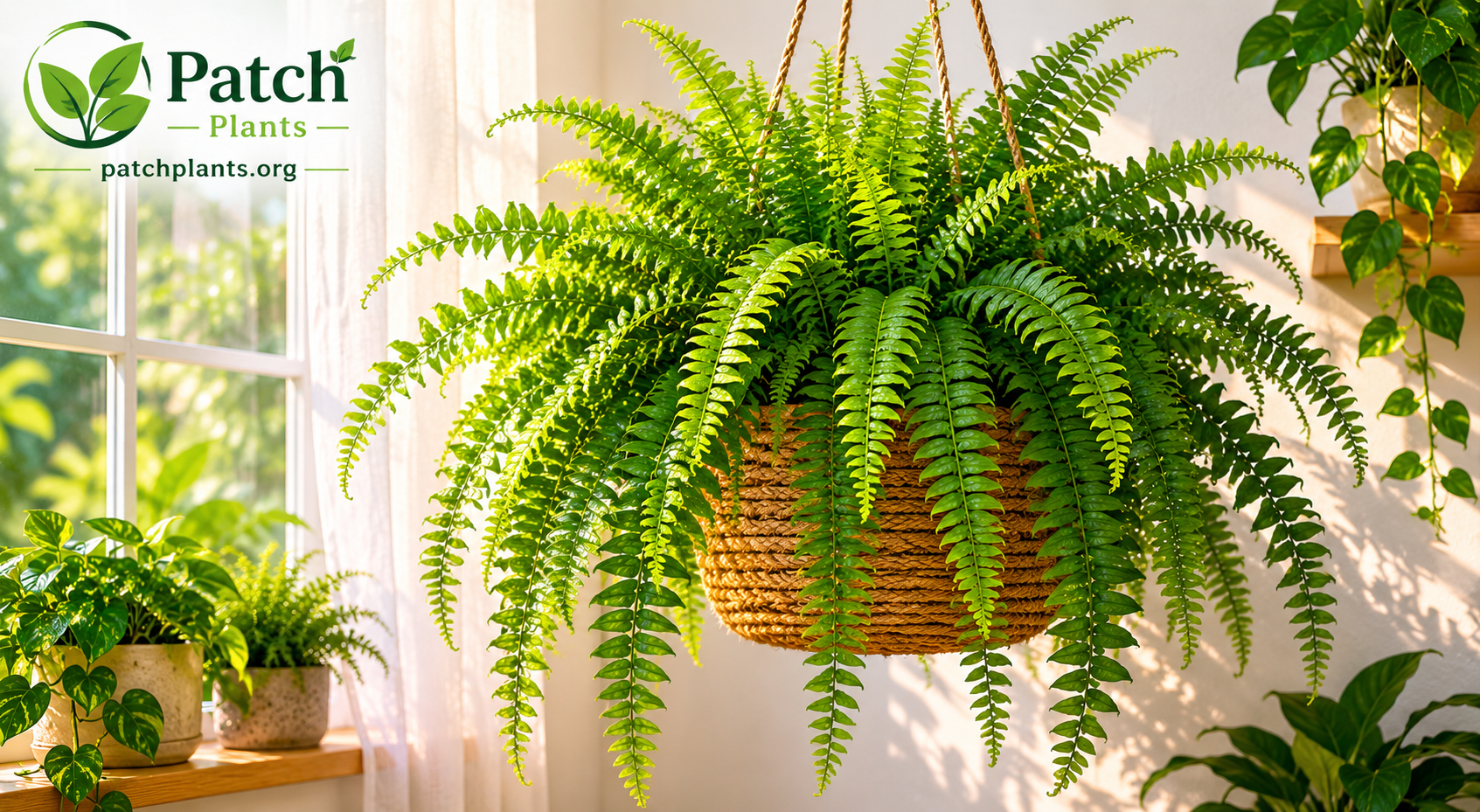
The classic variety remains the most widely available and most impressive in maturity — broad, deeply green, densely packed fronds arching gracefully in all directions from the central crown. Mature specimens in hanging baskets can produce fronds reaching 60–90cm in length, creating a genuinely extraordinary cascading display that makes boston fern one of the most impressive houseplants available for bright, humid spaces. Standard boston fern plant care follows the fundamentals covered throughout this guide.
Curly Boston Fern — Nephrolepis Exaltata ‘Fluffy Ruffles’
Curly boston fern care covers one of the most distinctive fern varieties available — fronds with deeply ruffled, wavy leaflets that create a texture resembling dense green feathers rather than the flat frond profile of standard boston fern. The ruffled form is more compact than standard boston fern, making it excellent for smaller spaces and indoor shelves rather than hanging baskets. Curly boston fern care requires slightly brighter indirect light than the standard variety to maintain the distinctive frond texture — in insufficient light the ruffling becomes less pronounced and growth more open.
Boston Sword Fern — Nephrolepis Cordifolia
Boston sword fern care covers a closely related but distinct species — Nephrolepis cordifolia — which produces more upright, sword-like fronds with slightly smaller leaflets than true boston fern. Boston sword fern care is marginally less demanding in terms of humidity requirements, making it the better choice for environments where maintaining the 50%+ humidity that standard boston fern needs is consistently difficult. It also demonstrates slightly greater drought tolerance, recovering better from occasional missed waterings.
Complete Boston Fern Care Guide
Light Requirements for Boston Fern
Boston fern care light requirements balance adequate brightness for healthy frond production with protection from the direct sun exposure that scorches the delicate leaflets and causes rapid moisture loss from the large frond surface area. In its natural habitat, boston fern receives bright but filtered light — the intensity of tropical sun moderated by the forest canopy to produce exactly the bright indirect light that indoor growing aims to replicate.
Ideal light for boston fern care indoors:
- Best position: 1–2 metres from a north or east-facing window — bright indirect light without direct sun
- Acceptable: South or west-facing window with sheer curtain filtering afternoon intensity
- Minimum: Adequate for survival but not thriving — north-facing windows in winter may need supplementary grow light
Signs of too much direct light:
- Frond tips turning yellow then brown and crispy despite adequate watering
- Leaflets developing pale, bleached patches on the side facing the window
- Soil drying out unusually rapidly
- Overall frond colour becoming yellowed and washed out
Signs of insufficient light:
- New fronds emerging pale, thin, and smaller than established growth
- Overall plant becoming progressively more open and less dense
- Slow growth even during spring and summer
Our complete indoor light guide covers how to identify and measure the ideal light positions for boston fern in every room type and window orientation.
Watering — How to Water Boston Fern Correctly
Boston fern care watering differs from most other popular houseplants in one important respect — boston fern prefers consistently moist soil rather than the dry-between-waterings approach that works for succulents, ZZ plants, and pothos. In its natural habitat, the soil and root environment around boston fern remains consistently moist from regular tropical rainfall, and allowing the soil to dry out completely causes immediate stress in a plant not evolutionarily adapted for drought periods.
Watering schedule for boston fern care:
- Spring and summer: Water when the top 2cm of soil feels dry — typically every 5–7 days
- Autumn: Reduce to every 7–10 days as growth slows and light levels decrease
- Winter: Every 10–14 days — reduced light and lower growth rate decrease moisture demand, but never allow soil to dry out completely
Method: Water thoroughly until water drains from the bottom, then empty the saucer after 15 minutes. Boston ferns dislike sitting in standing water — root rot develops quickly in waterlogged conditions.
Water quality matters: Like calathea and peace lily, boston ferns are sensitive to fluoride in tap water — switching to filtered or rainwater reduces the brown tip problem that many growers experience despite otherwise correct boston fern care. Our complete watering guide and overwatering signs guide cover moisture management for ferns in full detail.
Humidity — The Most Critical Factor in Boston Fern Care

Humidity is the single variable that determines whether boston fern care succeeds or fails in any indoor environment. More than light, more than watering, more than soil or feeding — the atmospheric moisture level surrounding your boston fern determines the quality of its growth, the health of its fronds, and whether you’re rewarded with cascading lushness or a progressively browning, dropping collection of unhappy frond stubs.
Humidity requirements for boston fern care:
- Ideal: 50–80% relative humidity — replicating the tropical forest conditions the plant evolved in
- Acceptable: 40–50% — possible to maintain boston fern health but frond tips will show some browning
- Problematic: Below 40% — fronds yellow and brown rapidly, significant leaf drop occurs
- Typical home humidity: 30–40% — insufficient for healthy boston fern care without active humidity management
Effective humidity solutions for boston fern:
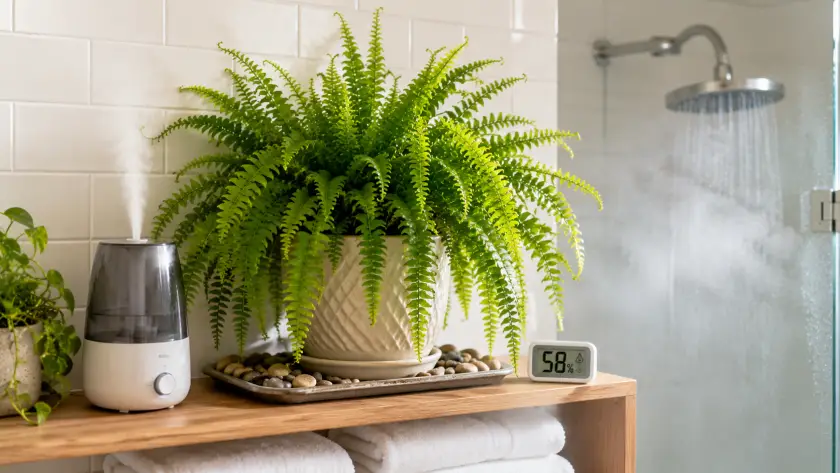
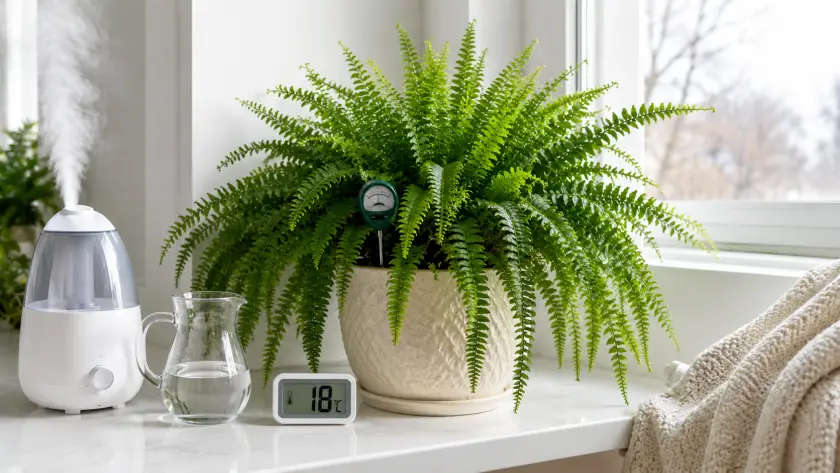
Cool-mist humidifier (most effective): Position 1–2 metres from the plant running daily during the heating season. A small humidifier maintaining 50–60% measured with a hygrometer provides the most reliable sustained humidity management for boston fern care indoors.
Bathroom placement: The most naturally humidity-rich indoor environment — shower steam creates regular elevated humidity that boston ferns thrive in. Position near a bright bathroom window for genuine boston fern indoor care success without any additional equipment. Our 33 best bathroom plants guide covers bathroom-specific positioning for boston fern and other humidity-loving plants.
Pebble tray: Fill a wide, shallow tray with pebbles, add water to just below the pebble surface, and place the pot on top. Evaporating water increases immediate surrounding humidity — less effective than a humidifier but useful as a supporting measure.
Plant grouping: Boston fern grouped with other moisture-loving plants creates a localized high-humidity microclimate through collective transpiration — useful in combination with other methods.
Misting: Frequently recommended but genuinely insufficient as a primary humidity management strategy. Misting raises immediate surrounding humidity for minutes before evaporating — it provides temporary relief but cannot maintain the consistent 50%+ humidity that boston fern care requires. Use as a supplement to other methods, not as a replacement. Our humidity hacks guide covers every affordable technique for creating and maintaining adequate humidity for boston fern.
Temperature Requirements
Boston fern care temperature requirements reflect the plant’s tropical origins — consistent warmth throughout the growing season, with a slightly cooler but never cold winter rest period.
- Ideal growing temperature: 16–24°C (60–75°F) year-round
- Winter minimum: 10°C (50°F) — below this causes permanent frond damage
- Avoid: Cold drafts from windows in winter (the most common temperature-related boston fern problem), air conditioning vents blowing directly on the plant, and outdoor temperatures below 7°C
Boston fern care outside in cold weather: Move outdoor boston ferns inside before night temperatures drop below 10°C consistently — this typically means bringing inside by September in most UK and northern European climates. Boston ferns have no frost hardiness whatsoever and cold damage is irreversible.
Soil Mix for Boston Fern
Boston fern plant care soil must balance the consistent moisture this plant prefers with adequate drainage to prevent the root rot that develops when moisture stagnates around the root system. A rich, organic, slightly moisture-retentive but well-aerated mix works best.
Ideal boston fern soil mix:
- 40% quality potting compost
- 30% peat moss or coco coir (moisture retention)
- 20% perlite (drainage and aeration)
- 10% worm castings (gentle slow-release nutrition)
Commercial alternatives:
- African violet mix — suitable moisture-retentive structure for boston fern
- Standard potting compost amended with 20% perlite and 20% peat/coco coir
Our best soil mix guide covers exact soil ratios for ferns alongside every other common houseplant type.
Fertilizing Boston Fern
Boston fern care tips for feeding include restraint — boston ferns are moderate feeders that respond well to gentle spring and summer nutrition but show tip burn and leaf drop when over-fertilized, a problem that many growers encounter when applying standard houseplant fertilizer at full strength.
Feeding schedule:
- Spring and summer: Every 4–6 weeks with balanced liquid fertilizer (NPK 10-10-10) at half the recommended strength
- Autumn: Every 6–8 weeks reducing gradually
- Winter: Stop completely — boston fern winter care does not include feeding while the plant is in its resting period
Our fertilizing indoor vs outdoor plants guide covers seasonal feeding schedules for ferns.
Repotting Boston Fern
Boston fern care repotting every 1–2 years prevents the root-bound conditions that reduce moisture uptake and cause the frond yellowing that owners often misattribute to watering or humidity problems. Boston ferns grow more rapidly than most other popular houseplants and fill their pots within a growing season in good conditions.
Signs repotting is needed:
- Roots emerging clearly from drainage holes
- Plant drying out within 2–3 days of thorough watering
- Frond production slowing despite spring and summer care
Spring repotting into a pot 5cm larger, with fresh moisture-retentive soil, gives the fastest recovery. Our how to repot a plant guide and repotting mistakes guide cover every step in detail.
Boston Fern Care Outdoors

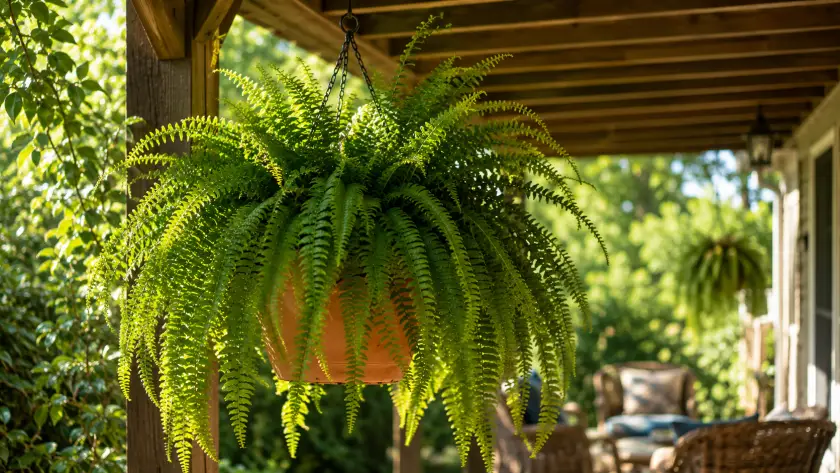
Boston fern care outdoors is genuinely excellent during warm months — outdoor humidity levels, natural rainfall, and dappled shade under trees or covered porches provide conditions closer to the boston fern’s natural habitat than most indoor environments can replicate. For anyone asking how to care for a boston fern outside, the answer is straightforward: give it shade, moisture, and protection from direct sun and wind.
Ideal outdoor positions for boston fern care outside:
- Covered porch or veranda — protected from direct sun and drying wind
- Hanging basket under a tree canopy — dappled shade with natural humidity from surrounding vegetation
- North-facing garden wall — consistent shade without direct sun exposure
Boston fern care outdoors summer management:
- Check soil moisture every 2–3 days — outdoor air movement and warmth dry the growing medium faster than indoors
- Water more frequently during hot dry periods — boston fern care outside in summer may require daily watering during heat waves
- Protect from strong afternoon direct sun — even outdoor boston fern care outdoors benefits from shade during the most intense hours
How to care for boston ferns outdoors in autumn: Begin monitoring overnight temperatures from August — once nights consistently drop below 10°C, move back indoors before cold damage occurs. Inspect for pests before bringing inside — outdoor periods commonly introduce mealybugs, scale, and spider mites that then affect indoor plants. See our best low-maintenance outdoor plants guide for companion outdoor plant ideas during boston fern’s summer outdoor placement.
Boston Fern Winter Care

Boston fern winter care is the most demanding period of the entire care calendar — the combination of lower light, reduced watering, and dramatically drier indoor air from central heating creates exactly the wrong conditions for a plant evolved in consistently warm, moist tropical environments.
Complete boston fern care winter strategy:
Humidity management: The single most important boston fern winter care action is running a humidifier near the plant throughout the heating season. Without active humidity management, the dry heated air of a typical winter home drops to 20–30% relative humidity — creating conditions that cause rapid, dramatic boston fern decline regardless of any other care adjustment. Our humidity hacks guide covers every affordable winter humidity solution.
Positioning: Move boston fern away from radiators and heating vents for boston fern care winter — the drying effect of direct heat on nearby foliage is the most common single cause of winter boston fern decline. Position near a window for maximum winter light while keeping distance from any heat source.
Watering adjustment: Reduce watering frequency for boston ferns care for winter to every 10–14 days — lower light and reduced growth mean less moisture demand, and overwatering in winter causes root rot more rapidly than in summer. Maintain consistently slightly moist soil — never completely dry, never waterlogged.
Light supplementation: A small LED grow light positioned above the plant for 12 hours daily compensates for the reduced natural light of boston fern winter care period and significantly improves frond condition through the darker months.
Pest vigilance: Spider mites thrive in the dry winter conditions that boston fern care winter management aims to combat — check the undersides of fronds weekly for fine webbing and tiny moving dots, treating immediately with neem oil solution at the first sign of infestation.
How to care for a boston fern in the winter — the summary: Humidifier running, away from heat sources, reduced watering frequency, maximum available natural light, no fertilizing. These five adjustments address every winter challenge boston ferns face and allow the plant to maintain reasonable health through the most difficult season for boston ferns care for winter in temperate climates.
Troubleshooting Common Boston Fern Problems
Brown Leaf Tips
Brown tips are the most universal complaint in boston fern care — and almost always result from low humidity, tap water fluoride, or direct sun exposure. Identify which applies by context:
- Brown tips despite consistent watering: Low humidity — run a humidifier
- Brown tips with crispy edges: Both low humidity and fluoride in tap water — humidifier plus switch to filtered water
- Brown patches rather than tips: Direct sun damage — move further from the window
Yellowing Fronds
Yellowing fronds in boston fern care result from overwatering (most common), insufficient light, or natural ageing of older fronds. Check soil moisture first — consistently wet soil causing root rot produces widespread yellowing with possible mushy crown. Our yellow leaves guide covers every yellowing scenario in detail.
Significant Leaf Drop
Sudden mass leaf drop in boston fern almost always results from one of three causes: sudden temperature change (cold draft, moved from warm to cool room), dramatic humidity drop (heating switched on for winter season), or severe underwatering. Identify the trigger, correct it immediately, and the plant will typically recover and produce new fronds once conditions stabilise. Our revive a dying plant guide covers recovery strategies for severely stressed boston ferns.
Not Growing
Stalled growth in boston fern care during the growing season results most commonly from root-bound conditions, insufficient light, or low humidity suppressing metabolic activity. Our leaf curl and droop guide covers additional diagnostic information for struggling ferns.
Pet Safety — Is Boston Fern Safe for Cats and Dogs?
Boston fern is completely non-toxic to cats and dogs — the ASPCA confirms Nephrolepis exaltata is safe for both species, making it one of the most valuable large, dramatic houseplants for pet-owning households where many popular alternatives including asparagus fern (toxic despite the name) carry genuine safety concerns.
This complete pet safety makes boston fern care indoors particularly attractive for households with curious cats or dogs — a plant that produces cascading, touchable fronds at cat-accessible heights without any toxicity risk is genuinely rare among statement-sized houseplants. Our cat-friendly plants guide and dog-friendly plants guide cover additional non-toxic options across all plant categories.
How to Style Boston Fern by Room
Boston fern care and display work best in positions that serve the plant’s humidity and light requirements while maximising the visual impact of those extraordinary cascading fronds.
Hanging basket near a bright window: The most classic and most effective display position for boston fern — elevated in a hanging basket, fronds cascade freely in all directions creating the waterfall effect that makes boston fern one of the most photographed houseplants in the world. Position near an east-facing window for ideal morning light without afternoon intensity. Our low-light hanging plants guide covers hanging display principles for ferns and all other trailing varieties.
Bathroom display: The naturally humid bathroom environment is ideal for boston fern care indoors — steam from showers provides genuine, consistent humidity boost without any equipment, and the lush tropical presence of a well-grown boston fern transforms a bathroom into a genuinely spa-like space. Our 33 best bathroom plants guide covers bathroom-specific boston fern positioning in detail.
Covered porch or veranda in summer: Boston fern in a hanging basket on a covered outdoor porch during summer months is one of the most classically beautiful displays available — the outdoor humidity and natural dappled light produce the finest frond quality possible. See our how to style indoor plants by room guide for indoor boston fern display ideas across every room type.
Companion plants: Pair boston fern’s lush cascading texture with the architectural structure of snake plant or ZZ plant for strong visual contrast, or with the dramatic tropical foliage of calathea for a humidity-loving plant group that benefits from collective transpiration. See our bedroom plant decorating guide for how boston fern works in sleeping spaces.
Frequently Asked Questions
How do you care for a boston fern? Boston fern care requires bright indirect light (north or east-facing window), consistently moist but never waterlogged soil (water every 5–7 days in summer), humidity above 50% (humidifier or bathroom placement), temperatures between 16–24°C, and filtering or rainwater to avoid fluoride brown tips. The single most important factor is maintaining adequate humidity — without it, no other aspect of how to care for boston ferns will produce genuinely good results.
How do I care for a boston fern in winter? Boston fern winter care requires moving away from radiators and heat vents, running a humidifier to counteract dry heated air, reducing watering to every 10–14 days, maximising available natural light, stopping fertilizing completely, and checking weekly for spider mites that thrive in winter’s dry conditions. How to care for a boston fern in the winter is primarily about humidity management — address this correctly and all other boston ferns care for winter adjustments fall into place naturally.
How do I care for a boston fern outdoors? Boston fern care outdoors works excellently in warm months — position in dappled shade under a tree canopy or on a covered porch away from direct sun and drying wind. Check soil moisture every 2–3 days as outdoor air movement dries the growing medium faster than indoors. How to care for a boston fern outside in summer may require daily watering during hot dry periods. Bring back indoors before overnight temperatures drop below 10°C.
Why is my boston fern turning brown? Brown tips in boston fern care most commonly indicate low humidity, fluoride in tap water, or direct sun exposure — identify which applies from the context of your care routine and correct the specific cause. Widespread browning combined with frond drop indicates a more significant stress event — cold draft exposure, dramatic humidity drop, or severe dehydration. Our leaf curl and droop guide covers every browning scenario with exact solutions.
Are boston ferns easy to take care of? Are boston ferns easy to take care of? With the right humidity setup, yes — boston fern care becomes genuinely manageable and rewarding. The challenge is that many indoor environments don’t naturally provide the 50%+ humidity boston ferns prefer, so some investment in humidity management is usually necessary. Once that’s addressed, care of boston fern follows a simple, consistent routine that produces extraordinary results. See our best indoor plants for beginners guide for easier alternatives if high humidity management isn’t practical in your space.
How often should I water my boston fern? Water your boston fern every 5–7 days in spring and summer when the top 2cm of soil feels dry, every 7–10 days in autumn, and every 10–14 days in winter. Unlike most popular houseplants, boston fern care does not follow a dry-between-waterings approach — the soil should remain consistently slightly moist rather than drying out completely between waterings. Use filtered or rainwater to avoid fluoride tip browning. See our complete watering guide.
Is boston fern toxic to cats and dogs? No — boston fern care households with pets have excellent news. Nephrolepis exaltata is confirmed completely non-toxic to cats and dogs by the ASPCA, making it one of the safest large statement houseplants for pet-owning households. This pet safety is one of boston fern’s most significant advantages as a hanging or cascading display plant. See our cat-friendly plants guide and dog-friendly plants guide.
How do I propagate boston fern? Boston fern propagates through division during spring repotting — separate the root ball into 2–3 sections with a clean sterile knife, ensuring each section has healthy fronds and roots attached, then pot each division in fresh moisture-retentive soil mix. Maintain high humidity around new divisions during establishment. Our complete propagation guide covers division techniques for clumping plants including boston fern in full detail.
Related Guides
- 33 Best Bathroom Plants Guide
- Low Light Hanging Plants Guide
- Calathea Care Guide
- Peace Lily Care Guide
- Spider Plant Care Guide
- Snake Plant Care Guide
- ZZ Plant Care Guide
- Pothos Care Guide
- Monstera Care Guide
- Philodendron Care Guide
- Aloe Vera Care Guide
- Money Tree Care Guide
- Dracaena Care Guide
- Rubber Plant Care Guide
- Jade Plant Care Guide
- Colorful Foliage Indoor Plants
- Air Purifying Indoor Plants
- Best Indoor Plants for Beginners
- 35 Low Maintenance Plants
- 20 Oversized Indoor Plants
- Complete Indoor Light Guide
- Complete Watering Guide
- Signs You’re Overwatering
- Humidity Hacks Guide
- Best Soil Mix Guide
- Fertilizing Indoor vs Outdoor
- How to Repot a Plant
- Repotting Mistakes to Avoid
- How to Propagate Houseplants
- Why Leaves Turn Yellow
- Leaf Curl Browning Droop Guide
- How to Revive a Dying Plant
- Cat Friendly Plants Guide
- Dog Friendly Plants Guide
- Style Indoor Plants by Room
- Decorate Bedroom with Plants
- Best Low Maintenance Outdoor Plants
- Rare Houseplants Guide
- Browse All Indoor Plants →
- Browse All Plant Care Guides →
Final Thoughts
Boston fern care rewards plant owners who take the time to understand what this plant actually needs rather than what seems intuitive from general houseplant experience. Most houseplant advice centres on avoiding overwatering, providing adequate light, and letting soil dry between waterings — and for the majority of popular plants, this is correct. Boston fern inverts several of these assumptions: it wants consistently moist soil, it prefers lower light than many tropical plants, and above all, it demands the one environmental factor that indoor environments most reliably lack — high humidity.
Understand that boston fern care is fundamentally a humidity management problem, and everything else becomes straightforward. A humidifier running through winter, a bathroom position during the heating season, or a covered outdoor spot during summer — any of these provides the moisture-rich air that boston fern evolved for, and in those conditions it grows with a lushness and vigour that transforms every space it inhabits.
How to care for boston ferns for the long term is ultimately about working with the plant’s nature rather than against it — providing the tropical forest conditions it expects, in whatever form that’s practically achievable in your specific home. Do that, and boston fern will reward you with cascading fronds of extraordinary beauty that justify every bit of the humidity management effort invested in making it thrive.
According to the Royal Horticultural Society (RHS), Nephrolepis exaltata has received the RHS Award of Garden Merit — confirming its exceptional performance and value as an indoor and conservatory plant when grown in suitable humidity conditions, making it one of the most formally endorsed ferns for home cultivation available. 🌿