Key Takeaways
- Bird of paradise plant care centres on four fundamentals — maximum available direct or bright indirect light, thorough but infrequent watering with complete drying between sessions, temperatures above 10°C at all times, and patience — this is a plant that rewards consistent, long-term care with extraordinary exotic blooms rather than quick gratification.
- How to care for bird of paradise plants successfully starts with understanding that Strelitzia reginae originates from the subtropical coastal regions of South Africa, where it receives intense direct sun, seasonal rainfall, and warm temperatures year-round — making light the single most important care factor for any indoor specimen.
- Bird of paradise plant care indoor success depends heavily on providing the brightest possible light position — a south-facing window with several hours of direct sun daily produces the vigorous growth and eventual flowering that makes bird of paradise plant care so rewarding, while insufficient light produces large but non-flowering plants indefinitely.
- White bird of paradise care (Strelitzia nicolai) follows the same fundamental principles as standard bird of paradise plant care but with important differences — it grows significantly larger (reaching 3–6 metres outdoors), tolerates slightly lower light levels, and rarely flowers indoors, making it primarily a dramatic large-scale foliage plant rather than a flowering specimen.
- Bird of paradise care outdoor during summer months produces the finest growth available — the combination of intense natural light, outdoor humidity, and rainfall replicates the plant’s natural conditions more closely than any indoor environment can, and plants summered outdoors routinely develop larger leaves, stronger stems, and greater likelihood of eventual flowering.
- How to care for bird of paradise flower properly includes understanding that indoor flowering requires several years of patient growing — most bird of paradise plants need 3–5 years of optimal care before producing their first bloom, and root-bound conditions, winter cool rest periods, and maximum light all contribute to triggering the flowering response.
- Bird of paradise plant care tips for long-term success include never repotting unnecessarily — slightly root-bound conditions encourage flowering, and the temptation to move bird of paradise plants into larger pots frequently actually delays the blooms that make this plant worth growing.
- Giant bird of paradise care (Strelitzia alba or S. nicolai) requires the same basic approach as standard care but with even greater attention to space — these plants produce truly architectural leaves reaching 60–90cm in length indoors and need proportionally more light and root space to support their dramatically larger leaf canopy.
- Bird of paradise care indoors requires patience with yellowing and splitting leaves — the characteristic leaf splits of bird of paradise are a natural adaptation (allowing wind to pass through without snapping stems in the plant’s coastal South African habitat), and yellowing of occasional lower leaves is completely normal and not an indicator of care problems.
- Are birds of paradise easy to care for? Yes — bird of paradise plant care is genuinely beginner-accessible once light requirements are correctly met. The plant is drought-tolerant, pest-resistant, long-lived, and forgiving of occasional care lapses, making it one of the most rewarding large tropical statement plants for confident beginner growers.
Introduction
There are plants that fill a room with greenery, and then there are plants that change the nature of a room entirely. The bird of paradise is the second kind. Those enormous, paddle-shaped leaves — deeply veined, intensely green, carried on thick upright stems — create an immediate sense of tropical abundance that requires no styling, no companion plants, and no particular talent for interior design to achieve. A single well-grown bird of paradise plant in the corner of a living room transforms the space in the way that only genuinely large, genuinely magnificent plants can.
Bird of paradise plant care has developed a slightly intimidating reputation, largely because the flowers — those extraordinary orange and blue Strelitzia blooms that give the plant its name — require years of optimal care to produce indoors. But the reputation misrepresents the plant’s actual nature. As a houseplant, bird of paradise care is straightforward: bright light, infrequent thorough watering, warmth, and time. The difficulty isn’t in keeping a bird of paradise alive and growing beautifully — that part is genuinely accessible. The challenge is patience, and understanding that a plant producing increasingly magnificent foliage over years of bird of paradise plant care is not failing to deliver — it’s building toward something extraordinary.
This complete bird of paradise plant care guide covers every variety in detail — from standard Strelitzia reginae through white bird of paradise care (S. nicolai), giant bird of paradise care, mexican bird of paradise care, and orange bird of paradise care — alongside complete indoor and outdoor care fundamentals, troubleshooting, pet safety, and the specific conditions that trigger the flowers that make birds of paradise flower care such a rewarding long-term pursuit. For more large statement tropical plants that complement bird of paradise beautifully, our 20 oversized indoor plants guide covers the most architecturally impressive houseplants available.
Bird of Paradise Varieties — Complete Guide
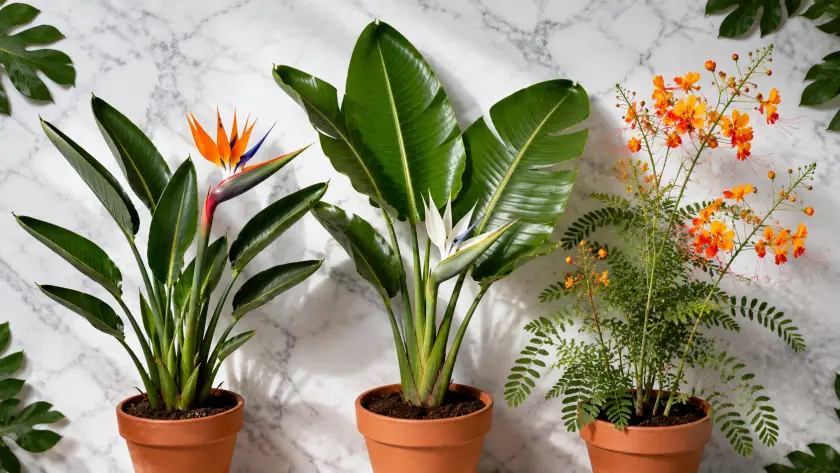
Standard Bird of Paradise — Strelitzia Reginae
The classic bird of paradise plant care subject — Strelitzia reginae produces the iconic orange and blue flowers that give the genus its common name. Indoors, it reaches 90–150cm in height with leaves 30–60cm long. It’s the most likely variety to flower in indoor conditions given optimal bird of paradise plant care over several years, making it the variety most suited to patient growers specifically pursuing the extraordinary birds of paradise flower care experience.
White Bird of Paradise — Strelitzia Nicolai
White bird of paradise care covers one of the most dramatic large-scale houseplants available. Strelitzia nicolai produces enormous banana-like leaves reaching 60–90cm indoors on stems that can reach ceiling height in a few years of good white bird of paradise plant care. The white and blue flowers it produces are equally spectacular but extremely rare in indoor conditions — most growers of white bird of paradise care indoors treat it primarily as a dramatic foliage plant rather than a flowering specimen.
White bird of paradise care indoor is slightly more forgiving than standard Strelitzia in terms of light tolerance — it manages in bright indirect light without direct sun more readily — but still requires the brightest available position for the vigorous growth that makes white bird of paradise plant care indoors so visually rewarding. White bird of paradise care outdoor during summer produces the largest possible leaves and the strongest stems available from indoor-started specimens.
Giant Bird of Paradise — Strelitzia Alba
Giant bird of paradise care (Strelitzia alba) follows similar principles to white bird of paradise plant care but with an even more imposing ultimate size — 9+ metres in its natural South African habitat, though more typically 2–3 metres in indoor cultivation. Giant bird of paradise plant care requires genuinely spacious positioning and the absolute maximum available light to support the energy demands of its enormous leaf canopy.
Mexican Bird of Paradise — Caesalpinia Pulcherrima
Mexican bird of paradise care covers a completely different plant genus despite the shared common name — Caesalpinia pulcherrima is a flowering shrub rather than a Strelitzia species, producing clusters of spectacular orange-red flowers on a multi-stemmed shrubby plant. Mexican bird of paradise plant care is primarily suited to outdoor growing in warm climates, preferring full sun, excellent drainage, and dry conditions — the opposite of the moisture and shade tolerance of true Strelitzia care.
Orange Bird of Paradise
Orange bird of paradise care typically refers to Strelitzia reginae in its standard orange-flowered form — the most commonly cultivated bird of paradise species and the subject of most bird of paradise plant care guidance. The orange and blue flowers are the defining characteristic of the genus in popular culture and the primary goal of most birds of paradise flower care pursuit.
False Bird of Paradise — Heliconia
False bird of paradise care covers Heliconia species — tropical plants with brightly coloured bracts resembling bird of paradise flowers but belonging to a completely separate family. False bird of paradise plant care requires high humidity, consistent moisture, and bright indirect light — more demanding than true Strelitzia care and best suited to greenhouse or very humid indoor environments.
Complete Bird of Paradise Plant Care Guide
Light Requirements — The Most Important Factor
Bird of paradise plant care light requirements are the most critical and most commonly underestimated factor in growing this plant successfully indoors. Strelitzia reginae originates from the subtropical coastal regions of South Africa’s Eastern Cape — a climate characterised by intense direct sunlight, warm temperatures, and low seasonal humidity. In its natural habitat, bird of paradise grows in full, direct sun for large portions of the day.
Indoors, bird of paradise plant care indoor success requires the brightest available position without compromise — a south-facing window providing several hours of direct sun daily is ideal. Unlike many tropical houseplants that need protection from direct sun, bird of paradise genuinely benefits from direct light indoors, where even south-facing window light is significantly less intense than outdoor full sun.
Ideal light for bird of paradise plant care:
- Best position: South-facing window with 4–6 hours of direct sun daily
- Acceptable: Bright indirect light from east or west-facing window — slower growth, delayed flowering
- Minimum for survival: 3–4 hours bright indirect light — plant survives but rarely flowers and grows slowly
- Outdoor summer placement: Direct outdoor sun with gradual acclimatisation — produces finest growth
Signs of insufficient light in bird of paradise plant care:
- New leaves emerging significantly smaller than established growth
- Stems becoming weak and struggling to support leaf weight
- Plant produces no flowering despite years of otherwise correct bird of paradise care
- Overall slow growth even during spring and summer
Signs of adequate light: Strong upright stems, leaves reaching their full size potential, and in mature specimens (3+ years), the appearance of flower buds from between the leaf bases. Our complete indoor light guide covers exactly how to measure and maximise light for bird of paradise plant care in every room type.
Watering — How to Care for Bird of Paradise Correctly
Bird of paradise plant care watering follows a dry-between-waterings approach — this is a plant from seasonally dry subtropical environments that stores water in its thick rhizomatous root system and tolerates drought periods better than most tropical houseplants. Overwatering causes root rot that progresses rapidly and is the most common cause of serious bird of paradise care decline.
Watering schedule for bird of paradise plant care:
- Spring and summer: Water thoroughly when the top 5cm of soil is completely dry — typically every 7–14 days depending on pot size and light level
- Autumn: Reduce to every 14–21 days as growth slows
- Winter: Every 3–4 weeks — a cool, dry winter rest period is actually beneficial for bird of paradise care, encouraging the physiological conditions that promote spring flowering in mature specimens
How to care for a bird of paradise plant in terms of watering:
- Water thoroughly until draining from the bottom — partial watering leaves lower roots dry while saturating the surface
- Empty the saucer completely after 15 minutes — bird of paradise plant care does not include standing in water
- Allow the top 5cm to dry completely before the next watering — err toward underwatering rather than overwatering
Reading the plant:
- Firm, upright, deeply green leaves: Well-hydrated — maintain current schedule
- Slightly drooping leaves with dry soil: Mildly underwatered — water thoroughly now
- Yellowing lower leaves with consistently moist soil: Overwatering — reduce frequency and check roots for rot
- Brown crispy leaf edges: Underwatering or low humidity — water more frequently
Our complete watering guide and overwatering signs guide cover moisture management for bird of paradise plant care in full detail.
Humidity and Temperature
Bird of paradise care humidity requirements are moderate — this plant originates from coastal South African environments where humidity is present but not extreme, and it tolerates the 40–50% humidity typical of most homes without significant stress. Unlike many tropical houseplants, bird of paradise plant care does not require humidifiers or misting as a standard care component, though providing 50%+ humidity during summer does support maximum growth.
Temperature requirements for bird of paradise plant care:
- Ideal growing temperature: 18–27°C (65–80°F) year-round
- Winter minimum: 10°C (50°F) — below this causes permanent leaf damage and potential plant death
- Cool winter benefit: Allowing temperatures to drop to 10–15°C in winter while reducing watering actually encourages bird of paradise flower care response — the temperature differential between summer growing conditions and winter rest signals the plant to initiate flower bud development
- Avoid: Frost (completely intolerant), cold drafts from exterior windows in winter, air conditioning vents blowing directly on the plant
Bird of paradise winter care: Reduce watering, stop fertilizing, maintain 10–15°C if possible (unheated room or cool conservatory), and ensure maximum available light during the shorter winter days. This cool dry rest period is the most important single management decision for promoting birds of paradise flower care in mature indoor specimens. Our humidity hacks guide covers temperature and humidity management for subtropical plants like bird of paradise.
Soil Mix for Bird of Paradise Plant Care
Bird of paradise plant care soil requires good drainage above moisture retention — this plant evolved in well-drained coastal soils that don’t remain wet for extended periods. A rich, free-draining mix that supports the large root system while preventing waterlogging works best.
Ideal bird of paradise plant care soil mix:
- 40% quality potting compost
- 30% perlite (drainage and aeration)
- 20% coarse horticultural sand
- 10% worm castings (gentle slow-release nutrition)
Commercial alternatives for bird of paradise plant care:
- Standard potting compost amended with 30–40% perlite — practical and effective
- Palm mix — well-draining structure suited to bird of paradise root systems
Our best soil mix guide covers exact soil ratios for bird of paradise plant care and every other large tropical houseplant type.
Fertilizing Bird of Paradise
Bird of paradise plant care fertilizing supports the vigorous growth this plant produces during its active season — large leaves require significant nutrition, and monthly feeding during spring and summer meaningfully improves leaf size, colour quality, and long-term flowering potential.
Feeding schedule for birds of paradise plant care:
- Spring and summer: Monthly with balanced liquid fertilizer (NPK 10-10-10) at the recommended strength — bird of paradise plant care can handle standard fertilizer concentration unlike more sensitive tropical plants
- Autumn: Every 6–8 weeks reducing gradually
- Winter: Stop completely — feeding during bird of paradise winter care rest period disrupts the physiological dormancy that promotes spring flower bud development
Our fertilizing indoor vs outdoor plants guide covers seasonal feeding schedules for large tropical houseplants including bird of paradise.
Repotting Bird of Paradise — The Most Common Mistake
Bird of paradise plant care repotting advice differs significantly from most houseplant guidance — and getting it wrong is the most common reason indoor bird of paradise plants never flower despite otherwise excellent care. Bird of paradise care flowering is actively encouraged by slightly root-bound conditions — the plant interprets constrained root space as a signal to focus energy on reproduction (flowering) rather than vegetative growth (leaves and roots).
The repotting rule for bird of paradise plant care: Repot only when roots are emerging significantly from drainage holes and the plant is drying out within 2–3 days of thorough watering. Do not repot preventatively or on a schedule — many bird of paradise plant care guides suggest annual repotting, which actually delays flowering by consistently providing new root growing space that signals the plant to focus on vegetative expansion.
When repotting is necessary for bird of paradise plant care:
- Roots emerging clearly from multiple drainage holes
- Plant drying out extremely rapidly despite thorough watering
- Physical instability — plant tipping due to top-heavy growth
Repotting process for bird of paradise care:
- Choose a pot only 5cm larger — the minimal size increase maintains some root-bound conditions
- Spring repotting for fastest recovery
- Handle roots carefully — bird of paradise roots are thick, succulent, and brittle at the tips
Our how to repot a plant guide and repotting mistakes guide cover every step in detail alongside the specific repotting considerations for large tropical houseplants.
Bird of Paradise Care Outdoor
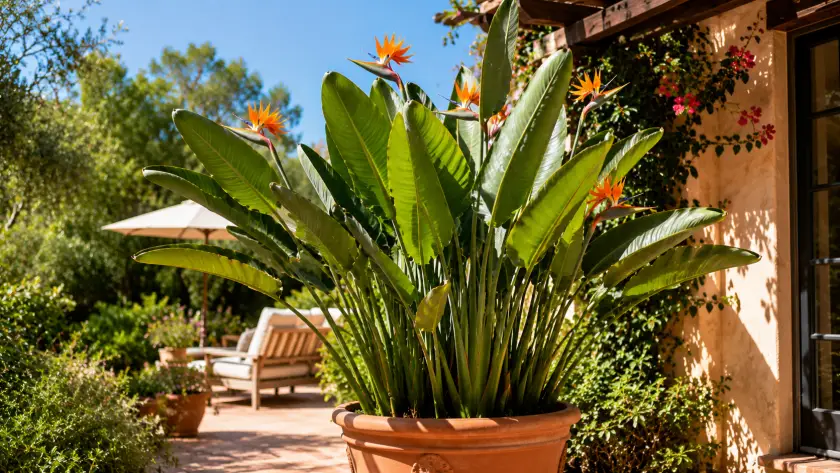
Bird of paradise care outdoor during summer months is the most impactful single management choice available for indoor-grown specimens — the combination of direct natural sunlight, outdoor humidity, and natural rainfall creates conditions that produce dramatically larger leaves, stronger stems, and significantly improved flowering prospects compared to year-round indoor growing.
How to care for a bird of paradise plant outdoors:
- Begin outdoor placement in a sheltered, partially shaded position in late spring after frost risk has passed
- Gradually increase sun exposure over 2–3 weeks to prevent leaf scorch on foliage adapted to indoor light levels
- Final outdoor position: maximum available sun — south or southwest-facing, unshaded for most of the day
- Water more frequently than indoors — outdoor air movement and direct sun dry the growing medium significantly faster
- Feed monthly during outdoor summer placement with balanced liquid fertilizer
How to care for bird of paradise flower production through outdoor placement:
- Outdoor summer placement combined with cool indoor winter rest is the most reliable combination for encouraging birds of paradise flower care in mature plants (3+ years old)
- Return indoors before the first autumn frost — typically September in UK and northern European climates
White bird of paradise care outdoor follows the same principles but benefits from some afternoon shade protection due to the larger, thinner leaf surface area that’s more susceptible to direct sun scorch in the hottest summer hours. Our best low-maintenance outdoor plants guide covers outdoor container growing principles that apply directly to bird of paradise summer placement.
Bird of Paradise Propagation
Bird of paradise plant care propagation is possible through division during spring repotting — separating established clumps at the root level into multiple sections, each with several leaves and an intact root section. Division is slow and careful work because bird of paradise roots are thick and brittle — forcing separation causes significant root damage that can take months to recover from.
Division propagation for bird of paradise plant care:
- Divide only during spring repotting when the plant genuinely needs a larger container
- Each division needs a minimum of 3–4 established leaves and a substantial root section
- Pot each division in appropriate well-draining mix and maintain in reduced light for 4–6 weeks while roots re-establish
- Expect 2–4 months before new growth resumes — division is stressful and recovery is slow
Important note on bird of paradise plant care propagation: Division resets the flowering timeline — a 4-year-old plant that has just begun producing flowers will need several more years to re-establish and flower again after division. If flowering is the goal, avoid dividing until absolutely necessary. Our complete propagation guide covers division techniques for large clumping tropicals in full detail.
How to Get Bird of Paradise to Flower
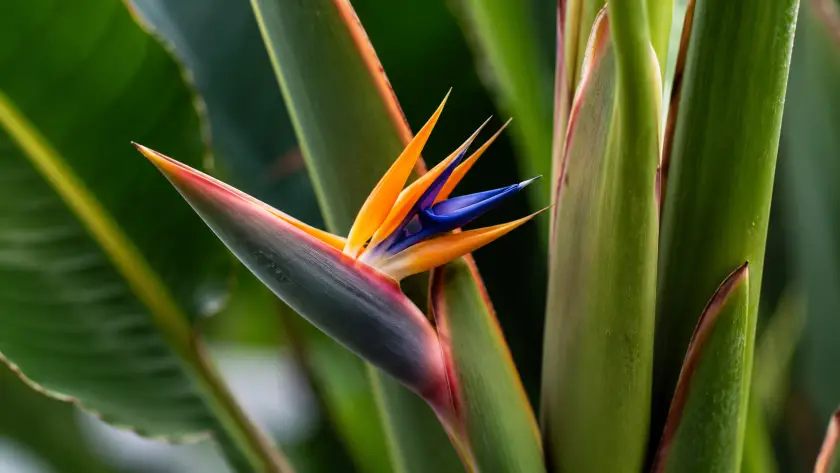
How to care for bird of paradise flower production is the most frequently asked question about this plant — and the honest answer is that it requires years of consistent optimal care rather than any single trick or technique.
Conditions required for birds of paradise flower care indoors:
Maturity: Most bird of paradise plants need 3–5 years of optimal care before flowering is physiologically possible. Newly purchased young plants will not flower regardless of care quality — patience through the maturation period is non-negotiable in any birds of paradise flower care strategy.
Maximum light: The single most impactful variable. A south-facing window with direct sun is the minimum for reliable flowering. Bird of paradise plant care in lower light positions produces beautiful foliage but rarely flowers.
Root-bound conditions: Do not repot unnecessarily — mildly root-bound plants flower significantly more reliably than those regularly moved into larger containers. This is the most commonly violated principle in bird of paradise plant care among enthusiastic growers who repot on schedule rather than need.
Cool winter rest: Allow temperatures to drop to 10–15°C during winter while reducing watering significantly. This temperature differential between summer growing conditions and winter rest is a key flowering trigger in bird of paradise care.
Years of consistent fertilizing: Monthly feeding during the growing season, every spring and summer for multiple years, builds the root system energy reserves that ultimately power flower production. Our fertilizing guide covers the feeding strategy that best supports long-term bird of paradise flower care goals.
Troubleshooting Common Bird of Paradise Plant Care Problems
Yellowing Leaves
Yellowing lower leaves in bird of paradise plant care most commonly indicate overwatering — check whether soil is consistently moist rather than drying between waterings. Multiple simultaneous yellowing leaves with soft stems indicates root rot requiring immediate intervention. Single occasional lower leaf yellowing is completely normal ageing — bird of paradise care includes regular lower leaf loss as new growth is prioritised. Our yellow leaves guide covers every yellowing scenario with exact diagnosis.
Splitting Leaves
Split leaves in bird of paradise plant care are entirely normal and not a sign of care problems — the characteristic fenestrations (splits) along the leaf margins are a deliberate evolutionary adaptation allowing wind to pass through the large leaf surface without snapping the stem. Occasional splitting is expected and healthy; excessive splitting beyond the natural leaf margin pattern indicates physical damage from low humidity or pest activity.
Brown Leaf Edges
Brown edges in bird of paradise plant care result from underwatering, low humidity, or fertilizer salt accumulation in the soil. Check soil moisture — if consistently dry, increase watering frequency. If humidity is below 40%, increase using our humidity hacks guide. Flush soil thoroughly with water every 3 months to remove salt buildup from regular fertilizing.
Not Flowering
The most common bird of paradise plant care frustration — a large, healthy, non-flowering plant despite years of care. Solutions in order of likely impact: move to maximum available direct light (most important), allow root-bound conditions to develop without repotting, implement a cool dry winter rest period (10–15°C, minimal watering), and continue consistent spring/summer fertilizing. If none of these apply, the plant may simply need more time — patience is the most honest answer in most bird of paradise care non-flowering situations.
Pests
Bird of paradise plant care pest problems are relatively rare but include scale insects (waxy brown bumps on stems and leaf undersides), mealybugs (white cottony clusters), and spider mites (fine webbing in dry conditions). Treat all pest types with neem oil solution applied weekly for 3–4 weeks. If your plant needs revival from severe decline, our revive a dying plant guide covers emergency intervention for bird of paradise plant care crises.
Pet Safety — Is Bird of Paradise Toxic?
Bird of paradise plant care in pet households requires caution — Strelitzia species are mildly toxic to cats and dogs according to the ASPCA, causing mild nausea, vomiting, and drowsiness if plant parts are ingested. The toxicity is considered mild rather than severe, but position bird of paradise plants out of reach of pets that chew foliage as a precaution.
For completely non-toxic large tropical alternatives that provide similar visual impact, our cat-friendly plants guide and dog-friendly plants guide cover safe large statement plant options including spider plant and boston fern for households where pet safety is a priority.
How to Style Bird of Paradise by Room
Bird of paradise plant care and display work best in positions that serve the plant’s maximum light requirements while allowing the architectural leaves to be appreciated from the angles that make them most visually impactful.
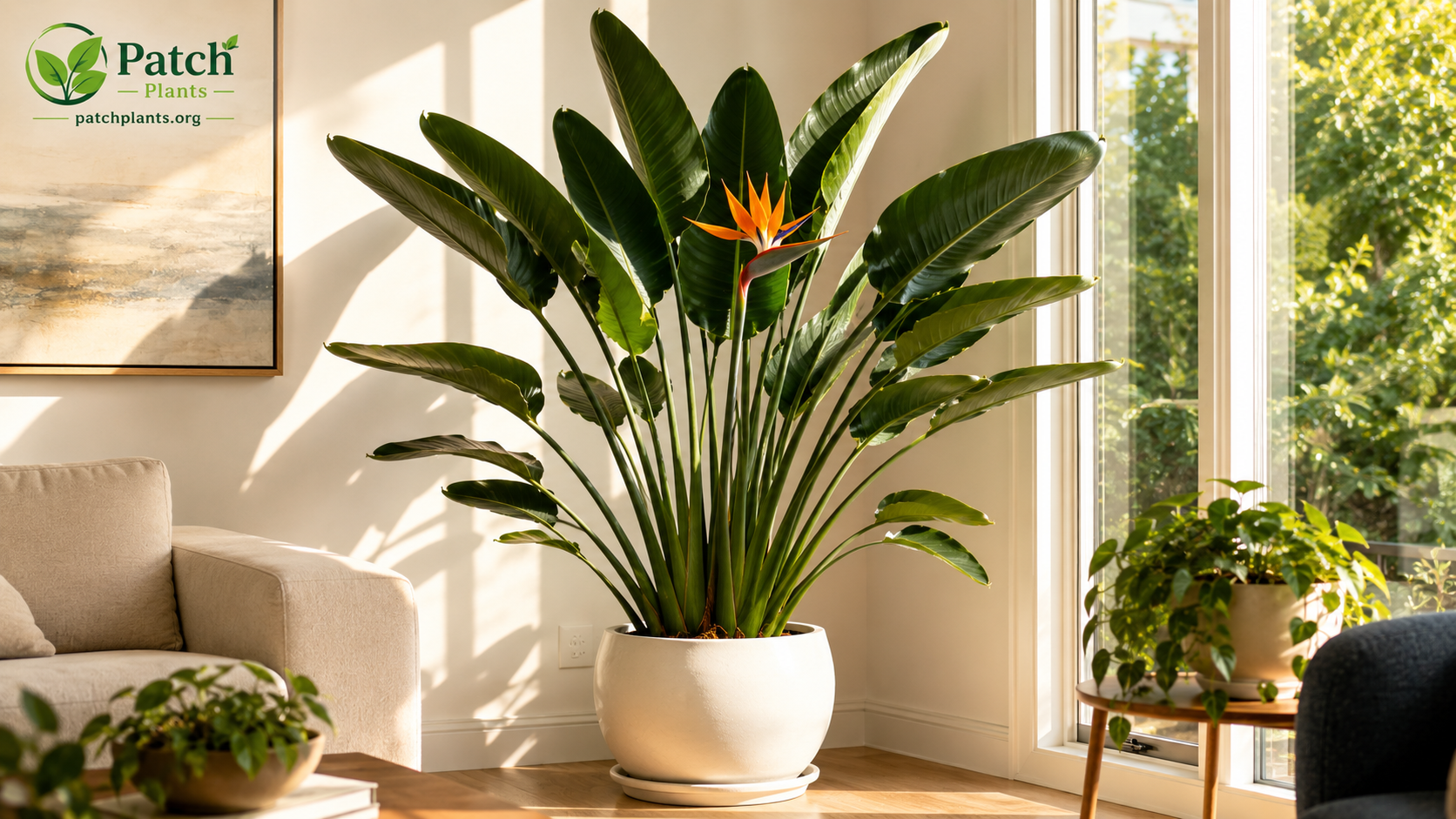
Living room statement corner: A large bird of paradise in a bright south-facing living room corner is among the most classically beautiful indoor plant displays available — the upright stems and enormous paddle leaves creating a genuinely tropical atmosphere. Pair with trailing companions like pothos at lower levels for layered depth, or with the architectural structure of snake plant for strong textural contrast. Our room-by-room styling guide covers complete bird of paradise positioning principles across every room type.
Home office: Bird of paradise plant care indoor in office environments is excellent — the plant’s upright structure doesn’t encroach on desk space while providing the biophilic benefits of large tropical foliage. See our office-friendly plants guide for how bird of paradise performs in artificially lit environments.
Bedroom: White bird of paradise care indoors in bedrooms creates a genuinely extraordinary sleeping space — the enormous leaves at head height create an enveloping tropical atmosphere that no other commonly available plant quite matches. See our bedroom plant decorating guide for exact positioning ideas.
For complementary foliage plants that pair beautifully with bird of paradise, calathea, monstera, and rubber plant all provide dramatic tropical texture in the spaces between large bird of paradise specimens.
Frequently Asked Questions
How do you care for a bird of paradise plant? Bird of paradise plant care requires maximum available direct or bright indirect light (south-facing window ideal), watering when the top 5cm of soil is completely dry (every 7–14 days in summer, every 3–4 weeks in winter), well-draining soil, temperatures above 10°C, and monthly fertilizing during the growing season. How to care for bird of paradise successfully is primarily about light — insufficient light is responsible for the vast majority of non-flowering and slow-growing bird of paradise plant care problems.
How do I get my bird of paradise to flower? How to care for bird of paradise flower production requires maturity (minimum 3–5 years of optimal care), maximum available direct sunlight, slightly root-bound conditions (avoid unnecessary repotting), a cool dry winter rest period (10–15°C, minimal watering), and consistent monthly fertilizing every growing season. Birds of paradise flower care is a long-term commitment — there are no shortcuts, but the extraordinary flowers that result from patient care make every year of bird of paradise plant care worthwhile.
How do I care for a white bird of paradise? White bird of paradise care (Strelitzia nicolai) follows the same fundamentals as standard bird of paradise plant care — bright light (tolerates slightly less direct sun than standard species), watering when the top 5cm is dry, warm temperatures, and monthly growing-season fertilizing. White bird of paradise care indoor is primarily focused on providing space for the plant’s dramatically larger ultimate size — ceiling height specimens are common in long-term white bird of paradise plant care indoors.
How do I care for bird of paradise outdoors? Bird of paradise care outdoor requires maximum available direct sun, good drainage, monthly feeding during summer, and vigilant watering during hot periods (daily may be necessary during heat waves). White bird of paradise care outdoor benefits from afternoon shade protection. Return all outdoor specimens indoors before overnight temperatures drop below 10°C. See our best low-maintenance outdoor plants guide for outdoor container care principles.
Are birds of paradise easy to care for? Are birds of paradise easy to care for? Yes — bird of paradise plant care is genuinely beginner-accessible given adequate light. The plant is drought-tolerant, pest-resistant, and forgiving of occasional care lapses. The only genuine difficulty is patience — waiting for the 3–5 years of optimal birds of paradise plant care required before flowering is possible. Our best indoor plants for beginners guide covers easier alternatives if large-scale patience isn’t practical.
Why are my bird of paradise leaves splitting? Leaf splits in bird of paradise plant care are completely normal and expected — they are a natural evolutionary adaptation, not a sign of care problems. The splits allow wind to pass through the large leaf surface without snapping the stem in the plant’s coastal South African habitat. Excessive splitting beyond natural leaf margin patterns may indicate physical damage from low humidity or pests, but standard splitting in bird of paradise care is healthy and desirable.
Is bird of paradise toxic to cats and dogs? Bird of paradise plant care in pet households requires mild caution — Strelitzia species are considered mildly toxic to cats and dogs by the ASPCA, causing mild digestive upset if plant parts are ingested. Position out of reach of pets that chew foliage. See our cat-friendly plants guide and dog-friendly plants guide for completely safe alternatives.
How often should I water bird of paradise? Water your bird of paradise plant every 7–14 days in spring and summer when the top 5cm of soil is completely dry, every 14–21 days in autumn, and every 3–4 weeks in winter. Bird of paradise plant care watering always follows a dry-between-waterings approach — overwatering is the leading cause of serious bird of paradise care decline and root rot. See our complete watering guide.
Related Guides
- 20 Oversized Indoor Plants
- Monstera Care Guide
- Fiddle Leaf Fig Care Guide
- Rubber Plant Care Guide
- Dracaena Care Guide
- Calathea Care Guide
- Peace Lily Care Guide
- Snake Plant Care Guide
- Pothos Care Guide
- Philodendron Care Guide
- ZZ Plant Care Guide
- Jade Plant Care Guide
- Money Tree Care Guide
- Aloe Vera Care Guide
- Boston Fern Care Guide
- Spider Plant Care Guide
- Colorful Foliage Indoor Plants
- Air Purifying Indoor Plants
- Best Indoor Plants for Beginners
- 35 Low Maintenance Plants
- Rare Houseplants Guide
- Complete Indoor Light Guide
- Complete Watering Guide
- Signs You’re Overwatering
- Humidity Hacks Guide
- Best Soil Mix Guide
- Fertilizing Indoor vs Outdoor
- How to Repot a Plant
- Repotting Mistakes to Avoid
- How to Propagate Houseplants
- Why Leaves Turn Yellow
- Leaf Curl Browning Droop Guide
- How to Revive a Dying Plant
- Cat Friendly Plants Guide
- Dog Friendly Plants Guide
- 33 Best Bathroom Plants
- Style Indoor Plants by Room
- Decorate Bedroom with Plants
- Office Friendly Plants Guide
- Best Low Maintenance Outdoor Plants
- Browse All Indoor Plants →
- Browse All Plant Care Guides →
Final Thoughts
Bird of paradise plant care is an exercise in the most rewarding kind of patience — the kind that builds something genuinely extraordinary over time. Those extraordinary orange and blue flowers, when they finally arrive after years of optimal birds of paradise plant care, are among the most spectacular sights available in indoor horticulture. But the journey to that moment — the steadily expanding leaf canopy, the increasingly architectural trunk, the growing sense of something magnificent taking shape — is itself deeply satisfying.
How to care for bird of paradise well is ultimately about providing the plant with conditions that remind it of coastal South Africa: maximum light, occasional thorough watering, warm growing seasons, and cool dry winters. Do those things consistently, resist the temptation to repot too frequently, and give it the years it needs — and bird of paradise plant care will reward you with one of the most dramatic, most beautiful, and most genuinely impressive houseplants it’s possible to grow.
Whether you’re growing standard Strelitzia reginae for its flowers, white bird of paradise for its extraordinary large-scale foliage, or giant bird of paradise for maximum architectural impact — the principles of bird of paradise plant care remain consistent. Light, patience, restraint with the watering can, and the quiet satisfaction of watching something grow magnificently over years of attentive, unhurried care.
According to the Royal Horticultural Society (RHS), Strelitzia reginae has received the RHS Award of Garden Merit — confirming its exceptional performance and reliability as a houseplant and conservatory specimen when provided with adequate light and frost-free winter conditions. 🌿