Key Takeaways
- Succulent care is built on one foundational principle that overrides every other consideration — succulents evolved in dry environments where water is scarce and drainage is fast, and the single most common cause of every succulent care failure is overwatering a plant that is biologically designed to survive without it.
- How to care for succulents starts with understanding the “soak and dry” watering method — water thoroughly until draining from the bottom, then allow the soil to dry completely before watering again, typically every 14–21 days in summer and once monthly in winter.
- Succulent plant care light requirements are the second most important care factor — most succulents need 4–6 hours of bright direct or indirect light daily, and insufficient light causes the etiolation (stretching toward the light source) that ruins the compact, dense form that makes succulents so visually appealing.
- Succulent care indoors presents one specific challenge that outdoor growing doesn’t — most indoor environments don’t provide the light intensity that succulents naturally receive, making south-facing windowsills or supplementary grow lights essential for maintaining the compact, richly coloured growth that defines healthy succulent plant care indoors.
- Succulent care outdoors produces the finest growth available — direct sun, excellent natural air circulation, and natural rainfall patterns that mimic the seasonal dry cycles succulents evolved with all contribute to the deepest colours, most compact forms, and healthiest root development of any succulent care environment.
- Echeveria succulent care — the most widely sold and most recognisable succulent genus — requires bright direct light, extremely well-draining gritty soil, and complete soil drying between waterings, with the rosette form needing particular attention to prevent water pooling in the central leaves which causes crown rot.
- Haworthia succulent care differs from most succulents in one critical respect — haworthia is genuinely shade-tolerant, making it the most suitable succulent for lower-light indoor positions where most other succulents would etiolate and fail.
- String of pearls succulent care is one of the most visually distinctive succulent care subjects — the trailing stems of spherical leaves require bright indirect rather than direct light, more frequent watering than most succulents, and hanging basket placement that allows the extraordinary cascading form to develop freely.
- Succulent care for beginners should start with the most forgiving genera — haworthia, aloe, and gasteria all tolerate lower light and occasional overwatering better than most succulents, providing the experience and confidence needed before progressing to more demanding varieties like echeveria and lithops.
- Are succulents easy to care for? In the right conditions — yes. When the most common mistake (overwatering) is avoided, succulent care is genuinely minimal-effort and extraordinarily rewarding, producing plants that grow more beautiful each year with less intervention than almost any other houseplant category.
Introduction
Succulents occupy a unique position in the plant world — they’re simultaneously among the most forgiving and the most mistreated houseplants available. Forgiving because they evolved in environments where drought, poor soil, and temperature extremes are normal conditions rather than exceptional ones. Mistreated because the same friendly accessibility that makes succulents so popular also leads most new owners toward the same fatal mistake: watering them too often, treating them like the tropical moisture-lovers that share their garden centre shelves.
Succulent care is genuinely simple once the evolutionary logic behind it is understood. These plants — from the familiar rosette-forming echeverias to the architectural haworthias, the trailing string of pearls, the architectural aloes, and the extraordinary stone-mimicking lithops — all developed in seasonally dry environments where water arrives infrequently but intensely, drains rapidly through porous rocky soils, and disappears completely between events. Every succulent care principle follows directly from this origin story. Gritty, fast-draining soil. Infrequent but thorough watering. Maximum light. And above all, restraint — the willingness to leave a plant alone when every instinct says it’s time to water again.
This complete succulent care guide covers every major variety, every care fundamental, and every common problem — from echeveria succulent care through haworthia succulent care, string of pearls succulent care, donkey tail succulent care, zebra plant care succulent, and every other variety you’re likely to encounter. Whether you’re starting your first collection or troubleshooting an established group of plants, this is the succulent care resource that covers everything you need. For more drought-tolerant plants that complement succulent collections beautifully, our 35 low-maintenance plants guide covers the complete range of water-wise indoor and outdoor plants.
What Are Succulents? Understanding the Biology Behind Succulent Care
The term ‘succulent’ refers to any plant that stores water in thickened, fleshy tissues — leaves, stems, or roots — as an adaptation to dry, arid environments where rainfall is unreliable. The word comes from the Latin succulentus (juicy), describing the water-swollen tissue that defines the family. This tissue storage is the physical mechanism that makes succulents drought-tolerant, and understanding it transforms how to care for succulents from a list of rules into intuitive sense.
When a succulent is watered, its fleshy tissues absorb and store that moisture. Between waterings, the plant draws on these reserves rather than requiring constant soil moisture — the same drought survival strategy that allows these plants to survive weeks or months without water in their native habitats. When the soil remains consistently moist (as it would for tropical houseplants), the succulent’s roots sit in anaerobic waterlogged conditions they never evolved to handle, rot develops, and the plant declines from precisely the care it doesn’t need.
Succulents originate from diverse habitats worldwide — the deserts of South Africa (Haworthia, Aloe, Gasteria, Lithops), Mexican highlands (Echeveria, Sedum, Graptopetalum), Mediterranean coastal regions (Aeonium), African savannah (Sansevieria, the snake plant), and the rainforests of Central America (Schlumbergera, the Christmas cactus). This geographic diversity explains the considerable variation in specific succulent care requirements across genera — what works for a desert echeveria differs meaningfully from what a forest-edge haworthia or a tropical Christmas cactus needs. Our aloe vera care guide, jade plant care guide, and string of pearls care guide cover those specific genera in complete detail.
Succulent Varieties — Care Guide by Type
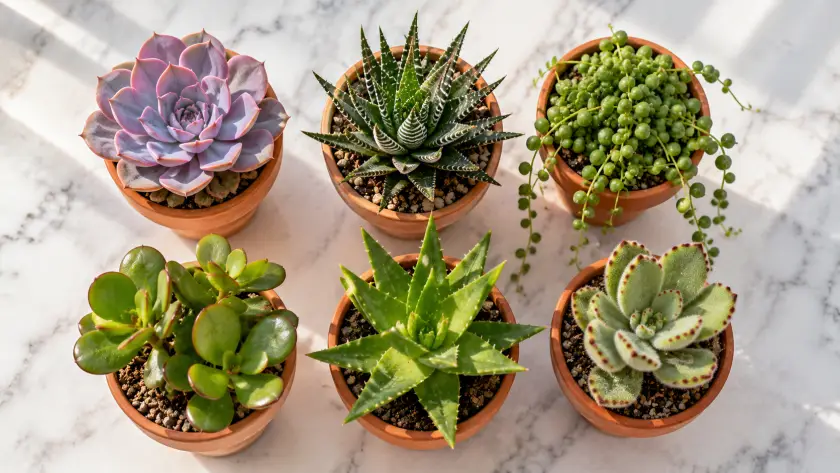
Echeveria — The Most Popular Succulent Care Subject
Echeveria succulent care covers the most widely sold and most recognisable succulent genus — those perfect rosettes of symmetrical, often pastel-coloured leaves in green, grey, blue, pink, and purple that define the popular image of succulents in modern interior design. Over 150 Echeveria species exist, all native to the semi-arid regions of Central America and Mexico.
Echeveria succulent care requirements: full to bright direct sun (minimum 4–6 hours daily), extremely well-draining gritty cactus mix, watering only when soil is bone dry (every 14–21 days in summer), complete drying between waterings in winter (monthly or less). The characteristic rosette form requires one specific care consideration — never water into the centre of the rosette, as standing water in the crown causes rot that destroys the central growing point. Water the soil only, never the plant itself. The best colours in echeveria — the pink blushes, purple edges, and silvery-blue tones — develop most intensively in bright direct sun and under the mild stress of slightly constrained root space.
Haworthia — Best Succulent for Low Light Indoor Care
Haworthia succulent care covers one of the most genuinely shade-tolerant succulents available — small, architectural plants producing rosettes of thick, often translucent or striped leaves that evolved in the dappled shade of rocks and larger plants in South African scrubland. This shade tolerance makes haworthia the single best succulent care recommendation for lower-light indoor environments where most other succulents would fail.
Haworthia succulent care differs from most succulents in its light requirements — bright indirect light rather than full direct sun, tolerating north-facing windowsills that would cause echeveria to etiolate immediately. Taking care of succulents in the haworthia genus is among the most forgiving succulent care available — these compact plants grow slowly, require watering every 2–4 weeks in summer, and tolerate occasional overwatering better than most succulents. The zebra plant care succulent (Haworthia fasciata) — the most popular haworthia variety with distinctive white horizontal bands — follows the same care principles as standard haworthia.
String of Pearls — Trailing Succulent Care
String of pearls succulent care covers Senecio rowleyanus — one of the most visually extraordinary succulents available, producing trailing stems covered in spherical, pea-sized leaves that are genuinely unmistakable. Native to the semi-arid regions of southwest Africa, string of pearls grows along the ground in its natural habitat, rooting at nodes along the trail, which explains its remarkable suitability for hanging baskets where the stems can cascade freely.
String of pearls succulent care differs from most succulents in several important ways — it prefers bright indirect rather than full direct sun (direct afternoon sun scorches the delicate spherical leaves), needs slightly more frequent watering than most succulents (the small leaf surface area means less water storage capacity), and requires a hanging position where air circulates freely around the cascading stems. Our complete string of pearls care guide covers every specific requirement in full detail.
Donkey Tail — Sedum Morganianum Care
Donkey tail succulent care (Sedum morganianum) covers another exceptional trailing succulent — overlapping, plump blue-green leaves packed densely along hanging stems that reach 60–90cm in length over several years of good care. Donkey tail succulent care requires the same fundamental approach as most succulent care but with one important note — the leaves attach very loosely to the stems and fall at the slightest touch. Handle donkey tail as little as possible and position where it won’t be brushed by passing hands.
Jade Succulent — Crassula Ovata Care
Jade succulent care (Crassula ovata) covers one of the most widely grown and longest-lived succulents available — a slow-growing, shrubby plant that develops a thick, woody trunk with age, ultimately resembling a small tree and reportedly living for decades with correct succulent care. Our complete jade plant care guide covers all aspects of jade succulent care in full detail.
Bear Paw Succulent — Cotyledon Tomentosa Care
Bear paw succulent care (Cotyledon tomentosa) covers one of the most characterful succulents available — chunky, fuzzy leaves with distinctive tooth-like bumps at the tip that give the plant its common name. Bear paw succulent care requires bright direct light, careful watering that avoids the fuzzy leaf surfaces (wet fuzz traps moisture and promotes rot), and well-draining gritty soil. The fuzzy coating burns easily in very intense direct afternoon sun — provide bright morning sun with afternoon protection.
Split Rock Succulent — Pleiospilos Nelii Care
Split rock succulent care (Pleiospilos nelii) covers one of the most unusual succulents available — a mimicry plant native to South Africa that resembles a stone split down the middle. Split rock succulent care is among the most demanding succulent types — it requires very infrequent watering (once monthly even in summer, completely dry in winter), full direct sun, and mineral-rich gritty soil. New leaf pairs emerge annually, splitting through the old leaves which wither as the new pair develops — never water during this transition or the old leaves will not dry correctly.
Complete Succulent Care Fundamentals
Light — The Most Important Succulent Care Factor
Succulent care light requirements determine the plant’s form, colour, and long-term health more than any other factor. Understanding succulent care light means understanding etiolation — the stretching, elongating growth that occurs when a succulent doesn’t receive adequate light. An etiolated succulent produces widely-spaced, pale, soft leaves on elongated stems reaching toward any available light source. This is irreversible — once the stem has stretched, it remains stretched — and the only solution is propagating healthy new growth from the etiolated specimen.
Light requirements for succulent care:
- Ideal: 4–6 hours of bright direct or very bright indirect light daily
- Succulents in full direct sun: Echeveria, aloe, sedum, crassula — these are genuine sun-lovers
- Succulents tolerating indirect light: Haworthia, gasteria, aloe vera — lower-light tolerant exceptions
- Minimum: 3–4 hours bright indirect — succulents survive but won’t display their best colours or compact form
Succulent plant care indoor light strategy:
- South-facing windowsill: Best available indoor position for most succulent care
- East-facing: Adequate for many varieties — morning sun without scorching afternoon intensity
- West-facing: Afternoon sun — adequate but monitor for scorch in summer
- North-facing: Sufficient only for haworthia and gasteria — most succulents etiolate rapidly
Signs your succulent needs more light:
- Stems stretching toward the light source — etiolation
- Leaves paling from their characteristic colours — green fading from blue-green, pink fading from red
- Leaves spacing widely apart on the stem rather than remaining compact
- Plant leaning strongly in one direction — rotate quarterly to encourage even growth
Succulent care outdoors light: Direct outdoor sun — even UK summer sun — is generally suitable for most succulents. Gradually acclimatise plants moved from indoor to outdoor positions over 2 weeks to prevent sun scorch on tissues adapted to lower indoor light intensities. Our complete indoor light guide covers how to assess and maximise light for succulent care in every room type.
Watering — The Soak and Dry Method for Succulent Care
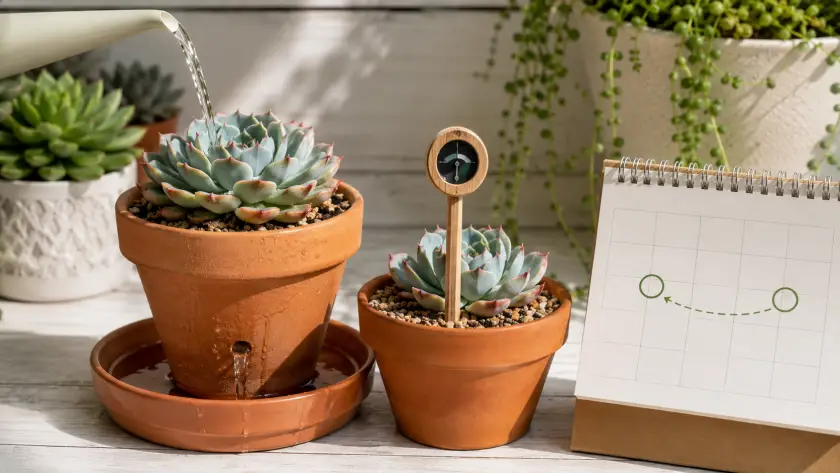
How to care for succulents in terms of watering is the single most important skill in the entire succulent care system — and the most commonly misapplied. The fundamental principle is “soak and dry” — water thoroughly (soak), then wait until the soil is completely dry before watering again (dry). This replicates the seasonal rainfall patterns of succulent native habitats where intense rain is followed by extended dry periods.
Soak and dry watering for succulent care — step by step:
- Check before watering: Insert a finger or wooden skewer 3–5cm into the soil — water only when completely dry at this depth. Never water if any moisture is detectable.
- Water thoroughly: Water slowly until it drains freely from drainage holes. This wets the entire root zone, encouraging roots to grow downward rather than remaining shallow near the surface.
- Empty the saucer: Remove all standing water from the saucer within 15 minutes — succulents should never sit in water.
- Wait: Allow the soil to dry completely before the next watering — this takes longer than most owners expect.
How often to water succulents — seasonal guide:
- Spring and summer (growing season): Every 14–21 days for most varieties when kept indoors; every 7–14 days in very bright outdoor positions during hot weather
- Autumn: Every 3–4 weeks as growth slows
- Winter: Once monthly or even less — many succulents are semi-dormant and need minimal water during lower-light months. How to care for succulents indoors in winter is primarily about restraint.
Signs of overwatering in succulent care:
- Leaves becoming translucent, mushy, or falling off easily when touched
- Stem soft or mushy at soil level
- Soil remaining wet for more than 2 weeks after watering
- Yellow, waterlogged leaves drooping rather than remaining firm
Signs of underwatering in succulent care:
- Leaves developing wrinkles, particularly near the stem
- Leaves becoming thin and flat rather than plump and turgid
- Bottom leaves shrivelling and drying — this is often normal ageing but accelerated underwatering
How to care for succulents after overwatering recovery: Unpot immediately, remove mushy roots, allow to dry for 24–48 hours, then repot in fresh dry gritty mix. Withhold water for one week after repotting. Our signs of overwatering guide and revive a dying plant guide cover complete succulent care recovery protocols.
Soil — The Most Critical Succulent Care Infrastructure
Succulent care soil is non-negotiable — standard potting compost retains far too much moisture for succulent roots, creating the waterlogged conditions that cause root rot regardless of correct watering frequency. Even perfectly timed watering in the wrong soil kills succulents.
Ideal succulent care soil mix:
- 50% coarse gritty material (perlite, coarse sand, fine gravel, or pumice)
- 50% quality potting compost or cactus mix base
Commercial options for succulent plant care:
- Cactus and succulent mix — widely available, appropriate structure for most succulent care
- Standard potting compost amended with 40–50% perlite — effective DIY option
What to avoid in succulent care soil:
- Pure standard potting compost — retains too much moisture
- Fine sand — compacts when wet and worsens drainage rather than improving it
- Moisture-retentive mixes designed for tropical plants
Our best soil mix guide covers exact succulent care soil compositions for every variety type.
Pots and Drainage for Succulent Care
Succulent care container selection has one absolute rule — drainage holes are mandatory. No drainage hole means no successful long-term succulent care, regardless of how carefully watering is managed. Terracotta pots are particularly well-suited to succulent care — the porous walls allow moisture to evaporate through the pot sides, increasing the drying rate between waterings and actively supporting the dry conditions succulents need.
Container choices for succulent plant care:
- Terracotta: Best for most succulent care — porous, breathable, aesthetically complementary
- Ceramic glazed: Adequate if drainage holes are present — dries more slowly than terracotta
- Plastic: Functional but retains moisture longest — requires most careful watering restraint
- Avoid: Glass containers, decorative pots without drainage, and any vessel where water cannot drain freely
Temperature and Humidity for Succulent Care
Succulent care temperature requirements are broad — most varieties tolerate the standard home temperature range of 16–24°C comfortably. The critical temperature boundary is frost — most succulents have no frost tolerance and suffer permanent damage below 0°C. Some hardier varieties (Sempervivum, Sedum, certain Agave) tolerate freezing temperatures, but indoor varieties should always be protected from frost.
Succulent care outdoors in winter: Bring all frost-tender succulents inside before the first frost — typically October in UK climates. Provide maximum available indoor light during winter and reduce watering significantly.
Humidity for succulent care: Low to moderate humidity suits all succulents — the naturally lower humidity of most homes (30–50%) is appropriate and reduces the risk of fungal issues that can affect succulents in high-humidity environments. Unlike most tropical houseplants, succulents do not benefit from humidifiers or misting.
Fertilizing Succulents
Succulent care fertilizing is minimal compared to most houseplants — succulents evolved in nutrient-poor soils and don’t require heavy feeding. Over-fertilizing encourages rapid, weak growth that compromises the compact form and pest resistance that define healthy succulent care.
Feeding schedule for succulent plant care:
- Spring and summer: Every 4–6 weeks with cactus and succulent liquid fertilizer (low nitrogen, higher phosphorus/potassium) at half the recommended strength
- Autumn: Stop as growth slows
- Winter: No feeding — succulents are semi-dormant
Our fertilizing indoor vs outdoor plants guide covers succulent care feeding schedules alongside every other plant type.
Repotting Succulents
Succulent care repotting is needed every 2–3 years when roots emerge from drainage holes or the plant outgrows its container. Spring is the optimal repotting time for most succulent care subjects.
How to take care of succulents during repotting:
- Allow soil to dry completely before repotting — dry roots are easier to handle and less susceptible to damage
- Choose a pot only slightly larger — 2–3cm diameter increase maximum
- Use fresh, dry gritty succulent mix
- Wait 7–10 days before the first post-repotting watering to allow any damaged root tips to callous
Our how to repot a plant guide and repotting mistakes guide cover every step in detail.
Succulent Care Outdoors
Succulent care outdoors produces genuinely superior results to indoor growing for most varieties — the combination of direct natural sun, excellent air circulation, and natural rainfall patterns that mimic seasonal dry cycles creates the conditions where succulents express their full potential in colour, compactness, and vigour.
How to care for succulents outdoors:
- Position in full sun — south or southwest-facing positions
- Ensure perfect drainage — raised beds, gravel gardens, and container growing all provide the excellent drainage outdoor succulent care requires
- Water only during dry spells in summer — natural rainfall is typically sufficient for most outdoor succulent care in UK climates
- Monitor for slugs — outdoor succulents are more vulnerable to slug damage than indoor specimens
- Return frost-tender varieties inside by October
Succulent care outdoors in summer: Gradually acclimatise indoor-grown succulents to outdoor direct sun over 2 weeks before full outdoor placement — even in the UK, moving from low-light indoor positions to direct outdoor sun causes leaf scorch without gradual adjustment. Start in dappled shade, progressing to full sun over 10–14 days. Our best low-maintenance outdoor plants guide covers outdoor container succulent growing in detail.
Succulent Propagation
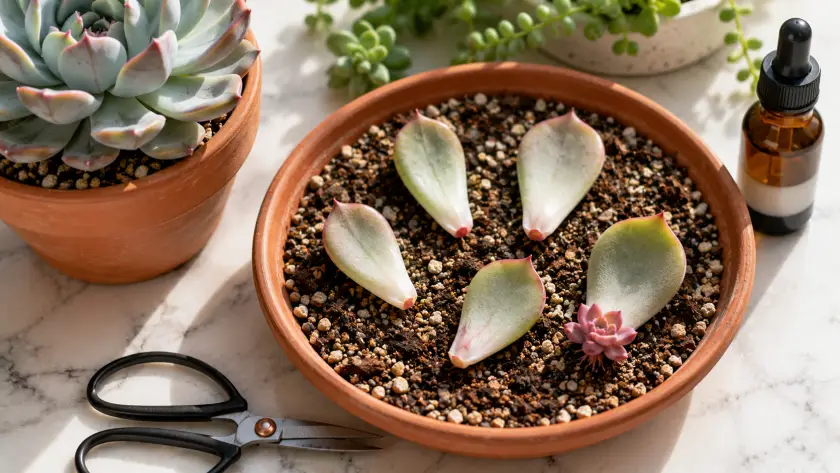
Succulent care propagation is one of the most rewarding aspects of growing these plants — most varieties propagate remarkably easily through leaf cuttings, stem cuttings, or offsets, making collection building from a single parent plant entirely achievable.
Leaf propagation for succulent care:
- Gently twist a healthy, plump leaf from the stem — it must come away cleanly with the base intact
- Lay on dry cactus mix — not inserted into the soil, simply laying on the surface
- Place in bright indirect light — no direct sun on unrooted leaf cuttings
- Mist very lightly every 3–4 days — just enough to prevent complete desiccation
- Tiny rosettes emerge from the leaf base over 4–8 weeks
- The parent leaf shrivels as it feeds the new plant — completely normal succulent care process
Stem cutting propagation for succulent care:
- Cut a healthy stem with several nodes using clean sterile scissors
- Allow the cut end to callous on a dry surface for 24–48 hours — this step is non-negotiable for succulent care propagation success
- Insert calloused end into dry cactus mix
- Wait 1 week before the first light watering
Offset propagation: Many succulents produce offsets — miniature plants at the base of the parent — that can be separated and potted individually once they reach a third of the parent plant’s size. Our complete propagation guide covers every succulent care propagation method in full detail.
Pet Safety — Are Succulents Toxic?
Succulent care pet safety varies significantly across the genus — some succulents are completely safe for cats and dogs, while others carry genuine toxicity concerns.
✅ Pet-safe succulents:
- Haworthia — completely non-toxic
- Echeveria — non-toxic to cats and dogs
- Sedum — generally safe in normal quantities
⚠️ Toxic succulents:
- Aloe vera — mildly toxic to cats and dogs (causes digestive upset)
- Jade plant (Crassula ovata) — toxic to cats and dogs
- String of pearls (Senecio rowleyanus) — toxic to cats and dogs
Our cat-friendly plants guide and dog-friendly plants guide cover pet safety across all succulent varieties in detail.
Troubleshooting Common Succulent Care Problems
Etiolation — Stretching Toward Light
The most common succulent care problem in indoor growing — stems elongating with widely-spaced, pale leaves reaching toward the light source. Move immediately to the brightest available position. The stretched portion cannot be undone — propagate the healthy top as a cutting to start a compact new plant. Our complete indoor light guide covers repositioning strategies for etiolated succulents.
Mushy Leaves and Stems
Overwatering causing root rot — the most serious succulent care emergency. Unpot immediately, remove all mushy roots and tissue, dry for 24–48 hours, then repot in fresh dry gritty mix. See our revive a dying plant guide.
Wrinkled Leaves
Underwatering — water thoroughly using the soak and dry method and the plant recovers within days. If leaves remain wrinkled after correct watering, check for root damage that’s preventing water uptake. Our signs of overwatering guide covers distinguishing between overwatering and underwatering symptoms.
Losing Colour
Succulent care colour loss — the vibrant reds, purples, and pinks that define many succulents develop most intensively in bright direct light and under mild stress from temperature fluctuations and slightly constrained root space. In lower light, most succulents fade to plain green. Move to a brighter position for colour recovery over 4–6 weeks. Our complete indoor light guide covers light optimisation for coloured succulents.
Yellow Leaves
Yellow leaves in succulent care indicate overwatering (most common), insufficient light (overall yellowing), or natural ageing of lower leaves (occasional single leaf yellowing, normal). Diagnose by checking soil moisture first. Our yellow leaves guide covers every yellowing scenario.
Pests
Succulent care pest problems include mealybugs (white cottony clusters in leaf joints — the most common succulent pest), scale insects, and fungus gnats (in overwatered soil). Treat mealybugs with 70% isopropyl alcohol applied with a cotton bud directly to the insects, then neem oil spray weekly for 3 weeks. Isolate immediately to prevent spread to other succulents. See our leaf curl browning and droop guide for additional pest identification guidance.
How to Style Succulents by Room
Succulent care and display work best when light requirements are met — styling decisions that compromise light access compromise plant health. Within that constraint, succulents are among the most versatile styling plants available.
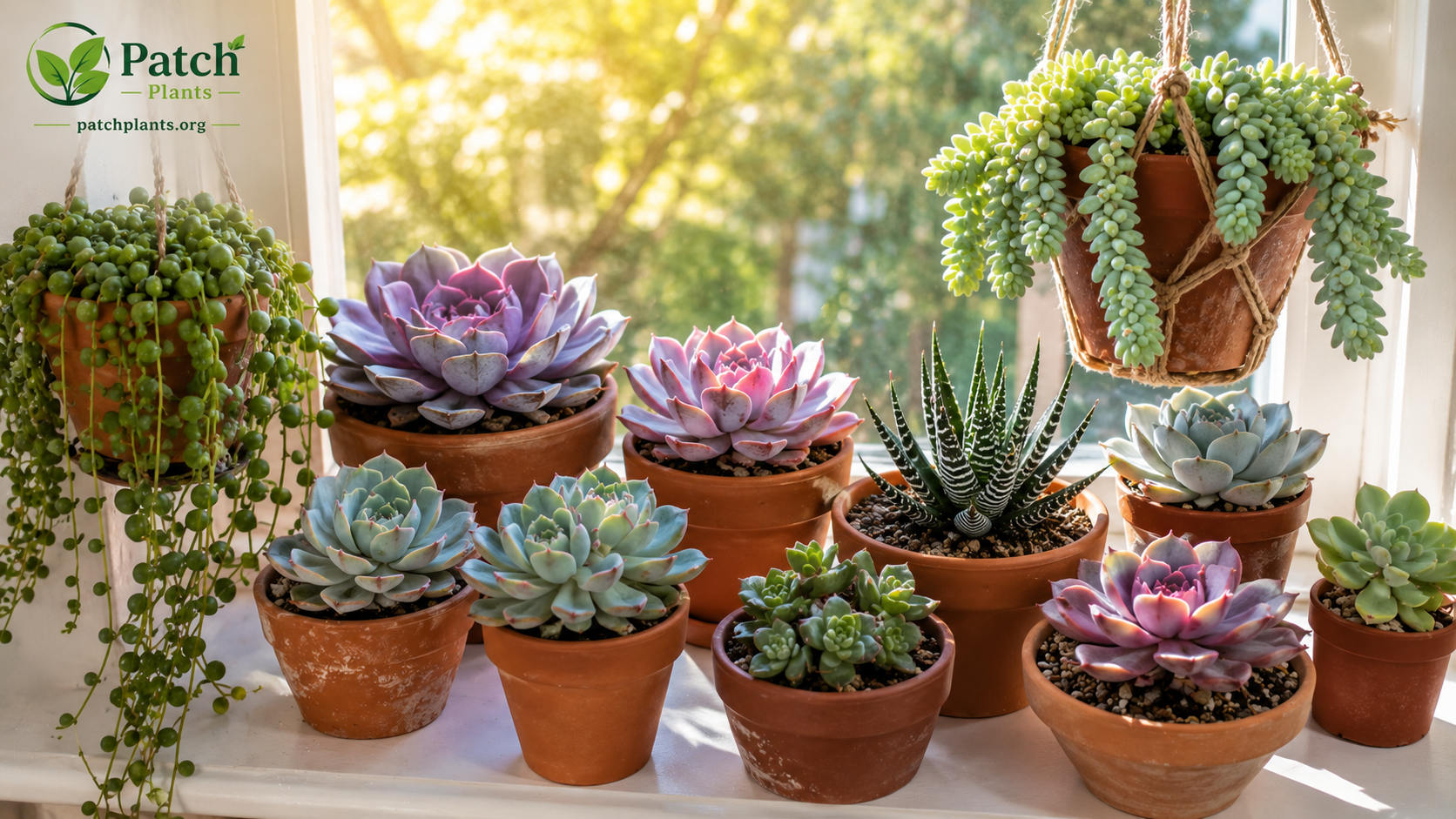
South-facing windowsill displays: The classic succulent care display environment — groups of different echeveria varieties in terracotta pots creating a varied colour and form collection that changes as light shifts through the day. See our room-by-room styling guide for specific room positioning guidance.
Hanging displays: String of pearls and donkey tail in hanging baskets near bright windows — the trailing forms are best appreciated from below, making hanging placement the optimal display method for these varieties. Our low-light hanging plants guide covers hanging succulent display principles.
Office and desk displays: Haworthia and small echeveria varieties are ideal succulent care choices for desk displays — compact, slow-growing, and tolerant of the lower light levels typical of office environments. See our office-friendly plants guide for office-specific succulent care positioning.
Bedroom displays: Small succulent arrangements near bright bedroom windows create low-maintenance, visually striking bedside and dresser displays. Our bedroom plant decorating guide covers bedroom succulent styling in detail.
For complementary non-succulent plants that pair beautifully with succulent displays, snake plant, ZZ plant, and air-purifying plants all share similar drought-tolerant care requirements while providing contrasting textures and forms.
Frequently Asked Questions
How do you care for succulents? Succulent care requires bright direct or indirect light (4–6 hours minimum daily), watering only when soil is completely dry using the soak and dry method (every 14–21 days in summer, monthly in winter), gritty well-draining cactus soil, drainage holes in all containers, and temperatures above 0°C. The most important rule in how to care for succulents is water less than feels natural — overwatering kills more succulents than any other cause.
How often should I water succulents? How to take care of succulents in terms of watering: every 14–21 days in spring and summer when soil is bone dry, every 3–4 weeks in autumn, and once monthly or less in winter. Always check soil moisture before watering rather than following a fixed schedule — succulent care watering varies with light level, pot size, and seasonal temperature. See our complete watering guide.
Are succulents easy to care for? Are succulents easy to care for? Yes — once overwatering is avoided. Succulent care requires minimal intervention and is genuinely more forgiving of underwatering than most houseplants. The most common mistake is treating succulents like moisture-loving tropical plants — avoiding this single error makes how to care for a succulent plant genuinely straightforward. See our best indoor plants for beginners guide for succulent care for beginners recommendations.
How do I care for succulents indoors? How to care for succulents indoors requires the brightest available position — ideally a south-facing windowsill providing direct sun — well-draining cactus soil, terracotta pots for optimal moisture management, and restrained watering (every 14–21 days in summer, monthly in winter). The most challenging aspect of succulent plant care indoor is providing adequate light — grow lights are valuable supplements in darker homes. See our indoor light guide.
How do I care for succulents outdoors? Succulent care outdoors requires full direct sun positioning (south or southwest-facing), excellent drainage, minimal supplementary watering in UK climates (natural rainfall is typically sufficient), and bringing frost-tender varieties inside before the first autumn frost. How to care for succulents outdoors in summer includes gradually acclimatising indoor-grown plants to direct sun over 2 weeks before full outdoor placement.
Why is my succulent stretching? Stretching (etiolation) in succulent care indicates insufficient light — the plant is reaching toward the light source. Move to a brighter position immediately. The stretched portion is permanent — propagate the healthy top as a cutting to start a new compact plant. This is the most common succulent care indoor problem and is entirely preventable with adequate light positioning from the start.
How do I propagate succulents? Succulent care propagation is straightforward — twist a healthy leaf cleanly from the stem, lay on dry cactus mix, and mist very lightly every few days until tiny rosettes emerge from the base over 4–8 weeks. For stem cuttings, allow the cut end to callous for 24–48 hours before inserting into dry cactus mix. See our complete propagation guide.
Why is my succulent losing its colour? Colour loss in succulent care — fading reds, purples, and pinks — results from insufficient light. The stress pigments (anthocyanins) that create vibrant succulent colours develop most intensely in bright direct light. Move to a brighter position for colour recovery over 4–6 weeks. Some varieties also develop better colour with slight temperature fluctuations between day and night — outdoor summer placement often produces the most intensely coloured succulent care results.
Related Guides
- String of Pearls Care Guide
- Aloe Vera Care Guide
- Jade Plant Care Guide
- Christmas Cactus Care Guide
- Snake Plant Care Guide
- ZZ Plant Care Guide
- Pothos Care Guide
- Monstera Care Guide
- Philodendron Care Guide
- Dracaena Care Guide
- Rubber Plant Care Guide
- Calathea Care Guide
- Spider Plant Care Guide
- Boston Fern Care Guide
- Bird of Paradise Care Guide
- Money Tree Care Guide
- Peace Lily Care Guide
- 35 Low Maintenance Plants
- Best Indoor Plants for Beginners
- Rare Houseplants Guide
- Colorful Foliage Indoor Plants
- Air Purifying Indoor Plants
- Low Light Hanging Plants
- 33 Best Bathroom Plants
- Complete Indoor Light Guide
- Complete Watering Guide
- Signs You’re Overwatering
- Best Soil Mix Guide
- Fertilizing Indoor vs Outdoor
- How to Repot a Plant
- Repotting Mistakes to Avoid
- How to Propagate Houseplants
- Why Leaves Turn Yellow
- Leaf Curl Browning Droop Guide
- How to Revive a Dying Plant
- Cat Friendly Plants Guide
- Dog Friendly Plants Guide
- Style Indoor Plants by Room
- Decorate Bedroom with Plants
- Office Friendly Plants Guide
- Best Low Maintenance Outdoor Plants
- Browse All Indoor Plants →
- Browse All Plant Care Guides →
Final Thoughts
Succulent care rewards a particular kind of restraint — the willingness to water less than instinct suggests, to provide more light than seems necessary, and to trust that a plant evolved for drought and sun knows how to handle the conditions it evolved for. The enormous diversity of the succulent world — from the perfect geometric rosettes of echeveria to the architectural columns of haworthia, the extraordinary spheres of string of pearls, and the stone-mimicking surrealism of lithops — all becomes accessible once the fundamental succulent care principles are understood and applied consistently.
How to care for succulents is ultimately about respecting their nature rather than projecting the moisture-loving care that works for tropical houseplants onto plants that evolved in precisely the opposite conditions. Bright sun. Gritty soil. Infrequent, thorough watering. And patience — because the most beautiful succulents are those that have grown slowly and consistently over years of correct succulent care, developing the compact forms, intense colours, and architectural presence that only time and appropriate conditions can produce.
According to the Royal Horticultural Society (RHS), succulents represent one of the fastest-growing categories in UK houseplant sales and garden design, with their drought tolerance, architectural diversity, and extraordinary range of forms making them among the most recommended plants for both experienced collectors and complete beginners approaching succulent care for the first time. 🌵