Key Takeaways
- How to propagate houseplants successfully comes down to five methods: stem cuttings in water, stem cuttings in soil, leaf cuttings, division, and offsets — each suited to specific plant types, and each achievable at home with minimal equipment beyond clean scissors and patience.
- Houseplant propagation is most reliable during spring and early summer when plants are in active growth — attempting propagation during winter produces significantly slower results or complete failure in most species, as plant biology is oriented toward rest rather than new growth during colder months.
- Propagating houseplants in water is the most beginner-friendly method — you can watch roots develop through a clear glass jar, confirm successful rooting before committing to soil, and the visual progress makes it genuinely motivating to continue through the weeks of waiting.
- The easiest houseplants to propagate include pothos, spider plant, snake plant, philodendron, and tradescantia — all rooting reliably from stem or leaf cuttings with minimal intervention, making them ideal starting points for anyone new to houseplant propagation.
- Best houseplants to propagate in water include pothos, philodendron, monstera, coleus, and tradescantia — all developing strong, visible roots within 1–3 weeks when stem cuttings are placed in a clear container in bright indirect light with water changed every 3–4 days.
- Clean tools are not optional in plant propagation methods — dirty or blunt scissors introduce bacteria to the cut surface that cause rotting before roots develop, and this single factor accounts for a significant proportion of propagation failures that beginners attribute to other causes.
- Propagating houseplants from cuttings requires callousing — allowing the cut end to dry for 30 minutes to several hours before placing in water or soil — particularly for succulents and cacti, where wet cut surfaces in contact with moist growing medium almost always cause rot.
- The best time to propagate houseplants is late spring through early summer — but any time the parent plant is visibly healthy, actively producing new leaves, and not under stress from recent repotting, pest treatment, or environmental change provides a viable propagation window.
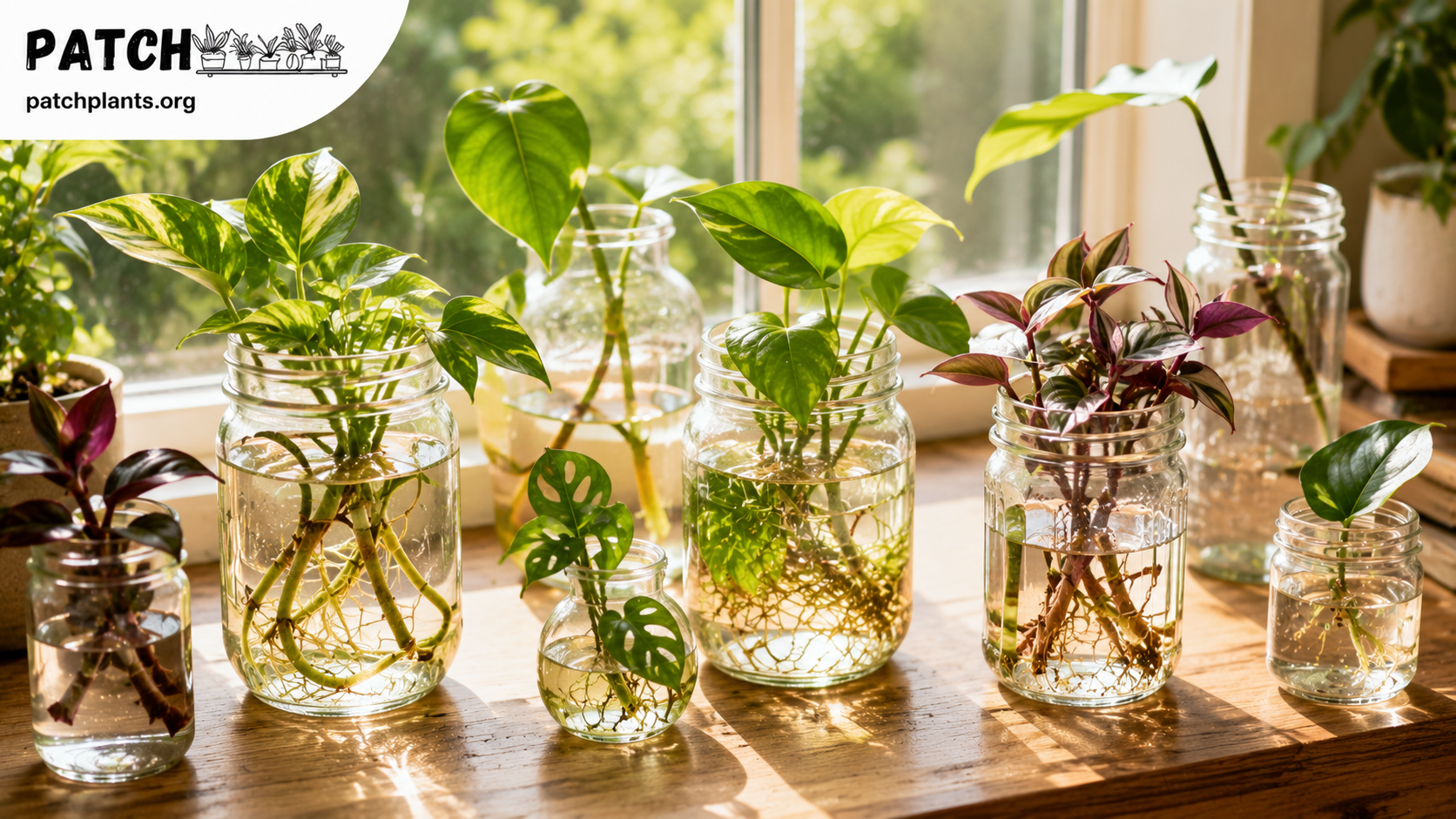
- Houseplant propagation station setups — dedicated windowsill areas with grouped propagation vessels, uniform lighting, and consistent temperature — significantly improve success rates by maintaining the stable warm conditions that cuttings need during the vulnerable pre-rooting period.
- How to propagate houseplants rewards patience above all — the urge to check for roots constantly, tug at stems to test resistance, or move cuttings to new positions disrupts the fragile early root development that determines success, and leaving cuttings undisturbed in a stable environment for the full expected rooting period is the single most impactful habit experienced propagators develop.
Introduction
One of the most genuinely satisfying moments in plant ownership happens not when you buy a plant, but when you successfully grow a new one from a piece of an existing one. A small glass jar on the windowsill, a stem cutting with a few leaves floating at the surface, and three weeks later — white roots spiralling through the water, reaching downward with unmistakable intention. It costs nothing, requires no specialist equipment, and produces something that feels, with complete justification, like a minor miracle.
How to propagate houseplants is one of the most searched plant care topics online, and for good reason — it represents the point at which plant ownership moves from passive enjoyment to active participation. You stop being someone who keeps plants alive and start being someone who creates plants from existing ones, sharing cuttings with friends, filling empty shelves with new specimens, and building a collection that reflects your own knowledge and effort rather than your budget.
This complete houseplant propagation guide covers every method in full detail — from the simplest water propagation for pothos beginners through to division techniques for large tropical specimens — with step-by-step instructions, timing guidance, troubleshooting for the most common failures, and specific advice for the plants most frequently propagated at home. Whether you’re attempting your first pothos cutting or planning a houseplant propagation station for a serious growing operation, everything you need is here. For more guidance on caring for newly propagated plants once they’re established, our best soil mix guide covers the exact soil compositions that support healthy root development in every plant type.
Why Propagate Houseplants?
Before covering methods, it’s worth pausing on the question of why. Propagating houseplants offers several distinct benefits that go beyond the simple satisfaction of the process itself.
Cost: A single pothos or philodendron cutting placed in water costs nothing beyond the glass jar it sits in, and produces a fully rooted plant indistinguishable from a purchased specimen within 3–6 weeks. Rare and expensive plants — variegated monsteras, unusual hoyas, rare calatheas — can be multiplied from a single purchased specimen over time, eliminating the need to buy multiple expensive plants.
Collection building: Propagating houseplants allows a collection to grow organically rather than commercially — filled with plants that have personal histories, received as cuttings from friends, grown from pieces of plants with sentimental significance, or simply multiplied from a favourite specimen.
Sharing: Propagated plants make genuinely meaningful gifts — particularly for plant-loving friends who understand that a rooted cutting represents real time, attention, and care rather than a transaction. Our indoor plant gift guide covers how propagated plants pair beautifully with fragrant varieties as thoughtful combined gifts.
Plant health: Propagation also serves a practical purpose in maintaining plant health — overgrown plants can be divided to give each section more resources, leggy plants can be cut back and the healthy tops propagated into compact new specimens, and plants showing early signs of decline can be propagated before the problem becomes irreversible.
The 5 Main Houseplant Propagation Methods
Method 1: Stem Cuttings in Water — Best for Beginners
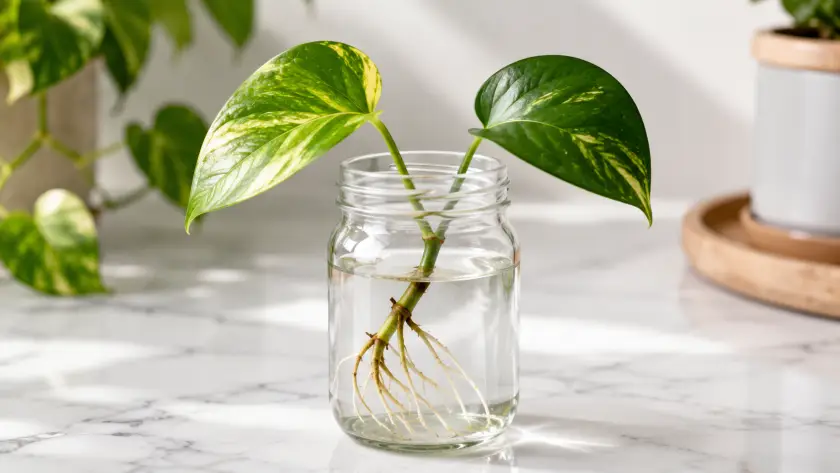
Propagating houseplants in water is the most accessible entry point into propagation for beginners — visible root development confirms success before any commitment to soil, and the process requires nothing beyond a healthy parent plant, clean scissors, and a glass jar.
How to propagate houseplants in water — step by step:
Step 1 — Select a healthy stem: Choose a stem with at least 2–3 nodes (the points where leaves attach to the stem) and no signs of pest damage, disease, or yellowing. Healthy parent plants produce cuttings that root most readily.
Step 2 — Make a clean cut: Using clean, sharp scissors or a sterile blade, cut just below a node at a 45-degree angle. The 45-degree cut increases the surface area available for root development. Wipe scissors with alcohol before cutting to prevent bacterial transfer.
Step 3 — Remove lower leaves: Remove any leaves that would sit below the waterline — submerged leaves rot quickly and introduce bacteria that can kill the cutting before roots develop. Leave 2–3 leaves at the top.
Step 4 — Allow to callous: Set the cutting on a dry surface for 30–60 minutes. This brief drying period reduces the risk of bacterial entry through the fresh cut surface.
Step 5 — Place in water: Fill a clean glass jar with room-temperature filtered or tap water and position the cutting so the bare stem is submerged and leaves remain above the waterline. Clear glass allows root monitoring without disturbing the cutting.
Step 6 — Position and wait: Place in bright indirect light — avoid direct sun which encourages algae growth in the water and can stress the cutting. Change water every 3–4 days to prevent bacterial buildup. Roots typically appear within 1–3 weeks for fast-rooting plants.
Step 7 — Transfer to soil: Once roots reach 3–5cm, transfer to a pot with appropriate soil mix. Water immediately after potting and maintain in bright indirect light. Expect 1–2 weeks of adjustment as the plant transitions from water to soil.
Best houseplants to propagate in water:
- Pothos — roots within 1–2 weeks, almost impossible to fail
- Philodendron — reliable and fast, beautiful root development
- Monstera — nodes root readily, patience required for larger specimens
- Spider plant — offshoots root almost immediately in water
- Tradescantia — one of the fastest rooters available
Method 2: Stem Cuttings in Soil — More Direct, Slightly Riskier
Soil propagation skips the water stage entirely — cuttings are placed directly into moist growing medium and develop roots without the intermediate water phase. It produces stronger initial root systems than water propagation (roots adapted to soil from the start) but requires more monitoring and carries higher failure risk since root development can’t be observed directly.
How to propagate houseplants from cuttings in soil — step by step:
Step 1 — Take and prepare the cutting: As with water propagation — clean cut below a node, lower leaves removed, 30–60 minute callousing period.
Step 2 — Prepare the growing medium: Use fresh, lightly moistened potting mix — damp but not wet, compressing a handful should produce no dripping water. Cuttings root best in an airy, well-draining mix rather than dense or saturated soil.
Step 3 — Optional rooting hormone: Dip the cut end in powdered rooting hormone — available at any garden centre — before inserting into the soil. Rooting hormone contains auxins that stimulate root cell development and meaningfully improves success rates, particularly for slower-rooting plant types.
Step 4 — Insert the cutting: Make a small hole in the soil with a pencil or finger, insert the cutting to a depth that covers at least one node, then firm gently around the stem. Direct insertion without a pre-made hole can wipe off rooting hormone.
Step 5 — Create humidity: Cover loosely with a clear plastic bag, plastic bottle with the bottom cut off, or clear plastic propagation dome. The enclosed humidity reduces water loss through the leaves while roots are developing and the plant cannot yet absorb water efficiently.
Step 6 — Monitor and wait: Check soil moisture every 3–4 days — maintain slightly moist but never wet. Test for rooting after 3–4 weeks by tugging gently — resistance indicates developing roots. New leaf growth is the most reliable sign of successful rooting.
Best plants for soil cutting propagation:
- ZZ plant — stem sections and individual leaves both root in soil
- Rubber plant — stem cuttings root reliably in moist soil
- Dracaena — cane sections laid horizontally on moist soil produce new plantlets
Method 3: Leaf Cuttings — Succulents and Specialty Plants
Snake plant leaf propagation and succulent leaf propagation are the most common applications of this method — individual leaves removed from the parent plant and laid on or inserted into moist growing medium, producing tiny new plantlets from the base of the leaf over 4–8 weeks.
Snake plant leaf propagation — step by step:
Step 1: Select a healthy, mature leaf from the outer edge of the plant using our snake plant care guide as reference for identifying healthy growth.
Step 2: Cut the leaf into 5–8cm sections, noting which end is the bottom (closer to soil) — sansevieria leaves only produce roots and new growth from the bottom end, so orientation matters.
Step 3: Allow sections to callous for 24–48 hours on a dry surface.
Step 4: Insert each section bottom-end-down into lightly moistened cactus mix, burying 2–3cm. Space sections 3–4cm apart in a shallow tray.
Step 5: New growth — tiny new snake plant rosettes — emerges from the base of each cutting after 6–12 weeks. Note: leaf cuttings of variegated snake plant revert to solid green — only division preserves variegation.
For succulents: Individual leaves removed by gently twisting (not cutting) from the stem, laid flat on dry cactus mix, producing tiny rosettes from the leaf base over 4–6 weeks. The parent leaf shrivels as it feeds the new plant — completely normal. Our aloe vera care guide covers leaf and offset propagation for this specific genus in detail.
Method 4: Division — For Clumping Plants
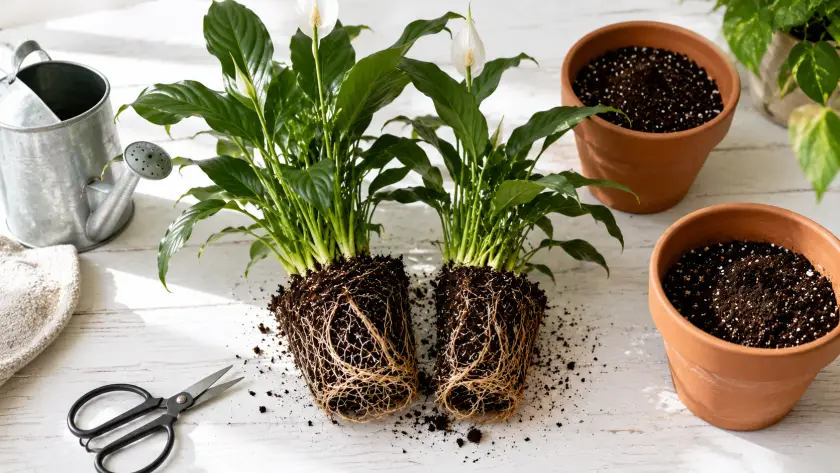
Division is the propagation method for plants that grow as multiple stems or clumps from a shared root system rather than from a single central stem. It’s the fastest and most reliable method available — producing fully-formed plants with established root systems immediately — and is typically performed during spring repotting.
Division step by step:
Step 1: Water the plant thoroughly 24 hours before division to reduce transplant stress on the root system.
Step 2: Remove the plant from its pot and gently shake or rinse excess soil from the roots to make the root structure visible.
Step 3: Identify natural divisions — separate stem clusters with their own root sections. For clumping plants like peace lily and calathea, these natural separations are usually visible once soil is removed.
Step 4: Gently separate root sections by hand or cut with a clean sterile knife where they can’t be separated manually. Each division needs a minimum of 2–3 stems with intact roots attached.
Step 5: Pot each division in appropriate fresh soil, water thoroughly, and position in bright indirect light. Expect 2–4 weeks of reduced growth as the divided plants re-establish.
Best plants for division:
- Peace lily — divides easily at the root
- Calathea — natural root clumps separate readily
- Spider plant — produces offshoots ideal for division
- Boston fern — divides from the root ball readily
Our how to repot a plant guide covers the combined repotting and division process in detail, and our repotting mistakes guide covers the errors most commonly made when dividing clumping plants.
Method 5: Offsets and Pups — The Easiest Method of All
Some plants produce miniature versions of themselves — called offsets, pups, or runners — that already have their own root systems developing when detached from the parent plant. This is the easiest propagation technique available because the plant has essentially done most of the work before you intervene.
How to propagate houseplants from offsets:
Step 1: Wait until the offset is at least one-third the size of the parent plant — detaching too early produces weak plantlets with insufficient root development to survive independently.
Step 2: For plants that produce offsets on runners (spider plant, strawberry begonia), allow the offset to touch the surface of a small pot of moist soil while still attached to the runner. Secure with a small clip or toothpick until rooted, then cut the runner.
Step 3: For plants that produce offsets directly at the base (aloe, agave, some succulents), use a clean knife to separate the offset at the point where it joins the parent’s root system, ensuring the offset has its own roots attached.
Step 4: Pot in appropriate soil, water lightly, and position in bright indirect light.
Plants that produce offshoots and pups:
- Spider plant — produces plantlets on long runners prolifically
- Aloe vera — pups form at the base of mature plants
- Christmas cactus — segments detach and root readily
The Best Time to Propagate Houseplants
Best time to propagate houseplants is consistently spring through early summer — the period when most houseplants are entering their most active growth phase, producing the hormonal conditions in stem tissue that make rooting most efficient and reliable.
Seasonal propagation guide:
- Spring (March–May): Optimal — plants emerging from winter dormancy with peak rooting hormone activity. Best results for all propagation methods.
- Early summer (June–July): Excellent — warm temperatures and long days support rapid root development.
- Late summer (August): Acceptable — results begin slowing as plants start preparing for autumn.
- Autumn (September–November): Slower — possible but results take longer and success rates drop.
- Winter (December–February): Least reliable — most plants are semi-dormant and root development is significantly slower. Some tropical species still root in winter if kept warm enough.
Can you propagate houseplants in the winter? Yes — but manage expectations. Water propagation of fast-rooting species like pothos can succeed in winter given adequate warmth and light, but the same cutting that roots in 2 weeks in May might take 6–8 weeks or not root at all in December. Use a heat mat beneath propagation vessels to maintain 20–24°C at the root zone in winter for improved results.
Caring for Cuttings During Propagation
Light Requirements
Cuttings need bright indirect light throughout the rooting period — enough to support photosynthesis in the leaves (which provide the energy for root development) without the intensity of direct sun that causes leaf scorch in the particularly vulnerable unrooted state. Our complete indoor light guide covers how to identify the ideal light positions in any room for propagation setups.
Watering Cuttings
Water propagation: Change water every 3–4 days to prevent bacterial buildup — stagnant water promotes rot rather than rooting. Use room-temperature water — cold water shocks tender cutting tissue.
Soil cuttings: Maintain slightly moist but never wet conditions — soil that stays saturated for extended periods causes rot at the cut surface. Check every 3–4 days and water only when the top 2cm feels dry. Our overwatering signs guide covers how to identify the early warning signs of waterlogged cutting conditions.
Humidity
Maintaining high humidity around cuttings significantly improves success rates — the leaves of an unrooted cutting cannot replace water lost through transpiration as efficiently as a rooted plant, so high surrounding humidity reduces this moisture loss during the most vulnerable period. Clear plastic bags, plastic bottle cloches, or dedicated propagation domes all work effectively. Our humidity hacks guide covers DIY humidity management techniques for propagation environments.
Setting Up a Houseplant Propagation Station
A houseplant propagation station — a dedicated space for ongoing propagation activity — makes the process more organised, more visually appealing, and significantly more successful through consistent environmental conditions.
Basic propagation station components:
- A bright windowsill or table near an east or south-facing window
- Multiple clear glass vessels in different sizes for water propagation
- A tray of small pots with drainage holes for soil cuttings
- Fresh propagation mix or cactus soil
- Rooting hormone powder (optional but recommended)
- Clear plastic bags or a purpose-made propagation dome for humidity
- Labels or small tags for noting cutting dates
Upgrading the setup:
- A heat mat under propagation vessels maintains consistent 20–24°C root zone temperature year-round — particularly valuable in winter
- A small grow light above the propagation station extends effective propagation season into autumn and winter
- A clip-on hygrometer monitors humidity levels inside propagation domes
The visual pleasure of a well-organised propagation station — rows of glass vessels with cuttings at various root development stages, small pots of newly potted propagations beginning to grow — is one of the most genuinely satisfying aspects of serious houseplant growing. For inspiration on how to incorporate propagation areas into styled indoor plant displays, our room-by-room styling guide covers how propagation setups can become decorative features in their own right.
The Easiest Houseplants to Propagate

Easiest houseplants to propagate for beginners — plants that root so readily they make ideal confidence-building starting points before attempting more challenging species:
Pothos — The definitive beginner propagation plant. Stem cuttings placed in water root within 1–2 weeks in bright indirect light, and the success rate for healthy cuttings is effectively 100%. Start here if you’ve never propagated before.
Spider plant — Produces offshoots on runners that can be rooted in water or soil while still attached to the parent plant. Success rate is extremely high and the process is nearly automatic.
Snake plant — Leaf sections root reliably in cactus mix with minimal attention. Slower than pothos but highly reliable. Sansevieria trifasciata propagation via leaf cuttings is one of the most classic houseplant propagation techniques available.
Tradescantia — Perhaps the fastest-rooting houseplant available. Stem cuttings develop visible roots in water within days rather than weeks.
Philodendron — Node cuttings root readily in water or soil, and the vigorous growth habit of most philodendron species means new leaf production begins quickly after rooting.
ZZ plant — Slower than the above but highly reliable through both leaf and stem cutting methods. Individual leaflets placed in moist soil produce new rhizomes over 8–12 weeks.
Calathea — Division during spring repotting is the most reliable propagation method, producing fully-formed plants immediately from natural root clump separation.
Jade plant — Stem and leaf cuttings both root readily in cactus mix with a callousing period — one of the most reliable succulent propagation subjects available.
Troubleshooting Common Propagation Problems
Cuttings Rotting in Water
Rot in water-propagated cuttings almost always results from one of three causes: leaves submerged below the waterline, water not changed frequently enough (change every 3–4 days), or a dirty container harbouring bacteria. Ensure all leaves are above the waterline, clean the jar with diluted hydrogen peroxide before starting, and change water regularly.
Cuttings Rotting in Soil
Soil cuttings rot when the growing medium is too wet for too long. Maintain slightly moist rather than wet conditions — let the top 2cm dry between light waterings. Ensure adequate drainage holes in the propagation pot and use a well-draining mix rather than dense standard compost. If rot appears, remove the cutting, trim the rotted section back to clean tissue, allow to callous for 24 hours, and restart in fresh dry mix.
No Roots After Several Weeks
If no roots have developed after the expected timeframe, check: Is the cutting in bright enough light? Is the temperature warm enough (below 18°C significantly slows rooting)? Was rooting hormone used? Is the cutting still healthy with green leaves? Sometimes propagation simply takes longer than expected — particularly in winter or for naturally slow-rooting species. If the cutting remains green and shows no rot, continue waiting.
Cuttings Wilting or Dropping Leaves
Some leaf drop after taking a cutting is normal — the plant is adjusting to the reduction in its root system relative to its leaf surface. Maintain humidity around the cutting to reduce moisture loss, ensure bright indirect light, and avoid moving or disturbing the cutting. If wilting is severe, removing one or two of the remaining leaves reduces transpiration demand while roots develop. See our leaf curl and droop guide for distinguishing normal post-propagation adjustment from genuine distress.
Successfully Rooted but Struggling After Potting
The transition from water to soil is the most challenging moment in water propagation — water-adapted roots have different cell structure than soil-adapted roots and experience genuine shock during transition. Minimise this by: allowing roots to reach at least 3–5cm before potting, using a light propagation mix rather than dense compost, maintaining consistent moisture for the first 2–3 weeks, and keeping in high humidity conditions during the transition period. Our revive a dying plant guide covers recovery strategies for propagated plants that struggle after potting.
Frequently Asked Questions
What is the easiest way to propagate houseplants? Water propagation is consistently the easiest method for beginners — place a stem cutting with at least one node in a clear glass jar of water in bright indirect light, change the water every 3–4 days, and visible roots develop within 1–3 weeks for most species. The visual confirmation of root development before any commitment to soil makes it both the most beginner-friendly and the most motivating propagation method available. Pothos, philodendron, and tradescantia are the most reliable easy houseplants to propagate this way.
When is the best time to propagate houseplants? The best time to propagate houseplants is late spring through early summer — when plants are in their most active growth phase and root tissue responds most readily to the propagation process. Spring cuttings root faster, more reliably, and produce stronger initial root systems than autumn or winter cuttings of the same species. Can you propagate houseplants in the winter? Yes, but results are significantly slower and success rates lower — use a heat mat to maintain warm root zone temperatures if propagating outside the growing season.
How long does houseplant propagation take? Houseplant propagation timelines vary significantly by method and species. Water-propagated stem cuttings from fast-rooting species like pothos typically show roots within 1–2 weeks. Soil cuttings generally show new growth after 3–6 weeks. Leaf cuttings from snake plant and succulents require 6–12 weeks before new plantlets emerge. Division produces results immediately as plants already have established root systems. Offset propagation is similarly immediate once the offset is detached and potted.
What are the best houseplants to propagate and sell? The best houseplants to propagate and sell are those that root quickly, produce multiple cuttings from a single parent plant, and have consistent demand. Pothos (multiple varieties including golden, marble queen, and neon), tradescantia, spider plant, and snake plant all meet these criteria. Rarer varieties including variegated pothos, unusual philodendron cultivars, and specific hoya varieties command significantly higher prices per cutting for those willing to invest in parent plants first.
Why are my propagation cuttings rotting? Rotting cuttings in water result from leaves submerged below the waterline, infrequent water changes, or bacterial contamination in the vessel. Rotting cuttings in soil result from consistently wet growing medium without adequate drainage. Both scenarios are preventable — ensure all leaves remain above waterlines, change water every 3–4 days, allow cut surfaces to callous before inserting into soil, and maintain moist-but-never-wet soil conditions throughout the rooting period.
How long should roots be before planting in soil? Propagating houseplants in water produces cuttings ready for soil transfer when roots reach 3–5cm — long enough to establish in the soil quickly but not so long that extensive water-adapted root structure makes soil transition difficult. Cuttings transferred with roots under 2cm often fail to establish and die within 1–2 weeks of potting. Waiting for 5cm+ roots before potting significantly improves post-potting survival rates for water-propagated cuttings.
Can I propagate any houseplant from cuttings? Most houseplants can be propagated from some type of cutting, but not all respond to stem cutting propagation. Plants without stems — such as peace lily and clumping calathea — are best propagated through division. Succulents and snake plants respond better to leaf cuttings than stem cuttings. Palms and tree ferns cannot be practically propagated at home. Before attempting propagation, research the specific method recommended for your plant type — the right method makes the difference between consistent success and repeated failure.
What is a houseplant propagation station? A houseplant propagation station is a dedicated area for ongoing propagation activity — typically a bright windowsill or table with grouped propagation vessels, consistent temperature, and a humidity enclosure. Even a basic setup of a windowsill tray with several glass jars of water cuttings constitutes a propagation station. More developed setups include heat mats for consistent root zone temperature, grow lights for year-round propagation, humidity domes for soil cuttings, and organised labelling systems for tracking cutting dates and species.
Related Guides
- Pothos Care Guide
- Philodendron Care Guide
- Snake Plant Care Guide
- Spider Plant Care Guide
- Monstera Care Guide
- ZZ Plant Care Guide
- Peace Lily Care Guide
- Calathea Care Guide
- Rubber Plant Care Guide
- Fiddle Leaf Fig Care Guide
- Aloe Vera Care Guide
- Jade Plant Care Guide
- Christmas Cactus Care Guide
- Dracaena Care Guide
- Money Tree Care Guide
- String of Pearls Care Guide
- Colorful Foliage Indoor Plants
- How to Repot a Plant
- Repotting Mistakes to Avoid
- Best Soil Mix Guide
- Complete Watering Guide
- Signs You’re Overwatering
- Complete Indoor Light Guide
- Humidity Hacks Guide
- Fertilizing Indoor vs Outdoor
- Why Leaves Turn Yellow
- Leaf Curl Browning Droop Guide
- How to Revive a Dying Plant
- Best Indoor Plants for Beginners
- 35 Low Maintenance Plants
- Air Purifying Indoor Plants
- Cat Friendly Plants Guide
- Dog Friendly Plants Guide
- 33 Best Bathroom Plants
- Low Light Hanging Plants
- Best Smelling Indoor Plants
- Style Indoor Plants by Room
- Decorate Bedroom with Plants
- Best Low Maintenance Outdoor Plants
- Browse All Plant Care Guides →
- Browse All Indoor Plants →
Final Thoughts
Propagating houseplants is one of those skills that starts as an experiment and becomes a practice — something you return to each spring with increasing confidence, a growing understanding of which plants root when, and a windowsill full of glass jars that represents not just free plants but a genuine relationship with the biological processes that make them grow.
The methods covered in this guide range from the genuinely effortless — a pothos cutting in a glass of water — through to the more involved — carefully dividing a mature peace lily at the roots while preserving both sections intact — but all share the same underlying principle. Plants want to grow. The stems, leaves, and offshoots of healthy houseplants carry within them everything needed to produce new root systems and new plants, given the right conditions. Your role is providing those conditions — warmth, light, clean water or appropriate soil — and then stepping back to let biology do the work.
How to propagate houseplants successfully is ultimately about developing patience and observation — learning to read the plant’s signals, recognise the difference between normal adjustment and genuine distress, and trust that the process unfolding invisibly in the water or soil is proceeding on its own timeline rather than yours.
According to the Royal Horticultural Society (RHS), stem cutting propagation is the most widely applicable and reliably successful propagation technique for the majority of houseplant species, with the optimal timing for most temperate and tropical houseplants being late spring through early summer when auxin levels in plant tissue are at their seasonal peak — confirming that timing is among the most impactful variables in any houseplant propagation attempt. 🌿