
Key Takeaways
- Humidity hacks are budget-friendly, zero-equipment strategies that measurably increase the atmospheric moisture around your plants without the cost, noise, or maintenance of a humidifier — and many work best when combined rather than used individually.
- Plants that like humidity — including calathea, boston fern, peace lily, monstera, anthurium, and orchids — lose water through their leaves faster than they can replace it through roots when indoor air drops below 40% relative humidity, causing the brown tips, curling leaves, and stunted growth that indicate plants that need humidity aren’t getting enough.
- Increase humidity without humidifier by grouping plants together — transpiration from multiple plants creates a localised microclimate with measurably higher humidity than the surrounding room, and this costs nothing and requires no equipment change.
- Pebble trays are among the most consistently effective humidity hacks — a shallow tray filled with pebbles and warm water placed beneath the pot raises humidity within the immediate plant zone through constant evaporation without the roots sitting in water.
- How to raise humidity for plants that genuinely require it — calathea, ferns, fittonias — is most effectively achieved by relocating them to naturally humid rooms (bathroom, kitchen) where daily steam from showers and cooking provides consistent atmospheric moisture.
- Misting provides a short-term humidity boost — approximately 20–30 minutes — and is most valuable as part of a combined approach with other humidity hacks rather than as a standalone strategy, and must be done in the morning to allow water to evaporate before cooler night temperatures create fungal risk.
- How to add moisture to air without humidifier effectively requires addressing the sources of humidity loss as much as adding moisture — keeping plants away from radiators, heating vents, and cold drafts prevents the constant humidity drain that makes all other humidity hacks less effective.
- DIY humidity tents — a clear plastic bag or cloche loosely propped over a struggling plant — create a near-saturated microclimate that is particularly effective for recovering plants and cuttings that require high humidity to establish successfully.
- Plants that absorb humidity from the air — including ferns, calathea, and peace lily — use atmospheric moisture through their leaf surfaces independently of soil watering, meaning that raising ambient humidity directly reduces their water stress and the associated leaf symptoms.
- The most effective humidity hacks strategy combines multiple low-effort approaches simultaneously — grouping plants, adding pebble trays, relocating to naturally humid rooms, and keeping plants away from heat sources — rather than relying on any single technique.
Introduction
Most homes aren’t tropical rainforests — and that’s a problem for the significant majority of popular houseplants that evolved in precisely those conditions. Indoor air in temperate climates typically sits at 30–50% relative humidity, dropping further in winter when central heating runs continuously and outdoor cold air replaces the naturally more humid summer air. For plants that need humidity — the calatheas, ferns, peace lilies, monsteras, anthuriums, and orchids that dominate most houseplant collections — this means spending most of their lives in conditions significantly drier than their evolutionary origins, producing the brown leaf tips, curling foliage, and stunted growth that indicate chronic humidity stress.
The instinctive solution is a humidifier — but not everyone wants another appliance running continuously, refilling regularly, and adding to electricity costs. The good news is that effective humidity hacks don’t require a humidifier. The strategies in this guide — from the completely free (grouping plants together, relocating to naturally humid rooms) through the minimal-cost (pebble trays, DIY humidity tents) to the creative (strategic laundry drying, open water bowls) — all raise atmospheric moisture around your plants in ways that are measurably beneficial, budget-friendly, and easy to maintain consistently.
This complete humidity hacks guide covers every technique, which plants benefit most, how to combine approaches for maximum effect, and how to recognise when your efforts are working. For connected plant care topics, our complete watering guide, complete indoor light guide, DIY humidity tray guide, and leaf curl browning and droop guide cover every related topic in detail.
Why Humidity Matters — The Science Behind Happy Plants
Plants that like humidity evolved in environments where atmospheric moisture is high enough that their leaves can absorb water vapour directly from the air through their stomata — the tiny pores on leaf surfaces through which gas exchange occurs. In these conditions, the leaf surface stays hydrated, stomata can remain open for photosynthesis, and transpiration (the process by which plants move water from roots through stems to leaves) operates efficiently.
When indoor air drops below the humidity levels these plants evolved in, the moisture gradient reverses — water moves out of the leaf into the drier surrounding air faster than the roots and vascular system can replace it. The plant responds by closing its stomata to reduce water loss, which simultaneously reduces photosynthesis and growth. Extended low humidity produces the characteristic symptoms that tell you plants that need humidity aren’t getting it: brown leaf tips (the leaf edges and tips dry out first), curling or cupping leaves (the leaf tries to reduce its surface area to slow water loss), and overall stunted growth and reduced vigour.
Different plants have different humidity tolerance thresholds. Plants that absorb humidity and genuinely require high atmospheric moisture — calathea, boston fern, fittonia, orchids — show stress below 50–60% relative humidity. Moderate humidity plants — monstera, peace lily, philodendron, spider plant — prefer 40–60% and tolerate lower levels without severe symptoms. Low-humidity tolerant plants — snake plant, ZZ plant, succulent, cactus — evolved in dry conditions and don’t benefit from humidity hacks at all.
Understanding which category your plants fall into determines which humidity hacks are worth implementing and for which plants.
The 10 Best Humidity Hacks — Tested and Ranked
Hack 1: Group Plants Together
Effectiveness: ⭐⭐⭐⭐ | Cost: Free | Effort: Minimal
Grouping plants is the most underrated of all humidity hacks — it costs nothing, requires no equipment, and works continuously without any ongoing maintenance. Plants release water vapour through transpiration as a natural part of their daily function, and when multiple plants are grouped closely together, the combined transpiration from the group creates a localised microclimate with measurably higher humidity than the surrounding room air.
The effect is most pronounced when the group contains a mix of large-leaved plants (which transpire more water) and the target humidity-loving plants. Position the group away from air movement sources — windows, doors, heating vents — that would disperse the microclimate before it can benefit the plants within it.
Combine grouping with pebble trays (Hack 2) and the cumulative effect is significantly greater than either technique alone. For plants like calathea, monstera, philodendron, and peace lily, grouping alone can make a visible difference to leaf tip health within 2–3 weeks. Our 35 low-maintenance plants guide covers which plants group well together for maximum mutual benefit.
Hack 2: Pebble Trays
Effectiveness: ⭐⭐⭐⭐ | Cost: Near Zero | Effort: Minimal
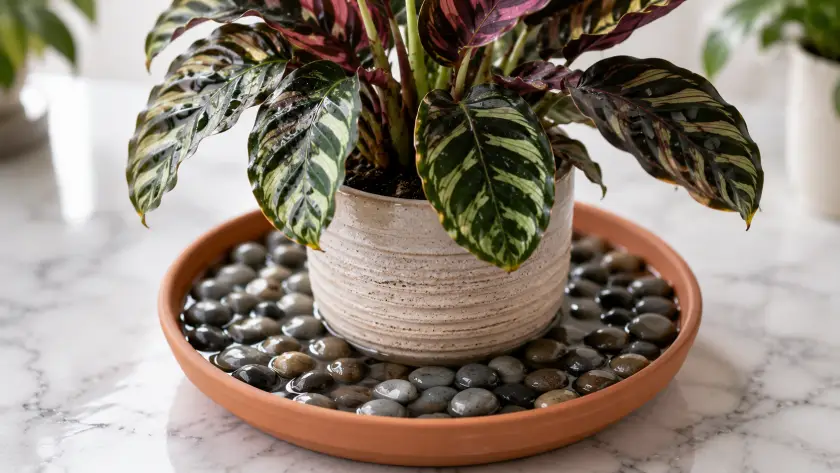
The pebble tray is the classic humidity hack for good reason — it provides continuous passive evaporation directly beneath the plant where it matters most. Fill a shallow tray or saucer with pebbles or gravel, add water to just below the top of the pebble layer, and place the pot on top of the pebbles ensuring the pot base sits above the water level and doesn’t touch it directly. As water evaporates upward from the tray surface, it increases humidity in the immediate zone surrounding the plant.
The key refinement that most guides miss: use warm water rather than cold. Warm water evaporates faster and provides better short-term humidity elevation, which is particularly valuable during the drier winter months when central heating is running. Refill the tray as needed — typically every 2–4 days depending on room temperature and evaporation rate.
Our dedicated DIY humidity tray guide covers pebble tray construction, sizing, and optimisation in complete detail. Pebble trays work best for boston fern, calathea, orchids, anthurium, and bird of paradise.
Hack 3: Relocate to Naturally Humid Rooms
Effectiveness: ⭐⭐⭐⭐⭐ | Cost: Free | Effort: One-time move
The most effective single humidity hack available is relocating humidity-loving plants to rooms that are naturally humid — bathrooms and kitchens — where daily steam from showers, baths, and cooking provides consistent atmospheric moisture without any additional equipment or effort.
Bathrooms are particularly effective for plants that like humidity — shower steam regularly brings bathroom humidity to 80–100%, and even between uses the enclosed space maintains higher humidity than the rest of the home. Plants like boston fern, calathea, peace lily, pothos, and spider plant all thrive in bathroom conditions. Our 33 best bathroom plants guide covers exactly which plants suit bathroom growing conditions.
For plants that need both humidity and some light — monstera, philodendron, rubber plant — kitchen windowsills provide the combination of natural light and cooking steam that creates near-ideal conditions. Even a weekly “bathroom vacation” — bringing a struggling plant into the bathroom while showering — provides a meaningful humidity boost for plants kept elsewhere in the home.
Hack 4: Mist Correctly — Not Just More Often
Effectiveness: ⭐⭐⭐ | Cost: Free | Effort: Regular
Misting is the most commonly recommended and most commonly misapplied of all humidity hacks. The fundamental limitation is that misting raises humidity for approximately 20–30 minutes before the fine water droplets evaporate and humidity returns to ambient levels — which means single daily misting sessions provide minimal lasting humidity benefit.
Where misting genuinely helps is as part of a combined approach — supplementing the more sustained humidity elevation from pebble trays and grouping — and when done correctly: in the morning (so water evaporates during the day rather than sitting on leaves in cooler night temperatures that promote fungal growth), using filtered or distilled water (tap water leaves white mineral deposits on leaves over time), and focusing on the undersides of leaves where stomata are concentrated.
Plants to mist: Calathea, orchids, boston fern, monstera, anthurium.
Plants not to mist: Succulent, cactus, snake plant, ZZ plant — these drought-adapted plants don’t need or benefit from misting and can develop fungal issues if regularly misted.
Hack 5: DIY Humidity Tents
Effectiveness: ⭐⭐⭐⭐ | Cost: Near Zero | Effort: Minimal
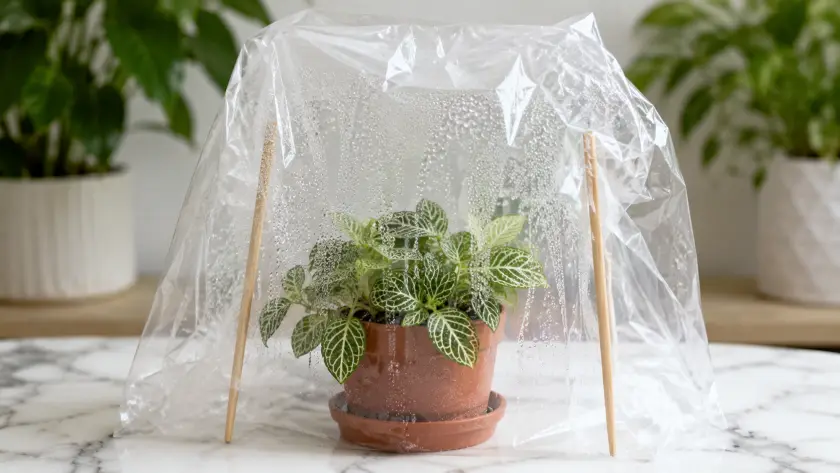
A humidity tent — a clear plastic bag or cloche loosely propped over a plant with chopsticks or skewers to prevent contact with the leaves — creates a near-saturated microclimate around a struggling plant by trapping transpired moisture within the tent rather than allowing it to disperse into the room. This is the most intensive single-plant humidity hack available and is particularly effective for recovery situations and propagation.
Best uses for humidity tents: Recovering plants from humidity stress, newly propagated cuttings that need high humidity to establish roots, plants transitioning from high-humidity nursery conditions to lower-humidity home environments, and extremely high-humidity-demanding plants like fittonia and maidenhair fern that struggle consistently in typical home conditions.
Important: Open the tent for 1–2 hours daily to allow air exchange and prevent the stagnant humid conditions that promote fungal growth. Remove the tent entirely once the plant shows healthy new growth indicating it has adapted to surrounding conditions. Our how to revive a dying plant guide covers humidity tents as part of broader plant recovery protocols.
Hack 6: Move Away from Radiators, Heaters, and Cold Drafts
Effectiveness: ⭐⭐⭐⭐⭐ | Cost: Free | Effort: One-time
This humidity hack works by prevention rather than addition — stopping the humidity loss that makes all other techniques less effective. Radiators and heating vents blast hot dry air that dramatically reduces local humidity levels and can drop the air immediately surrounding a nearby plant to near-desert levels of dryness regardless of any humidity additions elsewhere.
Cold drafts from windows and exterior doors have the same effect in winter — cold air carries almost no moisture, and the constant cold air movement removes whatever humidity has built up around plants.
Check every plant’s position relative to heat sources and drafts before investing in any other humidity hacks — moving a plant just 60–90cm away from a radiator can resolve humidity stress symptoms that weeks of pebble trays and misting had failed to address. Snake plant, money tree, and peace lily are among the plants most visibly affected by radiator proximity.
Hack 7: Open Water Bowls Near Plants
Effectiveness: ⭐⭐⭐ | Cost: Free | Effort: Minimal
Placing bowls of water near plants — on the same shelf, on nearby windowsills, or within the plant grouping — provides ongoing passive evaporation that gradually elevates local humidity. The effect is subtle compared to pebble trays but requires no setup and is completely passive once in position.
Use wider, shallower bowls rather than tall narrow containers — greater water surface area means faster evaporation and better humidity elevation. Placing bowls on warm surfaces (on top of or near radiators rather than beside the plants) can increase evaporation rate significantly while keeping the moisture-adding effect close to the plants. Refresh water every few days to prevent the stagnant water issues that attract mosquitoes. This humidity hack pairs particularly well with grouping and is most useful as a supplementary technique in the overall humidity management system.
Hack 8: Strategic Indoor Laundry Drying
Effectiveness: ⭐⭐⭐ | Cost: Free | Effort: Minimal
Drying clothes on an indoor rack releases significant atmospheric moisture as the wet fabric dries — typically enough to raise whole-room humidity by 5–10% depending on room size and the amount of laundry. Positioning the drying rack near plants that like humidity lets them benefit directly from this evaporative moisture release.
This humidity hack is most effective in smaller rooms and during winter months when indoor heating is reducing humidity most severely. Ensure adequate ventilation to prevent the mould and condensation that can develop if indoor drying is combined with poor air circulation in an already poorly ventilated space. Our humidity hacks guide on our site covers ventilation balance in detail.
Hack 9: Terrarium Growing for Maximum Humidity Plants
Effectiveness: ⭐⭐⭐⭐⭐ | Cost: Low–Medium | Effort: Setup only
Closed glass terrariums create self-sustaining high-humidity environments that are genuinely transformative for the most demanding plants that need humidity — maidenhair fern, fittonia, mosses, and other plants that genuinely cannot thrive in typical home humidity levels without constant intervention. Inside a closed terrarium, transpiration and evaporation create a water cycle where moisture released by the plants condenses on the glass and returns to the soil, maintaining near-constant high humidity with minimal external input.
Even open terrariums provide measurably higher humidity within the glass vessel than the surrounding room — suitable for slightly less demanding humidity lovers like calathea, small ferns, and orchids. For plants featured in our rare houseplants guide, terrariums often make the difference between a plant that merely survives and one that genuinely thrives in typical home conditions.
Hack 10: Mulch and Moss Topdressing
Effectiveness: ⭐⭐⭐ | Cost: Low | Effort: Minimal
Adding a layer of sphagnum moss, organic mulch, or decorative pebbles to the soil surface slows evaporation from the pot, maintaining consistent moisture in the root zone between waterings. While this doesn’t directly increase air humidity, it supports the overall water balance of the plant — reducing the water stress that accompanies low-humidity conditions by ensuring roots have consistent access to soil moisture even as leaves experience humidity-related water loss.
Sphagnum moss topdressing is particularly effective as it stays moist after watering and releases moisture slowly, creating a more consistent root-zone humidity level. This technique is most beneficial for boston fern, calathea, anthurium, and other consistently moisture-demanding plants.
Which Plants Need These Humidity Hacks Most?
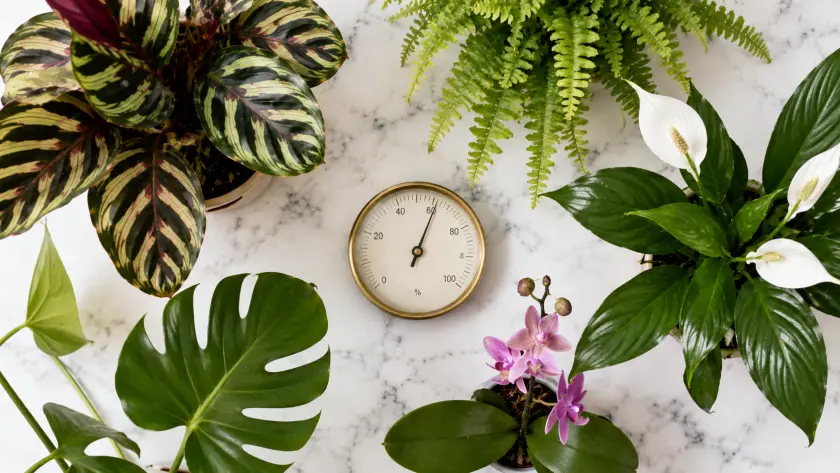
High humidity plants (50–70%+ required): Calathea — humidity stress shows immediately as brown crispy edges. Boston fern — fronds turn yellow and crispy without adequate humidity. Fittonia — collapses dramatically in low humidity. Maidenhair fern — the most humidity-demanding common houseplant. Orchids — aerial roots absorb atmospheric moisture directly.
Moderate humidity plants (40–60%): Monstera — benefits visibly from humidity but tolerates moderate home levels. Peace lily — humidity lover that performs better with elevated atmospheric moisture. Philodendron — faster growth and larger leaves with humidity support. Pothos — tolerant but shows improvement in higher humidity. Spider plant — tip browning reduces with improved humidity. Rubber plant — leaves stay glossier with moderate humidity. Bird of paradise — large leaves benefit from atmospheric moisture. Money tree — appreciates humidity particularly in heated winter rooms. Christmas cactus — forest cactus that prefers higher humidity than its name suggests.
Low humidity plants (don’t need humidity hacks): Snake plant, ZZ plant, succulent, jade plant, aloe vera — all evolved in dry conditions and don’t benefit from elevated humidity. See our 35 low-maintenance plants guide and top drought-resistant plants guide for more low-humidity plants.
Signs Your Humidity Hacks Are Working
Recovery from humidity stress is visible but gradual — expect 2–4 weeks before seeing meaningful improvement:
Positive signs: New leaf growth emerging without brown tips, existing leaves firming and straightening from their curled or drooping position, improved leaf colour and glossiness, and the overall plant looking more vigorous and upright. For plants that absorb humidity like calathea, the leaf movement (leaves rising during the day, folding at night) becomes more pronounced as the plant becomes more hydrated.
Signs more intervention is needed: Continued brown tip development on new leaves, persistent leaf curling or cupping, slow growth despite adequate light and feeding — these indicate the current humidity hacks aren’t achieving sufficient humidity elevation and a more intensive approach is needed. See our leaf curl browning and droop guide and why leaves turn yellow guide for detailed symptom analysis.
Common Humidity Hack Mistakes to Avoid
Over-misting without ventilation — daily misting in a poorly ventilated space creates the stagnant wet conditions that cause fungal leaf diseases. Always mist in the morning and ensure air can circulate after misting.
Focusing on humidity while ignoring light — plants that like humidity also need adequate light to photosynthesise and maintain health. Moving a plant to a more humid location (like a dark interior bathroom) that reduces its light access can cause more damage than the humidity improvement provides. See our complete indoor light guide.
Letting pebble tray water touch the pot base — roots sitting in water cause root rot regardless of whether the humidity benefit is real. Always ensure the pot base sits above the water line in pebble trays. See our signs of overwatering guide.
Applying humidity hacks to the wrong plants — succulents and cacti don’t benefit from elevated humidity and can develop fungal issues if regularly misted or grouped with humidity-creating plants in enclosed positions. Our succulent care guide covers humidity requirements for drought-adapted plants.
Using tap water for misting — mineral deposits from tap water leave white spots on leaves that are aesthetically unpleasant and can block stomata over time. Use filtered, distilled, or rainwater for misting.
Frequently Asked Questions
How do I know if my plant needs more humidity? Look for brown leaf tips (especially on calathea, ferns, and peace lily), leaves that curl inward or cup downward, overall wilting that doesn’t resolve after correct watering, and slow growth despite good light and feeding. Plants that need humidity show these symptoms most clearly in winter when central heating runs continuously. See our leaf curl browning and droop guide for comprehensive symptom diagnosis.
How to raise humidity for plants without a humidifier? The most effective combined approach: group plants that like humidity together, add pebble trays filled with warm water beneath each pot, relocate the most demanding plants to a naturally humid bathroom or kitchen, and move all plants away from radiators and heating vents. This combination of humidity hacks can raise local plant humidity from 30–40% to 55–65% without any electrical equipment. See our DIY humidity tray guide for pebble tray setup details.
Can I mist my plants every day? Daily misting is fine for high-humidity plants like calathea, ferns, and orchids provided there is adequate air circulation and misting is done in the morning. Daily misting in poorly ventilated spaces or on plants that don’t need elevated humidity increases fungal disease risk. Never mist succulents, snake plant, ZZ plant, or other drought-adapted plants. Our calathea care guide covers misting specifics for the most demanding humidity lovers.
Do pebble trays actually work? Yes — pebble trays genuinely raise humidity within the immediate zone surrounding the plant through continuous passive evaporation. The effect is localised (within approximately 30cm of the tray) rather than room-wide, which is why they work best as part of a combined humidity hacks approach alongside grouping and relocation. Our DIY humidity tray guide covers maximising pebble tray effectiveness.
Which plants benefit most from humidity hacks? The plants that benefit most from humidity hacks are calathea, boston fern, maidenhair fern, fittonia, orchids, anthurium, monstera, peace lily, and philodendron — all tropical plants that evolved in consistently humid environments. Christmas cactus also benefits despite its cactus name — it’s a forest plant that prefers higher humidity than desert cacti.
How to add moisture to air without humidifier in winter specifically? Winter is when humidity hacks matter most — central heating removes moisture from indoor air continuously. Focus on: keeping plants grouped together, using pebble trays with warm water (refilling more frequently as warm dry air increases evaporation), relocating most sensitive plants to the bathroom, placing open water bowls near radiators (away from plants) to add moisture to room air, and using indoor laundry drying strategically. See our complete watering guide for winter-specific watering and humidity management.
Related Guides
- DIY Humidity Tray Guide
- Complete Watering Guide
- Complete Indoor Light Guide
- Leaf Curl Browning Droop Guide
- Why Leaves Turn Yellow
- Signs You’re Overwatering
- How to Revive a Dying Plant
- What Is Root Rot Guide
- How to Repot a Plant
- Best Soil Mix Guide
- Fertilizing Indoor vs Outdoor
- Calathea Care Guide
- Boston Fern Care Guide
- Peace Lily Care Guide
- Monstera Care Guide
- Philodendron Care Guide
- Pothos Care Guide
- Spider Plant Care Guide
- Snake Plant Care Guide
- ZZ Plant Care Guide
- Peace Lily Care Guide
- Money Tree Care Guide
- Christmas Cactus Care Guide
- Rubber Plant Care Guide
- Bird of Paradise Care Guide
- Aloe Vera Care Guide
- Jade Plant Care Guide
- Succulent Care Guide
- String of Pearls Care Guide
- 23 Blooming Indoor Plants
- Rare Houseplants Guide
- 33 Best Bathroom Plants
- 35 Low Maintenance Plants
- Best Indoor Plants for Beginners
- Top Drought Resistant Plants
- 20 Oversized Indoor Plants
- Low Light Hanging Plants
- Air Purifying Indoor Plants
- Indoor Plants That Smell Amazing
- Style Indoor Plants by Room
- Decorate Bedroom with Plants
- Office Friendly Plants Guide
- Cat Friendly Plants Guide
- Dog Friendly Plants Guide
- Browse All Plant Care →
- Browse All Indoor Plants →
Final Thoughts
Humidity hacks work because they address a genuine plant need — atmospheric moisture — using strategies that align with the plant’s natural environment rather than fighting against the conditions of home growing. The techniques in this guide don’t require expensive equipment, significant ongoing effort, or dramatic home changes. They require attention — noticing which plants are showing humidity stress, understanding what they actually need, and implementing the combination of humidity hacks that fits your space, budget, and routine.
The most successful approach is always the combined one. Grouping plants, adding pebble trays, relocating the most demanding varieties to naturally humid rooms, and keeping everything away from heat sources creates a cumulative humidity improvement that any single technique alone can’t match. Start with the free, zero-effort changes (grouping, relocation, moving away from radiators) and add pebble trays and supplementary misting as needed based on how your plants that like humidity respond.
According to the Royal Horticultural Society (RHS), maintaining appropriate atmospheric humidity is one of the most significant factors in houseplant health in UK homes, where winter central heating creates conditions far drier than most popular houseplants evolved in — making humidity hacks not just helpful additions to plant care practice but genuinely essential tools for keeping tropical houseplants thriving through the colder months. 🌿


[…] Humidity hacks for plants […]
[…] Humidity hacks without a humidifier […]
[…] humidity help, read humidity hacks without a humidifier and DIY indoor humidity […]
[…] humidity support, read humidity hacks without a humidifier, DIY humidity tray, and misting for […]
[…] Use this guide with Boston Fern care guide, low light plants for bathroom, and humidity hacks without a humidifier. […]
[…] can also explore our humidity hacks for houseplants, tropical houseplant guide, and general indoor plant […]
Your point of view caught my eye and was very interesting. Thanks. I have a question for you.