
Key Takeaways
- Leaf curl is never random — it is always a specific response to an identifiable environmental or biological stress, and accurately reading the direction, texture, and pattern of the curl points directly to the cause without guesswork.
- Upward curling leaves on plants typically indicate heat stress, excessive direct sun, or severe underwatering — the leaf curls upward to reduce its exposed surface area and slow the water loss that the stressful condition is causing.
- Downward curling leaves most commonly indicate overwatering, root rot, or nutrient toxicity from over-fertilizing — conditions where the roots are compromised and unable to maintain the turgor pressure that keeps leaves flat and firm.
- Leaf curling and browning appearing simultaneously is the most urgent plant stress signal available — when both symptoms occur together, the plant is experiencing prolonged compound stress that requires prompt diagnosis and multiple simultaneous corrections rather than a single-factor fix.
- Brown tips on plants result from low humidity, mineral salt accumulation from tap water or excess fertilizer, or fluoride sensitivity in species like spider plant and dracaena — and the key diagnostic feature is that tip browning from these causes produces crispy dry brown edges, not soft mushy brown tissue which indicates overwatering.
- Leaves turning brown in different patterns indicate different causes — brown tips only indicate humidity or water quality issues, brown patches indicate sun scorch or fungal disease, overall yellowing-then-browning indicates overwatering, and rapid whole-leaf browning indicates temperature damage or root system failure.
- Plant drooping leaves result from turgor pressure loss — the water balance inside leaf cells that keeps them firm — and can be caused by either underwatering (not enough water reaching cells) or overwatering (root damage preventing water uptake), making soil moisture the essential first diagnostic check.
- Indoor plant leaf curl differs from outdoor plant leaf curl in its most common causes — indoor curl is predominantly humidity, inconsistent watering, and light placement, while outdoor curl is more frequently pest infestation, weather extremes, and soil nutrient issues.
- Leaf curl treatment requires identifying the specific cause rather than applying generic remedies — watering more to fix heat-stress curl when the plant is actually overwatered, or increasing humidity when the real problem is pests, both delay recovery and can cause additional damage.
- The most resilient approach to leaf curl, browning, and droop prevention is matching plant species to the care routine and environment you can genuinely provide — a snake plant in a low-humidity room never develops humidity-related leaf curl, while a calathea in the same position will always struggle regardless of how carefully other aspects of care are managed.
Introduction
Plants speak through their leaves — and leaf curl, browning, and drooping are their most expressive vocabulary. Every experienced plant owner learns to read these signals accurately because the information they contain is specific, diagnostic, and immediately actionable once you understand what each symptom pattern means. Every new plant owner makes the same early mistake: seeing drooping leaves and watering immediately, or seeing brown tips and misting frantically, without first checking whether the diagnosis fits the symptom.
The frustration of leaf curl and browning is that the symptoms of opposite problems — overwatering and underwatering, too much light and too little — can look remarkably similar on the surface. Leaves droop in both overwatered and underwatered plants. Leaves turning brown happen in both humidity-stressed and sun-scorched plants. Brown tips on plants appear from both underwatering and mineral salt build-up. The symptoms alone don’t tell you the answer — the combination of symptoms, soil conditions, plant history, and environment does.
This complete guide covers every leaf curl cause and pattern, every browning scenario, every drooping situation, and the correct leaf curl treatment and recovery approach for each. For connected guidance, our why leaves turn yellow guide, signs of overwatering guide, how to revive a dying plant guide, and what is root rot guide cover every connected diagnosis in full detail.
Why Do Leaves Curl? — The Complete Leaf Curl Causes Guide
Leaf curl is a physical defence mechanism — the leaf changes its shape to reduce the surface area exposed to the stressful condition causing the problem. Understanding which direction the leaf curls and what the surrounding conditions are provides a rapid diagnosis of the underlying leaf curl causes without needing to guess.
Upward Curling Leaves on Plants
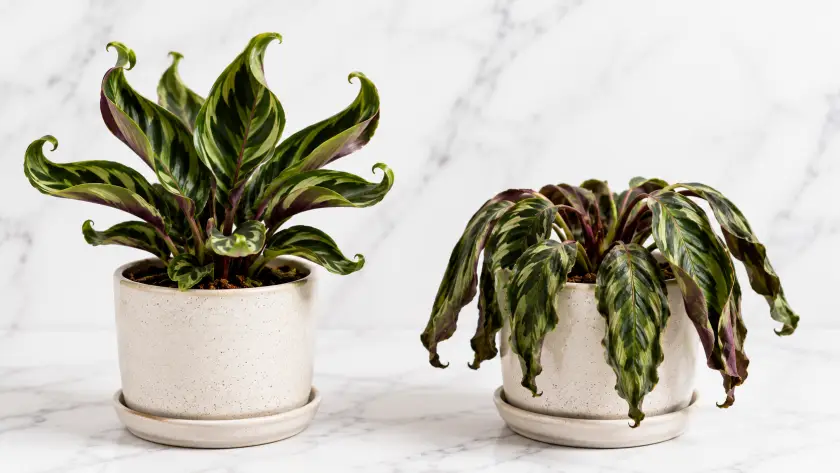
Upward curling leaves on plants — the leaf edges curl upward toward the central vein, forming a trough or U-shape when viewed from the end — typically indicate the plant is trying to reduce water loss from its upper leaf surface. The most common causes of upward leaf curl are heat stress from excessive temperatures or direct sun intensity, severe underwatering where the plant is limiting exposed surface to conserve remaining moisture, and low humidity causing faster-than-normal transpiration.
Diagnosis: Check the growing conditions — is the plant in direct sun during the hottest part of the day? Has watering been neglected? Is the room air very dry? For each species, our individual care guides cover the specific light and watering requirements: calathea, monstera, pothos, peace lily, snake plant.
Leaf curl treatment for upward curl: Move away from direct intense sun to bright filtered indirect light. Water thoroughly if soil is dry at 3–5cm depth. Increase humidity using the techniques in our humidity hacks guide and DIY humidity tray guide.
Downward Curling Leaves
Downward curling leaves — edges curl under and downward — typically indicate the opposite problem from upward curl. Where upward curl is the plant conserving water, downward curl is often the plant losing the structural integrity that keeps leaves extended because root function is compromised. The most common causes are overwatering and root rot (damaged roots can’t supply water to leaves even when soil is wet), nutrient toxicity from excess fertilizer damaging roots, and in some species, cold air exposure or temperature extremes.
Diagnosis: Check soil moisture — is it consistently wet? Does the soil smell sour or fermented? These confirm overwatering. Have you recently fed heavily? Fertilizer burn can cause downward curl within days of application. See our signs of overwatering guide and what is root rot guide.
Leaf curl treatment for downward curl: Allow soil to dry completely before next watering. If root rot is suspected, unpot and inspect — see our how to revive a dying plant guide. If fertilizer burn is suspected, flush soil thoroughly with plain water to dilute salt concentration.
Twisting or Wrinkled Leaf Curl
Twisting, distorted, or wrinkled leaf curl — where new leaves emerge already misshapen or existing leaves develop irregular curled patterns rather than curling uniformly — most commonly indicates pest infestation or leaf curl disease (fungal or viral infection). Pests that cause this type of curl by feeding on young growth include aphids, thrips, broad mites, and spider mites — all of which damage developing leaf tissue before it has fully expanded, causing permanent distortion in the mature leaf.
Diagnosis: Examine the undersides of leaves with a magnifying glass — tiny moving dots (spider mites), small oval insects (aphids or scale), or fine silvery stippling (thrips) confirm pest involvement. Distorted new growth with sticky honeydew residue strongly indicates aphid infestation. Leaf curl disease from fungal or viral causes typically produces yellowing alongside distortion and may show irregular spots or mottling.
Leaf curl treatment for distorted curl: Isolate the plant immediately to prevent spread. Treat aphids and thrips with insecticidal soap or neem oil applied to all leaf surfaces including undersides. Treat spider mites with 70% isopropyl alcohol on a cotton bud applied directly to visible mites, followed by neem oil spray weekly for 3 weeks. Prune severely distorted growth — the damaged tissue won’t recover and removing it improves airflow and reduces pest habitat.
Yellow Curling Leaves
Yellow curling leaves — where leaf curl is accompanied by yellowing rather than the green colour of heat-stress curl — indicate a combination of overwatering and poor drainage (the most common cause), root rot producing both colour change and physical distortion, or nutrient deficiency (particularly nitrogen, potassium, or magnesium) preventing the plant from maintaining healthy leaf tissue.
Diagnosis: Check soil moisture and root condition first — overwatering produces the most common version of yellow curling leaves. If soil is dry and watering is not excessive, consider nutrient deficiency — plants that haven’t been fed in 6–12 months or that are in heavily depleted old soil may show yellow curling as a deficiency symptom. See our why leaves turn yellow guide for complete yellowing diagnosis.
Leaves Turning Brown — The Complete Pattern Guide
Leaves turning brown in different patterns provide specific diagnostic information about the underlying cause. Reading the pattern accurately prevents the misdiagnosis that leads to wrong interventions.
Brown Tips on Plants
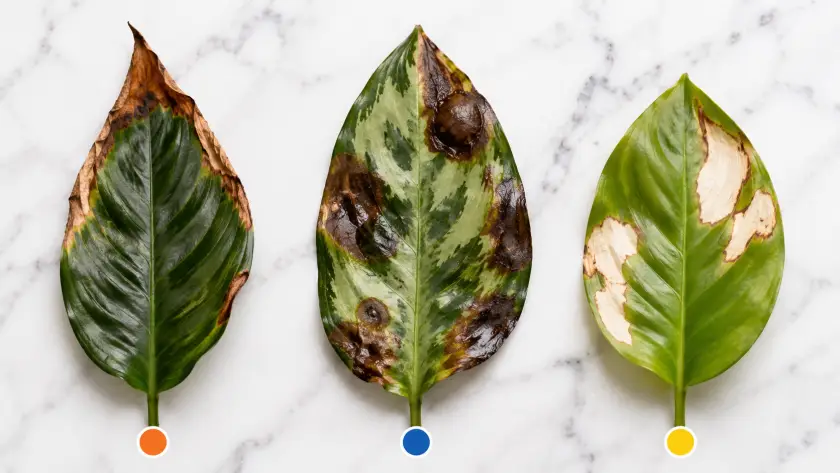
Brown tips on plants — browning that begins at the very tip of the leaf and progresses inward along the leaf edges while the central leaf tissue remains green — is the most common browning pattern in indoor houseplants and has three primary causes.
Low humidity produces crispy, dry brown tips on plants in tropical species (calathea, boston fern, peace lily, monstera) when indoor air is too dry. The tip tissue has the highest concentration of stomata and loses water fastest in low-humidity conditions. Treatment: implement the techniques in our humidity hacks guide.
Mineral salt accumulation from tap water or excess fertilizer builds up in the outermost leaf tissue where it reaches toxic concentrations first, producing brown tips on plants that look identical to humidity-related browning. Treatment: flush soil thoroughly with plain water (allowing 3–4 full pot volumes to drain through) and switch to filtered or rainwater for species sensitive to fluoride and chlorine — particularly spider plant, dracaena, calathea, and peace lily.
Inconsistent watering — allowing soil to swing between bone dry and waterlogged — stresses root systems enough to produce tip dieback even when individual waterings are correct. Treatment: establish a consistent soil-check-before-watering routine using our complete watering guide.
Important note: Brown tips that are already present won’t turn green again — the tissue is dead. Trim affected tips with clean scissors at a slight angle to restore a natural leaf shape, then address the underlying cause to prevent new tip browning on subsequent growth.
Brown Patches on Leaves
Brown patches on leaves — irregular brown areas in the middle of leaves rather than just at the tips or edges — have different causes from tip browning and require different leaf curl treatment approaches.
Sun scorch produces brown patches on leaves that were directly exposed to intense sunlight — typically on the top surface of leaves facing a bright window. The patches appear suddenly after a period of intense direct sun and have a crispy, bleached quality. Affected tissue is permanent but new growth in better-positioned light will be healthy. Move to bright filtered indirect light.
Fungal disease produces brown patches that are often circular or irregular with a yellow halo, and may show progression from small spots to larger merged areas over days. Improve air circulation, remove affected leaves with sterile scissors, and treat with copper-based fungicide or neem oil. Avoid overhead watering that wets foliage. See our signs of overwatering guide for overwatering-related fungal conditions.
Cold damage — sudden temperature drop from cold drafts, cold windows in winter, or accidental frost exposure — produces brown patches quickly, particularly on cold-sensitive tropical plants. Affected tissue is permanent but moving the plant to a warmer position prevents new damage.
Brown patches on peace lily leaves specifically deserve attention — peace lily develops brown patches from both overwatering and underwatering, from direct sun, and from fluoride sensitivity. The peace lily care guide covers peace lily browning diagnosis in full detail.
Houseplant Leaves Turning Brown and Crispy
Houseplant leaves turning brown and crispy — where entire leaves or large portions of leaves dry out completely to a crispy texture — indicate severe underwatering, very low humidity combined with heat, or root failure preventing water uptake. This is distinct from soft mushy browning which indicates overwatering.
Diagnosis: Touch the brown tissue — crispy and dry confirms water stress or humidity issues. Soft and mushy confirms overwatering or root rot. Check soil moisture — bone dry confirms underwatering, wet confirms root damage preventing water uptake despite adequate soil moisture. Our signs of overwatering guide covers the distinguishing characteristics of each.
For indoor plant leaves turning brown and crispy in calathea specifically — this is almost always a combination of low humidity and mineral sensitivity. Use our humidity hacks guide and switch to filtered water.
Plant Drooping Leaves — Diagnosis and Recovery
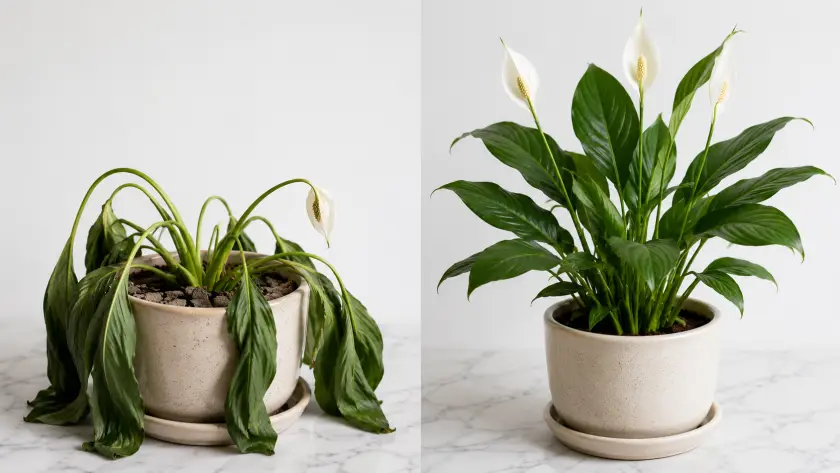
Plant drooping leaves — where leaves hang down rather than extending outward in their normal growth direction — result from turgor pressure loss in leaf cells. Turgor pressure is the internal water pressure that makes plant cells rigid and keeps leaves extended, and it depends entirely on the root system successfully absorbing and transporting adequate water to the leaves.
Drooping from Underwatering
The most intuitive plant drooping leaves cause — soil is dry, roots have no water to absorb, turgor pressure drops, leaves hang down. Curling leaves solutions for underwatering droop: water thoroughly until water drains from the bottom, empty the saucer, and observe. Most underwatered plants recover visible turgor within 2–4 hours. Peace lily is the most dramatic example — it collapses completely when underwatered but springs back within hours of correct watering.
Drooping from Overwatering
Plant drooping leaves from overwatering is the more dangerous and more commonly misdiagnosed situation — soil is wet, yet leaves droop, and the instinctive response of adding more water accelerates the root rot causing the problem. Drooping leaves care for overwatering requires opposite treatment: stop watering immediately, check drainage, and if drooping continues despite wet soil for more than 3–4 days, unpot and inspect roots. See our signs of overwatering guide and what is root rot guide.
The definitive droop test: Check soil moisture before doing anything else. Bone dry soil = underwatering droop, water immediately. Wet soil = overwatering droop, do not water, investigate roots.
Drooping from Root Bound Conditions
Plant drooping leaves in a plant with correct watering and adequate light can indicate root-bound conditions — where the root mass has become so dense and has replaced so much soil volume that the plant cannot absorb adequate water between waterings despite correct watering frequency. The plant dries out faster than the watering schedule accounts for. See our repotting mistakes guide for repotting a rootbound plant guidance.
Drooping from Sudden Light or Temperature Change
Moving a plant from shade to bright sun, or from a warm room to a cold one, produces temporary plant drooping leaves as the plant adjusts to the new conditions. This droop typically resolves within 3–7 days as the plant adapts — and no watering intervention is needed unless soil is genuinely dry.
Leaf Curling and Browning Together — The Most Urgent Plant Stress Signal
Leaf curling and browning occurring simultaneously indicate that multiple stressors are present or that a single stressor has reached a severe enough level to produce compound symptoms. When both symptoms appear together, the diagnostic approach should identify the primary cause while checking all connected factors:
Low humidity + inadequate watering — produces upward leaf curl and brown tips on plants simultaneously in tropical plants. Both symptoms improve together when humidity is raised and watering corrected.
Chronic overwatering progressing to root rot — produces downward leaf curl and soft brown patches or yellowing together, as root function deteriorates. Treatment requires active root inspection and repotting. See our how to revive a dying plant guide.
Pest infestation with secondary fungal infection — produces distorted leaf curl alongside brown patches where the pest damage has allowed fungal entry. Treat both simultaneously — pests first, then fungal infection — using neem oil which has efficacy against both.
Heat stress + underwatering — produces upward leaf curl with crispy brown tips on plants and eventually crispy houseplant leaves turning brown and crispy entirely. Move to a cooler, filtered light position and water correctly.
Leaf Curl and Browning by Plant — Common Species Patterns
Calathea leaf curl and browning: The most common cause is low humidity combined with mineral sensitivity from tap water. Calathea produces upward leaf curl at edges and crispy brown tips on plants simultaneously. Relocate to a more humid position, switch to filtered water, and implement our humidity hacks guide.
Monstera leaf curl: Upward curl typically indicates underwatering or low humidity. Downward curl with yellowing indicates overwatering. New leaves that emerge curled and don’t fully unfurl indicate the plant needs higher humidity during the critical leaf development period.
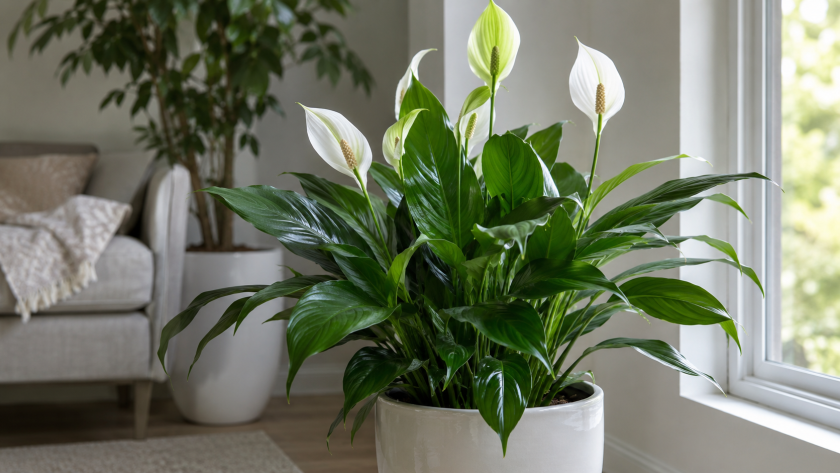
Peace lily drooping and browning: Dramatic drooping from underwatering (resolves within hours of watering), combined leaf curling and browning from low humidity, and black leaf tips from overwatering. The most variable browning pattern of any common houseplant — see the peace lily care guide for specific symptom diagnosis.
Pothos leaf curl: Rarely curls unless severely underwatered or root-bound. Yellowing with slight downward curl indicates overwatering. Brown tips indicate low humidity or mineral accumulation.
Snake plant browning: Brown tips from overwatering (soft mushy base) or underwatering (dry crispy tip). Wrinkling or curving of normally flat leaves indicates severe underwatering. One of the most resilient plants for leaf curl resistance — curling in a snake plant indicates significant neglect.
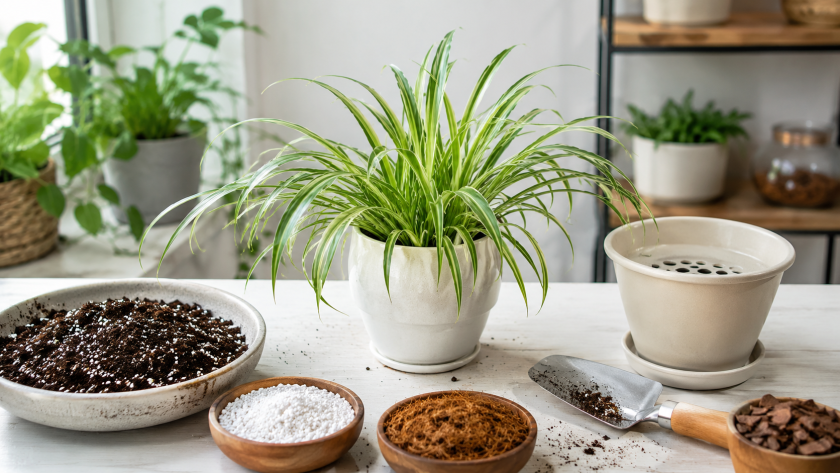
Spider plant brown tips: Almost always mineral sensitivity from fluoride and chlorine in tap water, or low humidity. Switch to filtered water and increase humidity. Extremely reliable indicator of water quality issues.
Rubber plant drooping: Heavy leaves drooping typically indicates underwatering — the rubber plant holds significant leaf weight and droops visibly when turgor pressure drops. Recover with thorough watering.
Fiddle leaf fig brown patches: The most symptom-sensitive of all common houseplants. Brown spots from overwatering (soft, dark, starts from centre of patch), underwatering (crispy edges), root rot (spreading irregular patches), bacterial infection (small spots with yellow halo), and sun scorch (bleached crispy patches on exposed side) all produce distinct patterns.
ZZ plant yellowing: Almost always overwatering — ZZ plant stores water in rhizomes and rarely needs watering. Yellow leaf curl with wet soil is a definitive overwatering indicator in ZZ plant.
Dracaena brown tips: Fluoride sensitivity producing crispy brown tips is the most common dracaena leaf problem. Use filtered water and avoid fluoride-containing fertilizers.
Bird of paradise leaf splitting and curl: Natural leaf splitting is normal and healthy. Curling edges indicate underwatering or low humidity. Brown tips indicate low humidity or mineral accumulation.
How to Fix Leaf Curl — The Correct Leaf Curl Treatment by Cause
Leaf curl treatment must match the specific cause — applying the wrong remedy delays recovery and can cause additional damage. Use the diagnosis from the sections above to identify the cause, then apply the corresponding treatment:
Heat stress curl: Move to a cooler position with filtered rather than direct light. Ensure adequate watering. Recovery within 1–2 weeks in corrected conditions. See our complete indoor light guide.
Underwatering curl: Water thoroughly using the soak-and-drain method. Check soil moisture every few days going forward rather than following a fixed schedule. See our complete watering guide.
Overwatering curl: Stop watering, improve drainage, check roots. If root rot is present, treat using our how to revive a dying plant guide and what is root rot guide.
Low humidity curl and browning: Implement grouped planting, pebble trays, bathroom positioning, or misting using our humidity hacks guide and DIY humidity tray guide.
Pest-related curl: Isolate immediately. Identify pest type and treat with appropriate method. Apply neem oil preventively to all nearby plants. Monitor weekly for 4–6 weeks.
Nutrient deficiency curl: Resume regular feeding with balanced fertilizer at correct dose for the plant type. See our fertilizing indoor vs outdoor plants guide.
Mineral accumulation browning: Flush soil with plain water (3–4 full pot volumes), switch to filtered water, and reduce fertilizer to half-recommended dose for 2 months.
Frequently Asked Questions
Why do my plant’s leaves curl inward? Leaf curl inward (upward) typically indicates heat stress, excessive direct sun, severe underwatering, or very low humidity — the leaf reduces its exposed surface area to slow water loss. Check conditions in sequence: Is the plant in direct sun? Is soil dry at 3–5cm depth? Is the room air very dry? Correct the first factor identified and monitor for improvement over 7–14 days. See our complete indoor light guide and humidity hacks guide.
What causes brown tips on plants? Brown tips on plants are caused by low humidity (the most common cause in tropical houseplants), mineral salt accumulation from tap water or excess fertilizer, inconsistent watering causing root stress, or fluoride sensitivity in species like spider plant, dracaena, and peace lily. The browning is always crispy and dry (not soft and mushy) from these causes — soft mushy browning indicates overwatering or disease rather than tip browning causes.
Why are my houseplant leaves turning brown and crispy? Houseplant leaves turning brown and crispy indicate severe underwatering, very low humidity combined with heat, or root failure preventing water uptake despite watering. Touch test the brown tissue — crispy confirms water stress or humidity issues. Check soil — bone dry confirms underwatering, wet confirms root damage. Our signs of overwatering guide covers distinguishing between the two causes.
What’s the difference between drooping and curling? Plant drooping leaves indicate turgor pressure loss — insufficient water reaching leaf cells from root absorption failure or genuine underwatering — producing leaves that hang down rather than extending normally. Leaf curl indicates a specific physical response to environmental stress — heat, low humidity, pests, or nutrient issues — producing leaves that change shape while often retaining their normal orientation. Drooping is primarily a water transport issue. Leaf curl is primarily an environmental response.
Can leaf curl disease be cured? Leaf curl disease from viral causes cannot be cured — affected plants should be isolated and monitored, with severely affected growth pruned. Leaf curl disease from fungal causes can be managed with copper-based fungicide applied to all leaf surfaces, improved air circulation, and removal of affected tissue. Prevention through correct spacing, avoiding overhead watering, and maintaining plant vigour through correct care is more effective than treatment after infection.
How do I fix yellow curling leaves? Yellow curling leaves most commonly result from overwatering — check soil moisture first. If soil is consistently wet with this symptom, see our signs of overwatering guide and what is root rot guide. If watering is correct, check for nutrient deficiency — see our fertilizing guide. If both are correct, check for root-bound conditions using our repotting mistakes guide.
Which plants are least likely to suffer from leaf curl? Plants least prone to leaf curl are drought-adapted low-humidity-tolerant species — snake plant, ZZ plant, succulent, jade plant, and cast iron plant all tolerate the variable humidity, inconsistent watering, and temperature fluctuations of typical home environments without developing the leaf symptoms that affect more demanding tropical species.
Related Guides
- Why Leaves Turn Yellow
- Signs You’re Overwatering
- What Is Root Rot Guide
- How to Revive a Dying Plant
- Complete Watering Guide
- Complete Indoor Light Guide
- Humidity Hacks Guide
- DIY Humidity Tray Guide
- Fertilizing Indoor vs Outdoor
- Repotting Mistakes to Avoid
- How to Repot a Plant
- Best Soil Mix Guide
- Calathea Care Guide
- Monstera Care Guide
- Peace Lily Care Guide
- Pothos Care Guide
- Snake Plant Care Guide
- Spider Plant Care Guide
- Rubber Plant Care Guide
- Fiddle Leaf Fig Care Guide
- ZZ Plant Care Guide
- Dracaena Care Guide
- Bird of Paradise Care Guide
- Boston Fern Care Guide
- Philodendron Care Guide
- Money Tree Care Guide
- Christmas Cactus Care Guide
- Aloe Vera Care Guide
- Jade Plant Care Guide
- Succulent Care Guide
- String of Pearls Care Guide
- How to Propagate Houseplants
- 35 Low Maintenance Plants
- Best Indoor Plants for Beginners
- 33 Best Bathroom Plants
- 20 Oversized Indoor Plants
- Office Friendly Plants Guide
- Air Purifying Indoor Plants
- Low Light Hanging Plants
- Keep Pests Away Outdoor Plants
- Best Low Maintenance Outdoor Plants
- Top Drought Resistant Plants
- Cat Friendly Plants Guide
- Dog Friendly Plants Guide
- Style Indoor Plants by Room
- Browse All Plant Care →
- Browse All Indoor Plants →
Final Thoughts
Plants communicate through their leaves — and leaf curl, browning, and droop are the most expressive parts of that language. Learning to read these signals accurately is the skill that separates plant owners who lose plants to problems that were entirely fixable from those who catch issues early, apply the right intervention, and watch their plants recover and grow stronger.
The essential habit is observation before action — looking at the specific pattern of the symptom, checking the soil, assessing the environment, and identifying the cause before deciding what to do. A plant that droops in wet soil needs opposite treatment from a plant that droops in dry soil. Leaf curl that goes upward needs different intervention from leaf curl that goes downward. Brown tips on plants that are crispy indicate different problems from browning that is soft and mushy.
According to the Royal Horticultural Society (RHS), the majority of houseplant health problems — including leaf curl, leaves turning brown, and plant drooping leaves — are directly caused by environmental factors that are within the plant owner’s control, with incorrect watering, inappropriate light, and inadequate humidity accounting for the vast majority of leaf symptom presentations seen in UK houseplant collections. 🌿
[…] Leaf curl, browning, and droop […]
[…] foliage as well as flowers, read colorful foliage indoor plants. For plant problem support, use leaf curl, browning, and droop and why plant leaves turn […]
[…] plant troubleshooting, read leaf curl, browning, and droop, why plant leaves turn yellow, and how to revive a dying […]
[…] problem-solving, use root rot guide, yellow leaves on plants, leaf curl, browning and droop, and how to revive a dying […]
[…] Leaf curl, browning and droop […]
[…] more problem help, read yellow leaves on plants, leaf curl, browning and droop, root rot guide, and how to keep pests away from outdoor […]
[…] symptom guides, read yellow leaves on plants, leaf curl, browning and droop, root rot guide, and how to revive a dying […]
[…] more troubleshooting, read leaf curl, browning and droop, root rot guide, and how to revive a dying […]