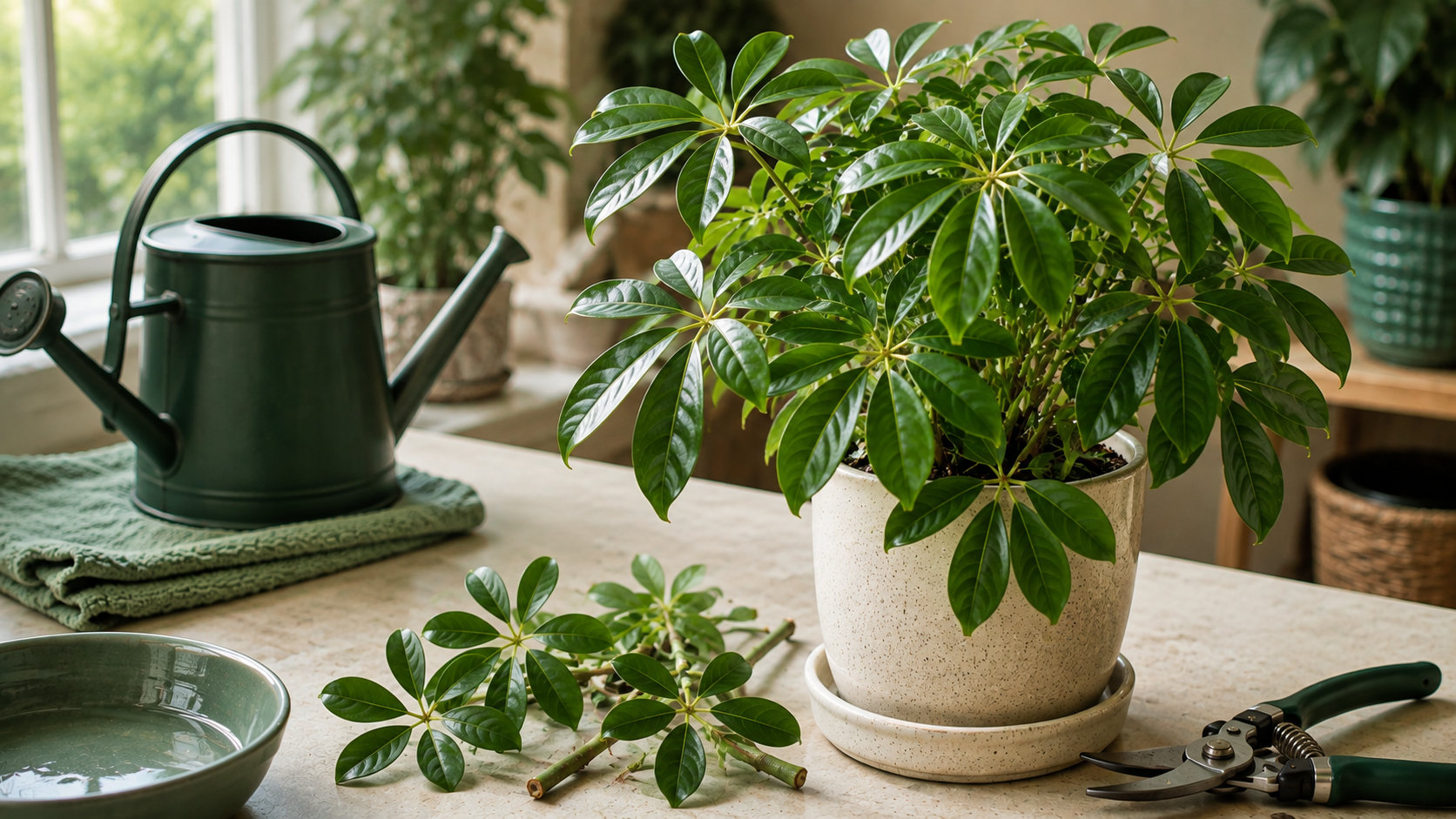
Schefflera pruning keeps an umbrella plant compact, balanced, and easier to manage indoors. Left alone, schefflera can become tall, top-heavy, bare on the lower stems, or uneven from leaning toward the light.
The good news is that pruning schefflera is not difficult. You only need clean tools, good timing, and a clear idea of where to cut. This guide shows you how to trim leggy stems, shape the canopy, reduce height, avoid over-pruning, and help your plant recover with strong new growth.
The Simple Trim Plan
The best schefflera pruning routine is simple: prune mainly in spring or summer, remove dead or damaged growth first, shorten leggy stems just above a leaf node, shape one stem at a time, and place the plant in bright indirect light afterward. Do not remove too much healthy foliage in one session, especially if the plant is stressed, recently repotted, dry, pest-infested, or growing in low light.
Key Takeaways
- Schefflera pruning helps control height, encourage branching, and keep the plant fuller.
- The best time to prune schefflera is usually spring or summer during active growth.
- Cut just above a leaf node or branch junction so the plant can branch from that point.
- Use sharp, clean pruners or scissors to avoid crushed stems and rough cuts.
- Remove dead, diseased, damaged, and pest-affected growth before shaping.
- After pruning, give bright indirect light and avoid overwatering while the plant recovers.
- Use this guide with pruning basics, Schefflera plant problems, and complete guide to indoor light.
Schefflera Pruning at a Glance
| Pruning Task | Best Time | Where to Cut |
|---|---|---|
| Remove dead leaves or stems | Any time | Back to healthy tissue or the stem base |
| Shorten leggy stems | Spring or summer | Just above a leaf node |
| Control height | Active growing season | Above a node at the height you want |
| Pinch soft tips | During active growth | Above a young leaf pair or growth point |
| Thin crowded growth | Spring or summer | At the branch junction |
| Correct pest damage | As soon as needed | Below damaged growth, into healthy tissue |
| Major renovation | Spring, when plant is strong | Gradually, over more than one session |
Why Schefflera Pruning Matters
Schefflera naturally grows upward and outward. Indoors, light often reaches the plant from one direction, so stems may lean, stretch, or grow unevenly. Pruning helps redirect growth and keeps the plant from becoming a tall, bare umbrella on thin stems.
Pruning improves shape
Trimming individual stems lets you keep the plant rounded, upright, or tree-like. Instead of cutting everything flat across the top, prune one stem at a time so the plant keeps a natural shape.
Pruning encourages fullness
When you cut above a healthy node, the plant can respond with new side growth. This is especially useful for a leggy schefflera with long stems and most leaves at the top.
Pruning reduces weak growth
Long, thin stems often happen when the plant has been growing in too little light. Trimming helps, but light correction matters too. Without better light, new growth may become leggy again.
Pruning removes problems early
Yellow leaves, broken stems, pest-damaged tips, and rubbing branches should be removed before they drain energy or spread problems through the plant.
When to Prune Schefflera
The best time to prune schefflera is when the plant is actively growing. For most indoor plants, that means spring through summer. During this period, the plant has better light, warmer conditions, and more energy to produce new shoots.
Spring pruning
Spring is the best time for bigger shaping. The plant is coming out of slower winter growth, and new leaves usually respond more strongly.
Summer pruning
Summer is also good for light trimming, tip pinching, and correcting uneven growth. Just avoid heavy pruning during extreme heat or drought stress.
Autumn pruning
Light cleanup is fine in autumn, especially if you are removing dead, yellow, or damaged leaves. Avoid major cuts if the plant is already slowing down.
Winter pruning
Winter is not ideal for heavy pruning because indoor light is lower and growth is slower. Remove dead or diseased growth if needed, but save shaping for spring when possible.
Immediate corrective pruning
You do not need to wait for spring to remove broken, dead, diseased, or heavily pest-infested stems. That kind of pruning protects the plant and keeps the problem from getting worse.
Signs Your Schefflera Needs Trimming
Your plant will usually show you when it needs trimming. Look at the whole plant from all sides before deciding where to cut.
Common signs
- Long bare stems with leaves only at the top.
- One side growing much fuller than the other.
- Branches leaning toward the window.
- Stems crossing, rubbing, or growing inward.
- Top growth becoming too heavy for the pot.
- Yellow, damaged, or pest-marked leaves.
- The plant touching the ceiling, wall, curtain, or furniture.
When trimming is not the first fix
If your schefflera is dropping many leaves, sitting in soggy soil, or showing active pest damage, solve the stress first. Pruning a weak plant too heavily can slow recovery.
For symptom help, read Schefflera plant problems, yellow leaves on plants, and leaf curl, browning and droop.
Gather the Right Schefflera Pruning Tools
Clean tools make cleaner cuts. A crushed or ragged stem is harder for the plant to seal and can look messy as it dries.
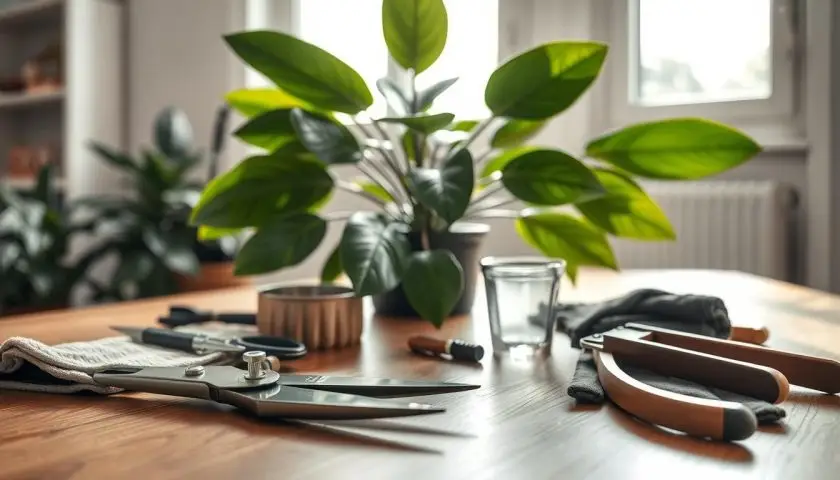
Best tools for indoor schefflera
- Sharp hand pruners: Best for woody stems and mature plants.
- Clean scissors: Useful for soft young tips and small leaves.
- Small loppers: Helpful only for thick outdoor or oversized stems.
- Rubbing alcohol: Useful for cleaning blades before and during pruning.
- Gloves: Helpful if plant sap irritates your skin.
- Trash bag: Keeps pest-damaged leaves and cut stems contained.
How to clean pruning blades
- Wipe dirt or sap from the blade.
- Disinfect with rubbing alcohol or a suitable disinfectant.
- Let the blade dry briefly.
- Clean again after cutting pest-damaged or suspicious stems.
- Wipe tools dry before storing them.
Why sharp blades matter
Sharp blades make a clean cut. Dull scissors can crush a schefflera stem, leaving ragged tissue that dries unevenly.
Assess the Plant Before You Cut
Do not start cutting from the top without a plan. Schefflera looks best when pruned stem by stem.
Turn the plant slowly
Rotate the pot and look at the plant from every angle. Notice which side is fullest, which stems are leaning, and where the plant has bare sections.
Find the main stems
Some schefflera plants grow as a cluster of several stems. Others are trained like a small tree. Identify the main framework before removing anything large.
Choose your goal
- Do you want the plant shorter?
- Do you want it bushier?
- Do you want a tree-like shape?
- Do you need to remove damaged growth?
- Do you need to correct one-sided growth?
Plan modest cuts first
Start with the most obvious problem stems. You can always prune more later, but you cannot put a large stem back once it is cut.
How to Prune a Schefflera Plant Step by Step
This simple method works for most indoor umbrella plants, including dwarf umbrella tree and larger schefflera types.
Step 1: Remove dead and damaged growth
Cut off dead stems, broken branches, and damaged leaves first. If a stem is partly alive, cut back to firm, healthy tissue.
Step 2: Remove pest-affected growth
If you see scale, mealybugs, sticky residue, webbing, or badly damaged tips, remove the worst affected growth and isolate the plant if needed.
Step 3: Shorten leggy stems
Find a long bare stem and look for a leaf node. Cut just above that node. New side shoots often develop below the cut when light and care are right.
Step 4: Reduce height gradually
If the plant is too tall, shorten the tallest stems first. Avoid cutting every main stem to the same height unless you want a very blunt, artificial look.
Step 5: Shape the sides
Trim outward or uneven branches to balance the canopy. Work around the plant slowly instead of cutting one side heavily.
Step 6: Thin crowded interior growth
If the centre is packed with weak, crossing, or inward-growing stems, remove a few to improve airflow and make the plant look cleaner.
Step 7: Step back and stop early
After several cuts, step back. Schefflera often looks better when you stop before it looks “finished.” New growth will fill in over the next few weeks.
Where Exactly to Make Schefflera Cuts
Cut placement is the most important part of how to prune a schefflera plant. A good cut encourages better regrowth and avoids ugly stubs.
Cut above a leaf node
A node is the point where a leaf or branch grows from the stem. Make your cut just above this point, leaving a small clean section of stem.
Cut at a branch junction
When removing a whole side branch, cut close to the branch junction without tearing the main stem.
Avoid long bare stubs
Long stubs can dry back and look untidy. They may also fail to produce the neat new growth you want.
Do not cut into soft wet tissue repeatedly
If a stem looks mushy or rotted, cut back to firm tissue and review your watering routine. Mushy stems often point to root or stem stress.
How to Fix a Leggy Schefflera
A leggy schefflera usually has long stretched stems, sparse lower leaves, and a top-heavy canopy. Pruning helps, but light is the real long-term fix.
Why schefflera gets leggy
- Too little usable light.
- The plant is far from a window.
- One side faces the light all the time.
- The plant has not been rotated.
- It has not been pinched or shaped for a long time.
- It was overfed in low light.
Leggy plant pruning method
- Move the plant to bright indirect light before or soon after pruning.
- Choose the longest bare stems.
- Cut each one above a healthy node.
- Leave enough foliage so the plant can keep making energy.
- Rotate the pot weekly while new shoots develop.
- Pinch new tips once they grow enough to branch.
When the plant has leaves only at the top
If most leaves are only at the top, do not remove everything in one session. Shorten one or two stems first, wait for new growth, then continue shaping later.
For light fixes, read complete guide to indoor light, low light house plants, and house plants that like direct sunlight.
How to Shape Schefflera for Fuller Growth
A fuller schefflera usually comes from regular light trimming, better light, and patience. The goal is not to cut the plant into a ball. The goal is to guide the plant into a balanced shape.
For a bushy plant
- Pinch soft growing tips during active growth.
- Shorten long stems above nodes.
- Rotate the plant for even light.
- Keep the plant close enough to bright indirect light.
- Avoid overfeeding in low light.
For a tree-like plant
- Keep the strongest upright stems.
- Remove low weak growth gradually.
- Shape the top canopy lightly.
- Use a support stake if the trunk bends.
- Avoid stripping too many lower leaves at once.
For an uneven plant
Trim the longer side more lightly than you think. Then rotate the weaker side toward brighter light. This encourages more balanced future growth.
Schefflera Arboricola Pruning vs Larger Schefflera
Schefflera arboricola pruning is usually easier because the plant is naturally smaller and bushier. Larger umbrella tree types may need stronger height control and support.
Dwarf umbrella tree
Dwarf umbrella tree responds well to light trimming and tip pinching. It is a good candidate for keeping compact on a desk, shelf, plant stand, or small indoor corner.
Larger umbrella tree
Larger schefflera plants can become tall indoor trees. Prune individual stems to keep the height manageable, and avoid removing too many leaves from the top all at once.
Variegated schefflera
Variegated plants need enough light to keep their pattern strong. If green-only shoots appear and dominate the plant, you can trim them back to protect the variegated look.
Schefflera Outdoor Pruning
Outdoor schefflera can grow faster and larger where the climate is warm enough. Outdoor pruning follows the same basic rules, but timing and weather matter more.
Best outdoor pruning timing
Prune after cold risk has passed and before harsh heat. Spring is usually safer for major shaping.
Do not prune before frost
Fresh cuts and tender regrowth can be damaged by cold. If cold weather is expected, delay major pruning.
Do not prune during heat stress
If the plant is wilting, sunburned, dry, or heat-stressed, water and stabilize it first. Prune once it is actively growing again.
Thin crowded stems
Outdoor plants may become dense. Light thinning can improve airflow and make pest checks easier.
For outdoor plant care, read how to keep outdoor plants alive, outdoor plants for storms and heatwaves, and garden calendar.
Care After Schefflera Pruning
Schefflera care after pruning should be steady, not dramatic. Do not overwater, overfeed, or move the plant repeatedly after trimming.
Light after pruning
Place the plant in bright indirect light. Strong recovery depends on enough light for new growth.
Water after pruning
Check the soil before watering. A plant with fewer leaves may use water more slowly for a while.
Fertilizer after pruning
Wait until you see new growth before feeding. Fertilizer will not force recovery if the plant is stressed, dry, or overwatered.
Humidity after pruning
Normal indoor humidity is usually fine, but very dry air can slow recovery. A humidity tray or plant grouping can help if leaf edges dry quickly.
Watch new shoots
New growth may appear below the cut when the plant is healthy and light is strong enough. If nothing happens for several weeks, review light, watering, root health, and temperature.
For aftercare basics, read complete watering guide, signs you are overwatering, and fertilizing indoor vs outdoor plants.
Common Schefflera Pruning Mistakes
| Mistake | What Happens | Better Choice |
|---|---|---|
| Using dirty blades | Pests or disease can spread | Clean tools before and during pruning |
| Cutting in deep winter | Recovery is slower | Save major shaping for spring or summer |
| Leaving long stubs | Stems dry back and look untidy | Cut just above a node or junction |
| Removing too many leaves | The plant loses energy-making foliage | Prune gradually |
| Pruning without fixing light | New growth becomes leggy again | Move to bright indirect light |
| Watering heavily after pruning | Soil may stay wet too long | Check soil before watering |
| Ignoring pests | New growth can be damaged quickly | Inspect leaves and stems after trimming |
Problems After Pruning Schefflera
A little temporary stress is normal after pruning, but major drooping, yellowing, or leaf drop means something else may be wrong.
| Problem | Likely Cause | First Fix |
|---|---|---|
| Drooping after pruning | Shock, dry soil, wet roots, or low light | Check soil and move to bright indirect light |
| Yellow leaves | Overwatering, old leaves, root stress, pests | Check drainage and roots |
| No new growth | Low light, cold room, weak roots, slow season | Improve warmth and light |
| Brown cut tips | Normal drying or rough cuts | Use sharper tools next time |
| Sticky leaves | Scale or other sap-feeding pests | Inspect stems and leaf undersides |
| New shoots are pale and weak | Not enough light | Move closer to bright filtered light |
For troubleshooting, read yellow leaves on plants, root rot guide, how to revive a dying plant, and how to clean plant leaves.
Can You Propagate Schefflera From Pruning?
Yes, healthy stem tips removed during pruning can often be used as cuttings. This is a good way to save material from a plant that has grown too tall.
Basic cutting method
- Choose a healthy non-rotten stem tip.
- Cut below a node with clean pruners.
- Remove lower leaves so no leaves sit in the rooting medium.
- Place the cutting in water or a light propagation mix.
- Keep it warm with bright indirect light.
- Move to potting mix once roots are strong enough.
When not to propagate
Do not use cuttings from pest-infested, mushy, diseased, or badly weakened stems. Healthy cuttings root more reliably.
For related skills, read how to propagate houseplants, how to repot a plant, and repotting mistakes to avoid.
Schefflera Pruning Frequency
How often you prune depends on growth speed, light, plant size, and the shape you want.
For a compact tabletop plant
Pinch or trim soft tips every few months during active growth. This keeps growth denser.
For a floor plant
Shape lightly once or twice a year. Remove problem stems as needed.
For a tall indoor tree
Do a larger structural prune in spring, then light touch-ups during summer.
For a stressed plant
Do not prune for appearance until the plant is stable. Remove only dead, diseased, or damaged growth.
Helpful PATCH Guides for Schefflera Pruning
Use these PATCH guides to improve pruning, light, watering, pest care, repotting, and long-term houseplant health.
Schefflera and Pruning Guides
- Schefflera Plant Problems
- Pruning Basics
- Plant Care hub
- How to clean plant leaves
- How to revive a dying plant
Light, Water and Soil Guides
- Complete guide to indoor light
- House plants that like direct sunlight
- Low light house plants
- Small low light indoor plants
- Complete watering guide
- Worst times to water plants
- Signs you are overwatering
- Best soil mix guide
- How to repot a plant
- Fertilizing indoor vs outdoor plants
Plant Problem Guides
- Yellow leaves on plants
- Why plant leaves turn yellow
- Leaf curl, browning and droop
- Root rot guide
- How to keep pests away from outdoor plants
- Misting for plants
- Humidity hacks
Indoor Plant Guides
- Indoor Plants hub
- Tropical house plants
- Best indoor plants for beginners
- Best indoor plants for first-time plant parents
- Best indoor plants for tiny apartments
- Oversized indoor plants
- Blooming indoor plants
- Colorful foliage indoor plants
- Create an indoor jungle without overcrowding
- Style indoor plants by room
Specific Plant Care Guides
- Parlor Palm dying
- Tall Snake Plant
- Snake Plant care guide
- Dracaena care guide
- Rubber Plant care guide
- Fiddle Leaf Fig care guide
- Monstera plant care guide
- Pothos plant care guide
- Philodendron care guide
- ZZ Plant care guide
- Spider Plant care guide
- Peace Lily care guide
Styling and Support Guides
- Moss pole for plants
- Indoor plants as room dividers
- Statement plants for minimalist interiors
- Scandi home with plants
- Decorate your bedroom with plants
- Improve your home office with plants
- Best office plants
- Office-friendly plants
Frequently Asked Questions
When is the best time to prune schefflera?
The best time to prune schefflera is spring or summer, when the plant is actively growing. Light cleanup can be done any time if you are removing dead, broken, or diseased growth.
Where should I cut when pruning schefflera?
Cut just above a leaf node, leaf point, or branch junction. This gives the plant a better chance of branching below the cut and avoids long bare stubs.
Can I prune schefflera if it is leggy?
Yes. Cut leggy stems back above healthy nodes, then improve the light. If the plant stays in low light, new growth may stretch again.
How much schefflera can I cut back at once?
For normal indoor pruning, remove a modest amount of healthy foliage at one time. If the plant needs a major renovation, spread the work over more than one session.
Should I prune yellow schefflera leaves?
Remove fully yellow, dead, or damaged leaves. If many leaves are yellowing at once, check watering, drainage, light, pests, and root health before doing heavy pruning.
Can I prune schefflera in winter?
You can remove dead or damaged growth in winter, but heavy shaping is better in spring or summer when the plant can recover faster.
What tools are best for schefflera pruning?
Use sharp hand pruners for woody stems and clean scissors for soft tips. Disinfect blades before pruning and between suspect cuts.
Why is my schefflera drooping after pruning?
Drooping after pruning can come from shock, dry soil, wet roots, low light, or temperature stress. Check the soil before watering and keep the plant in bright indirect light.
Can I propagate schefflera cuttings after pruning?
Yes. Healthy stem tips can be rooted in water or a light propagation mix. Avoid using diseased, pest-infested, or mushy cuttings.
How do I make schefflera bushier?
Prune above nodes, pinch soft tips during active growth, rotate the pot regularly, and give bright indirect light. Bushier growth depends on both pruning and enough light.
Final Thoughts
Schefflera pruning is easiest when you treat it as shaping, not chopping. Remove damaged growth first, shorten leggy stems above nodes, and trim one stem at a time so the plant keeps a natural umbrella shape.
Ask Extension explains that indoor schefflera may need pruning to stay manageable, that trimming is best in spring or summer during active growth, and that cuts should be made just above the point where a leaf grows from the stem: Ask Extension schefflera pruning advice.
After pruning, give the plant bright indirect light, careful watering, and time. If the plant is healthy, new growth should help fill the shape over the next few weeks.
Final Recap
Schefflera pruning helps keep umbrella plants compact, full, balanced, and easier to manage indoors. The best time to prune schefflera is spring or summer, when the plant is actively growing. Start by removing dead, damaged, diseased, or pest-affected growth. Then shorten leggy stems just above healthy leaf nodes, thin crowded branches, and shape the canopy gradually. Use sharp clean pruners, avoid long stubs, and do not remove too much healthy foliage at once. After pruning, place the plant in bright indirect light, water only when the soil needs it, wait to fertilize until new growth appears, and watch for yellow leaves, drooping, pests, or root stress. With careful cuts and steady aftercare, schefflera can grow fuller, stronger, and better shaped over time.