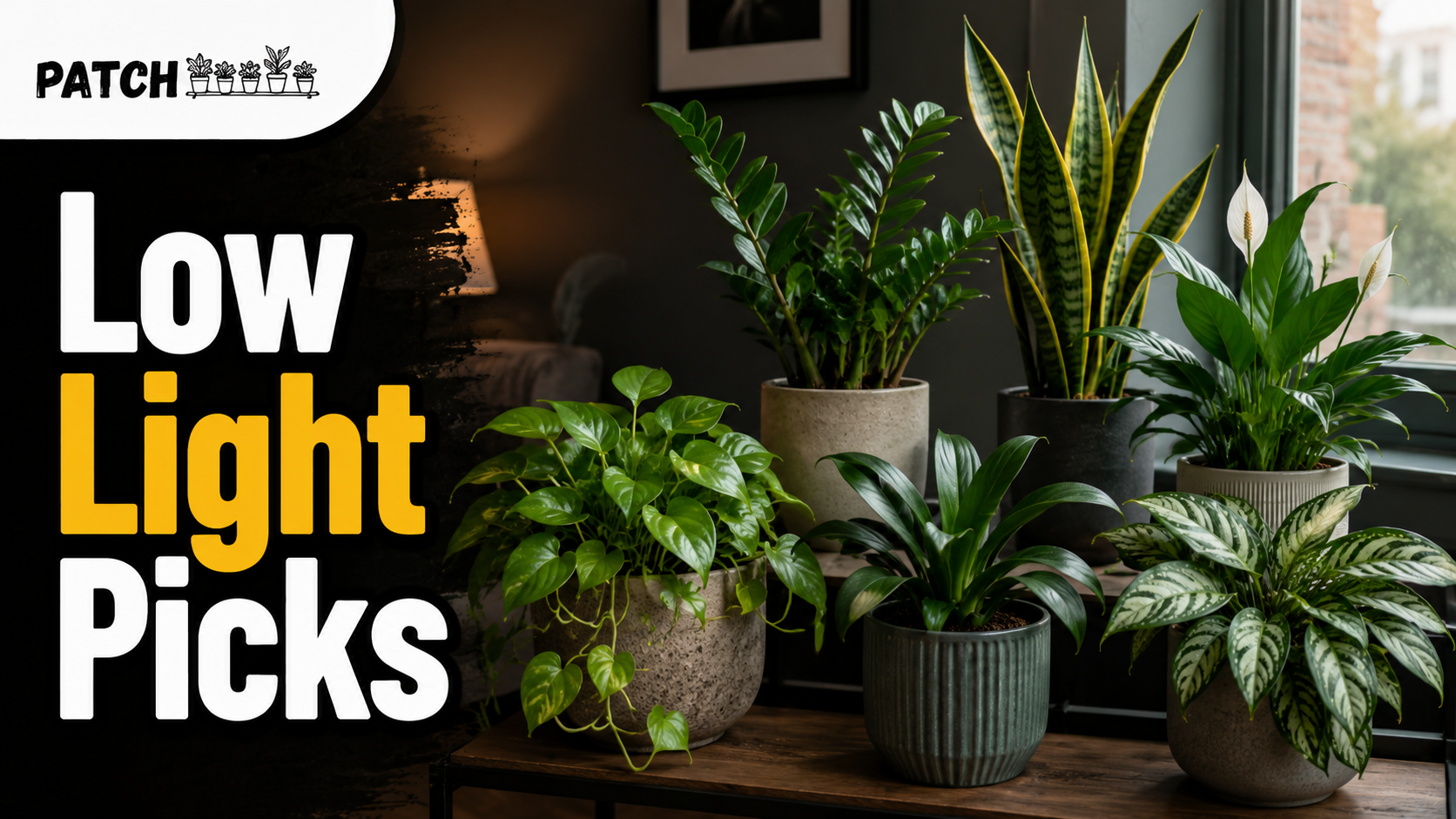
Low light house plants are ideal for homes that lack large, sunny windows. From snake plants and ZZ plants to cast iron plants, pothos, and Chinese evergreens, several indoor species can tolerate the softer daylight found in north-facing rooms, shaded apartments, bedrooms, and offices.
But there is an important difference between a plant that tolerates low light and one that grows well in it. Even shade-tolerant houseplants need enough light for photosynthesis. A windowless room with no suitable artificial lighting cannot support healthy long-term growth simply because you choose a tough plant.
This guide compares 19 popular indoor plants for low to moderate light, identifies the best options for genuinely dim spaces, and explains watering, placement, grow lights, pet safety, and common problems. It also points out which attractive plants actually need more light than their reputation suggests.
What Are the Best Low Light House Plants?
The best low light house plants for most homes are snake plant, ZZ plant, cast iron plant, Chinese evergreen, pothos, heartleaf philodendron, and parlor palm. These plants tolerate relatively low levels of indirect light, although they generally grow faster or more vigorously when conditions are brighter.
For a beginner who sometimes forgets to water, start with a snake plant or ZZ plant. For a trailing shelf plant, choose green pothos or heartleaf philodendron. For a leafy plant in a shaded room, consider cast iron plant or a green Chinese evergreen.
For a bathroom with a window and suitable humidity, peace lily or Boston fern may be attractive, although ferns need more consistent moisture and usually appreciate brighter filtered light.
Key Takeaways
- Low light means reduced but usable light, not total darkness.
- Snake plant, ZZ plant, cast iron plant, Chinese evergreen, pothos, and heartleaf philodendron are reliable low-light-tolerant choices.
- Boston fern, Calathea, spider plant, rubber plant, Peperomia, and African violet generally perform better with at least medium or bright indirect light.
- Plants often grow more slowly and use less water in lower light, so watering should follow soil conditions rather than a fixed schedule.
- A windowless bathroom or hallway needs a suitable grow light if plants are expected to grow there long-term.
- Pet safety varies: cast iron plant, parlor palm, Boston fern, and spider plant are among the commonly grown plants listed as non-toxic by the ASPCA.
- Houseplants should not be relied upon as substitutes for ventilation or air filtration.
What Does Low Light Mean for Indoor Plants?
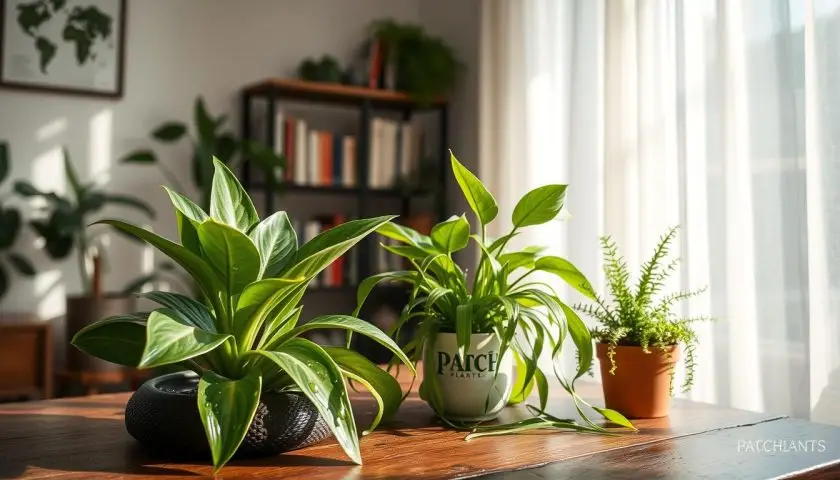
In indoor gardening, low light generally describes areas receiving weak natural or artificial illumination. These locations may include a north-facing window, a shaded windowsill, or a room where daylight reaches the plant without direct sunshine.
According to the University of Minnesota Extension’s guide to indoor plant lighting, low-light environments are approximately 50–250 foot-candles. Actual readings vary throughout the day, and species differ in their ability to use limited light.
The important point is that low light is not the same as no light. Plants still require enough light energy to maintain their leaves, roots, and normal biological processes.
Low Light vs. Medium Light vs. Bright Indirect Light
| Light Level | Typical Indoor Situation | Plant Selection |
|---|---|---|
| Low light | North-facing window or noticeably shaded room with usable daylight | Snake plant, ZZ plant, cast iron plant, green Aglaonema |
| Medium indirect light | Reasonably bright room without prolonged direct sunshine | Pothos, heartleaf philodendron, parlor palm, Dracaena, prayer plant |
| Bright indirect light | Bright window area with filtered or reflected daylight | Rubber plant, spider plant, Rhipsalis, many Peperomia, African violet |
| No meaningful natural light | Windowless bathroom, dark hallway, or enclosed office | Use sufficient plant lighting rather than relying on shade tolerance |
These are practical categories, not rigid boundaries. Window orientation, latitude, curtains, trees, nearby buildings, and seasonal changes all affect the amount of light reaching a plant.
How to Tell Whether Your Room Is Too Dark
A simple reading test can provide a rough first impression. If you can comfortably read ordinary print in a room during daytime without switching on a lamp, the space may offer some usable light for shade-tolerant plants.
However, the reading test is not a reliable substitute for measuring light. Human eyes adjust to darkness much better than many plants can compensate for insufficient light.
For a more useful assessment, measure light near the actual leaves with a light meter and compare conditions with credible species-specific recommendations.
Can Plants Live in a Room Without Windows?
Yes, but only if they receive sufficient artificial light. Modern grow lights can provide the light energy needed for photosynthesis when natural daylight is inadequate.
Ordinary office lights may contribute useful illumination, but their effectiveness depends on brightness, distance from the foliage, and the number of hours they operate. A dim decorative lamp switched on briefly in the evening is not a reliable solution for a windowless plant room.
For more information, read our complete indoor light and grow lights guide.
Quick Comparison: 19 Low Light House Plants
This table separates plants with strong low-light tolerance from those that are often recommended for shaded rooms but typically need brighter conditions to remain attractive or flower.
| Plant | Light Suitability | Watering Preference | Care Level |
|---|---|---|---|
| 1. Snake Plant | Excellent low-light tolerance | Dry well between waterings | Easy |
| 2. ZZ Plant | Excellent low-light tolerance | Allow substantial drying | Easy |
| 3. Pothos | Good; greener forms are more suitable | Let upper mix dry | Easy |
| 4. Heartleaf Philodendron | Good tolerance | Let upper mix dry | Easy |
| 5. Peace Lily | Good foliage tolerance; brighter light for flowers | Keep moderately moist | Easy to moderate |
| 6. Cast Iron Plant | Excellent low-light tolerance | Allow partial drying | Easy |
| 7. Chinese Evergreen | Good; green types perform best | Allow upper mix to dry | Easy |
| 8. Parlor Palm | Good tolerance | Moderate, consistent moisture | Easy to moderate |
| 9. Boston Fern | Filtered light; medium preferred | Consistent moisture | Moderate |
| 10. Spider Plant | Tolerates some shade; medium preferred | Let upper mix dry slightly | Easy |
| 11. Dracaena | Good for selected green varieties | Allow partial drying | Easy |
| 12. Rubber Plant | Medium to bright indirect preferred | Allow partial drying | Moderate |
| 13. Prayer Plant | Medium indirect preferred | Consistent light moisture | Moderate |
| 14. Calathea | Medium filtered light preferred | Consistent moisture | Moderate to demanding |
| 15. English Ivy | Low to medium light tolerance | Moderate moisture | Moderate |
| 16. Lucky Bamboo | Good in low to medium indirect light | Fresh water or appropriately moist soil | Easy |
| 17. Peperomia | Medium to bright indirect preferred | Allow partial drying | Easy |
| 18. Rhipsalis | Filtered medium to bright light preferred | Moisture varies by species | Moderate |
| 19. African Violet | Bright indirect light for reliable flowering | Moderate, careful watering | Moderate |
Best buying advice: If the room is genuinely dim, prioritize the first eight plants and selected green Dracaena varieties. The remaining entries are included to explain which popular shade-tolerant plants work better when the room has more usable daylight.
19 Best Low Light House Plants for Bedrooms, Offices and Apartments
1. Snake Plant — Best for Beginners
Botanical name: Dracaena trifasciata, formerly Sansevieria trifasciata.
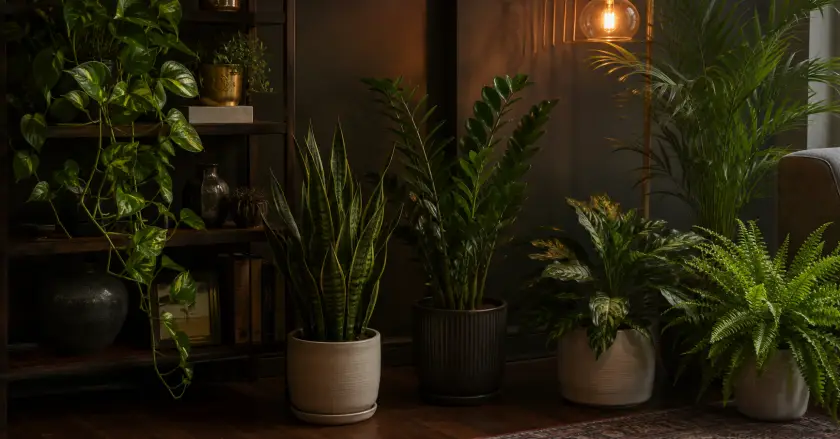
Snake plant is among the best low light house plants for beginners because it tolerates relatively low illumination, occasional missed waterings, and normal indoor conditions.
Its upright, sword-shaped leaves make it particularly useful for narrow corners, bedrooms, offices, and spaces where trailing plants would get in the way.
Snake plants grow slowly in weak light. They may maintain their appearance for a long time, but brighter indirect light generally supports stronger new growth.
- Best light: Low to bright indirect light.
- Watering: Allow the potting mix to dry well before watering again.
- Best room: Bedroom, office, or shaded living room with daylight.
- Main risk: Root rot from overly frequent watering.
Choose a pot with drainage holes and avoid oversized containers that keep moisture around a small root system for too long.
For detailed care, read our snake plant care guide.
2. ZZ Plant — Best for Infrequent Watering
Botanical name: Zamioculcas zamiifolia.
ZZ plant is another excellent choice for darker rooms. It has upright stalks, glossy green leaflets, and underground rhizomes that store water.
Those rhizomes help the plant tolerate periods of dryness. However, they also make prolonged waterlogging particularly risky.
In a relatively shaded apartment or office, a ZZ plant may remain attractive while producing only occasional new growth. This is normal when the plant receives less energy from light.
- Best light: Low to bright indirect light.
- Watering: Allow the growing medium to dry substantially between waterings.
- Best room: Office, apartment, or low-maintenance indoor display.
- Main risk: Persistently wet soil and damaged rhizomes.
ZZ plants do not need regular misting or heavy feeding to remain healthy. A suitable pot, proper watering, and adequate light are more important.
For detailed care, visit our ZZ plant care guide.
3. Pothos — Best Trailing Low Light Plant
Botanical name: Epipremnum aureum.
Pothos is popular for hanging baskets, bookshelves, and plant stands because its vines trail naturally over the edges of containers.
Many pothos plants tolerate lower light, although growth may become slower and the spaces between leaves may increase when the room is too dark.
Variegated pothos varieties usually need more light to maintain attractive leaf patterns. A greener form is generally a better option for a shaded area than a highly white-variegated cultivar.
- Best light: Low to bright indirect light.
- Watering: Let the upper portion of the potting mix dry before watering.
- Best room: Bedroom shelves, offices, and hanging planters.
- Main risk: Leggy vines in inadequate light or root problems from soggy soil.
Trim overly long stems to manage the shape, and move the plant closer to a light source if new leaves become progressively smaller.
See our pothos plant care guide for watering, pruning, and propagation advice.
4. Heartleaf Philodendron — Best for Shelves
Botanical name: Philodendron hederaceum.
Heartleaf philodendron is a climbing or trailing tropical plant with smooth, heart-shaped green leaves. It is a practical option for shelves and hanging containers in rooms receiving low to medium indirect light.
Green forms usually tolerate lower light better than heavily variegated philodendrons. In unsuitable darkness, growth may become sparse and the stems may stretch toward a nearby window.
- Best light: Low to medium indirect light; brighter indirect light supports stronger growth.
- Watering: Allow the upper growing medium to begin drying.
- Best room: Bedroom, office, or living room shelf.
- Main risk: Stretched vines and slow growth from inadequate light.
For a fuller plant, prune suitable stems during active growth and provide enough light for healthy branching.
Read our complete Philodendron care guide for additional information.
5. Peace Lily — Best for Green Foliage and Occasional Flowers
Botanical name: Spathiphyllum species and cultivars.
Peace lily has glossy green foliage and distinctive white spathes that surround its true flowers. It can tolerate lower light, making it a common choice for shaded living rooms, bedrooms, and offices.
However, peace lilies generally need brighter indirect light to flower well. A plant in a dim room may remain leafy but produce few or no blooms.
- Best light: Low to medium indirect light for foliage; brighter indirect light for flowers.
- Watering: Keep appropriately moist without leaving the roots waterlogged.
- Best room: Living room or bathroom with a window.
- Main risk: Wilting caused by moisture problems and poor flowering in deep shade.
Do not automatically water a drooping peace lily without checking the soil. Both dehydrated and damaged roots can cause similar symptoms.
For full care instructions, read our peace lily care guide.
6. Cast Iron Plant — Best for Shaded Corners
Botanical name: Aspidistra elatior.
Cast iron plant is well known for its tolerance of shaded indoor conditions. It produces broad, dark green leaves on long stalks and has a relatively slow growth rate.
It is useful for hallways with some daylight, shaded rooms, and offices where faster-growing tropical foliage plants may struggle.
Cast iron plant is not truly a no-light plant, but it is one of the better choices when the available light is lower than ideal.
- Best light: Low to medium indirect light.
- Watering: Allow part of the growing medium to dry before watering.
- Best room: Shaded hallway or apartment corner.
- Main risk: Overwatering, especially in cool conditions.
Another advantage is pet safety. The ASPCA lists cast iron plant as non-toxic to cats and dogs.
7. Chinese Evergreen — Best for Decorative Leaves
Botanical name: Aglaonema species and cultivars.
Chinese evergreen offers broad foliage with green, silver, cream, pink, or red patterns depending on the variety.
For genuinely low-light conditions, darker green or green-and-silver cultivars are usually the most practical choices. Bright pink, cream, and heavily variegated forms often need stronger indirect light to maintain vigorous growth.
- Best light: Low to medium indirect light for many green forms.
- Watering: Water when the upper soil becomes appropriately dry.
- Best room: Living room, bedroom, or office.
- Main risk: Cold drafts, soggy soil, and fading patterns in inadequate light.
Keep Chinese evergreen away from pets that chew foliage because the plant contains irritating calcium oxalate crystals.
For more colorful foliage ideas, explore our beginner-friendly indoor plant guide.
8. Parlor Palm — Best Pet-Safer Palm for Low Light
Botanical name: Chamaedorea elegans.
Parlor palm offers delicate, arching green fronds and a softer appearance than upright plants such as snake plant or Dracaena.
It is more tolerant of relatively low indirect light than many tropical palms, although it still needs adequate illumination for healthy long-term growth.
- Best light: Low to medium indirect light.
- Watering: Keep moisture balanced, allowing some drying without severe dehydration.
- Best room: Living room, bedroom, or office.
- Main risk: Dry leaf tips, overwatering, or harsh direct sun.
Parlor palm is a particularly useful option for pet owners because the ASPCA lists it as non-toxic to cats and dogs.
9. Boston Fern — Best for Humid Rooms With Filtered Light
Botanical name: Nephrolepis exaltata, including the Boston fern cultivar.
Boston fern is often described as a shade plant, but it generally performs better in a room with usable medium or bright filtered light rather than a very dark corner.
Its arching fronds give hanging baskets a lush appearance. Unlike ZZ plants and snake plants, Boston ferns need more consistent moisture and often benefit from higher humidity.
- Best light: Medium to bright filtered light; avoid harsh direct sun.
- Watering: Maintain suitable moisture without waterlogging.
- Best room: Bright bathroom or humid indoor area.
- Main risk: Brown, crispy fronds caused by dry air or poor moisture management.
Boston fern is listed as non-toxic to cats and dogs by the ASPCA.
For species-specific instructions, read our Boston fern care guide.
10. Spider Plant — Best for Hanging Displays With Moderate Light
Botanical name: Chlorophytum comosum.
Spider plant produces arching leaves and long stems carrying small plantlets. It is widely grown on shelves and in hanging baskets.
Spider plants can tolerate some shade, but medium to bright indirect light generally supports fuller growth and better development of plantlets.
In weak light, the plant may become less vigorous. Variegated forms may also show reduced contrast.
- Best light: Medium to bright indirect light; tolerates some lower light.
- Watering: Let the upper soil dry slightly before watering.
- Best room: Bright bedroom, office shelf, or bathroom with a window.
- Main risk: Brown tips from various moisture, water-quality, or fertilizer issues.
The ASPCA lists spider plant as non-toxic to cats and dogs. However, keep plants out of reach if pets repeatedly chew them.
11. Dracaena — Best Upright Plant for Offices
Botanical name: Dracaena species and cultivars.
Dracaena includes several popular upright houseplants with narrow, strap-like, or broader foliage. Green varieties of some species can adapt to lower indoor light better than strongly variegated forms.
Many Dracaena plants suit rooms with soft indirect light, making them useful beside office furniture or in spaces where wide-growing plants are impractical.
- Best light: Low to medium indirect light for suitable cultivars.
- Watering: Allow some drying between waterings.
- Best room: Office, living room, or hallway with daylight.
- Main risk: Prolonged wet soil, cold exposure, and leaf-tip damage.
Not every Dracaena has the same requirements. Confirm the exact species or cultivar before assuming it will thrive in a dim corner.
Read our Dracaena plant care guide for more information.
12. Rubber Plant — Better for Medium to Bright Indirect Light
Botanical name: Ficus elastica.
Rubber plant has large, glossy leaves and an upright growth habit that makes it a popular statement houseplant.
It is sometimes included in low-light plant lists, but it is not among the best choices for genuinely dark rooms. Although it may tolerate somewhat reduced light, a brighter indoor position usually supports better health and leaf production.
- Best light: Medium to bright indirect light.
- Watering: Allow the upper potting mix to dry appropriately.
- Best room: Living room or bedroom with a reasonably bright window.
- Main risk: Slow growth, leaf drop, or root stress in unsuitable conditions.
If your room is very dark, choose a cast iron plant or ZZ plant instead. If you have enough indirect light for a larger statement plant, read our rubber plant care guide.
13. Prayer Plant — Best for Patterned Leaves in Softer Light
Botanical name: Maranta leuconeura and related cultivated forms.
Prayer plants have decorative leaf patterns and are known for changing the position of their leaves between day and night.
They usually prefer gentle, filtered light rather than direct sun. However, a truly dark room can still cause weak growth.
- Best light: Medium indirect light.
- Watering: Maintain reasonably consistent moisture without saturation.
- Best room: Warm bedroom or bright bathroom with filtered light.
- Main risk: Crispy leaf edges, moisture stress, or cold exposure.
Prayer plant is a good option when you want patterned foliage and are willing to pay closer attention to humidity and watering.
14. Calathea — Best for Patterned Tropical Foliage
Botanical names: Various species, many now classified in the genus Goeppertia.
Calathea and related ornamental prayer plants are prized for patterned leaves. Some have stripes, contrasting veins, dark green surfaces, or colorful undersides.
They dislike harsh direct sun, but that does not mean they grow best in near darkness. Most are better suited to medium filtered light.
- Best light: Medium indirect or suitably bright filtered light.
- Watering: Keep moisture appropriate and consistent without waterlogging.
- Best room: Humid room with a window.
- Main risk: Browning margins caused by environmental or root stress.
These are usually more demanding than snake plants, ZZ plants, and cast iron plants.
For detailed care, use our complete Calathea plant care guide.
15. English Ivy — Best for Cooler Indoor Conditions
Botanical name: Hedera helix.
English ivy is a trailing or climbing plant with distinctive lobed leaves. It can tolerate lower indoor light and may be useful in a cool, well-lit room without strong direct sun.
However, it often struggles in hot, dry indoor conditions and may attract spider mites.
- Best light: Low to medium indirect light, with brighter conditions supporting stronger growth.
- Watering: Maintain suitable moisture without leaving roots waterlogged.
- Best room: Cooler room with a shaded window.
- Main risk: Dry air, spider mites, and weak growth in deep shade.
English ivy should not be planted outdoors indiscriminately. It is invasive or otherwise problematic in parts of the United States, so avoid allowing indoor plants to establish in local natural areas.
16. Lucky Bamboo — Best for Compact Desks
Botanical name: Dracaena sanderiana.
Lucky bamboo is not a true bamboo. It is a Dracaena species commonly sold as upright stalks with leafy shoots.
It tolerates soft indirect light and is popular for desks, shelves, and compact indoor spaces. It can be grown in water or an appropriate potting mix.
- Best light: Low to medium indirect light.
- Watering: Maintain clean water if grown hydroponically, or suitable soil moisture if potted.
- Best room: Desk or shelf with adequate ambient light.
- Main risk: Water-quality problems, root damage, or leaf scorch from intense sun.
Change stagnant water regularly and avoid leaving the roots in dirty containers. If leaf tips brown repeatedly, review water quality, fertilizer use, and overall growing conditions.
17. Peperomia — Best for Small Spaces With Moderate Light
Botanical name: Peperomia species and cultivars.
Peperomia includes a diverse collection of compact plants, many with thick leaves and attractive textures.
Some green forms tolerate reduced light, but most perform better with medium to bright indirect light. Highly variegated varieties are especially poor choices for very dark rooms.
- Best light: Medium to bright indirect light for many varieties.
- Watering: Allow an appropriate amount of drying between waterings.
- Best room: Desk, shelf, or windowsill with indirect light.
- Main risk: Root damage from persistently wet soil.
Peperomia is useful when space is limited, but the exact species matters. Do not assume every plant labeled Peperomia has identical water or light requirements.
18. Rhipsalis — Best Unusual Hanging Plant for Filtered Light
Botanical name: Rhipsalis species.
Rhipsalis is a genus of mostly epiphytic cacti with trailing or branching stems. Unlike many desert cacti, these plants are associated with habitats where they receive filtered light rather than intense direct sunshine.
That makes selected Rhipsalis species suitable for bright shade and hanging baskets, but they should not be assumed to thrive in very dark rooms.
- Best light: Medium to bright filtered light, depending on species.
- Watering: Species-specific; avoid prolonged waterlogging.
- Best room: Hanging display near a filtered-light window.
- Main risk: Using the same care routine as a sun-loving desert cactus.
Choose the species carefully and provide an airy mix suitable for epiphytic growth.
19. African Violet — Best Flowering Option With Added Light
Botanical name: Streptocarpus ionanthus, formerly commonly called Saintpaulia.
African violet produces soft, fuzzy leaves and delicate flowers in shades of purple, pink, white, or blue.
It is often included in low-light flowering plant lists, but it is not a reliable choice for a genuinely dark corner. Flowering generally requires suitable bright indirect light or a properly positioned grow light.
- Best light: Bright indirect light or suitable artificial plant lighting.
- Watering: Maintain appropriate moisture without waterlogging the crown.
- Best room: Bright shelf or east-facing window area.
- Main risk: Poor flowering in insufficient light and crown problems from unsuitable watering.
If your priority is flowering rather than foliage alone, provide sufficient light instead of selecting a darker location simply because African violet is sometimes described as shade tolerant.
Read our African violet care guide for more detail.
Best Low Light Indoor Plants by Room
The best plant for a room depends on more than light. Temperature, humidity, airflow, space, and pets can also affect the choice.
Best Low Light Plants for Bedrooms
Snake plant, ZZ plant, cast iron plant, and parlor palm are practical choices for bedrooms with limited but usable daylight.
For a trailing display on a shelf near a window, green pothos or heartleaf philodendron may also work well.
Keep plant containers away from bedding and walkways where they could fall or be knocked over.
Best Low Light Plants for Bathrooms
Peace lily, parlor palm, Boston fern, and selected prayer plants may suit bathrooms with adequate filtered light.
Bathrooms can provide useful humidity, but a windowless bathroom without sufficient artificial plant lighting is not suitable for long-term growing.
For more details, read our best plants for your bathroom guide.
Best Low Light Plants for Offices
ZZ plant, snake plant, green Chinese evergreen, heartleaf philodendron, and suitable Dracaena are useful office choices.
For an office without windows, check the actual light reaching the plant. Overhead lighting that is adequate for people may or may not be sufficient for houseplant growth, especially if the lights are off at night and throughout weekends.
See our office-friendly plant guide and best office plants for additional ideas.
Best Low Light Plants for Small Apartments
Compact ZZ plants, small snake plant cultivars, pothos, heartleaf philodendron, and small parlor palms can work in apartments where floor space is limited.
Choose the plant’s mature size as well as its light requirement. A vigorous trailing plant may eventually need more space than a compact upright variety.
Our indoor plants for tiny apartments guide covers practical small-space arrangements.
Best Low Light Plants for Hallways
Snake plant, ZZ plant, cast iron plant, and green Dracaena varieties are among the most practical hallway choices.
If the hallway is permanently dark, add a suitable grow light rather than rotating the same stressed plant through an environment with insufficient illumination.
Best Low Light Hanging Plants
Green pothos and heartleaf philodendron are especially useful for hanging containers in relatively shaded areas.
Spider plants and some Rhipsalis species also make attractive hanging displays but generally prefer more light.
For additional ideas, browse our low-light hanging plants guide and trailing plants for shelves.
How to Care for Low Light House Plants
Low light plant care is mostly about respecting slower growth and lower water use while ensuring that the plant still receives enough energy from light.
1. Check Soil Moisture Before Watering
Plants often use water more slowly in lower light because photosynthesis and growth are reduced.
However, this does not mean every low light houseplant should be allowed to dry completely. Snake plants and ZZ plants tolerate more drying than Boston ferns and prayer plants.
| Plant Group | Watering Approach |
|---|---|
| Snake plant and ZZ plant | Allow substantial drying between waterings |
| Pothos and Philodendron | Water after the upper growing medium begins drying |
| Chinese evergreen and cast iron plant | Allow moderate drying while avoiding prolonged drought |
| Peace lily and parlor palm | Maintain suitable, balanced moisture |
| Boston fern, prayer plant, and Calathea | Provide more consistent moisture without saturation |
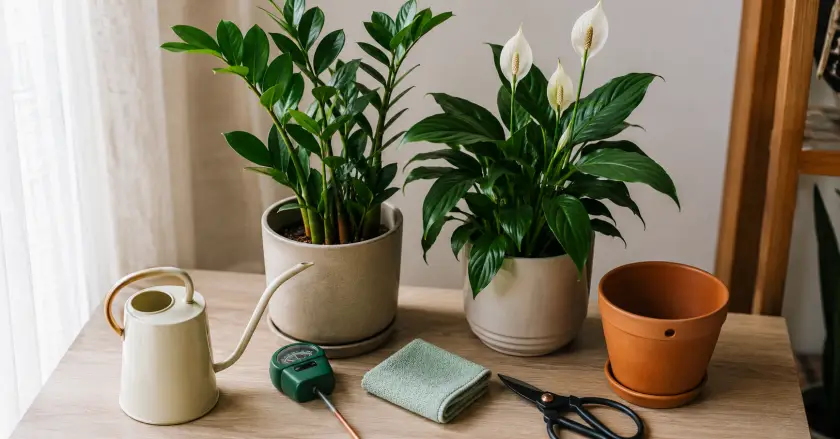
Use your finger, the weight of the container, or a suitable moisture-checking method to assess the root zone before watering.
For detailed advice, read our complete watering guide.
2. Use a Pot With Drainage
Drainage holes allow excess water to leave a container. This is especially important in lower light, where wet soil may take longer to dry.
A decorative cachepot can be used around a nursery pot, but remove excess water after watering so the roots are not left standing in a reservoir.
3. Match the Potting Mix to the Plant
There is no single ideal mix for every low light houseplant.
Snake plants generally benefit from a well-draining medium that does not remain wet for long periods. Ferns and many tropical foliage plants prefer more moisture retention, provided the mix still allows sufficient air around roots.
For more guidance, read our best soil mix guide.
4. Fertilize Only When Needed
Plants growing slowly in low light generally need less fertilizer than plants producing vigorous new growth.
Use a suitable houseplant fertilizer according to its label during active growth when needed. Do not attempt to correct inadequate light by increasing fertilizer.
Too much fertilizer can damage roots and contribute to brown leaf margins or accumulated salts in the potting mix.
5. Keep Leaves Clean
Dust on foliage can reduce the light reaching a leaf surface. In low-light conditions, keeping broad leaves reasonably clean helps plants make use of the light available.
Use a soft damp cloth for sturdy foliage. Avoid aggressive rubbing on delicate, fuzzy, or easily damaged leaves.
For safe methods, read our guide to cleaning plant leaves.
6. Monitor Temperature and Humidity
Different species have different preferences. Boston fern and prayer plant may struggle in excessively dry indoor air, while snake plant and ZZ plant are often less demanding.
Keep sensitive plants away from heating vents, cold drafts, and sudden temperature changes.
For humidity-sensitive species, a clean humidifier can be useful in dry homes. Check conditions with a hygrometer rather than assuming humidity is the cause of every brown leaf tip.
Our humidity management guide covers additional approaches.
7. Rotate Plants When Appropriate
Plants near a window may lean toward the direction of available light. Rotating the pot occasionally can support a more balanced appearance.
However, rotation does not increase the total amount of light a plant receives. If growth becomes weak or stretched, the solution is often a brighter position or supplemental lighting.
Can You Use Grow Lights for Low Light House Plants?
Yes. Grow lights are useful in rooms with little natural daylight and can support plants that otherwise struggle during dark winter months.
The effectiveness of a grow light depends on the amount of usable light reaching the foliage, its distance from the plant, the spectrum, and how long it operates each day.
How to Set Up a Grow Light
- Identify the species and its approximate light requirement.
- Choose a plant light with clear guidance about coverage and intensity.
- Place the fixture according to the manufacturer’s recommended distance.
- Use a consistent daily light period appropriate to the plant.
- Monitor new growth and adjust if leaves stretch or show signs of excessive intensity.
- Allow a regular dark period rather than leaving the light on continuously.
A small, adequately powered LED grow light can be a practical solution for a shelf or desk. The brightest-looking bulb is not necessarily the most suitable one, so compare actual plant-light specifications when available.
If the room has no window at all, plant lighting should be treated as a core requirement, not an optional decorative addition.
Low Light Plant Problems and How to Fix Them
| Problem | Possible Cause | What to Check |
|---|---|---|
| Yellow leaves | Excess water, poor drainage, weak light, or natural aging | Soil moisture, roots, and age of affected leaves |
| Leggy stems | Insufficient light | Distance from window and growth pattern |
| Brown leaf tips | Dry air, water stress, salts, or root problems | Humidity, moisture, fertilizer, and water quality |
| Very slow growth | Low light, normal species habit, or seasonal slowdown | Actual light level and new growth health |
| Wet soil for many days | Low water use, oversized pot, or unsuitable mix | Container size, drainage, root health |
| Loss of variegation | Insufficient light or cultivar-specific changes | Light exposure and new growth pattern |
| Leaf drop | Environmental change, root problems, or inadequate light | Recent movement, watering, and temperature |
Why Are My Low Light Plants Turning Yellow?
Yellowing can have several causes, including excessive watering, inadequate light, nutrient problems, root stress, or ordinary aging.
If several leaves turn yellow while the soil remains wet, investigate drainage and roots before watering again.
For more troubleshooting, see our signs of overwatering guide and root rot guide.
Why Is My Houseplant Growing Tall and Thin?
Long stems with widely spaced leaves can indicate inadequate light, a response sometimes called etiolation.
Move the plant toward suitable brighter light gradually, or provide an adequately positioned grow light. Pruning may improve its shape, but new growth will remain weak if the lighting problem continues.
Why Does My Low Light Plant Have Brown Tips?
Brown tips may result from moisture stress, fertilizer salts, dry indoor air, temperature changes, or species-specific sensitivities.
Do not assume a humidifier is the answer without checking the soil, water quality, recent fertilizer use, and root condition.
Why Are My Plants Not Growing?
Some shade-tolerant plants grow naturally slowly, including cast iron plant. Others may slow down because of insufficient light or winter conditions.
Healthy, stable foliage with occasional new leaves may be normal. Repeated leaf loss, weak stems, and progressively smaller new leaves suggest that the conditions should be reviewed.
Are Low Light House Plants Safe for Cats and Dogs?
Low light tolerance does not determine pet safety. Several popular shade-tolerant houseplants can cause irritation or illness if chewed.
Commonly Grown Non-Toxic Options
- Cast iron plant: Listed as non-toxic to cats and dogs by the ASPCA.
- Parlor palm: Listed as non-toxic to cats and dogs by the ASPCA.
- Boston fern: Listed as non-toxic to cats and dogs by the ASPCA.
- Spider plant: Listed as non-toxic to cats and dogs by the ASPCA.
Plants That Need Additional Pet Precautions
- Pothos: Contains irritating calcium oxalate crystals.
- Philodendron: Contains irritating calcium oxalate crystals.
- Peace lily: Contains irritating calcium oxalate crystals; it is not a true lily.
- Chinese evergreen: Contains irritating calcium oxalate crystals.
- ZZ plant: Can cause irritation if chewed.
- Snake plant: Harmful if ingested.
- Dracaena and lucky bamboo: Can be harmful to pets.
- English ivy: Toxic if ingested.
Use the ASPCA’s houseplant safety guidance to check common toxic houseplants. Confirm the exact botanical species for any new plant, particularly when different plants share a common name.
Non-toxic does not mean suitable for eating. Even non-toxic plant material can cause stomach upset in pets that consume it.
If a pet chews a potentially harmful plant and develops symptoms, contact a veterinarian or animal poison control service promptly.
Our cat-friendly plants guide and dog-friendly plants guide provide more planning ideas.
Do Low Light House Plants Purify Indoor Air?
Some houseplants can absorb certain airborne chemicals in controlled laboratory studies. However, this does not mean that keeping a few potted plants in a typical home will meaningfully clean the indoor air.
A peer-reviewed study published in the Journal of Exposure Science & Environmental Epidemiology evaluated reported volatile organic compound removal rates from potted plants and found that ordinary ventilation generally provides much greater air-cleaning capacity.
You can read the research in PubMed’s summary of the review on potted plants and indoor air quality.
Choose low light houseplants primarily for their appearance, enjoyment, and suitability to your space. To improve indoor air quality, prioritize appropriate ventilation, source control, and filtration when needed.
Low Light House Plant Care Checklist
| Task | When to Check | What to Look For |
|---|---|---|
| Check available light | At placement and when seasons change | Usable daylight or adequate artificial light |
| Check soil moisture | Before watering | Dryness appropriate to the species |
| Empty decorative pot | After watering | No standing water around roots |
| Inspect leaves | Regularly | Yellowing, pests, dust, brown tips |
| Check growth | During active growing periods | New leaf size and stem spacing |
| Review humidity | When sensitive plants show symptoms | Dry air, heating vents, or moisture stress |
| Fertilize | Only when appropriate during active growth | Healthy growth and fertilizer directions |
| Repot | When root or soil condition requires it | Crowded roots, deterioration, drainage problems |
Common Mistakes With Low Light House Plants
- Assuming low light means complete darkness: Every living houseplant still needs usable light.
- Watering every week regardless of conditions: Lower light often slows water use and soil drying.
- Choosing heavily variegated plants for deep shade: Many colored cultivars need more light for healthy growth.
- Expecting flowers in a dark room: African violets and peace lilies generally bloom better with brighter light.
- Using an oversized pot: Excess growing medium can remain wet around a relatively small root system.
- Fertilizing to compensate for weak light: Extra nutrients cannot replace light energy.
- Ignoring pet toxicity: Many popular low-light plants should be kept out of reach of animals that chew foliage.
- Believing houseplants replace ventilation: Ordinary potted plants are not effective substitutes for air exchange or filtration.
- Never checking the plant after placement: Slowly declining foliage may be easy to overlook in dim spaces.
Frequently Asked Questions About Low Light House Plants
What are the best low light house plants for beginners?
Snake plant, ZZ plant, cast iron plant, green pothos, and heartleaf philodendron are strong beginner choices. These plants tolerate relatively low indirect light, although they still need adequate illumination and species-appropriate watering.
Can low light houseplants survive in a room with no windows?
They can grow in a windowless room if they receive sufficient artificial light. No houseplant can remain healthy indefinitely in complete darkness. Choose a suitable grow light and provide consistent illumination appropriate to the plant.
What is the easiest low maintenance plant for a dark room?
Snake plant and ZZ plant are among the easiest choices for low-light areas with some usable daylight. They tolerate periods of dry soil and need less frequent watering than many tropical foliage plants. Cast iron plant is another reliable option.
Which low light indoor plants are safe for cats and dogs?
Cast iron plant, parlor palm, Boston fern, and spider plant are listed as non-toxic to cats and dogs by the ASPCA. Always verify the botanical name and remember that even non-toxic plants should not be treated as food.
Are there flowering houseplants that grow in low light?
Peace lily can tolerate lower light, but it typically flowers more readily in brighter indirect conditions. African violet also needs suitable brighter light or a grow light for reliable flowering. Deep shade is generally poor for blooming plants.
Final Thoughts
Low light house plants can make shaded apartments, bedrooms, offices, and hallways feel greener and more inviting when you select species suited to the actual conditions.
For the lowest-maintenance options, start with snake plant, ZZ plant, or cast iron plant. For attractive trailing growth, choose pothos or heartleaf philodendron. For a softer, leafy display, consider Chinese evergreen or parlor palm.
Remember that low-light tolerance is not the same as thriving in darkness. Provide usable light, check the soil before watering, and adjust care as the seasons change.
If your space is genuinely windowless or very dim, a suitable grow light can make the difference between a plant that slowly declines and one that maintains healthy growth.
For a wider selection of easy-care species, continue with our best indoor plants for beginners guide or our indoor lighting guide.